A Biker Pulled a Priest From His Coffin During the Funeral—Then the Entire Church Heard the Sound Everyone Else Had Called Settling Wood
The biker shoved past grieving mourners, tore open the priest’s coffin, and pulled the body toward him while the congregation screamed—because he was the only person in Saint Matthew’s Church who had heard three weak knocks beneath the hymn.
My name is Claire Bell. Father Elias Bell was my uncle, my employer, and the closest thing I had to a father after my parents died. At forty-one, I had spent nearly half my life managing his parish office in Gallup, New Mexico.
I planned his funeral myself.
That Friday morning, Saint Matthew’s was filled beyond capacity. Winter sunlight passed through old stained-glass windows. Incense hung above the pews, the organ played softly, and parishioners stood shoulder to shoulder beneath the dark wooden rafters.
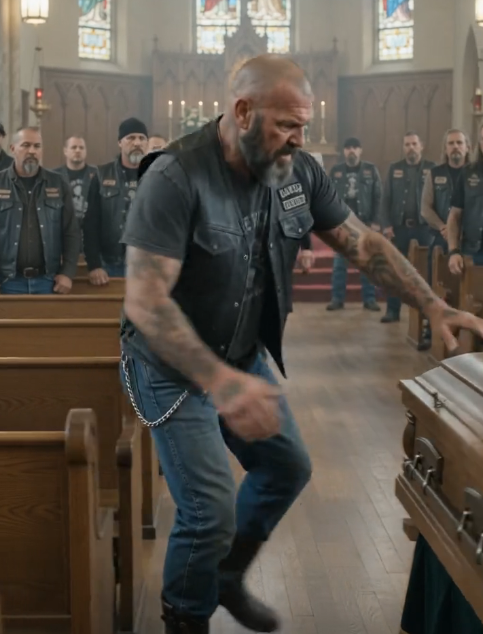
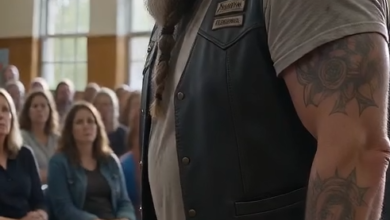
Thirty bikers occupied the final six rows.
They came because Father Elias had spent twenty-four years serving as volunteer chaplain to riders nobody else wanted inside a church. He officiated their weddings, sat beside hospital beds, visited jail cells, and conducted funerals when families refused to claim the body.
At the center of them stood Ray “Hammer” Dawson.
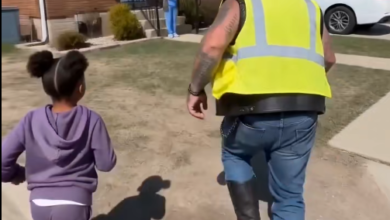
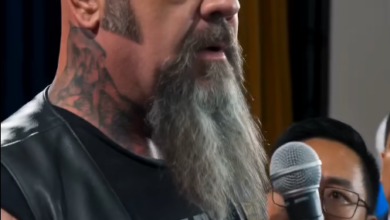
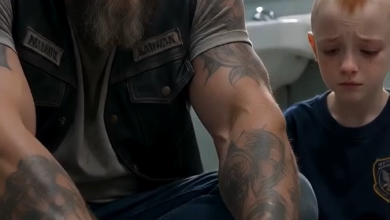
Hammer was fifty-six, six feet four, nearly 285 pounds, with a shaved head, thick black-and-gray beard, tattooed forearms, scarred knuckles, faded jeans, motorcycle boots, and a plain black leather cut. He looked like a man hired to remove trouble.
That morning, he became it.
My uncle’s coffin rested below the altar. He had requested a simple green burial, so there had been no embalming. The lid remained closed because the funeral director said the cold and the delay in transport had caused changes the family would not want remembered.
Halfway through the final hymn, Hammer lifted his head.
The rest of us kept singing.
He stepped into the aisle.
Leon Brooks, a large Black biker seated beside him, caught his arm and whispered something. Hammer shook free and walked toward the coffin.
I thought grief had broken him.
“Ray,” I warned.
He raised one hand.
“Stop the organ.”
Nobody obeyed.
The congregation turned. The organist continued playing because she assumed the interruption was part of some biker ritual.
Hammer struck the side of the coffin with his palm.
A woman screamed.
The funeral director hurried forward. Two ushers blocked Hammer at the first pew. I grabbed his vest and demanded that he leave.
He did not fight us.
He only said, “Quiet.”
Then the hymn ended.
For three seconds, the church became still.
Tap.
Tap.
Tap.
The sound was so faint I felt it before I accepted hearing it.
The funeral director said the wood was settling. An usher said it came from the heating pipes. Someone behind me called Hammer a drunken animal exploiting our grief.
Hammer put his ear against the lid.
Another sound came from beneath it.
Scrape.
Pause.
Two taps.
Hammer reached for the coffin latches.
People surged toward him. Leon and two other bikers moved between Hammer and the congregation, not threatening anyone, but preventing us from dragging him away.
“If I’m wrong,” Hammer said, “arrest me afterward.”
He broke the first latch.
The funeral director shouted that he was desecrating a body. I slapped Hammer across the face.
He took it.
Then he tore open the second latch and lifted the lid.
My uncle lay in white vestments with his hands folded across his chest. For one terrible second, nothing changed.
Then his right index finger moved.
Hammer reached inside, slid one arm beneath Father Elias’s shoulders, and pulled him upright. The priest’s head fell against the biker’s leather vest.
The church erupted.
I screamed at Hammer to put him down.
He turned my uncle’s face toward me.
Father Elias’s lips parted.
A sound escaped them—not a word, barely even breath, but enough to stop every voice in the building.
Hammer pressed two fingers against his neck.
“Call an ambulance,” he said.
The funeral director backed away.
Beneath my uncle’s folded hands, his medical-alert bracelet had been turned inward. A glucose monitor attached near his ribs blinked weakly through the burial garment.
Father Elias was not dead.
But that was only the first truth hidden inside the coffin.
The second involved a collapsed motorcycle garage twenty-seven years earlier, when a younger Hammer Dawson had survived because Father Elias refused to believe three knocks beneath concrete were only cooling pipes.
Want to know why Hammer recognized the tapping and how a living priest reached his own funeral? Drop KNOCK in the comments — I’ll share more soon.
Part 2 — The Priest Who Chose a Wooden Coffin
Father Elias Bell was sixty-eight when we believed he died.
He had lived with Type 1 diabetes since his twenties. He managed it carefully, carried glucose tablets in his coat, and wore both a continuous glucose monitor and a medical-alert bracelet. Most parishioners never knew because he disliked making his health the first fact in any conversation.
The week before his funeral, northern New Mexico was struck by an ice storm.
Power failed across several neighborhoods. Saint Matthew’s rectory lost heat during the night, and the backup generator refused to start. Father Elias stayed behind because the church shelter had opened its doors to twenty-three people whose homes were colder than his.
He gave his last space heater to an elderly couple.
At 4:12 in the morning, I spoke to him by phone. He sounded tired but coherent. He told me the generator was “possessed by a minor demon” and asked me to bring coffee when the roads opened.
At 7:40, a volunteer found him unconscious in the rectory pantry.
The room was cold enough that frost had formed along the bottom of the window. Father Elias lay beside an open container of glucose tablets. His skin was chilled, his breathing too shallow for the frightened volunteer to recognize, and his pulse extremely weak.
Emergency services were overwhelmed by storm-related calls.
What followed became the subject of a state investigation, licensing hearings, and two civil cases. No single failure placed Father Elias inside the coffin. Several did.
The first responders did not use all available monitoring long enough to distinguish profound hypothermia and severe hypoglycemia from death. A temporary physician covering the rural district relied on incomplete observations relayed by phone and authorized a pronouncement.
The funeral home accepted the documentation.
No embalming occurred because Father Elias had requested a green burial and our family wanted the funeral held quickly so parish shelters could remain focused on the storm. His body was kept refrigerated, which concealed the fact that he had never completely lost the faint metabolic signs of life.
A junior funeral-home employee later reported seeing condensation inside the transport covering. He assumed it came from temperature change.
Another employee thought she noticed a small movement near Father Elias’s hand. Her supervisor told her refrigeration could cause muscles to shift.
Every warning was assigned a harmless explanation.
By Thursday evening, the coffin was closed.
I signed the final authorization.
That signature lived in my dreams for months.
Hammer knew none of those details when he entered the church. He had been told only that Father Elias had been found unresponsive during the storm and pronounced dead. He accepted it because everyone else did.
Still, something bothered him.
Father Elias had once made Hammer promise that if he died, the club would not roar into the church during the service. “God already knows you own motorcycles,” he had said. “You don’t need to announce it through the windows.”
The riders parked two blocks away and walked through snow carrying their helmets.
Hammer sat in the final row because he did not trust himself near the coffin.
Father Elias had known him longer than almost anyone alive.
Twenty-seven years earlier, Hammer was twenty-nine and working nights in a custom motorcycle garage outside Albuquerque. He drank too much, slept at the shop, and treated anger like a tool that could repair anything if swung hard enough.
Father Elias had been assigned to a nearby parish.
They met after Hammer punched a church van.
The van had stalled in front of the garage, blocking the entrance. Hammer kicked the bumper, cursed the driver, then struck the side panel.
Father Elias stepped out wearing a black clerical shirt and looked at the dent.
“You fixing that?”
“No.”
“Then hit it again. Perhaps symmetry will help.”
Hammer stared at him.
Father Elias returned the stare.
That was the beginning.
The priest brought the van back for repairs. He paid in cash, coffee, and unwanted questions. Within a year, Hammer occasionally attended late evening services, always sitting closest to the exit.
Then the garage collapsed.
Part 3 — What Happened When the Lid Opened
The congregation did not become calm when Father Elias breathed.
Grief reversed too quickly for our bodies to follow.
People screamed, prayed, pushed toward the altar, and demanded answers nobody possessed. An elderly parishioner fainted near the second pew. Someone tried to pull Hammer away from the coffin, believing the movement had been caused by him.
Hammer ignored everyone.
“Leon, clear the aisle.”
Leon turned and lifted both hands. “Back up. Give him air.”
Several bikers formed a wide boundary around the coffin. They did not touch mourners unless someone was about to fall. Their leather cuts and tattooed arms made the scene look more threatening, but their work was simple: create space, open the side doors, and guide emergency responders toward the altar.
I stood frozen.
Father Elias’s eyelids fluttered.
Hammer lowered him onto the carpet rather than leaving him inside the coffin. A retired nurse from the parish checked his airway and pulse. His breathing was slow and irregular, but present.
The funeral director kept saying, “This isn’t possible.”
The nurse looked at him. “Then explain it later.”
She found the glucose monitor beneath the burial garment. Its battery was nearly depleted, but the display showed an urgent low-glucose warning. Hammer removed his leather jacket, folded it, and placed it beneath Father Elias’s head.
My uncle’s cheek rested against the same worn leather I had just grabbed while trying to stop his rescue.
The ambulance arrived six minutes later.
Paramedics brought warming equipment, oxygen, intravenous glucose, and a cardiac monitor. They asked when Father Elias had last been seen alive.
The question broke me.
“Five days ago,” I said.
One paramedic stopped moving.
The second repeated the question, believing he had heard incorrectly.
“His funeral was today.”
The paramedic looked toward the coffin.
Hammer stepped between him and the shocked congregation. “Treat him first.”
Father Elias was transported to the University of New Mexico Hospital by helicopter after initial stabilization. Doctors described his condition as a profound metabolic coma complicated by prolonged hypothermia and dehydration. They could not immediately predict neurological recovery.
He was alive.
That was all we knew.
Police questioned Hammer outside the church. Several witnesses had reported him for damaging the coffin and mishandling a body. The funeral director wanted charges until video from three different phones captured the tapping.
The first recording contained only the hymn and Hammer asking for silence.
The second captured three soft knocks after the organ stopped.
The third showed Father Elias’s finger moving before Hammer touched him.
No charges were filed.
Public opinion reversed before sunset.
The same people who had called Hammer a monster began calling him a miracle worker. News vans appeared outside the church. Reporters searched for his motorcycle club. A video of him tearing open the coffin spread across social media without context.
Hammer refused every interview.
“He knocked,” was all he said.
At the hospital, I sat beside Leon in a waiting room that smelled of vending-machine coffee and disinfectant. Hammer paced near the windows with dried coffin varnish on his knuckles.
I approached him.
The red mark from my slap remained across his cheek.
“I’m sorry,” I said.
He shook his head.
“I hit you.”
“You thought I was hurting him.”
“I stopped you.”
“Didn’t stop me.”
That was true, but it did not relieve the shame.
I asked how he heard the sound beneath the hymn.
Hammer touched his right ear. He had partial hearing loss from years around engines, yet he had detected what hundreds of mourners missed.
“Wasn’t hearing,” he said. “Knew the pattern.”
“What pattern?”
“Three. Pause. Two.”
He looked toward the operating-room doors.
“Your uncle used it.”
“When?”
Hammer sat for the first time.
“Night he found me under the garage.”
Then Leon told me the story Hammer would not.
The old Albuquerque shop had collapsed after a gas explosion in the adjacent unit. Firefighters searched the accessible sections, but unstable beams forced them back. Hammer was trapped beneath a workbench and part of the roof, unable to shout because dust and smoke had filled his throat.
Father Elias arrived as a volunteer chaplain.
He was not part of the rescue crew. He had no authority to enter. He stood outside speaking with firefighters when he heard a faint tapping beneath the metallic cooling noises.
Three taps.
Pause.
Two.
The site commander believed it was contracting steel.
Father Elias demanded silence.
The tapping returned.
He persuaded the crew to reposition listening equipment. They found Hammer beneath a void smaller than a kitchen table.
For five hours, firefighters removed debris.
Father Elias remained near the opening, tapping the same pattern against a pipe so Hammer would know someone was still there.
Three.
Pause.
Two.
Hammer lost consciousness before they reached him.
He woke in the hospital with Father Elias sitting beside the bed, tapping the pattern against the metal rail.
“You hear that again,” the priest told him, “you listen.”
Twenty-seven years later, Hammer did.
Part 4 — The Life Beneath the Paperwork
Father Elias remained unconscious for thirty-one hours after reaching the hospital.
Doctors slowly corrected his glucose level, body temperature, electrolyte imbalance, and dehydration. Tests showed signs of stress but less neurological injury than feared.
Cold had placed him in danger.
It may also have slowed his metabolism enough to extend the time he could survive.
No doctor called it a resurrection.
No one claimed the funeral had awakened him.
He had been alive throughout—a living man hidden beneath incorrect paperwork, assumptions, and a closed lid.
When Father Elias finally opened his eyes, I was standing beside his bed.
His first words were too soft to understand. I leaned closer.
“Bad turnout?”
I laughed and cried at the same time.
“You filled the church.”
“Good.”
“You were inside the coffin.”
His eyes moved toward me.
“I gathered.”
“How?”
“Dark. Cold. Couldn’t move.”
He remembered sound before sight. He heard the organ, recognized the hymn, and tried to call out. His throat produced nothing.
Then he moved one finger.
The coffin lining brushed against his nail.
He tapped.
Nobody responded.
He waited, gathered strength, and tapped again.
Three times.
Pause.
Twice.
It was the pattern he had used with Hammer beneath the garage.
Father Elias did not know whether Hammer was present. He chose the pattern because it represented an answer he had once promised another trapped man.
Hammer entered the room later that afternoon.
He stopped at the threshold.
Father Elias looked at the leather jacket folded across Hammer’s arm.
“You damaged my coffin.”
“Yeah.”
“Expensive?”
“Funeral home’s problem.”
“You pulled me onto a church floor.”
“Also yeah.”
Father Elias lifted one weak hand and tapped the bedrail.
Three.
Pause.
Two.
Hammer’s jaw tightened.
The priest smiled. “You listened.”
Hammer turned toward the window.
He did not cry where anyone could see.
That evening, the state medical investigator interviewed Father Elias, me, first responders, hospital staff, and funeral-home employees. The process continued for months.
The investigation found serious failures in the initial assessment, remote pronouncement, transfer procedures, and funeral-home verification. The funeral home had not legally pronounced Father Elias dead, but its staff accepted incomplete documentation and dismissed signs that required escalation.
Its director’s license was suspended pending review.
The emergency agency changed its hypothermia assessment protocol and retrained staff. The county added mandatory confirmation steps before transferring people found unresponsive in extreme cold.
None of those changes erased what happened.
Father Elias refused to turn the investigation into revenge.
“Accountability,” he said, “is not the same as destroying every frightened person who made a mistake.”
Hammer disagreed with the softness of that statement.
“Some mistakes close coffins.”
“Yes.”
“They need consequences.”
“Yes.”
“You still defending them?”
“No. I am defending the truth from becoming simpler than it was.”
The junior funeral-home employee who had noticed condensation visited Father Elias. She was twenty-two and had worked there for six weeks. She apologized until words failed.
Father Elias asked what she would do differently.
“Refuse to be quiet.”
“Then do that.”
She later became a central witness during the licensing hearing.
The funeral director did not receive such gentle treatment. He had overridden employee concerns and discouraged further checks. He faced professional penalties and civil action.
Hammer never visited him.
Leon said that was the priest’s first miracle.
The larger revelation came three weeks after Father Elias awoke, when hospital staff returned the personal effects removed before the funeral.
Among them was a damaged insulin pump controller and a folded card Father Elias carried behind his medical-alert identification.
The card listed my phone number, his physician, his condition, and one additional name.
Ray Dawson.
Under emergency contact, Father Elias had written Hammer before anyone else.
I showed him the card.
“Why Ray?”
My uncle looked toward the hospital window. “Because if I couldn’t speak, he would make people listen.”
He had been right.
Part 5 — A Brotherhood Asked to Believe One Sound
Hammer’s club struggled after the rescue.
From the outside, they appeared united. Inside, several riders admitted they had tried to stop him.
Leon had caught Hammer’s arm in the back row. Boone had told him to sit down. Two older members believed grief was causing him to imagine sounds.
They carried that guilt into the clubhouse.
Hammer did not allow it to stay hidden.
“You heard wood,” he told them. “I heard him.”
Boone stared at the floor. “We almost held you back.”
“You did hold me back.”
“I’m sorry.”
Hammer shook his head. “You protected a funeral from a man tearing at a coffin.”
“But you were right.”
“After.”
Brotherhood had been tested in a place where loyalty offered no obvious answer. Supporting Hammer risked desecrating a priest’s body. Stopping him risked sealing a living man inside.
No patch, rule, or road tradition prepared them for that choice.
What mattered came next.
When Hammer said he heard the tapping again, Leon stepped between him and the crowd. He did not know Hammer was right. He chose to create time for the truth to appear.
Father Elias later visited the clubhouse using a cane.
The riders lined both sides of the garage. Nobody revved an engine. Nobody played music. The room smelled of leather, coffee, and metal polish.
Father Elias walked directly to Leon.
“You tried to stop him.”
Leon nodded.
“Then you helped him.”
Another nod.
“Both decisions came from protecting someone.”
Leon looked toward Hammer. “One of them was wrong.”
“Most decisions are clearer after the coffin opens.”
The priest asked the club to stop punishing itself.
Then he asked for help.
Saint Matthew’s parish wanted every usher, staff member, volunteer, and willing congregant trained in CPR, AED use, and responding to medical emergencies. The club paid for instructors and equipment. Several bikers attended every session.
Hammer sat in the back.
During the first practical exercise, the instructor asked for a volunteer to demonstrate checking responsiveness. Father Elias pointed at Hammer.
The room laughed.
Hammer did not.
He lay on the training mat while the priest knelt beside him and shouted, “Ray, can you hear me?”
Hammer opened one eye. “Unfortunately.”
That was the first time I saw my uncle laugh without wincing after the hospital.
The club also rebuilt the rectory generator. They added remote temperature monitoring, battery backups, and a system that notified multiple people if power failed. Licensed technicians handled the electrical work while the bikers repaired walls and cleared the storage room.
Hammer refused to let Father Elias sleep alone during the first winter storm.
The priest objected.
Hammer placed a sleeping bag outside the rectory door.
“You cannot stay there all night.”
“Watch me.”
“I have a guest room.”
“Smells like incense.”
“It is a rectory.”
Hammer slept in the guest room.
Recovery came slowly. Father Elias tired easily and sometimes lost words in the middle of sentences. He underwent rehabilitation and returned to limited parish duties months later.
The first service he attended was not advertised.
Even so, every pew filled.
The coffin was gone. The altar flowers were simple. Hammer sat in the final row, as he always had.
Father Elias reached the pulpit, looked at the congregation, and paused.
Nobody knew what to say to a man whose funeral they had attended.
He spared us.
“I reviewed your singing from inside the coffin,” he said. “We need work.”
The laughter arrived unevenly, followed by tears.
Hammer looked down at his boots.
Under the pulpit, Father Elias tapped the wood three times.
Pause.
Twice.
From the back pew came the same answer.
Part 6 — The Door Left Unlocked
Saint Matthew’s changed after the funeral that failed.
The church established formal emergency procedures. Medical information was treated carefully, and no volunteer was expected to diagnose anyone. The lesson was not that every coffin contained a living person.
The lesson was that uncertainty deserved attention.
The funeral home changed ownership after the investigation. The building remained open, though the original director did not return. New policies required concerns from any employee to be documented and escalated.
The junior employee who spoke at the hearing later visited Father Elias every Christmas.
Hammer never discussed the rescue publicly, but he developed a ritual.
Before every funeral he attended, he arrived early and stood alone near the coffin. He did not touch it. He did not frighten families. He simply remained still for several seconds and listened.
Leon once asked what he expected to hear.
“Nothing.”
“Then why do it?”
Hammer looked at the coffin.
“Because once wasn’t nothing.”
Father Elias resumed his work with riders. He returned to hospital rooms, county jails, weddings, memorial rides, and garages where men preferred talking beside engines rather than inside offices.
He no longer wore his medical-alert bracelet turned inward.
Hammer had replaced the band with a wider leather strap stamped with tactile medical symbols and an emergency contact plate. A professional verified that it remained clear and accessible.
The inside carried no religious phrase.
Only five words:
If uncertain, check one more time.
Every winter, Hammer tested the rectory generator before the first freeze. Father Elias made coffee and criticized his work. Leon repaired whatever Hammer deliberately left imperfect so the priest would have something to complain about.
The broken coffin lid remained in storage at the church.
Father Elias refused to display it. He said surviving something did not require building a shrine to the container.
A small piece of wood had splintered from the latch when Hammer opened it. I found the fragment in his leather jacket weeks later and asked whether he wanted it thrown away.
He turned it between his fingers.
“No.”
“What will you do with it?”
“Listen.”
He placed it inside the same drawer where he kept photographs of riders Father Elias had buried.
Not a trophy.
A reminder.
Part 7 — The Last Row Was Occupied
Three years after the funeral, Father Elias conducted a memorial service for a rider named Leon Brooks.
Leon had died from cancer after months of treatment. His death had been medically confirmed, documented, and understood by everyone who loved him.
The church filled with leather cuts.
Hammer sat in the last row holding Leon’s blue bandanna. His beard had turned almost completely gray. The coffin remained open at the family’s request.
Before the service, Hammer approached it.
He stood beside Leon for a long time.
Then he leaned down and listened.
Nobody laughed.
Nobody thought he had lost his mind.
He heard nothing.
Hammer nodded once and returned to his seat.
Father Elias walked to the pulpit with the help of a cane. His voice had weakened with age, but it carried through Saint Matthew’s without a microphone.
He spoke about Leon clearing an aisle when everybody else surged forward. He spoke about the difference between certainty and courage. He did not mention miracles.
At the end, the congregation remained silent.
Father Elias tapped the pulpit three times.
Pause.
Twice.
Hammer answered from the final row.
The sound moved through the church exactly as it had the morning the coffin opened, except no one screamed. Several riders lowered their heads. Others placed scarred hands on the shoulders beside them.
Afterward, Father Elias found Hammer outside near the motorcycles.
“You listened today?” he asked.
“Yeah.”
“And?”
“He was gone.”
Father Elias nodded. “Then we let him go.”
The bikers mounted their Harleys one by one. Hammer remained until everyone else had started. He folded Leon’s bandanna, placed it inside his vest, and looked back at the church doors.
They were open.
A strip of afternoon light crossed the aisle and reached the place where a coffin had once rested.
Hammer started his engine.
Before pulling away, he tapped the fuel tank three times.
Pause.
Twice.
From the church doorway, Father Elias raised one hand.
Then the motorcycles carried Leon’s brothers west along Route 66.
Follow the page for more unforgettable biker stories about misunderstood riders, tested brotherhood, and the quiet sounds courageous people refuse to ignore.