Part 2: A Biker Dragged a Piano Into the Street and Crushed It With His Harley—Then His Club Delivered the Instrument His Late Wife Had Forbidden Him to Keep Silent
Part 2 — The House Where the Coughing Started
Sophie Bell began coughing in late August, three months after a tropical storm pushed rain beneath the rear wall of her family’s bungalow.
Her mother, Laura, hired a roofer and replaced damaged drywall. The visible moisture disappeared, and a basic inspection found no widespread mold inside the living areas.
Sophie’s symptoms continued.
The coughing became strongest during piano practice. Laura assumed posture, dust, or anxiety caused it, while Sophie insisted the instrument was innocent because it had belonged to her grandmother Ruth.
Ruth Bell bought the piano secondhand in 1973.
She taught all three daughters to play on it, although only Laura continued beyond childhood. When arthritis stiffened Ruth’s hands, she gave the instrument to Sophie.
The piano reached the Bell house during the storm season.
Rain entered through a damaged window while the family waited for movers. The exterior dried, but moisture remained trapped against the soundboard, felt, and interior braces.
Nobody looked behind it.
Sophie practiced every afternoon.
Ray noticed the cough because Evelyn had once taught children in their home. For thirty-one years, he had listened to beginners repeat scales through walls while repairing motorcycles in the garage.
He knew the difference between frustration and struggling for breath.
One Tuesday, Sophie stopped halfway through a melody and pressed both hands against her chest.
Ray crossed the street.
Laura met him at the porch.
“She’s okay.”
“She don’t sound okay.”
“Her doctor knows.”
Ray removed his leather vest before entering, folded it over one arm, and wiped his boots on the mat. That small courtesy surprised Laura more than his concern.
Inside, the air smelled faintly sweet and damp.
Ray walked toward the piano.
Sophie covered the keys.
“Don’t touch it.”
He stopped.
“Wasn’t planning to.”
“You hate piano.”
“My wife played.”
“What happened to her?”
Ray looked toward the instrument.
“She stopped.”
Sophie waited for more.
None came.
Evelyn Dawson died from ovarian cancer twelve years earlier. Ray had survived military service, prison, alcoholism, and enough highway accidents to fill a club memorial wall, but his wife’s illness broke the part of him that believed repairs were always possible.
During her final months, Evelyn continued teaching.
Ray carried children’s backpacks, adjusted the piano bench, and waited outside whenever treatment made music difficult. He never learned to play, although she repeatedly tried teaching him one song.
It was the melody Sophie practiced.
“Moon River.”
Evelyn loved it because Savannah’s humid evenings made her think every river eventually carried something home. Ray disliked the song because she played it during the week she learned treatment had stopped working.
After her funeral, he closed the piano lid.
He locked the room.
The Iron Lanterns avoided mentioning it.
When Ray heard Sophie repeat the first four measures across Victory Drive, grief kept him on the sidewalk. Her coughing finally made him cross it.
Ray asked whether he could inspect the floor beneath the instrument because the storm had warped one board.
Laura agreed.
Tiny Ruiz and a contractor shifted the piano carefully. When Ray removed the loose floor trim, a heavier musty odor escaped from the instrument’s back.
He called a licensed environmental inspector rather than guessing.
The inspection identified contamination within the piano’s porous interior. The house needed targeted cleaning, but the main source was the instrument itself.
Sophie overheard the recommendation.
“No.”
Laura knelt beside her.
“The inspector says it can make you sick.”
“He can clean it.”
The inspector explained that surface treatment could not reliably remove contamination embedded throughout felt, unfinished wood, and adhesive. Restoration would cost more than another piano and might not make it safe.
Sophie looked at Ray.
“You fix old things.”
“Yes.”
“Then fix it.”
Ray touched one scarred finger to the piano’s cracked side panel.
“Some things stay dangerous when they look repaired.”
The words sounded like they were about more than wood.
Laura signed the disposal authorization the following morning. She asked that Sophie be allowed to say goodbye.
Ray arranged the licensed crew, protective handling, street permission, and sealed disposal container. He also ordered the Iron Lanterns to prepare Evelyn’s piano.
That demand split the club.
Tiny refused first.
“Evelyn’s piano stays with you.”
“No.”
“She made this clubhouse a family.”
“Exactly.”
“You haven’t opened that room since she died.”
“Opening it now.”
Tiny looked toward Ray’s locked house.
“Brother, you give that piano away, you don’t get it back.”
Ray’s expression hardened.
“That’s what giving means.”
Part 3 — The Morning the Keys Broke
The destruction began under controlled conditions, but nothing about it looked controlled from my porch.
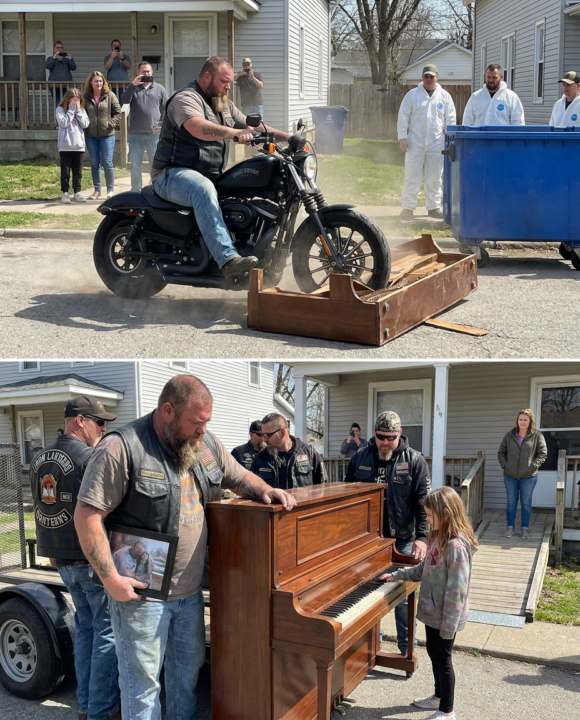
The lane beside Victory Drive had been temporarily closed with permission. A remediation contractor supervised, residents stood behind barriers, and the contaminated piano had been partially dismantled to reduce weight and prevent unstable metal components from creating additional danger.
Ray wore protective riding gear.
He still looked like a furious man destroying a child’s inheritance.
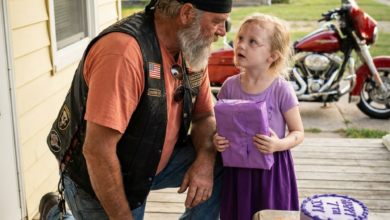
Sophie stood beside Laura while the crew wheeled the piano outside. She held Ruth’s music book and watched the instrument cross the porch threshold for the final time.
Her grandmother arrived from assisted living in a transport van.
Ruth knew what the inspector found. She supported the disposal, yet seeing the piano in the street removed every practical argument from her face.
“That was my mother’s bench,” she whispered.
Sophie heard.
She ran toward the instrument.
Ray caught her before she reached the containment area. He lifted her carefully, carried her behind the barrier, and placed her beside Laura.
“Let me go!”
“Can’t.”
“You’re stealing it.”
“Removing it.”
“You said you fixed things.”
Ray crouched so their eyes met.
“Fixing you first.”
The sentence did not comfort her.
Sophie struck his leather vest with both fists. Ray accepted each blow until Laura pulled her away.
Neighbors began filming.
I did too.
I wish I had not.
The video captured the most brutal angle: Sophie crying, Ray mounting his Harley, and the piano lying in the lane like an injured animal.
It did not capture the laboratory report.
It did not capture weeks of coughing or the dark contamination sealed behind the instrument’s polished wood.
The Road King rolled forward.
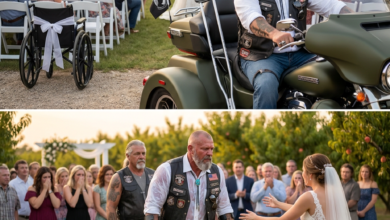
Ray’s front tire crossed the exposed keyboard casing. Keys snapped and scattered against the containment sheeting. A fractured wooden panel collapsed beneath the motorcycle’s weight.
Sophie screamed.
Ray’s face tightened behind the helmet.
Then he completed the pass.
The remediation crew immediately moved the broken components into the sealed disposal container. Nobody salvaged wood, felt, strings, or keys except the single cleaned sample approved for Sophie as a keepsake.
The contractor removed protective coverings and prepared the area for professional cleaning.
The practical work ended.
The neighborhood anger did not.
A man from two houses away confronted Ray.
“You enjoyed that?”
Ray removed his gloves.
“No.”
“Then why use the bike?”
Ray looked toward a pickup that had slowed near the debris container.
“Because somebody would’ve dragged it home if it still looked like a piano.”
The pickup drove away.
Another neighbor accused him of making the destruction into theater. That criticism contained truth.
Ray wanted Sophie to understand the piano could not be retrieved after everyone left. He also needed to transform the object from a cherished instrument into contaminated material in his own mind.
The Harley made the ending final.
Ray wiped road dust from the rescued key and sealed it in a small plastic case. He handed it to Ruth, not Sophie.
“Keep it until she wants it.”
Ruth accepted.
“Evelyn would have hated this.”
Ray’s shoulders stiffened.
“You knew her?”
“We played church recitals together.”
That surprised everyone.
Ruth and Evelyn had known each other during the 1980s. They lost contact after Evelyn began teaching privately and Ruth moved across the county.
Ruth touched Ray’s arm.
“She would’ve hated the noise.”
Ray looked toward his Road King.
“She hated that bike.”
“She loved that piano.”
Ray’s voice roughened.
“Then she’ll hate what comes next.”
The white trailer arrived.
Tiny drove. Five Iron Lanterns sat inside the truck, none wearing their usual expressions. The trailer doors opened, revealing Evelyn’s mahogany upright secured beneath quilted blankets.
Ray approached.
His hands shook before touching the straps.
Tiny blocked him.
“Last chance.”
Ray looked toward Sophie, who remained against her mother’s side.
“No.”
The club rolled Evelyn’s piano down the ramp.
Unlike Sophie’s contaminated instrument, this one had been stored in stable conditions and inspected before transport. A piano technician had assessed it, while cleaning professionals verified it was suitable for delivery.
The mahogany finish remained nearly perfect.
Evelyn’s fingerprints did not.
Ray had polished them away the night before.
That detail haunted him.
He could still remember where her right hand rested above middle C, but the physical trace had disappeared beneath his cloth.
As the piano reached the Bell porch, Sophie refused to look at it.
“I don’t want somebody dead’s piano.”
Ray stopped.
The sentence struck harder than her fists.
Tiny stepped forward, but Ray raised one hand.
The girl continued.
“You killed mine and brought me a funeral.”
Ray closed his eyes.
For several seconds, every biker on Victory Drive remained motionless.
Then Ray ordered the men to return the piano to the trailer.
Laura objected.
“Ray, she’s upset.”
“She said no.”
“She’s ten.”
“Still no.”
The Iron Lanterns began turning the piano around.
That became the false ending.
Ray had destroyed one instrument and failed to deliver another. Sophie had lost her piano, the neighbors had witnessed only cruelty, and Evelyn’s instrument was returning to the locked room where silence had held it for twelve years.
Then Ruth opened the old piano bench.
Inside lay an envelope bearing Sophie’s name.
Part 4 — The Letter Written Before Sophie Was Born
The envelope had not originally carried Sophie’s name.
Evelyn wrote FOR THE NEXT CHILD WHO NEEDS THIS PIANO across the front. Ruth added Sophie’s name after discovering it beneath a stack of yellowed lesson books.
Ray had never opened the bench.
After Evelyn’s death, he lowered the piano lid, locked the room, and refused to move anything. The bench remained positioned exactly where she left it.
Tiny and the other Lanterns entered only after Ray decided to give the instrument away.
They found sheet music, pencils, a tuning-fork case, and the sealed letter.
Tiny hid it inside his vest.
He did not tell Ray because he feared the message might change his decision.
That nearly broke the brotherhood.
When Ruth held up the envelope, Tiny admitted what he had done.
Ray turned toward him.
“You knew?”
“Since last night.”
“You let me drag it out here without telling me?”
“I thought you’d change your mind.”
“That yours to decide?”
“No.”
“Then why?”
Tiny looked at Evelyn’s piano.
“Because she was ours too.”
The Iron Lanterns had treated the instrument as Ray’s private grief, but Evelyn fed them after long rides, organized holiday drives, stitched torn jacket linings, and taught several members’ children without charging.
Her piano represented the last room where the club felt like a family before cancer changed everything.
Giving it away felt like losing her again.
Ray removed his leather vest.
He placed it on the trailer floor.
“You can honor Evelyn or own her,” he told Tiny. “Can’t do both.”
Tiny lowered his eyes.
Ray asked Sophie whether Ruth could read the letter aloud. The girl hesitated, then nodded.
Evelyn’s handwriting slanted sharply across three pages.
She wrote the letter during her final summer of teaching. She knew Ray would lock the piano after her death because he locked away anything he could not repair.
She knew the Iron Lanterns would defend that choice.
So she left instructions.
Do not turn my piano into a headstone.
Evelyn asked Ray to keep the instrument only until another child needed it more than his grief did. She warned that silence could damage music as surely as moisture or neglect.
Then she wrote about the song she never managed to teach him completely.
“Moon River.”
Evelyn said Ray always stopped after four measures because he believed his hands were too rough. She believed the real reason was simpler: finishing a song required allowing it to leave him.
The final line read:
When the right child reaches the fifth measure, you’ll know I found the road out.
Nobody spoke.
Sophie looked at the sheet music she had carried all morning.
The melody she had practiced for weeks was “Moon River.”
She always stopped after four measures because coughing interrupted her before the fifth.
Ray had heard it from his garage.
That was why her unfinished practice haunted him.
He had believed the song belonged to Evelyn’s final days. The letter revealed she had intended it for a beginning beyond them.
Sophie asked, “Did she know me?”
“No,” Ray said.
“Then how did she know the song?”
“She knew me.”
“That isn’t the same.”
Ray looked toward the mahogany piano.
“Close enough today.”
Sophie approached the trailer.
She pressed one finger against the wrapped keyboard lid but did not accept the gift immediately.
“What if it makes me sick too?”
A piano technician explained that the instrument had been professionally assessed, cleaned, and stored in appropriate conditions. Laura’s home would also receive follow-up environmental checks before regular use resumed.
Ray did not ask Sophie to trust sentiment.
He showed her the inspection paperwork.
The girl read only the first line before handing it to her mother.
“Can we try it outside?”
The movers positioned the piano temporarily beneath the covered porch, away from the remediation area. A technician checked its stability and tuning.
Sophie sat on the bench.
Her feet did not reach the pedals.
Ray remained in the street.
Ruth opened the music book.
The first four measures came slowly. Sophie paused where she usually coughed, one hand rising toward her chest from habit.
Nothing happened.
She played the fifth.
Ray turned away.
Tiny placed one hand on his shoulder.
The biker did not remove it.
Sophie continued through the next line, made three mistakes, stopped, and began again. Evelyn’s piano responded with a warmer tone than the old instrument ever produced.
Ray listened to the same song he had avoided for twelve years.
The motorcycle club had not merely brought a replacement piano.
They had carried Evelyn out of a locked room.
Part 5 — The Room Ray Finally Opened
The Bell house remained under environmental review for several days, so Evelyn’s piano returned temporarily to Dawson Iron Works rather than entering immediately.
This time, Ray did not lock it inside his house.
He placed it in the clubhouse.
The sight looked impossible: a polished mahogany upright standing between tool cabinets, motorcycle lifts, road maps, oil drums, and a row of black leather vests.
Sophie visited for lessons after her doctor approved her return to normal activities.
Ruth taught from a folding chair.
Ray worked nearby.
He claimed the noise disrupted him, yet every Tuesday he chose the repair bay closest to the piano.
The first lesson ended when Sophie asked him to sit beside her.
“No.”
“Evelyn said you know four measures.”
“Evelyn wrote a lot.”
“Were you always scared of her?”
Tiny dropped a wrench.
Every Iron Lantern in the garage stopped breathing.
Ray wiped his hands.
“Mostly.”
“Come play.”
“No.”
Sophie shifted along the bench.
Ray stared at the empty space.
His late wife had occupied it for thirty-one years. Sitting there felt more intimate than opening her closet or sleeping on her side of the bed.
Sophie waited.
Ray finally approached.
The bench creaked beneath his weight. His massive tattooed forearms looked absurd above the delicate keys, and the silver skull ring clicked against the wood until he removed it.
Sophie placed his right hand correctly.
“Start.”
Ray played the first note too hard.
The second barely sounded.
By the fourth measure, sweat had appeared along his shaved head. He lifted both hands.
“That’s it.”
“Fifth measure.”
“No.”
“Evelyn said.”
Ray looked toward the letter framed on the clubhouse wall.
Sophie waited without begging.
Ray pressed the next key.
The fifth measure began.
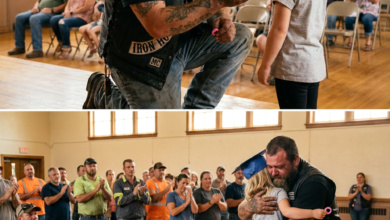
The Iron Lanterns turned away under various excuses. Cole inspected a clean workbench. Tiny opened an empty refrigerator. Two veteran riders walked outside and pretended to discuss tire pressure.
Ray completed the line.
Sophie smiled.
“Again.”
He swore quietly.
Then he played it again.
The piano moved into the Bell house after clearance. The Iron Lanterns carried it through the front door while Ray remained outside beneath the oak tree.
Laura asked why he would not enter.
“Ain’t mine anymore.”
“It can still be yours sometimes.”
Ray shook his head.
“Giving means gone.”
Sophie overheard.
She brought out the piano key saved from the contaminated instrument. Ruth had cleaned the sealed keepsake as advised before allowing her to handle it.
Sophie offered it to Ray.
“That one’s gone too.”
“Different.”
“How?”
“It can’t play, but I can remember it without breathing it.”
Ray accepted the key.
He mounted it inside a small metal frame at Dawson Iron Works beside Evelyn’s letter.
Below it, he added no plaque.
The object did not need explanation for those who knew.
My video of the piano’s destruction had gathered thousands of views before I understood the truth. I deleted it, but copies remained.
I recorded a correction.
Ray refused to appear.
Sophie agreed only if the video began with the inspection report and ended with her fifth measure, not her tears.
The correction spread farther than the original.
Some viewers still accused Ray of theatrics for using his Harley. They were not entirely wrong. The motorcycle was unnecessary to the physical disposal.
It was necessary to the promise he made himself.
No contaminated instrument would survive in recognizable form. Nobody would collect it from the curb. No other child would play against the same hidden mold.
Ray allowed criticism to remain.
Good intentions did not erase frightening appearances.
The Bell family’s permission, professional supervision, and containment mattered more than strangers deciding whether Ray looked heroic.
When asked whether he regretted crushing the piano, he answered carefully.
“Regret the kid watched.”
“Would you do it again?”
Ray looked toward Sophie playing inside the house.
“Would move her farther away.”
That was as close to remorse as he offered.
Then he added:
“Still break the piano.”
Part 6 — Tuesday Music at Dawson Iron Works
Sophie recovered steadily under medical care and environmental follow-up. Her symptoms did not disappear overnight, but she could practice without the same immediate coughing that once interrupted every lesson.
She played Evelyn’s piano for one hour each day.
On Tuesdays, she crossed Victory Drive and taught Ray.
He never became skilled. His fingers remained stiff, his timing wandered, and he treated sheet music like repair instructions written by an enemy.
Sophie refused to lower expectations.
The Iron Lanterns began scheduling club meetings around the lessons. They claimed this was accidental, although eleven motorcycles appeared outside Dawson Iron Works every Tuesday before the fifth measure.
Tiny learned the left-hand part.
Cole sang badly until everyone banned him.
Ruth attended when her health allowed and corrected stories Ray told about Evelyn. According to Ray, his wife had been endlessly patient. According to Ruth, Evelyn once threw a metronome into the yard after he arrived forty minutes late.
Ray believed that version.
The locked piano room inside his house changed too.
He removed the dust covers, opened the curtains, and donated Evelyn’s remaining lesson books to a community music program. He kept one chair and the photograph that traveled with the piano.
The room became a guest room.
Ray slept there once during a storm when roof repairs made his bedroom unusable. He later admitted that the silence felt different.
Not empty.
Finished.
Sophie performed “Moon River” at her school recital eighteen months after the piano’s destruction. Ray sat in the last row wearing his leather vest and cleanest motorcycle boots.
When she reached the fifth measure, she looked directly at him.
Ray lifted one scarred hand.
The gesture was small enough that nobody else noticed.
After the recital, Sophie asked whether Evelyn had found the road out.
Ray considered the question.
“No.”
Sophie frowned.
He touched the photograph inside his vest.
“Think I finally opened the door.”
Part 7 — The Piano That Crossed Victory Drive
Seven years later, Sophie left Savannah to study music education.
Evelyn’s piano remained in the Bell house because Sophie’s younger brother had begun taking lessons. The instrument had been tuned, maintained, and played so often that small scratches appeared around the bench.
Ray approved of the scratches.
“Means nobody worshipped it.”
Before Sophie left for college, she visited Dawson Iron Works carrying the framed key from her first piano.
Ray had displayed it beside Evelyn’s letter for years.
Sophie removed it from the wall.
“Thought that lived here,” Ray said.
“It did.”
“Where’s it going?”
“With me.”
He nodded.
She then handed him a smaller frame containing a photograph from the morning of the destruction. It did not show the Harley crushing the piano.
It showed Ray seated on the motorcycle afterward, helmet removed, while Sophie stood on the porch holding her music book.
Neither looked at the other.
Beneath the photograph, Sophie had written:
THE MORNING THE MUSIC MOVED.
Ray complained that the words sounded sentimental.
He hung it anyway.
That evening, the Iron Lanterns rode with Sophie’s family to the interstate entrance. Ray remained behind her car until the final exit, then raised one hand and turned his Road King back toward Victory Drive.
He passed the Bell house slowly.
Through the open window came the first uneven measures of “Moon River,” now played by another child on Evelyn’s mahogany piano.
Ray stopped at the curb.
The engine idled beneath him, deep and steady, while music crossed the street toward the garage where grief had once kept every door closed.
He listened through the fifth measure.
Then the biker rode home.
Follow our page for more unforgettable biker stories about misunderstood sacrifices, quiet second chances, and the precious things tough men finally learn to release.