Part 2: A Biker Carried an Empty Child’s Coffin Into a Route 66 Diner and Set It on a Table — By Sunset, His Harley Was Gone and the Coffin Was Filled With Envelopes for a Grieving Waitress
Part 2 — The Boy at Table Twelve
My name is June Mercer, and I had owned Bell’s Highway Diner outside Gallup, New Mexico, for nineteen years when Hammer carried that coffin through my door.
People later said I should have stopped him.
Maybe they were right.
But grief makes ordinary objects cruel. A child’s sneaker becomes unbearable. A half-empty cereal box becomes evidence. A table where a boy once arranged sugar packets into roads can feel more dangerous than any tattooed man standing beside it.
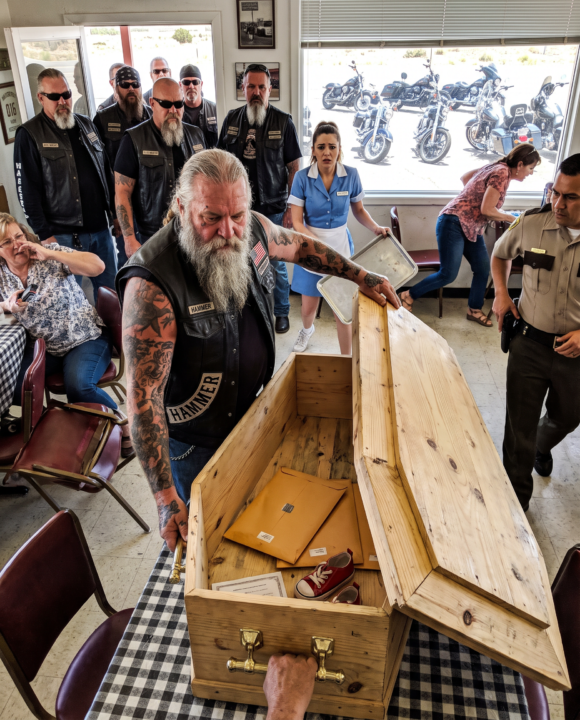
Eli Bell had claimed Table Twelve as his own.
He began coming to the diner at three years old, when Nora could not afford daycare between her afternoon shift and his medical appointments. I kept crayons beneath the register. Our cook, Benny, made him grilled-cheese sandwiches cut into four wheels because Eli insisted squares tasted faster.
Hammer first met him during a thunderstorm.
The power had failed, stranding six customers and two truckers while rain crossed the parking lot sideways. Hammer sat at the counter with his black leather cut dripping onto the floor. Eli had been frightened by thunder, but the sound of Hammer’s Harley starting outside fascinated him.
“Does it have a heartbeat?” he asked.
Hammer looked at Nora.
She shrugged.
“Loud one,” Hammer told the boy.
Eli walked around him, studying the tattoos, chain wallet, boots, and silver skull ring. Then he pointed through the window at the old Electra Glide.
“What’s her name?”
“Mercy.”
“Why?”
Hammer’s coffee cup stopped halfway to his mouth.
“Long story.”
“I know long stories.”
Hammer glanced at me. “Kid always like this?”
“Since birth.”
That was the first time I saw him smile.
It barely moved his beard, but it happened.
After that, Hammer came every Thursday. Eli made roads from sugar packets while Hammer repaired small things around the diner without being asked: a loose stool, a sticking door, the flickering sign above the kitchen.
He never accepted free food. Nora placed the bill beside him. Hammer paid it, then left enough beneath the coffee cup to cover another family’s breakfast.
He called the practice carrying the next mile.
Nobody knew where he learned it.
Hammer’s history was scattered through Gallup like damaged motorcycle parts. Some people remembered the bar fights. Others remembered the year he spent in county jail after breaking a man’s jaw outside a gas station. Veterans knew he had served as an Army recovery mechanic and returned from Kuwait with burned hands, a ruined knee, and the habit of sleeping in his garage because closed bedrooms felt too quiet.
He did not deny any of it.
“Did what I did,” he once told me. “Then I had to wake up afterward.”
The Iron Lanterns had not saved him from that past. They made him carry it honestly. Their rules were simple: no drinking on rides, no weapons inside community events, no using the patch to frighten people, and no brother left alone on the anniversary of a death.
That last rule existed because of Hammer.
Andre told me so years later.
Twenty-seven years before Eli died, Hammer had been married to a woman named Susan. Their daughter, Claire, was eight, freckled, stubborn, and obsessed with motorcycles even though Hammer had forbidden her to ride.
Claire developed leukemia.
Insurance paid for treatment until it did not. Hammer sold tools, borrowed against the house, and worked nights repairing trucks behind a closed tire shop. When Claire died, he had thirty-eight dollars in checking and two notices taped to his front door.
The funeral home required payment.
Hammer had none.
He signed a county assistance form that placed Claire in a shared municipal section without the cedar coffin Susan had chosen. There was no procession. No motorcycle escort. No headstone for nine months.
Hammer did not forgive himself.
His marriage ended within a year. He began drinking. Then came the fight, the jail cell, and the years when Mercy was the only possession he refused to surrender.
He had bought the Harley before Claire became ill. She pressed her paint-covered hand against the fuel tank during his first rebuild, leaving a silver print beneath the clear coat.
“Don’t erase me,” she had said.
Hammer kept the print.
He named the motorcycle Mercy after a night nurse who sat beside Claire when he was too exhausted to stay awake. Nurse Mercy Alvarez brought him coffee, washed his daughter’s hair, and paid the first sixty dollars toward the grave marker.
She was Sheriff Tom Alvarez’s mother.
Only four people knew that history before the coffin arrived: Hammer, Andre, Tom, and me. Nora did not.
Eli knew even less. To him, Mercy was simply an old motorcycle with a handprint on the tank and an engine that sounded like a mechanical heart.
The boy gave Hammer a drawing during their final breakfast together. It showed the biker riding beneath a crooked yellow sun, with a smaller figure sitting behind him.
The words were misspelled:
ME AND HMMER SOMDAY.
Hammer folded the picture into the inside pocket of his cut.
Eli entered the hospital that evening.
He never returned to Table Twelve.
When Hammer heard Nora asking me for money, he stared at the empty booth for nearly a minute. Then he took the drawing from his vest and flattened it beside his coffee.
“How short?” he asked.
I knew what he meant.
“More than seven thousand.”
“When?”
“Friday.”
Hammer looked toward Mercy in the parking lot.
“No county box,” he said.
“It’s Nora’s decision.”
“Shouldn’t be the only one she can afford.”
He left without finishing his coffee.
That night, the Iron Lanterns held an emergency meeting in Hammer’s garage. Andre later told me the argument lasted until two in the morning.
Hammer wanted the club to collect donations using an unfinished demonstration coffin donated by a retired carpenter. He believed people would ignore a jar, scroll past an online fundraiser, and forget Nora after writing a sympathetic sentence.
Nobody could ignore a coffin.
Several brothers opposed him.
Luis Ortega said the idea was cruel. Switch Hayes said carrying a coffin into Nora’s workplace would turn private grief into a spectacle. Andre warned that people would see their leather cuts, invent a threat, and call the police.
Hammer listened.
Then he placed Eli’s drawing on the table.
“Boy needs a grave,” he said.
Andre shook his head. “That doesn’t make every idea good.”
“No.”
“You willing to lose the patch over this?”
Hammer removed his cut.
He laid it beside the drawing.
“If cloth matters more, keep it.”
The room went silent.
Brotherhood had reached its first test.
The Iron Lanterns voted against using the club’s name.
Hammer accepted the vote.
Then he picked up the coffin alone.
Part 3 — The Forty-Eighth Envelope
The unfinished coffin came from Walter Briggs, a seventy-three-year-old carpenter who had once built caskets for a family funeral home near Grants. It was a sales sample, never blessed, never assigned, and never intended to hold a body.
Hammer called it a box.
Nobody else could.
At dawn, he loaded it into Andre’s pickup. Andre had voted against the plan, yet he still drove because he refused to let Hammer carry it alone.
They stopped at forty-seven places.
The hospital came first. A night nurse placed twenty dollars into an envelope and wrote her name across the flap. A janitor added five. A respiratory therapist contributed twelve dollars and the bus token she had been saving for breakfast.
Hammer accepted everything.
At Gallup Middle School, Eli’s teacher gave him seventy-three dollars collected from the staff lounge. A school custodian handed over an envelope containing three wrinkled ones.
“Not much,” the man said.
Hammer looked at him. “More than empty.”
They visited the fire station, two repair shops, a grocery store, a veterans’ hall, and the motel where Nora cleaned rooms on Sundays. Hammer never mentioned her debts beyond the funeral amount. He did not describe Eli’s final hours. He did not show hospital photographs.
He said only, “A mother needs to bury her boy.”
By ten in the morning, the envelopes held $2,183.
Still short.
Andre suggested an online fundraiser. It might gather the remainder after several days. Hammer looked at his watch.
Nora’s funeral deposit was due that afternoon.
He told Andre to drive to Red Mesa Motor Exchange.
Mercy stood in the dealer’s showroom by eleven.
The owner, Cal Roberts, knew the bike. Everyone did. He had offered Hammer $18,000 for it the previous year, partly because of the careful restoration and partly because riders in three states recognized its silver handprint.
That morning, Cal offered sixteen.
Hammer said yes.
No bargaining.
No final ride.
He removed the folded drawing from his vest, pressed one scarred palm against Claire’s silver handprint, and signed the title.
Andre stopped him before the ink dried.
“We can sell another bike.”
“No.”
“Club owns two touring bikes.”
“They belong to everybody.”
Luis arrived after hearing where they had gone. Switch came behind him. Within minutes, six Iron Lanterns stood in the showroom arguing that Hammer had no right to turn Claire’s last mark into funeral money for someone else.
Hammer let them finish.
Then he looked at Andre.
“Remember what I did after Claire?”
Andre did.
Hammer had spent the night of his daughter’s burial sitting on the floor of an empty garage with a loaded revolver beside his boot. Andre, then a young mechanic who barely knew him, remained outside the door until morning.
Hammer never forgot that.
“I had people,” he said. “Nora’s got invoices.”
Andre lowered his voice. “Mercy is all you have left of her.”
Hammer’s hand remained on the fuel tank.
“No. Memory ain’t parked.”
Cal produced a cashier’s check for $16,000. Hammer asked him to divide the amount into two envelopes. One contained the exact funeral balance. The other held everything remaining.
“What’s the second for?” Cal asked.
“The next parent.”
The cashier placed both inside a thick brown envelope.
Number forty-eight.
By noon, the coffin sat on Table Twelve. Customers fled. The sheriff arrived. Nora returned and slapped Hammer after seeing the box.
Then Hammer opened it.
The first forty-seven envelopes covered almost a third of the funeral. The forty-eighth covered the rest.
Nora refused it.
“I said no,” she whispered.
Hammer held the envelope between them. “Wasn’t a question.”
“You sold your motorcycle.”
“Had a buyer.”
“That bike belonged to your daughter.”
His eyes changed.
Someone had told her.
Nora stepped closer, anger holding her upright where grief could not. “You think losing your child gives you permission to use mine?”
Hammer flinched.
Not visibly enough for the crowd, perhaps. I saw it.
“You brought a coffin into the place where he ate breakfast,” she continued. “You let strangers film it. They’re outside calling this a miracle, and my son has been dead four days.”
Nobody defended Hammer.
She was right.
Kindness can still wound when it arrives without consent.
Hammer lowered the envelope. “I was wrong about the room.”
“You were wrong about all of it.”
He nodded once.
Then he closed the lid.
That should have ended the fundraiser. Hammer could have handed me the checks quietly and left. Nora could have rejected them. The diner could have returned every envelope.
Instead, a man outside kicked the coffin.
His name was Curtis Dale, a local contractor who had recorded the first video. He pushed through the doorway accusing the Iron Lanterns of exploiting a dead child. When Andre blocked him, Curtis shouted that the coffin proved bikers were threatening local families.
Phones rose.
The story had escaped us.
Hammer stepped between Curtis and the coffin. He did not clench his fists. He did not raise his voice.
“Back away from the box.”
Curtis shoved him.
Seven bikers moved at once.
Boots struck tile. Leather creaked. A chair overturned.
Nora screamed for them to stop.
Hammer raised one scarred hand.
Every Iron Lantern froze.
Curtis mistook restraint for weakness. He swung at Hammer and struck the side of his beard. Hammer could have folded him across the counter.
He did not.
He stepped backward.
“Sheriff,” he said, “your floor.”
Tom arrested Curtis for disorderly conduct and assault. By then, the footage made Hammer look guilty anyway. The clip showed a giant tattooed biker beside a child-sized coffin while frightened customers fled. It did not show the envelopes.
Within an hour, the diner phone began ringing.
Threats came first.
Then cancellations.
Someone spray-painted MONSTERS across the side wall. A local radio host demanded that the Iron Lanterns be investigated. The funeral home called Nora and asked whether journalists would disrupt Eli’s service.
Nora looked at the coffin.
“Take it away.”
Hammer lifted one end. Andre took the other.
As they reached the door, Eli’s red sneaker rolled from beneath the counter and stopped against the coffin.
Nora stared at it.
Then at Hammer.
“Wait.”
He stopped.
She picked up the sneaker, placed it inside the empty box, and touched the first envelope.
“What happens to the extra money?”
Hammer answered without turning.
“Another family.”
“You already planned that?”
“Yes.”
“Before you sold Mercy?”
“Yes.”
Nora lifted the thick envelope. The cashier’s check inside was larger than the funeral balance.
For the first time, she understood that Hammer had not sold the Harley only to bury Eli.
He was trying to build something that would outlive both of them.
But the plan still lacked a name, legal papers, and the consent of the woman whose grief had started it.
That was when Nora made the decision none of us expected.
“Put the coffin back on the table.”
Part 4 — What the Bikers Removed
The Iron Lanterns placed the coffin on Table Twelve again.
Nora stood beside it.
Her hands shook as she opened each envelope, but she did not count the money. She read the names.
People who had received extra coffee during winter storms. A teacher whose breakfast Nora had covered after his wallet disappeared. A truck driver she once followed into the parking lot because he seemed too dizzy to drive. A nurse who remembered Nora singing quietly beside Eli’s bed.
Forty-seven people had written their names.
Hammer had not written his.
Nora opened the final envelope. Inside was the dealer’s cashier’s check, Mercy’s signed title, and a small photograph of eight-year-old Claire Dawson pressing her silver-painted hand against the Harley’s fuel tank.
On the back, Susan had written:
Claire said machines need something human to find their way home.
Nora read it twice.
Then she asked Hammer why he had hidden his name.
He rubbed one thumb across his skull ring. “Didn’t want collecting interest.”
“This isn’t a debt.”
“Good.”
“Then look at me.”
Hammer did.
Nora returned the photograph but kept the check.
“I’ll accept enough for Eli’s service.”
He nodded.
“The rest does not belong to me.”
“Agreed.”
“It does not belong to your club.”
“Agreed.”
“And you don’t get to decide alone which grieving parent deserves it.”
Hammer glanced toward Andre.
“Agreed.”
Those three answers changed everything.
Nora asked me for a legal pad. She wrote a name across the top:
The Empty Box Fund.
No child’s name. No biker’s name. No ownership disguised as generosity.
The fund would pay urgent burial expenses for parents who fell between charity rules, insurance exclusions, and county deadlines. A funeral director, a hospital social worker, one diner employee, and one Iron Lantern would review requests.
Hammer refused the biker seat.
Nora insisted.
“You carried it in,” she said. “Now learn to share the weight.”
That was when the three brothers who had walked out returned.
They were no longer wearing their cuts.
At first, I believed they had abandoned the club because Hammer ignored the vote. Then I saw what they carried.
Luis held an envelope containing the title to his utility trailer. Switch brought the emergency savings he kept inside a red toolbox. Mason Pike, the youngest member, carried the keys to a custom chopper he had spent six years building.
Hammer’s face hardened.
“No.”
Mason placed the keys inside the coffin.
Hammer removed them.
“No bikes.”
“You sold yours,” Mason said.
“One was enough.”
“You don’t decide alone,” Nora reminded him.
For several seconds, grief and brotherhood pulled in opposite directions.
Andre stepped between the men. He explained why they had removed their patches. They did not want the public to believe their donations purchased loyalty to the Iron Lanterns. They had walked outside, taken off the leather, and returned as mechanics, fathers, veterans, and neighbors.
No club credit.
No staged photograph.
No names larger than the family receiving help.
Hammer studied them.
Then he returned Mason’s keys.
“Keep the bike. Give one month.”
Mason accepted.
Luis kept his trailer and contributed the next three payments from a roofing job. Switch donated repair labor to the diner, removing the graffiti before sunset.
The empty coffin began filling again.
One of the customers who had fled returned with fifty dollars. Then came the retired couple from the kitchen exit. The mother who had dragged out her children brought them back, each carrying an envelope decorated with crooked hearts.
Curtis Dale’s wife arrived alone.
She apologized for her husband and placed two hundred dollars into the box.
The sheriff contributed the sixty dollars his mother, Nurse Mercy, had once paid toward Claire’s headstone. He had kept the exact amount inside an envelope after she died, planning to give it to Hammer someday.
Hammer would not take it.
Tom placed it inside the coffin.
“For the next marker,” he said.
By three in the afternoon, Table Twelve disappeared beneath envelopes. People stood quietly along the walls. Nobody filmed after Nora asked them to lower their phones.
The V-twin engines outside remained silent.
Then Cal Roberts arrived from the motorcycle dealership.
He carried Mercy’s keys.
Hammer’s jaw tightened. “Deal was signed.”
Cal agreed.
The Harley had legally changed ownership. The buyer, however, was not Cal.
Twenty-seven people had combined money to purchase it through the dealership. Some were Iron Lanterns. Others were veterans Hammer had helped into recovery, travelers he had rescued from roadside breakdowns, and parents whose children had received anonymous Christmas gifts from Dawson Diesel.
Cal placed the keys beside the coffin.
“You can buy it back for one dollar.”
Hammer did not reach for them.
“That money could stay in the fund,” he said.
“It already is. Buyers donated the bike.”
“Then sell it twice.”
A murmur moved through the room.
Cal stared at him. “Ray.”
“Sixteen thousand buries more kids.”
“That handprint—”
“Isn’t my daughter.”
Hammer said it too quickly.
His voice cracked on the final word.
He turned toward the window before anyone saw more.
That was the second twist. Hammer had sold Mercy once, and the town had tried to return it. He refused because accepting the motorcycle would remove money from the purpose created by its loss.
Nora walked beside him.
“Claire asked you not to erase her.”
“She ain’t paint.”
“No. But you’re acting like keeping something means you loved her less than losing it.”
Hammer did not answer.
Nora picked up Mercy’s keys and placed them inside the coffin, not in Hammer’s hand.
“Then the fund owns one motorcycle.”
Andre began to understand.
They would not sell Mercy again. They would use it.
The Iron Lanterns would display the Harley at memorial rides, diners, repair shops, and community events. Every dollar raised beside its silver handprint would enter the Empty Box Fund.
Hammer would maintain it.
He would not own it.
For the first time since arriving, he accepted help without treating it as a debt.
“One condition,” he said.
Nora waited.
“No photographs of the kids.”
“Agreed.”
“No parents begging on camera.”
“Agreed.”
“No club logo on the box.”
Andre answered this time.
“Agreed.”
The brotherhood had survived, though not by following Hammer.
It survived by stopping him from carrying everything alone.
Part 5 — The Burial and the Empty Seat
Eli’s funeral took place Friday morning beneath a pale New Mexico sky.
There were no reporters.
Nora had asked for privacy, and the Iron Lanterns enforced it without intimidation. They parked two blocks away, removed their cuts, and stood along the road in plain shirts while the hearse passed.
Mercy did not lead the procession.
Hammer refused.
“This ride belongs to the boy,” he said.
Instead, he drove my old pickup behind the family car. The unfinished collection coffin remained locked in the diner. Eli’s real casket had been donated by the funeral home after its director learned the full story.
It was blue.
Nora chose it because Eli once said the sky was the only road that never needed repairs.
During the service, Hammer stood at the back. He kept Claire’s photograph inside his vest and Eli’s drawing in the other pocket.
Nora asked him to approach the grave.
He shook his head.
She asked again.
Hammer walked forward with the posture of a man entering a room he had avoided for twenty-seven years. His boots sank slightly into the soft soil. His hands remained at his sides until Nora gave him the red sneaker.
They had buried the other one with Eli.
“Where should this go?” she asked.
Hammer studied it.
“Somewhere it keeps moving.”
After the service, he tied the sneaker to Mercy’s rear luggage rack with a strip of black leather. It remained there during every Empty Box fundraiser that followed.
The first request arrived three weeks later.
A nineteen-year-old father from Window Rock had lost his premature daughter and lacked $1,900 for cremation and a private memorial. Hospital assistance required documents that would take ten days.
The service was scheduled in four.
The new fund paid the difference.
Nobody took a photograph.
The second request came from a grandmother raising two boys after their mother died in a highway collision. The Empty Box Fund covered the cemetery fee and three nights at a motel near the hospital.
The third family declined help after learning it began inside a child-sized coffin. Nora worried the image had become too heavy.
Hammer agreed.
They stopped displaying the coffin with its lid open.
Instead, Walter Briggs built a clear wooden panel across the top. Donors could slide envelopes through a narrow opening without seeing how much money lay inside. The box became less like a funeral object and more like a promise with handles.
Still, criticism continued.
Some people accused the Iron Lanterns of turning grief into publicity. Others claimed the fund was a scheme. The first accountant they hired discovered that cash donations required better tracking, donor receipts, and strict separation from the club’s accounts.
Hammer hated paperwork.
Nora made him learn.
Every Thursday, she sat across from him at Table Twelve with a ledger. Hammer recorded amounts while she checked receipts. If his handwriting became unreadable, she pushed the page back.
“Again.”
Hammer grumbled.
Nora waited.
He wrote it again.
The most difficult entry was the original $16,000 from Mercy’s sale. Hammer wanted the entire amount listed as anonymous.
Nora refused.
“Why?”
“Because people will think this happened without cost.”
“Cost ain’t the point.”
“It matters when the person giving believes he must disappear.”
Hammer stared at her.
She wrote his name.
Ray Dawson — motorcycle sale.
He did not cross it out.
The local radio host who had accused the club visited the diner two months later. He expected Hammer to demand an apology.
Hammer gave him a donation form.
The host contributed five hundred dollars and never broadcast the correction Hammer deserved. Andre was furious.
“Make him say he was wrong.”
Hammer returned to his coffee.
“Money spends quieter.”
That answer became famous around Gallup, though Hammer disliked hearing it repeated.
The fund grew. Funeral homes began waiving administrative fees. A credit union offered a managed account. A retired attorney filed nonprofit documents without charging. The diner dedicated Table Twelve to private family meetings, not memorial decorations.
Eli’s sugar roads disappeared.
One morning, I found Hammer arranging packets across the table exactly as the boy had done. He stopped when he saw me.
“You remembered the pattern,” I said.
“Kid built bad intersections.”
I sat across from him. “You ever visit Claire?”
“Every March.”
“On Mercy?”
He nodded.
That year, Nora asked to join him.
Hammer almost refused, but she had learned the difference between invitation and rescue. She did not argue. She simply left a note beside his coffee:
I know what the first burial costs. I don’t know what the twenty-eighth does.
He arrived at her apartment before sunrise.
Nora rode behind him to the municipal cemetery outside Albuquerque. The red sneaker moved against the luggage rack. Claire’s silver handprint caught the early light.
At the grave, Hammer discovered a new marker.
The old stone had carried only Claire’s name and dates. The new one included the line Susan had written behind the photograph:
SOMETHING HUMAN TO FIND THE WAY HOME.
Nora had paid for it using her first wages after Eli’s funeral.
Hammer stood over the marker for a long time.
“You shouldn’t have,” he said.
Nora answered with his own words.
“Wasn’t a question.”
He knelt and pressed two fingers against Claire’s name.
His shoulders shook once.
Only once.
Then he stood, returned to Mercy, and started the engine.
The V-twin broke the cemetery silence like a heart remembering its work.
Part 6 — Every Thursday, One Envelope
The Empty Box remained at Bell’s Highway Diner.
Not every day.
Nora brought it out each Thursday morning, the same shift when Hammer once drank coffee while Eli built sugar roads. The coffin rested on Table Twelve for one hour with no photographs, speeches, or explanation beyond a small card stating that every envelope helped a family meet an immediate burial expense.
Hammer always arrived first.
He parked Mercy where Nora could see the silver handprint from the register. The red sneaker stayed tied behind the seat until its color faded from bright red to dusty pink.
He ordered black coffee, wheat toast, and one scrambled egg.
Then he placed an envelope into the box.
Sometimes it held twenty dollars. Sometimes two hundred after a good week at the garage. Once it contained only six dollars because Hammer had replaced a young mother’s transmission without charging labor.
Nora counted every amount.
She never ranked them.
Within three years, the fund helped forty-two families. Some buried children. Others buried parents, spouses, or siblings after sudden accidents. The board eventually expanded its purpose because grief did not become cheaper when the person inside the casket was older.
The unfinished coffin accumulated marks.
A brass handle loosened. Coffee stained one corner. A child drew a tiny wheel beneath the lid where donors could not see it.
Hammer repaired everything except the wheel.
“Leave that,” he said.
The Iron Lanterns developed a new ritual. When the fund approved a request, one member delivered the payment without wearing his cut. Another remained available to repair the family’s car, cover a work shift, or drive relatives from the airport.
They never arrived as a crowd.
They had learned that help could become another burden if it filled the whole room.
Nora learned something too.
On Eli’s birthday, she stopped working alone. She allowed me to cover her shift, accepted dinner from Andre’s wife, and rode with Hammer to the overlook east of Gallup.
They took Mercy.
At sunset, Nora untied the red sneaker and replaced the worn leather strap. Hammer held the bike upright while she worked.
“Think it’ll stay?” he asked.
She pulled the knot.
“It stayed this long.”
When they returned, an envelope waited beneath the diner door. It contained nine dollars, three quarters, and a note from a twelve-year-old girl whose father’s cremation the fund had paid for.
The money came from her lemonade stand.
Hammer placed the nine dollars and seventy-five cents in a separate ledger line.
Nora asked why.
“First money she carried herself.”
The envelope was later framed inside the diner kitchen, away from cameras and customers.
Beneath it sat Eli’s drawing.
Two children who never met.
One motorcycle.
And an empty box that did not remain empty for long.
Part 7 — What Mercy Carried Home
Five years after Hammer brought the coffin into my diner, the Empty Box Fund received its hundredth request.
A waitress from Farmington had lost her teenage daughter in a winter highway accident. She had no savings, no paid leave, and three days to arrange a service.
Nora approved the payment.
Hammer delivered it.
He did not tell the woman his history. He placed the funeral-home check on her kitchen table, repaired the loose hinge on her front door, and left before she found words large enough for gratitude.
Mercy waited at the curb.
The silver handprint had faded, but it remained visible. Eli’s red sneaker was now protected inside a clear cover behind the seat.
Hammer swung one leg over the bike.
The woman ran outside.
“Why are you doing this?”
He looked toward the road.
“Somebody filled the box.”
That was all.
Back at the diner, the original coffin still rested on Table Twelve every Thursday. Its pine had darkened from years of hands, envelopes, coffee steam, and New Mexico dust.
The lid carried one new mark.
Nora had asked Walter Briggs to carve two small tire tracks into the wood. They began at one handle, crossed the center, and disappeared beneath the far edge.
No names.
Hammer’s rule.
On the anniversary of Eli’s death, a journalist requested a photograph of Hammer standing beside the coffin. He declined. She asked for a photograph of Nora. Nora declined too.
Instead, they photographed Table Twelve after everyone had gone.
The coffin stood in the center. Forty-three envelopes lay inside. Beside it sat one cup of black coffee, one red sneaker, and a row of sugar packets arranged into a crooked road.
Mercy was visible through the window.
That photograph later traveled farther than the video that had made people believe Hammer was threatening a grieving mother. Donations arrived from Arizona, Texas, Colorado, and places none of us recognized.
Hammer never watched the numbers.
He watched the doors.
Whenever a parent entered uncertainly, he moved away from the table so Nora could speak first. If the person wanted him there, he stayed. If not, he drank his coffee near the register.
He finally understood that carrying the box through the door had been the easy part.
Learning when to set it down took longer.
Hammer is sixty-three now. His beard has gone almost completely gray, and his right knee no longer trusts cold mornings. Andre keeps telling him to replace Mercy with a lighter motorcycle.
Hammer refuses.
Every Thursday, the old Harley rolls into the diner lot at 7:10 a.m. The engine cuts. The red sneaker stops moving. Heavy boots cross the pavement.
Hammer enters carrying one envelope.
Never empty.
Follow our page for more powerful biker stories about misunderstood riders, quiet sacrifices, and ordinary people whose kindness travels farther than any highway.