A 52-Year-Old Biker Smashed a Woman’s Phone in a Hospital Waiting Room — Minutes Later, Police Discovered Who Her Livestream Had Brought Through the Doors
Part 2 — Eleven Bikers, Forty-Eight Blue Blankets
I knew Rook before the phone broke.
He and the Red River Riders came to Mercy Ridge on the first Friday of every month, usually just after noon, their V-twins rattling the glass doors before falling silent beneath the emergency awning. They never entered the pediatric wing wearing club cuts unless a child specifically asked to see the motorcycles.
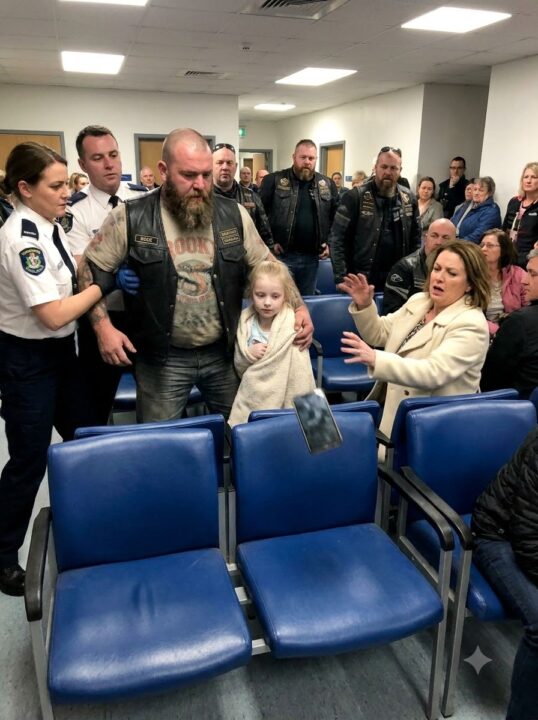
That Friday, they brought forty-eight pale-blue blankets.
Each blanket contained a small bird stitched into one corner. Some birds leaned sideways. Some had uneven wings. The one sewn by Tuck Brennan, the club’s sixty-one-year-old treasurer, looked more like a blue potato with a beak.
The children never cared.
Rook inspected every seam because loose thread could catch on dressings. His heavy hands moved slowly over the fabric, scarred fingertips searching for knots, metal fasteners, or anything that might scrape injured skin.
He learned that habit from his daughter, Ellie.
Twenty-four years earlier, six-year-old Ellie Mercer suffered second-degree burns during an electrical fire in the apartment where Rook lived with his wife, Beth. Rook carried Ellie down two flights of smoke-filled stairs wrapped inside his leather riding jacket.
She survived.
The photograph almost destroyed them anyway.
A freelance photographer arrived while firefighters were still working. He captured Ellie sitting on a curb in torn pajamas, crying for her mother while a paramedic treated her burns.
Rook ordered him to stop.
The photographer kept shooting.
One image appeared in newspapers, then on fundraising posters and television broadcasts. A charity used it without the family’s knowledge. Strangers mailed letters to the hospital. One man identified Ellie’s school from the crest visible on her damaged backpack and appeared outside the building with flowers.
He said he only wanted to meet the brave little girl.
Police found photographs of other injured children inside his van.
Ellie was moved to another school. Beth covered their apartment windows. Rook began checking every parked vehicle before allowing his daughter outside.
The photographer had not created the threat.
He had exposed the door.
That distinction mattered to Rook, though it took him years to explain it without clenching his fists.
At the time, he chose the fist.
He found the photographer outside a television station and struck him twice. The second blow broke the man’s jaw after he was already falling.
Rook pleaded guilty to aggravated assault.
He served eighteen months.
He never called the sentence unfair.
“You don’t get to say you were protecting somebody after you stop controlling your hands,” he once told me while repairing a loose wheel on a pediatric supply cart. “After that, you’re just the next danger in the room.”
Prison cost him more than time. Beth moved Ellie to Arkansas and filed for divorce. Rook’s union electrical job disappeared. His younger brother, Wade, sold Rook’s Harley to pay legal bills without permission.
That betrayal split them for eleven years.
When Rook came home, he bought back the motorcycle from a used dealership in Broken Arrow. The Road King had different pipes, a dented tank, and almost ninety thousand miles on the engine.
He recognized a scratch Ellie had made with her bicycle handlebar.
He kept it.
The Red River Riders helped him rebuild the motor in a garage off East Admiral Place. Brotherhood came slowly. Rook did not join because he wanted a reputation. He joined because men who worked with their hands understood silence and did not ask him to explain why cameras made his shoulders tighten.
Ellie eventually contacted him.
She was seventeen.
Their first meeting took place inside a diner near Fort Smith, Arkansas. Rook arrived two hours early, drank six cups of coffee, and left his phone inside the Harley’s locked saddlebag.
Ellie brought the bluebird.
She had drawn it during burn therapy when she was six—a round creature with one wing larger than the other. Her therapist told her birds did not need matching wings in drawings to know where home was.
Rook had it sewn inside his cut.
Not outside.
“It isn’t a patch for strangers,” he said.
Rebuilding their relationship required nine years. Rook attended therapy. He learned to ask before stepping between Ellie and a camera. He learned that protecting someone did not mean choosing every decision for them.
Ellie became a pediatric occupational therapist specializing in children recovering from burns and traumatic injuries. She helped create the Bluebird Comfort Project, which supplied soft blankets, loose clothing, distraction kits, and privacy cards to three Oklahoma hospitals.
Rook and his club did the hauling.
The boxes waiting beside the Mercy Ridge entrance that Friday contained more than blankets. Each kit included a card printed with simple instructions for adults around injured children: do not photograph, do not post identifying details, do not ask the child to repeat what happened, and let medical staff locate family.
The cards were delayed at the print shop.
Rook had brought one old sample in his vest pocket.
When the woman began streaming Lucy, he touched that card twice.
I saw him.
I assumed he was reaching for cigarettes.
That was my first mistake.
My second was believing the girl had been forgotten.
Lucy Vale had arrived in an ambulance beside her mother, Dana. A pan of oil caught fire in their apartment kitchen. Dana smothered the flames around Lucy, then collapsed from smoke inhalation before paramedics reached the building.
Their charts were separated during triage.
Dana had no identification. Lucy knew her mother only as Mommy, and shock reduced every question to tears. A technician moved Dana to imaging while a respiratory team attempted to confirm her identity.
Lucy’s grandmother was driving from Claremore.
For seventeen minutes, the system knew the child and the mother as two unrelated patients.
The livestreamer used those seventeen minutes to tell thousands of viewers that Mercy Ridge had abandoned a burned girl.
Her name was Kara Bell.
She had come to the hospital for routine blood work and had built a modest online audience covering public confrontations, neglected animals, medical-billing disputes, and what she called “stories institutions hoped nobody would see.”
Sometimes she exposed genuine misconduct.
That made her certain every camera she raised was righteous.
She had also ignored Lucy’s first request.
“Please don’t.”
Rook heard it.
So did three other adults.
He was simply the first one who stood.
Part 3 — The Stranger Who Knew Lucy’s Name
The man entered Mercy Ridge at 3:27 p.m.
He wore a gray hooded sweatshirt, damp work boots, and a visitor sticker from another medical building across town. He looked ordinary enough to disappear inside any waiting room.
“Lucy,” he called.
The little girl lifted her head.
Rook remained against the wall. One cuff had been placed around his right wrist while Officer Hayes reviewed conflicting witness statements.
The stranger moved closer.
“I’m Uncle Darren.”
Lucy stared at him. “I don’t have an Uncle Darren.”
Everything tightened.
Officer Hayes stepped between them and asked for identification. The man produced an Oklahoma driver’s license bearing the name Darren Cole, then explained that he was Dana’s cousin.
Lucy shook her head.
Kara leaned toward her broken phone, which was now resting faceup inside an evidence tray. The livestream continued receiving messages even though the lens had been covered.
One comment contained Darren’s full name.
Another thanked him for going there.
He was a viewer.
Darren insisted he only wanted to help. He showed Hayes a screenshot of Kara’s broadcast, paused at the exact moment Lucy’s bracelet faced the camera.
Her first name was visible.
The stream’s location tag identified Mercy Ridge. A hallway sign behind Erin had briefly shown the emergency-department entrance number.
Darren had assembled the rest.
“People online were worried,” he said.
“You told the child you were family,” Hayes replied.
“I didn’t want to scare her.”
“You lied so she would trust you.”
Darren looked toward the eleven bikers. “And they don’t scare her?”
Rook answered without turning.
“She knows what I am.”
“What are you?”
“The man blocking the camera.”
Hayes escorted Darren to a separate room. A records check revealed no warrant, no documented offense, and no legal reason to arrest him for entering a public lobby.
That did not make his behavior harmless.
Security issued a trespass notice and walked him outside. He continued filming from the parking lot, telling Kara’s viewers that Mercy Ridge was protecting bikers while silencing concerned citizens.
The story split online within an hour.
One short clip showed Rook smashing the phone and being restrained. It received more views than Kara’s original livestream.
A second clip showed him saying every adult in the room was responsible. Some called him a hero. Others called the sentence a threat.
Neither clip showed Lucy asking Kara to stop.
Mercy Ridge administration suspended all Red River Riders visits while its lawyers reviewed the incident. The forty-eight blankets remained sealed inside the lobby supply room.
The club did not take that quietly.
Tuck wanted to release Kara’s name, employer, home address, and every screenshot he could collect. Milo Briggs, the club’s youngest member, had already found her car registration through an old marketplace post.
Rook took his phone.
“Delete it.”
“She put the kid online.”
“So you’ll put her online?”
“She deserves to feel watched.”
Rook’s expression hardened. “That what we do now?”
Milo lowered his eyes.
Rook deleted the draft, then removed the small Red River Riders pin from Milo’s cut.
“You don’t wear us while you build a mob.”
Milo’s face went pale. A club pin was not decoration. Removing it in public meant his place among the brothers would be reviewed.
Tuck stepped between them. “He’s angry.”
“So was I when I broke a man’s jaw.”
The room became quiet.
Rook handed the phone back.
“Anger explains the fire. Doesn’t choose where it spreads.”
That decision divided the club. Six riders believed Rook cared more about protecting Kara than defending them. Three threatened to abandon the Bluebird deliveries.
Wade Mercer arrived during the argument.
He had joined the Red River Riders four years earlier, after finally admitting that selling Rook’s Harley had not saved the family. It had paid a lawyer who promised an impossible acquittal while Beth struggled alone.
The brothers had rebuilt trust around engines because neither knew how to begin with words.
Wade placed Rook’s club pin on the table.
“If Milo loses his for wanting retaliation, take mine too.”
Rook looked at him. “Why?”
“Because I sent Kara’s profile to him.”
There it was.
The betrayal inside the brotherhood.
Wade had seen the first clip and believed Kara staged the confrontation. He asked Milo to investigate, never telling him where to stop. Now screenshots of Kara’s house were circulating in a private group.
A stranger had already left a cracked phone on her porch.
Kara called Mercy Ridge demanding Rook’s arrest.
Rook was still in the building.
Officer Hayes had not cuffed him formally because Erin’s account and security footage suggested criminal damage, not assault. Kara’s phone was broken, but the chair cushion supported Rook’s version.
Then Kara showed us the photograph from her porch.
A black motorcycle glove lay beside the shattered device.
It resembled the gloves worn by half the Red River Riders.
Hospital administrators wanted every biker removed immediately. Hayes warned Rook that leaving through the main entrance could cause another confrontation because reporters and livestreamers were gathering outside.
Rook did not ask who had threatened Kara.
He asked where Lucy was.
Dana had been identified by then. She remained unconscious but stable in respiratory observation. Lucy’s grandmother was forty minutes away, delayed by a highway collision near Catoosa.
Child services sent a temporary advocate.
Lucy refused to leave the blue chair.
She believed moving would prevent her mother from finding her.
Rook sat on the floor eight feet away, still visible through the glass wall of the consultation room. He did not approach. He did not speak until Lucy pointed toward the faded bird inside his vest.
“What’s that?”
“A bad drawing.”
“It’s a bird.”
“That’s what the artist claims.”
Lucy almost smiled.
She asked whether it could stay with her.
Rook removed his cut and slid it across the floor. The leather stopped beside her sneaker.
The little girl wrapped one hand around the bluebird.
Outside, thirty phones waited to record the supposedly violent biker leaving the hospital.
Inside, he sat in a plain gray T-shirt, refusing to take back the only thing that identified him as one.
Then Hayes received a call.
The glove on Kara’s porch did belong to a Red River Rider.
It belonged to Wade.
Part 4 — What Wade Left on the Porch
Rook stood when he heard his brother’s name.
His chair scraped once.
Every officer in the room watched his hands.
Wade did not run. He entered Mercy Ridge through the ambulance bay carrying his other glove and asked to speak with Hayes.
“I left it there,” he said.
Rook remained silent.
Wade explained that he had ridden to Kara’s house after finding her address. He carried a replacement phone purchased with cash, intending to leave it on the porch with a note demanding that she remove Lucy’s video.
He never reached the door.
Three cars were parked outside. Two men stood near Kara’s windows filming. Someone had spray-painted a camera symbol across her garage.
Wade placed the boxed phone on the porch, pulled off one glove to write the note, then heard Kara shouting from inside. He left without the glove because he feared the crowd would recognize his motorcycle and connect Rook to the harassment.
The box had disappeared before police arrived.
Only the glove remained beside a different broken phone brought by someone else.
Wade had tried to correct one wrong in secret.
Instead, he made Rook appear responsible for another.
“Why didn’t you call me?” Rook asked.
“You would’ve stopped me.”
“Yes.”
“I thought replacing the phone would settle it.”
“You thought property was the problem.”
Wade stared at the floor.
Kara’s original device was not merely damaged hardware. It contained forty-three minutes of Lucy’s fear, Dana’s partial medical information spoken by staff in the background, images of patients entering treatment, and viewer messages coordinating a trip to the hospital.
The phone was evidence.
Rook had nearly destroyed it.
That fact complicated every easy version of the story. He had protected Lucy from another close-up, but he had also risked eliminating the record proving what happened.
He understood immediately.
“I’ll answer for that,” he told Hayes.
Kara wanted him charged with felony destruction of property, claiming the phone, case, microphone, and data were worth more than two thousand dollars. A repair technician later determined that the screen and camera housing were damaged, but the storage remained intact.
The cost fell below the felony threshold.
Rook did not celebrate.
He offered to pay.
Kara refused because accepting money, she said, would let him purchase forgiveness.
“I’m buying glass,” he replied. “Forgiveness isn’t mine to price.”
While attorneys argued, Ellie Mercer arrived.
She wore navy scrubs beneath a raincoat and carried a case of printed Bluebird privacy cards. At forty, she had her father’s dark eyes and her mother’s habit of pressing her lips together before saying something difficult.
Rook did not expect her.
Neither did Kara.
Ellie walked past her father first and knelt beside Lucy. She introduced herself, showed the girl how to place the bluebird blanket beneath the loose dressing without catching the edge, and asked permission before touching anything.
Lucy nodded.
Ellie covered the child’s hospital bracelet with a soft fabric band.
Only then did she face the adults.
Kara recognized her.
The old photograph of six-year-old Ellie had won a regional journalism award. Kara had used it in a college presentation about images that changed public policy.
She remembered the crying girl on the curb.
She had never learned her name.
“That was you?” she asked.
Ellie looked toward the broken phone. “It’s always somebody.”
The sentence landed harder than shouting.
Kara defended the livestream. She said the image of Ellie had helped raise money for burn treatment and that her broadcast forced Mercy Ridge to locate Lucy’s family faster.
Erin corrected her.
The hospital located Dana through ambulance records and dental information. The livestream changed nothing except the number of strangers who knew where Lucy sat.
Kara looked toward the child.
Lucy hid her face.
For the first time, Kara did not raise a camera to capture the reaction.
Ellie placed one Bluebird card on the table. It listed five questions:
Did the child consent?
Can the child understand where this image may travel?
Does the image reveal a location, school, bracelet, face, or medical detail?
Would you record this moment if it were your child?
Are you helping the child—or proving that you were there?
Kara read the final line twice.
Rook said nothing.
He had learned that explanations from frightening men were often mistaken for threats. Ellie’s quiet voice could enter places his could not.
But the largest turn came from Lucy.
She lowered the blanket and looked at Kara.
“I told you no.”
Kara opened her mouth.
Nothing came out.
The waiting room had heard the request. The livestream had recorded it. The woman who claimed to give an abandoned child a voice had ignored the only words that child managed to say.
Kara ended the stream remotely through her account.
The archived video disappeared from her page.
Copies remained everywhere.
Deleting an original does not recall an image once strangers own it. Ellie knew that from childhood. Rook knew it from watching his daughter’s fear outlive the fire.
That was why he had recognized Darren’s message.
Twenty-four years earlier, before the stranger appeared at Ellie’s school, someone had written beneath her photograph:
DON’T MOVE HER. I’M COMING TO SEE MY BRAVE GIRL.
Different screen.
Same promise.
Rook had not lost control when he read it in Mercy Ridge.
For perhaps the first time in his life, he kept it.
Part 5 — The Mother Behind the Double Doors
Dana Vale woke shortly after midnight.
Smoke had inflamed her lungs, and a bruise darkened one side of her face where she struck the kitchen floor. Her first clear word was Lucy’s name.
Erin brought the girl upstairs.
Rook remained in the emergency lobby because he was not family, and because hospital administrators had not decided whether he would be banned after discharge.
Lucy refused to return his vest.
She wore it over the pale-blue blanket, the hem dragging behind her as she walked toward the elevator. The leather swallowed her small shoulders, but her fingers stayed curled around Ellie’s faded bird.
Dana began crying when she saw it.
She knew the Bluebird Comfort Project.
Two years earlier, Ellie had helped Dana’s nephew after a fireworks injury. Dana recognized the bird before anyone explained who Rook was.
Lucy told the story in pieces. The camera. The woman. The biker. The officers. The stranger who claimed to be an uncle.
Then she repeated Rook’s sentence.
“All the grown-ups were responsible.”
Dana asked to meet him.
Hospital counsel objected because a criminal complaint remained possible. Dana insisted.
Rook entered without his cut, chain wallet, rings, or boots. Officer Hayes had returned his property, but Rook left anything intimidating with Wade in the hallway.
Dana studied him.
“You broke the phone?”
“Yes.”
“You touch her?”
“No.”
“You scare my daughter?”
“Yes.”
Rook did not soften the answer.
Lucy had flinched when he stood. She had cried harder when security rushed him. Protecting her did not erase his part in making the room frightening.
Dana appreciated that more than an excuse.
“Why didn’t you wait for staff?” she asked.
“I asked for help.”
Erin remembered hearing him call toward the desk. She had been receiving a cardiac patient and raised one finger, asking him to wait.
He waited thirty-one seconds.
During those seconds, Kara moved close enough to show Lucy’s tears and bracelet together.
“I chose the phone,” Rook said. “Should’ve chosen better.”
Dana looked toward her daughter, who was tracing the bluebird with one finger.
“You chose before anybody else did.”
That was not absolution.
It was simply true.
Dana declined to request a protective order against Rook and told investigators she did not want her daughter used to promote either side. No interviews. No heroic reenactments. No photographs of Lucy meeting the biker who saved her from a camera.
Rook agreed before she finished.
Kara struggled longer.
Her account had lost sponsors after the full waiting-room audio revealed Lucy saying no. Other viewers defended her, arguing that public outrage was necessary to hold hospitals accountable.
Kara could have built a second wave of content around being canceled.
She almost did.
She recorded a seventeen-minute response blaming Rook, Mercy Ridge, online harassment, and the confusing ethics of public spaces. Before posting it, she watched Lucy’s original stream from beginning to end.
At minute four, Lucy asked her to stop.
At minute seven, Kara told viewers to share the broadcast.
At minute nine, she zoomed toward the dressing.
At minute eleven, Rook stood.
Kara deleted her response.
Two days later, she issued a forty-three-second statement from a blank wall. She did not show Lucy’s face, repeat the child’s medical details, or describe Rook as either monster or hero.
“I heard a child say no,” she said, “and treated my intention as more important than her answer.”
She donated the livestream revenue to the Bluebird Comfort Project.
Rook sent it back.
Kara called Ellie, offended.
“Why won’t he take it?”
“Because the money came from Lucy’s fear.”
“What am I supposed to do with it?”
“Refund what you can. Use the rest to remove copies.”
Kara hired a digital-rights service to issue takedown requests. It could not erase everything, but within three months most high-traffic copies disappeared.
The Red River Riders faced their own reckoning.
Wade admitted finding Kara’s address. Milo admitted preparing the post. Tuck admitted encouraging both while telling himself the club was defending Rook.
The club voted to suspend all three men from public rides for sixty days.
Rook surrendered his road-captain pin too.
President Amos “Preacher” Sloan pushed it back across the table.
“You stopped the post.”
“After my brothers built it.”
“You can’t control every man.”
“I can decide what carries our name.”
Preacher considered that, then placed the pin beside the bluebird blanket on the table.
“Then teach it.”
Rook created a new club rule. Red River Riders would never publish the address, workplace, family, vehicle, or private information of anyone involved in an online dispute. No exceptions for enemies. No retaliation disguised as investigation.
Milo resisted.
“What if somebody comes after a kid again?”
Rook placed the damaged screen from Kara’s phone on the table. She had eventually accepted a replacement on the condition that he keep the broken part.
“Stand in front of the kid,” he said. “Not outside somebody’s house.”
The hospital investigation ended one week later.
Security footage confirmed that Rook never touched Kara. It showed him requesting that she stop three times and calling toward the nurses’ desk before taking the phone. It also showed the device striking the padded chair first.
The district attorney offered a deferred agreement for misdemeanor property damage: restitution, an anger-management review, and six months without another incident.
Rook accepted.
His lawyer believed the charge could be fought.
Rook refused.
“I took what wasn’t mine.”
Kara accepted the replacement phone but asked that restitution be paid directly to a children’s privacy program. The court allowed it.
Mercy Ridge lifted the club’s ban.
The forty-eight blankets finally entered the pediatric unit. Lucy received the first one, though she insisted on returning Rook’s leather cut in person.
She found him beside his Road King under the emergency awning.
Rainwater ran along the old scratch Ellie had left on the tank.
Lucy held out the vest.
“You forgot this.”
“No,” he said. “Knew where it was.”
She touched the bird.
“Did your daughter draw it good?”
Rook examined the crooked wings.
“No.”
Lucy smiled.
“But it got home,” he added.
Part 6 — The Empty Chair Beside the Camera Sign
Mercy Ridge changed the waiting room after the incident.
Not dramatically.
No brass plaque carried Rook’s name. No mural turned Lucy into a symbol. Dana would not permit it, and Rook would have removed it himself.
A simple privacy sign appeared beside check-in. Soft fabric bands were made available to cover patient names on bracelets. Staff received a procedure for responding when visitors filmed children or medical conversations.
One blue chair remained beneath the television.
It was the chair Rook used.
Every first Friday, the Red River Riders arrived with blankets, loose shirts, coloring kits, and unscented lotion approved by the burn team. The V-twin rumble still shook the entrance glass. Rook still checked every stitch.
Then he sat in that chair for five minutes.
The replacement vinyl carried a shallow dent where his weight settled. He drank vending-machine coffee and watched the room without making people feel watched.
Kara returned once.
She came without a microphone, tripod, or assistant. At check-in, she placed her phone inside a privacy sleeve before entering the pediatric floor.
Rook noticed.
He said nothing.
She spent two hours helping Ellie package fabric bracelet covers. They were not friends afterward. Some harms close slowly, and some relationships do not need to become warm to become decent.
Wade returned to club rides after his suspension. He and Rook rebuilt the damaged side case on the Road King together.
Near midnight, Wade finally asked the question he had avoided.
“You ever think hitting that photographer saved Ellie?”
“No.”
“Never?”
Rook tightened a bolt.
“Made me feel useful for five seconds. Left Beth alone eighteen months.”
Wade stared at the engine.
“I thought going to Kara’s house was protecting you.”
“I know.”
“That make it better?”
“No.”
Rook handed him the wrench.
“Makes it something you can stop doing.”
That was as close as the Mercer brothers came to forgiveness that night.
Months later, Lucy visited the Bluebird workshop with Dana. The burn on her forearm had faded into a pale uneven patch. She carried a cardboard sign she had drawn for the waiting room, but it contained no photograph of herself.
The picture showed a large black bird standing between a small bluebird and a square camera.
Rook studied it.
“Black bird looks angry.”
“He is.”
“Why?”
“He wants the camera to ask first.”
Lucy taped the drawing beside the privacy sleeves.
Rook sat beneath it.
The chair did not break.
Part 7 — Every Adult in the Room
One year after the livestream, Mercy Ridge held its first Bluebird Ride for pediatric recovery programs.
Dana permitted Lucy to attend under one condition: no photograph would show her face without her asking first.
Rook made every rider repeat the rule.
Seventy-three Harleys gathered along Riverside Drive before sunrise. Engines rolled through the fog in heavy uneven pulses. Leather cuts darkened with mist. Chrome reflected the hospital’s white entrance lights.
Kara stood near the registration table.
She was not livestreaming.
She took photographs of motorcycles, volunteers, sealed supply boxes, and hands tying blue ribbons to handlebars. Whenever a child entered the frame, she lowered the camera.
Lucy approached her wearing a blue cap.
“You can take one,” she said.
Kara crouched but did not lift the phone. “Where do you want me?”
Lucy positioned her beside Rook’s Road King and turned her own face away, showing only the cap, one small hand, and the pale mark on her forearm.
“Now.”
Kara took a single photograph.
She showed it to Lucy before saving it.
Lucy approved.
Rook watched from several feet away. The faded bluebird remained inside his vest, visible only when the leather opened in the morning wind.
Officer Hayes joined the ride on a borrowed touring bike. Erin stood near the hospital doors with Dana and Ellie. Wade fastened forty-eight folded blankets to the support trailer while Milo checked every strap twice.
At 7:10, Rook mounted his Road King.
Lucy walked toward him carrying a padded blue phone case. Kara’s original replacement case had been donated to the privacy workshop, where children covered it with crooked birds.
Lucy placed it inside Rook’s saddlebag.
“What’s that for?” he asked.
“If you need to break another one.”
Dana closed her eyes.
Ellie laughed first.
Rook looked at the case, then at Lucy.
“Next time, I ask for the sleeve.”
“Good.”
The motorcycles started one by one.
Before Rook pulled away, a visitor near the entrance raised a phone toward Lucy. Rook did not grab it. He did not stand in front of the lens.
He pointed toward the privacy sign.
The visitor lowered the camera and asked.
Lucy shook her head.
The phone disappeared into a pocket.
Rook gave her a small nod, released the clutch, and led seventy-three motorcycles toward the Arkansas River as the blue ribbons snapped behind them.
The loudest man said nothing.
This time, the room listened.
Follow the page and leave ROOK below for more stories about misunderstood bikers who protect people before protecting their reputations.