A Biker Gang of 45 Learned Sign Language for a Deaf Little Girl Who Had No Friends — Then She Asked Them a Question None Could Answer
Part 2 — The Blue Book Inside Hammer’s Vest
I joined the Iron Vale Riders eleven years before we met Lily. We were not saints, and Hammer would have thrown anyone out for claiming otherwise. Some brothers had records. Several were sober because the alternative had nearly killed them. We fought among ourselves, missed child-support payments, buried friends, and sometimes mistook silence for strength.
Hammer had built the club around one rule: When a brother says he needs help, believe the first sentence.
He applied it to everyone except himself.
His garage sat behind a cinder-block building near East Route 66. By seven every morning, the place smelled of motor oil, hot rubber, and road coffee. Hammer repaired touring motorcycles for travelers who could not afford dealership prices. He charged wealthy riders properly and quietly undercharged veterans, widows, and anyone traveling with a child.
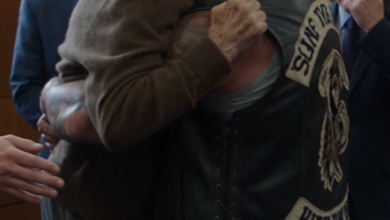
The blue book stayed inside his vest.
I saw its faded corner occasionally when he reached for a rag or his reading glasses. Whenever anyone asked about it, Hammer changed the subject.
After our first sign-language lesson, I waited until the other brothers left.
Evelyn had taught us five expressions: hello, my name is, nice to meet you, again, and slowly. Hammer remained in front of the whiteboard, repeating them with severe concentration.
“You knew one sign before tonight,” I said.
He kept practicing.
“Friend,” I added. “You tried it at the diner.”
“My fingers remembered part of it.”
“From whom?”
Hammer’s hands stopped.
“My sister.”
That was all he gave me.
The next six weeks humbled every man in the room. Spoken language let us hide behind tone, volume, and unfinished sentences. ASL did not. Your face carried grammar. Your body carried intent. Attention was not optional.
Tiny Walsh hated that part.
Tiny was six-foot-two and called Tiny because biker humor rarely evolved past the age of twelve. He had spent twenty-three years working night security, where a hard stare and a louder voice solved most problems.
During the third lesson, Evelyn paired him with Luis Ortega. Tiny kept looking at Luis’s hands instead of his face.
“You’re missing half the sentence,” Evelyn told him.
“I can see his fingers.”
“But you aren’t seeing him.”
Tiny muttered something impolite.
Evelyn folded her arms. “Do you want the child to adjust to you, or are you here to meet her?”
The room went still.
Tiny took off his sunglasses.
He never wore them indoors again.
Luis faced a different problem. Two fingers on his right hand had limited movement after an explosion outside Kandahar. He became angry whenever Evelyn corrected a hand shape he physically could not make.
On the fourth Tuesday, he shoved his chair back.
“This language isn’t built for hands like mine.”
Evelyn caught his sleeve as he passed.
“Every language belongs to the people who need it,” she said. “We adapt.”
She showed him alternative movements. She taught him to sign with his left hand when necessary. Hammer sat beside him for an hour, practicing the same sentence until both men could say it clearly:
My hands are different. My meaning is not.
We did not tell Lily.
At the diner, she still saw us some Saturdays. One or two brothers would deliberately order from Sarah’s section, then attempt a small sign with Lily.
At first, we used only greetings.
Lily corrected us mercilessly.
She taught Bear that his attempt at nice to meet you looked closer to nice to argue with a chicken. She laughed so hard her shoulders shook. Bear spent the next week practicing in the mirror.
That was the first time I saw Lily laugh without checking whether anyone else understood why.
Soon, she began leaving folded drawings on our table. Motorcycles with enormous wheels. Men with beards reaching their boots. Forty-five stick figures with raised hands surrounding one smaller figure in yellow.
At the bottom of every page, she drew the same empty chair.
None of us understood what it meant.
Sarah noticed the change in her daughter but did not trust it yet. People had promised to learn signs before. Teachers memorized ten words, distant relatives learned the alphabet at Christmas, and other parents said they would encourage their children.
The enthusiasm always faded.
“Please don’t make her believe this is permanent,” Sarah told me one afternoon. “She remembers every person who stops trying.”
That warning reached the clubhouse before our next lesson.
Three members were absent.
Hammer placed their chairs in front of the room.
He did not yell. He called each man, asked if he was sick or working, and listened. Two returned before Evelyn finished the warm-up. The third, a roofer named Danny Pike, arrived with concrete dust still in his hair.
“Forty-five means forty-five,” Hammer said.
From then on, attendance became a club obligation. You could miss a weekend ride. You could skip poker. You could not casually skip the language.
We practiced everywhere. At gas stations, two bikers stood beside the pumps signing about fuel prices. At diners, we ordered meals without speaking. During club meetings, the first ten minutes happened entirely in ASL.
It changed us in ways none expected.
Tiny learned that Luis had nightmares he had never described aloud. Bear discovered Danny had been unable to read until age thirty-seven. Hammer learned every brother’s children’s names, because Evelyn made family conversation part of our lessons.
The clubhouse became quieter.
Not empty. Attentive.
One night, after everyone left, I found Hammer sitting alone beneath the fluorescent lights. The blue book lay open on the table.
A photograph had slipped from its pages.
It showed a teenage Hammer with long hair and no beard beside a thin girl wearing a denim jacket. Her right hand formed the sign for brother. Hammer’s hands rested uselessly at his sides.
“That’s June?” I asked.
He nodded.
On the back, in faded ink, someone had written: He’ll learn when he’s ready.
Hammer stared at those words for a long time.
“She waited,” he said. “I wasn’t.”
Then he returned the photograph to the book and asked me to help him practice Lily’s favorite question:
Will you still be my friend when talking becomes hard?
This time, his hands did not tremble.
Part 3 — The Birthday Invitation No One Accepted
The crisis began with a stack of purple envelopes.
Lily’s ninth birthday was three weeks away. She made the invitations herself at the diner after school, carefully writing each classmate’s name in silver marker. Sarah bought enough paper for twenty-four invitations because Lily had twenty-three classmates and insisted her teacher needed one too.
Each invitation included a drawing of hands signing friend.
Lily planned a small party at Thorpe Park. Cupcakes. Lemonade. Sidewalk chalk. A borrowed canopy in case the Arizona sun became too sharp.
She distributed every envelope on Monday.
By Friday, nobody had answered.
Sarah sent polite messages to parents. Several claimed they had forgotten. Two said their children felt “uncomfortable” because they would not know how to communicate. Another suggested that Lily attend a program with “children more like her.”
The sentence cut deeper than an insult because it arrived disguised as advice.
Lily did not complain.
She began removing paper plates from the shopping bag beneath Sarah’s kitchen table. First twenty-four. Then twelve. Then six.
At the diner the following Saturday, she did not correct Bear’s signing. She simply nodded and returned to her drawing.
Hammer noticed the missing light before anyone explained the darkness.
“What happened?” he asked Sarah.
“Nothing.”
Hammer waited.
Sarah looked toward her daughter. “It’s her birthday.”
“When?”
“Next Saturday.”
“Where?”
Sarah’s eyes sharpened. “Don’t.”
“I asked where.”
“I will not have forty-five motorcycles turn her birthday into a spectacle. She already feels different everywhere she goes.”
Hammer absorbed that without flinching.
Then Lily walked over.
She had seen enough lip movement to know they were discussing her. Her hands rose.
Sarah interpreted aloud.
“She says she canceled it.”
Hammer signed directly to Lily, slowly but clearly.
Why?
Lily answered:
Parties need friends.
Tiny turned his face toward the window.
Bear studied the tabletop. Luis flexed his damaged fingers beneath it. Around us, the diner continued moving—plates clattering, coffee pouring, strangers speaking without having to wonder whether anyone would make the effort to understand.
Hammer signed another question.
How many friends would make a party?
Lily shrugged.
Then she held up one finger.
One would be enough.
Hammer nodded and stood.
Outside, the club gathered near the bikes. Wind moved grit across the parking lot. A truck downshifted on Route 66, its engine growling past us.
“No motorcycles at the park,” Hammer said.
Tiny looked surprised. “We’re not going?”
“We are. But Sarah is right. This isn’t our show.”
He divided the work. Bear would bring folding tables. Danny would build a ramp over a broken section of sidewalk because Lily’s classmate Mateo used a wheelchair and was the only child who had expressed interest. Luis would handle decorations. I would repair the park’s old portable generator without making it roar all afternoon.
“Forty-five men showing up is still a spectacle,” I said.
“Then we don’t show up as forty-five bikers.”
“What do we show up as?”
Hammer looked toward Lily through the glass.
“Friends.”
Word spread through the club families. Wives, partners, older children, and grandchildren volunteered. Evelyn offered to interpret, but Hammer declined.
“If we need you to speak for us,” he said, “then we aren’t ready.”
For six nights, we rehearsed a group greeting. Not a performance. Not a memorized stunt for cameras. Each member prepared a personal sentence for Lily.
Bear learned: You make me laugh.
Luis learned: Different hands can still tell the truth.
Tiny practiced: I was afraid of being quiet until you taught me to listen.
Hammer chose not to reveal his sentence.
On Thursday, the principal of Lily’s school called Sarah. A parent had reported that a motorcycle gang was planning to appear at a child’s party. The principal expressed concern about safety.
By Friday afternoon, Thorpe Park revoked the reservation pending review.
Sarah called me from the diner storeroom. I could hear pans crashing in the kitchen behind her.
“Lily thinks I canceled it,” she said. “She packed the decorations away herself.”
When I told Hammer, he went still.
Then he reached for his helmet.
“No,” I warned. “Forty-five bikes at city hall will confirm everything they believe.”
“I’m not going to city hall.”
“Where, then?”
“To speak to the person who made the report.”
The parent was Mark Dillard—the father of one of the boys who had mocked Lily in the diner.
Hammer found him outside the school during afternoon pickup. I followed because someone needed to prevent two frightened men from mistaking each other’s posture for an invitation.
Parents saw Hammer crossing the parking lot and pulled out their phones. A teacher hurried toward the front office. Mark placed himself between Hammer and his son.
“You stay away from my family.”
Hammer stopped ten feet away.
“I came to invite your boy to a birthday party.”
Mark stared at him.
Hammer took a purple envelope from inside his vest. Lily had written the boy’s name on it before canceling the party.
“You threatened him at the diner.”
“No. I noticed him.”
“Is that supposed to scare me?”
“It should embarrass you.”
Mark stepped forward. “You think dressing up your gang as some charity makes you safe around children?”
Hammer’s jaw tightened. Behind him, more parents were recording. Every instinct built during his roughest years told him to answer force with force.
He did something harder.
Hammer raised his hands and signed:
Your son laughed because he did not understand. We are learning. He can learn too.
Mark could not understand the signs. He saw only a huge tattooed man moving his hands in front of his child.
He slapped them away.
Hammer’s blue book fell onto the asphalt.
The binding broke.
A photograph, a dried flower, and a folded hospital bracelet scattered beneath the idling cars. Hammer stared down at them. His hands curled once.
No one breathed.
Then Lily’s classmate Mateo rolled forward in his wheelchair. He had been waiting beside the curb with his mother.
Mateo picked up the photograph.
He looked at the girl beside young Hammer, then at the faded handwriting on the back.
“What does this mean?” he asked.
Hammer crouched, but before he could answer, Mark’s son stepped out from behind his father.
The boy raised one uncertain hand.
He signed the only word he remembered from watching Lily.
Sorry.
Hammer looked at him.
Then the principal came outside and told Hammer that the police were on their way.
Part 4 — Forty-Five Men at a Locked Gate
Two patrol cars arrived without sirens.
That mattered to Hammer. He told me later he had expected noise—doors slamming, commands shouted, hands near holsters. Instead, Officer Denise Campbell stepped out, assessed the phones, frightened parents, scattered book pages, and one enormous biker kneeling on the asphalt.
She asked Hammer to stand.
He obeyed.
Mark immediately described threats, gang intimidation, and an organized gathering targeting children. Parents nodded because uncertainty often borrows confidence from the loudest voice.
Officer Campbell turned to Hammer.
“Your version?”
Hammer pointed to Mateo, who still held the photograph.
“Birthday invitation.”
That was all.
I explained the diner, the ASL lessons, the canceled reservation, and the purple envelope. Evelyn arrived before I finished; Tiny had called her when Hammer left the garage.
She interpreted the signs Hammer had used.
No threat.
No insult.
Only an invitation.
Officer Campbell asked Mark’s son whether Hammer had frightened him. The boy looked at his father, then toward the broken book.
“He didn’t,” he whispered. “He asked me to come.”
Mark’s anger did not vanish, but it lost its audience.
The principal reviewed the videos. One parent had captured the entire encounter, including Mark striking Hammer’s hands. After twenty tense minutes, the officers left without making an arrest.
The park reservation, however, remained suspended.
Hammer gathered June’s belongings from the pavement. The hospital bracelet had been folded inside the book for nearly three decades. Its plastic had yellowed
TITLE: A Biker Gang of 45 Learned Sign Language for a Deaf Little Girl Who Had No Friends — Then She Told Them Something No One Else Had Ever Stayed Long Enough to Hear
SEO DESCRIPTION: Forty-five intimidating bikers learn sign language for a lonely deaf girl, giving her the family and voice she had never known.
Part 1 — Teaser, Version 1: When Forty-Five Engines Fell Silent
Forty-five Harleys surrounded a deaf eight-year-old girl outside a roadside diner, and when the largest biker raised both tattooed hands toward her, her terrified mother thought she was watching a threat unfold.
I was standing beside him.
My name is Calvin Mercer, though everyone in our club calls me Preacher, a joke that started because I spent twelve years in prison and came out speaking less than any man they knew. At fifty-four, I repaired diesel engines outside Flagstaff, Arizona, rode a black Harley Road King, and belonged to the Iron Vale Riders—a group the newspapers preferred to call a biker gang because the truth sounded less profitable.
There were forty-five of us that Saturday.
Forty-five leather cuts. Forty-five sets of boots grinding gravel. Forty-five engines whose low V-twin rumble shook the windows of Millie’s Route 66 Diner until spoons trembled inside coffee cups.
People stared.
Some reached for their phones.
A father hurried his two boys inside. An elderly couple abandoned half a pie and slipped through the rear exit. The deputy parked across the highway rested one hand on his radio because men like us were rarely allowed to arrive in large numbers without someone preparing for trouble.
Then Hammer killed his engine.
Ray “Hammer” Dawson was six-foot-four, close to 285 pounds, with a shaved head, a black-and-gray beard, scarred knuckles, and tattooed forearms thick as fence posts. His plain black leather vest carried no readable slogan, only road dust, old stitching, and a tiny strip of faded blue fabric sewn inside the left pocket.
He looked like the kind of man mothers warned children about.
That morning, he walked straight toward one.
The girl stood beside a white minivan, clutching a purple backpack against her chest. She had dark curls, a yellow dress, and a hearing device tucked behind each ear. Her name was Lily Bennett. I knew that much because we had spent six weeks quietly learning everything else.
Lily could not hear the motorcycles the way the rest of us did. She felt them through the soles of her red sneakers and the thin asphalt beneath her feet. As the last engines went silent, she looked up at forty-five strangers with skull rings, chain wallets, weathered faces, and hands roughened by years of steel, gasoline, and bad decisions.
Her mother, Sarah, stepped between us.
“Please,” she said. “Whatever this is, she hasn’t done anything.”
Hammer stopped so suddenly the gravel snapped under his boots.
Nobody behind him moved.
He took off his aviator glasses. Then his skull ring. Then his leather gloves. Each object went into his vest pocket slowly, as if he understood that every hard edge on him looked sharper through a frightened mother’s eyes.
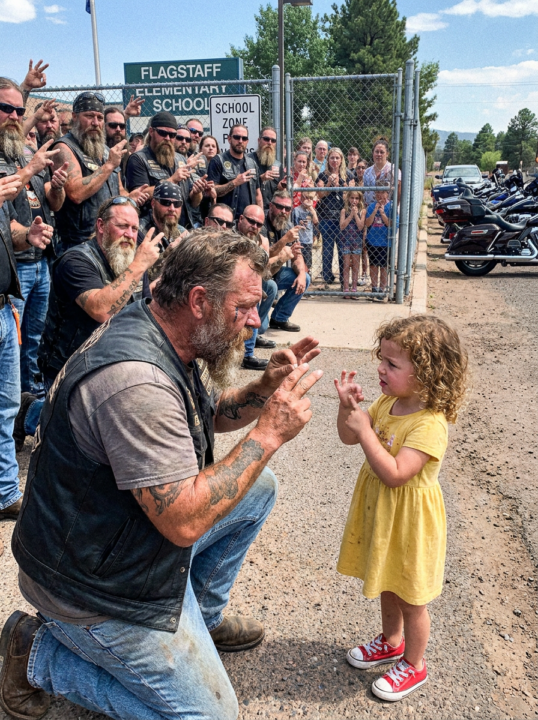
He lowered himself onto one knee.
Sarah pulled Lily closer.
The deputy opened his cruiser door.
And Hammer raised his hands.
His first movement was clumsy. His right thumb shook. The arthritis in two fingers kept them from bending cleanly, and a tendon he had cut in a welding accident dragged one gesture out of shape. But Lily understood.
Her eyes widened.
Hammer signed:
HELLO. MY NAME IS HAMMER.
Lily stared at his hands, then at his face.
He continued.
WE CAME TO MEET YOU.
Behind him, forty-four bikers removed their gloves.
The parking lot became so still I could hear a loose sign bracket tapping the diner wall. I could smell hot exhaust, road coffee, leather, and the desert rain gathering somewhere beyond the red hills. Sarah’s hand remained on Lily’s shoulder, but her grip loosened.
Hammer lifted both hands again.
YOU ARE NOT ALONE.
Lily’s purple backpack slipped from her fingers.
For six months, children at her school had spoken around her, over her, and sometimes about her while she watched their mouths move. At lunch, they laughed before she received the joke in writing. At recess, games began before anyone explained the rules. Some children knew the sign for hello. One teacher knew enough to ask if she needed the restroom.
Almost nobody knew enough to ask what she was thinking.
That was the difference.
Lily had people who helped her. She did not have people who waited for her answer.
Hammer looked over his shoulder.
That was our signal.
Forty-five tattooed men formed a crooked half-circle around one small girl. Some had practiced until midnight. Some carried laminated cards in their saddlebags. Two had fingers damaged by combat. One had lost half his thumb in a mill. Another had driven ninety miles every Tuesday to attend lessons because the video calls made his hands appear backward on an old phone.
We were not graceful.
But every man lifted his hands.
Together, we signed:
WE ARE YOUR FRIENDS. WE WANT TO HEAR YOU.
Lily looked from face to face. Her mouth opened, though no sound came. Then she began signing so fast that most of us lost her after the first sentence.
Hammer did not pretend to understand.
He held up one finger and signed the phrase Evelyn Park, our seventy-one-year-old instructor, had drilled into us harder than anything else:
AGAIN. SLOWLY. I AM LISTENING.
Lily began again.
This time, all forty-five of us watched.
Not her hearing devices. Not her mother. Not the interpreter who was not there.
Her.
What Lily told us in that parking lot began with a drawing hidden inside her purple backpack, involved a boy who had taken her lunch every Thursday, and ended with Hammer gripping the faded blue cloth inside his vest as though it were the only thing keeping him upright.
But before Sarah could ask why forty-five strangers had learned her daughter’s language, Lily made one final sign that none of us expected—and Hammer’s face changed like a door to a locked room had just opened.
Part 1 — Teaser, Version 2: The Girl Nobody Waited For
The little deaf girl signed one desperate sentence inside a crowded diner, and although nobody at her table understood it, a terrifying biker across the room quietly dropped his coffee cup.
I saw the cup break.
It struck the tile beneath Ray Dawson’s hand, bounced once, and split beside his motorcycle boot. Conversations stopped. A waitress froze with a pot of coffee tilted over an empty mug. Two tourists near the window stared at the 285-pound biker as if they expected him to overturn the table next.
Ray—Hammer to the forty-four men who rode behind him—never noticed the glass.
He was watching the girl in booth seven.
Her name was Lily Bennett. She was eight years old, small for her age, with dark curls tucked behind two hearing devices and a purple backpack pressed between her sneakers. Her mother, Sarah, was trying to order pancakes while a tired waitress repeated questions too quickly for Lily to read her lips.
“Chocolate chips?” Sarah asked.
Lily signed something.
Her mother shook her head. “Slower, honey.”
Lily tried again.
Sarah caught only part of it. She offered strawberries. Lily turned toward the window, shoulders folding inward.
It looked like a tiny family misunderstanding.
Hammer knew better.
The rest of us did not.
We had pulled into Millie’s Route 66 Diner after a cold morning ride through Flagstaff. Our leather cuts smelled of gasoline and desert dust. Chains knocked against belt loops. Heavy boots crowded the aisle. Hammer sat at the end of our table, broad shoulders hunched over black coffee, his scarred hands wrapped around the cup.
Then Lily signed that sentence.
The cup fell.
I bent to pick up the pieces, but Hammer caught my wrist.
“Leave it.”
His voice was barely more than gravel.
“What did she say?” I asked.
He did not answer.
He crossed the diner.
Sarah noticed him when his shadow reached their booth. She drew Lily toward the wall. I understood why. Hammer had sleeve tattoos, a scar beneath his left eye, a thick black-and-gray beard, and knuckles that looked like they had negotiated most of his life without words.
“Can I help you?” Sarah asked.
Hammer looked at Lily.
Then he made a sign.
It was small and stiff, no more than two fingers touching the back of his other hand. Lily turned instantly.
Hammer tried another.
Lily frowned.
He tried again, slower.
Recognition moved across her face.
ALONE?
That was the only sign he knew.
Sarah stared at him. “Do you know sign language?”
Hammer looked down at his hands.
“No.”
One word.
Then he returned to our table, dropped twenty dollars beside his untouched coffee, and walked outside. Through the window, I watched him stand beside his Harley while sleet began tapping the chrome. His head was lowered. One hand had disappeared inside the left side of his vest.
I followed.
“What happened in there?”
He pulled out a narrow strip of faded blue fabric. It had once been part of a child’s ribbon. The edges were frayed nearly white.
“My sister used that sign,” he said.
“For what?”
“When nobody waited.”
He folded the cloth and returned it to his pocket.
Then he looked through the diner window at Lily, who sat surrounded by people yet somehow looked farther away than anyone I had ever seen on an empty road.
Hammer said, “We’re learning.”
I laughed because I thought he meant the two of us.
He did not.
At the next Sunday meeting, Hammer stood before all forty-five members of the Iron Vale Riders. Men who had survived combat, prison, addiction, layoffs, divorce, cancer, and the deaths of their own children leaned against tool cabinets inside our garage. A few were still wearing riding gloves. Nobody knew why a white-haired woman named Evelyn Park stood beside Hammer with a dry-erase board.
Hammer told us about Lily.
Then he said every man would learn American Sign Language.
The garage erupted.
Men complained about work schedules. One said his fingers no longer moved well enough. Another asked what any of it had to do with motorcycles. Mack Turner, one of our oldest members, walked toward the door.
Hammer did not raise his voice.
“The kid lives in a room full of people,” he said, “and nobody hears her.”
Mack stopped.
Hammer laid the faded ribbon on the table.
“So did my sister.”
That was all.
For six weeks, we practiced inside the garage after work. We learned the alphabet beside stripped engines. We signed family, friend, hungry, angry, scared, motorcycle, pancake, joke, and listen. The men who learned quickly helped those whose fingers fought every movement. Arguments became laughter. Laughter became concentration.
Nobody missed the final lesson.
Then, on a bright Saturday morning, forty-five Harleys entered Millie’s parking lot. Sarah saw us surround her daughter and stepped in front of Lily, certain that something terrible was happening.
Hammer removed his gloves.
Every biker behind him did the same.
When forty-five pairs of scarred hands rose together, Lily stopped breathing for a moment—and the first story she told us exposed a secret she had been carrying alone at school for months.
Part 2 — The Blue Ribbon Inside Hammer’s Vest
The diner meeting had not been planned. That mattered, because people later reshaped it into something cleaner than it was—a charitable idea born fully formed in the mind of a noble biker, followed by rehearsals, photographs, and a perfect surprise.
The truth was rougher.
Hammer’s first reason for learning sign language was guilt.
His younger sister, June, had lost most of her hearing after meningitis when she was five. Their father, Warren Dawson, worked a copper mine and believed disability could be beaten through discipline. He forbade signing inside the house because a doctor had told him it might stop June from learning to speak.
It was bad advice delivered with authority.
Warren treated it like scripture.
June learned to read lips. She learned to pronounce words she could not hear. She learned to smile when confused because asking people to repeat themselves made their impatience visible.
Hammer was nine.
He loved his sister, but he was also a boy desperate for his father’s approval. When June tried teaching him signs beneath the kitchen table, he copied them only until footsteps approached. Then he shoved his hands into his pockets.
“She knew I was ashamed,” he told me.
We were in the club garage during the first week of lessons. Evelyn had gone home. The others were drinking coffee from paper cups and practicing the alphabet beneath buzzing fluorescent lights.
“You were nine,” I said.
“I was her brother.”
That ended the discussion.
The blue fabric in Hammer’s vest came from the ribbon June wore during a school photograph. She had tied it around her wrist years later when she left Arizona for a deaf boarding school in California. Hammer promised he would learn her language before she came home for Christmas.
He learned seven signs.
June died of pneumonia that November.
Hammer was sixteen when he helped carry her coffin. At the funeral, one of June’s teachers signed a eulogy while Hammer watched from the second row. The teacher’s hands moved through memories Hammer did not possess—jokes June had told, dreams she had described, anger she had never shown at home.
He realized strangers had known his sister better than he had.
For nearly forty years, he carried that knowledge like a stone.
Then he saw Lily sign ALONE.
Evelyn Park understood what Hammer did not: motivation could start a lesson, but it could not complete one. She had interpreted for courts, hospitals, schools, and grieving families across northern Arizona. She was small, silver-haired, Korean American, and entirely unimpressed by forty-five bikers.
On the first night, she walked into our garage, smelled the motor oil, looked at our patched leather cuts and said, “If any of you are here to learn party tricks, leave.”
Nobody moved.
“Good,” she said. “Gloves off.”
The first lesson humiliated us.
Men who could rebuild transmissions blindfolded could not shape a clean letter R. Mack’s arthritic fingers locked halfway through the alphabet. Denny had lost the tip of his index finger in Afghanistan and kept apologizing when signs looked wrong. Reuben mixed up mother and father. I accidentally told Evelyn that my motorcycle was divorced.
She stared at me.
The garage exploded with laughter.
Even Hammer smiled.
But Evelyn taught us that ASL was not English performed with hands. The face mattered. Space mattered. Movement carried grammar. Looking away while someone signed was the same as turning your back during a spoken sentence.
That lesson landed harder than the others.
Most of us had spent our lives believing listening was passive. You sat. You stayed quiet. You waited for the other person to finish.
Evelyn showed us that listening required the whole body.
Hammer practiced obsessively. He taped vocabulary cards above his workbench, beside his bathroom mirror, and inside the lid of his toolbox. At traffic lights, he rehearsed finger spelling against the fuel tank. At night, he video-called Evelyn and repeated the same sentence until she stopped correcting him.
AGAIN. SLOWLY. I AM LISTENING.
He wanted that sentence perfect.
The rest of us found our own reasons to stay. Denny admitted the explosions overseas had damaged his hearing, though he had hidden it for years. Mack’s grandson was autistic and sometimes used signs when speech failed him. Reuben simply said nobody had ever learned a language for him, and he wanted to know what it felt like to do that for someone else.
Brotherhood had always meant showing up when a bike broke down, a wife got sick, or a member needed bail.
Now it meant standing under fluorescent lights on a Tuesday night while forty-four grown men corrected the shape of your hand.
It was less dramatic.
It was also harder.
During the fourth week, Evelyn brought in her friend Marcus Cole, a Deaf mechanic from Phoenix. Marcus was fifty-nine, Black, broad-shouldered, and more intimidating than half our club. He studied our rough signing without expression.
Then he pointed at Hammer and signed rapidly.
Evelyn interpreted.
“He says you move your hands like two frightened chickens.”
Hammer nodded. “Fair.”
Marcus smiled.
By the end of the night, he had taught us motorcycle vocabulary Evelyn did not know. The garage came alive. Men signed tire, chain, engine, road, repair, ride, and brother. For once, nobody needed to be convinced to practice.
Then Marcus asked why we were learning.
Hammer showed him June’s ribbon.
Marcus listened to the story. Afterward, he signed something without asking Evelyn to interpret.
Hammer understood.
THIS IS NOT FOR YOUR SISTER. SHE IS GONE. DO IT FOR THE GIRL WHO IS HERE.
Hammer’s jaw tightened.
Then he nodded.
From that night forward, Lily was no longer a stand-in for June.
She became Lily.
An eight-year-old who loved astronomy, disliked strawberries, collected smooth stones, drew motorcycles with impossible numbers of wheels, and had more to say than the adults around her had learned to receive.
We knew none of those things yet.
But we were finally preparing to ask.
Part 3 — The Story Hidden in the Purple Backpack
The Saturday we returned to Millie’s, our plan was simple: introduce ourselves, sign a few sentences, give Lily a helmet decorated with hand-painted stars, and leave before our presence became a spectacle.
Nothing involving forty-five motorcycles stays simple.
By the time Hammer reached Lily, phones were already recording. The deputy had crossed the highway. Millie’s customers lined the windows. Sarah stood in front of her daughter with the rigid posture of a mother measuring how much damage she could absorb.
Then Hammer signed hello.
Fear became confusion.
Confusion became stillness.
When all forty-five of us signed WE ARE YOUR FRIENDS. WE WANT TO HEAR YOU, Lily’s face changed. Not into the huge smile later described by social media posts. Those posts lied by making the moment easier.
She looked suspicious.
That was fair.
Adults had made promises before. Teachers said they would include her, then began speaking while facing the board. Children learned three signs, performed them once, and forgot. Relatives told Sarah they would study ASL but arrived at Christmas knowing only I love you.
Lily had learned that enthusiasm faded.
So she tested us.
She signed quickly.
Hammer asked her to repeat herself slowly.
She did, but only slightly.
Mack understood the sign for school. Denny caught boy. I recognized take and Thursday. Hammer followed more of it than the rest of us, but his expression darkened.
Sarah touched Lily’s shoulder.
“What is she saying?”
Hammer did not answer for her.
He signed to Lily, MAY I TELL YOUR MOTHER?
Lily shook her head.
Sarah looked hurt. “Honey, I’m right here.”
Lily’s hands moved.
Hammer interpreted carefully. “She says that is the problem.”
The words struck harder than anger.
Sarah stepped back.
Lily opened her purple backpack and removed a stack of drawings. The first showed a cafeteria. Stick figures sat at long tables. One small figure had no mouth. The second showed a boy taking a carton of milk from her tray. The third showed a teacher with her back turned while Lily raised both hands.
Thursday after Thursday, a twelve-year-old boy named Colton had taken part of Lily’s lunch. Sometimes he took the milk. Sometimes the cookie. Once he took the entire bag. Other children laughed because Lily’s protests sounded different when she forced her voice.
She told teachers.
They misunderstood.
One thought she wanted another lunch. Another told her not to point. A classroom aide promised to handle it, then transferred schools. Lily stopped trying.
Sarah knew none of it.
“Why didn’t you tell me?” she asked, tears already gathering.
Lily answered with sharp movements.
Hammer watched, then hesitated.
“What?” Sarah demanded.
He interpreted. “She did. You thought she was complaining about the food.”
Sarah covered her mouth.
Lily reached deeper into the backpack and removed one final drawing. It showed a little girl beneath a black sky. Around her stood dozens of adults with empty faces. Above them, inside a speech bubble, she had drawn hands.
At the bottom was a figure wearing a black vest.
Hammer.
She had drawn him after the first diner meeting.
She remembered his single clumsy sign.
ALONE?
For all the mistakes Hammer had made that day, he had been the only stranger who correctly named what she felt.
The parking lot was no longer quiet. People whispered. Phones moved closer. The deputy approached Colton’s mother, who happened to be inside the diner and had recognized her son in the drawings.
Hammer rose.
Every movement around us changed.
People expected fury from a man his size. Colton’s mother pulled her son behind her. The deputy stepped between them. Forty-four bikers shifted their weight, boots grinding the gravel in a sound that frightened everybody who did not know us.
Hammer looked at Colton.
The boy was pale.
“Did you take her food?” the deputy asked.
Colton shrugged.
His mother said, “He’s a child. This is being blown out of proportion.”
Lily watched their mouths move but could not follow from where she stood.
Hammer moved to the side so she could see.
Then he signed every word being said.
Not only the flattering ones.
When Colton’s mother called the situation ridiculous, Hammer signed that too. When the deputy asked questions, he positioned himself beside the speaker and interpreted what he could. Evelyn, who had arrived quietly in her sedan, filled the gaps.
Lily remained inside the conversation.
That was new.
Colton’s mother accused us of intimidating her son. She was not entirely wrong. Forty-five bikers, even standing still, made a hard wall. Hammer noticed Colton trembling.
He stepped back.
Then another step.
He turned to us and signed SPACE.
All forty-four men moved away.
Hammer knelt until he and Colton were eye level. “You don’t need to be scared of me,” he said, while Evelyn interpreted for Lily. “But you need to answer her.”
Colton looked at Lily.
He whispered, “I thought she didn’t understand.”
Lily understood that sentence without interpretation.
The cruelty of it passed across her face.
Colton began crying—not theatrically, not enough to erase what he had done, but with the frightened shame of a boy realizing that the person he had treated like a blank wall had been watching him the entire time.
Lily signed.
Hammer translated.
“She asks why he thought not understanding made it okay.”
Nobody answered.
Not Colton. Not his mother. Not the deputy. Not us.
Then Lily signed something else.
She did not want him punished.
She wanted him to sit with her on Thursday.
Colton stared at her.
Lily pointed toward the diner, then signed PANCAKES.
The false ending seemed perfect. A bullied child offered mercy. A boy accepted. Adults cried. Phones recorded. The deputy relaxed. Millie began moving tables together.
But Hammer did not smile.
His hand had closed around June’s ribbon.
Because Lily’s final drawing contained a detail nobody else had noticed: behind the figure in the black vest stood forty-five motorcycles, and above one of them she had drawn a small blue ribbon moving in the wind.
Lily had never seen the ribbon inside Hammer’s pocket.
Yet she knew it was there.
Part 4 — The Question Lily Asked About June
Inside Millie’s, we took over six tables.
The staff pushed them together while customers shifted toward the walls. Leather creaked. Chairs complained beneath heavy men. Helmets filled the windowsill. The smell of coffee mixed with hot oil drifting through the open door.
Lily chose the center seat.
For the first time in her life, forty-five adults argued over who got to sit close enough to talk with her.
She solved the problem by standing on the bench.
Her hands flew.
We failed immediately.
She signed faster than Evelyn had ever dared. Jokes landed three seconds late. Names blurred. Mack confused moon with month. Reuben told Lily he owned three grandmothers instead of three motorcycles. She laughed so hard that her hearing devices whistled.
The men froze.
Lily laughed harder.
That sound—thin, bright, imperfect—broke whatever tension remained in the room.
Hammer sat across from her. He followed more than anyone except Evelyn and Marcus. When Lily described her drawings, he asked about the blue ribbon.
Her smile disappeared.
She signed slowly.
THE GIRL TOLD ME.
Hammer’s hands went flat on the table.
“What girl?” Sarah asked.
Lily pointed at his vest.
THE GIRL YOU KEEP HERE.
Even Evelyn hesitated.
Hammer removed the ribbon. In daylight, it looked like nothing—two inches of faded cloth with a tiny line of white stitching. He laid it beside Lily’s pancake plate.
“How did she know?” I whispered.
Sarah shook her head. “She couldn’t.”
Hammer signed directly to Lily.
WHO TOLD YOU?
Lily touched the ribbon and answered.
A week after the first diner encounter, she had seen Hammer outside the public library. He was sitting alone on his parked Harley, trying to copy signs from an old book. A photograph had slipped from between its pages.
Lily found it after he rode away.
The photograph showed sixteen-year-old Hammer beside a thin girl wearing a blue ribbon around her wrist. On the back, June had written a note. Lily could not read all the faded handwriting, so she brought it to the librarian.
The note said:
Ray, if you ever decide to listen, start with your hands.
The librarian had given the photograph to Sarah, who planned to return it when she next saw Hammer. But Lily copied the ribbon into her drawing first.
No ghost.
No miracle.
Just a lost photograph and a child who noticed what adults overlooked.
Hammer exhaled. His shoulders dropped, but the relief carried pain inside it. Sarah retrieved the photograph from Lily’s backpack and handed it to him.
He looked at June’s face for a long time.
“I thought this burned,” he said.
The old Dawson house had caught fire after their father died. Hammer had arrived too late to save the photographs. He believed every image of June had been destroyed.
Yet one had survived inside an ASL book donated to the Flagstaff library decades earlier.
The book had June’s name on the first page.
Hammer stared at it. “Where did you get this?”
The librarian, who had followed us from the parking lot, answered. “A donation box from the old county school. It was processed last month.”
Hammer opened the book.
Small pencil marks covered the margins. June had drawn arrows beside signs she struggled to remember. Near the back, she had written lists of people she wanted to teach: Mom. Ray. Mrs. Alvarez. The mailman. Any kid who wants to know me.
Hammer found his name twice.
He closed the book.
Lily watched him, waiting.
He signed, SHE WAS MY SISTER.
Lily nodded.
DID YOU LISTEN TO HER?
The room seemed to contract.
Hammer could have lied. He could have told a softened version. Nobody would have corrected him.
He shook his head.
NOT ENOUGH.
Lily considered this.
Then she pushed the photograph toward him and signed, YOU LISTEN NOW.
Hammer’s face tightened. His eyes became wet, but no tears fell. He folded the photograph once, carefully, along an old crease and placed it with the ribbon.
That might have been the twist people remembered if the story had ended inside the diner.
It did not.
The next Thursday, all forty-five bikers returned.
Not to confront Colton.
To eat lunch.
Millie closed the rear dining room for two hours. Sarah arranged permission slips. The school allowed Lily’s class to walk over with teachers and aides. Colton sat beside Lily, pale and silent, while our members crowded chairs meant for smaller bodies.
Evelyn made one rule.
Nobody could speak for the first thirty minutes.
Every request had to be signed.
The hearing children discovered frustration within five minutes. They knew only fragments. They tapped Lily’s shoulder constantly. They asked Evelyn for shortcuts. They laughed when their fingers failed.
Lily waited.
Patiently.
She corrected them.
Colton wanted syrup but did not know the sign. Lily showed him. He copied it. She shook her head, repositioned his hand, and made him repeat it.
Hammer watched from the end of the table.
For once, Lily was not the slowest person in the room.
She was the teacher.
That Thursday lunch became weekly. Then parents joined. Millie learned enough ASL to take Lily’s order without looking at Sarah. The deputy learned traffic and emergency signs. A waitress learned allergy, pain, bathroom, and help.
Colton kept coming.
Not because the moment had transformed him into a saint. Some weeks he was impatient. Once he mocked another boy’s signing and Lily refused to speak with him for the rest of lunch.
He returned the following Thursday and apologized in her language.
That mattered more.
Three months after the first lesson, Lily invited the Iron Vale Riders to her school’s spring friendship assembly. The principal agreed to reserve a row of seats.
He expected perhaps five bikers.
Forty-five motorcycles arrived.
When the school saw the entire club turning into the driveway, the security officer locked the front gate.
Part 5 — Forty-Five Men Outside a Locked School Gate
The school sat on the eastern edge of Flagstaff, where the highway opened toward dry hills and long freight trains. Its parking lot was built for minivans, not motorcycles. Our engines rolled against the brick walls in a low wave.
Children rushed to the windows.
Teachers pulled blinds.
The security officer, a former sheriff’s deputy named Carl Graves, closed the gate and stood with one hand against it. He knew Hammer by reputation, though reputations in small towns were stitched from truth, rumor, and whatever made the speaker feel cautious.
Hammer stopped ten feet away.
He killed his engine.
The others followed.
Silence moved down the line one motorcycle at a time.
Carl called the principal. The principal called Sarah. Sarah was inside the auditorium helping Lily attach paper stars to a blue curtain. By the time she reached the entrance, parents had gathered behind the glass doors.
“What are you doing?” she asked Carl.
“Forty-five riders were not approved.”
“They were invited.”
“I was told a few friends.”
Sarah looked past him at the men waiting on the road. “Those are her friends.”
Carl did not move.
The situation could have turned ugly. A younger version of Hammer might have forced it. Several members muttered. Denny kicked his stand down so hard it sparked. Mack asked whether deaf children were permitted forty-five friends only when those friends wore polo shirts.
Hammer raised one hand.
Our men stopped.
Then he looked at Carl and signed, though Carl did not understand.
Sarah translated.
WE WILL WAIT.
The assembly began without us.
Inside, Lily sat on a folding chair beneath stage lights she could not hear buzzing. She had prepared a short presentation about friendship and communication. An interpreter stood beside her. Three hundred children filled the auditorium.
Her eyes stayed on the side door.
It never opened.
She signed to Sarah, THEY PROMISED.
Sarah answered, THEY ARE HERE.
WHERE?
OUTSIDE.
Lily removed the paper star pinned to her dress.
Then she walked off the stage.
The principal followed her into the hallway. Teachers whispered. Parents lifted phones. Lily moved through the lobby, pushed open the front door, and crossed the pavement toward the locked gate.
Carl called after her.
She did not turn.
The morning wind caught her yellow dress. On the other side of the chain-link gate stood forty-five bikers—big men in worn leather, tattooed arms hanging at their sides, motorcycle boots planted in road dust.
Lily stopped.
Hammer stepped forward.
The gate remained between them.
He lifted his hands.
WE CAME.
Lily signed back.
YOU ARE LATE.
Hammer glanced toward the locked gate.
NOT OUR CHOICE.
She looked at Carl.
Then at the principal.
Then she did something none of us had rehearsed.
Lily sat on the pavement.
Hammer sat on the other side.
One by one, forty-four bikers lowered themselves onto the road. Bad knees cracked. Chains rattled. Leather stretched. Passing cars slowed at the sight of a child and an army of bikers seated in silence on opposite sides of a locked school gate.
Lily began her presentation there.
She signed about the diner. About being alone in crowded rooms. About how people often thought communication meant making her understand them, while almost nobody made the same effort to understand her.
Hammer interpreted aloud for the hearing adults.
His signing was no longer clumsy.
Then Lily asked each biker to introduce himself.
Forty-five men took turns.
Mack signed that he repaired roofs and hated peas. Denny signed that he had nightmares but motorcycles helped him sleep afterward. Reuben signed that he had three motorcycles—carefully correcting the sign he once confused with grandmothers.
Children began leaving the auditorium.
They crowded behind the gate.
Teachers followed.
The assembly relocated itself without permission.
Carl looked at the principal. The principal looked at Sarah. Neither wanted to be the person whose locked gate had become the clearest part of Lily’s lesson.
Carl opened it.
Nobody rushed through.
Hammer stood, stepped aside, and let Lily choose what happened next.
She walked past the gate, took his hand, and led him into the school.
The other bikers followed in two quiet lines.
Inside the auditorium, forty-five men filled the stage behind one eight-year-old girl. Their leather cuts looked almost black beneath the lights. Tattooed hands rested against jeans. Several bikers glanced nervously toward the audience because men comfortable facing bar fights and desert storms had discovered that an elementary school could terrify them.
Lily took center stage.
She signed one sentence.
Hammer spoke it aloud.
“When people look at me, they see what I cannot hear.”
She continued.
“When people look at them, they see what they should fear.”
The room held still.
Lily turned toward the bikers.
Forty-five pairs of hands rose.
Together, we signed the sentence Evelyn had taught us six months earlier:
WE SEE YOU. WE HEAR YOU. YOU BELONG WITH US.
Children began raising their hands.
Not to applaud.
To sign it back.
Some shaped the words incorrectly. Some watched their classmates for help. A kindergarten boy used both arms. A teacher cried without wiping her face.
Lily stood inside a room of nearly four hundred people and watched her language move from hand to hand.
Hammer remained behind her.
He reached into his vest, removed June’s ribbon, and tied it around the handle of Lily’s purple backpack.
She touched it.
Then she signed, NOW SHE CAME TOO.
Hammer looked away.
That was when the first tear fell.
Only one.
It landed on his scarred knuckle before he closed his hand.
Part 6 — The Club Meeting Lily Was Never Supposed to Attend
After the assembly, the town changed in small, uneven ways.
Millie’s added a laminated ASL sheet beside each menu. The school funded a second full-time interpreter after parents learned Lily had spent entire afternoons without proper access. Carl Graves attended Evelyn’s beginner class and practiced emergency signs until Lily stopped correcting him.
The Iron Vale Riders changed too.
We added ten silent minutes to every club meeting. During those minutes, voices were not allowed. New prospects had to learn twenty basic signs before receiving a road name. Marcus began visiting monthly to teach us phrases we could use during breakdowns, accidents, and medical emergencies.
Hammer resisted every attempt to turn the story into publicity.
A local television station called. He refused.
A national motorcycle magazine offered a feature. He refused that too.
When a reporter asked why forty-five bikers had learned ASL, Hammer gave the only quote he ever approved:
“The girl lived in silence because nobody understood. So forty-five of us learned her language. Now she has forty-five friends who hear everything she says.”
Lily corrected him later.
She had forty-six friends.
Colton had begun learning too.
The first time Lily visited our garage, Sarah expected her to be frightened by the engines. Instead, Lily pressed one palm against the fuel tank of Hammer’s idling Harley and grinned when the vibration traveled up her arm.
She signed, LOUD.
Hammer laughed. “You can’t hear it.”
Lily rolled her eyes.
She pressed his hand against the tank, then placed her own hand over his chest.
I CAN FEEL IT.
Hammer’s smile disappeared.
He understood.
June had once done the same thing with their father’s truck. He had forgotten until that moment.
Lily spent the afternoon learning the difference between a wrench and a socket. Reuben let her tighten a bolt on his mirror. Denny taught her the sign Marcus used for carburetor, then admitted he did not know whether it was official or something Marcus invented to embarrass hearing mechanics.
Near sunset, Lily found the photograph of June clipped above Hammer’s workbench.
She stood beneath it for a long time.
Then she asked, WOULD SHE LIKE ME?
Hammer answered without hesitation.
SHE WOULD TALK TOO FAST. YOU WOULD LOVE HER.
Lily smiled.
At the following club meeting, she arrived wearing a small denim vest Sarah had sewn from an old jacket. There were no club patches, only a blue ribbon stitched over the left pocket and a hand-shaped patch Evelyn had made.
Every man stood.
Lily climbed onto Hammer’s empty chair.
She signed that she wanted a road name.
Suggestions came quickly. Star. Spark. Little Hammer. Purple. Pancake. The room became chaos until Lily raised both hands.
Silence.
She signed her own choice.
ECHO.
Hammer frowned. WHY ECHO?
Lily answered, BECAUSE YOU SAY SOMETHING, AND I SEND IT BACK. I SAY SOMETHING, AND NOW YOU SEND IT BACK.
Nobody proposed another name.
From then on, she was Echo.
She attended picnics, charity rides, garage cookouts, and every ASL lesson her mother allowed. The bikers became her uncles in every way except blood. They argued over birthday gifts, inspected Sarah’s dates with unnecessary suspicion, and kept emergency contact cards in their wallets.
But the thing Lily valued most was simpler.
Whenever she signed, they looked at her.
No phone. No wandering eyes. No half-listening while planning an answer.
Forty-five faces turned toward her and stayed.
Part 7 — The Ride That Made No Sound
One year after we first surrounded Lily in Millie’s parking lot, the Iron Vale Riders organized a birthday ride.
Lily was turning nine.
Sarah refused to let her ride on the highway, so Hammer built a small sidecar for slow trips through a closed section of the county fairgrounds. He painted it midnight blue and added silver stars. The seat belt received three inspections from Sarah, two from Marcus, and eleven from bikers who trusted Hammer with their lives but not with a child’s birthday.
At noon, forty-five motorcycles lined the empty loop.
Lily climbed into the sidecar wearing a white helmet. No logo. No slogan. Only a blue ribbon tied beneath the rear clasp.
Hammer handed her padded gloves.
She refused them.
He understood why.
She wanted her hands free.
The engines started.
The vibration rose through the pavement. Lily pressed both palms against the sidecar and closed her eyes. She could not hear the deep thunder rolling across the fairgrounds, but she felt each engine joining the next until forty-five separate pulses became one.
Hammer looked down.
READY?
Lily signed, I HAVE BEEN READY FOR A YEAR.
He laughed and eased forward.
The convoy traveled no faster than fifteen miles an hour. Families stood along the fence. Millie waved a dish towel. Evelyn signed from a folding chair while Marcus held a cardboard cup of coffee. Colton ran beside the fence until he lost a shoe and had to stop.
Lily waved to everyone.
On the second lap, she stopped waving.
She began talking.
Her hands moved in the desert air above the sidecar. She told Hammer the clouds looked like torn paper. She told Reuben his motorcycle was still too shiny. She told Mack she had discovered peas were not terrible if mixed with mashed potatoes.
Every biker near enough to see answered.
Brief signs passed backward through the convoy like signals between ships. Joke. Yes. Look. Friend. Again. Birthday. Together.
At the far end of the loop, Hammer stopped beneath a row of cottonwood trees. He reached into his vest and touched the photograph of June. He no longer carried it as punishment.
He carried it as an introduction.
Lily noticed.
YOU MISS HER?
EVERY DAY.
DOES IT HURT?
Hammer considered the question.
YES. DIFFERENT NOW.
Lily nodded as if nine-year-olds understood grief better than adults believed.
Then she signed, SHE TAUGHT YOU LATE. BUT YOU LEARNED.
Hammer looked toward the forty-four men waiting behind him—former soldiers, mechanics, roofers, ex-prisoners, fathers, widowers, recovering addicts, and men who had once believed their hands were useful only for tools, handlebars, or fists.
Now those hands could say afraid.
They could say tell me again.
They could say I was wrong.
They could say stay.
Hammer turned back to Lily.
YOU TAUGHT US.
She shook her head.
WE TAUGHT EACH OTHER.
Hammer started the motorcycle.
The convoy moved beneath the trees, blue ribbon fluttering from Lily’s helmet, tattooed hands rising one after another as forty-five bikers repeated the same sign down the line.
FRIEND.
No engines needed to be heard.
Follow our page for more unforgettable biker stories about rough-looking strangers whose quiet choices change someone’s entire world.