Part 2: A Widow Burned the Only Photograph of Her Husband on His Harley Tank—But the Flames Revealed the Safe Code Hiding Letters He Had Written for Every Child
Part 2 — The Man Who Repaired Tomorrow
Cole Mercer joined the Iron Lanterns before most of us understood what brotherhood required.
I met him in 2004 at a roadside gas station west of Tulsa. My Road King had a broken throttle cable, my wallet held eleven dollars, and my patience had expired twenty miles earlier.
Cole parked beside me.
He wore a welding shirt instead of leather and carried more tools than food. Without asking my name, he repaired the cable, tested it twice, and refused payment.
“You stranded?” he asked.
“Was.”
“Then pay the next man.”
That became the first Iron Lantern rule Cole helped write.
He repaired quietly.
Other riders fixed machines to demonstrate skill. Cole fixed them to remove fear from somebody’s morning.
He married June six years before joining the club. Avery was three when I met them, a serious child who watched Cole as though checking whether adults remained where they were placed.
Avery was June’s daughter from a previous relationship.
Her biological father disappeared before she could remember him. Cole entered her life when she was eighteen months old, packed lunches, attended pediatric appointments, and taught her to hold flashlights during repairs.
He never referred to her as his stepdaughter.
Yet he never completed a legal adoption.
The biological father refused consent for years, then vanished without surrendering parental rights. By the time legal options changed, money, illness, and ordinary family life kept delaying the paperwork.
Avery knew none of those details.
She only knew her birth certificate carried a surname different from Cole’s.
That difference became sharp during adolescence.
When angry, she called him June’s husband.
Cole never answered with anger.
He placed breakfast outside her bedroom and waited.
Noah arrived five years later. Lily came after another five. Cole treated each child differently because they were different people, not because they entered his life through different doors.
Avery learned tools.
Noah learned maps.
Lily learned secrets.
Every birthday, Cole created a garage treasure hunt. The clues always included something that rolled, something that rang, and something nobody else could touch.
The final clue led behind his red tool cabinet.
The children assumed the narrow compartment contained gifts.
It did.
Later, Cole installed a real safe inside the wall.
He told nobody except June that a safe existed, and even she did not know the combination.
Cole’s illness appeared through ordinary failures.
He dropped a socket.
He forgot the route to a diner he had visited for twenty years. He lost weight and blamed summer heat.
June forced him to see a doctor.
The diagnosis gave him months, not years.
Cole responded by making lists.
He labeled electrical panels, recorded insurance numbers, wrote maintenance instructions, and created separate boxes of tools for each child.
June asked him to rest.
He said he was repairing tomorrow.
The phrase angered me.
“You can’t wrench this one,” I told him.
“Know that.”
“Then sit with your family.”
“Doing both.”
Cole understood that preparing for death could become another method of avoiding the people who feared it. He scheduled his secret work after the children slept, then spent daylight hours with them.
He attended Avery’s school debate.
He helped Noah build a model bridge.
He allowed Lily to paint one fingernail on his scarred left hand bright purple.
That nail remained purple at his funeral.
The Iron Lanterns struggled with Cole’s preparation.
Tiny wanted to organize a long final ride. Cole refused because treatment left him exhausted.
Clay Maddox offered to rebuild the Road King.
Cole said the bike needed nothing.
I offered to store his tools.
He shook his head.
“Family decides.”
That answer tested the club.
We considered Cole’s motorcycle part of our shared history. We had ridden beside it through storms, funerals, marriages, and nights when one brother needed twenty engines outside his window.
Cole reminded us that brotherhood did not create ownership.
His vest, motorcycle, photographs, tools, and stories belonged first to June and the children.
“Club gets memories,” he said. “Family gets choices.”
During his final week, Cole asked me to remove the Road King’s fuel tank after the funeral, have it professionally drained and purged, then place it on a safe steel stand.
I asked why.
“June knows.”
“She know fire’s involved?”
“Enough.”
“What are you hiding?”
Cole’s voice had weakened.
“Words.”
I assumed he meant a final note.
I did not imagine hundreds.
Part 3 — The Ashes on Cole’s Harley
Cole’s memorial ended at noon.
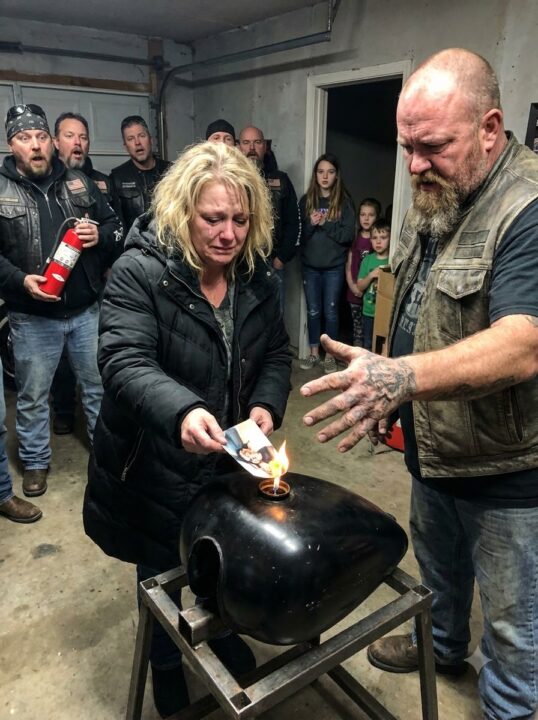
By two, June stood inside Dawson Iron Works with the photograph and silver lighter. She had waited until the children, the club, and Cole’s Road King were present because the instruction demanded witnesses.
Cole knew she might lose courage alone.
He also knew the club might stop her.
The brotherhood failed its first test.
Tiny accused June of performing grief for attention. Clay said the photograph should be copied before burning. Another rider claimed Cole’s belongings were now part of club history.
June listened.
Then she handed me Cole’s instruction card.
His handwriting had deteriorated, but the message remained clear:
RAY—DON’T LET THEM TURN ME INTO PROPERTY. LET JUNE BURN THE PHOTO. THE PART THAT MATTERS WON’T BURN.
I read the line aloud.
The room changed.
Tiny stepped back.
Clay lowered his phone.
I moved between June and the riders, not because I understood the act, but because Cole had predicted our worst instinct: confusing love with possession.
June lit the photograph.
Avery screamed.
Noah pulled Lily close.
Cole’s face disappeared beneath flame.
Every biker in that garage had witnessed damaged machines, roadside fires, and memorial photographs carried through rain. None of us were prepared for deliberate destruction performed by the person who loved Cole longest.
June’s hands shook.
The lighter did not.
When the heat revealed numbers on the concealed copper plate, grief transformed into urgency. We gathered around the safe behind Cole’s tool cabinet.
The six-number sequence did not open it.
June tried twice.
The keypad flashed red.
Avery blamed her.
“You burned Dad for nothing.”
June closed her eyes.
I examined the plate.
The stamped sequence read 17–04–29, but Cole never trusted straightforward codes. He taught the children to reverse routes when checking directions and read measurements twice before cutting.
Noah remembered the treasure-hunt rule.
“Dad always said the way home is the road backward.”
June entered 92–40–71.
The safe clicked.
Lily reached for the handle.
I stopped her.
“Your mom opens it.”
June shook her head.
“Together.”
All three children placed one hand on the handle. Avery stood highest, Noah beneath her, and Lily pressed two fingers against the bottom.
They pulled.
The safe contained no cash.
That disappointed one club member until Tiny told him to leave.
Inside were four shelves filled with envelopes.
The first shelf held Avery’s name.
The second held Noah’s.
The third belonged to Lily.
The final shelf contained letters for June, me, Tiny, and the Iron Lanterns.
Each child’s stack was organized by moments rather than dates.
FOR YOUR NEXT BIRTHDAY.
FOR THE FIRST TIME SOMEBODY BREAKS YOUR HEART.
FOR WHEN YOU ARE ANGRY AT ME FOR DYING.
FOR WHEN YOU FORGET MY VOICE.
FOR THE DAY YOU BECOME OLDER THAN I WAS.
Avery found one envelope sealed in black wax.
FOR WHEN YOU LEARN WHY YOUR LAST NAME ISN’T MINE.
She tore it open.
June reached for her hand.
Avery moved away.
Cole’s letter explained the adoption that never happened. He described court delays, her biological father’s refusal, his own financial mistakes, and the years he assumed love made paperwork unimportant.
Then he admitted the truth.
He regretted waiting.
Inside the envelope were signed adult-adoption documents prepared for Avery’s eighteenth birthday, along with instructions for June and an attorney.
Cole could not complete the process after death.
Avery could choose whether to continue it with June’s legal support and the court.
He wrote:
YOU WERE MY FIRST CHILD. I WAS LATE TO THE LAW, NEVER LATE TO YOU.
Avery folded at the waist.
No dramatic scream came.
She simply stopped standing.
I caught her before she reached the floor.
June knelt beside us.
Noah and Lily began crying because their sister cried.
The safe had opened.
The family had not.
Not yet.
Avery pushed Cole’s letter toward me.
“Read yours.”
I found my envelope.
The front carried three words:
FOR HAMMER—ALONE.
I refused.
Avery looked up.
“You made Mom burn his picture because he told you.”
“I let her.”
“Then open what he told you.”
Thirty bikers waited.
Cole had written alone.
I carried the letter into the back bay.
For the first time since his death, I left his family behind.
Part 4 — The Letter to the Man Who Stayed
Cole’s letter began with an insult.
HAMMER, IF YOU’RE READING THIS IN PRIVATE LIKE I ASKED, YOU FINALLY FOLLOWED ONE INSTRUCTION.
I heard his voice immediately.
That hurt more than the funeral.
Cole wrote that he expected the club to misunderstand June. He knew we would treat the burning photograph as destruction because bikers built rituals around objects: motorcycles, vests, patches, road bells, photographs, and fuel tanks.
Those objects mattered.
They were not people.
Cole feared his death would turn the Road King into a shrine, June into a caretaker of club history, and his children into witnesses to a man everyone else remembered more loudly than they did.
He wanted the picture gone.
Not because the photograph was worthless.
Because it was too easy.
One smiling image could freeze him at twenty-nine while Avery remembered arguments, Noah remembered broken promises, and Lily remembered hospital smells.
Cole wanted his children to inherit a father complicated enough to remain real.
The letters held those complications.
He admitted failures.
He apologized without asking immediate forgiveness.
He told each child stories suited to them, including memories June did not know he kept.
My letter contained a different request.
Cole wanted the Road King dismantled.
I stopped reading.
The bike waited in the front bay, black paint polished, engine rebuilt six months before diagnosis, and Cole’s purple-painted fingernail mark preserved on the left grip where Lily touched him.
Dismantling it felt worse than burning the photograph.
I returned to the safe.
June saw my face.
“What did he ask?”
“Nothing.”
Avery held up her father’s letter.
“Don’t do that.”
“Do what?”
“Decide we can’t handle it.”
The child sounded like Cole.
I handed June my letter.
She read the paragraph aloud.
Cole did not want the motorcycle sold whole or displayed untouched. He wanted one part given to each child when they were ready.
Avery would receive the tool compartment because she always carried what other people forgot.
Noah would receive the odometer because he loved measuring distances.
Lily would receive the left grip bearing her purple paint.
June would keep the key.
The engine would go to Dawson Iron Works and be rebuilt into a teaching display for young mechanics.
The fuel tank would remain with the family because it carried three hidden handprints.
“What does the club get?” Tiny asked.
June continued reading.
THE CLUB GETS THE ROAD. QUIT ASKING MY FAMILY FOR PARTS OF ME.
Tiny turned away.
Cole had anticipated all of us.
The test of brotherhood was not whether we could protect his motorcycle.
It was whether we could release it.
Clay objected.
“That Road King is how people know him.”
Avery stood.
“No. It’s how you know him.”
The distinction silenced the room.
The Iron Lanterns voted anyway, although the decision did not belong to us. Twenty-six supported Cole’s instructions. Four refused to participate.
One rider removed his vest and left.
Tiny stayed but would not touch the motorcycle.
I did not blame him.
Grief creates foolish borders. We defend machines because they cannot die again.
June asked whether dismantling could wait.
Cole’s letter allowed that.
NOT BEFORE THEY’RE READY. NOT SO LONG THAT READY BECOMES NEVER.
We closed the safe.
Each child selected one immediate letter. The remaining envelopes stayed locked inside until the family could decide how and when to open them.
June swept the photograph’s ash from the fuel tank into a small metal container.
Avery watched.
“I thought you wanted to erase him.”
June sealed the lid.
“I wanted to obey him.”
“Was that worth the picture?”
June looked toward the shelves of letters.
“No.”
Avery appeared surprised.
June continued.
“Losing it still hurts. The letters don’t make the picture worth less.”
That answer mattered.
The twist was not that paper memories were meaningless.
The twist was that Cole had asked June to sacrifice one memory so three children could receive hundreds.
Neither replaced the other.
At sunset, we carried the detached tank into the Mercer house.
June placed it beneath the only empty space on the living-room wall.
No photograph hung above it.
Only three handprints beneath black paint.
Part 5 — The Letters Cole Timed for Tomorrow
The family did not open every letter at once.
That was my idea.
June’s was better.
Each child chose one envelope during the first week, then the safe remained closed until a moment named on another envelope actually arrived.
Noah opened FOR YOUR FIRST RIDE WITHOUT ME six months later.
Cole instructed him not to ride a motorcycle until properly trained, licensed, equipped, and ready. He also admitted that Noah might never want to ride.
DON’T INHERIT MY ROAD IF YOUR FEET WANT ANOTHER ONE.
Noah became interested in bicycles instead.
The Iron Lanterns accepted the correction.
Lily opened FOR WHEN YOU FORGET MY VOICE at age nine.
The envelope contained no recording.
Cole wrote that forgetting exact sounds was not betrayal. He described how he once forgot his own mother’s laugh, then remembered the way she covered her mouth when embarrassed.
He asked Lily to remember gestures instead of audio.
She remembered the purple fingernail.
Avery opened the adoption letter repeatedly but did not file anything immediately.
At eighteen, she completed the adult-adoption process posthumously only in the symbolic and family records available to her, while legally changing her surname to Mercer through the proper court process.
The judge asked why.
Avery answered:
“The man arrived before the name did.”
She brought Cole’s tool-compartment cover to court inside her purse.
June kept the safe combination hidden from everyone outside the family. The copper plate remained scorched, and the original photograph existed only as ash.
Then Tiny found something.
While preparing the Road King for eventual dismantling, he removed the seat and discovered a strip of undeveloped photographic film sealed beneath the frame.
Cole had hidden it there years earlier.
We took it to a specialist.
The negative produced four images from the Route 66 diner where the original photograph had been taken.
One showed Cole laughing beside the motorcycle.
Another showed June walking toward him.
The third captured Avery at age three sitting on the fuel tank while Cole held her waist.
The fourth showed the photographer’s thumb.
The burned photograph had not been the only image.
Cole did not know the film survived.
That mattered because it prevented the story from becoming too perfect. He had truly believed he asked June to destroy the last picture.
The new photographs were accidents.
June printed three copies of the image with Avery.
She placed one inside the safe, one in Avery’s room, and one at Dawson Iron Works.
No copy replaced the ashes.
Cole’s plan had delivered letters.
Chance returned a face.
Tiny cried when he saw the developed image.
He apologized to June.
“I thought you were taking him.”
June touched the photograph.
“So did I.”
The motorcycle was dismantled on the first anniversary of Cole’s death.
Every child attended.
Nobody used power tools until Lily removed the left grip herself. Noah recorded the odometer reading. Avery opened the tool compartment and found a ten-millimeter socket Cole had accused her of losing for six years.
She laughed.
That was the first laughter inside the garage that did not make everyone feel guilty.
The Iron Lanterns rebuilt the engine as a cutaway teaching model for a vocational program. Students could turn the crank slowly and watch internal movement without starting it.
Cole’s Road King no longer traveled.
It taught.
The fuel tank stayed in the Mercer living room. June placed the copper safe code beneath it and the sealed ash container inside the old key recess.
Visitors sometimes asked why no photograph sat on top.
Lily gave the best answer.
“Dad’s behind the wall.”
She meant the safe.
She also meant the letters.
Part 6 — One Envelope at a Time
Years passed through envelopes.
Avery opened one after her first serious breakup. Noah opened one when he failed his driver’s test. Lily opened one after winning a school art prize and discovered Cole had misspelled congratulations three different ways.
June opened her letters more slowly.
The first was labeled FOR THE MORNING YOU HATE ME FOR LEAVING.
She waited two years.
Cole wrote that illness had not been a choice, but secrecy sometimes was. He apologized for spending nights preparing letters when June needed him beside her.
He did not ask her to call the preparation noble.
He called it fear with good handwriting.
June laughed when she read that line.
Then she became angry again.
Both reactions were allowed.
My final letter remained unopened for four years.
The envelope read FOR WHEN YOU THINK THE CLUB IS YOUR FAMILY MORE THAN YOUR FAMILY IS.
I knew what Cole would say.
That was why I avoided it.
When I finally opened the letter, he reminded me that the Iron Lanterns existed to carry riders back toward people who loved them, not replace those people.
Brotherhood was a bridge.
Not a house.
After reading, I drove to my sister’s home in Missouri, where I had not visited in six years because club obligations always seemed urgent.
I took no motorcycle convoy.
Just the Road King and one overnight bag.
Cole had repaired another tomorrow.
The safe remained behind the red tool cabinet until June moved houses. The Iron Lanterns transferred it under her supervision.
Nobody asked for access.
Tiny carried the empty photograph frame.
June kept that too.
She never placed another picture inside it.
The frame hung above the fuel tank, holding only the wall.
Absence became part of the display.
Not the whole of it.
Part 7 — What the Flames Left Us
Ten years after Cole’s death, Lily opened the final envelope addressed to all three children.
Avery was twenty-seven. Noah was twenty-two. Lily was seventeen.
They gathered at Dawson Iron Works because Cole requested the letter be read beside the engine display built from his Harley.
June sat between them.
The Iron Lanterns waited outside.
The letter contained no dramatic secret.
Cole wrote about breakfast.
He described Avery burning toast, Noah reading cereal boxes, and Lily hiding blueberries inside her sleeves. He admitted those mornings had seemed repetitive while he lived them.
After diagnosis, they became the scenes he feared losing first.
His final instruction was simple:
MAKE BORING MEMORIES. THEY LAST LONGER THAN BIG ONES.
The children went home and cooked breakfast at midnight.
June brought the empty picture frame.
They placed it on the table without filling it.
The safe was nearly empty by then. Only copies, legal records, and several envelopes the children chose to preserve unopened remained.
Nobody regretted finding it.
Everyone still regretted the photograph.
Both truths survived.
Cole’s fuel tank remains in June’s living room. The three scratched handprints are visible when afternoon light reaches the black paint.
Inside the key recess rests a small tin of ash.
Beneath the tank lies the heat-darkened copper code.
At Dawson Iron Works, the photograph recovered from the hidden negative hangs above Cole’s teaching engine. He is laughing beside the Route 66 diner, unaware of illness, letters, safes, or the people who will argue over how to remember him.
I pass it every morning.
Some days I touch the frame.
Most days I start work.
When the garage closes, I hear Cole’s engine only through students turning its cutaway crank by hand. Metal moves slowly beneath clear panels, showing every hidden connection.
Nothing roars.
Everything remains.
Follow our page for more unforgettable biker stories about misunderstood grief, hidden promises, and the rugged families who discover love waiting behind the final lock.