A Little Girl Poured Pink Paint Over a Biker’s Black Harley—His Club Rose in Fury, Until He Saw the Last Picture Her Mother Had Left Behind
Part 2 — The Woman Who Put Color Inside Iron Mercy
Most people in Kingman knew Rosa Vega as the five-foot-three woman who ran a motorcycle paint shop between a transmission garage and an abandoned motel on old Route 66.
We knew her as the only person Hammer obeyed.
They met fourteen years before the pink paint hit the Road King. Hammer had just finished serving thirty-two months for aggravated assault after nearly killing a drunk man outside a bar. The man had struck a waitress first, but Hammer kept hitting long after the threat ended.
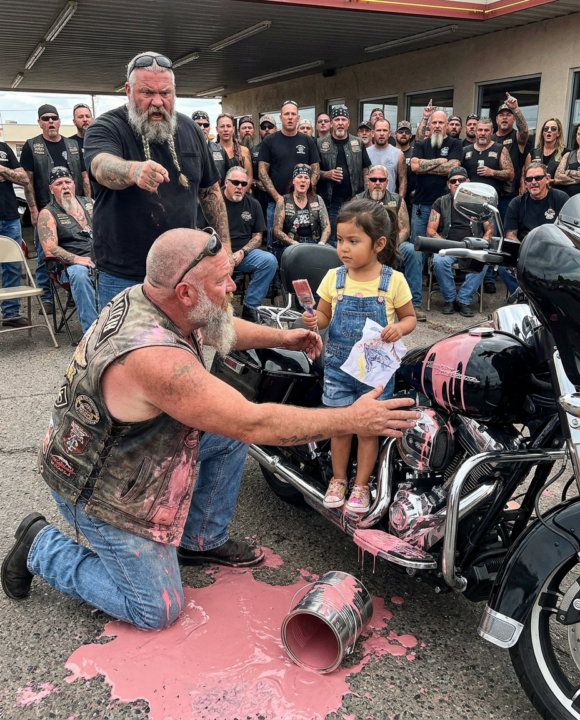
Prison did not make him gentle.
It made him quiet.
On his third week home, he brought the Road King to Vega Custom Color with a dented tank and dried blood beneath one grip. Rosa walked around the motorcycle, looked at his skull ring and told him the bike appeared as emotionally constipated as its owner.
Hammer stared at her.
Rosa stared back.
“What color?” she asked.
“Black.”
“It’s already black.”
“Blacker.”
She refused.
Instead, she painted one thin rose-colored line beneath the tank where nobody could see it unless they knelt. Hammer discovered it two months later while changing an oil line.
He rode straight to her shop.
“You put pink on my motorcycle.”
“Rose.”
“Remove it.”
“No.”
He returned the next day.
Then the next.
By the end of that summer, Hammer worked evenings in Rosa’s shop to pay for repairs he could already afford. He sanded tanks, swept paint dust and learned how to hold an airbrush without strangling it.
Rosa had a four-year-old daughter named Lily and no patience for men who treated single mothers like damaged merchandise. Lily’s biological father had disappeared before her first birthday. Hammer never called himself her replacement.
He simply arrived.
He repaired the backyard gate. He learned which dinosaur-shaped pasta Lily would eat. When she developed pneumonia at six, he slept in a hospital chair with his boots still on because she gripped one of his vest chains whenever she woke.
Rosa noticed every act.
She praised none of them.
That was how they loved each other.
Iron Mercy took longer to accept her. Our clubhouse motorcycles were mostly black, gunmetal or dark red. Rosa called them “thirty versions of the same funeral.”
Then Boone wrecked his Street Glide on gravel and brought her the damaged fairing.
She returned it midnight blue with a small copper compass hidden beside the headlight. The compass pointed west because Boone’s son was buried in California.
Boone said nothing when he collected it.
After that, every brother wanted Rosa to paint something he would never explain aloud.
A date beneath a saddlebag. A child’s initials inside a fender. A white feather under a fuel cap. Rosa said motorcycles carried secrets better than men because steel did not interrupt.
The Road King slowly became hers.
Hammer transferred the title after a creditor tried seizing it during a civil judgment tied to his old assault case. Rosa paid the remaining loan from her shop account, then refused to transfer it back after the judgment ended.
“You ride it,” she told him. “I own it. That keeps both of us humble.”
She rode behind him on weekends, her red scarf snapping above the exhaust. Lily grew up believing the black motorcycle belonged to all three of them.
Legally, it belonged only to Rosa.
When doctors found the cancer, she continued working until the smell of solvent made her sick. I took over larger jobs. Hammer installed new ventilation. Boone handled deliveries so customers would not see Rosa resting on the office floor between coats.
The club thought we were protecting her dignity.
Rosa called it coordinated lying.
During her final winter, she began drawing motorcycles with Lily in the hospice family room. Most were impossible machines: purple tires, yellow engines, wings over the saddlebags.
One was always the same.
Hammer’s black Road King, painted pink.
Three white stars crossed the tank. A child’s handprint covered the rear fender. Beside the motorcycle stood a square man whose beard reached his belt.
I saw the drawing once.
“What’s that?” I asked.
“An argument I intend to win after I’m dead,” Rosa said.
I assumed she was joking.
Hammer entered before I could ask more, and Rosa slid the page beneath Lily’s coloring book. She made me promise not to mention it until she had finished the instructions on the back.
I kept that promise.
Too well.
After Rosa died, her sister Maribel closed the paint shop. Hospital bills, unpaid rent and tax penalties had consumed most of the business account. Hammer announced that Iron Mercy would auction the Road King, clear the debts and reopen the shop as Rosa’s Road, a nonprofit garage for teenagers leaving foster care.
Nobody questioned him.
The title was in Rosa’s name, but Maribel had been appointed estate administrator. Hammer said she had approved the sale.
We believed him because grief made his voice sound like authority.
Three nights before the auction, I found Lily alone inside the closed paint shop. She was standing before an old metal cabinet, holding Rosa’s drawing in one hand and a key in the other.
The key had been taped behind the page.
“What are you looking for?” I asked.
“Mama’s pink.”
I told her the old paints were probably unusable. I escorted her outside, locked the shop and called Maribel.
I did not check the cabinet.
Lily returned on auction morning while everyone watched the arriving riders. The gallon she carried out was not ordinary house paint.
Rosa had mixed it herself.
And taped beneath its lid was a note none of us had yet seen.
Part 3 — The Day Brotherhood Chose the Wrong Promise
Paint has a window.
During the first minutes, it is only a mess. After air reaches the binders, it becomes a decision.
The rose-pink mixture on the Road King was old but active. It carried industrial hardener, pearl pigment and enough bonding agent to bite directly into the black clear coat. We had perhaps twelve minutes to strip it without destroying the finish beneath.
I opened my solvent case.
Hammer closed it.
“Ray, listen to me. If we move now, I may save the tank.”
“No.”
“The paint is curing.”
“I said leave it.”
Boone stepped between us. He had ridden with Hammer since before Iron Mercy had a clubhouse. He had covered Ray’s back in prison visiting rooms, funerals and more roadside fights than either man admitted.
That morning, his loyalty had a price tag.
The collector from Phoenix had offered forty-two thousand dollars for the Road King. Another donor promised to match the sale if the motorcycle remained connected to Rosa’s last ride. Without those funds, we could not pay the shop’s back taxes or launch the apprenticeship program.
Six foster teenagers were scheduled to begin in September.
Boone pointed toward them standing near the diner wall.
“You want to explain to those kids why their garage disappeared?”
Hammer remained between him and Lily. “Don’t put that on her.”
“She poured the paint.”
“She is nine.”
“She knew what she was doing.”
Lily’s face changed.
That cut deeper than shouting.
She lowered the brush, looked at the pink motorcycle and seemed to understand for the first time that fulfilling her mother’s drawing might have destroyed something other people needed.
“I can wash it,” she said.
Nobody answered quickly enough.
She grabbed a diner towel and rubbed the tank. The half-cured pigment smeared into the black, creating a bruised purple patch wider than her hand.
Boone cursed.
Hammer turned so fast the brothers around him stepped back.
“One more word at her,” he said, “and you answer to me without the patch.”
Boone removed his sunglasses. “You threatening your road captain over paint?”
“Over a child.”
“The child is not the whole club.”
“No. She’s the reason there’s still one.”
The Phoenix collector approached with his purchase agreement. Graham Sutter was a decent man who collected motorcycles connected to local history, but he saw value through preservation. The spilled paint had erased the version he wanted.
“I can’t honor forty-two,” he said. “Not in this condition.”
Hammer nodded.
“I could offer twelve for parts and provenance.”
“No.”
“Ray, the drivetrain alone—”
“It isn’t for sale.”
Boone laughed once, but there was no humor in it. “You do not get to decide that now.”
Maribel stood beside the black SUV. She was Rosa’s older sister, a hospital billing manager with silver in her dark hair and grief hardened into efficiency. She had taken Lily into her home after Rosa died because Hammer possessed no legal guardianship.
She looked at the motorcycle, then at Lily.
“What did you do?”
Lily reached for the folded drawing.
Maribel did not take it.
“I told you to stay beside me.”
“Mama wanted—”
“Your mother is gone.”
The sentence landed hard.
Lily stepped backward. Hammer moved, but Maribel raised one hand.
“You have filled her head with club promises, memorial rides and stories about what Rosa wanted. She needs a home, school and people who understand that dead parents do not send instructions through motorcycles.”
Hammer’s jaw tightened.
Maribel faced him. “You told me this auction would close the estate.”
“It would have.”
“You told me the motorcycle belonged to you.”
“I rode it.”
“That is not what I asked.”
For the first time, uncertainty moved through our brothers.
Hammer had ordered us to restore a motorcycle he did not own, advertise an auction the estate might not have authorized and build an entire program on money that did not yet exist.
Boone turned toward him. “You said Maribel signed.”
“She agreed in principle.”
“So no.”
Hammer said nothing.
Boone removed the Iron Mercy road-captain pin from his cut.
The small piece of metal hit the auction table.
“I won’t ask brothers to follow a lie.”
Two members stepped beside Boone. Then three more. Nobody surrendered his main patch, but the empty space forming around Hammer said enough.
Brotherhood had reached its test.
We failed quietly.
Lily bent to collect the empty paint can. Beneath the fallen lid, a narrow strip of paper had stuck to the dried pigment. She peeled it free, but pink paint covered most of the handwriting.
Only one line remained legible.
LET LILY CHOOSE.
Maribel froze.
She recognized Rosa’s handwriting too.
Hammer held out his hand. Lily gave him the note, then backed away as if she no longer trusted any adult near her mother’s words.
The collector left.
The matching donor withdrew by phone twelve minutes later. A county representative postponed our nonprofit inspection. The foster families gathered their children and drove away.
By noon, the fundraiser lot was nearly empty.
Pink paint hardened across the motorcycle.
Lily sat behind the diner with her knees against her chest. Hammer remained on the pavement beside the Road King, Rosa’s crayon drawing in one hand and the stained note in the other.
I joined him.
“You could have told us there was no signed auction authorization.”
“Would you have rebuilt it?”
“No.”
“That’s why.”
“You used us.”
“I needed the shop open.”
“For Lily?”
“For kids Rosa never got time to help.”
I looked toward Boone loading his saddlebag.
“You may have lost the club.”
Hammer studied the five words beneath Rosa’s drawing.
WHEN HE HIDES, ADD COLOR.
“She knew,” he said.
“Knew what?”
“That I’d turn her motorcycle into a headstone.”
Behind us, a car door slammed.
Maribel had found Lily.
The girl resisted when her aunt took her hand. Hammer rose but did not interfere. Legally, he had no right.
Lily looked over her shoulder as Maribel led her toward the SUV.
“Are you going to make it black again?”
Hammer stared at the pink paint covering Rosa’s motorcycle.
“No.”
“Are you mad?”
“No.”
“Then why won’t you look at me?”
He tried.
He could not.
Lily entered the SUV believing she had cost foster children their garage, divided the biker club that had helped raise her and ruined the last motorcycle her mother ever rode.
The black SUV disappeared east along Route 66.
Hammer stayed behind with the pink Road King and six men who no longer knew whether they still followed him.
That should have been the lowest point.
It was not.
At 3:40 that afternoon, Maribel returned without Lily. She carried Rosa’s sealed estate envelope, the motorcycle title and a flash drive wrapped in the red scarf from her sister’s last ride.
“I found these behind the drawing cabinet,” she said.
Then she looked at the pink Harley.
“My sister knew exactly what that child would do.”
Part 4 — The Instructions Rosa Left Behind the Drawing
We gathered inside Rosa’s old paint shop because the clubhouse no longer felt neutral.
Dust covered the counters. Masking tape had dried into hard yellow rings. Rosa’s respirator still hung beside the spray booth, and a child’s height marks climbed the office doorframe in blue pencil.
Hammer stood near the entrance without his cut.
Boone stood across the room without his road-captain pin.
Maribel placed the title on Rosa’s workbench. The owner’s line carried one name.
Rosa Elena Vega.
Hammer had never transferred it back because Rosa had refused. After her diagnosis, she updated her will. The Road King would pass directly to Lily, held in trust until her eighteenth birthday.
Hammer was not the owner.
The club was not the owner.
Lily was.
“She painted her own motorcycle,” I said.
Maribel nodded. “Apparently.”
That was the first twist.
The second waited inside the envelope.
Rosa had written separate instructions for the shop, her daughter and Hammer. The letter authorizing the auction existed, but its language differed from what Hammer had told us.
The bike could be sold only if Lily chose to sell it after seeing Rosa’s final design.
Hammer had hidden that condition.
Boone’s voice went cold. “You knew.”
Hammer did not defend himself. “I knew she had a choice.”
“You scheduled the auction before showing her the drawing.”
“I thought keeping the shop mattered more.”
“To whom?”
“To Rosa.”
Maribel inserted the flash drive into the office computer.
A video opened.
Rosa appeared sitting in the hospice family room beneath a knitted blanket. Her cheeks were hollow, her fingers swollen and her red scarf covered the place where treatment had taken her hair. Lily slept beside her with a pink crayon still held in one fist.
Rosa looked directly into the camera.
“If Ray is watching this, he has already ignored at least three written instructions.”
Nobody laughed.
“I know that man. He will polish grief until it looks like loyalty. He will protect my motorcycle from rain, fingerprints, bad roads and every living thing that might change it. Then he will call that love.”
Hammer lowered his head.
Rosa lifted the crayon drawing.
“This is not a paint plan. Not exactly. It is permission.”
She explained the three white stars. One represented Lily. One represented Hammer. The third represented a son Rosa had lost during pregnancy two years before Lily was born.
That child had no grave. Rosa had scattered the ashes from the passenger seat of the Road King during a desert ride west of Kingman.
Afterward, she had asked me to bury a small white star beneath the black clear coat.
I had forgotten.
Rosa had not.
“The motorcycle carried all three of us,” she said. “Even when only two seats looked occupied.”
Lily’s small handprint on the rear fender was not decoration either. At five, she had pressed her paint-covered palm against a practice panel inside Rosa’s shop. Rosa saved the print and converted it into a stencil.
The stencil waited inside the locked cabinet.
Beside it were three sealed cans of pearl rose paint, white star templates and a folder containing the complete design.
The gallon Lily had poured over the Harley was the test batch.
Rosa had left the cabinet key behind the drawing because she believed Lily would search for the color if Hammer refused to show her the plan.
“She set this up?” Boone asked.
Maribel shook her head. “She gave Lily a choice and guessed Ray would remove every other one.”
The video continued.
Rosa spoke about the apprenticeship garage. She wanted it built, but not from the sale of Lily’s inheritance. Her plan was smaller: reopen one work bay, teach three teenagers, prove the program, then expand.
Hammer had enlarged the dream because large efforts let him hide inside work.
He had created the auction goal.
He had created the deadline.
He had nearly sold Lily’s motorcycle to outrun the silence Rosa knew would follow her death.
On screen, Rosa took a slow breath.
“Ray, if Lily chooses black, keep it black. If she chooses pink, help her paint it. If she pours the whole can on without sanding first, Calvin will complain for several days, but he will fix it.”
Every face turned toward me.
“I would not say several,” I muttered.
Rosa smiled faintly, as if she had heard.
Then her expression changed.
“Do not make my daughter responsible for keeping you alive. That is too heavy for a child. But let her remind you that alive things change color.”
The video ended.
No music.
No final speech.
Only Rosa reaching toward the camera while asking Maribel whether the red light had turned off.
Hammer stayed still for so long that I heard the old wall clock skip.
Then he walked to the cabinet.
Inside were Rosa’s design folder, sealed paint, the handprint stencil and a small envelope addressed to each Iron Mercy member. Some contained a sentence. Others held photographs or receipts from acts Rosa had never publicly mentioned.
Boone’s envelope carried a picture of his midnight-blue fairing and four words.
WEST IS STILL HOME.
His fingers closed around the photograph.
Hammer lifted the pearl rose paint.
“What do we need?” he asked me.
“For what?”
“To finish it.”
Boone looked up. “The auction money is gone.”
Hammer placed the can on the bench. “I know.”
“The taxes are due in twelve days.”
“I know.”
“Your plan failed.”
Hammer finally faced him. “Then build a better one.”
Boone touched the empty place where his road-captain pin had been.
“You lied to us.”
“Yes.”
“You nearly sold a child’s motorcycle.”
“Yes.”
“You going to apologize?”
Hammer considered the question.
“To Lily first.”
He began walking toward the door.
Maribel blocked him.
“She doesn’t want to see you.”
Hammer stopped.
“She thinks your brothers hate her,” Maribel continued. “She thinks six foster kids lost their garage because she poured paint. She has locked herself in Rosa’s room and put the drawing under the door so nobody can take it.”
Boone picked up his pin but did not return it to his vest.
“What does she need?”
Maribel looked around at the men who had stood in anger when the can tipped.
“She needs to know grown men can repair what they break too.”
That night, Boone sold his custom Street Glide to Graham Sutter for twenty-eight thousand dollars.
He did not ask Hammer’s permission.
Deacon mortgaged his tow truck for nine thousand. Two prospects donated the savings meant for new motorcycles. I waived six months of shop rent and called every paint supplier Rosa had ever helped.
By sunrise, Iron Mercy had enough to pay the back taxes and open one apprenticeship bay.
Not six.
Three.
Exactly as Rosa planned.
At 8:12 the next morning, thirty-one Harleys stopped outside Maribel’s house. No one revved an engine. No one wore club colors.
Hammer walked to the porch alone, carrying the pink-stained leather cut he had laid across Rosa’s motorcycle.
Lily watched through the window.
He placed the folded vest on the step and knelt beside it.
“I’m not here for the bike,” he said through the door. “I’m here because I let you believe paint mattered more than you.”
The lock clicked.
Lily opened the door three inches.
“Does Boone still hate me?”
From the sidewalk, Boone answered.
“No, ma’am. Boone was loud and wrong.”
The door opened wider.
Hammer held out Rosa’s handprint stencil.
“Your motorcycle,” he said. “Your color. Your decision.”
Lily looked past him at thirty bikers waiting without patches.
“Can it have more stars?”
Hammer nodded. “As many as you need.”
She picked up his stained cut.
“I think this needs pink too.”
For the first time in ten months, Hammer smiled.
Barely.
But we saw it.
Part 5 — How Thirty-One Bikers Learned to Paint Pink
Restoring the Road King required nineteen days.
Removing Rosa’s test paint would have been easier, but Lily refused to erase the first thing she had placed on her mother’s motorcycle. I sanded the hard edges smooth while preserving a narrow section of her original crooked brush mark beneath the new clear coat.
It remained imperfect.
That made it honest.
We rolled the Harley into Rosa’s old spray bay. Lily wore a child-sized respirator, coveralls and gloves. Hammer stood behind her in a disposable suit that made him look like a tattooed refrigerator wrapped for shipping.
I taught Lily to keep the spray gun level.
Hammer tried giving advice.
She pointed toward the masking room. “Mama’s video said Calvin fixes it.”
Hammer left without argument.
That may have been Rosa’s greatest posthumous accomplishment.
We began with pearl rose across the tank and fenders. Under ordinary garage light, the color appeared muted and warm. In Arizona sun, tiny gold particles rose through it like desert dust at evening.
Lily placed the first white star.
The smallest represented the brother she had never met. She pressed it near the front of the tank because Rosa had told her older siblings should ride first.
The second star represented Rosa.
That was Lily’s change to the design.
The third belonged to Hammer. The fourth was Lily’s. Then she added a fifth for Maribel and a sixth for every teenager who might enter Rosa’s Road believing nobody expected them to finish anything.
Hammer did not stop her.
The child’s handprint went onto the rear fender. Rosa’s original stencil was too small because Lily had grown, so we made a new one from her nine-year-old hand.
Beside it, Hammer pressed his palm into removable masking film.
His hand was nearly twice the size of hers.
Lily trimmed the outline herself and placed it beneath hers, not beside it.
“Why there?” I asked.
“So he catches me.”
Hammer turned away until his breathing settled.
The club repaired more than paint during those nineteen days.
Boone returned to work without his road-captain pin. He swept floors, installed tool cabinets and allowed the foster teenagers to call him Mr. Collins, a title he hated more than any road insult.
On the seventh evening, Hammer brought him coffee.
“You sold your bike,” Hammer said.
Boone tightened a bench vise. “Had too many.”
“You had one.”
“Then the problem solved itself.”
Hammer placed the road-captain pin beside the coffee.
Boone did not pick it up.
“Not yet,” he said.
Hammer nodded.
That was the whole apology between them.
Graham Sutter, the collector who withdrew his offer, returned with a flatbed full of donated equipment. He admitted that Rosa had painted his late wife’s helmet twelve years earlier and refused payment.
“I wanted to preserve the wrong part of her,” he said.
He purchased no motorcycle.
Instead, he funded the first year of safety gear.
Maribel amended the estate plan with Lily’s approval. The Road King would remain in trust. Hammer could maintain and ride it, but every major change required Lily’s consent.
She made him sign a separate handwritten agreement.
Rule one: no returning it to black.
Rule two: no riding on Rosa’s birthday without Lily.
Rule three: the red scarf traveled in the right saddlebag.
Hammer signed all three.
The pink leather cut presented another problem. Industrial paint had soaked into the back patch, stiffening the lower letters of IRON MERCY. A leather specialist said restoring it would require replacing the panel.
Hammer refused.
He wore the stain.
At our next club meeting, the pink patch crossed one shoulder like a mark someone might mistake for embarrassment.
Nobody laughed.
Three brothers asked Lily to add a pink stripe to their motorcycles. Boone requested one beneath his new used bike’s tank, hidden where Rosa had once marked Hammer’s Road King.
Lily declined.
“Hidden doesn’t count.”
Boone let her paint the stripe across the front fender.
By the time the Road King was ready, twenty-seven club motorcycles carried some trace of Rosa’s color. One had a pink brake caliper. Another had a rose line around a saddlebag. Deacon painted the entire toolbox mounted on his tow truck.
The remaining four riders said pink did not suit their machines.
Lily accepted that.
Choice had been the point.
Rosa’s Road opened with one paint bay, three apprentices and no ceremonial ribbon. Lily cut a strip of pink masking tape across the shop entrance while Hammer held the ends.
The first students were seventeen-year-old Noah, eighteen-year-old Tasha and nineteen-year-old Miguel. Each had moved through multiple foster homes. None owned a motorcycle.
Rosa’s curriculum began with sanding.
“Color comes later,” her old notes said. “First learn what must be removed and what must remain.”
On opening day, a reporter asked Hammer whether the pink Harley represented healing.
He looked at the microphone.
“It represents a kid choosing paint.”
Then he walked away.
Lily answered instead.
“It means Mama knew he’d be stubborn.”
The reporter asked whether Hammer was her father.
Lily studied him across the shop. He was showing Noah how to hold a sanding block, guiding the teenager’s wrist without taking the tool from his hand.
“No,” she said. “He’s Hammer.”
That answer satisfied everyone who mattered.
The completed Road King rolled into sunlight at 4:26 on a Friday afternoon.
Pearl rose covered the body. Six white stars crossed the tank. Two handprints rested on the rear fender. One imperfect brush line remained sealed beneath the finish.
Hammer approached carrying Rosa’s red scarf.
He tied it below the passenger backrest and started the engine.
The V-twin caught after two turns.
Its sound filled the shop, shook dust from the rafters and rolled through the open bay toward Route 66.
Lily covered her ears and laughed.
Hammer did not ride.
He switched off the engine, removed the key and placed it in her palm.
“Still yours.”
She closed her fingers around it.
“Take me on Mama’s road.”
Hammer looked at Maribel.
Maribel looked at the helmet waiting on the bench.
Then she nodded.
Part 6 — The Pink Line Along Route 66
Hammer’s first ride on the pink Road King followed the same route Rosa had taken after leaving oncology care.
He rode slowly.
Lily sat behind him in full protective gear, her small arms secured around his waist. Maribel followed in my truck while twenty-seven motorcycles formed a staggered line behind us.
Nobody called it a memorial ride.
Lily called it checking the paint.
We stopped at the overlook west of Kingman where Rosa had once scattered her son’s ashes. Hammer shut down the engine. The others followed until the desert held nothing but cooling metal and distant highway tires.
Lily removed one white paper star from her pocket.
She placed it beneath a rock, then returned to the Harley.
“Does Mama know it’s pink?”
Hammer looked across the open desert.
“Your mama knows everything inconvenient.”
Lily accepted that answer.
Every month afterward, she spent one Saturday at Rosa’s Road. She learned masking, sanding and color mixing. Hammer taught safety. I taught paint. Boone taught teenagers how to recognize when anger had taken control of their hands.
That lesson was not in Rosa’s notes.
The apprenticeship garage expanded slowly. Three students became five. Noah earned his first certification. Tasha designed a helmet using copper feathers. Miguel rebuilt the dented tank from the motorcycle Hammer had ridden before prison.
None of them became a different person overnight.
They simply finished what they started.
On Rosa’s birthday, Hammer parked the pink Road King outside the shop at 7:10 a.m. Lily arrived carrying a tiny brush and a jar of pearl rose paint.
Every biker who came through received one stripe somewhere on his machine—but only if he asked.
Some chose a place everyone could see.
Others still chose beneath the tank.
Lily no longer argued.
By then, she understood that hidden color could still be real.
Hammer kept Rosa’s red scarf inside the right saddlebag. Her crayon drawing traveled beneath the seat in a waterproof sleeve. The pink-stained leather cut remained on his back through rain, heat and every club ride.
The stain grew darker with road dust.
He never cleaned it away.
One year after the auction failed, Boone finally returned the road-captain pin to his vest. Lily fastened it herself.
“You were loud and wrong,” she reminded him.
“Yes, ma’am.”
“Don’t do it again.”
“No promises.”
She narrowed her eyes.
Boone corrected himself. “Fewer promises. Better ones.”
Hammer heard that and nodded.
For men like us, it was enough.
Part 7 — The Motorcycle That Was Never a Headstone
The following spring, Iron Mercy organized the first Rosa’s Road Run.
Forty-three motorcycles gathered outside the old paint shop before sunrise. Some came from Flagstaff. Others rode in from Phoenix, Needles and Las Vegas.
Every motorcycle carried pink somewhere.
A stripe. A star. A handprint. A small line beneath the tank.
Three graduates from Rosa’s Road stood near the front wearing clean work shirts with their names stitched above the pockets. Noah had accepted a position at a restoration shop. Tasha was studying industrial design. Miguel remained with us as the program’s first paid instructor.
Lily inspected every motorcycle.
She rejected two sloppy stripes and made their owners redo them.
At 6:42, we heard the pearl-rose Road King before we saw it.
Hammer turned onto the frontage road, his black-and-gray beard moving above the collar of his stained leather cut. Rosa’s red scarf fluttered behind the passenger seat.
Lily rode with Maribel that morning because she had a job at the starting line.
She carried the original empty paint can.
The rim remained crusted pink. Inside it, donors placed enough money to fund the apprenticeship garage for another year.
Nobody auctioned the Harley.
At the riders’ meeting, Hammer stood before forty-three bikers, seven students, three reporters and half the town. People expected a speech about Rosa.
Hammer hated speeches.
He unfolded her crayon drawing and held it against the motorcycle so everyone could see the impossible pink machine had become real.
Then he handed the page to Lily.
“She chose,” he said.
That was all.
The ride traveled west along Route 66. Hammer led on the pearl-rose Road King. Boone followed on the used motorcycle he once thought he would never own. Deacon’s pink toolbox rattled behind his tow truck at the rear.
I rode near Lily and Maribel.
At Rosa’s overlook, the motorcycles stopped in a long curved line. Engines went quiet one after another until the desert wind lifted the red scarf from Hammer’s saddlebag.
Lily walked to him carrying a seventh white star.
“For who?” Hammer asked.
“For whoever needs one later.”
He considered the answer, then knelt beside the Road King.
Lily pressed the star beneath the clear edge of the rear fender. It did not have a name. Rosa had left room for people she would never meet, and her daughter had understood.
Hammer ran one scarred finger over the star.
A year earlier, thirty-one bikers had risen because a child poured paint over black steel. We believed we were protecting Rosa’s memory, the club’s honor and a motorcycle worth more than most of us could afford.
The child had protected something else.
Change.
Hammer started the Road King. Its V-twin pulse rolled across the stone, deep and uneven. Lily climbed behind him after Maribel gave permission and secured both arms around his waist.
The red scarf lifted.
Six white stars crossed the tank. Two handprints rested on the fender. One crooked brush mark remained beneath the clear coat, preserved exactly where Lily had made it.
Hammer looked back at us.
“Road’s waiting.”
The pink Harley moved first.
This time, all of us followed.
Drop HAMMER below and follow the page for more full stories about bikers whose hardest choices reveal what they were protecting.