Part 2: A Biker Dug a Hole Beside a Playground at Three in the Morning—What Police Found Beneath His Shovel Was Never Meant to Be Buried Forever
Part 2 — The Names Hammer Carried in His Saddlebag
I met Ray “Hammer” Dawson properly while Officer Alvarez photographed the time capsule and the sky above Ashford changed from black to the bruised gray that comes before sunrise. Up close, he smelled of damp leather, motor oil, and the bitter gas-station coffee bikers drink when sleep feels more dangerous than exhaustion.
He had wrapped his bleeding knuckles with a bandanna, but every few minutes he crouched beside the hole and checked whether dirt had shifted around the box. His care seemed strange after watching those same hands hammer a shovel through roots.
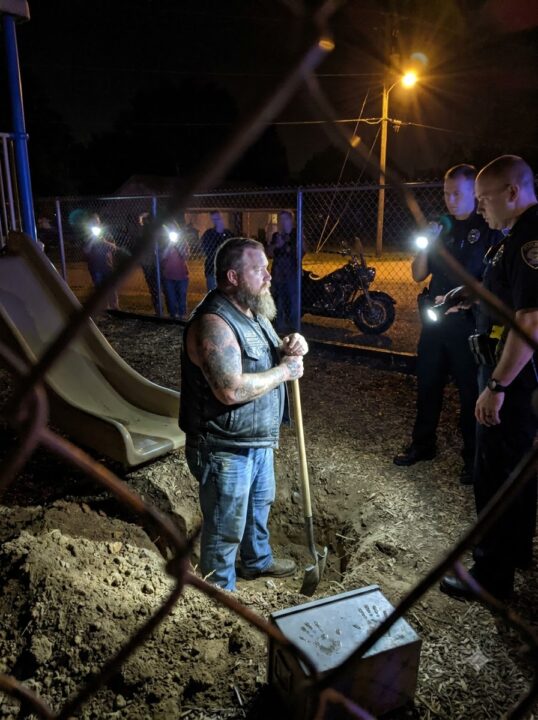
“Why didn’t you wait for permission?” I asked.
Hammer looked at me, then toward the demolition notice fastened to the playground fence. “Permission was arriving four hours late.”
That answer was pure Hammer: short, hard, and carrying more history than he intended to explain.
Twelve years earlier, his daughter Lily had been nine years old and receiving treatment for acute lymphoblastic leukemia at Mercy Children’s. Hammer had been forty-four, recently sober, newly divorced, and still learning that fatherhood required a different kind of courage than any fight he had survived.
He owned a failing motorcycle garage then, and some mornings he arrived at the hospital wearing yesterday’s shirt because he had worked through the night to cover Lily’s medical expenses. Nurses initially feared him, especially when his boots shook the polished corridor and his voice carried through the oncology ward.
Lily never did.
She called him “the world’s ugliest teddy bear” and made him wear pink adhesive stars over the skull tattoos on his knuckles. Hammer left them there during customer meetings, club rides, and one memorable traffic stop.
The Iron Vow riders began visiting Mercy because Hammer refused to leave Lily alone during treatment, yet he also refused to ask his brothers for help. They solved the problem in the manner biker clubs often solve emotional situations: they arrived without discussing feelings and repaired whatever was broken.
Bear Collins replaced the hospital playroom’s damaged bookshelves. Luis Ortega fixed three wheelchairs without charging anyone, while Doc Mercer brought breakfast every Tuesday and pretended the forty sandwiches were an ordering mistake.
The children stopped calling them bikers.
They called them the Loud Uncles.
Lily loved the garden behind the outpatient wing because it was the only place where medicine did not dictate the day. She could press her hands into soil, choose what grew, and watch butterflies land without asking whether they had washed first.
A young child-life specialist named Hannah Reed suggested the time capsule after five patients completed treatment during the same summer. Twelve children painted the container, filled it with messages, and promised to return when the youngest among them turned twenty-one.
Each child contributed three things: a photograph of who they were, a letter to who they hoped to become, and one object representing the life waiting beyond the hospital.
Hammer remembered every object because Lily made him help create the inventory. Noah Kim placed a baseball card inside, Ava Martinez contributed a plastic stethoscope, and Marcus Green packed a tiny wooden airplane.
Lily chose seeds.
Not ordinary flower seeds, either. She spent weeks reading gardening catalogs and selected twelve varieties that could survive Ohio winters, poor soil, and inexperienced hands.
“She picked stubborn plants,” Hammer told me. “Said those were our kind.”
The capsule was buried beside the playground during a ceremony attended by families, nurses, and six Iron Vow riders. Hammer stood behind Lily while she pushed soil with her red glove, promising he would bring her back for the opening.
At the time, doctors believed she had a reasonable chance.
Eight months later, the cancer returned.
Hammer did not describe those final months in detail. He mentioned hospital alarms, cold coffee, and the particular sound Lily’s sneakers made when she was still strong enough to walk the corridor.
She died before her tenth birthday.
The Iron Vow surrounded Hammer afterward, but grief made him cruel toward anyone trying to help. He stopped attending meetings, smashed a customer’s motorcycle tank during an argument, and spent three nights sitting beside the locked playground.
On the fourth night, Bear found him asleep against the fence.
“He carried me home,” Hammer said.
Bear weighed at least sixty pounds less.
That detail almost made Hammer smile.
The club preserved his sobriety by giving him practical tasks. They made him rebuild carburetors, escort charity rides, and teach younger members how to remain calm when trouble arrived wearing a familiar face.
Every July, they rode past Mercy Park at dawn. Hammer never entered, but he slowed enough to see the spot beside the swings.
Meanwhile, the outpatient building closed, Mercy Children’s merged with a larger hospital system, and the playground became city property. Records migrated between offices until the time capsule existed only in the memories of scattered families.
Then Hannah Reed called Hammer.
She had been clearing boxes before retirement when she found a faded photograph of the burial ceremony. Behind it, Lily had written the capsule’s location in purple marker and added five words:
“Dad knows where we planted tomorrow.”
Hannah checked the property schedule and discovered the playground would be demolished the next morning. She contacted the city, the buyer, the hospital, and the construction company, but nobody could authorize a delay before business hours.
Hammer did not argue with bureaucracy.
He loaded a shovel onto his Harley.
Before leaving, however, he opened an old metal drawer at his garage and removed Lily’s red glove, twelve seed packets he had replaced every year, and a folded design for a memorial garden.
The design had not been drawn by Hammer.
It was in Lily’s handwriting.
He had carried it inside his saddlebag for twelve years without building it because the final instruction required something he could not provide alone.
Across the bottom, Lily had written:
“This garden only counts if everybody comes back.”
Hammer had spent the previous six months locating the surviving children, although he told none of them exactly what he intended. Seven had answered his messages.
Five families could only answer for children who were gone.
At 4:02 that morning, Bear, Doc, Luis, and fourteen other Iron Vow riders reached the playground. They carried shovels, lumber, bags of soil, and twelve smooth limestone markers.
Yet when Bear approached the hole, Hammer raised one hand.
“Nobody opens it,” he said. “Not without the kids.”
The club obeyed, though the bulldozer was already less than three hours away and rain had begun softening the walls around the capsule.
That was the first test of their brotherhood: help Hammer save Lily’s promise without taking from him the moment he had spent twelve years fearing.
It would not be the last.
Part 3 — When the Bulldozer Reached Mercy Park
By five in the morning, the open hole had become unstable. Rainwater ran down its sides, roots snapped beneath the weight of the steel box, and Officer Alvarez warned that another collapse could trap it permanently.
Hammer refused to let anyone attach a chain.
He believed the capsule’s lid had already been damaged, and dragging it free might tear open the letters inside. Instead, the bikers formed two lines and began removing soil with garden trowels, bare hands, and coffee cups.
The sight was almost absurd: eighteen hard men in leather kneeling around a children’s time capsule while police flashlights illuminated their patches. Their motorcycles stood silent along the curb, rain gathering on chrome.
Neighbors gradually left their porches.
Some brought umbrellas. Others carried towels, work gloves, or the embarrassed expressions of people who had written ugly things online before learning the person they accused had a daughter’s name sewn inside his vest.
I brought a tarp from my garage.
Hammer accepted it without mentioning my call to police.
At 5:26, the box shifted.
A metallic crack sounded beneath the soil, and Hammer dropped into the hole before anyone could stop him. He braced the capsule with his shoulder while Luis and Bear dug around the broken corner.
Mud covered Hammer’s beard. Blood seeped through his bandanna, but his body remained locked beneath the weight as though moving would allow twelve childhoods to collapse.
“Ray, get out,” Bear ordered.
“Get the kids here.”
“They’re coming.”
“Then dig.”
The first survivor arrived nine minutes later.
Dr. Ava Martinez stepped from a gray sedan wearing hospital scrubs beneath her coat. The plastic stethoscope she had placed in the box as a child had become the promise guiding her adult life.
She looked across the playground, recognized Hammer beneath the mud, and covered her mouth. Then she removed her coat, climbed into the hole, and began digging beside him.
Noah Kim came next, followed by Marcus Green, Tessa Ward, Olivia Grant, Daniel Ross, and Sophie Reed. They had driven from three states after receiving Hammer’s messages, though none expected to find him holding the earth apart with his back.
They were adults now.
Around the hole, however, they became children again.
Ava called him Mr. Lily’s Dad. Noah remembered the pink stars on his knuckles, and Sophie immediately recognized the red glove stretched across two of Hammer’s fingers.
The seven survivors knelt beside the biker while families representing the five children who had died gathered behind them. Nobody instructed anyone where to stand.
They simply found their places around the painted names.
Then the bulldozer arrived.
Its diesel engine drowned the rain, and its work lights illuminated the unfinished scene. Site supervisor Carl Vickers stepped from a truck, studied the police cars and motorcycles, then produced an order authorizing demolition at seven.
Maria requested a delay.
Carl called his office but received no answer. He explained that the city had imposed penalties for every postponed day, and the developer had already scheduled trucks to remove the playground equipment.
Hammer climbed from the hole.
Mud ran from his vest, and his right hand trembled with exhaustion. He walked toward the bulldozer until its blade filled the space behind him.
“You start that machine,” he said, “you go through me first.”
The Iron Vow riders moved instinctively.
Bear caught Hammer’s shoulder before the others could form a wall. The club had promised the city two years earlier that it would never again use intimidation during civic disputes, following an ugly confrontation that almost cost several members their jobs.
If they blocked the demolition, police might arrest them. If they stepped aside, the capsule could be destroyed before the authorization offices opened.
Brotherhood suddenly required choosing between standing beside Hammer and preventing Hammer from becoming the man grief once made him.
Bear faced him quietly.
“Lily asked everybody to come back,” he said. “She didn’t ask you to go away in cuffs.”
Hammer’s jaw tightened. For several seconds, I thought he might strike the closest friend he had.
Instead, he removed his club patch.
He handed the leather cut to Bear and said, “Then this is just me.”
That hurt the riders more than an arrest would have.
Ava stepped between Hammer and the machine. She explained that the capsule belonged to the families, contained private medical-era correspondence, and might qualify as a protected memorial artifact.
Carl listened, but paperwork still favored demolition.
At 6:31, the rain became heavy enough to fill the hole faster than buckets could empty it. Water reached the capsule’s damaged corner, and purple paint began lifting from the lid.
Hammer jumped back into the excavation.
This time, every survivor followed.
The Iron Vow riders remained at the edge because Hammer had forbidden them from touching the box before the children arrived. Now the children were there, but nobody had formally released the club from that promise.
Lily’s father looked up at Bear.
“Bring them home, brother.”
Eighteen bikers moved together.
They passed straps beneath the capsule, laid boards across the collapsing hole, and lifted on Ava’s count. Their boots slid in mud while the steel scraped against roots that had grown around it for twelve years.
Halfway up, the damaged corner split.
A stream of brown water poured inside.
Hammer made a sound I had never heard from a grown man, not quite a shout and not quite a plea. He thrust his arm beneath the opening, trying to block the rain with his own body.
The capsule slipped again.
Bear caught one strap. Luis caught another, while Doc fell to his knees and pressed the lid shut with both palms.
For several breathless seconds, twelve years of letters hung above the hole by wet canvas and scarred hands.
Then the straps held.
The box landed on the tarp.
Everyone stared at it as though it were breathing.
Carl’s radio crackled. The city attorney had finally returned his call, but the answer was not the rescue we expected: the demolition order remained valid, and removing the capsule did not stop the playground from being cleared.
Hammer had saved the box.
He had lost the ground beneath it.
The bulldozer operator restarted his engine, and the old swings began trembling from the vibration. Hammer stood beside Lily’s muddy handprint while twelve families watched the place their children had once called tomorrow prepare to disappear.
That should have been the end.
Then Sophie Reed noticed something carved into the bottom of the capsule.
It was not a child’s name.
It was a deed number.
Part 4 — The Secret Beneath Lily’s Painted Handprint
Sophie worked as a county records analyst, a career nobody had known about when Hammer began searching for the survivors. She cleaned mud from the numbers and photographed them before calling a colleague who owed her a favor.
The deed number belonged to a narrow parcel of land beneath the playground.
It did not belong to the city.
During Mercy’s original expansion, a retired pediatric surgeon named Dr. Samuel Vale had purchased the playground parcel separately through a charitable trust. He feared future administrators might sell the children’s outdoor space, so he created a restriction requiring approval from three former patient families before development.
The hospital merger had buried that restriction beneath decades of incomplete records.
The capsule had not been placed randomly.
Dr. Vale attended the burial ceremony and carved the deed number into its base, believing the children’s return would remind future adults to check who truly owned the land. He died six years later, and his trust became inactive after its attorney retired.
Carl turned off the bulldozer.
Nobody celebrated yet.
A deed number could delay demolition, but it could not explain why Lily’s garden design required everybody to return. Nor could it tell Hammer whether twelve years of rain had destroyed her letter.
The families carried the capsule beneath the picnic shelter. Ava cleaned the broken corner while Officer Alvarez documented every step, and Hammer remained several feet away with Lily’s glove clenched inside his fist.
“You should open it,” Ava told him.
Hammer shook his head.
“We open ours,” she replied. “You open hers.”
Bear returned Hammer’s cut, but Hammer stared at the missing space where the club patch had been removed. Taking it back would mean accepting that his brothers had protected him by refusing to follow blindly.
Bear did not offer an apology.
Neither did Hammer.
After a long silence, Ray slipped the vest over his shoulders. Bear pressed the patch into his palm and said, “Earned twice.”
That was all they needed.
The capsule’s lock had corroded, so Luis used a small rotary tool while Doc shielded the lid from sparks. Once the final hinge separated, nobody touched it until the seven survivors and five grieving families formed a complete circle.
Hammer placed both hands beneath the edge.
The steel lid rose.
Inside were twelve waterproof containers wrapped in colored cloth. Water had entered one corner, but Lily’s gardening catalog had absorbed most of it, protecting the letters stacked above.
The first seven children opened their own packages.
Noah found the baseball card and laughed because he had never become a professional player, although he now coached children recovering from serious illnesses. Marcus unfolded his wooden airplane and revealed that he maintained rescue helicopters in Kentucky.
Ava held up the plastic stethoscope beside the real one around her neck. She did not cry immediately; she simply touched both instruments together and closed her eyes.
The five deceased children’s packages went to their families. Some opened them beneath the shelter, while others carried them toward quiet corners of the park.
Hammer waited until everyone else had something in their hands.
Lily’s container was purple.
Inside rested a photograph of a thin girl wearing a bandanna beneath an oversized Iron Vow T-shirt. Beside her stood Hammer, younger and heavier, allowing pink stars to cover his tattooed fingers.
There was also a small metal key, twelve seed envelopes, and a folded letter addressed to her future self.
The envelope for Hammer lay beneath it.
His hands began shaking.
He tried opening it with his thumbnail, but the paper tore along the edge. Bear reached forward, then stopped, understanding that help could become theft in a moment like this.
Ava offered a pocketknife instead.
Hammer cut the envelope carefully.
The letter began with Lily complaining that adults always became sad when children discussed dying. She wrote that she did not plan to die, but planning for frightening possibilities made them smaller.
Then she explained the garden.
If all twelve children returned, they should plant one section together and celebrate. If some could not return, the survivors should still grow their flowers because absence did not deserve empty ground.
If Lily herself was gone, Hammer was forbidden from building a monument only for her.
She knew her father too well.
“Dad,” Ava read when Hammer’s voice failed, “you make everything heavy when you are scared somebody will forget. Please don’t make me heavy.”
Hammer turned away.
Ava continued.
Lily wanted twelve curved flower beds surrounding the playground, one for each child. The surviving children could choose what grew in theirs, while families of those who had died could plant the preserved varieties selected long ago.
At the center, she wanted no statue.
No angel.
No stone child frozen forever at nine years old.
She wanted a bench wide enough for frightened parents, plus a small cabinet containing clean gloves for anyone who needed to touch the soil.
Then came the instruction Hammer had never seen because the original garden plan in his saddlebag ended one page earlier.
“The key opens Dad’s red toolbox. Under the false bottom is money he thinks nobody knows about. Use it for dirt, not motorcycles.”
Everyone looked at Hammer.
For the first time that morning, the corner of his mouth moved.
Lily had discovered the cash he secretly saved for her future college expenses. After she died, Hammer could not spend it, donate it, or even move it from the toolbox.
For twelve years, the money remained beneath a tray of wrenches.
It totaled $18,460.
Enough to begin the garden.
Yet Lily’s final paragraph contained the true reversal.
She had not designed the garden because she feared being forgotten. She designed it because she feared Hammer would disappear into grief after losing her.
The playground, the survivors, the annual planting, and the returning families were meant to give him somewhere he had to appear.
Lily was nine years old.
She had arranged to save her father.
Hammer lowered himself onto the wet bench beneath the shelter, still holding the letter between both scarred hands. His eyes reddened, but no tears fell.
He read the final line silently.
Then he stood, walked to the damaged capsule, and lifted the packets of stubborn perennial seeds.
“Where do we start?” he asked.
Sophie held up her phone.
“With the land.”
Her colleague had located the trust’s successor provision. If three former patient families agreed, Mercy Park could be transferred to a new nonprofit dedicated to pediatric healing and remembrance.
Seven survivors were standing beneath the shelter.
Five more families stood beside them.
The bulldozer had arrived to erase the playground.
Instead, it remained parked beside the first meeting of what would become the Lily Vale Memorial Garden Trust.
Hammer had dug into the ground searching for his daughter’s unfinished promise.
What he uncovered was a future she had prepared for him.
Part 5 — Twelve Gardens and One Empty Center
The legal work took four months, although the story spread through Ashford before the mud dried on Hammer’s boots. My original neighborhood post disappeared beneath hundreds of comments, but screenshots remained, preserving every accusation we had made.
Hammer never asked anyone to delete them.
When a local reporter questioned him, he said, “Leave them up. Shows how fast people can bury a man before checking the hole.”
That sentence traveled farther than the photograph.
The developer eventually withdrew its demolition request after the trust restriction was confirmed. The city transferred maintenance responsibility to the new nonprofit, while the Iron Vow agreed to provide labor without controlling the memorial.
That final condition mattered.
Several club members wanted the garden entrance shaped like motorcycle handlebars, and another suggested chrome plaques bearing their patches. Hammer rejected every idea that made the bikers more visible than the children.
“This ain’t ours,” he said. “We’re just carrying lumber.”
The garden design followed Lily’s instructions as closely as safety regulations allowed. Twelve curved planting beds surrounded the restored playground, forming an open circle with paths wide enough for wheelchairs.
Seven beds belonged to survivors.
Five belonged to memory.
Ava planted purple coneflowers because they had grown outside the window of her treatment room. Noah chose black-eyed Susans, while Marcus planted milkweed after remembering Lily’s obsession with monarch butterflies.
The families of the children who had died made quieter choices.
Ethan’s parents planted blue salvia matching his favorite baseball cap. Ruby’s older sister selected white phlox, while Jamal’s father brought sunflower seeds saved from their last family garden.
Hammer planted Lily’s bed alone at first.
He worked before sunrise, arriving on his Harley with tools strapped across the passenger seat. He measured every curve twice, mixed compost by hand, and refused assistance whenever the task involved Lily’s soil.
Then Bear appeared carrying two coffees.
He did not ask permission.
He set one cup beside Hammer, picked up a rake, and began leveling the path between Lily’s bed and Jamal’s.
Hammer watched him for a while.
“You’re crooked,” he finally said.
Bear examined the path. “So are you.”
They continued working.
That small exchange marked the club’s repair after the bulldozer confrontation. Hammer had removed his patch because he believed brotherhood meant following him into any fight; Bear returned it because real brothers sometimes stand in your way.
The Iron Vow riders built the bench at the garden’s center from reclaimed oak taken from Mercy’s original playroom shelves. Doc sanded the armrests, Luis reinforced the legs, and Bear carved twelve tiny circles beneath the seat where visitors would not immediately see them.
Hammer burned one initial into each circle.
No names appeared on the front.
Lily had requested a place for frightened parents, not a shrine demanding that every visitor understand its pain. On ordinary afternoons, people could simply sit there while their children played.
The glove cabinet stood beside the bench.
Inside were gardening gloves in adult and child sizes, sunscreen, hand wipes, and laminated instructions explaining which flowers visitors could tend. Lily’s small red glove rested behind glass on the cabinet door.
Hammer initially resisted displaying it.
He said it belonged in his saddlebag.
Ava reminded him that Lily designed the cabinet for people who needed to touch the soil. The glove was not evidence of what Hammer had lost; it was an invitation to continue her work.
He agreed on one condition.
The cabinet would never be locked.
The steel time capsule underwent restoration but retained its dents, scratches, and damaged corner. Rather than hiding it in a museum, the trust mounted it beneath the shelter at a height children could reach.
Copies of the letters were protected behind glass. Originals remained with the families, exactly where they belonged.
The carved deed number stayed visible.
Sophie insisted upon that because one forgotten number had saved the land when every modern system failed. She called it proof that memory sometimes survives through the least beautiful detail.
My part began with an apology.
I visited Hammer’s garage carrying printed copies of my posts and admitted that I had turned uncertainty into accusation. He listened while tightening a bolt on an old Harley and never interrupted.
When I finished, he wiped his hands and asked whether I knew bookkeeping.
I had managed accounts for my husband’s plumbing business before he died.
The garden trust needed a volunteer treasurer.
That was Hammer’s answer to my apology: not forgiveness spoken aloud, but work placed into my hands.
I accepted.
Through the financial records, I learned the meaning of several details from that first morning. The twelve limestone markers behind Hammer’s garage were not headstones, as one neighbor had claimed.
They were garden borders.
The replacement seed packets were not an inability to release Lily. Every year Hammer purchased fresh versions because he understood old seeds might fail when the opening date finally arrived.
The rolled plans in his saddlebag were copies. The original pages had remained beneath the false bottom of his red toolbox alongside the college money.
Even the time of his digging carried meaning.
Lily had died at 3:03 in the morning.
Hammer began digging at 3:03 because he wanted the hour that took his daughter to become the hour he started keeping her promise.
During the garden’s opening ceremony, nobody delivered a grand speech. Survivors planted first, followed by families, nurses, neighbors, police officers, and riders.
Carl Vickers, the demolition supervisor, brought a young dogwood tree.
He planted it near the old bulldozer tracks.
When Hammer’s turn came, he knelt beside Lily’s bed and opened one of the preserved packets. Tiny seeds fell into his palm, almost invisible against the lines and scars.
A little girl undergoing treatment at the new Mercy campus stood nearby. Her surgical mask carried pictures of yellow moons, and she asked why somebody so large needed such tiny flowers.
Hammer considered the question.
“Big things ain’t always the ones that hold on,” he said.
He gave her half the seeds.
Together, they pressed them into the earth.
Part 6 — The Nights When Nothing Needed Digging
The garden changed slowly, which suited Hammer. He distrusted transformations that happened before a person had time to understand what they were becoming.
During the first winter, the flower beds looked empty beneath snow, and several neighbors worried the memorial had failed. Hammer continued visiting every Thursday, brushing ice from the glove cabinet and inspecting the bench for cracks.
He never arrived at three in the morning again.
Usually he came shortly after six, when Route 42 carried bakery trucks and hospital employees beginning early shifts. The Harley’s V-twin announced him before he turned onto Mercy Lane, but he shut it down at the curb and pushed the motorcycle through the gate.
He said exhaust frightened the rabbits.
Nobody believed that was the only reason.
Each spring, the surviving children returned on the capsule’s anniversary. Some brought spouses, babies, medical colleagues, or students who knew nothing about the thin children in the photographs.
They did not hold a memorial service.
They weeded.
Noah’s children raced around the restored swings while Ava checked the first-aid supplies. Marcus repaired the cabinet hinges, and Sophie updated the trust records so no future office merger could erase the land again.
Families of the five children who died came when they could. Their grief did not obey calendars, and Hammer never required attendance to prove remembrance.
When a flower bed remained unattended, the Iron Vow cared for it without replacing the family’s choices. They trimmed, watered, and left enough disorder to show the garden belonged to living hands.
Bear became responsible for the bench.
He complained about the assignment while sanding it every spring, although everyone knew he had carved an extra circle beneath the right armrest. The circle contained no initial.
I asked him about it once.
He nodded toward Hammer and said, “For whoever the garden saves next.”
The answer made sense sooner than expected.
A father named Michael began visiting after his six-year-old son received a lymphoma diagnosis. Michael sat on the center bench for hours, staring at the oncology information folder he could not bring himself to open.
Hammer noticed him during a Thursday inspection.
He sat at the opposite end without introducing himself. For nearly twenty minutes, neither man spoke while children’s shoes scraped across the playground and wind moved through Lily’s coneflowers.
Finally, Michael asked whether Hammer had lost someone.
“My girl.”
“How’d you survive it?”
Hammer rubbed soil from his knuckles. “Still working on that.”
He handed Michael a pair of gloves.
The two men weeded until sunset.
That became another garden ritual. Hammer never offered advice to frightened parents, because he believed advice could sound like judgment when somebody was drowning.
He gave them tasks instead.
Some watered plants. Others tightened bolts, painted birdhouses, swept pathways, or sorted gloves inside the cabinet.
Work created a small space where terror could loosen its grip without requiring anyone to name it.
The neighborhood changed too.
Curtains no longer moved suspiciously when Iron Vow motorcycles arrived. Children recognized the riders, and parents sometimes left broken bicycles near the shelter with notes asking whether Hammer could help.
He always complained.
He always fixed them.
My original photograph of the open hole remained printed inside the trust office. Beneath it, Hammer placed a second image taken one year later from the same angle.
The first showed a biker surrounded by police, mud, and accusation.
The second showed twelve flower beds, seven survivors, five grieving families, and children running through a place the city almost erased.
Hammer disliked photographs, but he understood why these two belonged together.
One picture showed what we believed.
The other showed what he was doing.
On the fifth anniversary, the trust buried a new time capsule beneath a marker beside the dogwood tree. This time every permit, map, ownership record, and opening date was filed in six locations.
Children from the oncology program contributed letters.
Hammer added nothing until the final minute.
Then he placed a single photograph inside: Lily kneeling beside the original box, wearing one red glove and waving her dirty bare hand at the camera.
On the back, he wrote:
“She came back. Just not the way I expected.”
Part 7 — The Garden That Opens at Three
Fifteen years after Lily died, Mercy Garden began opening once each summer at three in the morning.
The gathering was Hammer’s idea, though he denied it whenever anyone gave him credit. Families arrived carrying flashlights, coffee, folding chairs, and children too excited to sleep.
The Iron Vow riders parked their motorcycles along Route 42.
They did not rev their engines.
At 3:03, Hammer unlocked the gate and walked first to Lily’s flower bed. He wore the same plain black leather cut, now faded almost gray at the shoulders, while her pink ribbon remained protected inside.
The red glove stayed behind glass.
He no longer needed to carry it.
Visitors spread throughout the garden in the darkness, tending flowers by flashlight while moths moved around the dogwood tree. Parents sat on Lily’s bench, survivors exchanged quiet updates, and children played beneath swings once marked for demolition.
At sunrise, Hammer made coffee on a camping stove.
That was the entire ceremony.
There were no balloons, speeches, or lists of battles won and lost. The garden already carried those stories in roots, dents, fingerprints, and the twelve circles hidden beneath an ordinary bench.
Hammer grew older.
His beard turned almost completely gray, arthritis thickened his hands, and eventually he replaced the heavy Road King with a lighter Harley. Nobody teased him about it more than Bear.
Still, he rode every Thursday.
On the morning he turned sixty-eight, I found him sitting beside the restored time capsule with a new envelope resting on his knee. It came from Ava, who had just accepted a position directing pediatric care at Mercy’s rebuilt campus.
Her letter contained plans for a healing garden beside the new oncology wing.
The design used twelve curved beds.
Hammer studied it for a long time, then placed it inside his leather cut near Lily’s ribbon. His expression remained stern, but his thumb moved gently across the folded paper.
“You going to help them?” I asked.
He looked toward the children chasing one another around the swings.
“Got a shovel.”
That afternoon, forty-two Iron Vow riders arrived with lumber, tools, soil, and enough food to feed the neighborhood. Hammer started his Harley only after every child had left the playground.
The engine settled into its familiar uneven heartbeat.
Before riding away, he stopped near the dogwood tree and looked back at the place where police once found him waist-deep in an illegal hole.
Lily’s flowers moved in the exhaust breeze.
The steel capsule caught the final light, its damaged corner still visible beneath twelve painted handprints. Beyond it, a frightened father knelt beside his recovering son and showed him how to press a seed into the ground.
Hammer lifted two fingers from the handlebar.
Then he turned toward Route 42.
The motorcycle’s rumble faded beyond Mercy Lane, while the garden remained open behind him—unlocked, imperfect, and filled with tomorrow.
Follow our page and leave “HAMMER” in the comments for more powerful biker stories about promises, brotherhood, and the people nobody should judge too quickly.