Part 2: A Waitress Emptied an Entire Coffee Pot Over a Giant Biker’s Head—Then the Diner Saw Blue Fire Crawling Across Leather He Could No Longer Feel
Part 2 — The Riders Who Stopped Beneath the Blue Clock
Hammer had not ridden into Tucumcari looking for me.
At least, that was what he said later.
He and the five men behind him belonged to the Iron Mercy Riders, a loose brotherhood of mechanics, veterans, paramedics, welders, and men who carried more memorial patches than living-member patches.
They were returning from Amarillo after escorting the remains of a former club brother to his family in Albuquerque. November weather had turned hard after sunset, and freezing wind crossed Interstate 40 in long sideways gusts.
Boone Collins rode beside Hammer.
Boone was sixty-two, Black, a former Army recovery-vehicle operator, and the only person in the club who could tell Hammer he was wrong without starting a thirty-minute silence.
Deacon Price had worked as a flight medic. Lobo Ramirez repaired commercial elevators. Wyatt Bell drove a cattle truck. Cole Mercer, the young prospect, was Boone’s nephew.
Cole had joined the ride because his father had vanished when he was nine and Boone believed a club could teach the boy what an unreliable man had not.
Hammer remained unconvinced.
“Patches don’t raise anybody,” he had told Boone. “Work does.”
That night, work found them at an abandoned service station six miles east of Tucumcari.
A minivan sat beneath one dead light. A woman traveling with an infant had run out of fuel after her gauge failed. Cole carried a spare gasoline container in his saddlebag and volunteered before anyone asked.
The station’s emergency pump was still operational through a card reader, but its automatic shutoff had corroded. When Cole squeezed the nozzle into the portable container, gasoline surged over the opening.
He panicked.
The hose slipped.
Fuel struck his chest and splashed toward the woman holding her baby.
Hammer stepped between them.
He pulled the woman backward, turned his broad back toward the spray, and reached across the pump to hit the emergency shutoff. Gasoline soaked his leather cut from the right shoulder to his waist.
The spill lasted perhaps four seconds.
It was enough.
Boone ordered everyone away from the pumps. Deacon checked the woman and child. Lobo spread absorbent pads from an emergency kit while Wyatt called the number posted on the station wall.
Cole stared at Hammer’s soaked vest.
“I didn’t know it would jump like that.”
Hammer looked at him.
“Fuel doesn’t care what you know.”
Cole waited for the shouting.
None came.
That was worse.
Boone told Hammer to remove the cut, seal it in a storage bag, and ride without it until they reached town. Hammer touched the leather near his shoulder.
The inside carried names.
One belonged to a brother who died in Fallujah. Another belonged to Hammer’s father. A third was stitched beneath a small pocket that nobody else was allowed to open.
Hammer did not remove the vest.
“I’ll wash it at the diner.”
“You can wash your skin too,” Boone said.
“Skin’s covered.”
“You don’t know that.”
Hammer gave him a look that ended the discussion for everyone except Deacon.
The former medic walked behind him and pressed two fingers against the scarred skin above his collar.
“Feel that?”
“No.”
Deacon moved lower.
“This?”
“No.”
“How far does the numbness go now?”
“Same place it went yesterday.”
That was not an answer.
Thirty-two years earlier, burns had destroyed sections of the sensory nerves across Hammer’s upper back, right shoulder, and part of his neck. Grafted skin closed the wounds. It did not restore warning.
He could feel pressure in some areas but not temperature. A hot shower might burn him before he noticed. A freezing ride could damage his skin while he complained only about stiff joints.
Smoke inhalation had also weakened his sense of smell.
His brothers watched him around campfires. They checked heating pads before he used them. Boone had once pulled him away from an exhaust pipe that was melting his jacket.
Hammer hated every part of it.
“Not helpless,” he reminded them.
“No,” Boone said. “Just numb and stubborn.”
They reached the Mesa Bell Diner fifteen minutes later. Hammer parked far from the pumps, yet the gasoline vapor continued rising from his leather.
Cole wanted to confess again.
Hammer stopped him.
“You tell Boone after we get cleaned up. You don’t tell that mother. She has enough to remember.”
Cole misunderstood the mercy.
He thought Hammer intended to hide the spill.
Inside the diner, I was pouring the final coffee of my shift.
My mother, Evelyn Ellis, had worked behind the same counter before I was born. She stayed after the Sun Mesa fire, purchased the diner with insurance money years later, and raised me in the apartment upstairs.
She taught me three rules about fire.
Smoke can travel farther than flame.
Children hide when frightened.
And the quietest fire may be the one already touching you.
Evelyn died when I was seventeen.
Afterward, I left Tucumcari for community college, trained as an emergency medical technician, and returned when the diner’s new owner offered me work. I never became a paramedic. Tuition, grief, and two jobs slowly defeated that plan.
Still, the training stayed.
I knew gasoline could burn blue.
I knew artificial light could hide it.
I knew someone soaked in fuel should remove contaminated clothing immediately.
What I did not know was why the giant biker beneath the blue clock stared at my mother’s photograph as if he had spent thirty-two years avoiding it.
The Sun Mesa Motor Court had stood across Route 66 until the night of November 19, 1994. A faulty electrical connection started a fire inside a service corridor. Wind pushed it through the roof before alarms woke the guests.
My mother had been delivering coffee to the night manager.
I had been sleeping in Room 8 while she worked.
She told me a stranger found me after the hallway collapsed. He wrapped me in his leather jacket, broke the bathroom window with his bare hand, and carried me through fire.
She never gave me his name.
Whenever I asked why, she said the man had not wanted a child growing up believing she owed him something.
The only memory I kept was not his face.
It was sound.
A deep mechanical rumble outside the building. Boots striking broken glass. A voice beneath a leather fold saying, “Keep breathing, little bird.”
When Hammer entered the Mesa Bell, something inside me recognized the rhythm of his boots.
My mind did not.
My body did.
He sat beneath the photograph and touched the hidden pocket inside his vest. I placed cold coffee before him. The exposed pilot on our wall heater clicked in the draft.
Then the gasoline ignited.
By the time I understood what the blue line was, it had already climbed six inches.
And Hammer was still asking whether my mother had kept the diner.
Part 3 — Six Bikers Stood Up at Once
I did not think before raising the carafe.
That saved him.
It also nearly started a riot.
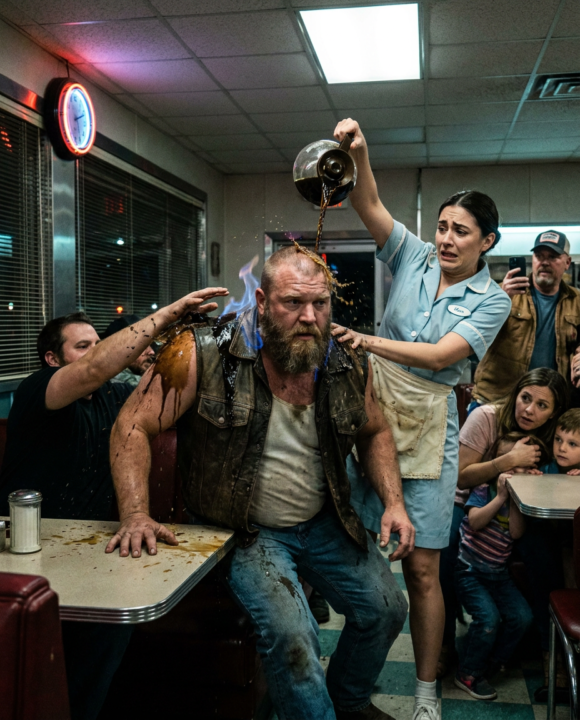
The cold coffee hit Hammer’s scalp first, then divided around his ears and ran through his beard. Most of it struck the right shoulder of his vest, exactly where the blue flame was moving.
The fire collapsed.
Steam and bitter coffee vapor rose together.
Hammer’s mug broke on the floor.
Boone stood.
So did Deacon. Lobo came out of the booth with both hands open, while Wyatt stepped between the frightened customers and Cole knocked over his chair.
The sound was enormous.
Boots. Glass. Screams. The scrape of steel chair legs. A child crying beneath a table.
Boone caught my wrist before I could reach for another container.
“What did you do?”
“He’s burning!”
“He’s drinking coffee.”
“His back!”
Boone looked.
The flame was almost invisible beneath the ceiling lights. He saw only black coffee running from Hammer’s collar and believed I was searching for an excuse.
Our manager, Dennis Holt, came through the kitchen door carrying a spatula.
“Mara!”
“Get the extinguisher.”
“You just assaulted a customer.”
“Dennis, get the extinguisher!”
The college student held his phone toward us. He had captured everything beginning half a second before I poured.
From his angle, there was no flame.
Only me.
One of the truckers grabbed my shoulder. Another dialed 911 and announced that a waitress had attacked a biker gang.
Hammer turned toward me.
He did not roar.
That frightened me more.
Coffee dripped from his eyebrows. His cheek scar shone beneath the fluorescent light. One blackened patch curled away from his shoulder.
“Why?” he asked.
I pointed.
The neon clock flickered off.
Darkness covered the diner for one beat, leaving only the red kitchen light and the moon through the windows.
Every person saw it then.
A blue crescent burned beneath Hammer’s collar.
Boone released me.
“Cut off the vest,” I said.
Deacon moved first. He drew a rescue knife from his belt and sliced through the front fastening. Hammer tried to help, but the gasoline-softened lining had fused against his cotton shirt near the shoulder.
When Deacon pulled, a black edge peeled away.
Hammer did not flinch.
“Brother,” Boone said quietly.
“I know.”
“No, you don’t. That’s the problem.”
Dennis returned with the extinguisher but aimed it toward Hammer’s face. I pushed the nozzle down and told him to wait. The coffee had extinguished the visible flame, and blasting dry chemical into Hammer’s eyes would not help.
Then liquid reached the floor.
Coffee mixed with gasoline running from the vest. A thin stream traveled beneath the counter toward the base of the wall heater.
The pilot clicked again.
“Everybody out!” I shouted.
Customers froze.
People often do when commands become real.
I pointed toward the front door. “Leave your food. Leave your bags. Take the children outside now.”
The mother dragged her boys from beneath the table. Wyatt held the door. Lobo helped the elderly couple stand, one on each arm. Boone moved customers without touching anyone harder than necessary.
Cole remained beside Hammer.
His face had gone gray.
“This is mine,” he said.
Hammer looked at him.
“Later.”
“I spilled it.”
“Later, prospect.”
The word landed like a door closing.
A flash of blue appeared near the heater.
Dennis discharged the extinguisher across the baseboard. White powder exploded into the air, coating the coffee, fuel, boots, and lower cabinets.
The pilot vanished.
For three seconds, I believed the danger had ended.
Then smoke came from Hammer’s shirt.
Deacon cut from the waist upward. The cloth separated, revealing a web of old grafted skin across Hammer’s back and a fresh red burn forming near his shoulder blade.
He should have screamed.
He did not even turn.
That sight silenced Cole.
I took a pitcher of clean water from the sink and cooled the burned area while Deacon checked Hammer’s airway. The beard around his collar had singed, but he was breathing normally.
“Any pain?” Deacon asked.
“Left knee.”
“From the fire.”
“No.”
Hammer sounded irritated by the question.
The jacket lay on the tile. Flames were gone, but gasoline continued evaporating from it. Boone used metal tongs from the grill to lift it and carried it outside.
Hammer stopped him.
“Inside pocket.”
“Forget the pocket.”
“Boone.”
Something in his voice changed.
Boone placed the vest on the hood of an abandoned sedan beyond the parking lot. He opened the wet leather carefully and found the small inner compartment.
Its edge had burned through.
A flattened metal case slid out and struck the pavement.
The lid opened.
I saw a red child’s barrette, partly melted on one side. Beneath it lay a photograph browned by age and a folded letter protected inside a plastic sleeve.
Boone closed the case before I could read anything.
Sirens approached from the east.
The sheriff’s deputy arrived before the ambulance because dispatch believed an assault was underway. He found Hammer shirtless in the parking lot, six bikers surrounding him, and me holding a water pitcher.
Dennis rushed outside.
“She poured coffee on a customer.”
“She put the fire out,” Boone said.
The college student showed the deputy his video. It began with the coffee.
The officer watched twice.
“Is there footage of the flame?”
“Not from where I stood.”
Dennis crossed his arms. “I didn’t see one until after she threw the coffee.”
Hammer looked at the deputy.
“She saved me.”
“Did she injure you?”
Hammer glanced at the forming burn on his shoulder.
“Fire did.”
“Do you want to make a complaint?”
“No.”
The ambulance arrived. Paramedics wrapped Hammer’s back in sterile dressings and asked him to lie down.
He refused until every customer was outside and the fire department confirmed that gasoline vapor had cleared from the diner.
That was Hammer.
He could not feel part of his own body, yet he counted strangers before allowing anyone to treat him.
The fire captain examined the heater, the fuel trail, and the blackened vest.
“You got lucky,” she told him.
Hammer looked toward me.
“No.”
The word came out rough.
“I got seen.”
That should have ended the night.
Instead, the student uploaded his twelve-second video before the ambulance left. Its caption accused a waitress of pouring coffee over a veteran biker because he complained about service.
By 1:00 a.m., thousands of people had watched it.
By 1:20, someone posted the diner’s address.
Dennis received threats. I received worse. The owner told me not to return until the situation settled.
Meanwhile, Hammer lay in a hospital bed while Deacon explained that the new burn might require another graft.
Boone sat beside him with the scorched metal case.
“We have to tell her,” Boone said.
“No.”
“She already saw the barrette.”
“She doesn’t know what it means.”
“Not yet.”
Hammer stared at the ceiling.
Boone placed the old photograph on his chest.
“You rode thirty-two years to make sure she lived,” he said. “Tonight she made sure you did.”
Hammer closed his eyes.
The false story was spreading across the country.
The true one was waiting inside a burned letter.
Part 4 — The Child Beneath the Leather Jacket
Boone came back to the Mesa Bell at three in the morning.
Firefighters had opened every window. White extinguisher powder covered the floor, coffee dripped from the counter, and broken ceramic lay beneath the stool where Hammer had been sitting.
I was cleaning alone.
Dennis had ordered me home, but the diner had belonged to my mother before it belonged to him. I would not leave it smelling of gasoline.
Boone entered without his vest.
That made him look smaller.
Not harmless. Just tired.
He placed the flattened metal case on the counter between us.
“Hammer told me not to show you.”
“Then why are you here?”
“Because brothers can be wrong.”
He opened the lid.
The red barrette lay on top. Its plastic petals had melted along one edge, but three remained intact.
I owned a pair of them as a child.
My mother had purchased them at a pharmacy in Albuquerque because I wanted red flowers in my hair for my fifth birthday. One disappeared during the Sun Mesa fire.
Beneath the barrette was the photograph.
The image had been taken on the highway outside the burning motor court. A young man knelt in the gravel without a shirt. His long dark hair was partly burned, his back raw beneath streams of water, and his arms remained wrapped around a little girl wearing one red barrette.
My mother stood above him, emptying a diner coffee urn across his burning leather jacket.
The girl was me.
The man was Hammer.
I knew my mother’s face instantly. She looked twenty-nine, terrified, and determined. Smoke covered half the sky behind her.
The photograph captured the moment after Ray Dawson brought me out.
Not a firefighter.
Not a police officer.
A twenty-four-year-old biker with a stolen motorcycle part in his saddlebag and an active warrant for missing a probation meeting.
Boone told me what happened.
Hammer had been called Ray back then. He had grown up outside Gallup with a father who repaired mining equipment when sober and broke furniture when he was not.
Ray learned engines early. He also learned that machines were easier to predict than men.
At nineteen, he helped steal three motorcycles from a dealership warehouse. He claimed he only changed the ignition assemblies. The court considered that participation.
He served eighteen months.
When the Sun Mesa fire happened, Ray had been out for less than a year. He and Boone were riding east in an unreliable pickup with two motorcycles tied in the bed.
They stopped across from the motor court after the pickup overheated. Ray heard glass break and saw smoke coming from Room 8.
Other guests were already outside.
A woman was screaming that her daughter was missing.
The hallway entrance had become impassable. A maintenance worker warned that the roof might collapse. Boone ran to wake the night manager and call firefighters.
Ray wrapped a wet leather jacket around his head and went through a bathroom window.
He found me beneath the sink.
Children hide when frightened.
I had crawled into the cabinet because smoke covered the ceiling. Ray broke the doors with his boots, wrapped his jacket around me, and carried me to the window.
Then the ceiling came down.
Burning insulation struck his back. Gas from a ruptured line ignited along the jacket. Ray kept me beneath him while crawling through broken glass.
Outside, my mother saw the flames.
The nearest water was inside the coffee urn she had carried from the diner.
She poured it over him.
It was the same motion I had made thirty-two years later.
Boone said Hammer spent six weeks in a burn unit and underwent eleven operations over the next four years. Infection nearly killed him twice. Nerves across his right shoulder and upper back never recovered.
The probation warrant was resolved while he lay in the hospital. The judge visited him, looked at the grafts, and told him the court could not pretend the fire erased his past.
Ray answered, “Wasn’t asking it to.”
That response impressed the judge more than an apology would have.
Ray completed probation. He found work repairing diesel engines, then opened a motorcycle shop with Boone. The Iron Mercy Riders grew from six men who fixed stranded bikes without charging into a brotherhood that escorted veterans, recovered stolen motorcycles, and raised money quietly for burn units.
Hammer never spoke publicly about Sun Mesa.
My mother wanted to thank him. He refused money, interviews, and a ceremony proposed by the town council.
He accepted only three things.
The photograph.
My missing barrette.
And one promise.
He asked my mother never to tell me I owed my life to him.
“She gets to grow up free of that,” he said. “No debt.”
My mother respected the promise, but she continued writing to him.
The letter inside the case was the last one.
Boone unfolded it.
Ray,
Mara starts college next month. She wants to become a paramedic, though she still gets quiet whenever she smells smoke. You asked me not to tell her your name, and I have kept that promise. But every August, tuition arrives from a fund that claims it belongs to Route 66 mechanics. I know what you are doing.
You carried her once. You do not have to keep carrying her.
If she ever meets you, let her buy you one cup of coffee. Just make sure it is better than mine.
Evelyn
I read it twice.
Then a third time.
During my first two years of community college, an anonymous mechanics’ fund paid the balance my scholarships did not cover. When my mother became ill, the same fund covered three months of rent.
I had believed it came from a regional trade association.
It came from Hammer’s shop.
“Did he know I worked here?” I asked.
Boone looked toward the photograph above the pie case.
“He knew you came back to Tucumcari. He didn’t know which nights you worked.”
“Why was he here tonight?”
“Every November nineteenth, he rides past the old motel site. Usually he keeps going.”
“Why did he stop?”
Boone gave a tired smile.
“Cole was soaked in gasoline. Hammer needed coffee, water, and an excuse to keep the kid from realizing how badly he’d messed up.”
The giant biker had entered my diner while protecting a younger rider from shame.
He sat beneath the photograph of the fire that destroyed the nerves in his back.
Then he started burning again.
I had poured coffee on him before knowing who he was.
My mother had done the same thing.
Boone pushed the metal case toward me.
“He says the barrette belongs to you.”
I closed the lid.
“No.”
“Why?”
I looked at the coffee stain surrounding Hammer’s broken mug.
“Because it already found where it belongs.”
At the hospital, Hammer learned Boone had shown me the letter.
For the first time in twenty years, the two men argued like strangers.
Hammer called it betrayal.
Boone called it overdue.
Then Hammer removed the Iron Mercy ring from his finger, placed it on the bedside table, and told Boone to leave.
The brotherhood had survived prison, war, funerals, and thirty years of hard roads.
It almost broke over a five-year-old girl’s red barrette.
Part 5 — What the Short Video Left Outside the Frame
Hammer remained in the hospital for four days.
The burn covered a narrow section of his shoulder and upper back. Because the coffee had extinguished the flame quickly, surgeons avoided another major graft.
The doctor told him he had been seconds from a deeper injury.
Hammer looked toward the window.
“How many?”
“Seconds?”
“Yeah.”
“Perhaps ten.”
He nodded as though somebody had handed him a bill.
I visited on the second afternoon carrying a fresh pot of coffee.
The nurse at the desk looked at me, looked at the news playing silently above her, and asked whether bringing glass containers into Hammer’s room was wise.
“It’s stainless steel,” I said.
Hammer was sitting upright when I entered. His back was bandaged, his beard had been trimmed around the burned section, and the skin above his right eyebrow had healed from a small cut caused by the broken mug.
He did not greet me.
I placed the insulated pot on the table.
“Hot?” he asked.
“Yes.”
“Keep it over there.”
That was the closest Hammer came to a joke.
I poured two cups and set his down only after testing it with my hand. He watched the motion.
“My mother wrote that I should buy you one.”
“She wrote too much.”
“She kept your secret.”
“So did Boone. Until he didn’t.”
“He thought you might die.”
“I had a surface burn.”
“You were wearing gasoline beside an open pilot.”
Hammer studied his coffee.
“Still a surface burn.”
We sat without speaking.
The silence did not feel empty. It felt like the quiet after a fire alarm stops, when nobody trusts the building yet.
Finally, I asked why he had carried my barrette for thirty-two years.
Hammer touched the edge of his bandage.
“Doctors told me what I lost.”
“What did you lose?”
“Feeling. Movement. Some work.”
He looked toward the metal case on the windowsill.
“That little thing reminded me what came out.”
He had never regarded the scars as proof of what fire took. The barrette reminded him a child survived beneath the jacket.
I asked about the tuition fund.
Hammer’s jaw tightened.
“Your mother asked for nothing.”
“That doesn’t answer me.”
“You wanted training.”
“I didn’t finish.”
“You tried.”
Again, the answer was only two words.
It carried more kindness than a speech.
Cole arrived that afternoon with Boone, Deacon, and the scorched vest sealed inside an evidence bag. Hammer’s ring remained on the bedside table.
Cole stood near the door.
“I told the fire investigator everything.”
Hammer waited.
“The pump, the spill, you covering the woman and baby. I should’ve made you remove the cut. I should’ve warned the diner.”
“You should’ve controlled the nozzle.”
“I know.”
“No. Now you know.”
Cole removed the plain prospect patch from his pocket and placed it beside Hammer’s ring.
“I’m done.”
Boone began to speak, but Hammer raised one hand.
“Why?”
“I almost got you killed.”
“You made a mistake.”
“I hid it.”
“There it is.”
Hammer told Cole to pick up the patch.
The young man did.
“You don’t earn a place here by never failing,” Hammer said. “You earn it by telling the truth before somebody else burns.”
Cole looked toward Boone.
Hammer pointed at him.
“Don’t look at your uncle. Answer.”
“I understand.”
“Good. Spend six Saturdays with Deacon doing fuel-spill training. Then tell me again.”
Cole returned the patch to his pocket.
Brotherhood survived.
Not because the men excused what happened.
Because Hammer gave the mistake somewhere useful to go.
The investigation found three failures at the Mesa Bell. The pump shutoff had been defective. The diner’s wall heater lacked a proper safety shield. The exposed pilot sat too close to the entrance and should have been replaced years earlier.
Dennis had signed inspection forms without reading them.
When the owner threatened to fire me, the fire captain delivered her report in person. She explained that cold coffee was not an approved extinguishing method, but the water-heavy liquid had been the closest immediately available option and had stopped a moving flame before it reached Hammer’s beard and airway.
A fire extinguisher would have been better.
Ten seconds later would not.
The college student’s short video continued spreading until the mother of the two boys uploaded her own recording. Her angle showed the blue flame climbing Hammer’s back before I lifted the carafe.
It also showed Hammer placing himself between me and his brothers after the coffee fell.
The public story reversed overnight.
The same strangers who called me violent began calling me a hero. The same accounts that described Hammer as a criminal called him a legend.
Neither description interested us.
One had been based on twelve seconds.
The other was based on twenty-eight.
Neither included the thirty-two years between two coffee pots.
Reporters arrived at the hospital. Hammer refused interviews. I answered one question outside.
“Did you know who he was when you saved him?”
“No.”
“Would it have changed what you did?”
“No.”
That ended the interview.
The Iron Mercy Riders repaired the diner while the owner replaced the heater and pump. Lobo rewired the entrance. Wyatt installed a proper fuel shutoff. Deacon trained every employee to use extinguishers and fire blankets.
Cole cleaned the coffee stain beneath the counter by hand.
Boone repaired Hammer’s vest.
He replaced the burned lining with fire-resistant material and stitched a narrow brown line around the damaged shoulder. On the inside, he created a new pocket for the metal case.
Hammer did not ask for his ring back.
Boone returned it anyway.
When Hammer came to collect the vest, the two men stood in the parking lot beside their motorcycles.
“You crossed a line,” Hammer said.
“I know.”
“You’d do it again?”
Boone considered lying.
“Yeah.”
Hammer placed the ring on his finger.
“Figured.”
Then he handed Boone his helmet and climbed onto the Harley.
Before leaving Tucumcari, he came inside for coffee.
I placed one mug before him.
Hammer looked at it.
“Cold?”
“Not unless you catch fire.”
He grunted.
Outside, six engines started beneath the blue clock. The sound rolled through the windows, crossed old Route 66, and reached the empty ground where the Sun Mesa Motor Court had once stood.
For the first time, Hammer did not ride past it.
He stopped.
So did all five brothers.
I watched from the diner as Hammer removed the metal case from his vest, held it for a moment, and returned it to the pocket.
Then he looked back at me.
One scarred hand rose from the handlebar.
Mine rose from behind the glass.
No debt.
Just recognition.
Part 6 — The Brown Stitch in Hammer’s Vest
The Mesa Bell reopened three weeks later.
A metal shield covered the new heater. The old pump was removed completely. Two extinguishers hung where every employee could reach them without crossing the kitchen.
Dennis stopped treating inspection forms like receipts.
He read every line.
We mounted no heroic plaque. Hammer would have removed it. Instead, I placed the warped coffee carafe on the upper shelf behind the counter, where it looked like another piece of tired diner equipment.
Only regular customers knew why it was there.
The college student returned to apologize. He had deleted the original video, though copies continued circulating.
“I posted before I knew what happened,” he told me.
“That was the problem.”
He looked toward the old carafe.
“Can I make a video explaining everything?”
“You can make one about waiting.”
He did.
It received fewer views.
That felt appropriate.
Cole completed his six Saturdays of fuel-safety training and asked Deacon for six more. He began carrying absorbent pads, a fire blanket, and a small infrared thermometer on every ride.
Before Hammer entered a diner, Cole quietly scanned the older man’s back for heat.
Hammer pretended not to notice.
Boone said that was how gratitude looked on him.
The red barrette remained in Hammer’s repaired vest. The photograph and my mother’s letter stayed beside it. I gave him a new plastic sleeve to protect them from water and gasoline.
“You could keep these somewhere safer,” I said.
“Could.”
“A locked box.”
“Wouldn’t be with me.”
I understood.
Every November nineteenth, the Iron Mercy Riders returned to Tucumcari. They stopped across from the empty motel lot, killed their engines, and stood in silence for exactly one minute.
Afterward, they entered the Mesa Bell.
Hammer always chose the stool beneath the blue clock.
I poured his coffee and tested the mug before placing it in his hand. He complained that I treated him like damaged equipment.
“You listen to damaged engines,” I said.
“They complain less.”
The scar on Hammer’s new burn faded from red to pale silver. Sensation never returned. His doctor warned the numb area might continue spreading as damaged nerves aged.
The club responded without speeches.
Boone placed temperature strips inside Hammer’s riding gear. Deacon replaced the batteries in his smoke detectors. Cole fitted a heat sensor beneath the collar of Hammer’s new jacket.
If the temperature rose too quickly, a small motor vibrated against the part of his chest he could still feel.
Hammer called it irritating.
He never removed it.
The brown stitching around the repaired section of his vest slowly darkened beneath road dust. From a distance, it looked like another scar.
Up close, it traced the exact path the blue flame had traveled.
Part 7 — This Time the Coffee Stayed in the Cup
One year after the fire, Hammer arrived alone.
The other riders waited near the former Sun Mesa site, but he crossed Route 66 and entered the diner first.
The V-twin engine stopped beneath the window. His boots struck the tile. The chain at his wallet tapped once against the counter.
Every sound returned me to that night.
Hammer looked older. His beard held more gray, and his right shoulder moved stiffly beneath the repaired leather. The brown stitching remained visible along the collar.
He sat beneath the blue clock.
I poured coffee.
Before I could set the mug down, a warning buzz came from inside his jacket.
Both of us froze.
Hammer touched his chest.
I smelled the air.
No gasoline.
No smoke.
The sensor had reacted to heat from the new wall vent.
Cole ran through the door carrying an infrared thermometer, followed by Boone and the other riders. Within seconds, six men surrounded Hammer and inspected his vest while customers watched.
Hammer endured it for almost a minute.
Then he looked at me.
“They’re getting worse.”
“At keeping you alive?”
“At being subtle.”
Boone heard him.
“Subtle didn’t work last time.”
The men returned to their table. Cole checked the vent and adjusted the sensor threshold before allowing Hammer to sit down again.
I placed his coffee on the counter.
Hammer wrapped both hands around the mug.
“Your mother’s was worse,” he said.
“You remember her coffee?”
“Could strip paint.”
I smiled.
“Then why did you keep returning?”
Hammer looked at the framed photograph above the pie case. My mother stood at the edge of the old image, frozen forever beside smoke and broken windows.
“Had to make sure the little bird kept breathing.”
He said it casually.
Then he drank.
Outside, the other motorcycles waited beneath a pale November sky. Their chrome reflected the blue diner clock and the empty ground across the highway.
Hammer finished one cup and left three dollars beneath the saucer.
At the door, he stopped.
The repaired vest creaked when he turned. The red barrette rested somewhere inside it, beside my mother’s letter and the photograph of two strangers saving each other thirty-two years apart.
“Next year?” I asked.
Hammer nodded.
“If the coffee improves.”
He stepped outside. Six V-twin engines came alive one after another, low and uneven, until their separate sounds became one rumble.
Hammer joined the formation.
Before pulling onto Route 66, he looked through the window and raised one scarred hand.
I raised the coffee pot.
He pointed at it and shook his head.
This time, the coffee stayed in the cup.
Drop BLUE below and follow the page for more full stories about bikers whose quiet scars reveal what crowds miss.