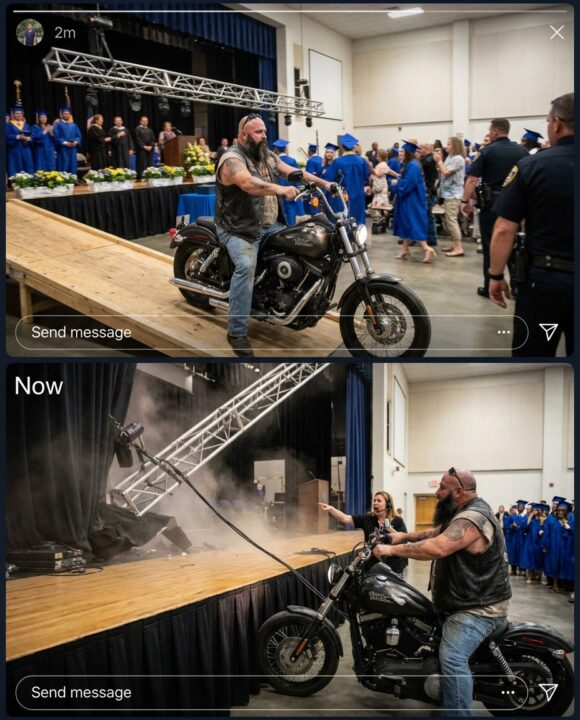
Part 2: The Biker Rode His Harley Straight onto the Graduation Stage—Then Used the Motorcycle to Pull a Falling Steel Light Rig Away from Two Hundred Students
Part 2 — The Boy Hammer Promised to Watch Graduate
Eli’s father, Thomas Carter, rode with Iron Mercy for six years without becoming a patched member.
He preferred construction helmets to motorcycle clubs, although he joined weekend charity runs and repaired the clubhouse roof whenever Bear complained about leaks.
Thomas worked as a structural welder.
He inspected bridges, industrial stairs, stadium rails, and heavy supports most people walked beneath without noticing.
Hammer respected him because Thomas never approved work to protect a deadline.
“Steel doesn’t care about excuses,” he often said.
When Eli was nine, Thomas died at a highway construction site after a distracted driver entered a closed work zone.
The death left Denise with medical debt, funeral costs, and a boy who stopped believing adults returned when they promised.
Eli broke windows.
He fought classmates.
He stole a motorcycle helmet from a sporting-goods store, though he had nowhere to ride.
Hammer attended juvenile court beside Denise.
The judge asked whether he was family.
Hammer answered, “Close enough to stay.”
That became his role.
He did not replace Thomas.
He showed Eli how to clean tools, change oil, admit mistakes, and return stolen property without expecting public praise.
When Eli skipped school, Hammer found him inside an abandoned bus garage.
He did not lecture.
He handed the boy a broom.
They cleaned the clubhouse until midnight.
Eli eventually asked why Hammer always wore a red tassel inside his vest.
The biker said it belonged to Madeline.
Nothing more.
Eli learned the rest from Marisol.
Madeline Dawson loved stage design. She painted sets, repaired costumes, and argued that technical crews deserved applause because actors looked impressive only after invisible people made the room safe.
Hammer worked as a union stage rigger then.
He installed suspended lighting systems for theaters, concert halls, and civic venues.
On the afternoon of Madeline’s final rehearsal, Hammer heard a metallic ticking above the community-theater stage.
He reported it to his foreman, Carl Bannon.
Bannon inspected the rig from the floor and blamed temperature movement.
Hammer trusted him.
Two hours later, the truss dropped during a lighting transition.
Three students were injured.
Madeline died before paramedics reached the hospital.
Investigators found a locking pin had not fully seated. A secondary cable reduced the fall but failed to redirect the frame away from the student crew.
Bannon altered part of the inspection log after the collapse.
Hammer discovered the alteration and attacked him outside the courthouse.
He broke Bannon’s jaw.
Hammer served nineteen months for aggravated assault. After release, chronic shoulder pain and grief pulled him into prescription-drug dependence.
He lost his rigging certification.
He almost lost his motorcycle garage.
Iron Mercy refused to lose him.
Bear removed the pills from his house. Marisol drove him to treatment. Doc slept outside Hammer’s bedroom during withdrawal because the man woke believing steel was falling through the ceiling.
Recovery did not erase Madeline.
It changed what Hammer did with the weight.
He stopped working above stages but never stopped hearing rigging.
Chains under uneven tension produced different notes. A sliding pin had a dry, irregular click, while a shifting truss transferred vibration through walls, floors, and handrails.
Hammer noticed sounds other people dismissed.
During Eli’s junior year, Beckford High selected Franklin County Civic Hall for graduation because the school gym required renovation.
The venue’s technical contractor was Bannon Event Systems.
Carl Bannon had retired.
His son, Travis, managed daily operations.
Hammer discovered the connection during rehearsal.
He almost left.
Eli noticed him near the loading entrance and asked why.
“Old place,” Hammer said.
“You’ve never been here.”
“Old people.”
Eli looked toward Travis Bannon.
Then he saw Madeline’s tassel inside Hammer’s vest.
“You promised Dad.”
Hammer nodded.
“I know.”
“You leaving?”
“No.”
That was the first test.
Hammer stayed through rehearsal.
He helped Iron Mercy move accessibility ramps but refused to touch the overhead system because the contractor held legal responsibility.
Then he heard the click.
Hammer informed Travis.
Travis produced a digital inspection record signed by senior technician Nathan Cole. He said the truss used redundant safety systems and accused Hammer of reliving an old trauma through ordinary rigging noise.
The accusation worked because it contained truth.
Hammer did relive Madeline’s death.
That did not make the sound imaginary.
He requested that the venue lower the truss and inspect the primary assembly.
Travis refused.
Principal Ellis asked whether the students faced immediate danger.
Hammer could not prove they did.
The pin remained partially seated, and the frame appeared level.
He submitted a written concern.
The venue logged it.
At least, we believed they had.
Graduation morning, Hammer returned before sunrise. He found the truss already raised and the stage closed to outside volunteers.
A technician assured him the assembly had been checked overnight.
Hammer touched the side support.
No clicking.
He stepped away.
Three hours later, after lights heated the steel and vibrations traveled through speakers, the pin began moving again.
This time, Hammer saw it.
He also saw Eli entering the row beneath the dropping corner.
The Road King waited in the loading lane because Iron Mercy planned a post-ceremony escort.
Between Hammer and the students stood curtains, a wide accessibility ramp, and one hanging maintenance cable.
He did not have time to find a safer machine.
He had only the motorcycle already beneath his hands.
Part 3 — The Stage That Became a Collapse Zone
The civic hall held nearly two thousand people when the truss failed.
Panic created a second emergency before the steel reached the stage.
Parents surged toward exits and front aisles. Graduates scattered between chairs, while teachers shouted conflicting instructions beneath alarms, engine noise, and breaking equipment.
Hammer’s Harley struck a decorative column made from lightweight stage material. The column shattered, causing several parents to believe he deliberately rammed the ceremony.
Security officers chased him onto the ramp.
None could see the moving pin.
Stage manager Evelyn Ross did.
She had worked beneath suspended equipment for nineteen years. When the pin fell beside the podium, she ordered the immediate evacuation Hammer had already begun.
“Clear stage left!”
Her command gave trained crew members direction.
Hammer used the main control cable only because it already carried a prepared maintenance loop and Ross directed him toward the safe pull lane.
This was not a technique anyone should imitate.
It was an emergency improvisation under professional instruction after required protections failed.
The Road King strained against the cable.
Its rear tire lost traction, caught briefly, then moved far enough to draw the loose side of the rig toward the empty loading bay.
The shifting angle kept the truss from descending flat across the graduate rows.
It swung.
That movement saved students while placing Hammer directly beneath the outer edge.
A light fixture hit the saddlebag. The Harley fell onto his right leg, and Hammer’s helmet struck the stage.
The truss landed across curtains, speaker cabinets, the damaged motorcycle, and an unoccupied section of riser.
Emergency crews took twelve minutes to free him.
He remained conscious for nine.
During those minutes, Hammer counted graduates he could see.
He reached thirty-eight before pain interrupted him.
Then he started again.
Eli crawled beneath a row of seats trying to reach him. Firefighter Lena Brooks pulled the boy back and promised Hammer was receiving help.
Eli shouted that promises meant nothing.
Denise held him.
“You made it across,” she said.
“Not yet.”
Graduation had stopped before his name.
No diploma had reached his hand.
Hammer heard through the noise.
“Finish it,” he said.
Eli believed he meant the ceremony.
Hammer meant school, grief, the promise to Thomas, and every unfinished thing the boy had tried abandoning first.
Paramedics transported Hammer to St. Gabriel Medical Center.
His injuries included a fractured lower leg, dislocated shoulder, deep bruising, and a concussion.
No graduate required hospitalization.
Four attendees received treatment for minor injuries sustained during evacuation.
Travis Bannon released a statement within hours.
He described Hammer as an unauthorized individual who drove heavy machinery into a controlled event and interfered with safety equipment during an active ceremony.
The statement suggested the motorcycle’s cable tension caused the truss failure.
Video clips seemed to support him.
Most recordings began when the Harley entered. They showed Hammer attaching the cable, accelerating, and the truss dropping moments later.
Online audiences decided the biker caused the collapse.
Bannon Event Systems demanded his arrest.
The venue suspended Evelyn Ross for directing Hammer.
Iron Mercy members gathered outside the hospital.
Bear wanted to ride directly to the company warehouse and force Travis to preserve records.
Marisol refused.
“Police warrant. Lawyers. Cameras.”
“They’re destroying Hammer.”
“And if we surround them, we help.”
The club divided.
Several riders believed restraint allowed Bannon to erase evidence as his father had after Madeline’s death. Others knew intimidation could compromise the investigation and frighten witnesses.
Eli listened from the hospital corridor.
The boy had spent nine years believing power meant acting first because waiting usually ended with somebody leaving.
Hammer taught him otherwise.
Eli walked between Bear and the elevator.
“He said finish it.”
Bear looked down.
“Finish what?”
“The truth.”
Eli asked every graduate to preserve original phone videos without posting private footage. Students uploaded files through the investigator’s evidence portal.
Parents contributed photographs taken before the ceremony.
One image showed the truss three hours earlier.
The main pin lacked the required locking component.
Another showed Travis Bannon standing onstage beside an open hardware case.
A third captured the safety cable lying disconnected from its normal guide.
Investigators seized the venue’s digital logs.
Hammer’s written warning had been deleted.
The deletion occurred from Travis’s administrator account.
He claimed a clerical error.
Then Evelyn Ross produced a paper copy she had placed inside her lunch bag after noticing the digital log disappear.
Hammer’s report described intermittent metallic movement near the stage-right primary connection.
That was where the failure began.
Travis changed his story.
He admitted a technician found the correct locking clip missing during final setup. Rather than lower the truss and delay graduation, the technician installed a temporary substitute.
Travis approved it.
The substitute did not fit.
Heat, vibration, and movement allowed it to loosen.
The motorcycle did not cause the truss to fall.
Hammer’s pull changed where it landed.
We believed the evidence had cleared him.
Then investigators found Hammer’s fingerprints on the missing original locking clip.
He had handled it before graduation.
Travis accused him of sabotage motivated by Madeline’s death.
The club fell silent.
Hammer remained unconscious.
Only one person knew why his fingerprints were there.
Eli.
Part 4 — The Locking Clip Inside Eli’s Graduation Gown
Eli arrived at the hospital carrying a small plastic evidence bag.
Inside was the proper locking clip.
He had found it during rehearsal beneath the stage stairs.
At the time, he did not know what it was.
The curved metal piece looked like a heavy pin with a retaining loop. Eli handed it to Hammer, asking whether it belonged to a motorcycle.
Hammer recognized it immediately.
He carried the clip to Travis Bannon and asked whether the overhead assembly was missing hardware.
Travis examined it.
He claimed it came from unused equipment stored backstage and told Hammer to discard it.
Hammer refused.
He placed it on the technical desk beside the rigging inspection sheet.
Eli watched.
Later, when Eli returned for his garment bag, he found the clip on the floor. Afraid somebody would trip or accuse him of stealing equipment, he placed it inside his gown pocket.
He forgot.
After the collapse, he discovered it while changing at the hospital.
Hammer’s fingerprints existed because he tried reporting the hardware.
Travis’s fingerprints existed too.
More importantly, security footage showed Travis taking the clip from the desk and dropping it near Eli’s garment bag after Hammer left.
He knew it belonged to the truss.
He did not reinstall it.
Why?
The correct pin assembly required lowering the entire frame, bringing in certified equipment, and delaying graduation several hours.
Bannon Event Systems faced financial penalties for delays caused by improper setup.
Travis chose the substitute.
Then he moved the real clip so nobody could prove it had been found before the ceremony.
That decision mirrored his father’s fourteen years earlier.
Carl Bannon altered Madeline’s inspection record to hide incomplete locking verification. Travis removed Hammer’s report and hid the correct component to conceal a rushed installation.
Two generations protected the company.
Two generations placed children beneath their shortcuts.
Yet the deepest twist involved Madeline.
After her death, investigators recovered her phone but never unlocked the final voice memo because the file appeared corrupted.
New forensic software restored it during the Beckford investigation after detectives reopened the earlier case.
Madeline recorded the rigging noise minutes before the community-theater collapse.
Her voice could be heard beneath it.
“Dad said clicks mean something isn’t seated.”
Then Carl Bannon answered off camera.
“Your dad hears problems because problems keep him employed.”
Madeline asked him to lower the truss.
Bannon refused.
She texted Hammer, but poor reception delayed delivery until after the collapse.
Her message read:
The pin looks wrong. Come check.
Hammer carried guilt for trusting Bannon’s assurance.
Madeline had trusted Hammer’s knowledge.
She tried using it.
Carl dismissed them both.
The restored evidence led prosecutors to review Bannon’s false statements from the original investigation. Statutory limits restricted some charges, but civil claims and professional sanctions followed.
Carl’s rigging credentials were revoked.
Travis faced criminal charges connected to Beckford’s falsified logs, reckless conduct, and evidence tampering.
Evelyn Ross’s suspension ended.
She returned as an independent safety coordinator under a new venue contract.
The investigation cleared Hammer completely.
Public opinion reversed.
Television crews called him a hero. Commentators requested interviews about “the motorcycle miracle.”
Hammer refused.
A motorcycle did not miraculously save graduates.
A warning had been ignored, proper hardware went missing, a trained stage manager directed emergency action, students moved, firefighters responded, and a biker accepted terrible personal risk.
Calling it a miracle made the preventable failure sound unavoidable.
Hammer woke two days after the collapse.
Eli sat beside him wearing his graduation gown over jeans.
“You didn’t finish,” Hammer whispered.
“The ceremony didn’t.”
“Same thing.”
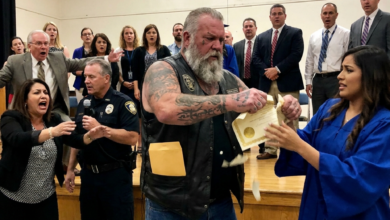
Principal Ellis entered carrying a diploma.
Hospital staff cleared space near the window. Denise stood beside the bed, while Bear, Marisol, and three teachers waited in the hallway.
I called Eli Carter’s name.
He crossed the room.
Hammer tried standing.
Pain stopped him.
Eli received the diploma, turned, and placed it on Hammer’s blanket.
“That belongs to you too.”
Hammer pushed it back.
“No.”
“You promised Dad.”
“I watched.”
“You drove onto the stage.”
“Still watching.”
Eli removed his blue-and-gold tassel.
Inside Hammer’s vest, folded beside Madeline’s photograph, hung her faded red tassel.
Eli tied his beside it.
The colors touched.
Hammer looked toward the window.
His eyes remained dry, but his scarred hand covered both tassels for several seconds.
Then Denise opened a wooden box sent by Madeline’s former theater teacher.
Inside was a folded paper graduation cap.
Madeline had made it months before her death because she planned to attend an early-college information night.
Across the underside, she wrote:
Dad, when I graduate, don’t bring the whole motorcycle club inside.
Eli laughed.
Hammer did too, then winced because laughter pressed against bruised ribs.
The sentence transformed the room.
Madeline had never reached graduation.
Her father had still brought the Harley onto one.
Not for spectacle.
To make sure two hundred other children did.
Part 5 — The Graduation We Finished Without a Stage
Beckford High held a second ceremony six weeks later.
We did not return to Franklin County Civic Hall.
Families gathered on the school football field beneath daylight, with no suspended truss, theatrical lights, or steel frame above the graduates.
The stage stood twelve inches high.
Every structure received independent inspection.
Students could choose whether to participate because some did not want another ceremony after the trauma.
All but seven returned.
Hammer attended in a wheelchair near the back fence.
His injured leg remained in a brace, while his shoulder prevented him from wearing the leather vest properly. Marisol draped it across the chair behind him.
Iron Mercy parked beyond Franklin Road.
No engines interrupted.
Eli entered with his class but kept the hospital diploma at home. He wanted his name called alongside everyone else.
Before the procession, graduates placed two objects on an empty front-row seat.
Madeline’s photograph.
Her red tassel.
Hammer objected when he saw them.
“This isn’t her class.”
Jasmine Moore, student council president, answered:
“She got us here.”
That was not entirely accurate, and Hammer said so.
Madeline warned. Hammer heard. Ross directed. Students moved. Emergency crews responded.
Jasmine nodded.
“Then the chair is for warnings people ignore.”
Hammer accepted that.
During my speech, I did not describe the Harley entering the hall. Most people had seen enough footage.
I spoke about reports, checklists, and the responsibility of adults to stop ceremonies when safety becomes uncertain.
Celebrations can be rescheduled.
Children cannot.
Eli crossed the stage near sunset.
Denise stood.
Hammer remained seated because his leg brace locked, but he lifted one scarred fist above his head.
Eli saw him.
He touched the two tassels hanging beneath his gown.
After the final name, students did not throw caps immediately.
They turned toward Hammer.
Eli walked to the wheelchair and handed him a microphone.
Hammer refused.
The students waited.
He finally took it.
“Check the people above you,” he said.
Parents looked toward the empty sky.
Hammer shook his head.
“Not the ceiling. The people signing the paper.”
That became the only quote he allowed reporters to use.
The district created an independent event-safety policy. Any documented concern involving overhead structures required written resolution by qualified professionals before occupancy.
No administrator could delete a complaint.
No contractor could self-certify corrective work tied to its own error without external review.
Students and volunteers gained clear authority to report unusual movement, sound, heat, smell, or visible damage without being dismissed as disruptive.
Iron Mercy changed too.
Club volunteers stopped accepting informal technical roles outside their credentials. Good intentions no longer substituted for licensing, training, or responsibility.
Hammer became an adviser only on community communication and emergency planning.
He did not inspect rigging.
He knew the limits of experience.
Bannon Event Systems dissolved after losing contracts and insurance. Several employees cooperated with investigators and joined a worker-owned production company requiring independent sign-off.
Hammer opposed harassing those workers.
“They didn’t all make Travis’s choice.”
Bear struggled with that distinction.
He wanted everyone connected to Bannon gone.
Then one technician, Luis Ortega, visited the clubhouse.
Luis admitted installing the temporary clip under Travis’s instruction. He believed the truss would remain stable for one ceremony, though his training told him the substitution was unacceptable.
He carried a resignation letter written before the collapse but never submitted.
“I needed the job,” Luis said.
Hammer looked at Madeline’s photograph.
“So did I.”
Luis expected anger.
Hammer gave him accountability.
“You still made the choice.”
“Yes.”
“Then tell every investigator. Every detail.”
Luis did.
His testimony established how corporate pressure became an unsafe act inside one technician’s hands.
He accepted professional discipline and later retrained before returning to supervised work.
Hammer did not forgive him publicly.
He refused to make forgiveness another performance.
At the next Iron Mercy meeting, Bear asked whether Luis deserved a second career.
Hammer answered:
“Madeline deserved a first one.”
The room became silent.
Then he added:
“Both can be true.”
Brotherhood learned to hold that weight.
Eli enrolled in community college to study emergency management. He continued working inside Hammer’s motorcycle garage, although Hammer prohibited him from touching client brakes without supervision.
Denise asked whether the collapse influenced his career.
Eli said his father taught him steel matters.
Hammer taught him warnings matter.
The stage taught him systems matter.
Years later, Eli became the safety coordinator at Franklin County Civic Hall after its complete renovation.
His first act was not hanging Madeline’s photograph.
It was reviewing every open corrective-action report.
No memorial can replace that work.
Part 6 — The Sound Hammer Still Hears Above Crowds
Hammer never returned to professional rigging.
He still hears suspended metal.
Inside restaurants, schools, theaters, and churches, his eyes move upward whenever a chain settles or ventilation makes a panel click.
The response is physical.
His shoulders tighten. Fingers close, and his breathing pauses until he identifies the sound.
Counseling helped him separate memory from immediate danger.
It did not erase attention.
Every graduation season, Beckford High invites him to rehearsal.
He attends as Eli’s mentor and Madeline’s father, not as an inspector.
A licensed team examines every structure before doors open.
Hammer reads the completed report afterward.
If he asks a question, nobody laughs.
The black Road King survived the stage collapse.
Its saddlebag remained crushed, one crash bar bent, and paint burned where the cable rubbed across its rear assembly.
Hammer refused full restoration.
He repaired only what made the motorcycle roadworthy after independent assessment.
The damaged saddlebag stayed.
Inside, he carries Madeline’s paper cap.
Eli’s tassel remains beside hers in the vest, though he borrowed it once for his college graduation.
Hammer waited in the audience that day.
No motorcycle entered.
When Eli crossed the stage, Hammer checked the overhead rig once, then looked only at the boy.
That was progress.
Afterward, Eli returned the tassel.
Hammer refused.
“Keep yours.”
“You kept it nine years.”
“Borrowed.”
Eli tied both tassels around the Road King’s handlebar.
Red and blue-gold threads moved together whenever the engine idled.
During community events, children ask why the motorcycle looks damaged.
Hammer never says it saved a graduation.
He says:
“Steel landed. Kids didn’t.”
That is enough.
The civic hall now keeps the fallen locking pin inside its safety-training room. Beside it sits Hammer’s original written warning and the inspection log Travis deleted.
No photograph of injured people appears.
The evidence does not need faces to become serious.
Before every major event, staff read the warning aloud.
A sentence near the end says:
Intermittent metallic movement should be investigated before occupancy.
Hammer wrote it with a borrowed pen.
It nearly disappeared.
Now nobody begins a ceremony until someone confirms it was answered.
Part 7 — The Stage Madeline Finally Crossed
Fourteen years after Beckford’s interrupted graduation, the civic hall invited Hammer to its reopening anniversary.
He almost declined.
Eli, now safety director, asked him to come before the public arrived.
They entered through the same loading corridor where the Road King once waited.
The ramp had been rebuilt. New controls lined the wall, and every overhead assembly carried visible independent inspection records.
Hammer touched nothing.
He listened.
No dry clicking.
No shifting chain.
Only air moving through the empty hall.
Eli led him onto the stage.
At center stood one small table.
Madeline’s paper graduation cap rested beside a posthumous certificate from the community theater’s education program.
The certificate did not pretend she completed high school.
It recognized her final safety warning and established a scholarship for student technical crews.
Hammer stared at it.
“You did this?”
“Her teacher did. I checked the paperwork.”
Hammer almost smiled.
Eli handed him Madeline’s restored voice memo inside a small player.
Hammer did not press the button.
He knew her final recorded words.
He had spent years hearing them inside dreams.
Instead, he placed the paper cap on his shaved head.
It barely fit.
Eli laughed.
Hammer walked from one side of the stage to the other, passing beneath the lights Madeline never lived to design.
No audience applauded.
No cameras recorded.
At the far side, he removed the cap and placed it beneath his vest.
“Done?” Eli asked.
Hammer looked back toward the empty stage.
“She crossed.”
Outside, the Road King waited beneath morning light. Its bent saddlebag caught the sun, while two tassels moved beside the handlebar.
Hammer started the engine.
Eli opened the loading door.
This time, the motorcycle rode away from the stage.
No steel followed.
Follow our page for more unforgettable biker stories about frightening misunderstandings, tested brotherhood, hidden warnings, and rough men who refuse to lose another child.