Police Ordered a 285-Pound Biker to Drop the Knife Inside Their Station — Then He Looked Through the Glass and Asked One Question About a Boy in the Rain
The first time I saw Ray Dawson, he walked into my police station carrying a sheathed hunting knife in one tattooed hand—and asked me to give him a receipt before I decided whether to put him in cuffs.
I was the desk sergeant that Thursday evening at Dayton Central. Rain had been pushing trash along Third Street since lunch, and the lobby smelled of wet coats, old coffee, and the lemon cleaner our custodian used on the tile.
Then the outer door opened.
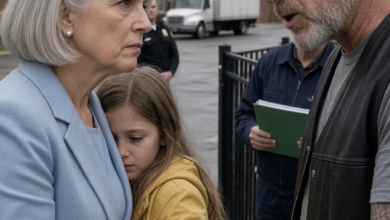
Ray stood six-foot-four and close to 285 pounds, with a shaved head, a thick black-and-gray beard, and tattooed forearms exposed beneath a plain leather vest. Water ran from his shoulders. His motorcycle boots left dark prints behind him.
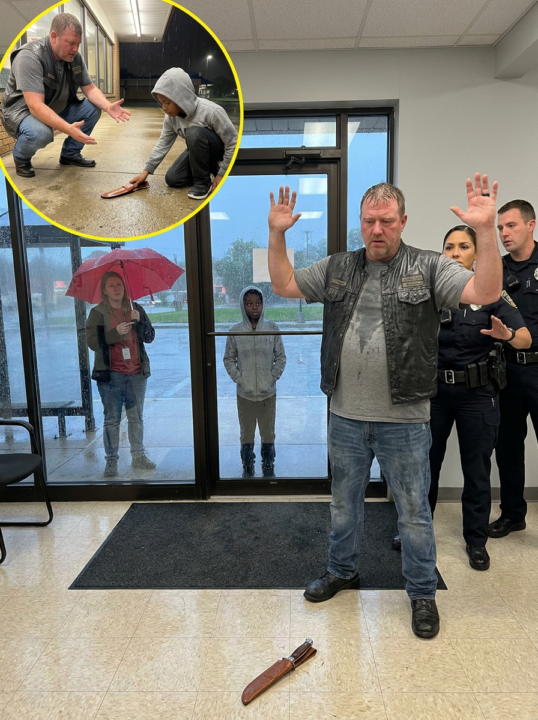
In his right hand was a knife in a worn brown sheath.
Officer Nolan saw it at the same moment I did.
“Put the knife down. Now.”
Ray stopped.
He did not reach toward his vest. He did not argue. He lowered the sheathed knife onto the floor, moved one boot backward, then raised both hands where we could see them.
The lobby became completely silent.
Nolan moved in from the side while I came around the desk.
Ray looked frightening enough to make every reaction seem sensible. Yet his eyes were not on Nolan’s hand or my badge.
They were fixed on the clock.
“Need it logged before six,” he said.
That was not the sentence I expected.
“What happens at six?” I asked.
“Intake starts closing.”
“Intake where?”
He pressed his lips together. “Can we secure the blade first?”
We did. Nolan placed Ray against the wall and checked him for other weapons. There were none. In one pocket we found a wallet, a motorcycle key, and two crumpled bus-transfer slips. In another was a folded card from a youth shelter.
No name was visible from where I stood.
“Whose knife is it?” I asked.
“It was handed to me.”
“By whom?”
“Somebody who wants it gone.”
That answer made Nolan’s expression harden. “Was it used in a crime?”
“Not that I know.”
“You expect us to take your word?”
“No, ma’am.”
He said it without attitude. His voice was rough, but his hands remained open against the wall.
I had spent twenty years watching people decide which details to offer and which ones to bury. Ray was withholding something. I was certain of that. What I could not tell was whether he was protecting himself, protecting evidence, or protecting a person who might still be in danger.
Then I noticed the plastic grocery bag near the door.
It contained a clean sweatshirt, sealed socks, crackers, and a paper cup with a lid. Ordinary things. Everything looked sized for someone much smaller than Ray.
Nolan noticed them, too.
“Who are those for?”
Ray glanced through the rain-streaked glass. “Kid outside.”
I looked toward the curb. Under the bus shelter across the street stood a thin figure in a gray hoodie beside a woman holding a red umbrella. The kid was watching our doors without moving.
“Bring him in,” Nolan said.
Ray finally turned from the clock.
“Not until you tell me whether walking through that door makes him a suspect.”
That was the moment the station changed for me. The huge biker had entered carrying a knife, accepted two officers closing in on him, and still seemed less worried about his own freedom than about what our doorway might do to a frightened boy.
I asked Ray why the shelter card was in his pocket, why intake mattered, and why he had brought the knife instead of throwing it into the river or leaving it in an alley.
His answer was only seven words.
“Because somebody would find it after we left.”
Then the boy across the street lifted his head, and I saw fear cross his face when Nolan reached for the evidence bag.
Ray had not come to hide what the teenager carried—but until we learned why the boy surrendered it, none of us knew whether the biker had saved his future or walked into a crime.
Part 2 — The Bed That Would Not Stay Open
The woman with the red umbrella introduced herself as Tessa Monroe, an outreach coordinator from Harbor House Youth Shelter. She placed the intake form on my desk but kept one hand over the name.
“He is not accused of hurting anyone,” she said.
Nolan glanced at the knife.
Tessa followed his eyes. “I said he isn’t accused. I didn’t say there isn’t a problem.”
Before she explained, Ray asked me to let the boy stay outside until we understood what entering the station would mean. I told him nobody could guarantee an outcome before we knew the facts. He accepted that. Then he asked if Tessa could tell us what had happened without identifying the teenager until identification became necessary.
It was an awkward request. It was also a reasonable one.
The story began six blocks west of us, ninety minutes earlier.
Ray belonged to a riding club called the Iron Lanterns, a mixed group of mechanics, nurses, warehouse workers, veterans, and retirees who used a borrowed storage unit near Route 4. That afternoon, five members had loaded hygiene kits and winter clothing into a pickup while Ray followed on his old Harley.
He hated carrying boxes on the bike. He liked hearing the engine beneath him after a bad day. Those were the only two explanations he gave.
Harbor House was their last stop. Rain had started as they unloaded, tapping against helmets and turning the alley behind the shelter the color of dirty steel. Ray carried in cases of socks while Tessa checked names at the intake desk.
That was when he noticed the boy.
Malik Carter was sixteen, Black, thin from weeks of irregular meals, and wearing a gray hoodie that had never been designed for November rain. A canvas backpack hung from one shoulder. He stood near the entrance but would not cross the yellow line on the floor.
Tessa had a bed available. Malik had completed most of the intake questions. He had even allowed staff to call the school district’s homeless-student liaison.
Then he refused the required bag and pocket check.
Harbor House had a firm safety rule: residents could not bring weapons inside. Staff did not search teenagers by force, and refusing inspection was not itself a crime. But no completed safety check meant no bed.
Tessa offered to store ordinary prohibited items in a locked property cabinet. Malik still said no.
“Then I can’t admit you tonight,” she told him.
He backed toward the door.
Ray was stacking boxes against the wall. He did not step into the argument. He asked Tessa whether she needed him to move the socks. That gave Malik a moment in which nobody was staring at him.
The boy left.
Ray watched through the glass as Malik crossed the parking lot without raising his hood.
“You calling police?” he asked.
“No offense was reported,” Tessa said. “I’m calling our street team.”
“You know what he’s carrying?”
“No. I know he’s frightened of letting anyone see it.”
Ray looked at the clock above the intake desk. A bed could be held temporarily, but not all night. Several other teenagers needed placement, and Harbor House could not promise a space it was not using.
“How long?” he asked.
Tessa gave him the deadline. Six o’clock for Malik to resume intake, with some flexibility if a verified plan was already underway.
Ray followed at a distance after notifying Tessa. One of his club brothers, Boone, came with him. They found Malik beneath the awning of a closed laundromat, trying to open a packet of crackers with cold fingers.
Ray stopped far enough away that the boy still had a clear path to the sidewalk.
“Shelter’s got your bag,” Malik said.
“Club donated it.”
“So you work there?”
“No.”
“You a cop?”
Ray almost smiled. “Not with this beard.”
Malik looked toward Boone, who had remained near the bikes. “Then why are you following me?”
“Because there’s a dry bed behind you and rain in front of you.”
The boy’s jaw tightened. “You don’t know anything.”
“That’s true.”
The answer stole the next argument from him.
Ray sat on the concrete ledge beside a newspaper box. Water dripped from his beard. He did not ask Malik to sit, explain himself, or become grateful.
He opened his own packet of crackers.
For several minutes, the two of them ate without pretending it was trust.
Malik eventually asked what time it was. Ray answered. Five minutes later, he asked again.
At 4:51, Tessa called Ray. She had obtained permission to meet Malik at a neutral location and complete intake there if the safety issue could be resolved lawfully. She could not tell Ray to take possession of anything. She could explain the available options and ask what Malik wanted.
Ray put his phone on speaker only after Malik agreed.
Tessa said the shelter could store many belongings, but not a weapon. If Malik believed an item had been used in a crime, police needed the truth. If it had not, the department might accept a voluntary surrender for disposal, but nobody could promise what officers would decide before hearing the facts.
Malik stared into the rain.
“Police see me with it, I’m done,” he said.
Ray did not tell him that fear was foolish. He did not promise immunity. He said there might be another way to walk into the station—one that began with Malik choosing to hand over the item before anyone searched him.
The teenager studied the enormous man in leather.
Then he asked Ray the question that changed the afternoon.
“If I give it to you, will you say it was yours?”
Part 3 — The Choice Beneath the Laundromat Awning
Ray’s answer came without hesitation.
“No.”
Malik turned away. “Then forget it.”
“I won’t lie for you,” Ray said. “I will stand beside the truth if you tell it.”
“That means I get arrested.”
“It means I don’t know. Anybody who says they know is selling you something.”
Boone shifted near the motorcycles. He was fifty-eight, broad through the shoulders, with a gray ponytail and the permanent squint of a man who had spent thirty years welding. He had wanted to help, but uncertainty made him restless.
“Could put it in a storm drain,” he said quietly.
Ray looked at him.
“No.”
“Nobody gets hurt. Kid gets his bed.”
“And when somebody else pulls it out?”
Boone rubbed his jaw. “Then break it. Toss the pieces.”
Ray’s voice stayed level. “I’m not teaching a kid that his first step indoors has to start with us hiding something.”
The words landed hard because Boone was not cruel. He was trying to solve the next ten minutes. Ray was thinking about what Malik would have to live with afterward.
Malik hugged the backpack against his chest. “You two done talking like I’m not here?”
Ray nodded. “Fair.”
He asked what Malik wanted them to know. Not where he got the item. Not what had happened at home. Just what he needed from the adults standing beneath the awning.
The boy’s answer was small.
“I need somewhere nobody steals my shoes.”
Tessa, still on speaker, said Harbor House had lockers and staff awake overnight. She also said she could not promise perfection. Residents sometimes argued. Things occasionally went missing. But Malik would have a bed, a shower, and a locker with his own key.
Malik looked down at his sneakers. The left sole had begun separating from the upper.
“What happens if I show you?” he asked Ray.
“I step back first.”
“Why?”
“So you don’t think I’m taking it.”
Ray rose slowly, moved several feet away, and turned his hands outward. Boone did the same after a moment.
Malik set the backpack on the ground. He unzipped an inner pocket and removed a hunting knife inside an old leather sheath. He held it close to his leg, not raised, not pointed at anyone.
Boone inhaled sharply.
Ray did not move.
The leather sheath bore two stamped initials: A.C.
“Who is A.C.?” Ray asked.
“My brother.”
“Where is he?”
Malik’s throat worked before sound came. “Dead.”
Rain hammered the laundromat awning, filling the silence the adults refused to fill with easy condolences.
The knife had belonged to Andre Carter, Malik’s older half brother. Andre had used it for camping trips with friends and kept it in a drawer afterward. When he died in a highway collision eighteen months earlier, Malik took it before the apartment was cleared.
It was not only a blade to him. It was the last possession nobody had managed to take.
After Malik’s mother died from complications of an illness, he moved between relatives. One arrangement ended when an aunt lost her lease. Another couch disappeared after the tenant was threatened with eviction for having an extra occupant. Malik began sleeping in transit stations, laundry rooms, and occasionally a friend’s car.
Three weeks earlier, two men had taken his backpack while he slept. They returned the empty bag after finding almost nothing worth selling.
Since then, Malik had carried Andre’s knife.
He said he had never used it against anyone. He had never displayed it in a fight. Tessa knew of no complaint naming him, and no officer was currently looking for him. Yet the knife kept him out of the very shelter that could reduce his reason for carrying it.
A circle with no clean opening.
Ray crouched, but he did not reach.
“You want to keep your brother,” he said. “I get that.”
“You don’t.”
“Probably not the way you do.”
Malik’s grip tightened around the sheath.
Ray asked whether Andre had given him the knife. Malik admitted he had taken it after his brother’s death, before family members divided the belongings. Ray told him that detail mattered and should be told exactly as it happened.
“You trying to talk me into confessing?”
“I’m trying not to make up a better story than yours.”
Malik looked toward the street. A city bus hissed at the corner, opened its doors, then moved on.
Tessa reminded him that he could speak with a youth advocate before answering detailed questions. The choice to seek shelter remained his. No one beneath the awning would grab him or block the sidewalk.
At 5:07, Malik placed the sheathed knife on top of his backpack.
“What if they cuff him?” Boone asked.
Ray looked at Malik rather than Boone. “Then we call the advocate, we tell the truth, and we stay.”
The boy’s eyes narrowed. “You stay?”
“If you want me there.”
“For how long?”
Ray glanced at the dark sky. “Until we know where you’re sleeping.”
It was a promise with edges. Not forever. Not adoption. Not a life repaired before dinner.
Still, Malik could test it.
He pushed the knife across the wet concrete with two fingers. Ray wrapped it in a shop towel from his saddlebag without removing it from the sheath. He called the station, identified himself, described what he intended to surrender, and asked how to approach safely.
The dispatcher instructed him to keep it sheathed and visible, follow officers’ directions, and avoid sudden movement. Ray repeated the instructions so Malik could hear.
Boone wanted to drive the boy in the pickup. Malik refused to sit inside a vehicle with men he had just met. Tessa agreed to meet him at the bus shelter across from the station.
So Malik took the bus. Ray rode behind it. Boone followed at a distance.
At Dayton Central, the outgoing desk officer had noted the call, but a shift change and another arrest kept the warning from reaching me before Ray entered the vestibule.
I saw the knife before I saw the towel tucked beneath it.
“Put it down!”
Ray obeyed.
Within seconds, Nolan had him against the wall. Boone stopped outside. Across the street, Malik saw uniforms surround the biker who had promised to stay and took one step backward.
Then another.
Tessa arrived and caught his sleeve—not to restrain him, but to let him feel where her hand was.
Inside, Ray turned his head toward the window.
“Don’t let him think I lied,” he said.
Nolan tightened his hold. “Face the wall.”
Ray did.
But his tattooed hands had begun to shake, and I realized he was watching the boy decide whether every adult promise ended at the first sign of trouble.
Part 4 — What the Biker Was Really Surrendering
I told Nolan to ease back.
Not release Ray. Not yet. Just give the room enough space for everybody to hear one another.
The knife was already secure. Ray had followed every command. His name matched the person who had called dispatch, and the recorded call confirmed that he had announced a voluntary surrender before entering the station.
That did not settle where the knife came from.
But it changed the question.
We moved Ray to a chair near the desk. Nolan remained within reach, visibly unconvinced. Tessa stood on the other side of the glass doors while Malik waited beneath the shelter across the street.
“Start from the beginning,” I said.
Ray looked at Tessa. “Her beginning or mine?”
“The knife’s.”
Tessa uncovered the intake form. The name Malik Carter appeared at the top, along with his age and the number for Harbor House. She explained the shelter’s safety rule, the available bed, and the conversation beneath the laundromat awning.
Then she said the words Ray had been refusing to say for him.
“Malik voluntarily gave Mr. Dawson the knife because he wants to enter shelter without carrying a prohibited item.”
Nolan folded his arms. “Why didn’t the kid surrender it himself?”
“Because he believes walking into a police station with a knife will get him arrested,” Tessa said.
“He might still have questions to answer.”
“Yes. That’s why I am here.”
Ray leaned forward. “Nobody’s asking you to ignore anything.”
Nolan looked at him. “Sounds like you’re asking us not to arrest the kid.”
“I’m asking you to find out if there’s a crime before you treat him like one.”
The answer sharpened the room. I understood Nolan’s frustration. Police stations are not disposal bins where objects lose their histories. If that knife had been used to threaten someone, Ray’s intentions would not erase it.
So we checked.
I called our juvenile liaison, Lieutenant Price, a Black woman with twenty-seven years on the job and no patience for adults who converted frightened teenagers into speeches. She reviewed the dispatch call, examined the sheathed knife without wiping or altering it, and checked recent reports.
No robbery report described it. No assault report named Malik. No warrant or missing-person entry instructed us to detain him. Tessa confirmed that Harbor House had contacted the appropriate youth services coordinator earlier that afternoon.
There was still a boy outside who needed to tell us where the knife came from.
Price crossed the street without a patrol group. Tessa accompanied her after Malik agreed. Ray stayed in the lobby where the boy could see him through the glass.
That mattered more than Ray said.
Five minutes passed. Then ten.
The station clock reached 5:53.
Ray’s knee began bouncing. The floor trembled beneath his boot. He had faced Nolan’s command without flinching, but a minute hand moving toward six was dismantling him.
“You can’t control the shelter’s clock,” I said.
“No.”
“You can’t control what Malik tells Lieutenant Price.”
“No.”
“Then breathe.”
He looked at me. “Working on it.”
Across the street, Malik spoke while staring at the pavement. Price listened with her notebook closed. Tessa made one short phone call, then raised a finger toward us.
One bed was still held.
At 5:57, they crossed Third Street.
Malik stopped outside the vestibule. The knife was no longer visible, but he stared at the place on the floor where Ray had set it down.
Ray remained seated.
“You coming in?” he asked.
Malik looked at Nolan, then at me. “Am I getting cuffed?”
“You are not under arrest,” I said. “We need to ask about the knife. Tessa and Lieutenant Price can stay with you, and you can request further assistance before answering anything you don’t understand.”
He waited.
“Ray stays?”
“If you want him to.”
Malik entered.
The interview happened in a small room with the door open. He repeated what he had told Ray: the knife had belonged to Andre; he took it from their apartment after his brother died; he carried it inside his backpack because he was afraid of being robbed again; he had not used it against anyone.
His aunt answered Price’s call. She confirmed Andre had owned the knife and said the family did not want it returned. She also confirmed enough of Malik’s recent circumstances for youth services and Harbor House to continue their work.
Under the facts available, we identified no arrestable offense. The knife could be accepted for disposal according to department procedure. Malik was not booked, photographed, or placed in a cell.
He was offered a property receipt.
That was why Ray had asked for one before cuffs.
Harbor House needed confirmation that the prohibited item was no longer in Malik’s possession. Ray had rehearsed the request because he knew his size, his vest, and the sight of the knife might swallow the explanation before he got it out.
He had accepted that risk.
Malik signed the surrender form himself. His hand shook halfway through his last name, and Ray put one finger on the corner of the paper to keep it from sliding.
He did not sign for him.
At 6:11, Tessa confirmed the bed. Intake would be completed at the shelter. A staff member had set aside dinner.
Nolan returned Ray’s wallet and motorcycle key. “Next time, wait outside after you call.”
Ray nodded. “That’s fair.”
Nolan hesitated. “You did call.”
“Yeah.”
It was not an apology, but it was the beginning of one.
As they prepared to leave, Malik asked what would happen to the knife. Price explained that it would remain secured and be destroyed under the department’s standard process. The boy swallowed hard.
Ray did not tell him it was only an object.
Instead, he asked, “What was your brother like?”
Malik looked surprised.
“Loud,” he said. “Burned everything he cooked.”
“Keep that part.”
The boy folded the property receipt and slid it into his wallet.
Outside, the rain had softened. Ray offered him the clean sweatshirt from the grocery bag, and Malik accepted it without thanking him. Nobody demanded that he should.
Before they crossed the street, Malik looked up at the biker.
“Why’d you do all that?”
Ray fastened his vest against the cold.
“Because you put the knife in my hand instead of somebody else.”
That was the truth none of us had seen from behind the desk: Ray had not taken the weapon to erase Malik’s choice; he had carried it into the light so the boy’s safest decision would not cost him the only bed left that night.
Part 5 — The Door Ray Had Once Refused
For several weeks, I assumed that was the end of my part in the story.
It wasn’t.
Ray returned to the station twice to confirm the disposal paperwork was complete. Malik’s name was protected under the ordinary rules governing juvenile records, and Ray did not ask for information he was not entitled to receive. He carried messages through Tessa and Harbor House—not permission to enter every part of the boy’s life.
That restraint interested me.
People who perform rescues often want ownership of the ending. Ray seemed almost suspicious of praise. When a local scanner page posted that police had “disarmed a biker” in our lobby, he refused an interview and asked us not to identify Malik.
“The kid doesn’t need his worst afternoon searchable forever,” he said.
I learned the rest of Ray’s history months later, after Harbor House invited community partners to discuss a supervised repair workshop. The Iron Lanterns offered mechanics and tools. Police youth services offered transportation contacts. Shelter staff set the boundaries.
Ray sat at the end of the table, uncomfortable without a motorcycle helmet to occupy his hands.
During a break, I asked why Malik’s refusal at the shelter had affected him so strongly.
He looked toward Tessa before answering. She nodded.
“When I was seventeen, a shelter asked me to surrender a knife,” he said. “I walked.”
His father had disappeared into prison when Ray was twelve. His mother moved through treatment programs and unstable apartments. Ray spent years with relatives, in temporary placements, and sometimes in places where nobody asked his age as long as he contributed cash.
The knife had belonged to his father.
“Thought carrying it made me less alone,” he said. “Mostly made every room harder to enter.”
One January night, a church shelter offered Ray a cot if he surrendered the blade. He refused. Nobody arrested him. Nobody dragged him inside. He slept in the back room of an abandoned tire store with two older men.
A week later, he helped them steal tools from a garage.
“The shelter didn’t make me do that,” he said. “The knife didn’t make me do it. I did it.”
He was careful about that distinction. Pain explained part of his road; it did not erase the people he had harmed along it.
The garage owner lost contracts after the theft. Ray was arrested months later during another break-in and served twenty-two months. He came out angrier, heavier, and certain that every employer could see the number stamped across his future.
A mechanic named Moses Bell hired him to sweep floors.
Moses was not gentle. He checked every inventory sheet, locked the cash drawer, and made Ray arrive fifteen minutes early. Trust did not appear as a gift. It arrived as small responsibilities that could be completed and checked.
After six months, Ray was allowed to change oil. After a year, brakes. After three years, Moses gave him a key to open the shop.
Ray still had it on his ring.
“What happened to your father’s knife?” I asked.
“Sold it before prison.”
“Ever try to find it?”
“No.”
“Why not?”
He rubbed the scar through his eyebrow. “Missed enough doors carrying that thing.”
That was why he would not let Boone throw Andre’s knife into a storm drain. Ray knew the temptation of turning fear into secrecy. He also knew that confiscating Malik’s choice and inventing a clean story would leave the boy with one more adult deciding what truth he could survive.
Yet the club did not agree on what came next.
Some Iron Lanterns wanted to collect weapons directly from other homeless teenagers and surrender them. Tessa stopped that idea immediately. Untrained volunteers approaching young people about weapons could create danger, violate trust, and interfere with real investigations.
Ray backed her.
Boone felt blamed. “We helped one kid.”
“We got lucky enough to have the right people there,” Ray said.
“So we do nothing?”
“No. We do what we’re qualified to do.”
The argument lasted through two club meetings. Voices rose. One member walked out. Another accused Ray of caring more about agency rules than brotherhood.
Ray did not pull rank. He brought Tessa to the next meeting.
She explained what the shelter needed: adults who kept scheduled commitments, repair help for donated bicycles, transportation funds handled through the organization, and volunteers willing to complete background checks and training. Harbor House did not need men roaming bus stations looking for teenagers to save.
That sentence stung.
It also stayed.
Boone was the first to fill out the volunteer form. In the space asking why he wanted to help, he wrote, “Because I almost put a knife where another kid could find it.”
Ray read the sentence twice.
The workshop began with four approved volunteers, two shelter staff members, and three damaged bicycles. Malik did not attend the first session. Or the second.
Ray came anyway.
He repaired cables, sorted bolts, and left before dinner. No one carried his attendance upstairs as evidence that Malik owed him something.
At the third session, Malik appeared in the doorway wearing the clean sweatshirt from the station. He had cut the cardboard band from the socks but still kept them folded in his locker.
“You fix motorcycles,” he said.
“Sometimes.”
“These are bicycles.”
“Good eye.”
Malik pointed to a bent wheel. “That one’s done.”
Ray spun it once and watched the rim wobble.
“Probably.”
“You came to fix stuff that can’t be fixed?”
“Came to find out.”
Malik entered the room.
For the next hour, they spoke almost entirely about spokes, cable tension, and why somebody had painted one bicycle with house paint. Ray did not ask about therapy, family, or the knife.
At the end, Malik wiped his hands on a rag.
“You still got that receipt?” Ray asked.
The boy’s face closed.
Ray immediately nodded. “None of my business.”
Malik reached into his wallet anyway. The paper had been folded into a square no larger than a postage stamp.
“Kept it,” he said.
Not as proof that police had taken something from him.
As proof that he had been allowed to give it up.
Part 6 — One Receipt and One Time Sheet
Progress did not arrive in a straight line.
Malik stayed at Harbor House for twelve nights, missed curfew on the thirteenth, and did not return for two days. Staff followed their procedures and contacted the people responsible for his safety. I heard his name during a briefing and felt the old fear rise before I knew any details.
Ray heard through Tessa that Malik was missing from placement. His first instinct was to put twenty motorcycles on the street.
Tessa told him no.
A convoy searching alleys for a frightened Black teenager could feel like help to the riders and a hunt to the boy. It could also drive him farther from trained outreach workers who knew where to look.
Ray paced the garage. Boone wanted routes. Luis had already filled his tank. The club’s need to act pressed against the harder requirement to act well.
Finally Ray took off his vest and hung it on a chair.
“What can we do?” he asked.
Tessa gave them a list. Keep phones available. Share no photograph publicly. Call the outreach line if they saw Malik, but do not chase or surround him. Prepare a clean set of clothing and food for when he returned.
Then they waited.
Malik was found the next afternoon at a library branch, asleep at a study table. He had left after an argument with another resident and convinced himself that returning would prove he could not handle shelter rules.
Ray did not meet him at the library. A trained outreach worker did.
By evening, Malik was safe, though his original bed had been reassigned. Harbor House arranged a temporary overnight placement while another opening was found.
Ray brought the clothing to staff and left.
“Not even going to talk to him?” Boone asked.
“Not unless he asks.”
Two days later, Malik asked.
They met in Harbor House’s common room with Tessa nearby. Malik expected anger. Ray carried a bicycle catalog and a cup of terrible vending-machine coffee.
“You going to tell me I messed up?” Malik asked.
“You know you missed curfew?”
“Yes.”
“Then you know.”
“That’s it?”
Ray opened the catalog. “You want more?”
Malik thought about it. “No.”
They spent twenty minutes comparing tire prices.
The next week, Malik returned to the workshop.
He was not transformed. He still slept in his clothes some nights. He hid food until staff helped him establish a place for snacks that nobody would take. Sudden footsteps in the hall woke him. He distrusted good news until it had happened twice.
But the workshop gave the calendar weight. Tuesdays meant school support. Thursdays meant bicycles. Every second Saturday, Ray arrived at ten unless staff had been told otherwise.
Once his Harley would not start. Ray called at eight, explained the problem, and took the bus.
Malik laughed for ten minutes when he saw him climb off.
“Helmet would’ve looked better,” he said.
“Bus driver disagreed.”
By spring, the repair program had six approved volunteers and a waiting rack of donated bicycles. Young people could participate, decline, or leave halfway through. Completed bikes went back through Harbor House’s transportation program, sometimes to the teenager who had helped repair them.
Malik became skilled at finding noises other people missed.
Ray never called it a gift. He called it attention.
A local garage offered one paid summer training place through the shelter’s employment partnership. Ray did not choose the recipient. Malik applied, failed the first basic math assessment, and threw the practice pages into a trash can.
That image reached me through Tessa: another piece of paper hovering over another bin.
This time Malik retrieved it himself.
He studied with Luis, passed the second assessment, and interviewed in a clean shirt borrowed from Harbor House. When asked how he handled mistakes, he said, “Depends if somebody lets me fix them.”
He got the placement.
On his first morning, Ray handed him a clipboard and pointed toward a locked tool cabinet. Every item had to be signed out and returned.
Malik stared at the rows of wrenches and sockets.
“You trust me with all this?” he asked.
“I trust the system,” Ray said. “You build the rest.”
It sounded severe. Malik smiled anyway.
At the end of the shift, every tool was present. Ray checked because pretending not to check would have made trust feel false.
Then he signed Malik’s first time sheet.
The boy folded the carbon copy and placed it in his wallet beside the police receipt. One paper recorded what he had surrendered. The other recorded what he had earned.
For months, he carried both.
Part 7 — Ray Waited Until the Bus Came
Two years after the knife crossed my station floor, I visited the garage on a cold Saturday morning.
Malik was eighteen. He had finished his high-school equivalency classes, moved into a supervised apartment program, and worked four shifts a week while taking courses at the community college. None of those facts made his life simple.
Rent still arrived every month. Buses ran late. Grief ignored schedules.
But he had keys.
One opened his apartment. One opened a locker at the college. A third, recently issued by the garage manager, opened the tool cabinet during his shift.
Ray’s old key still hung on the same ring Moses Bell had given him years before.
The garage smelled of rubber, coffee, and the faint metallic dust produced when somebody had been grinding too close to an open doorway. Ray stood beneath a raised pickup, his gray beard longer and his plain leather vest hanging from a hook.
Malik was helping a fifteen-year-old shelter resident adjust the brakes on a donated bicycle. The younger boy kept looking toward the exit.
Malik did not tell him to relax.
He moved aside so the doorway stayed clear.
“Try the lever now,” he said.
The boy squeezed it. The brake held.
“Again.”
It held again.
Only then did Malik smile.
On a shelf above his workbench sat an old metal camping cup and a photograph of two boys beside a lake. Malik’s aunt had found them while clearing another box of Andre’s belongings. The cup was dented. The photograph had water damage across one corner.
Neither could cut him.
Ray noticed me looking. “Kid kept the loud parts.”
Malik heard him. “Andre burned hot dogs in that cup.”
“You can’t burn water.”
“He found a way.”
For a moment, the garage filled with laughter that belonged to a person who was absent and still remembered.
Later, Malik pulled out his wallet. The police property receipt had softened along the folds, but the writing remained legible. Beside it was the carbon copy of his first time sheet and a current bus pass.
“You ever wonder if we made the right call?” I asked.
“About the knife?”
“Yes.”
He took his time.
“I hated you for taking it.”
“I know.”
“I hated Ray for bringing it in.”
Ray kept sorting sockets.
“Know that, too,” he said.
Malik folded the receipt again. “Still got indoors.”
That was all.
The Iron Lanterns continued working with Harbor House, but never as roaming rescuers. They repaired bicycles, funded bus cards through the shelter, and showed up for scheduled workshops after training. Some members left the program. New ones joined. Commitments were written down.
Boone eventually became the most stubborn keeper of boundaries. Whenever a rider suggested handling a situation privately, he pointed toward Tessa’s number taped inside the supply cabinet and said, “Call the people who know their job.”
Ray remained difficult in ordinary ways. He forgot birthdays, drank coffee nobody else could tolerate, and became impatient with online forms. Malik once went three weeks without answering his messages after they argued about a missed shift.
Ray did not drive to the apartment uninvited.
He sent one message through the agreed channel: “Shop’s open Thursday. Your choice.”
Malik came Friday.
On the anniversary of the station incident, Harbor House held no ceremony. Malik worked, Ray changed a tire, and I finished my shift at ten. Near closing, a large envelope appeared at the front desk with my name on it.
Inside was a photocopy of the old surrender receipt. Malik had written a short note beneath it.
“Sergeant Ramirez—You asked for the truth before you decided what I was. Thanks. Tell Nolan I remember he gave Ray his keys back.”
Nolan read it twice and complained about dust.
I placed the copy in my desk drawer, not on a public wall. It was Malik’s story to share, not ours to display.
At 10:17, I stepped outside and heard a Harley start across Third Street. Ray was leaving the garage after a late repair. Malik stood beside the curb with his backpack, waiting for the bus.
Ray offered him a ride.
Malik checked the bus tracker and shook his head. “Two minutes.”
Ray nodded and stayed anyway.
The bus arrived. Malik climbed aboard. Only after its doors closed did Ray pull into the street, his red taillight following at a respectful distance until both disappeared beyond the bridge.
He had promised to stay until the boy knew where he was sleeping.
Some promises learn how to become ordinary.
Follow our page for more biker stories about misunderstood strangers, quiet courage, and second chances that begin before anyone knows the ending.