A Biker Pulled Down My Father’s Statue During Its Dedication—Then Showed Me the Pendant I Remembered Holding When Someone Saved Me from the Flood in 1999
My father made a small sound behind me.
Not outrage. Not surprise.
The sound he made when a waiter brought a bill he thought somebody else had paid.
The statue lay on its side inside the cleared work enclosure. A broken microphone squealed beneath a folding chair. Nobody had been struck, but a little boy was crying against his mother’s coat.
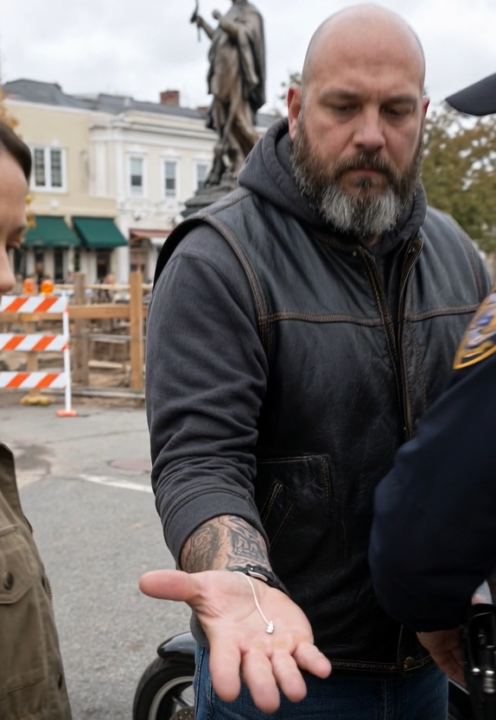
Jonah Mercer sat on the pavement while an officer secured his wrists. His motorcycle stood beyond the barrier, engine off. The pulling line lay slack. I kept looking at it because looking at anything mechanical was easier than looking at my father.
“Kate,” Dad said. “Come over here.”
I didn’t move.
The silver pendant Jonah had shown me was on the ground beside his boot. A tiny saint on one side. Two uneven punch marks near the edge.
I knew those marks.
For twenty-five years, I had remembered pressing my thumb against them while somebody carried me through black water.
Dad had told me the pendant was lost afterward.
An officer picked it up with Jonah’s permission and placed it inside a clear property bag.
“It belonged to my father,” Jonah said. “Frank Mercer.”
Dad shook his head.
“Frank worked at our warehouse. Of course he had things like that.”
Things like that.
As if I had recognized a kind of spoon.
My daughter Lucy stood beside my husband, Daniel, across the square. I signaled for him to take her to the library. He nodded without asking me to explain in front of her.
Dad reached for my elbow.
“You remember the hospital. You remember me there.”
I did.
A blanket. Orange juice through a straw. His hand on my forehead. My mother crying into the sleeve of his jacket.
That memory was solid.
The river wasn’t.
I had been twelve, frightened, and treated afterward for exposure. People had told me what happened until their version fitted inside the spaces I couldn’t fill.
Maybe Jonah knew that.
Maybe he had chosen the pendant precisely because he knew.
An officer asked whether Dad wished to make a statement about the damage. Dad straightened immediately.
“Absolutely.”
The sharpness embarrassed me. Then I felt disloyal for being embarrassed.
Jonah looked toward the library doors, where Lucy had disappeared.
“Don’t tell her he was a monster,” he said to me.
“Who?”
“Your father. Just tell her what he did.”
He said it without kindness, but without pleasure either.
The officer helped him stand. His leather vest creaked. A seam near the shoulder had been repaired with brown thread that didn’t match.
Dad told me to leave the square with him.
Instead, I asked Jonah where he had found the pendant.
“County property storage. They contacted my mother during the anniversary review. It was logged with Dad’s effects.”
“Then why didn’t you bring it to us?”
“I did. Three weeks ago.”
He looked at my father.
Dad’s hand dropped from my arm.
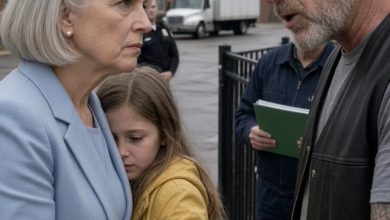
The mayor approached with a cloth pressed to a scrape on his own palm. He had caught it on the temporary railing when people stepped back. He asked me to keep our family dispute away from the cameras. I looked at the dedication banner, at my father’s smiling photograph, and wondered when a public monument had become private whenever someone questioned it.
My father had told the dedication committee nobody had disputed the memorial, so what else had he decided I didn’t need to hear?
When I was eleven, Dad hosted the warehouse employees’ picnic beside our pond.
Frank Mercer repaired the picnic-table leg with a washer from his pocket. Jonah, twenty then, let me sit on his motorcycle while it was parked on the gravel.
Frank wore a silver pendant backward, smooth side against the outside of his shirt.
“Saint gets shy,” he told me.
Two little punch marks caught the sunlight. Jonah had made them accidentally, helping repair the clasp.
Later, a storm rolled over the hill. Frank lifted a frightened toddler off the grass and hummed four soft notes until she stopped crying.
I copied them.
He grinned.
“Works better than shouting.”
Dad called us inside for cake. My mother carried wet shoes to the porch. For years afterward, I remembered that afternoon as proof that everybody had once been happy together.
I never asked who had been working while we ate.
That memory took less than a minute to return. I spent the rest of the afternoon trying to push it away.
At home, Lucy asked whether the man on the motorcycle was going to jail.
“He damaged something,” I said. “There will be consequences.”
“Was Grandpa lying?”
Daniel set a glass of water beside me. He didn’t answer for me.
“I’m finding out.”
Lucy frowned at her drawing. The dedication had been an assignment for school: draw somebody who helped your town.
She had already colored Dad’s suit.
I turned the paper over so she wouldn’t have to decide what to do with it yet.
My mother called before dinner.
“Your father says you stayed behind.”
“I did.”
“He’s very hurt.”
Outside, Daniel was bringing the trash cans in. A wheel caught on the pavement crack. I watched him lift it free.
“Did Jonah come to see you?”
Silence.
Then a kettle clicked off at her end.
“He came to your father’s office.”
“You knew?”
“I knew somebody was upset about the wording.”
The wording.
I opened the anniversary program. RICHARD COLE: THE MAN WHO BROUGHT FIVE CHILDREN HOME.
The fifth child was me.
Every year, our elementary school had invited Dad to describe the rescue. I remembered standing beside him while other children asked whether he had been afraid. He always squeezed my shoulder before answering. I had believed the squeeze meant we shared something nobody else understood. Now I couldn’t stop wondering whether it had been a signal to keep agreeing.
Four others had been inside the community-center shuttle stranded by the flood. I had climbed out through the back and become trapped farther downstream.
That much came from the old report. Everything beyond it was something somebody else had narrated.
“Mom, who gave him the pendant?”
“I don’t know.”
“Who?”
“Kate, I said I don’t know.”
She hung up gently, which somehow hurt more.
That evening, I emailed the county archivist whose name appeared on the anniversary exhibition. I asked about Frank Mercer’s property and the records Jonah had received.
She replied the next morning.
The pendant had been recovered with Frank’s body. Its description was on a contemporaneous inventory. A photograph showed both punch marks.
Jonah hadn’t invented the object.
Attached was an index for additional records being digitized, including emergency radio audio.
One entry was labeled COLE: CHILDREN LOCATED.
If Jonah was telling the truth about the pendant, why did the rescue recording still carry my father’s name?
Dad agreed to meet at his office, provided Jonah wasn’t involved.
I went alone.
He had taken the photograph from the dedication off his desk. In its place stood a picture of Lucy at her first piano recital.
It worked on me. I wish I could say otherwise.
“Listen to this,” he said.
He played a recording on his laptop.
Static. A man’s voice. My father’s voice, younger and breathless.
“Five children. County shuttle. East access road. Send everybody you’ve got.”
He gave directions to the rescue crews.
He described the water rising.
He sounded terrified.
Dad stopped the audio.
“Does that sound like a man who ran away?”
I didn’t answer.
Then he showed me a hospital record documenting his evaluation that night. Cold exposure. A cut on his forearm.
“Frank died. That’s terrible. It doesn’t mean I wasn’t there.”
He spoke quietly, almost reasonably. The pendant suddenly felt less decisive. Maybe Frank had helped. Maybe Dad had helped too. Maybe a town looking for one face had made the truth smaller without making it false.
I wanted that version so badly I nearly accepted it before checking anything.
The archivist, June Alvarez, met me at the county records center the following afternoon. She had retired from dispatch years earlier and returned part-time for the anniversary project.
She listened to Dad’s audio.
“That’s real,” she said.
My shoulders loosened.
Then she added, “It’s also an excerpt.”
The longer recording wasn’t yet fully indexed. She could submit my request for access, but needed to follow the county’s process.
I asked who had written the original rescue summary.
Deputy Alan Pritchard.
Later sheriff. Later mayor. Now retired, his name appeared on the memorial committee letterhead.
June pushed a photocopy toward me.
The first report credited Richard Cole with locating the children and coordinating assistance. A later typed account credited him with physically removing them from the water.
Different claims.
Same report number.
Pritchard’s initials appeared beside the revision.
The document index also listed a warehouse employee’s statement. Its pages weren’t in the report packet. June wrote down the attachment number and requested the separately stored annex. She didn’t promise what it would say. I liked her more for that, though I would have paid almost anything that afternoon for somebody to promise me the answer I wanted.
Dad’s voice was real. His hospital visit was real. The words that made him our hero had been added by somebody else.
I drove to Pritchard’s house. His wife answered and said he wasn’t taking visitors about the ceremony.
Behind her, the television showed a weather map.
“Did he change the report?” I asked.
Her face tightened.
“Everybody wanted something to be proud of afterward.”
She shut the door.
For a moment, I stood on the porch believing I had found the person who had made my father into a liar without his permission.
Then my phone rang.
Dad.
“Leave Alan alone.”
I hadn’t told anybody I was going there. I looked at the closed door, then at my father’s name glowing on the screen.
If the false account had been somebody else’s mistake, why was my father protecting the man who wrote it?
The money didn’t appear in a suitcase.
It appeared in a ledger.
An ordinary line between roofing expenses and a payment for leased forklifts.
COLE COMMUNITY RECOVERY FUND: P.A. SERVICES.
The records came from boxes the warehouse company had donated to the historical society after selling its original building. I requested the flood-year files because the company’s vehicles and employees had been involved in the emergency.
The archivist brought two boxes to a table. Nobody slid a secret envelope across a parking lot.
I spent six hours reading invoices while fluorescent lights hummed overhead.
P.A. was Pritchard’s consulting business.
The payments began three months after the revised report.
Alone, that proved less than I wanted. Recovery projects needed consultants. Pritchard understood local roads. I photographed the pages and kept looking.
Then I found the claims correspondence.
Our family company had stored equipment along a drainage route despite repeated concerns about access during heavy rain. The correspondence discussed potential liability, witness accounts, and the importance of establishing who had been present when the shuttle became trapped.
Dad’s reputation wasn’t just a medal.
It was a shield.
The same rescue story opened fundraising dinners and appeared in company brochures for years. Dad hadn’t merely failed to correct a newspaper sentence once. He had signed introductions, approved advertisements, and sent employees to anniversary events carrying his photograph. I stacked copies by date until the table held a record of opportunities to tell the truth that he had declined.
A man celebrated for risking his life was harder to describe as a man who had ignored warnings about the road beside his warehouse.
Another letter troubled me more.
A company attorney had asked whether Frank’s widow would accept assistance with funeral costs and outstanding household bills in exchange for resolving specified claims.
I knew Ruth Mercer had struggled after Frank died.
I hadn’t known our company had paid her.
I called Jonah’s attorney and asked to speak to him. He was out on bond, with conditions he had no intention of testing by coming near my father again.
We met at his garage with his attorney’s knowledge.
He listened while I described the letters.
“Mom took money,” he said.
“Did she know what she was signing?”
“Some of it.”
“Did you?”
He turned a socket over in his palm.
“I was twenty-one. I understood we were going to lose the house.”
I noticed a photograph above his workbench. Frank, younger than Jonah was now, holding a fish so small he looked embarrassed for it.
Beside it hung a framed rejection from the memorial committee. His objection had been received and denied.
He had tried paper first.
That didn’t make dragging the statue down right. It made the picture I had of that morning incomplete.
“Why didn’t Ruth speak?” I asked.
He put the socket down.
“You should ask her.”
Outside, rain began ticking against the garage door. My phone lit up with a message from Dad.
YOU’RE READING BUSINESS RECORDS YOU DON’T UNDERSTAND.
Below it came another.
THINK ABOUT WHAT THIS WILL DO TO YOUR DAUGHTER.
Why had every request for an explanation become a warning about the people I loved?
By Monday, I had become an ungrateful daughter helping a dangerous man destroy a good family.
Nobody used those exact words in the newspaper.
They didn’t need to.
Dad’s statement described Jonah’s vandalism, my emotional distress, and his hope that our family could heal privately. My photograph appeared beside a picture of the toppled statue.
Daniel suggested we write down what had happened while it was still fresh. We worked at the kitchen table after Lucy slept, putting dates beside calls and keeping the original messages. It was dull work, almost comforting. Whenever I started defending my father out loud, Daniel asked whether I was remembering something or trying to make the evening less painful.
At school pickup, a parent asked whether I planned to bring Jonah to the children’s concert.
I said no.
She looked relieved, which made me angrier than an insult would have.
Then my editor called.
I worked three days a week writing regional features. The paper had published my anniversary profile of Dad before the dedication.
I’d called him courageous.
I’d quoted myself remembering his hands in the water.
Now the editor wanted to know whether my reporting had been accurate.
“I’m checking,” I said.
“You should have checked before we printed it.”
He was right.
The next morning, my access to the warehouse archive was paused while ownership of some donated records was reviewed. Dad’s lawyer had raised questions.
I already had permitted copies. The pause still felt like a door closing inside my chest.
Then Ruth canceled our meeting.
A message from her phone said she wasn’t well enough to discuss the flood.
Jonah called an hour later.
“That wasn’t all of it.”
Dad had visited her.
He hadn’t threatened her in words an officer could act on. He reminded her about the settlement, the family trouble, and the possibility that Jonah’s conduct could make things worse.
She had asked him to leave.
Then she had drawn the curtains.
I went to see my mother. She met me at the kitchen counter with her church newsletter folded beside a plate of untouched toast.
“Did you know he went to Ruth?”
She closed her eyes.
“Your father feels cornered.”
“Did you?”
“Yes.”
There it was again. Someone else’s fear offered as a reason I should stop asking.
Mom slid the newsletter away. Beneath it lay an old photograph: Dad outside the hospital, wrapped in a blanket, a deputy beside him.
His shoes were pale suede.
I remembered them because Mom hated those shoes.
In the photograph, their light uppers looked dry. Mud marked the soles, but no line of river silt climbed the sides.
A picture couldn’t tell me everything. It told me enough to ask why she had brought it out.
“He changed before he came to my room,” I said.
Mom shook her head.
“They brought those clothes from the scene.”
Her voice was barely there.
She had known the hospital photograph didn’t fit the story. She had kept it anyway.
That evening, June emailed. The requested recording was ready for supervised listening, along with the dispatch log explaining its sequence.
I asked Jonah to come.
He said he needed to tell me something first.
What could he possibly confess that would make him more frightened of the truth than my father was?
“I drove the shuttle.”
Jonah said it standing beside his workbench, both hands flat on the wood.
For a second, I heard the words without understanding them.
The anniversary account said Frank Mercer had driven the children onto a flooded access road. Even the versions that called his death tragic described a terrible error in judgment.
“Dad wasn’t driving,” Jonah said.
“You were?”
He nodded.
He had volunteered to return the community-center shuttle after the picnic program. Five children remained aboard. The main road was closed. He knew the warehouse access road and believed he could get through before the water rose further.
There had been a warning barrier.
He moved it.
The shuttle stalled. Water came fast through the low ground. Jonah climbed out to reach the warehouse telephone because his own cell phone had no usable signal there.
Frank was working an evening shift inside.
Dad was there too.
“I told them where you were,” Jonah said. “Dad ran toward the road. Cole went to his car.”
Jonah had tried to follow Frank, but water knocked him down near the loading dock. Another employee pulled him back and kept him on the higher platform.
Richard drove to a dry junction and called for help from there.
That explained the radio.
It did not explain the river.
“My father got four children onto the warehouse steps,” Jonah said. “Then he found out you weren’t with them.”
I remembered a window. A hand slipping. The awful certainty that the bus would carry me under if I stayed inside it.
After that, darkness.
Frank went back.
He brought me far enough for others to take me. Then the current pulled him away.
Jonah looked at the photograph over the bench.
“They told Mom they’d pursue the driving part if we challenged the report. Maybe they could have. I don’t know. We never got advice from anyone who wasn’t being paid by Cole.”
Ruth accepted assistance.
Jonah accepted silence.
He said he had visited the river every year but avoided the public anniversary service. Ruth thought that was grief. He let her think it. When the county finally contacted them about Frank’s unclaimed effects and the archival review, the pendant forced him to explain what he had been hiding from his own children. Their questions had been harder than mine.
For years, he said his father had died because he was brave. He didn’t say his father had been there because Jonah had been reckless.
“I wanted his name cleared without mine getting dirty.”
He finally looked at me.
“That isn’t how it works.”
I sat on a stool. The floor smelled of oil and rainwater tracked in on boots.
There was no clean hero left for me to hold up against my father.
There was a dead man who had gone into the water, a frightened young man who had made a terrible decision, and families who had learned different ways to survive the explanation.
“Tell your lawyer,” I said.
“Already did.”
“Tell June when we listen.”
“I will.”
He took Frank’s pendant from a small envelope. Police had photographed it and returned it through his attorney.
The saint faced his palm. The two punch marks faced me.
He offered it, but I couldn’t take it yet.
When the recording began the next morning, whose voice would I recognize beneath all the voices that had spoken for me?
I recognized the humming before the words.
Four notes, faint beneath static and shouting. An open radio microphone had caught part of the rescue from the loading platform.
My body knew before my mind did.
My hands went cold. I had heard those notes against a wet shirt while somebody told me to keep my face turned toward his shoulder.
Then a man shouted Frank’s name.
Another voice answered that he’d gone back for the girl.
June stopped the recording when I asked. She gave me water and waited until I could say whether I wanted to continue.
We listened with the log beside us. The platform transmission came first. Dad’s call came later, from the dry junction. His excerpt described an emergency already unfolding; it did not describe him performing the rescue.
The recording wasn’t a complete film of the night. It was enough to contradict the account on the pedestal.
The town scheduled a public review of the memorial after receiving the records and witness statements. It happened weeks later, in the council chamber, with an independent historian presenting the chronology.
Dad insisted on speaking.
He arrived in the same navy suit he had worn at the dedication. Mom came separately and sat beside me.
Jonah sat near the back with Ruth and his attorney.
The recovered annex had helped bring Ruth there. The warehouse employee’s original statement named Frank as the man who brought the children onto the steps. Its account had been available before the amended summary was typed. Dad’s company had received a copy. This wasn’t a new recollection competing with his. It was an old record he had lived beside.
First, the historian explained the two reports. Then the payments. Then the recordings and supporting accounts, including the warehouse employee’s statement about Frank’s return with me.
Dad’s face changed at the humming.
Not much.
Enough.
When his turn came, he gripped the lectern.
“Memory changes,” he said. “Especially a child’s memory.”
I knew he meant mine.
He said he’d never asked to be a hero. He said he’d done his best during a disaster. He said the monument had always honored the whole town.
The council chair read the inscription aloud.
Dad looked down.
I stood when the chair recognized me.
“Where did the pendant come from?”
“Kate, not here.”
“You told me it was yours.”
“You were frightened.”
I held up the inventory photograph.
“It was recovered with Frank.”
Dad’s gaze went to Jonah.
“That doesn’t prove who carried you.”
“Then tell me why I remember it.”
He leaned toward the microphone.
“Because you kept grabbing it. Frank turned it backward so the edge wouldn’t scratch your face.”
A chair creaked behind me.
I hadn’t told the room that part.
Neither had the recording.
The childhood photograph showed the saint facing outward. Only the person close enough during the rescue could describe how Frank changed it while holding me.
The chair asked Dad how he knew.
He stared at the photograph.
“I saw them.”
“From where?”
“The warehouse steps. Before I left.”
Before I left.
His own account had put him on those steps receiving children. Now he had named the person carrying them while admitting he had watched and gone.
The clerk kept typing. Nobody applauded.
Dad looked at me, waiting for the daughter who always helped him finish a difficult sentence.
This time, what would happen if I let him finish it himself?
He didn’t.
His lawyer asked for a break. Dad left through the side door and did not return that evening.
The town suspended the memorial dedication and commissioned a corrected historical account. The damaged figure went into storage, where it could no longer tell a story simply by standing above people.
The fuller record took months.
Some questions about the old settlement and payments became matters for attorneys and investigators. Time had closed certain legal doors. It hadn’t made the documents true.
I stopped expecting one hearing to repair twenty-five years.
Sometimes I still reached for the phone to tell Dad something ordinary: Lucy’s spelling score, a funny sign outside the hardware store. Then I remembered we weren’t having ordinary conversations yet. Losing the version of him I loved didn’t happen once in the council chamber. It happened in small, inconvenient places, while I was buying milk or folding his granddaughter’s socks.
Jonah pleaded guilty to damaging the memorial. The agreement required restitution and community service. He sold a restored motorcycle to help cover the amount.
“It was mine to lose,” he said when I asked whether he regretted it.
Then he looked toward the photograph of the frightened boy at the dedication.
“He didn’t deserve that morning.”
He sent the family an apology through his lawyer. They didn’t have to answer.
I corrected my newspaper profile in print. I named the passages I could not support and explained how I had turned a family’s account into a reported fact.
My editor didn’t call it brave.
He called it necessary.
Ruth agreed to one interview, provided Jonah sat with her and nobody photographed her crying. She spoke about Frank’s work boots, his terrible handwriting, and how he always left half a cup of coffee beside the sink.
For once, the dead man sounded like somebody who had lived.
My mother moved into a small apartment near the library. She said she needed somewhere she could hear herself think.
Dad sent Lucy birthday money.
We returned it with a request that he arrange contact through us. I hadn’t decided what forgiveness would mean. I knew it couldn’t mean giving him back the job of explaining everything.
The replacement memorial was a low stone near the river walk.
It named Frank and the people who had assisted from the platform. It described Richard’s call for help without assigning him the rescue he hadn’t performed.
Jonah asked that the account include the shuttle driver’s decision.
His name appeared there too.
Nobody had to be missing for Frank to be present.
At the small ceremony, there were no speeches from family members. A historian read the corrected account. Ruth laid a grocery-store bouquet on the stone and adjusted the paper around its stems.
Lucy stood beside Jonah.
She had brought a drawing on stiff white paper: a man holding a child above dark water. His face was mostly beard. At his neck hung a tiny silver oval.
“Mom says he hummed,” she told Jonah.
He nodded.
“When people were scared.”
She asked whether he remembered the tune.
He tried. His voice broke on the second note. She waited while he started again.
That evening, I took the pendant from Jonah’s hand at last. He wanted me to have it for a while. We agreed that someday it would go to Lucy with the records, not just a story.
I turned the saint toward my chest.
Two small punch marks faced outward.
Lucy touched them with her thumb.
“Tell me his name again.”
“Frank Mercer.”
And when she asked again tomorrow, what else would I finally be ready to tell her?