A Biker Rode Across My Daughter’s School Assembly to Stop a Leaking Truck—Then I Found My Mother’s Signature on the Permission to Dump Behind the Playground
“That isn’t the version I signed.”
My mother said it without lowering her voice.
For a second, I felt embarrassed.
Not suspicious. Embarrassed.
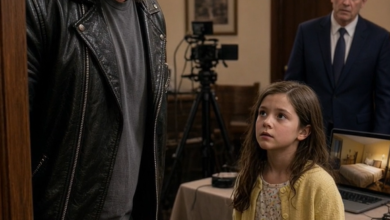
She was Dr. Evelyn Shaw, principal of Alder Creek Elementary outside Springfield, Ohio. She knew which children needed winter coats and which parents couldn’t attend conferences before six. I was her daughter, standing beside a fence, holding a paper I barely understood.
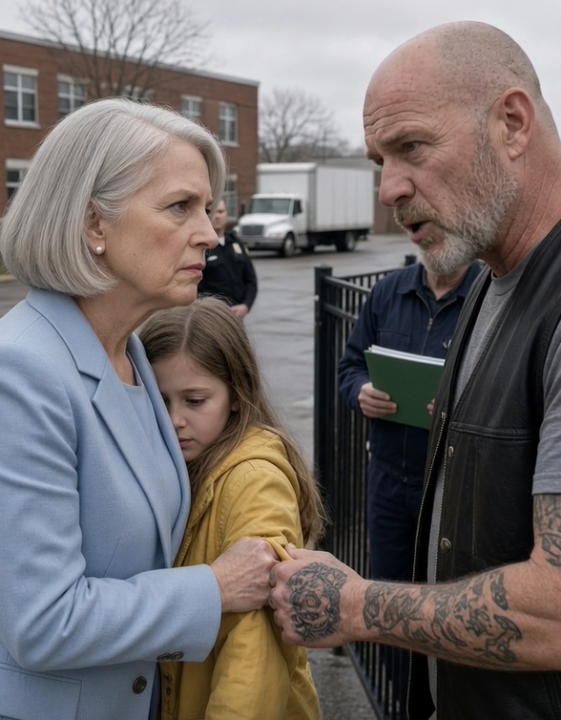
Dad had grease beneath his nails.
My mother had a doctorate.
I wish those details hadn’t mattered to me.
They did.
The school officer, Grant Ellis, glanced toward the truck. It had stopped beyond the rear gate, partly hidden by the gym.
The driver climbed down.
Dad twisted toward him.
“Keep him out of the ditch.”
“Stay still,” Ellis said.
I stepped closer to the fence.
“Dad, what’s in that truck?”
“I don’t know exactly.”
My mother opened both hands toward me.
“There. He doesn’t even know.”
Then the custodian coughed again.
Leon Bell had worked at the school longer than my daughter had been alive. He usually carried peppermints in his shirt pocket. That morning he held a green folder and kept rubbing his throat.
“Call the fire department,” he said.
My mother told him the office was handling it.
Ellis used his radio.
After that, adults finally began moving for reasons unrelated to Dad’s motorcycle. Teachers gathered their classes. Someone stopped the music. A second officer kept people away from the rear service road.
I took Wren’s hand.
She resisted.
“Grandpa didn’t hurt anybody.”
“I know.”
I didn’t know enough yet. But I knew that.
A teacher led us toward the front of the property while responders assessed the area. We didn’t choose our own route across the grounds. We followed the instructions we were given.
Wren kept turning around.
Dad stood still while Ellis checked his identification. His leather vest creaked when he lowered his arms.
He looked older without movement.
I had spent most of my life seeing him leave places. On his Harley. In his work truck. Through our kitchen door after an argument.
I wasn’t used to seeing him unable to go.
My mother caught up with us near the front sidewalk.
“Give me that,” she said.
She meant the authorization.
I folded it.
“Why?”
“Because it’s school business.”
Wren leaned against my hip. My mother noticed and softened her voice.
“Mara. There are children here.”
“Yes.”
I looked toward the playground.
“There are.”
Her mouth tightened.
She said Dad had misunderstood a landscaping arrangement. The material was supposed to be approved fill for erosion control. The contractor had probably changed something without telling her.
It sounded possible.
Then she touched the folded paper.
Her fingertip landed exactly where the signature was, though I hadn’t unfolded it.
“This page isn’t the whole agreement.”
Behind her, Leon sat on a low wall while a firefighter spoke to him.
The green folder rested beside his shoe.
If my mother had only approved harmless landscaping, why was Leon afraid to hand that folder over?
The last uncomplicated afternoon I remembered with both my parents had been Wren’s fifth birthday.
They were already divorced.
Still, Dad came early to repair the loose boards on Mom’s porch. Mom made lemonade and pretended she hadn’t baked his favorite cake.
Wren sat beneath the table, putting paper crowns on everybody’s shoes.
I borrowed Mom’s desk to wrap a present.
“Don’t move the green blotter,” she told me.
There was always a blue carbon sheet beneath it. She liked keeping a duplicate of notes she wrote by hand.
“Computers lose things,” she said.
Dad smiled from the doorway.
“So do people.”
Later, Wren asked why his little finger bent sideways.
“Old mistake,” he told her.
She hooked her smallest finger around it.
“Now it’s a handle.”
He let her keep holding on.
That morning outside the school, Wren asked whether the police would take away Grandpa’s handle.
I crouched in front of her.
“An officer is talking to him. That’s all I know.”
“Grandma said he wasn’t thinking right.”
I straightened her jacket.
“What did you see?”
“He stopped the truck.”
She said it simply.
I had seen the same thing and let everybody else’s interpretation get there first.
Parents arrived in waves after the school sent its emergency message. Most knew only that the campus was being cleared and children were being released from a designated location.
A few knew about the biker.
That part traveled faster.
My husband, Ben, called from the delivery route he drove for a plumbing supplier. He asked whether Wren was safe before asking anything else.
I said she was.
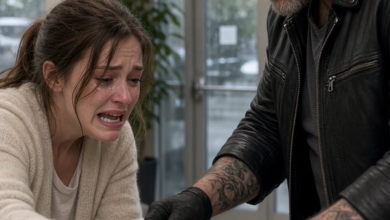
Then I heard myself add, “My mother says Dad caused a disturbance.”
Ben went quiet.
“What does your dad say?”
I looked across the street.
Dad sat on the curb beside his motorcycle while an officer spoke into a phone. A firefighter had placed a temporary barrier across the rear approach.
“He says he saw a leak.”
“Then start there.”
Ben arranged to collect Wren. I stayed.
Dad had been returning from an early parts pickup when he recognized the truck ahead of him. He knew the company. He had once worked dispatch and driven for one of its subcontractors.
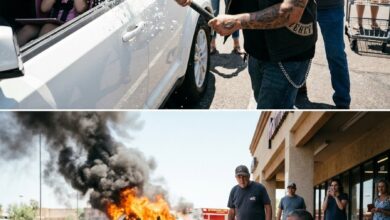
He saw liquid falling near a rear wheel.
Then the truck turned toward the school.
“I called it in,” he told me when Ellis allowed us to talk. “Operator asked for the road name. Truck kept moving.”
The usual route to the rear entrance curved around the property. Dad had used the open maintenance gate and the empty service strip to reach the crossing first.
He hadn’t ridden between children.
The distance had vanished in the first phone video.
From the parents’ side, it looked like he had charged the assembly.
“Why didn’t you call Mom?”
He looked toward her pale blue suit.
“I tried yesterday.”
That stopped me.
“About this truck?”
“About the company.”
He took his phone out and showed me an unanswered call, then a message.
PLEASE DON’T LET THEM THROUGH AGAIN.
My mother had replied with three words.
STAY OFF CAMPUS.
What had happened before the leak that none of us had been told?
By early afternoon, my mother’s signature looked less certain.
Not because it disappeared.
Because another one appeared beneath it.
Leon’s.
The folder contained a site-access sheet, a sketch of the drainage hollow, and delivery slips initialed by the person who opened the maintenance gate.
Leon had initialed them.
The district representative who arrived that afternoon explained that a principal could approve access for routine maintenance but could not independently authorize disposal of unidentified industrial material.
My mother nodded.
“Exactly.”
She sounded relieved that somebody had finally said it correctly.
The contractor’s paperwork described clean fill. The page Dad carried was a copy of the access authorization, attached to a delivery schedule.
It did not say hazardous waste.
I read it three times.
Dad stood beside me.
He didn’t pretend it said more than it did.
Leon told investigators he had opened the gate on six mornings. The truck came before classes, except that morning, when it arrived late.
“Who told you to let it in?” I asked.
“Your mother.”
She answered before he finished.
“For the landscaping work.”
Leon looked at the folder.
I noticed a damp patch beneath its elastic band. His hands were sweating.
An investigator asked whether he had watched the unloading.
“Some of it.”
“What did you see?”
He looked at my mother.
She folded her arms.
“Leon, please be accurate.”
He said the truck carried containers as well as loose material.
The contractor’s representative, speaking by telephone, said those containers held equipment and additives for soil stabilization.
I knew nothing about soil stabilization.
I knew enough about my mother to recognize the expression she wore when somebody gave her a useful sentence.
“There,” she said.
Leon pressed his lips together.
For the first time, I wondered whether he had done something behind her back. Maybe a little cash to open the gate. Maybe favors for a contractor. Maybe the person coughing on the wall knew more than the principal.
Then an officer asked him about an envelope.
Leon’s shoulders fell.
There had been money.
He admitted accepting two hundred dollars from the driver for “being available early.”
My mother closed her eyes.
It looked like disappointment.
It looked like proof.
Dad’s phone rang. A friend from his garage was calling to say a video of him crossing the school grounds had reached a local parents’ group.
The caption said he had threatened the principal.
He hadn’t.
But there he was, leaning forward over the handlebars, his mouth open.
No smell.
No leak visible.
No truck in the cropped frame.
Just Dad.
My mother put a hand on my elbow.
“Take Wren home. Let people who understand this handle it.”
I almost did.
Then Leon spoke.
“I asked where you wanted the envelopes.”
My mother’s hand tightened.
“What envelopes?” the investigator asked.
Leon looked at the green folder as though he wished he had never picked it up.
If the driver had only paid him once, what money had been going somewhere else?
The first envelope had gone into the school’s activity fund.
That was my mother’s explanation.
A community contribution from a local company helping improve school grounds.
The second, she said, had paid for storage.
The third she couldn’t immediately remember.
She wanted her calendar.
Her bookkeeper.
The opportunity to collect the relevant paperwork.
Investigators gave her the opportunity. They also documented what Leon handed over.
I learned the details in pieces over the following days, through records the district released, conversations I was permitted to have, and questions nobody could answer at once.
The leaking truck did contain industrial waste.
The initial response didn’t tell us everything about its contents or where earlier loads had gone. Samples had to be tested. Documents had to be compared with the material actually recovered.
The uncertainty made people angry.
Some wanted an immediate declaration that their children were fine. Others wanted someone arrested before dinner.
I wanted Wren’s sneakers out of our entryway.
I left them there because nobody had told me they were dangerous, and I was tired of turning every ordinary object into a threat.
The school remained closed while officials assessed the affected area.
Classes moved temporarily.
Parents missed shifts.
Leon received instructions about follow-up care after his evaluation. His cough improved. His fear did not.
Three days later, he called me from his kitchen.
“I kept copies.”
He had saved delivery slips because he worried the maintenance department would be blamed for work outside its budget.
Some slips carried handwritten load numbers.
Other pages described a service charge paid to a separate company.
That company’s mailing address was familiar.
My mother owned the little building.
I knew because I had helped paint its upstairs apartment after her last tenant left.
She had told me the rent paid her retirement expenses.
The company listed there wasn’t a tenant I recognized.
It was registered through a business associate of the hauling contractor. Its payments appeared in records investigators were beginning to trace.
The arrangement had a name on paper.
Consulting.
My mother had been receiving money connected to the deliveries.
That was the first fact I couldn’t explain away by saying she had been busy or careless or deceived.
I called her.
“Tell me what you consulted on.”
“Mara, you don’t understand commercial property.”
“Then explain it.”
She asked whether Dad was beside me.
He wasn’t.
“Your father has spent his entire life resenting people who built something.”
I looked at the kitchen ceiling. Dad had patched the water stain above our stove two winters earlier.
“What did the contractor buy from you?”
She ended the call.
That evening, Ben found a folded district letter in our mailbox. My mother had filed a formal complaint about Dad’s conduct and requested that he be barred from school property pending review.
Attached was a statement describing his “history of volatile behavior.”
She had included my name as a supporting witness.
I hadn’t given one.
When Ben turned the page, my own words were waiting in quotation marks.
Where had she got them?
She had got them from me.
A private conversation, eight months earlier, after Dad arrived at our house furious about a contractor who owed him money.
He hadn’t threatened me.
He had raised his voice.
Wren had gone upstairs.
Later, I called my mother and said, “Sometimes I don’t know what he’ll do next.”
I meant whether he would quit a job or refuse a payment or drive three hours to argue with someone who had stopped answering.
In the complaint, those words sat beneath a description of the school incident.
They looked like a warning I had ignored.
Parents began asking why I had allowed him near their children.
My mother didn’t need to invent a new daughter.
She only needed to edit the one she had.
Ben told me to stop reading the posts.
I couldn’t.
One included a photograph of our house, taken from the street. Another named the bakery where I worked and asked whether customers felt safe around “that family.”
My manager moved me off the front counter for two shifts.
She called it giving me breathing room.
I washed mixing bowls in the back and cried when the industrial dishwasher got loud enough to cover it.
Dad offered to stop visiting.
“No,” Ben said before I could answer.
My mother called Wren’s temporary classroom and offered to collect her.
She remained an approved contact.
The teacher called me because Wren said she didn’t want to go.
I drove there with flour still on my shoes.
Mom stood beside the office desk holding Wren’s coat.
“I thought you could use some help.”
Wren was behind the secretary’s chair.
Her face looked very small.
I took the coat.
“You need to ask me first.”
“I’m her grandmother.”
“Yes.”
My voice shook.
“You still need to ask.”
I changed the pickup list that afternoon.
I cried in the car afterward, which made Wren cry because she thought she had caused a fight.
We sat in the parking lot until I could explain that adults were responsible for adult decisions.
Two days later, Leon was placed on administrative leave.
The notice concerned unapproved payments and failures in his gate records. Those were real issues. They also made him the easiest person to point at.
He stopped answering calls.
Dad drove to his house and left groceries on the porch. He didn’t ask Leon to come out.
When he returned, I asked why he cared so much about a man who had taken cash to open that gate.
Dad stayed standing.
His helmet rested on our table, white scratches crossing its side.
“Because I know what it’s like,” he said.
“To be blamed?”
“To decide a little money means you don’t have to ask.”
He unzipped his vest.
From the inside pocket, he took a yellowed delivery slip.
His signature was at the bottom.
How long had he known there was something wrong behind that school?
Eight months.
Not everything.
Enough.
Dad had taken temporary driving work after a slow winter at the garage. The contractor paid quickly and didn’t ask whether his knees could still manage long days.
He delivered two loads labeled reclaimed grading material.
Both went to the hollow behind Alder Creek.
He knew my mother had approved access. He knew Leon opened the gate. He told himself those facts meant somebody had checked what he was hauling.
On the second trip, he saw containers partly covered by a tarp.
One had a damaged label.
He asked the dispatcher.
The dispatcher said the containers were empty returns and told him to mind his paperwork.
Dad finished the delivery.
Then he accepted a payment larger than the amount they had agreed on.
“Why?” I asked.
He rubbed the bent little finger.
“Because I wanted the money.”
There was no speech after it.
No excuse ready to make him noble.
We had been behind on rent while Ben changed jobs. Dad gave us most of that payment. He called it money from selling an old transmission.
I remembered hugging him.
I remembered telling him he had saved us.
My stomach turned.
“When did you tell Mom?”
“The next week.”
“What did she say?”
“That the paperwork was clean. That I’d frighten you for nothing.”
He had stopped driving for the company.
He had not reported it then.
He had made one phone call to the contractor and another to my mother. When neither gave him an answer he liked, he put the slip away.
For months.
The day before the assembly, Leon called him about a truck expected the next morning.
Leon had begun noticing stains where water collected. He didn’t know what they meant. He knew the approved work didn’t look like the plan anymore.
Dad tried my mother again.
She told him to stay off campus.
Then he saw the truck leaking on the road.
“That’s when you believed Leon?”
“That’s when I stopped finding reasons to wait.”
I wanted to hate him cleanly.
I couldn’t.
I couldn’t hug him either.
“Wren was playing there.”
“I know.”
“You knew where the money came from.”
“I knew where I’d worked. I didn’t know what was in it.”
“But you knew enough to ask.”
He looked at me.
“Yes.”
I pushed the delivery slip back toward him.
“Give that to the investigator.”
“I’m going to.”
“Today.”
He nodded.
The statement he gave did not make his role disappear. It gave investigators earlier dates, another driver’s name, and records they could compare with the contractor’s account.
He accepted that they would examine his conduct too.
I began to understand the difference between a person admitting harm and a person merely losing the ability to hide it.
The district announced a public meeting about the closure and the investigation’s preliminary findings.
My mother requested time to speak.
She said she intended to correct “a campaign of family retaliation.”
Dad asked whether I wanted him there.
“Yes,” I said.
But when my mother stood in front of that room, would I still know how to disagree with her?
The meeting took place in the high school auditorium.
Alder Creek’s gym remained unavailable, and nobody wanted to gather near the rear grounds.
Parents sat with notebooks.
Teachers sat beside substitutes who didn’t yet know their names.
Leon came in with his wife and chose a seat near the aisle. Dad sat beside Ben. I sat between my husband and an empty chair because my mother had told me she expected us to sit together.
I left it empty.
The board chair explained what could be discussed publicly. Some questions concerned an active investigation. Others concerned school operations, records, and the decisions that had put trucks on the grounds.
There would be no vote deciding criminal guilt.
There would be questions about who had permitted what.
A district facilities employee displayed the original maintenance proposal.
Repair erosion.
Improve drainage.
No industrial disposal.
Then came access records and a summary of payments officials had been able to document.
My mother waited with her hands folded.
When she spoke, she apologized for the disruption.
Not the deliveries.
The disruption.
She described trust misplaced in contractors and a custodian who had exceeded his authority. She acknowledged rental income from the building but said she had no control over every tenant’s business.
A few people nodded.
I could feel the old current pulling.
This was how she sounded at award nights.
This was how she sounded when telling a worried parent that somebody competent was taking charge.
The board chair asked whether she had given any separate instructions.
“No.”
“Any handwritten authorization beyond the access sheet?”
“No.”
My mother looked toward Leon.
“If people have created documents after the fact, I cannot answer for that.”
Leon lowered his head.
I stood before I had planned to.
The chair asked me to identify myself.
“Mara Shaw. I’m Evelyn’s daughter.”
My mother’s expression softened for the audience.
“Mara, sit down. You’ve been through enough.”
I stayed standing.
“Did you keep handwritten copies under your desk blotter?”
She blinked.
It was the first small thing.
Then she smiled.
“I’ve kept duplicate notes for years. That isn’t suspicious.”
“No.”
My hands shook around the paper I had brought.
“It’s how you taught me to keep track.”
The district had preserved materials from her office. Among them was the blue carbon sheet beneath the green blotter, still inside the desk pad.
A faint duplicate showed a handwritten direction naming the rear hollow, the contractor, and a restriction on the number of deliveries. The original had been recovered separately from the contractor’s records.
The board had provided the authenticated copy with its public materials that evening.
I didn’t reveal evidence nobody had seen.
I asked her to explain her own.
She glanced toward the screen as the facilities employee brought the page up.
“That doesn’t authorize dumping.”
“Then what did you authorize?” the chair asked.
My mother leaned toward the microphone.
“Sealed containers. They were supposed to remain sealed.”
Leon lifted his head.
Nobody spoke.
Then the chair asked, “You just told us you had not authorized containers.”
My mother drew back.
She tried the sentence again.
She meant equipment.
She meant temporary storage.
She meant whatever the contractor had described.
The chair asked about the money.
Then the dates.
The answers became shorter.
From the back, a parent asked why children had been sent out for the assembly after Leon raised concerns.
My mother looked toward me.
For once, I didn’t help her.
What would our family sound like when nobody filled the silence for her?
At first, it sounded like my phone ringing.
My mother called that night.
Then the next morning.
Then she sent a message saying I had humiliated her in public.
I read it at our kitchen table while Wren colored a picture beside me.
There was a motorcycle in the picture.
Its rider had an enormous beard and one enormous hand.
I put the phone facedown.
The district removed my mother from her position after completing its employment process. The criminal and environmental investigations took longer.
There were records to obtain, materials to identify, and payments whose descriptions did not match the work.
The contractor’s disposal scheme reached beyond one school.
That fact did not make our part smaller.
It made me wonder how many other families had looked at a fence and assumed someone responsible had checked what happened behind it.
My mother eventually admitted accepting payments in exchange for access and allowing the arrangement to continue after concerns were raised. Her agreement in the case did not describe her as a woman who had merely misplaced trust.
I read every page available to me.
Then I put them away.
Dad cooperated fully and accounted for the loads he delivered. His lawyer handled the questions about his own role. I stopped asking him to tell me it would all be fine.
He stopped trying.
Leon faced consequences for taking the driver’s money and for incomplete records. His testimony and preserved documents mattered. So did what he had done wrong.
He found work at a community center.
When I saw him there months later, he was replacing a door closer.
He took a peppermint from his pocket and asked whether Wren still liked them.
I said she did.
He gave me two.
The school reopened in stages after the required work and clearance. The hollow was fenced while remediation continued. Families received updates that were sometimes dull and sometimes frustrating.
I learned to value a sentence that said a result was still pending.
Wren asked to see the new classroom before returning.
Ben took time off.
Dad waited in the parking lot because his access restriction had not yet been formally resolved.
She saw him through the window.
“Can Grandpa come in?”
The new principal checked with the office.
She didn’t make an exception because he looked kind. She checked the record, confirmed the restriction had been lifted, and invited him inside.
I nearly cried at the ordinary care of it.
That Saturday, Dad came over with a small box.
Inside was a child’s bicycle bell.
Wren’s had stopped working.
He fitted the replacement while she held the tools. His Harley stood silent at the curb.
I brought coffee onto the porch.
For a while, we watched her ride circles on the driveway.
“I should’ve spoken sooner,” Dad said.
“Yes.”
He nodded.
I didn’t add anything to make the answer easier.
Wren stopped beside him and held out her hand. Her smallest finger found his crooked one.
“Your handle still works.”
He smiled.
“Still works.”
The bell rang when she pushed off again.
Later, my mother’s name appeared on my phone.
I let it ring while I watched my daughter.
When it stopped, Dad looked toward the screen, then away.
I picked up the phone and moved it inside.
Wren called from the driveway.
“Mom, are you watching?”
“I am.”
And tomorrow, when watching required more than standing on the porch, would I keep my eyes open?