A Huge Biker Was Mocked for Holding a Doll in a Toy Store — Then Everyone Learned Who It Was Really For
PART 2
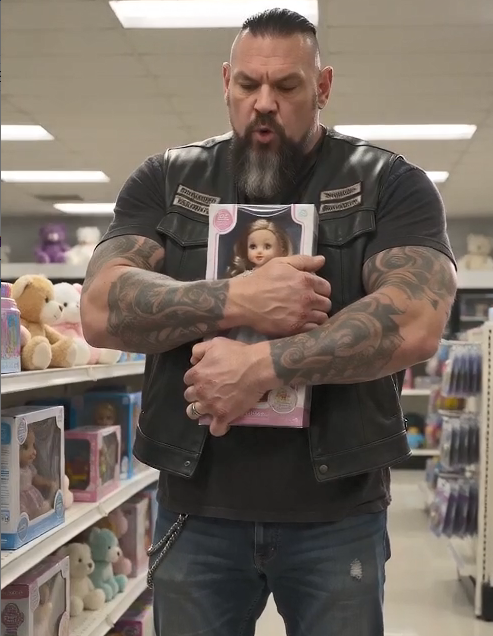
The biker’s name was Caleb “Bear” Morrison, though the teenagers filming him did not know that. They only saw the leather cut, the size, the gray in the beard, the tattoos running under both sleeves, and the old road patch sewn onto the back. They saw a man who did not belong among baby dolls, ribbon displays, glitter stickers, and tiny tea sets.
That was the whole problem.
People think belonging has a look.
Caleb had spent most of his life proving them right before he learned how to disappoint them better. He had been a mechanic, a bouncer, a divorced husband, a man who once slept three months in the back of his own repair shop because pride wouldn’t let him tell anyone he had nowhere else to go. He rode with a local motorcycle club out by US-131, older men mostly, veterans, welders, truckers, and the kind of women who could back a Harley into a gravel lot better than most men could park a sedan.
He was not soft in any obvious way.
That was why the doll looked so startling in his hands.
It was not cheap, either. The box said hand-painted collector doll, sixty-nine dollars before tax. It wore a blue dress with white lace at the collar. Brown curls. Freckles. Little cloth shoes with tiny buttons. A toy chosen by somebody who still believed a doll could be a friend, not just a thing.
The young man filming moved closer.
“Hey, man,” he said, laughing, “is that for your biker clubhouse?”
His friends snorted.
Caleb looked at him once.
Not angry.
Worse.
Tired.
“Put your phone down,” he said.
The boy grinned. “Why? You embarrassed?”
The cashier, a Black woman in her late forties named Denise, finally set down the ribbon and stepped from behind the counter. “That’s enough.”
But social cruelty gets momentum when it has an audience. The three boys were not finished. One made a baby voice. Another pretended to rock invisible arms. The father near the wooden train display looked away, but not before smiling. That small smile mattered. Caleb saw it too.
Still, he did nothing.
That was the first reveal.
A man who looked built for violence chose restraint when mockery offered him an easy excuse.
He turned the box over and examined the back, but he was not reading the marketing copy. His thumb rested near a small dent in the plastic window. His hand trembled once, barely enough to notice unless you were watching closely. Denise noticed. So did the woman standing near the back of the store, the one who had whispered about the hospital.
She was about thirty-five, white, thin from stress rather than body type, wearing a puffy gray coat and holding a little pink hat in both hands. Her name, I would later learn, was Marianne Bell. She had been in the store twenty minutes before Caleb arrived. She had been wandering the doll aisle like a person looking for a memory and terrified of finding it wrong.
When she heard the teenagers laugh, her face hardened in a way that had nothing to do with anger.
It was grief bracing itself.
Caleb glanced at her, and something passed between them. Not romance. Not familiarity exactly. Something more like shared instructions.
Wait.
Not yet.
Denise stepped closer to Caleb. “Sir, do you need gift wrap?”
He swallowed before answering. “Blue paper if you have it.”
One of the teenagers laughed again. “Of course he wants blue paper.”
This time Caleb looked down at the doll instead of at the kid.
“Blue was what she asked for,” he said.
That sentence should have shifted the room.
It didn’t yet.
Because people hear what confirms their first judgment until reality hits them hard enough to bruise.
The phone kept recording.
“Who’s she?” one teenager asked. “Your girlfriend?”
The cruelty landed.
Not because of the words, but because of how small they were compared to what Caleb was holding. He did not answer. He carried the doll to the counter, set it down as gently as if it were asleep, and took out a folded piece of paper from the inside pocket of his vest.
It was not money.
It was a child’s drawing.
A little stick girl. A blue dress. Brown scribbled curls. A large blocky word underneath: MOLLY.
Denise saw the drawing first.
Her expression changed.
Marianne saw it next and turned away so quickly the pink hat crushed between her fingers.
The cashier leaned over the counter, voice soft now. “This is the right one?”
Caleb nodded. “Closest they got.”
“Birthday?” Denise asked.
His jaw worked once.
“First one out,” he said.
Nobody understood that phrase yet.
First one out of what?
A foster home? A bad family? A shelter? A divorce? The teenagers kept smirking, but less confidently now, because the adults nearest the register had gone too quiet.
Then Marianne stepped forward with the pink hat in her hands.
“She picked that doll through the window,” she said, voice thin. “Before chemo took the last of her hair.”
That was the second reveal.
The room did not fully stop. Toy stores never stop completely. Somewhere a music box still played. A child near the dinosaur shelf asked for something plastic. The heat clicked on overhead. But the emotional center of the store shifted so sharply that the phone in the teenager’s hand suddenly looked obscene.
Caleb still didn’t explain.
That was what made it ache.
He let the mother do it, or rather, he did not stop the truth from coming the way it needed to come. Marianne stood beside him now, not touching him, but close enough that the shape of the scene changed. The large biker with the doll was no longer a joke standing alone. He was part of something fragile.
Denise wrapped the doll slowly.
Blue paper. White ribbon.
The teenager with the phone lowered it a little.
Not enough.
Marianne looked at him then, and her voice did what shame could not.
“My daughter turned six in the hospital,” she said. “Today she came home.”
The phone dropped all the way.
PART 3
Her daughter’s name was Lily Bell, and she had spent seven months inside Helen DeVos Children’s Hospital learning words no six-year-old should have to know. Port. Counts. Steroids. Fever protocol. Isolation. Neutropenic. She had also learned smaller cruelties, the ones adults sometimes forget to name because survival looks bigger from the outside.
She learned what it meant to miss kindergarten picture day.
She learned that hair grows back, but slowly.
She learned that adults lie gently when they say something “won’t hurt much.”
And somewhere between treatment rounds and night nurses and cartoons playing too softly in a room that never got dark enough, she saw the doll in the window of Lily & Lane Toys on the hospital shuttle route.
That part was almost ridiculous.
Every Thursday, hospital volunteers drove some of the long-term pediatric patients past downtown windows when their counts were strong enough for controlled outings. They called it a city ride. Mostly it was three blocks of normalcy. Storefronts. Traffic lights. People carrying coffee like life was ordinary. For a child trapped in medical time, that was enough to feel like travel.
Lily saw the doll through the toy-store window in late September.
The blue dress.
The brown curls.
The freckles.
She named her Molly before anyone told her whether the doll had a name already.
Marianne had promised, as mothers do when they need hope to hold shape, “When you come home, we’ll go get her.”
Then the infection came.
Then the fever.
Then two more weeks.
Then money did what money often does around illness. It shrank at the exact moment dignity needed it most. Marianne had missed work. Insurance had paid some and not others. Their car needed tires. The water heater had chosen the worst possible month to fail. A sixty-nine-dollar doll was not impossible, exactly, but it was irresponsible in a way sick children should never have to understand.
Caleb entered the story through the parking garage.
He had been there almost every Friday with the River Iron Riders, a biker group that did no press, no speeches, and no toy drive flyers with their own faces on them. They brought gas cards to families with long commutes. Fixed parents’ cars in the hospital garage. Swapped dead batteries. Changed tires. Quiet work. Useful work. The kind that gets done by people who know suffering has logistics.
Marianne first met Caleb when her car would not start after a twelve-hour hospital day.
She had stood under the parking garage lights with one hand over her face and the other holding a plastic bag of Lily’s laundry. Caleb heard the starter click from two lanes over, walked across with a portable jump pack, and said, “Battery’s not dead enough to quit. Just dramatic.”
It was such a strange sentence that she laughed when she had not laughed in days.
He fixed the battery connection, then noticed the front tires. Two weeks later, while Marianne sat upstairs with Lily during a spinal tap, Caleb and two club brothers replaced them in the garage without asking for permission cleanly enough for her to refuse. He left the receipt on the windshield.
It said: Paid. No argument.
That was the first small kindness.
The second was quieter.
Lily, who had begun losing her hair by then, saw him in the hallway holding a toolbox and asked if he was a pirate. Caleb looked down at his vest, tattoos, and beard, then answered, “Not this week.”
She liked that.
Children do.
He never crowded her. Never performed cheerfulness. Never used the voice adults use when they are afraid of sick kids. He talked to Lily like she was a person whose body happened to be under attack, not like a lesson wearing pajamas.
When she asked about his bike, he showed her pictures.
When she asked why his hands were so big, he said, “God overestimated the size of my tools.”
When she asked if motorcycles got scared, he said, “Only when they see hospital parking fees.”
She laughed hard enough for the nurse to check on her.
That was how trust formed.
Not all at once.
Not sentimental.
Bolt by bolt.
A week before discharge, Lily told him about Molly.
Not dramatically. Just during a hallway walk, IV pole squeaking beside her, pink mask over her face, slippers dragging slightly. She pointed through the shuttle window toward the toy shop and said, “That doll is waiting for me.”
Caleb remembered.
That was the entire redemption.
He remembered what everyone else was too exhausted to prioritize.
The first birthday after hospital should have been loud, bright, crowded with balloons and cousins and cake icing smeared on fingers. Instead, Lily’s homecoming birthday was going to happen in a small apartment with sanitized surfaces, a pharmacy schedule taped to the refrigerator, and a mother trying to smile while counting bills on the kitchen counter.
Caleb could not fix cancer.
He could not rewind the months.
He could not give Lily back the hair, the school days, the sleepovers, the careless body children are supposed to have before fear teaches them anatomy.
But he could buy the doll.
So he did.
And when teenagers laughed, he let them.
That was the part most people missed. He could have scared them silent in three seconds. His size alone would have done it. A harder voice. One step forward. One old look from whatever years had carved him. Instead, he took the ridicule because the alternative would have made the store about him.
The doll mattered more.
Marianne understood that when she stood beside him at the register and saw his jaw tighten without his hands moving. Denise understood it when he asked for blue paper and not one dollar of discount. Even the teenager holding the phone began to understand when the wrapped box sat between them like evidence of a cruelty too small for the moment.
“Delete it,” Denise said, not loudly.
The boy looked at her.
She pointed at his phone. “Now.”
He hesitated.
Caleb finally spoke to him directly.
“Kid,” he said, voice low enough to make everyone listen, “you ever get lucky enough to love somebody through a hospital, you’ll hate this video.”
That line did not humiliate the boy.
It did something worse.
It aged him.
He looked at the screen, thumb hovering, and for the first time all afternoon he looked like a child himself. Not cruel. Not cool. Just young and suddenly aware that he had been playing with something heavier than he could lift.
He deleted the video.
Then his friend deleted his.
The third boy muttered, “Sorry.”
Caleb nodded once but did not absolve him with warmth he had not earned. “Be earlier next time.”
That was the apology accepted and sharpened.
Marianne paid for the pink hat. Caleb paid for the doll. Denise tucked the child’s drawing carefully under the ribbon so it showed through the loop, a tiny stick girl guarding the package from becoming just merchandise.
When they left the toy store, the bell over the door rang too brightly for how quiet everyone had become.
Outside, Caleb placed the wrapped doll in his saddlebag, then paused and looked at Marianne.
“You want me to just drop it at the door?”
She shook her head. “She asked if the motorcycle man could come.”
That stopped him.
Men like Caleb are rarely afraid of rooms.
He looked afraid of that one.
“Hospital kids make big plans,” he said.
“She meant it.”
So he rode behind Marianne’s car to the apartment complex on the north side, slow through traffic, the doll wrapped in blue paper inside the saddlebag, protected from wind, rain, and the leftover laughter of people who had not known better.
At the apartment, Lily was waiting by the window.
Small. Pale. White. Six years old. Bald under a soft yellow cap. Wearing unicorn pajamas even though it was three in the afternoon. When she saw Caleb’s motorcycle roll into the lot, she slapped both hands against the glass and opened her mouth in silent joy before any sound came out.
That was the moment he looked away.
Maybe because it was too much.
Maybe because gratitude from children has no polite filter.
Marianne opened the door. The apartment smelled like disinfectant, vanilla cake, and the plastic scent of new medical supplies. A banner reading WELCOME HOME LILY hung slightly crooked across the living room. There were only four cupcakes on a plate because visitors still had to be careful. The whole room looked like celebration built under medical supervision.
Caleb stood at the threshold.
He did not enter until Lily said, “You can come in. I’m not contagious today.”
That line broke Marianne first.
Caleb stepped inside, removed his vest before sitting because he worried the patches might scratch the couch, and handed Lily the blue-wrapped box with both hands.
She knew before opening it.
Children know when a promise has weight.
Her fingers shook over the ribbon. Marianne helped with the tape. When the paper came off and Molly’s blue dress showed through the plastic window, Lily made a sound that was not quite laughter and not quite crying. It was something survival makes when joy returns too suddenly.
She hugged the box first.
Not the doll.
The box.
As if even the barrier around the gift was part of the miracle.
Caleb sat on the edge of the chair, huge and silent, staring down at his own hands like he did not trust them near the moment. Lily looked up at him and said, “She waited.”
He nodded, voice rough. “Yeah. She did.”
That was all.
It was enough.
PART 4 – ENDING
The toy-store video never got posted.
That became one of the quiet mercies of the story. In another version of the world, Caleb would have become a joke for six hours online before strangers corrected themselves in the comments and moved on feeling morally repaired. Lily’s gift would have become content. Marianne’s grief would have become context. The apology would have come late, thin, and mostly for the cameras.
Instead, the humiliation stayed local.
That mattered.
Because real repair works better when it has to look people in the eye.
Two days after Lily’s birthday, the teenager who had filmed him came back to Lily & Lane Toys with his mother. I know because Denise told Marianne, and Marianne later told Caleb, though he pretended not to care. The boy bought a small stuffed rabbit with his own money and asked Denise if she knew how to get it to the “hospital kids.” His mother stood behind him, red-eyed and silent, letting the awkwardness do what speeches could not.
Denise took the rabbit.
Then she made him write a card.
He wrote: For someone coming home soon.
That was not a full redemption.
It was a start.
Caleb kept visiting Lily after that. Not too often. He understood boundaries better than people assumed. Once every couple of weeks at first, then when Marianne asked, then whenever Lily had a hard appointment and needed “motorcycle weather” afterward. Sometimes he brought nothing. Sometimes a book. Once a pack of tiny sunglasses for Molly because Lily had decided dolls recovering from long waits needed accessories.
He never called himself family.
That was important too.
He was a man who had entered their lives through a broken car battery and stayed because staying had become useful. He carried groceries. Fixed a cabinet hinge. Put together a small white bookshelf in Lily’s room and grumbled through the cartoon instructions like they had personally insulted his intelligence. When Lily’s hair started growing back in uneven soft fuzz, he told her it looked “like a baby duck with union benefits.”
She laughed for a full minute.
Marianne cried in the kitchen where no one would see.
Spring came slowly that year.
Lily got stronger in the uneven way recovery happens. Two good days. One bad. Three brave hours followed by a nap so deep it frightened her mother. The doll Molly lived on her pillow, then in the car seat beside her, then on a chair at clinic visits. Nurses remembered it. Doctors smiled at it. Caleb once came into the waiting room and found Lily using a washable marker to give Molly tattoos.
He stared at the doll’s newly marked arms.
Then at Lily.
“Nice line work,” he said.
She beamed.
By summer, the story at the toy store had changed too. Denise kept a photograph behind the register—not posted publicly, just tucked near the tape dispenser—of Lily holding Molly beside Caleb’s motorcycle. No faces shared online. No hashtags. Just proof for the people who had been there that the doll had gone where it was supposed to go.
The father who had smirked that day came back once with his daughter and looked at the doll aisle too long. He did not say anything. Denise did not make him. Sometimes shame needs privacy to become better.
As for Caleb, the ridicule did not vanish from memory. It became part of the object.
Whenever Lily retold the story, she edited it the way children edit pain into power.
“Some boys laughed because Bear bought a doll,” she would say. “But Bear didn’t care because Molly was mine.”
Bear.
That was what she called him.
Not Caleb. Not biker. Not motorcycle man anymore.
Bear.
The nickname fit too well. Huge. Rough. More gentle than expected if you survived the first glance. He pretended to hate it for about five minutes, then answered to it forever.
A year later, on Lily’s seventh birthday, Marianne invited him again. This time there were more cupcakes. More visitors. Less medical equipment visible in the living room. Lily had short brown curls coming in around her ears, wild and soft, and she wore a blue dress because Molly still did.
Caleb arrived carrying no gift at first.
That worried Lily.
He saw her face and pointed toward the parking lot. “You think I forgot?”
She grinned.
Outside, strapped carefully to the back of his Harley, was a small wooden doll cradle he had built himself out of oak scrap from his shop. Sanded smooth. Painted pale blue. On the side, in uneven hand-burned letters, was one word:
MOLLY
Lily ran her hand over the letters like she was reading something sacred.
“Did you make it?”
Caleb shrugged. “Me and a bad attitude.”
She hugged his leg.
Not dramatically. Just automatically.
He froze the same way he had the first day at the apartment, then rested one careful hand on the top of her head, fingers light against those new curls.
That was the image that stayed with me.
Not the toy-store laughter.
Not the teenagers.
Not even the first birthday home.
A huge biker standing beside a Harley in an apartment parking lot while a little girl with regrown hair hugged his leg and a doll in a blue dress waited in a hand-built cradle at their feet.
No one filmed that.
Good.
Some moments deserve to live only in the people who earned them.
Years from now, if Lily keeps Molly, she may not remember every hospital day or every adult who tried not to look scared in her room. She may not remember the exact store window or how much the doll cost or the boys who laughed before understanding. But she will remember this much because children remember who kept promises in the language of objects.
A doll waited.
A biker remembered.
And when the world laughed at him for carrying something soft, he held on tighter.
Follow the page for more emotional, cinematic stories about misjudged people, quiet kindness, and the small gifts that carry more love than anyone can see at first.