Part 2: A Homeless Woman Threw Dirty Water on a Sleeping Biker Outside a Route 66 Store—But She Was the Only Person Who Realized an Entire Building Was Filling With Gas
Part 2 — The Night Ray Stayed Outside
Ray Dawson had not planned to sleep on the sidewalk.
The Iron Lanterns had spent the previous evening installing shelves inside a neighborhood food pantry two blocks away. When their work ended after midnight, Ray discovered that Bellman Hardware’s elderly owner had accidentally locked his keys inside the delivery van.
Ray opened the van without damaging it, then noticed the hardware store’s rear security light had failed.
The business had been burglarized twice that month. Mr. Bellman needed to leave for his wife’s medical appointment before dawn and could not remain until an electrician arrived.
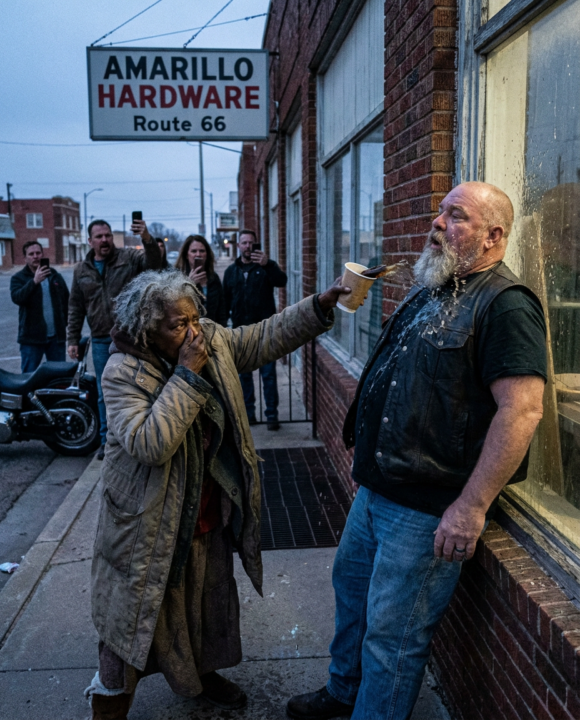
Ray offered to watch the storefront.
He brought a folding chair beneath the awning, parked his Road King where the headlight faced the entrance, and drank coffee until exhaustion defeated him around four-thirty.
He removed his hearing aids before falling asleep because rain had begun blowing beneath the awning.
Ray’s hearing loss came from an explosion during military service. He could understand conversation with both devices fitted properly, but without them he heard only low vibration, fragments of louder sounds, and an indistinct pressure where voices should have been.
His club brothers knew never to wake him by shouting from a distance.
They touched his boot.
Miriam did exactly that.
She found Ray at 5:35 while pushing her cart toward the bus depot. The gas odor reached her near the basement grate beneath Bellman Hardware, sharp and unnatural beneath the smells of wet pavement, stale fryer grease, and diesel traffic.
Miriam understood the warning immediately.
For twenty-two years, she had managed the Del Mar Apartments on the east side of Amarillo. She inspected furnace rooms, scheduled utility repairs, changed smoke-alarm batteries, and memorized which tenants required help during emergencies.
She lost that job after the property changed owners.
Then her husband developed kidney disease.
Medical appointments consumed their savings. She left work to care for him, fell behind on rent, and was evicted three months after his death.
Homelessness did not erase what she knew.
It only changed whether people believed her.
Miriam first tried the laundromat.
The night employee saw her through the glass and shook his head. When she pointed toward the basement, he pulled the blinds.
She crossed to my bakery, but I had not arrived.
Then she saw Ray.
Miriam knew him only as the tattooed biker who left coffee beside her cart without asking personal questions. Several weeks earlier, he had repaired its broken front wheel with a washer and a cotter pin.
She knelt beside him and shouted.
Ray did not respond.
She struck the pavement with her palm, kicked his boot, and shook the folding chair. Each attempt looked increasingly aggressive to the strangers who began watching.
Nobody asked what she was saying.
The delivery driver told her to move away.
A cyclist warned that Ray might hurt her.
Miriam pointed toward the grate and shouted gas, but the accusation surrounding her grew louder than the warning.
She needed Ray awake because she had no working phone and because the building held twenty-six residents whose names she had learned over years of sleeping nearby.
She knew Mrs. Chen worked nights and left her children with their grandmother.
She knew Mr. Alvarez used portable oxygen.
She knew apartment seven had a fire escape blocked by a broken planter that the landlord had ignored.
We called that loitering.
Miriam called it paying attention.
When she threw the gutter water, she expected Ray to become angry. She had already decided that his anger was less dangerous than an ignition beneath the building.
The first thing Ray saw was not her cup.
It was panic.
He read it in her mouth, her pointed finger, and the way she repeatedly pushed pedestrians away from the storefront instead of begging them for anything.
Ray smelled the odor.
Then he believed her.
That instant mattered because everyone else waited for proof that looked respectable: an alarm, a uniform, a meter, or a warning delivered by someone with an address.
Ray accepted the warning from the person standing in front of him.
He did not ask where she slept.
He asked which apartments were occupied.
Miriam named all of them.
As fire engines approached, Ray pulled on his wet hearing aids. One device worked intermittently. The other emitted a piercing feedback tone before failing completely.
He could hear almost nothing from his left side.
Miriam stayed there.
She pointed, counted residents, and repeated every instruction until he understood.
The biker became the visible rescuer.
The homeless woman became his hearing.
Part 3 — Twenty-Six Windows Above the Stores
The connected building occupied half a block between West Sixth Avenue and an alley behind the old Route 66 storefronts. Four businesses filled the ground floor, while twelve apartments sat above them behind faded brick and warped wooden windows.
A damaged underground service line had allowed gas to enter the shared basement.
Firefighters later determined that aging pipework and recent utility excavation had contributed to the failure. Nobody on the sidewalk knew the concentration or exact source that morning, which meant Ray treated every unnecessary action as dangerous.
He ordered people away from the building.
He stopped the delivery driver from starting his truck. He prevented me from unlocking the bakery and told the college student to move before making his emergency call.
Ray did not attempt to locate or repair the leak.
He was a motorcycle mechanic, not an emergency gas technician. His job was distance, warning, and evacuation until firefighters and utility crews could take over.
Miriam counted the residents as they emerged through the rear stairwell.
Mrs. Chen’s mother appeared with two children wrapped in blankets. A young couple followed barefoot. The laundromat employee finally exited through the alley after smelling gas inside his office.
“Apartment four,” Miriam said. “Mr. Alvarez.”
Ray signaled to an arriving police officer and explained that an older tenant with limited mobility remained upstairs. The officer relayed the information to the fire captain.
Firefighters entered using protective equipment and monitoring instruments.
Ray stayed outside the exclusion area.
That distinction disappeared from the video uploaded later. The clip showed him hammering a railing, directing residents, and carrying a child away from the curb. It made Ray appear to have managed the rescue alone.
Miriam was visible for two seconds.
In those two seconds, she threw dirty water.
The video title described her as a “violent homeless woman attacking a sleeping biker.” By sunrise, thousands of people had viewed it.
Nobody uploaded the previous six minutes.
At the scene, the evacuation continued.
Twenty-one residents had reached safety. Two were already at work. Mr. Alvarez was located and carried down by firefighters.
That left two people unaccounted for.
Miriam identified them as Lena Vaughn and her six-year-old grandson, Marcus, from apartment nine. Lena’s car remained in the alley, but the apartment window stayed dark.
The fire captain asked whether they might have left on foot.
Miriam shook her head.
“Marcus has asthma. Cold mornings make him slow. Lena won’t take him outside without the red backpack.”
The backpack was not visible among the evacuees.
The captain sent a team toward apartment nine.
Gas readings inside the basement were rising. The bakery’s automatic equipment had been isolated by responders, and utility crews worked to shut the supply from a safe location.
Ray stood beside Miriam beyond the police line.
Water dripped from his beard. His left hearing aid had stopped functioning entirely, forcing him to turn his right ear toward every voice.
“You saved time,” he told her.
Miriam watched the second-floor window.
“Not yet.”
A firefighter appeared at the rear landing with Lena.
She was conscious but confused.
No child followed.
Lena had awakened to pounding but believed it came from construction outside. When she smelled gas, she tried reaching Marcus’s room and became disoriented in the hallway.
Firefighters removed her.
Marcus remained missing.
Miriam gripped the police barrier.
“He hides in the bathtub.”
The fire captain heard.
“How do you know that?”
“His grandmother told me he hides there during thunderstorms.”
Another team entered with the information.
Ray looked at Miriam.
“How long have you known that family?”
“Two years.”
“Do they know you?”
“Marcus does.”
The child sometimes brought her crackers through the alley. Lena occasionally allowed Miriam to wash clothes after closing hours but feared the landlord would discover the arrangement.
The relationship existed quietly, beneath the notices and property rules that defined Miriam as someone who did not belong.
Now her knowledge narrowed the search.
Minutes passed.
Nobody crossed the barrier.
Ray’s hands remained closed around the metal rail. Tattoos disappeared beneath his fists, and water darkened the leather across his shoulders.
A firefighter emerged carrying Marcus wrapped in a yellow protective blanket.
The boy was conscious.
Miriam released the rail.
Her knees folded.
Ray caught her before she struck the pavement.
Bystanders applauded when the child reached the ambulance. Several aimed their phones at the biker holding the homeless woman upright.
The delivery driver slapped Ray’s shoulder.
“You saved the kid.”
Ray pushed his hand away.
“She found him.”
The man glanced at Miriam as though seeing her for the first time.
“She went inside?”
“No.”
“Then how—”
“She knew where to tell them to look.”
The immediate crisis seemed over. All residents were accounted for, responders controlled the ignition risks, and utility workers isolated the damaged line.
Then two police officers approached Miriam.
One held up the viral video.
“We need to speak with you about an assault complaint.”
The college student who filmed the incident had told police she attacked Ray without provocation.
Ray stepped between them.
Leather creaked.
His chain wallet rattled against wet jeans.
“She assaulted the water,” he said.
One officer looked confused.
Ray pointed toward himself.
“I ain’t complaining.”
“We still need her statement.”
“Then take mine too.”
Miriam touched his arm.
“Don’t make trouble.”
Ray looked at the woman who had used her last cup of water to wake him.
“Trouble already got edited.”
Part 4 — The Six Minutes Missing From the Video
The police did not arrest Miriam.
They moved everyone farther from the building, documented the statements, and asked witnesses what happened before the water hit Ray.
Most had seen nothing.
The delivery workers noticed Miriam only after she began kicking Ray’s boot. The cyclist remembered her shouting but could not recall the words. I arrived seconds before she threw the cup.
Only one camera had captured the full sequence.
Bellman Hardware’s exterior security system was outdated, but a battery backup kept one side camera running despite the business remaining closed.
Mr. Bellman arrived after his wife’s appointment and gave police access.
The recording contained no clear audio.
It did not need it.
At 5:35, Miriam appeared beside the basement grate and recoiled from the odor. She crossed to the laundromat, knocked, pointed, and received no response.
She tried my bakery.
Then she noticed Ray.
The video showed her kneeling beside him, clapping, shouting, touching his boot, and repeatedly pointing toward the vent. It showed passersby telling her to move away.
At 5:41, Miriam took the paper cup from her cart.
She hesitated for seven seconds.
Then she collected gutter water and threw it.
The edited online clip began there.
Ray watched the full footage once.
His expression did not change until the camera showed Miriam stepping between his sleeping body and the storefront grate.
Even before waking him, she had positioned herself closer to the suspected leak.
“Why’d you stand there?” Ray asked.
Miriam shrugged.
“People were smoking near the curb.”
“You could’ve moved.”
“So could they.”
The answer sounded like Ray.
He almost smiled.
The security footage also revealed why Ray slept through every warning. When rain began beneath the awning, he removed both hearing aids, dried them on his shirt, and placed them inside the protective case.
Miriam saw none of that.
She only knew the enormous man would not wake.
Ray had spent years hiding the extent of his hearing loss from casual acquaintances. He positioned himself on the right side of conversations, watched mouths, and allowed people to mistake his silence for intimidation.
During motorcycle rides, the Iron Lanterns used hand signals developed around him. At club meetings, Tiny repeated questions from Ray’s left side.
Outside that circle, few people knew.
The viral video made the hearing loss public.
Ray did not care.
What angered him was the caption beneath Miriam’s image.
By noon, online comments called her dangerous, ungrateful, filthy, and mentally unstable. Several praised Ray for showing restraint toward “someone like her.”
The Iron Lanterns saw the clip.
A younger member named Cole posted an angry response before speaking with Ray. He promised the club would find the woman who attacked their road captain.
His post spread quickly.
When Ray learned about it, he called an emergency meeting inside Dawson Iron Works.
Cole defended himself.
“I was protecting the club.”
“From who?”
“The woman who threw sewage on you.”
“Rainwater.”
“You didn’t know why she did it.”
“I do now.”
Cole folded his arms.
“Then tell us.”
Ray connected Mr. Bellman’s full security video to the garage television. Eleven bikers watched Miriam spend six minutes trying to warn people who ignored her.
Nobody spoke when it ended.
Ray pointed toward Cole’s phone.
“Take your post down.”
“It’s already shared everywhere.”
“Then chase it.”
“How?”
“Same way you spread it. Faster.”
Cole argued that deleting the post would make the Lanterns look weak.
Ray’s voice lowered.
“Brotherhood that needs a homeless woman to be the villain is already weak.”
The test divided them.
Some riders wanted a short correction stating that the incident was a misunderstanding. Ray refused that language.
Nothing had been misunderstood by Miriam.
She identified the danger, tried every reasonable warning available, and escalated only when people ignored her. The misunderstanding belonged to everyone else.
Ray recorded a new video.
He stood in the same soaked clothes outside Dawson Iron Works. The stain from the dirty water remained across his vest.
He did not describe himself as the rescuer.
He named Miriam.
He explained his hearing loss.
He showed the six missing minutes and told viewers that every resident escaped because the woman they mocked recognized the leak and refused to walk away.
The final sentence was brief.
“She woke the block before she woke me.”
Cole posted it from the club account.
The correction spread farther than the original clip.
News crews began calling.
Ray declined every interview that did not include Miriam.
Miriam declined all of them.
“I don’t want people knowing where I sleep,” she said.
Ray understood the safety concern. The club stopped releasing her location and asked journalists not to film her cart or usual sleeping places.
The public wanted a simple hero.
Miriam wanted privacy.
Ray wanted the record corrected.
The fire department issued a formal statement crediting an unnamed resident without housing, nearby businesses, first responders, and civilians who supported the evacuation.
Miriam laughed when she read it.
“I’m a resident now?”
Ray looked along West Sixth Avenue.
“You know the block better than its owners.”
That was when Mr. Bellman emerged from the closed hardware store carrying a yellowed folder.
Inside was an old employee photograph.
Miriam stood in the center.
Part 5 — The Woman Who Knew Every Apartment
Before managing the Del Mar Apartments, Miriam had worked along West Sixth Avenue.
In 1989, Bellman Hardware occupied two connected storefronts and maintained the upstairs apartments. Miriam served as assistant property manager, rent collector, maintenance coordinator, and the person tenants called when pipes froze after midnight.
She knew the original basement layout.
She knew the utility lines crossed beneath several businesses.
She had helped evacuate the same building during a smaller leak thirty-four years earlier.
Mr. Bellman remembered her only after viewing the security footage.
Age, weather, illness, and years without stable housing had changed her appearance. The young woman in his photograph wore a navy maintenance shirt and held a ring of apartment keys.
One detail remained unchanged.
She stood closest to the exit.
“What happened?” Ray asked Bellman.
The hardware-store owner lowered his eyes.
Miriam answered before he could.
“Life.”
She had left the block after receiving a better apartment-management position. Years later, caregiving, debt, job loss, and eviction reduced her world to a shopping cart and whatever shelter beds she could safely access.
Homelessness was not one mistake.
It was a collapse with many floors.
Mr. Bellman apologized for failing to recognize her.
Miriam accepted without pretending the apology repaired anything.
“I didn’t recognize myself some mornings,” she said.
The fire displaced twenty-six residents for nine days. The city and property owners arranged temporary lodging while crews repaired the service line, inspected the building, and verified it was safe.
Miriam received no automatic room because her name did not appear on a lease.
Ray objected.
The emergency coordinator explained the rules.
Ray asked for the rule in writing.
Tiny Ruiz quietly warned me that whenever Ray asked for paperwork, somebody’s afternoon was about to become unpleasant.
The Iron Lanterns did not demand that Miriam accept their help. Ray asked what she wanted.
“A door that locks,” she said. “No speeches.”
The club paid for a motel room using its emergency fund while a housing advocate helped her replace identification, apply for benefits, and enter a supportive-housing program.
Ray made every rider understand that this was not payment for saving him.
“Can’t buy a rescue,” he said. “We’re fixing what we ignored.”
The distinction mattered to Miriam.
She did not want to become a charity mascot photographed beside motorcycles. She accepted the room because it allowed her to sleep, store documents, and attend appointments without guarding everything she owned.
The neighborhood offered more.
Mr. Bellman asked whether she would consult on his tenants’ emergency directory after repairs. The property company initially rejected the idea because Miriam lacked a current address and recent employment history.
Ray said nothing.
He placed the old employee photograph, the fire department statement, and the full security video on the conference table.
Miriam received a temporary paid position through a local housing nonprofit, helping residents document accessibility needs and emergency contacts.
She did not become a property manager overnight.
She remained in recovery from the years the street had taken from her body and trust.
Some mornings she missed appointments.
Some doors still frightened her.
The story did not transform through one heroic act.
It changed because people finally treated what she noticed as valuable.
When the building reopened, residents gathered outside for a small safety briefing. News crews returned, hoping Ray would stand beside the fire captain.
He refused.
Miriam spoke for four minutes.
She explained that if anyone suspects a gas leak, they should move away, avoid potential ignition sources, and contact emergency services from a safe location. She did not advise untrained people to locate or repair leaks.
Then she looked toward the bakery.
“If the person warning you has dirty clothes,” she said, “the gas doesn’t care.”
Nobody applauded until she finished.
Ray stood at the back beside his Harley.
His hearing aids were visible behind both ears.
For the first time, he made no effort to hide them.
After the crowd dispersed, Miriam handed him a clean paper cup filled with water.
Ray examined it.
“From the gutter?”
“Tap.”
“Losing your edge.”
She smiled.
Then she poured half onto the sidewalk beside his boot.
Ray did not flinch.
Some alarms become jokes only after everyone survives.
Part 6 — The Railing They Never Repainted
Repairs changed nearly everything along the block.
Workers replaced damaged utility components, installed updated detection and ventilation equipment where required, cleared rear exits, and corrected the planter that had obstructed apartment seven’s fire escape.
The exterior railing retained the dents made by Ray’s tire iron.
The property company offered to replace it.
Residents refused.
They painted the railing bright yellow but left every hammer mark visible. A small metal plate nearby listed emergency numbers and evacuation instructions without turning Ray or Miriam into symbols.
Miriam moved into supportive housing six months later.
Her apartment was one room above a pharmacy, with a narrow window overlooking a bus route. The first night, she slept on the floor beside the door because the bed felt too far from the exit.
The housing counselor did not call it failure.
They continued.
Ray visited on Thursdays with coffee and whatever household object Miriam mentioned was broken. She charged him one dollar per repair so he could not call the work charity.
He paid in quarters.
The Iron Lanterns invited Miriam to conduct an annual clubhouse safety walk. She checked exits, extension cords, heaters, and alarm dates while tattooed men followed with clipboards.
Cole, the rider who posted the angry message, became her most obedient assistant.
She made him replace three overloaded power strips.
He never argued.
My bakery reopened with a manual startup inspection added to our morning routine. Before igniting equipment, we checked the building, followed professional guidance, and treated unusual odors as reasons to leave and call for help.
Ray still slept poorly.
His hearing loss became more severe, but he stopped pretending he understood words he could not hear. He pointed to his right ear, asked people to face him, and carried waterproof hearing-aid storage clipped inside his vest.
Miriam gave him a vibrating alarm designed for people with hearing loss.
“Use this before napping beside another gas line,” she said.
Ray attached it to his keychain.
The old cup remained in his saddlebag.
He had cleaned it but never threw it away.
When asked why, he answered, “Best alarm I ever owned.”
Part 7 — The Woman Beside the Sleeping Biker
Four years after the leak, Miriam had a permanent apartment and part-time work with the neighborhood housing nonprofit.
She still pushed a grocery cart along West Sixth Avenue, although now it carried emergency kits, bottled water, spare phone chargers, and printed resource cards for people sleeping outside.
Some business owners continued treating her cautiously.
History does not disappear because one video changes its caption.
Ray continued parking his Road King outside Bellman Hardware during the annual Route 66 street fair. His club helped maintain an accessible rest area and offered basic motorcycle checks without charging travelers.
On the fourth anniversary, he fell asleep beneath the awning again.
This time, his hearing aids remained in place, the vibrating alarm rested against his wrist, and eleven Iron Lanterns worked within sight.
Miriam found him leaning against the same brick wall.
She carried two paper cups.
A tourist noticed her approach and began watching carefully. The old viral video still lived online, copied beyond every correction.
Miriam raised one cup.
Ray opened one eye.
“Clean?”
“No promises.”
She handed it to him.
They drank together beneath the dented yellow railing while early traffic moved along the old Route 66 district.
Across the street, my bakery ovens started safely.
Upstairs, Marcus left for school carrying the same red asthma backpack Miriam had remembered during the evacuation. Mr. Alvarez watered plants beside an open window. Mrs. Chen’s children waved toward the biker and the woman sitting beside him.
People still credited Ray with saving the block.
He corrected them every time.
Miriam smelled the warning.
Miriam understood the building.
Miriam used the only alarm that reached a man who could not hear.
Ray merely woke up in time to help.
Before riding away that morning, he started the Harley only after Miriam gave him an exaggerated nod. The V-twin engine settled into its deep rumble, a sound Ray felt through his boots more clearly than he heard.
Miriam tapped the old cup against his fuel tank.
Ray touched two fingers to his brow.
Then the biker rode west while the woman who saved him remained beneath the yellow railing, watching every door on the block.
Follow our page for more unforgettable biker stories about misunderstood strangers, quiet courage, and the rugged men who never forget who truly saved the day.