My Nephew Was Terrified of the Biker Who Stood Outside the Park Every Evening — Until the Day He Ran Straight Into the Man’s Arms
My nephew Caleb had never been afraid of anything in his six years on earth — not thunderstorms, not the dark, not the neighbor’s dog that barked at everything — so when he started grabbing my hand and pulling me away from the park every single evening because of a man standing quietly near the fence, I told myself I was right to be worried too.
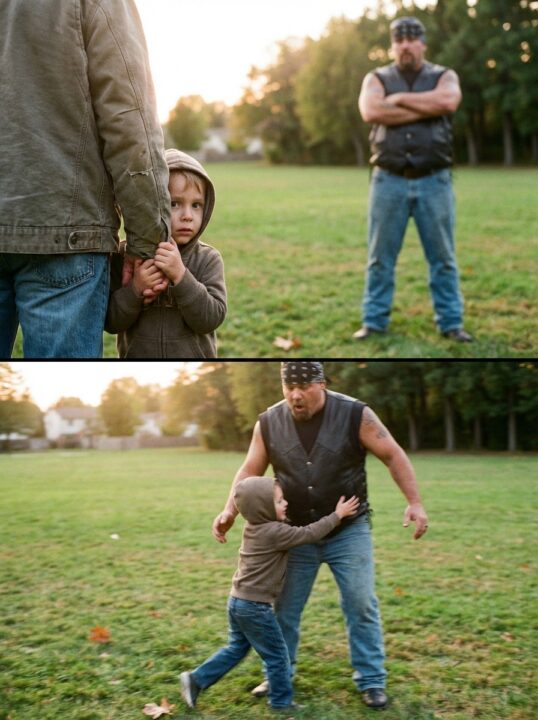
The man wasn’t doing anything. That was the strange part.
He didn’t pace. Didn’t approach the playground. Didn’t look at his phone. He just stood on the other side of the low iron fence with his arms crossed, wearing a jacket that had seen better decades, watching. Not any child in particular. Just — watching.
He had a bike parked behind him. Heavy thing, matte black, the kind that looked like it had been ridden through weather and didn’t apologize for it.
Caleb was six. Sharp, funny, the kind of kid who made friends in grocery store lines. He wasn’t shy. He wasn’t anxious. But every time we came to Riverside Park — which was three, sometimes four evenings a week, because his mom was working doubles at the hospital and I was the backup plan — he’d clock that man within thirty seconds of us arriving.
“He’s here again,” Caleb would say. Quietly. Like a report.
And he’d stay closer to me than usual. He wouldn’t say anything else.
For three weeks, I watched the man too. And the longer I watched, the less comfortable I felt.
Then on a Thursday evening, Caleb dropped my hand, took off running at full speed across the grass — straight toward him — and threw his arms around the man’s waist like he’d done it a hundred times before.
I was already moving. Already yelling Caleb’s name.
The man looked up at me over the top of Caleb’s head.
And his expression stopped me cold.
I should explain how I ended up being the one taking Caleb to the park in the first place.
My sister Dana had been a single mom since Caleb was three. Her husband left in the way that some men leave — gradually, and then all at once, until one day the truck was gone and so was he. She didn’t fall apart, which was the most Dana thing possible. She picked up extra shifts at St. Clement’s, enrolled Caleb in the school two blocks from my apartment, and handed me a spare key without making it feel like charity in either direction.
“Just Tuesdays and Thursdays,” she said, when it started. Within a month it was most of the week.
I didn’t mind. I was thirty-four, unmarried, working remotely doing UX design for a company based in Portland. My schedule bent. And Caleb was — he was genuinely good company, the kind of kid who asked real questions and remembered your answers.
Our routine was simple. I’d pick him up at three-fifteen. Snack at my place — crackers, apple slices, whatever was in the fridge. Then Riverside Park until dinner, because he needed to run, needed to be loud in a way that my apartment didn’t allow. We’d stay until the light went orange, then walk back.
The park had a small playground, a gravel path that looped around a pond, and a grassy open area where Caleb usually found other kids within minutes. It was the kind of unremarkable neighborhood park that people stop noticing after a while.
The man appeared the first week of October.
I noticed him before Caleb did, that first time. Just a figure near the east fence, still as a post. I registered him and moved on. Grown adult, standing at a park fence, not bothering anyone.
But Caleb noticed him too. And whatever Caleb saw, it stayed with him.
The second week, Caleb asked me while we were walking to the park: “Is that man going to be there today?”
I asked which man.
“The motorcycle man.”
I told him I didn’t know. I asked if the man had said something to him.
“No.”
“Done something?”
“No.” Caleb was quiet for a half-block. “He just looks at stuff.”
I didn’t know what to do with that. He just looks at stuff wasn’t a reason to avoid a public park. But I started watching more carefully.
The man came maybe four evenings a week. Always around five. Always to the same spot — a gap in the fence near the old oak tree on the east side, where the iron railing had been removed years ago to widen a maintenance path. He’d lean against the tree slightly. Cross his arms. Stay for maybe forty minutes. Then leave.
He was fifty, maybe fifty-five. Big-framed, the kind of big that used to be stronger. His hair was gray at the temples. The jacket was leather, black, with a small patch on the left shoulder I couldn’t read from distance. The bike, always parked on the street behind him, looked expensive in the way that working machines look expensive — not showy, just serious.
He didn’t bring a coffee. Didn’t bring a book. Didn’t check his watch.
He watched the playground.
The third week, I did something I’m not entirely proud of. I walked a slow loop on the path that took me close to the fence — close enough to see the patch on his jacket.
It was a name. Embroidered in faded white thread.
Denny.
I circled back to the bench where I’d left Caleb with his crackers, and I sat down, and I couldn’t explain why my chest felt tight. A man named Denny standing at a park fence four days a week, watching children play.
I started sitting closer to the gate.
The first small thing I noticed: he never watched the whole playground.
I’d assumed his gaze was general — the unfocused kind that people have when they’re thinking about something else entirely. But when I looked more carefully, from the right angle, his eyes moved. Tracked. He was watching something specific. Or someone.
I couldn’t figure out who.
The second thing: Caleb always knew when the man had left before I did. He’d relax visibly — shoulders dropping, voice getting louder — and sometimes he’d say “he went home” without me saying anything. I’d look up and the man would be gone. Caleb had been tracking him more closely than I’d realized.
The third thing happened on a Friday. The park was busier than usual — a birthday party at the pavilion, extra kids, more noise. I lost track of the man for a while in the activity. When I found him again, he was in a slightly different position. He’d moved four or five steps to the left.
To keep something in his sightline.
I followed the angle.
He was watching a boy. Eight, maybe nine. Red jacket, running with a group. A kid I didn’t recognize.
My whole body went still.
Then the boy stopped, said something to his friends, and ran toward the parking lot — where a woman was waiting, keys in hand, who scooped him up the way mothers scoop up children they’ve been missing all day. The man watched them drive away. Then he looked at the ground for a moment.
Then he left.
I sat with that for a long time.
The fourth thing was a Wednesday, two weeks later. I arrived early and the man was already there. And he had something in his hand that I hadn’t seen before — a small item, hard to make out, that he turned over slowly between his fingers. Not a phone. Something solid. Flat-ish. The size of a deck of cards, maybe smaller.
He put it back in his jacket pocket when a group of kids ran close to the fence.
Not defensive. Not startled. Just — private.
I didn’t tell Dana any of this. I didn’t know what I would have said.
The Thursday it changed started like all the others.
Crackers, apple slices, Caleb’s backpack on my kitchen chair. We walked to the park. Caleb ran ahead at the gate the way he always did, that burst of speed that meant he’d been saving it.
The man was there. East fence, same spot, arms crossed.
Caleb saw him. Slowed down. Did his usual thing where he positioned himself on the far side of the playground, the side closest to me.
I sat on the bench. Opened a work email I’d been avoiding. It was a normal evening.
Then, around five-thirty, I heard a sound that made my head come up fast.
Caleb was talking to another kid. A boy in a red jacket.
The same boy.
They were playing some kind of game involving a stick and a lot of negotiation. I watched them for a few minutes — easy, natural, kids who’d found a shared language quickly. I looked toward the east fence.
The man was watching them. Both of them. And his expression had shifted in a way that was hard to name. Not threatening. Something quieter than that. Something that looked almost like — relief.
I walked to the edge of the playground, slowly. Close enough to see his face clearly for the first time.
He wasn’t watching the playground like a threat.
He was watching it like someone watching something they weren’t allowed to be part of.
I went back to the bench. I didn’t have the full story yet. But something had rearranged in my chest.
Then Caleb left the red-jacket boy and walked toward me.
He passed the gate.
He kept walking.
Straight to the man at the fence.
I was on my feet and moving before I’d made the decision.
But Caleb reached him first. Arms out. Face pressed into the man’s jacket at waist height. The full, uninhibited hug that only small children give — the kind that assumes it will be returned.
It was returned.
The man’s arms came down around Caleb slowly. Like he was being careful not to do it wrong.
I stopped a few feet away.
The man looked up at me. And his eyes were wet. Not crying. Just — the edge of it. The place right before.
“I’m sorry,” he said. Before I could say anything. “I should have introduced myself. I know how it looks.”
I didn’t know what to say.
“That boy he was playing with,” the man said. “The one in the red jacket.” He paused. “That’s my son. We have him every other weekend. His mom and I—” He stopped. Tried again. “It’s been two years. The arrangement. I have Sundays and every other Saturday. The rest of the time I—”
He didn’t finish the sentence.
He didn’t need to.
He came to the park on the evenings he didn’t have his son, just to stand close to the place where his son sometimes was, just to exist in the same general square of the world, because it was the nearest thing to being there that he was allowed.
Caleb pulled back and looked up at him. “Your name is Denny,” he said. Pointed at the patch.
The man looked down at him. “Yeah.”
“My dad doesn’t come to the park either,” Caleb said. The way kids say devastating things — simply, factually, without knowing the full weight of them.
Denny looked at me. I looked at Denny.
I pulled the small object from his jacket pocket into the conversation without meaning to — I’d nodded toward it without realizing. He reached in and held it out. A photograph, laminated. A boy in a red jacket, maybe five or six in the picture, missing his two front teeth, laughing.
“I carry it so I can see him every day,” Denny said.
I had to look away for a second.
He hadn’t been watching the playground like a threat. He’d been watching it the way you watch a door you’re not allowed to open.
I didn’t tell Dana the whole story that night. Just that Caleb had made a new friend at the park. She was too tired to ask many questions. She ate her reheated pasta and listened to Caleb describe the red-jacket boy’s stick game in enormous detail.
Later, after Dana had gone to sleep in my spare room, I sat on the couch with the television off and thought about Denny at the fence. About the photograph in his pocket. About Caleb, who had spent three weeks keeping his distance and then one Thursday evening just — walked over.
I asked Caleb the next morning why he’d done it.
He shrugged. “He looked sad.”
Just that.
I thought about the patch on the jacket. Denny. A name worn where everyone could see it. And I thought about how I’d read it as a warning sign when it was really the most ordinary thing — a man who just wanted to be known by his name.
We went back to the park the following Tuesday.
Denny was there. He nodded at me across the grass. I nodded back.
Caleb waved.
Small things. That’s usually all it takes to start getting something right.
And the light that evening came through the oak tree the way it always does in October — long and gold and a little melancholy — and the kids ran in it like they always do, like they have no idea how fast it moves.