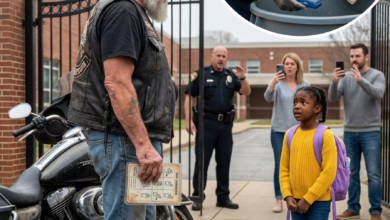
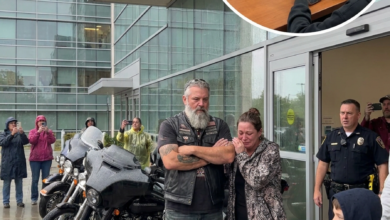
Part 2: Thirty-Five Bikers Escorted a Terrified Girl Into Court—Then Built a Human Wall So the Only Face She Could See Was the One That Believed Her
Part 2 — The People Outside Courtroom 6B
Bear first met Emily four months before the trial.
Her therapist, Dr. Naomi Price, submitted a request through the Middle Tennessee chapter of Bikers Against Child Abuse after Emily stopped sleeping in her own bedroom. The accused man had been released on bond under strict conditions, and although he was forbidden to contact her, legal protection did not quiet every sound outside the house.
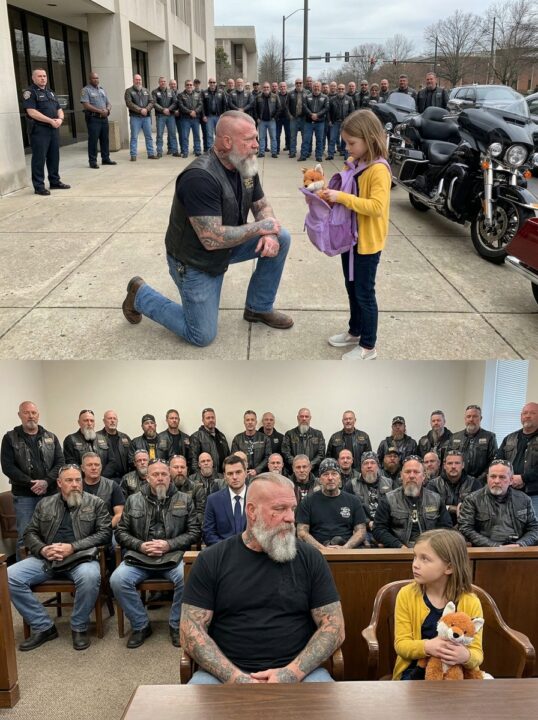
A truck slowed near the mailbox one evening.
It was not his.
Emily hid in a linen closet until midnight anyway.
Bear and Rosa “Redbird” Delgado visited the following Saturday. They arrived in an ordinary pickup because Dr. Price warned that motorcycle noise might overwhelm the child. Bear left his leather cut in the truck, covered his tattoos with a long-sleeved shirt, and brought no gifts beyond a blank sheet of paper.
Emily remained beneath the kitchen table.
Bear sat on the other side of the room.
For forty-seven minutes, he said nothing.
Redbird spoke with Emily’s mother, Sarah, about the organization’s rules. They were not bodyguards, investigators, or vigilantes. They would not confront the accused. They would not interfere with police, court orders, therapy, or family decisions. Their job was to help a frightened child feel less alone while trained professionals handled everything else.
Emily finally pushed a purple crayon across the floor.
Bear picked it up.
She pushed the blank paper next.
“What do I draw?” he asked.
“A door.”
Bear drew something resembling a crooked refrigerator.
Emily looked out from beneath the table. “That’s bad.”
“Been told.”
She corrected the hinges. Then she added a small figure behind the door and a large one sitting outside it.
“Which one am I?” Bear asked.
“The ugly one.”
“Fair.”
It was the first time Sarah heard her daughter laugh in six weeks.
Bear did not ask what had happened. He never used the accused man’s name. He asked whether Emily wanted him near the front door, in the driveway, or at the end of the street when she had a difficult appointment.
She chose the porch.
So Bear sat there.
He came every Wednesday evening in a faded charcoal shirt, work jeans, and boots carrying the smell of hot rubber and motor oil from Kane’s Custom Cycles. Sometimes Redbird came with him. Sometimes Curtis “Anchor” Shaw brought a chessboard and deliberately lost in ways so obvious Emily became offended.
They stayed two hours.
No more.
Bear fixed a loose railing but asked Sarah before touching it. Anchor replaced the porch light. Redbird taught Emily how to check whether a window was locked without checking it five times.
The rules mattered.
People imagined biker protection as confrontation. Emily needed predictability instead.
One evening, rain struck the porch roof while Bear and Emily sat on opposite sides of the front door. She remained inside. He remained outside. They communicated by sliding index cards beneath the threshold.
Are you scared of anything? she wrote.
Bear took a long time.
Yes.
Another card appeared.
What?
Bear wrote only four words.
Not believing someone soon enough.
Emily opened the door three inches.
Bear did not explain.
His answer stayed between them until trial week.
At the motorcycle shop, Bear’s chapter brothers noticed the change in him. He had always been disciplined, but now Wednesday repairs ended before six. He washed his hands twice, cleaned the grease from beneath his nails, and placed a small purple bead on his left boot.
The bead came from Emily.
Each time she survived something she believed she could not do—a forensic interview, a doctor’s appointment, a meeting with the prosecutor—she painted another wooden bead. Bear tied the first to his boot. Redbird wore one on her key ring. Anchor attached his to the zipper of his jacket.
The others asked for beads.
Emily refused.
“They didn’t earn faces yet,” she said.
So the chapter waited.
They supported Bear and his two assigned partners without demanding access to the child. They covered his hours at the garage. They answered calls when he left meetings shaken but refused to discuss confidential details. They practiced court behavior with a retired deputy who belonged to another chapter.
Silence was harder than riding.
Especially for men accustomed to solving practical problems with tools and labor.
Boone, a former Army medic, said it first. “A broken bracket tells you where it hurts.”
Bear tightened a vise. “Kids don’t owe us that.”
The chapter learned.
By the month before trial, Emily had met nine riders through supervised picnics and family events. She remembered everyone’s road name but still called Bear Mountain.
Then she visited the empty courtroom.
The prosecutor wanted her to understand where people would sit. Emily walked to the witness chair, looked toward the defense table, and dropped to the floor before anyone could catch her.
The room vanished for her.
Dr. Price knelt nearby without touching. Sarah cried behind the rail. Bear stood outside because only court personnel had been authorized to attend.
Through the open door, he heard Emily repeating one sentence.
“I can’t see him and talk.”
That night, she drew the courtroom in black crayon. The witness chair was a small purple square. The defense table became a dark rectangle. Between them she drew rows of faces.
Bear counted thirty-five.
“Why this many?” he asked.
“Because nine leave holes.”
She turned the paper over and wrote the road names she knew. For the remaining spaces, she drew circles.
Bear brought the drawing to the chapter meeting.
Thirty-four riders raised their hands.
Bear made thirty-five.
But brotherhood met its test before a single motorcycle reached the courthouse. Several members wanted to arrive in full colors and line the steps. One suggested facing the defendant as he entered. Another wanted reporters present so the public would understand why they were there.
Bear rejected all three ideas.
“This isn’t our day,” he said. “Nobody sees us unless she needs to.”
A longtime member named Mack challenged him. He believed hiding their patches suggested shame.
Bear removed his cut and placed it on the table.
“If a piece of leather matters more than the kid, stay home.”
The room went still.
Mack stared at Bear, then at Emily’s drawing.
He folded his own cut.
“I’ll be there.”
Thirty-five wooden beads waited beside the door.
Part 3 — The Morning Everything Nearly Failed
Trial morning began in rain.
The riders met before dawn beneath the awning of Kane’s Custom Cycles, where water ran from the roof in silver ropes and pooled around their boots. Bear checked every name against the list approved by courthouse security.
Thirty-five riders.
No prospects.
No guests.
No weapons beyond ordinary tools locked in the motorcycles, and those were left at the garage. Leather cuts could be worn into the building only if courthouse officials approved; Bear warned everyone to expect removal.
Mack looked at the rain. “Kid still coming?”
“If she doesn’t, we sit anyway.”
They left at 6:31.
Their engines started one at a time, then settled into a low synchronized rumble that traveled through the industrial block. Bear rode first on an old black Harley-Davidson Road King. Redbird followed. Anchor and Porch held the rear.
They never formed a threatening column around Emily’s vehicle.
Instead, they reached the courthouse early and shut the motorcycles down before she arrived.
That distinction would matter.
At 7:15, the defense filed an emergency objection. Counsel claimed the riders’ presence would contaminate the proceedings by signaling that the accused was dangerous. He included screenshots from public posts describing the group as a biker gang.
The judge called both attorneys into chambers.
I joined as victim advocate. Dr. Price participated by phone. Bear waited outside under guard, his hands visible and his shoulders too broad for the wooden bench.
The defense attorney made a reasonable point beneath the insulting language. Jurors could not be shown an organized display designed to imply guilt. A courtroom was not a rally.
The prosecutor argued that public observers could attend unless individually excluded for misconduct. The bikers had promised neutrality. Most important, Emily’s treatment team believed familiar support faces could reduce the risk of dissociation without coaching her testimony.
The judge asked whether fewer riders would work.
Dr. Price hesitated.
“That is not a clinical number,” she said. “It is the child’s number. I cannot promise it will work. I can say taking the choice from her this morning may confirm her belief that adults make every important decision without her.”
The judge examined Emily’s drawing.
Then she imposed conditions.
The riders would enter before the jury. Their identifying patches must remain covered or removed. They would occupy designated seats selected to preserve the jury’s unobstructed view. They would show no reaction, communicate with no witness, and leave immediately if instructed.
“No wall,” the judge said. “No spectacle.”
Bear was brought inside.
“Can your people follow that?”
“Yes, ma’am.”
“What if I remove half of them?”
Bear looked at the drawing.
“We leave if you say leave.”
“That was not my question.”
His jaw moved once beneath his beard.
“The child asked for thirty-five.”
The judge studied him.
“Then give me thirty-five adults, Mr. Kane. Not thirty-five bikers with something to prove.”
Bear nodded. “That’s what we brought.”
The plan almost collapsed at 7:54 when Emily saw the motorcycles through the rain-streaked window.
She had expected Bear, Redbird, and Anchor. No one had told her the chapter had agreed. Sarah feared the full number would overwhelm her and asked me to clear the lobby.
Before we could, Emily noticed the beads.
Purple. Red. Blue. Green. Yellow.
One on each boot, zipper, belt loop, or wrist.
She began counting.
The riders stayed still while a ten-year-old walked among them. Some were enormous men with gray beards and broken noses. Others were women in worn jeans, rain-darkened shirts, and leather boots. One was a school custodian. One drove a city bus. One managed a grocery store. Another repaired hospital elevators.
None introduced themselves.
Emily stopped before Mack.
He had resisted removing his patches. Now his vest was folded beneath one arm, and the purple bead hung from his boot.
“What’s your name?” she asked.
“Mack.”
“That’s not a safe name.”
He glanced at Bear.
Bear offered no help.
Emily studied Mack’s broad face, crooked nose, and white mustache. “You’re Teapot.”
Mack swallowed.
“Yes, ma’am.”
The riders entered security.
The black leather triggered inspections. Belt buckles filled plastic trays. Chain wallets rattled. Boots squeaked against the wet floor. Ordinary courthouse visitors moved away from them, and one woman pulled her son behind her body.
Bear saw.
He always saw.
But nobody defended himself.
Inside Courtroom 6B, defense counsel renewed his objection after Mack’s forearm tattoo became visible. The tattoo showed a skull surrounded by flames. It had been inked thirty years earlier after his younger brother died in a warehouse fire, but the jury would not know that.
Mack rolled down his sleeve.
The defense attorney turned toward the gallery. “This organized intimidation cannot be allowed.”
Bear looked down.
Judge Helen Ward removed the jury and addressed the lawyer sharply. “No person in that gallery has approached your client. No person has spoken. If you have evidence of intimidation, provide it. Their appearance is not evidence.”
The accused whispered something.
His attorney frowned, then requested that Bear be excluded specifically.
“On what basis?” the judge asked.
The accused claimed he recognized Bear from outside Sarah’s home and believed Bear had followed him.
That was new.
Bear’s head lifted.
The prosecutor looked at me. Sarah went pale. If Bear had violated the no-contact boundaries, the entire support arrangement would end and the defense could use it to attack Emily’s credibility.
A deputy separated Bear from the group.
He did not resist.
“Were you near the defendant’s residence?” the judge asked.
“No.”
“Did you follow him?”
“No.”
“Were you ever within sight of him?”
Bear hesitated.
The courtroom changed.
“Yes.”
Sarah covered her mouth.
Bear explained that two months earlier, he had been sitting on Emily’s porch during an approved visit when a dark pickup slowed across the street. Emily ran inside. Bear photographed the license plate from the porch and sent it to Detective Harmon.
The truck belonged to a contractor.
Not the accused.
But the accused had been riding in the passenger seat.
The defense attorney objected that this proved surveillance. Detective Harmon produced the incident report. Bear had not followed the truck. He had not left the property. Police later determined the contractor had taken a wrong turn while driving the accused to a job estimate. No bond violation was charged.
Bear had followed every rule.
The accused recognized him because Bear had been seated exactly where Emily asked him to be.
On the porch.
The judge allowed Bear to remain.
Then the jury returned, unaware of the argument.
At 9:38, Emily entered the courtroom.
She saw the accused.
Her body stopped.
The stuffed fox fell. One knee folded. Sarah reached for her, but Dr. Price warned us that too many hands could increase her panic.
Bear took half a step.
The bailiff looked at him.
He froze.
Emily’s breaths came fast and shallow. She stared at the defense table. The accused shifted in his chair, and his pen clicked twice.
Click.
Click.
Emily covered both ears.
Judge Ward called a recess before testimony began. The jury left. The defense demanded that Emily be found unavailable as a witness and her prior statements restricted under evidentiary rules. The prosecutor asked for ten minutes.
We took Emily to the waiting room.
She crawled beneath a table.
Just as she had during Bear’s first visit.
Nobody knew whether she would come out.
Part 4 — The Note Under Bear’s Shirt
Bear sat outside the waiting room door.
The other riders remained inside the courtroom under strict instruction. Redbird wanted to join him, but Emily had asked for Mountain. Only Mountain.
Sarah sat against the opposite wall, twisting a tissue until it tore.
“I did this,” she whispered. “I told her she could testify.”
Bear kept his eyes on the floor. “She chose.”
“She’s ten.”
“That’s why we give the choice back.”
Inside the room, Dr. Price helped Emily name five things she could see and four things she could touch. I watched through the narrow glass panel. The child’s knees remained pressed beneath her chin.
Time moved.
The judge had granted fifteen minutes.
At twelve, I told Bear we might have to use Emily’s recorded forensic interview and accept whatever legal limits followed.
Bear nodded.
He did not deliver a speech about courage. He did not ask to enter. He removed the small strip of paper from beneath his shirt and pressed it flat against his knee.
That was when I saw the handwriting.
It was not Emily’s.
The ink had faded brown. Tape covered one torn corner. A child had written six uneven words:
I told you. Please believe me now.
Bear noticed me reading.
“My daughter,” he said.
Nothing more.
I knew Bear had an adult daughter named Leah because she was listed as his emergency contact. I knew they rarely spoke. I assumed the distance came from prison, addiction, or the years bikers carried without discussing.
The truth was worse.
Leah was eleven when she told Bear that her mother’s boyfriend had been entering her room at night.
Bear did not believe her.
He was thirty-two then, newly sober and terrified of losing the only stable home his daughter had. The boyfriend coached Bear’s youth baseball team. He attended church. He owned a clean house and called Bear an unreliable ex-con who wanted custody.
Leah’s story changed in small details.
Traumatized children often disclose that way.
Bear thought changes meant lies.
He accused her of trying to ruin her mother’s relationship. He told her serious allegations required proof. Then he drove her back to that house.
Three weeks later, Leah ran away and left the note inside his toolbox.
I told you. Please believe me now.
Police found her at a bus station. Another child disclosed abuse by the same man soon afterward, and physical evidence supported both accounts. He was convicted.
Leah survived.
But survival did not restore the father she had needed on the first night.
Bear attended counseling. He apologized without asking forgiveness. He accepted supervised visits when Leah requested them and distance when she did not. He stopped drinking, stayed sober, and eventually joined Bikers Against Child Abuse after hearing one member speak at a recovery meeting.
He never told Leah the work made up for what he had done.
It did not.
The note stayed over his heart because regret had to remain specific.
I asked whether Emily knew.
“No.”
“Then why bring it?”
Bear folded the paper along its oldest crease. “So I remember whose fear matters.”
Inside the waiting room, something moved beneath the table.
A piece of paper slid toward the door.
Dr. Price picked it up.
Emily had drawn a single purple square surrounded by thirty-five circles.
Bear asked for a pencil. On the back, he drew the crooked door from their first meeting. Outside it, he drew one large figure sitting with both hands on his knees.
He pushed the paper beneath the door.
Emily wrote beneath the figure:
Mountain can’t come in.
Bear replied:
Court rule.
Another line appeared.
Then move the mountain.
Bear looked at me.
I understood.
We returned to Judge Ward with a revised request. Instead of seating the support group behind the witness box, where Emily would turn and search for them, we asked permission to place them within her forward line of sight.
The judge summoned counsel.
Defense objected again. The prosecutor presented the drawing. Dr. Price explained that the bikers would not literally block the defendant from everyone; they would occupy lawful public seats at an angle where their faces became Emily’s nearest visual anchors.
The judge walked into the empty witness box herself.
She examined the geometry.
From there, the accused remained partly visible between the shoulders of two riders.
“Not enough,” I said.
The defense attorney accused me of designing a barrier.
Judge Ward raised one hand.
She moved Bear’s proposed chair six inches left. Then she placed Redbird behind him, Anchor beside her, and the tallest riders through the second row.
The accused remained fully visible to the court and jury.
Emily would see only fragments if she deliberately leaned sideways.
The arrangement satisfied constitutional visibility while reducing direct visual exposure. It was imperfect, improvised, and subject to immediate termination if anyone reacted.
The defense still objected.
The judge overruled it.
“Mr. Kane,” she said, “your people cannot become witnesses with their faces.”
Bear understood.
No encouragement.
No nodding.
No angry expressions.
No tears.
They had to give Emily thirty-five faces while pretending they felt nothing.
That became the hardest ride any of them had taken.
The chairs moved.
Boots crossed the floor. Mack sat at the aisle. Porch positioned his steel prosthetic beneath the bench so its metal joint would not click. Redbird removed her silver earrings because they caught the light. Anchor tucked his hands beneath his thighs to stop them from closing into fists.
Bear sat in the center.
Before Emily returned, he placed Leah’s note beneath his shirt.
The accused watched him.
Bear never looked back.
Emily entered for the second time.
She found the purple beads first.
Then the faces.
She climbed into the witness chair. The clerk administered the oath. Emily promised to tell the truth in a voice so quiet the court reporter asked her to repeat it.
The prosecutor began with school.
Favorite subject.
Pets.
The stuffed fox.
Then she asked whether Emily knew the man seated beside defense counsel.
Emily’s eyes moved toward the table.
Bear filled the space.
Behind him sat thirty-four people who had been ordered not to rescue her from the moment. They could only remain.
Emily’s lips parted.
“Yes.”
“How do you know him?”
“He lived with us.”
“What did you call him?”
She answered.
The courtroom went still.
Then the prosecutor asked the question everyone had come to hear.
Emily’s fingers tightened around the fox.
She looked at Bear.
And Bear, who had once told a frightened child to prove her pain, gave this child the one thing he had failed to give his own daughter.
He believed her before she spoke.
Part 5 — When the Wall Was Tested
Emily’s testimony lasted one hour and forty-three minutes.
It did not sound like television.
There was no uninterrupted confession, no perfect chronology, and no sudden courtroom gasp. Emily sometimes answered with one word. Twice she said she did not remember. Once she corrected the prosecutor about the color of a bedroom lamp and became upset because she feared the mistake meant everything else would be dismissed.
The prosecutor slowed down.
“Can someone remember an important event and still forget a lamp?”
Emily looked toward Bear.
His expression stayed neutral under the judge’s rule.
“Yes,” she said.
She described the first incident without graphic detail. She explained where she had been, who was home, what the accused told her would happen if she spoke, and why she waited before telling her school counselor.
The defense table remained quiet.
Then a legal pad shifted.
Emily heard it.
Her eyes searched toward the sound, but Anchor’s wide shoulders and Redbird’s red scarf absorbed the movement. She found Porch instead.
Porch had been instructed not to gesture. His hands remained still.
Emily looked at the purple bead attached to his boot.
She continued.
During cross-examination, the wall met its real test.
Defense counsel did his job firmly. He asked why some details in Emily’s first interview differed from later statements. He asked whether her mother disliked the accused before the report. He questioned whether counseling, repeated interviews, and contact with the biker organization had influenced her memory.
Bear’s jaw tightened.
Mack watched the floor.
Redbird fixed her eyes on a point above the witness chair. Anchor breathed through his nose in slow counts. Thirty-five adults held every reaction inside their bodies because even one visible flash of anger could harm the child they came to support.
The attorney lifted Emily’s courtroom drawing.
“You planned where these people would sit, didn’t you?”
Emily looked at the circles.
“I drew faces.”
“And those faces make you feel that the accused is dangerous?”
Objection.
Sustained.
The lawyer tried again. “Did Mr. Kane tell you what to say today?”
“No.”
“Did he tell you he believed you?”
Emily paused.
“No.”
The answer surprised everyone except Bear.
“Never?”
“He said I don’t have to tell him.”
The attorney looked at his notes.
Emily continued before another question came.
“He said the truth doesn’t get bigger because a biker carries it.”
Bear closed his eyes for one second.
That was almost enough to get him removed.
The bailiff stepped forward. Judge Ward watched him. Bear opened his eyes and placed both hands flat on his knees.
The moment passed.
Defense counsel asked Emily whether she hated the accused.
“No.”
“Are you angry with him?”
“I don’t know.”
“Then why are you here?”
Emily stared at the stuffed fox. A loose thread trembled beneath her thumb.
“Because I want it to stop being my secret.”
Nobody moved.
The court reporter’s keys began again.
At 11:26, the defense requested a recess after Emily started shaking. The jury left. Sarah stood, but Emily did not run to her.
She looked at Bear.
“Did I mess it up?”
The judge had not released the witness. Bear could not answer.
Every muscle in his body wanted to.
I asked Judge Ward for permission.
She considered the child, then nodded once.
Bear’s voice was rough.
“You told it your way.”
“Was it enough?”
“That part isn’t yours to carry.”
Emily studied him.
Then she noticed the edge of the old note protruding above his collar. During the long testimony, sweat had loosened the tape holding it beneath his shirt.
“What’s that?”
Bear covered it with one hand.
“Reminder.”
“Of me?”
“No.”
He could have stopped there. Perhaps he should have.
Instead, he looked toward Judge Ward. She had allowed one answer, not a conversation. The jury was absent, but defense counsel remained. Anything Bear said could create a new challenge.
He lowered his hand.
“Someone I should’ve believed faster.”
Emily did not ask who.
She understood the important part.
“Did you learn?”
Bear swallowed.
“Still learning.”
The judge ended the recess.
Emily completed cross-examination. On redirect, the prosecutor asked whether any biker had told her the accused was guilty.
“No.”
“Why did you ask them to come?”
Emily looked at the gallery.
“When I see him, I feel like I’m back there. When I see them, I know I’m here.”
The prosecutor sat down.
Judge Ward excused the witness.
Emily climbed from the chair, but halfway to the door she stopped. She turned toward the defense table.
For the first time that morning, she deliberately leaned far enough to see the accused around Bear’s shoulder.
The room tightened.
Bear did not move to block her.
That choice mattered.
The bikers were not there to erase the man or choose what Emily saw. They were there so looking became her decision.
The accused met her eyes.
His expression changed. The patient smile disappeared.
Emily stared for two seconds.
Then she stepped back behind Bear’s shoulder.
“Okay,” she whispered.
She walked out.
The riders remained seated because court was still in session. Not one followed her. Not one celebrated. Not one looked at the defendant.
Only after the door closed did Bear release the breath he had been holding.
The prosecution rested that afternoon. The defense presented two witnesses the following morning and argued that the investigation had been shaped by family conflict. The bikers did not attend because Emily had not requested them.
They waited at the garage.
That tested the brotherhood again.
Mack paced between motorcycles. Redbird organized tools that did not need organizing. Anchor made coffee so strong nobody finished it. Porch sat on an overturned milk crate and watched Bear clean the same spark plug six times.
At 3:18 p.m., I called.
“The jury is back.”
Thirty-five engines started.
The riders reached the courthouse in twenty-two minutes but did not enter. The judge had warned against creating a visible reaction around the verdict.
They waited across the street in an ordinary public parking area.
Inside Courtroom 6B, the jury found the accused guilty on the principal charges.
Sarah folded forward.
Emily was not present. Judge Ward and Dr. Price had agreed she should not be made responsible for watching the result. She waited in a conference room two floors below, coloring the stuffed fox’s torn ear with a purple marker.
I delivered the news.
She asked only one question.
“Do I have to say it again?”
“No.”
Her shoulders lowered.
Outside, rain had stopped. The pavement reflected the courthouse windows. Thirty-five bikers stood beside their silent motorcycles while Sarah and Emily crossed the street.
Mack removed his sunglasses.
Redbird covered her mouth.
Anchor looked away.
Bear stayed near his Road King, leaving Emily space to choose the distance.
She walked directly to him.
Then she handed him a folded note.
Bear opened it.
The handwriting was uneven.
You believed me before I proved it.
His scarred fingers trembled.
The paper slipped once before he caught it.
Emily noticed the older note beneath his shirt.
“Now you have two reminders,” she said.
Bear could not answer.
So he lowered himself onto one knee and held both notes against his chest.
Part 6 — Leah Kane
The story should have ended with the verdict.
Most people believed it did.
Local reporters photographed the motorcycles and described a biker gang forming a human shield for a child witness. The image traveled faster than the facts. Some versions claimed the riders surrounded the accused. Others said they threatened him on the courthouse steps.
Neither happened.
Bear refused interviews.
“This is her story,” he told every reporter. “She doesn’t owe you a second telling.”
The chapter requested that photographs showing Emily’s face be removed. They corrected the claim that the riders had entered in outlaw colors. They emphasized that the judge, victim advocate, prosecutor, therapist, and courthouse security had approved the seating arrangement.
Then they returned to work.
Bear placed Emily’s note beside Leah’s inside a narrow waterproof pouch. For the first time in twenty-seven years, the older paper no longer rested alone.
Three weeks later, a woman arrived at Kane’s Custom Cycles shortly before closing.
She was forty, with dark hair pulled into a loose knot and Bear’s gray eyes. She wore hospital scrubs beneath a canvas jacket and carried no purse.
Bear saw her through the shop window.
The wrench dropped from his hand.
Leah had found the courthouse photograph online. It showed Bear kneeling beside Emily after the verdict, though the child’s face had been blurred. The caption included the sentence about thirty-five protecting faces.
Leah stood inside the garage doorway while six mechanics quietly found reasons to leave.
Bear wiped his hands on a rag.
“You need something fixed?”
It was the wrong question.
The only question he could manage.
Leah looked at the motorcycles, the purple bead on his boot, and the folded courtroom drawing pinned inside his open tool cabinet.
“I saw what you did.”
Bear said nothing.
“Did you tell her about me?”
“No.”
“Did you tell the chapter?”
“Only what training required.”
“Did you tell reporters?”
“No.”
Leah nodded.
She had spent years fearing her father might turn her childhood into his redemption story. She did not want to become the tragic reason strangers praised him. Bear understood that and kept her name out of every explanation.
“What did you tell the girl?” Leah asked.
“Nothing about you.”
“When she was scared.”
Bear looked toward the toolbox where her old note had once been found.
“I sat outside.”
Leah’s mouth tightened.
“You’re good at that now.”
The sentence struck, but Bear accepted it.
“Yes.”
She walked deeper into the garage. On the workbench sat thirty-five leftover wooden beads. Bear had collected them after the verdict because Emily wanted to repaint them for another child someday.
Leah picked up an unpainted one.
“I used to think you didn’t believe me because I told it badly.”
Bear’s breathing changed.
“No.”
“You said I changed details.”
“You were a kid.”
“You said proof mattered.”
“I was wrong.”
Leah turned the bead between her fingers. “Why?”
Bear did not defend himself with addiction, custody fear, manipulation, or the clean reputation of the man she accused.
“Believing you would’ve cost me the life I thought I’d fixed,” he said. “So I made you pay instead.”
Leah stared at him.
It was the first apology that did not ask her to comfort him.
She placed the bead on the workbench.
“I’m not here to forgive everything.”
“I know.”
“I’m not joining your organization.”
“I know.”
“And one courtroom doesn’t change my childhood.”
“I know.”
She picked up a purple marker.
“But the girl shouldn’t have to carry what you did to me.”
“No.”
Leah colored the bead slowly. The purple ink stained her thumb.
“When’s the next family picnic?”
Bear’s eyes lifted.
She set the finished bead beside his hand.
“I said picnic. Don’t make it bigger.”
He nodded.
“Saturday.”
“I might come.”
“That’s enough.”
Leah reached the door, then stopped.
“Dad.”
Bear had waited years to hear that word without knowing whether he deserved to answer.
“Yeah?”
“Thirty-five faces was a good idea.”
“It was hers.”
Leah looked at the drawing.
“Then tell her she had a good idea.”
She left before he could say anything else.
Bear sat on the workbench after the door closed. He did not cry. He unfolded both notes and laid them beside the new purple bead.
One note marked the moment he failed.
The other marked the choice to stay.
The bead did not erase either.
Part 7 — The Faces That Stayed
Sentencing occurred eleven weeks later.
Emily did not attend. She submitted a statement through the prosecutor and spent that morning at school taking a spelling test. Sarah said ordinary life had become the thing her daughter wanted most.
The thirty-five bikers did not fill the courtroom.
Bear attended alone.
He sat in the last row wearing a plain charcoal shirt, clean jeans, and the purple bead tied to his boot. His leather cut remained folded in his saddlebag.
The accused received a long prison sentence.
When deputies led him away, he looked toward Bear for the first time.
Bear did not return the look.
He was reading Emily’s note.
After court, Judge Ward found him on the steps.
“Mr. Kane.”
Bear stood.
“You followed every condition.”
“Yes, ma’am.”
“That was not easy.”
“No, ma’am.”
She studied the scarred hands holding the small paper.
“The public story will say you hid the defendant from her.”
Bear folded the note.
“We didn’t.”
“I know.”
“She looked when she chose.”
The judge nodded. “That distinction may be the whole story.”
Bear walked to his motorcycle.
Before he reached it, a courthouse custodian called from the doorway. Emily had left something in the witness waiting room during trial week.
It was the stuffed fox.
Sarah had assumed it was lost, but Emily no longer wanted it returned. She asked that Bear keep it for the next child who needed to enter a difficult room.
The fox rode inside his saddlebag.
At the next chapter meeting, Emily visited with Sarah, Dr. Price, and Leah. Nobody announced who Leah was. She sat near the rear wall wearing ordinary jeans and a canvas jacket.
Emily placed thirty-five unpainted beads on a table.
“Those were for me,” she said. “These are for whoever comes next.”
Mack—still Teapot to her—raised one thick hand.
“What color?”
“They choose.”
Bear looked toward Leah.
She gave him the smallest nod.
Over the next year, the chapter supported several children under professional referrals and strict boundaries. They attended school meetings, sat outside therapy offices, helped families replace broken locks, and answered late-night calls when ordinary house noises became impossible to ignore.
No other child requested thirty-five riders.
One asked for two.
Another wanted Redbird and nobody else.
A thirteen-year-old boy asked Bear to wait across the street where he could see the motorcycle but did not have to speak.
Bear followed each instruction exactly.
On the first anniversary of Emily’s testimony, thirty-five motorcycles returned to Nashville before sunrise. They did not approach the courthouse steps. They parked in the same public lot across the street and switched off their engines together.
Emily arrived with her mother carrying a cardboard box.
Inside were thirty-five small photographs. Each showed one rider’s face. Emily had written a single word beneath every image.
Mountain.
Redbird.
Anchor.
Porch.
Teapot.
Others carried words like Window, Lamp, Kitchen, Morning, and Home—ordinary things she associated with safety now.
Bear’s photograph carried no word beneath it.
He turned the card over.
On the back, Emily had written:
A wall is not something that hides me. It is something that stays while I speak.
Bear read it twice.
Leah stood beside him.
“She writes better notes than I did,” she said.
Bear looked at his daughter. “Both worked.”
Across the street, courthouse windows caught the morning sun. Commuters moved along the sidewalk without knowing why thirty-five intimidating men and women stood quietly beside cold motorcycles.
Emily walked down the row.
She touched each colored bead.
At the final bike, she climbed onto the parked Road King with Bear steadying the machine from the ground. The engine remained off. Her feet could not reach the boards.
“Can I start it?”
Sarah said no.
Bear said nothing.
Emily laughed.
The sound traveled across the parking lot, lighter than any engine.
Later, when the riders left, they started their Harleys one at a time. Bear waited until Emily and Sarah were inside their car before turning over the Road King.
The old V-twin caught.
Thirty-four motorcycles followed him toward the river, their exhaust rolling between the buildings before thinning into morning traffic.
Bear’s leather cut carried no photograph of Emily and no patch claiming what the chapter had done. Only two folded notes rested over his heart.
One from the girl he failed.
One from the girl he believed.
The purple bead tapped softly against his boot as the courthouse disappeared in his mirror.
Thirty-five faces had stayed.
One child had spoken.
Follow our page for more biker stories about quiet guardians who protect the vulnerable without asking to be called heroes.