Part 2: Bikers Escorted an Abused Child to Court for Years — Then She Returned as a Lawyer and Asked to Join Them
Part 2
People often imagine courage as something loud.
They think it looks like a raised voice, a slammed door, a fight won in public, or a hero arriving just in time to make everything easy. But the kind of courage Emily needed at eight years old was quieter than that. It looked like taking one more step toward a courthouse door while her knees shook so hard her foster mother could feel it through her hand.
The biker club was called the Harbor Saints Children’s Guard.
They were not there to replace police, lawyers, therapists, or family. They were there for one narrow, powerful reason: to help children feel less alone during the parts of the justice system that felt too big for a small body to survive.
Bear Johnson had started the chapter after his own niece had gone through a case years earlier. He had watched a child shrink every time an adult used words like testimony, hearing, continuance, and cross-examination, as if those words did not land on a kid like stones.
So Bear built a rule for his club.
No child walks into fear alone if they ask for us.
That was it.
No speeches.
No threats.
No cameras.
Just presence.
Emily’s first hearing lasted only forty minutes, but she came out looking older than she had when she went in. One biker named Rosa Alvarez, a forty-five-year-old Latina American woman with sleeve tattoos and soft eyes, offered her a small stuffed fox without asking for a hug. Emily accepted it and pressed its nose to her cheek.
That fox came to every hearing after that.
At the second hearing, Emily stood closer to Bear.
At the third, she nodded at Rosa.
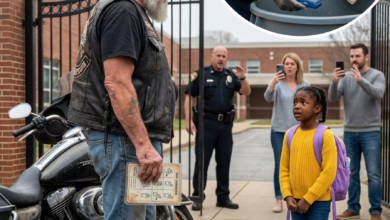
At the fourth, she asked if she could sit beside the motorcycles before going inside.
They let her.
Bear explained each bike like it was a patient animal.
“This one’s loud,” he said. “But only when I tell it to be.”
Emily touched the handlebar with one finger.
“Can people be like that?”
Bear looked at her carefully.
“Some can learn.”
That was the first time she smiled at him.
It was small.
But everyone saw it.
And nobody made it bigger than she was ready for.
Part 3
The hardest hearing came in winter.
Snow had turned the courthouse steps slick, and Emily arrived wearing a red coat too thin for the wind. She was ten then, still small, still careful, but no longer silent in the same way. She had learned the bikers’ names. She knew who carried mints, who had extra gloves, and which rider always stood farthest from the door because he said every team needed a lookout.
That morning, the case had been delayed again.
Delayed is a clean word for adults.
For Emily, it meant another month of nightmares before the next date.
She came out of the courthouse with her foster mother’s arm around her shoulders and stopped when she saw the bikers still waiting in the snow. She had been inside for hours. The hearing had changed. The schedule had failed. Adults had argued in rooms she did not understand.
But the bikers had not left.
Bear stood near the bottom step, snow gathered on the shoulders of his leather vest.
Emily looked at him.
“You’re still here?”
Bear frowned softly, as if the question hurt him.
“You told us to stand where you could see us.”
“But it’s cold.”
He nodded toward the other bikers.
“They’re ugly, but they’re warm-blooded.”
One of the men grunted, “Speak for yourself.”
Emily laughed.
Not politely.
Really laughed.
Her foster mother covered her mouth because sometimes laughter after pain feels like a miracle you are afraid to interrupt.
That day, Emily asked Bear a question that stayed with him for the next eighteen years.
“Do you think I’ll always be scared?”
Bear did not rush to comfort her with a lie.
He crouched until they were eye level.
“No,” he said. “But you might remember being scared, and that memory may visit sometimes.”
Emily’s face fell.
Bear continued gently.
“When it does, you build a bigger life around it, so fear doesn’t get the biggest room.”
Emily looked toward the courthouse.
“How?”
Bear glanced at the bikers behind him.
“One safe person at a time.”
That answer became a seed.
Nobody knew it yet.
But Emily carried it.
Part 4
The case finally ended when Emily was eleven.
There was no movie ending. No dramatic hallway confession. No perfect punishment that repaired everything. There was a ruling, paperwork, exhausted adults, and a little girl walking out of the courthouse with the stuffed fox tucked under one arm.
But something shifted that day.
Emily did not hide behind her foster mother when she reached the steps.
She walked to Bear first.
The bikers straightened without meaning to.
Emily stood in front of him and said, “I did it.”
Bear nodded.
“Yes, you did.”
“My voice shook.”
“It still worked.”
“I forgot some things.”
“You remembered enough.”
“I cried.”
Bear’s eyes softened.
“Crying doesn’t make truth smaller.”
Emily looked down at her shoes.
Then she said, “I don’t want to come here anymore.”
Bear smiled sadly.
“Good.”
That was the goal.
Not to become necessary forever.
To stand there until a child no longer needed them.
The club gave Emily a small patch that day, not one for a vest, not one that made her part of the organization in any official way. Just a little cloth circle with a stitched fox on it, matching the stuffed animal Rosa had given her.
On the back, Bear had written in marker:
You were never alone.
Emily kept it.
Through middle school.
Through high school.
Through college applications.
Through every moment when someone told her the legal system was too hard, too expensive, too cold, too slow, too full of people who had already stopped believing.
Emily did not become fearless.
That is not how healing works.
She became stubborn.
She became precise.
She became the kind of student who read every line twice because she knew a child’s life could turn on words adults missed. She worked in diners, libraries, and campus offices. She got scholarships. She cried in parking lots. She almost quit twice.
Each time, she opened the old box where she kept the fox patch.
You were never alone.
Then she kept going.
Part 5
Bear was seventy-four when Emily came back.
His beard had gone fully white. His knees hurt in cold weather. He no longer rode long distance unless someone lied to him about how far it was. But he still stood outside the courthouse when a child asked for the club, because some promises outlive a man’s joints.
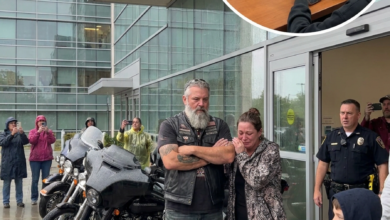
That morning, he was waiting for another case with Rosa and six newer members when he saw a woman in a navy suit walking toward them from the courthouse parking lot.
At first, he did not recognize her.
She was tall now, composed, with brown hair pulled into a professional bun, a leather briefcase in one hand, and a silver bar association pin on her lapel. She looked like someone the courthouse belonged to, not someone who had once needed help walking through its doors.
Then she stopped in front of him.
“Hi, Bear.”
His face changed.
“Emily?”
She smiled, but her eyes filled immediately.
“I passed the bar.”
For a moment, Bear did not move.
Then he pulled her into a careful hug, the kind that asked permission even after twenty years. Rosa cried openly. One of the younger bikers looked confused until Rosa whispered, “That’s our girl.”
Emily laughed through tears.
“I’m not a girl anymore.”
Bear wiped his eyes with the back of his hand.
“You are today.”
She reached into her briefcase and pulled out the old fox patch.
The marker had faded. The edges were frayed. But the words were still readable.
You were never alone.
Bear stared at it.
“I wondered if you kept that.”
Emily nodded.
“I kept it when I had nothing else that made sense.”
Then she looked past him toward the courthouse doors, where a caseworker was arriving with a small boy in a blue coat. The boy was maybe nine. He kept his head down. His hands were clenched around the straps of a backpack that looked too heavy for him.
Emily’s voice changed.
“I’m here for him.”
Bear looked at her.
“As his lawyer?”
“Yes.”
Then she took a breath.
“And I want to join the club.”
Bear blinked.
“You ride?”
Emily shook her head.
“No.”
Rosa tilted her head.
Emily looked at the child near the steps.
“I don’t need to ride. I need to stand where he can see me.”
Part 6
The club voted that afternoon.
Not because they doubted Emily.
Because they took the promise seriously.
Joining was not about looking tough, wearing leather, or standing in photographs with a meaningful caption. It meant training, background checks, court protocols, trauma-informed support, and learning how to be present without taking control. It meant understanding that a child’s story belongs to the child, not to the adults proud of helping.
Emily sat through every question.
She answered each one clearly.
Why do you want this?
Because someone did it for me.
What do you think we provide?
Not rescue. Presence.
What should a child owe us?
Nothing.
What happens if a child never thanks you?
Then we did it right anyway.
Bear watched her from the end of the table, feeling something too large for nostalgia. He had seen many children survive. He had seen some return to say thank you. But he had never seen one come back with the exact shape of the original promise in her hands.
Rosa finally asked, “What if standing there brings back your own memories?”
Emily did not pretend it would not.
“It will,” she said. “But Bear once told me to build a bigger life around fear so it doesn’t get the biggest room.”
Bear looked down.
His hands were shaking.
Emily continued.
“I built that life. Now I want to help someone else build theirs.”
The vote was unanimous.
They did not give her a full vest that day. She had not earned it yet, and Emily would have rejected anything symbolic without work behind it. They gave her a plain black support jacket with a small stitched fox on the inside pocket, where only she could see it.
Her first escort was the boy in the blue coat.
His name was Noah.
He was nine, white American, quiet, and angry in the way frightened children sometimes are when sadness feels too exposed. He refused to look at the bikers. He refused the stuffed animal Rosa offered. He refused water, gum, and every gentle question.
Emily did not push.
She stood near the courthouse steps in her navy suit and black support jacket, holding her briefcase.
After several minutes, Noah looked at her.
“Are you one of them?”
Emily glanced at Bear.
Then back at Noah.
“Yes.”
“You don’t look like them.”
She smiled softly.
“I used to be you.”
Noah stared at her.
For the first time that morning, his grip on the backpack loosened.
Part 7
Emily’s first day standing outside the courthouse lasted three hours.
Noah never said thank you.
He did not smile.
He did not hug anyone.
But when it was time to go inside, he looked back once to make sure Emily was still there. That was enough. Anyone who has ever stood beside a wounded child knows that trust often begins as a glance over the shoulder.
Bear saw it.
So did Emily.
The old promise had moved.
Not ended.
Moved.
Over the next year, Emily worked cases during the day and trained with the Harbor Saints Children’s Guard whenever court schedules allowed. She learned how to coordinate with advocates, when to step back, how to avoid making promises adults could not keep, and why sometimes the strongest thing a support person can do is remain boringly dependable.
Noah eventually accepted the stuffed fox.
He named it Court Dog, despite everyone explaining that it was clearly a fox. Children are allowed to be wrong about stuffed animals when the world has been wrong about bigger things.
One morning, outside the same courthouse where Emily had once trembled, Noah stood beside her and asked, “Were you really scared here?”
Emily looked at the courthouse doors.
“Yes.”
“What happened?”
She glanced toward Bear, now seated on a bench with his cane across his knees, still wearing his leather vest, still watching the steps.
“People stayed,” she said.
Noah considered that.
Then he moved half a step closer to her.
Years later, people would ask Emily why she joined a biker club when she did not ride a motorcycle. She would tell them they were asking the wrong question. The motorcycles had never been the rescue. The leather had never been the point. The point was the line of adults who understood that a child walking into court might need proof that the world still had protectors in it.
On the day Emily finally earned her full patch, Bear placed it in her hands himself.
His voice was rough.
“You came back.”
Emily looked at the courthouse steps.
“No,” she said. “I continued.”
And across the street, a new child arrived, looking at the door like fear lived behind it.
Emily stepped forward first.
Not as the child she had been.
Not only as the lawyer she had become.
But as the person willing to stand where the next child could see her.
Follow the page for more stories about the people we almost judged before we finally saw them.