Fifty Bikers Arrived at an Eight-Year-Old Girl’s Funeral Wearing Handmade Butterfly Wings—Then Her Mother Opened the Letter Explaining Why Exactly 500 Had to Fly
Part 2 — The Girl Outside the Hospital
My name is Daniel Mercer. My road name is Rook because, when I joined the Black River Riders at thirty-two, I moved straight into trouble and had no idea how to move back out.
I was not always the club’s road captain.
Before that, I was a father.
Lena arrived when I was twenty-three and still believed earning money excused everything else I failed to give. I repaired heavy equipment during the day, collected gambling debts at night, and came home smelling of cigarettes, hydraulic fluid, and excuses.
Her mother, Rebecca, waited longer than she should have.
Lena did too.
She was nine when I entered state prison for aggravated assault. The charge began outside a bar with a debt that did not belong to me and ended with one man in surgery. I told myself I had protected a friend.
The judge called it violence.
Lena visited twice during my first year. On the second visit, she drew a blue butterfly on the back of the vending-machine receipt and slid it beneath the glass.
“Because you’re stuck,” she said. “But you don’t have to stay what you are.”
I laughed because I did not know what else to do.
She stopped visiting.
Two years later, Rebecca remarried and moved to Arkansas. I received letters at first, then birthday cards, then silence. When I left prison, I found the little receipt folded inside my property envelope.
I carried it until rain destroyed the ink.
At forty-eight, Lena died from an overdose in a motel outside Little Rock.
Nobody called me until the following morning.
That is how the word LENA ended up across my hand. I wanted her name where I would see it whenever I reached for anything—keys, throttle, bottle, another man’s collar.
Especially a bottle.
I had been sober six years when Emma Carter walked up to me outside St. Catherine Children’s Hospital.
The Black River Riders had delivered forty blankets and several boxes of toys after a winter donation run. We were loading empty bins when Emma appeared beside my motorcycle. Her mother stood ten feet away, pushing an IV pole and watching carefully.
Emma wore a yellow coat over hospital pajamas. A purple scarf covered her head. Her skin had the pale, papery look I recognized from hospital corridors, although I did not yet know her diagnosis.
She pointed at the rook chess piece stitched beneath my name patch.
“Is that a castle?”
“A bird.”
“It looks like a castle.”
“It can be both.”
She considered that.
Then she touched the skull patch on the lower corner of my vest.
“Did you kill somebody?”
Her mother nearly dropped the IV pole.
“No,” I said.
“Did somebody kill you?”
“Not yet.”
“That’s not funny.”
“It was a little funny.”
She did not smile.
Emma asked why fifty men needed motorcycles loud enough to wake children receiving chemotherapy. I said the children had requested the engines.
“I didn’t.”
So I apologized.
That surprised her.
She asked whether I could start my Harley quietly. I explained that quiet was relative, then rolled the Road King to the far side of the parking area before firing it.
The next time we visited, Emma was waiting.
She brought ear defenders covered in butterfly stickers. After I started the engine, she placed one hand on the fuel tank and felt the V-twin pulse through the rubber sole of her palm.
“It sounds different through your hand,” she said.
That became our ritual.
I visited every other Thursday. We rarely discussed cancer. Emma wanted to know how riders received road names, why some boots had metal toes, and whether leather vests became heavier when they absorbed rain.
She asked questions grown people avoided.
During my fourth visit, she saw the silver butterfly pin inside my vest. It was no bigger than my thumbnail, tarnished around the edges, with a bent clasp repaired using copper wire.
Rebecca had mailed it after Lena died.
It had been pinned to our daughter’s denim jacket.
“Who gave you that?” Emma asked.
“A girl.”
“Is she alive?”
“No.”
“Did you love her?”
“I was supposed to.”
Emma waited.
Children understand the difference between a bad answer and an unfinished one.
“Her name was Lena,” I said.
Emma nodded as though I had trusted her with a road map.
After that, she began asking about Lena. What color had she liked? Blue. Did she ride motorcycles? Once, when she was six, around a grocery-store parking lot. Did she like butterflies?
I remembered the receipt.
“Yes.”
That was enough for Emma.
She never asked how Lena died. She asked how I stayed alive afterward.
I told her about the Black River Riders.
The club was not clean. Neither was I. Some men had records, some had divorces, and all of us had made choices we dressed up as loyalty because the real names hurt more.
But when I left prison with ninety-seven dollars, Bear gave me work at his garage.
When I stopped drinking, Ghost slept on my couch for nine nights.
When news of Lena’s death reached Springfield, Mateo rode beside me to Arkansas without asking whether I deserved comfort.
Brotherhood did not erase what we had done.
It made us witnesses to what came next.
Emma liked that answer.
Two months later, she asked to visit the clubhouse. Her immune system made that impossible, so we brought the clubhouse to the hospital parking lot. Twelve riders stood beneath her window while she inspected our motorcycles by video call.
She gave road names to the nurses.
She called Dr. Patel “Clutch,” because he always appeared when something went wrong. She named her mother “Steel,” although Sarah Carter weighed barely one hundred twenty pounds and cried in supply closets where Emma could not see.
Emma gave herself the road name Monarch.
“Because queens are bossy?” Bear asked.
“Because monarchs travel farther than people think they can.”
Bear turned away after that.
His son had vanished on a road trip when he was twenty-two. The official search ended after nine days. Bear’s private search never did.
Emma somehow noticed.
She noticed every crack men tried to hide beneath leather.
That was why, when fifty envelopes arrived three weeks after her death, none of us treated them like ordinary funeral invitations.
She had spent her last months studying us.
And somewhere along the way, she had decided fifty damaged men could carry something for her that no hearse could hold.
Part 3 — The Promise We Nearly Broke
Emma’s condition worsened in November.
Her tumor was a diffuse midline glioma. Dr. Patel explained the name once. I searched it later and wished I had not.
Radiation bought time.
Steroids bought smaller pieces of time.
Nothing bought enough.
By December, Emma’s right leg dragged when she walked. Her speech softened around certain consonants. She stopped visiting the parking lot, so I brought photographs to her room—Harleys covered in frost, Bear asleep beside a broken heater, Mateo’s granddaughter painting his fingernails while he pretended to object.
Emma laughed at that one.
Her laugh had changed.
It came out in two short breaths, followed by a cough she tried to hide beneath her blanket.
One afternoon, she asked me whether bikers attended children’s funerals.
I told her we attended when families invited us.
“What do you wear?”
“Black.”
“That’s boring.”
She had started making paper butterflies with an occupational therapist. Her right hand no longer obeyed her, so she folded with the left. The wings came out uneven.
Emma preferred them that way.
“Real butterflies aren’t even,” she said.
“They look even.”
“Only when they’re moving.”
She asked how many Black River Riders I trusted.
“All of them.”
“That’s not a number.”
“Fifty.”
We had fifty patched members and regular riders if I counted the three men who had left without turning in the parts of themselves that still belonged to us.
Emma somehow counted them too.
The first time she mentioned butterfly wings, I thought medication had blurred her thoughts. She wanted every rider at her funeral to wear a pair. Not pinned butterflies. Not small patches.
Full wings.
“Over the cuts,” she said.
“Bear won’t like that.”
“Bear doesn’t like pudding.”
“Most hospital pudding shouldn’t be trusted.”
She smiled, then lost the strength to hold it.
Emma’s mother stood by the window with both hands wrapped around a cold cup of coffee. Sarah was thirty-six, a paramedic who had spent her career arriving while other families were breaking. Now she could do nothing with the alarms surrounding her own daughter.
I asked why fifty.
Emma tapped the notebook against her blanket.
“Because ten is too easy.”
That was not the answer.
She asked whether five hundred butterflies sounded like enough to fill a cemetery. I told her I had never measured grief in insects.
“You should.”
Then she made me promise.
I did not tell the club.
Not immediately.
Bear had enough trouble. His wife’s death anniversary was approaching, the clubhouse roof leaked, and Ghost had accused him of hiding money from a fundraiser. Old damage was opening everywhere.
The Black River Riders had survived fistfights, arrests, funerals, marriages, and bankruptcies. We nearly broke over twelve thousand dollars raised for Mateo’s wife, Isabel.
Isabel needed heart surgery. Mateo asked the club for a loan. Bear refused because the money belonged to a veterans’ housing project and could not legally be redirected.
Mateo heard only refusal.
He returned his patch.
Ghost left two months later after his brother Elijah died in a crash. Bear had approved the route despite a storm warning. I defended Bear, and Ghost decided I had chosen rank over truth.
Calvin Reed drifted away after Noah disappeared. He never formally quit. He simply stopped answering.
Emma knew their names because I had told stories.
I had spoken of them as though they were dead.
She corrected me.
“If they can come back, don’t make them ghosts.”
The week before Christmas, Emma entered hospice care at home. The club parked two streets away so the engines would not disturb her neighbors. I sat beside her bed while a small artificial tree blinked near the oxygen machine.
She handed me a list.
Fifty names.
Ghost. Mateo. Calvin.
All there.
“You invite them,” she said.
“They may not come.”
“That’s their choice.”
“Bear may refuse.”
“That’s his mistake.”
Her voice was barely sound.
I asked how she planned to find five hundred butterflies in winter.
She tapped the side of her nose.
“People tell me things.”
The hospital greenhouse had partnered with a licensed butterfly conservatory south of Branson. Children learned about metamorphosis while helping maintain habitat plants. Emma had spent months recording caterpillar stages through a secure camera feed.
The winter release would use native painted ladies rather than monarchs, timed for a warm period and supervised by handlers. Emma knew more about the plan than I did, but she refused to explain everything.
“You’ll ruin it,” she said.
“How?”
“You ask too many adult questions.”
She died on January 17 at 4:12 in the morning.
Sarah called me before sunrise.
I sat on the garage floor beside my Road King until the concrete numbed my legs. Bear found me there an hour later. He placed two paper cups on the workbench and waited.
“She wanted wings,” I said.
He thought I meant angels.
I explained.
Bear’s jaw tightened. “No.”
“She asked.”
“A grieving family does not need fifty men turning a child’s burial into a biker show.”
“Her mother agreed.”
“Sarah is agreeing to anything that sounds like Emma.”
“That’s her right.”
“It’s our responsibility to know better.”
I stood too quickly and knocked coffee across the floor.
Bear did not move.
“You weren’t there,” I said.
“I’ve buried a child.”
“So have I.”
His expression changed.
I had never said that aloud inside the clubhouse.
Bear lowered his eyes toward the name across my hand. “Then you know why this can’t become content for strangers.”
I knew.
Phones would appear. People would photograph tattooed men in wings. A local page would post the image without context. Some would praise us. Others would accuse us of using a dead child.
Emma would disappear behind the spectacle.
That frightened me more than Bear’s refusal.
For two days, I considered breaking my promise.
Then the boxes arrived.
Each pair of wings had been made by hospital staff, families, students, and volunteers following Emma’s drawings. Every set was different. Beneath each lay a sealed letter with a biker’s road name.
The instructions were clear.
Wear the wings.
Do not open the letters until the cemetery.
Ride quietly.
Bring everyone.
Bear read his name on one envelope and crushed the edge between his fingers.
“What did that child know?” he asked.
“Enough.”
We called Ghost first.
He hung up.
Mateo listened, then asked whether Bear would attend. When I said yes, Mateo laughed without humor.
“Then the old man can wear my wings too.”
Calvin did not answer.
On the night before the funeral, forty-seven motorcycles stood outside the clubhouse. Three spaces remained empty.
Ghost arrived at 9:13.
He parked across the street and did not enter.
Mateo came twenty minutes later in a pickup because his Harley had not run in two years. He carried his old vest inside a plastic grocery bag.
The final space remained open until dawn.
At 8:06, while men fastened wings over leather, we heard a single engine approaching from Route 65.
Calvin Reed turned into the lot on Noah’s missing motorcycle.
Nobody understood.
The police had never found it.
Calvin stopped beside the empty space, removed his helmet, and looked directly at Bear.
“A little girl told me where to search,” he said.
Then he held up an unopened envelope bearing Emma’s purple fingerprint.
We thought that motorcycle was the first miracle of the day.
It was only the first secret.
Part 4 — Fifty Men in Wings
The ride to Maple Ridge Funeral Home took eighteen minutes.
Bear ordered a staggered formation and no unnecessary throttle. We passed strip malls, winter-bare trees, an elementary school, and the diner where Emma once made me eat blueberry pancakes after a hospital visit.
People stepped outside when they heard us.
Some filmed.
I kept my eyes on Bear’s taillight.
The wings changed the way we rode. Crosswinds caught the wire frames. Mateo’s orange pair leaned sideways. Ghost’s red wings struck his helmet whenever he checked traffic.
Nobody removed them.
Calvin rode Noah’s recovered Dyna at the back. Rust marked the exhaust. Mud remained beneath the frame even after cleaning. Emma had given him white wings painted with a narrow green line.
Noah’s favorite color.
Calvin had not told her that.
At the funeral home, the deputy approached Bear first.
“We were told twenty motorcycles.”
“There are fifty.”
“I can count.”
“Then we agree.”
The deputy looked past him at the wings.
His mouth moved once. No words came.
Inside, Emma lay in a white casket wearing a yellow dress and the purple butterfly clip she had worn the day we met. Sarah had placed no heavy makeup on her. Emma looked small, still, and tired.
I remained near the doorway.
Prison teaches a man to understand doors. Hospitals teach him to fear them.
Funeral homes teach something worse: every door leads to the same room.
Bear walked to the casket. His yellow wings brushed the flower stand, knocking one white rose onto the carpet. He picked it up, returned it to the vase, and leaned toward Emma.
“I hate pudding,” he whispered. “You were right.”
Ghost heard him.
The anger he had carried toward Bear did not disappear, but something inside it shifted.
Mateo stood beside Sarah and apologized for leaving the club before meeting Emma. Sarah told him Emma did not care about membership.
“She cared whether people returned.”
Mateo glanced toward Bear.
Calvin did not approach the casket immediately. He circled the room, staring at photographs from Emma’s life. One image showed her in the hospital greenhouse, sitting before a laptop while a butterfly handler held a mesh enclosure.
On the table beside her lay a road map.
Calvin lifted the photograph.
A purple circle marked an abandoned shed near Highlandville, thirty miles south of Springfield. That was where he had found Noah’s motorcycle beneath a rotting tarp.
“How?” he asked Sarah.
Sarah pressed her lips together.
“Emma joined an online butterfly count last summer. One volunteer uploaded a photograph from that property. She saw part of a motorcycle behind the greenhouse and remembered the decal from a picture Rook showed her.”
Calvin looked at me.
Months earlier, I had shown Emma a club album. Noah’s motorcycle had a small green chess knight beneath the rear light.
Emma noticed it.
She told Sarah, who contacted police. The property belonged to a man arrested on unrelated theft charges. Investigators recovered the Dyna and several other motorcycles.
Noah was still missing.
The discovery did not close Calvin’s wound. It proved his son’s trail had existed somewhere beyond the roadside helmet.
Emma had given him motion.
That was why she invited him.
The service began at noon. Dr. Patel spoke about Emma’s habit of renaming medical equipment. Her infusion pump was “Gerald.” The radiation mask was “the waffle.” She called the hospice oxygen concentrator “Darth Breather.”
People laughed.
Then Sarah read a paragraph from Emma’s notebook.
“If butterflies only came when people were ready, there would be no butterflies. They come when the weather says it is time.”
Sarah stopped twice.
I watched her fingers tighten around the paper.
After the final hymn, funeral staff prepared to move the casket. That was when ten white butterfly boxes appeared beneath the awning.
A handler from Ozark Wings Conservatory checked the temperature.
Fifty-seven degrees.
Too cold.
Painted lady butterflies require sufficient warmth to orient, fly, and feed. Releasing them into cold air could leave hundreds motionless on the ground.
The forecast had promised sixty-eight.
Missouri offered fifty-seven and a hard north wind.
The funeral director, Mr. Lawson, said the cemetery would allow only fifteen minutes after the graveside prayer. Another service followed ours. The conservatory handler recommended canceling the release or moving it indoors, where the butterflies could later be transported safely.
Sarah stared at the boxes.
“No,” she said.
It was the first time I heard steel in her voice.
Mr. Lawson explained again. Sarah did not shout. She placed one palm on Emma’s casket and said her daughter had planned the release for seven months.
The handler knelt beside her.
“I will not harm them to complete a picture,” she said. “Emma understood that.”
Sarah closed her eyes.
Bear removed his yellow wings.
Several mourners gasped softly. I thought he was quitting.
Instead, he handed the wings to the handler.
“Can these hold heat?”
The frame contained thin emergency blanket material between fabric layers. The reflective surface could help warm the ventilated boxes if arranged around them, but no one could force the temperature.
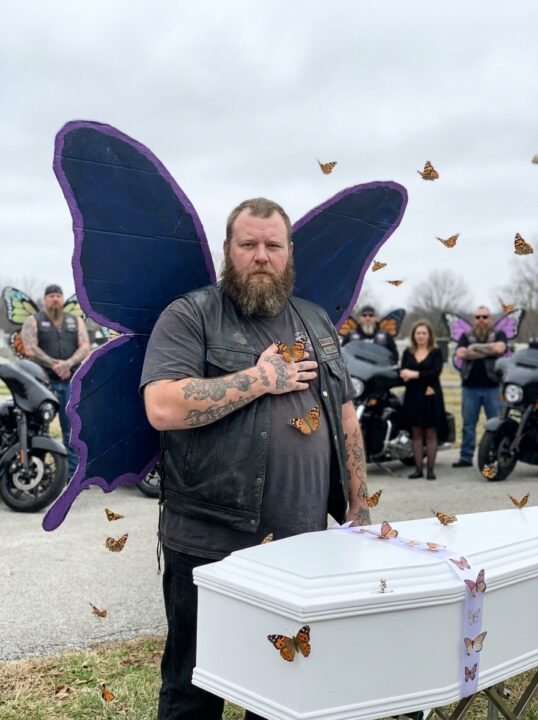
Fifty bikers removed their wings.
We built windbreaks along the funeral-home wall. Staff brought folding tables. The boxes remained sealed and shaded from direct contact while warm air circulated around them.
We waited.
The schedule collapsed. The cemetery called twice. Mr. Lawson paced near the hearse.
Bear told him to send the next family through first.
“We’ll wait.”
“The family paid for this time.”
“Then bill me.”
Sarah looked at him. “You don’t have that kind of money.”
“No.”
He turned toward Ghost.
“But we have fifty men.”
For the first time since Elijah’s crash, Ghost stood beside Bear without anger between their shoulders.
The club paid for an extended graveside arrangement, additional staff time, and a second hearse window. Mateo called a diner and ordered food for the waiting families. Calvin drove to the cemetery to explain in person.
Nobody filmed that part.
At 1:46, the clouds thinned.
At 2:03, the temperature reached sixty-two.
At 2:17, the handler opened a test envelope.
One painted lady crawled onto her glove. It opened its wings, remained still, then lifted toward the roofline.
Sarah covered her mouth.
The boxes could be transported.
We refastened our wings and rode to Maple Ridge Cemetery behind Emma’s hearse. The afternoon sun fell low across the road, making every wire frame cast a strange moving shadow over the pavement.
At the graveside, fifty envelopes remained unopened inside our vests.
Five hundred butterflies waited.
We still did not know the number mattered.
Then Sarah asked me to open Emma’s final instructions.
The first line read:
Ten butterflies for every biker, because every biker carries ten names he never says.
Beneath it was a second instruction.
Before the boxes opened, each of us had to read the name sewn inside our wings.
Part 5 — What Emma Sewed Inside
The strip inside my right wing was folded beneath a blue seam.
My hands shook while I pulled it free.
The cloth held ten names written in permanent marker. The first nine belonged to children I had heard Emma mention from St. Catherine’s pediatric floor.
Mia.
Noah B.
Jackson.
Avery.
Cole.
Sophie.
Malik.
Rose.
Ben.
The tenth name was Lena Mercer.
I stopped breathing.
Around me, forty-nine men opened similar strips.
Every wing carried ten names.
Some belonged to children treated at St. Catherine’s. Some belonged to parents, siblings, friends, and club members who had died. Emma had collected them during hospital workshops, phone calls, clubhouse video chats, and conversations with Sarah.
Five hundred butterflies.
Five hundred names.
The release was not meant to represent only Emma.
She had refused to fly alone.
Bear found the names of his wife and missing son on his strip. Ghost found Elijah. Mateo found Isabel’s father and a baby he and his wife had lost before anyone in the club knew she was pregnant.
Calvin’s cloth held Noah’s name last.
He pressed it against his mouth.
No body had been found, but Emma had left a small question mark beside the name. Not a cross. Not an ending.
Calvin folded the strip carefully and placed it inside his breast pocket.
Sarah explained that Emma had started the list after noticing how adults avoided naming dead children. People said “your loss,” “what happened,” or “the little one.”
Emma wanted names.
She asked parents on the ward. She wrote to hospice groups. She collected names from the Black River Riders after telling each man she was making a “family tree.”
Nobody understood what she meant.
The three estranged riders had been invited because their names completed connections the club had tried to erase.
Emma’s letters told the rest.
Bear opened his first. He read silently, then passed it to Ghost.
Emma had written:
Bear did not make the storm. Ghost did not make Elijah ride. If you keep blaming each other, the crash gets two more people.
Ghost’s eyes lifted.
Bear said nothing.
A road captain had warned about the weather. Bear had delayed departure but had not canceled the ride. Elijah left alone, believing he could beat the storm home.
Bear carried guilt.
Ghost needed somewhere to put his brother’s absence.
Emma had heard both versions from different men and reduced years of anger to three sentences a child could understand.
Ghost stepped closer.
“You should’ve called me.”
Bear’s jaw moved. “You wouldn’t answer.”
“You should’ve kept calling.”
Bear nodded.
No embrace.
No speech.
Ghost placed one hand on Bear’s shoulder, left it there for two seconds, and removed it.
That was enough.
Mateo’s letter contained a copy of financial records showing Bear had personally paid $8,000 toward Isabel’s surgery through an anonymous church fund after refusing to misuse restricted club donations.
Bear had sold his late wife’s jewelry.
Mateo stared at him.
“You let me hate you.”
“Money helped your wife. The name on the check didn’t.”
“You could’ve told me.”
“You had enough to carry.”
Mateo took off his old vest. The place where he had removed the club patch remained lighter than the surrounding leather.
He handed it to Bear.
“Hold this until I earn it again.”
Bear pushed it back.
“You came.”
Two words.
Mateo put the vest on.
Calvin’s letter did not reveal where Noah had gone. Emma had not solved that mystery. She told him who had uploaded the greenhouse photograph and included the investigator’s contact information.
Then she wrote:
Finding the motorcycle is not finding Noah. But it means the road did not end where they told you. Keep going.
Calvin read that line three times.
My envelope remained closed.
I wanted to delay it.
Emma’s butterfly landed on my hand before I broke the seal. It was one of the first released from the test carrier, orange and black, lighter than the ash from a cigarette.
It settled directly on the letters spelling Lena.
Sarah whispered, “She promised that would happen.”
Of course Emma could not command a butterfly. She had made Sarah promise to watch my hand because the tattoo would be exposed when I opened the boxes.
The butterfly chose where to land.
Emma had only believed I would notice.
My letter contained a photograph.
Lena was nine, sitting at a visitation table inside Missouri Eastern Correctional Center. I sat across from her in prison clothes. Between us lay the vending-machine receipt bearing the blue butterfly she had drawn.
I had never seen the photograph.
A corrections volunteer had taken it during a family-support day and later mailed it to Rebecca. After Lena’s death, Rebecca stored photographs she could not bear to discard. Years later, she began volunteering in the hospital greenhouse.
She met Emma there.
The woman standing beside Emma in the photograph from the funeral home was Rebecca. She had recognized me in a club donation video and told Emma about Lena only after the girl noticed my silver pin.
I had assumed Rebecca wanted no contact.
The truth was smaller and harder.
She did not know whether contact would help or reopen what Lena had spent years trying to close. Emma decided grown people were wasting time.
My letter read:
Rook, Lena drew a butterfly because she wanted you to change and come home. You did change, but you never went home. Her mom still waits at the greenhouse on Thursdays.
Beneath that, Emma had added:
Don’t make me invite fifty bikers again.
I laughed once.
It came out broken.
Sarah pointed toward the last row of mourners.
Rebecca stood beneath an oak tree.
She was fifty-two now. Silver ran through her brown hair. She wore Lena’s denim jacket, the one that had once held the butterfly pin inside my vest.
For sixteen years, I had imagined what I might say.
Every sentence felt dishonest.
I walked toward her wearing blue wings, glitter in my beard, and my dead daughter’s name beneath a living butterfly.
Rebecca looked at the wings.
“She would’ve loved those.”
“I failed her.”
“Yes.”
No comfort.
I respected that.
“I thought staying away was the only decent thing I had left.”
“It wasn’t.”
Behind us, the handlers prepared the remaining boxes. Children gathered near Emma’s casket. Fifty bikers formed a wide half-circle so everyone could see.
I gave Rebecca the silver pin.
She closed my hand around it.
“No,” she said. “Lena wanted you to carry it until you came back.”
“I’m here.”
“Then carry it differently.”
She turned the pin over. A second clasp had been added, along with a narrow strip of blue fabric.
Rebecca fastened it to the outside of my wing.
The secret was no longer inside my leather.
Sarah lifted the first lid.
Hundreds of painted ladies stirred.
Some rose immediately. Others crawled onto the edges and waited for warmth. Wings opened across the cemetery like small, uneven hands.
Bear released ten for the names he carried.
Ghost released ten beside him.
Mateo held his box with both palms.
Calvin whispered Noah’s name before opening his.
When my turn came, I placed the container beside Emma’s casket. Ten butterflies climbed toward the light.
The final one remained on the cardboard.
I waited.
Nobody hurried it.
After nearly a minute, it crossed onto my scarred thumb, rested above Lena’s name, and flew toward the oak tree where Rebecca stood.
People later called that a sign.
Maybe it was only a warm hand, a patch of sunlight, and an insect choosing the nearest place to rest.
That was enough.
Emma had never asked us to believe in magic.
She had asked us to show up wearing wings.
Part 6 — The Fifty-First Name
We believed the release completed Emma’s plan.
Sarah corrected us after the burial.
She carried one final envelope marked FOR THE CLUBHOUSE. Inside was a list of supplies, a drawing of a greenhouse, and a request written across three notebook pages.
Emma did not want an annual memorial ride.
She thought once a year was “how adults make themselves feel organized.”
She wanted the Black River Riders to help maintain the hospital’s butterfly greenhouse every Thursday, because Thursdays were when children received long infusions and needed somewhere quieter than the treatment floor.
Bear looked at the list.
Soil. Milkweed. Mesh repairs. Wheelchair-height planting tables. A new ventilation fan.
None of us knew anything about butterflies.
We knew engines, steel, roofs, electrical wiring, stubborn bolts, and the weight a structure could carry before failing.
That was close enough.
The first Thursday, twelve riders arrived at St. Catherine’s. The hospital made us clean our boots, cover our cuts, remove chains, and follow infection-control rules.
Bear complained about the hairnet.
A six-year-old boy told him it improved his face.
Bear wore it without another word.
We built two planting tables low enough for wheelchairs. Mateo repaired the misting system. Ghost rewired the ventilation fan. Calvin mounted a camera so children confined to rooms could watch caterpillars change.
I worked beside Rebecca.
At first, we spoke only about measurements. Cedar boards. Screw lengths. Drainage. Safe paint.
Then we spoke about Lena.
Rebecca told me our daughter had kept the prison photograph inside a paperback book. She had carried anger toward me for years, but anger was not the only thing she carried.
Lena attended one Black River Riders toy drive from a distance when she was twenty-one. She saw me unloading bicycles. She did not approach.
“She wanted proof it would last,” Rebecca said.
“It didn’t last long enough.”
“No.”
Again, no comfort.
Again, the truth.
We mounted Emma’s blue wings above the greenhouse door. Sarah had removed the wire frame and preserved the fabric. The strip bearing ten names remained sewn inside.
Every Thursday, visitors could add another name to a wooden box beneath them.
The fifty-first name came from Bear.
EMMA CARTER.
He wrote it in block letters, folded the paper once, and placed it inside without ceremony.
Ghost added Elijah.
Mateo added Isabel’s father.
Calvin added Noah’s name with the same question mark Emma had used.
I added Lena.
Then Rebecca placed her own folded paper beside mine.
I did not ask what she had written.
Blank courage counted too.
The Black River Riders changed after the funeral, though not as neatly as people later claimed. Ghost returned to rides but refused a formal role. Mateo re-earned his patch by his own rules, not Bear’s. Calvin continued searching for Noah with investigators.
We still argued.
Men left.
New prospects arrived and stared at the butterfly wings above the clubhouse bar, where Bear had hung a second set Emma made from pink sheets.
Nobody explained them immediately.
A prospect had to notice.
Then he had to ask.
Every January, Sarah ordered butterflies through the conservatory, but we never released five hundred again. Emma’s five hundred belonged to that afternoon and those names.
Instead, families released small groups when the weather was safe. Sometimes ten. Sometimes two.
Sometimes none.
On cold days, we waited.
That became part of the ritual too.
Part 7 — What Still Flies
Two years after Emma’s funeral, Calvin received a call from Arkansas.
A mechanic had seen the photograph of Noah’s recovered Dyna in an investigator’s bulletin. He remembered a young man arriving at his shop four years earlier, frightened and injured after escaping someone involved in motorcycle theft.
The mechanic had driven him to a bus station.
Noah used another name.
The trail led west.
Calvin found him in New Mexico, alive, sober, and terrified to return because the men who stole his motorcycle had threatened his family. He had spent years believing silence protected his father.
Their reunion did not repair everything.
No reunion does.
But one Sunday, Noah rode into the Black River Riders’ lot beside Calvin. The green chess knight was again fixed beneath the Dyna’s rear light.
Bear stood in the doorway wearing Emma’s pink wings.
Noah stared.
“You gonna explain those?”
“No.”
Bear handed him a second pair.
Noah put them on.
That photograph never reached the internet. We kept some moments for the people inside them.
Rebecca and I did not become a family again. Too much time had passed, and too much damage had names. We became two people willing to work at the same greenhouse and speak honestly about the daughter we had both lost.
On Thursdays, I still ride to St. Catherine’s.
The Road King’s V-twin echoes beneath the parking structure. Children sometimes wait behind the glass wearing ear defenders. I shut down the engine, remove my helmet, and touch the silver butterfly pin now fastened outside my vest.
The greenhouse smells of damp soil and warm leaves. Caterpillars chew through milkweed. Mesh cages rustle softly near the windows.
Emma’s photograph hangs beside the door without a slogan beneath it.
She is seven in the picture, still strong enough to stand. One hand rests against a mesh enclosure. The other points toward something outside the frame.
Sarah says she was pointing at me.
I had arrived late that day.
I do not remember.
Every January, the Black River Riders return to Maple Ridge Cemetery wearing the same handmade wings. Some are faded. Several have been repaired with tape. Bear’s yellow pair carries coffee stains and a burn hole from standing too close to a clubhouse heater.
We do not bring cameras.
We do not bring five hundred butterflies.
We read the names collected in the greenhouse box, then stand beside Emma’s grave until everyone is ready to leave.
One year, snow covered the cemetery.
No butterflies could fly.
Bear placed a folded paper on Emma’s headstone instead. It held only two words:
Still here.
Then fifty engines started in sequence.
The sound rolled through the bare trees and followed us toward Route 65. Our wings shook behind our shoulders, awkward and bright against the winter road.
For several miles, a blue butterfly pin tapped softly against my leather.
I could hear it between shifts.
Emma had asked us to help her fly.
She left us carrying the wings.
Follow our page and leave ROOK if you want more stories about bikers whose quiet promises outlive the final ride.