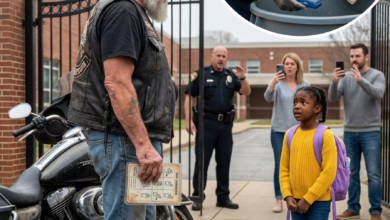
A Six-Year-Old Asked the Tattooed Biker Why He Rode a Harley Instead of a Horse—Three Days Later, Two Very Different Rides Appeared Side by Side
Part 2 — The Man Behind the Garage Door
My name is Mara Bennett. I was thirty-four that summer, worked mornings at a dental office in Tulsa, and spent most afternoons negotiating with a six-year-old who considered shoes optional and every stranger a future friend.
Noah and I moved to Broken Arrow after his father and I separated. The small rental house on East Canton Street was all I could afford within driving distance of my job and Noah’s school. The fence leaned toward Wade’s property, the air conditioner complained through July, and the kitchen window faced the open door of his detached garage.
I knew him first by sound.
At 6:10 every weekday morning, his garage door rolled upward. Tools clicked against a metal tray. A radio played old Red Dirt songs beneath the rough pulse of an idling Harley, and by 6:30 Wade was headed toward Mercer Cycle Works, the small repair shop he owned beside Highway 51.
He came home after dark smelling of motor oil and road dust. Sometimes four or five riders followed him. They looked like the kind of men a cautious mother noticed—thick beards, tattooed arms, leather cuts, heavy motorcycles—and yet they never drank in his driveway, never shouted after ten, and never left trash near the curb.
The first time Noah kicked a soccer ball beneath Wade’s half-open garage door, I expected trouble.
Wade picked up the ball, examined the scuffed surface, and asked, “This thing got brakes?”
“No.”
“Poor engineering.”
He returned it with one slow underhand toss.
Two days later, a small wooden stop sign appeared beside our driveway so Noah would remember not to chase the ball into the street. Wade claimed he had found it behind his shop. I later discovered fresh sawdust in his trash bin and red paint beneath one thumbnail.
That was how he did kindness.
Sideways.
Wade did not speak about family. He owned no framed photographs that I could see, received no holiday visitors, and spent Christmas morning changing the battery in an elderly widow’s car. Yet odd traces of another life remained around him.
A dented silver belt buckle hung above his workbench. A pair of unused spurs rested in a coffee tin. An old saddle sat beneath a canvas sheet in the deepest corner of his garage, though dust had gathered thickly around it.
And then there was the horsehair braid.
It was perhaps eight inches long, dark brown with a narrow streak of gold, tied to his mirror with a piece of red leather. It moved whenever the Harley idled, brushing against the chrome stalk like a small tail keeping time with the engine.
Noah noticed everything.
“Did that come from a horse?”
“Yes.”
“Was it your horse?”
“No.”
“Whose horse?”
Wade looked at me over Noah’s head.
“Your mom needs help with those groceries.”
He took both bags from my arms and ended the conversation.
The other bikers knew the subject was closed. Earl “Rivet” Cole, a retired welder with a white mustache and hands burned smooth across the fingertips, once caught me looking at the saddle.
“Dusty rode before he walked,” Earl said.
“Why did he stop?”
The old man glanced toward Wade, who was tightening a primary chain on the far side of the shop.
“Ask him if you want him quiet for a month.”
I did not ask again.
What I learned came in fragments. Wade had grown up outside Claremore on a cattle operation owned by his grandfather. He competed in junior rodeo, broke ranch horses, and spent twelve years working across Oklahoma and northern Texas as a ranch hand, horse trainer, and occasional pickup rider.
His nickname had existed long before the motorcycle.
He married at twenty-four. His wife, Jenny, taught third grade. Their daughter, Annie, arrived two years later and apparently inherited her father’s complete lack of caution around animals.
That was all anyone would say.
When Wade was thirty-three, he left the ranch, sold his pickup, and bought a used Harley-Davidson Electra Glide from Earl for less money than Earl should have accepted. He taught himself motorcycle repair, stopped attending rodeos, and never again entered a barn unless someone’s life depended on it.
The Harley was not rebellion.
It was replacement.
A horse moved beneath you with warmth, breath, intention, and memory. A motorcycle responded to fuel, spark, pressure, and steel. If an engine failed, Wade could open it, identify the broken part, and replace what was gone.
People were harder.
That Friday, when Noah said horses were softer, he did not know he had placed one small hand against the locked door Wade had spent seventeen years reinforcing.
I did not know either.
But Lila Grant did.
After Noah and I went inside, Wade called her ranch for the first time in nearly eleven years. Lila answered on the fourth ring, heard his voice, and said nothing for so long that Wade nearly hung up.
Finally, she asked, “Who died?”
“Nobody.”
“Then who needs help?”
Wade watched Noah through our kitchen window, galloping around the table on a broom.
“A kid next door.”
Lila laughed once. “That sounds worse.”
“I need a pony for an hour.”
“Do you?”
“The boy does.”
She let the lie sit between them.
Lila still owned Biscuit, though the pony had gray around her muzzle and had retired from regular lessons. Biscuit was gentle with children, accustomed to loud farm equipment, and one of the few horses Lila trusted near a motorcycle.
More importantly, Biscuit had once belonged to Annie.
When Wade asked to borrow her, Lila understood what he was actually requesting.
Not a pony.
Permission to return.
Part 3 — Two Rides on the Same Grass
Saturday morning arrived hot and cloudless. Cicadas buzzed in the cottonwood trees, a sprinkler clicked three houses down, and Biscuit stood beside Wade’s driveway chewing grass as if a cream-colored pony appearing in a suburban neighborhood required no explanation.
Noah approached her with both hands held against his chest.
“Is she mine?”
“No,” I said quickly.
Wade’s mouth moved beneath his beard. It may have been a smile.
“Borrowed,” he said. “Like library books, except books don’t kick.”
Noah stopped.
“Does she kick?”
“Not unless somebody stands where they shouldn’t.”
That became the morning’s first lesson. Wade showed him how to approach from the side, offer a flat palm, avoid walking directly behind her, and listen when an animal’s ears or body asked for space.
There was no sentimental speech. No cowboy performance.
Only rules.
Wade checked the child-sized western saddle Lila had brought. His scarred fingers moved through the leather with old speed—cinch, buckle, stirrup, pad—until he reached the reins.
Then he froze.
Biscuit turned her head toward him.
The pony’s coat was lighter than it had been seventeen years earlier, but the narrow gold streak in her mane remained. The braid tied beneath Wade’s Harley mirror had been cut from that mane on the last day Annie rode her.
Lila placed the lead rope in Wade’s hand.
He did not close his fingers.
“You can lead her,” she said.
“I know how.”
“I didn’t say you forgot.”
“I said the kid gets one lap.”
“No, you said you needed a pony for an hour.”
Wade looked toward Noah, perhaps hoping a six-year-old would lose interest. My son was trying to whisper into Biscuit’s ear while she searched his shirt pocket for food.
No such luck.
Wade accepted the rope.
The leather creaked inside his fist. Biscuit breathed across his knuckles, and the smell of warm hide, hay, and dry Oklahoma dirt seemed to strike him harder than any fist could have.
His shoulders dropped.
“Hey, girl,” he whispered.
Biscuit pressed her forehead against his chest.
Lila turned away. Earl suddenly became interested in the trailer latch. I pretended to adjust Noah’s helmet because it seemed kinder than watching Wade fight for control of his face.
No tears came.
Just one rough breath.
Then Wade looked at Noah. “Ready?”
My son nodded so hard the helmet slipped over his eyes.
Wade lifted him into the saddle. For a man with damaged shoulders, he made it look effortless. He placed Noah’s feet in the stirrups, adjusted his hands, and walked beside Biscuit as Lila led her around the orange cones.
The first lap was slow.
Noah sat rigidly, mouth closed, both hands gripping the saddle horn. Biscuit’s hooves pressed small dark marks into the morning grass. Wade stayed beside my son’s knee, one hand hovering close enough to catch him but never touching.
At the second cone, Noah laughed.
It began as a squeak and grew into the unrestrained sound only a child can make when his body discovers a new kind of motion. Biscuit’s ears turned toward him. Wade’s head lowered, and beneath the beard I saw his jaw tremble.
“Soft,” Noah announced.
“Yeah,” Wade said. “She is.”
By the third lap, half the street had gathered. Mrs. Hanley watched from her porch in slippers. Two teenagers held their phones up. A delivery driver slowed until a car behind him honked.
People had seen Wade’s motorcycles.
They had never seen him with a horse.
Noah asked whether Biscuit could race the Harley. I told him absolutely not. Lila told him Biscuit had earned retirement. Wade looked at the open field between our houses and considered the question with suspicious seriousness.
“No racing,” he said. “But we can ride together.”
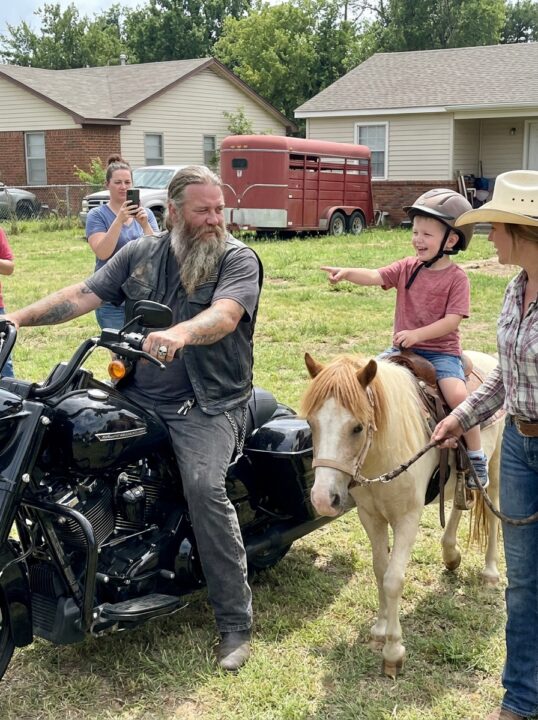
He rolled the Road King from his garage without starting it. The black motorcycle looked enormous beside the pony, all chrome, steel, and hard angles against Biscuit’s round belly and sunlit mane.
Wade climbed onto the Harley.
For a moment, the two versions of his life stood six feet apart.
He started the engine. The V-twin settled into a low potato-potato rhythm, loud enough to vibrate through the grass but not enough to startle Biscuit. Lila held the pony steady while Wade watched her ears.
Biscuit chewed.
Apparently, she had no opinion.
Wade eased the Harley forward at walking speed. Lila led Biscuit beside him. Noah sat in the saddle wearing a helmet too large for his narrow shoulders, laughing every time the motorcycle’s exhaust answered the pony’s hoofbeats.
One horse.
One Harley.
One six-year-old boy.
One fifty-year-old man who had spent seventeen years pretending the two halves of him could never occupy the same field.
I took out my phone.
The video lasted forty-three seconds. I began recording after they passed the first cone, so the frame opened on Noah riding Biscuit while Wade moved beside him on the Harley. The angle tilted. My thumb covered the lower corner. Wind struck the microphone, and the exposure washed out half the sky.
It was not professional.
It was true.
At the final cone, Noah turned toward Wade and shouted, “Mine is softer!”
Wade nodded solemnly. “Yours is softer.”
“But yours has music!”
“Fair trade.”
The neighbors laughed. Wade did not look toward the camera. He kept his eyes on Noah and Biscuit, matching their slow pace across the uneven lawn.
That should have been the ending.
A sweet neighborhood moment. A former cowboy helping a child. Something I might send to my sister and forget beneath a thousand other phone videos.
Then Biscuit stumbled.
Her front hoof caught the edge of a shallow sprinkler trench. Noah pitched sideways, one foot slipping free of the stirrup.
I screamed.
Wade shut the Harley down, dropped it onto the grass, and reached Noah before the motorcycle finished falling. One arm caught the boy around the waist. The other steadied the saddle. Lila pulled Biscuit’s head up and stopped her within a step.
Nobody hit the ground except the Harley.
Noah stared at Wade.
Wade stared at Noah’s dangling boot.
“You hurt?”
“No.”
“Anything twisted?”
“No.”
“Scared?”
Noah considered lying, then nodded.
Wade lowered him carefully. “Good. Scared means your brain is working.”
I rushed across the grass and checked every inch of my son. He was unharmed, but Wade’s left hand had torn against the saddle hardware. Blood ran across his palm and into his wrist.
His motorcycle lay on its crash bar, mirror buried in the grass.
He never looked at it.
Noah did.
“Your bike fell.”
“Bikes can be fixed.”
“Did I break it?”
“No, little man.”
“Did Biscuit break it?”
Wade glanced at the pony, who had returned to eating.
“She doesn’t look sorry.”
Noah started laughing again.
That was the false ending recorded in my video: Wade sitting in the grass with one bleeding hand, Noah leaning against his shoulder, Biscuit chewing beside them, and the fallen Harley ticking as its hot engine cooled.
But while Wade helped lift the motorcycle, the horsehair braid beneath the mirror came loose.
Noah picked it up.
“Is this Biscuit’s hair?”
Wade looked at the braid in my son’s palm.
“Yes.”
“Why do you keep it on your motorcycle?”
The yard went quiet.
Wade could have avoided the answer as he always had.
This time, he didn’t.
“Because she belonged to my daughter.”
Part 4 — The Cowboy He Left Behind
Noah looked around the yard as if Wade’s daughter might be standing somewhere beyond the pony.
“What’s her name?”
“Annie.”
“Is she grown up?”
Wade lowered himself onto the Harley’s footboard. His bleeding hand rested palm-up on his knee while Lila wrapped it with gauze from the trailer’s first-aid kit.
“She would be twenty-five.”
Would be.
I drew Noah against me, but Wade shook his head. He was not asking me to remove the child. Perhaps he had spent too many years speaking only to adults who knew when to become silent.
Noah did not.
“Where is she?”
Wade looked at Biscuit.
Annie Mercer had been five when Jenny bought the pony from a family near Muskogee. Biscuit was stubborn, food-driven, and patient enough to stand while a little girl tied ribbons into her mane.
Annie rode before school, after school, and sometimes in the dark while Wade walked beside her holding a flashlight. She competed in lead-line classes, learned to brush mud from Biscuit’s coat, and kept peppermints hidden in every jacket pocket.
When Annie was seven, she began bruising easily.
At first, Wade blamed the saddle. Then came the fevers, the nosebleeds, and a morning when she lacked enough strength to climb the three porch steps into the house.
Leukemia changed the family’s calendar. Ranch work became hospital visits. Rodeos became blood counts. Wade learned the language of ports, platelets, remission, relapse, and numbers adults whispered beyond a child’s bed.
Biscuit waited in the barn.
During the first year of treatment, Annie still rode on good days. Wade led the pony around the smallest pasture while Jenny walked beside them carrying water and a blanket.
The last ride happened on Annie’s eighth birthday.
She was too weak for the saddle, so Wade laid a thick pad across Biscuit’s back and lifted his daughter onto it. Annie leaned forward with both arms around the pony’s neck. They walked once around the barn at sunset.
Before Wade carried her inside, Annie asked him to cut a small lock from Biscuit’s mane.
“So you’ll remember soft things,” she said.
Annie died eleven days later.
Jenny left the ranch the following spring. Grief had turned every fence post and feeding bucket into an accusation. She moved to Colorado to live near her sister, while Wade stayed because he did not know where else a man went when the only person who called him Daddy was gone.
He tried to keep working horses.
The first time another child mounted Biscuit, Wade vomited behind the tack room. The second time, he walked to his truck and did not come back.
He sold most of what he owned.
Lila bought Biscuit for one dollar because Wade refused to give her away and could not tolerate hearing a fair price. Earl sold him the old Electra Glide. Wade rode until his hands went numb, then learned to repair motorcycles because broken engines did not ask him to discuss what happened.
He tied the horsehair beneath the mirror.
That was the only part of the ranch he allowed onto the road.
Noah listened without moving. He did not understand leukemia, divorce, or why adults sometimes abandon places they love because staying hurts more than leaving.
He understood daughters.
“Did Annie like loud motorcycles?”
Wade rubbed his bandaged palm across his jeans. “She never saw me ride one.”
“She would like yours.”
“You think?”
“It has good music.”
Wade turned his head away.
That was the moment the story twisted in a direction none of us expected. Wade had brought Biscuit because he thought my son needed an experience. In truth, Noah had been leading Wade back toward something the older man could not approach alone.
Reverse roles do not always announce themselves.
Sometimes they wear mismatched socks.
Noah asked to ride again. I expected Wade to refuse after the stumble, but he crouched until they were eye level.
“You got scared.”
“Yes.”
“You still want back up?”
“Yes.”
“Why?”
Noah touched Biscuit’s mane. “Because she didn’t mean it.”
Wade studied him for several seconds.
Then he lifted the boy into the saddle.
This time, Wade did not return to his Harley. He took Biscuit’s lead rope and walked on foot. One lap became two. At the far end of the field, Lila quietly handed him a longer rein.
“Get on,” she said.
Wade shook his head.
“You’ve already come this far.”
“I came for the boy.”
“No,” Lila replied. “The boy came for you.”
Earl walked to the trailer and brought out an adult saddle. He and Lila had packed it without telling Wade.
That was their gamble.
Wade stared at it as though it belonged to a dead man. Technically, it did. The saddle had been his, stored in Lila’s tack room for seventeen years beneath a canvas cover.
She had cleaned it the night before.
“You planned this,” Wade said.
“I prepared for it.”
“There’s a difference?”
“A few pounds of leather.”
Wade did not mount that morning. The distance was still too far.
But he touched the saddle.
He ran his thumb along the horn where Annie had carved a tiny crooked A with a horseshoe nail. Then he carried it into his garage and set it beside the Harley instead of hiding it beneath the old canvas sheet.
For Wade, that was movement.
For Noah, it was merely lunchtime.
We ate peanut-butter sandwiches on the porch while Biscuit grazed beneath the maple tree. Wade sat on the bottom step with his boots in the grass. My son placed the horsehair braid in his hand.
“You should put it back.”
Wade looked toward his motorcycle.
“No,” he said. “Think I’ll keep it somewhere softer.”
That afternoon, he stitched it inside the left chest of his leather vest, directly over his heart.
Part 5 — Nine Million Strangers
I posted the video Sunday evening after asking Wade’s permission.
He did not understand why anyone outside our street would care.
“It’s a kid on a pony.”
“It’s a biker riding beside him.”
“People have seen bikers.”
“Not like this.”
Wade looked suspiciously at my phone. “Does that thing show the bike falling?”
“Yes.”
“Cut that part.”
“Noah says it’s his favorite part.”
“Kid has poor judgment.”
I uploaded forty-three seconds with a simple caption: My son asked our biker neighbor why he rode a Harley instead of a horse. Wade decided the boy deserved to compare them.
By bedtime, the video had eleven thousand views.
By breakfast, it had passed three hundred thousand.
News pages copied it. Cowboy groups shared it. Motorcycle clubs reposted it beside photographs of old ranch hands on touring bikes. Parents sent clips of children arguing over which ride they would choose.
The imperfect details made it spread—the tilted frame, the harsh Oklahoma sunlight, Noah’s crooked helmet, Biscuit’s unconcerned chewing, and Wade’s Harley tipping into the grass while he reached for the child.
Viewers expected the large tattooed biker to save his chrome first.
He chose Noah.
The comments arrived faster than I could read them. Some were funny. Some were cruel. A few accused us of staging the entire scene, which annoyed Wade less than strangers criticizing the way he had adjusted Noah’s stirrups.
“The left one was half an inch low,” he admitted.
One comment rose above the others:
Cowboy meets biker. Generation meets generation.
It received hundreds of thousands of reactions.
Wade read it at my kitchen table while Noah ate cereal beside him. He held the phone with one finger, as if touching the screen too firmly might break the internet.
“What am I supposed to say?”
“Whatever you want.”
“I don’t want anything.”
“Then say that.”
Noah leaned across the table. “Tell them I was right.”
Wade looked at him.
Then he typed six words:
The kid was right. Horses are softer.
His reply spread almost as quickly as the video.
By the third day, the clip had passed nine million views. A morning television program asked us to fly to New York. A motorcycle company offered riding gear. A feed manufacturer wanted Biscuit in an advertisement.
Wade declined everything.
“No circus,” he said.
Lila agreed. Biscuit had already survived one child’s glitter ribbons. She did not need corporate fame at fourteen.
Yet Wade accepted one invitation.
The Children’s Rehabilitation Center in Tulsa operated a therapeutic horsemanship program for children with physical disabilities, trauma histories, and developmental differences. One of its instructors saw the video and recognized Lila.
She did not ask Wade to appear on television.
She asked whether he could repair a broken mounting ramp.
The center had been waiting six months for enough funds to replace it. Without the ramp, children using wheelchairs required extra staff support to mount safely. Wade visited after closing, measured the frame, and told the director he would return Saturday.
He brought twelve bikers.
Earl welded the broken joint. Two riders replaced warped boards. Another electrician repaired the arena lights. Lila inspected the horses while Wade worked where he could keep his back toward them.
At noon, a nine-year-old girl named Kayla arrived early with her mother. Kayla had spina bifida and used a purple wheelchair decorated with star stickers. She watched the bikers assemble the ramp, then pointed at Wade.
“You’re the horse-is-softer man.”
Every rider stopped working.
Wade slowly turned.
Earl laughed so hard he had to sit on a toolbox.
Kayla asked whether Wade rode horses. He gave the answer he had used for seventeen years.
“Not anymore.”
“Why?”
“Long story.”
“I have time.”
Wade glanced toward her mother, who covered a smile.
Kayla’s therapy horse was a broad sorrel gelding named Jasper. When the repaired ramp was ready, two instructors helped her mount. Wade stood beside the arena gate with his arms folded, pretending to inspect the weld.
Kayla rode past him once.
Then twice.
On the third pass, she stopped Jasper and held out a hand.
“Walk with me.”
Wade looked around for somebody else.
She kept her hand extended.
He entered the arena.
For fifteen minutes, Wade walked beside Jasper exactly as he had walked beside Biscuit and Annie years earlier. Kayla talked the entire time—school, braces, her mother’s bad singing, and her plan to become a veterinarian who refused to treat snakes.
Wade said little.
When the session ended, Kayla asked if he would return next Saturday.
“I’ve got a shop.”
“Is it open all day?”
“Half day.”
“Then come after.”
The riders waited.
Wade scratched the scar beneath his ear. “We’ll see.”
In biker language, that meant yes.
He returned the following Saturday. Then the next. He repaired gates, tightened saddle racks, and learned every horse’s name while insisting he was there only because the center’s equipment had been badly maintained.
The children did not challenge the excuse.
They simply gave him jobs.
Hold this helmet. Check this buckle. Walk beside me. Tell my mother I am ready. Stand where I can see you.
Each task moved him closer.
Three months after Noah asked the original question, Lila brought Wade’s old saddle to the therapeutic center. She placed it on Jasper before dawn and said nothing.
Wade arrived to find the gelding waiting near the mounting block.
“So this is an ambush,” he said.
“An intervention,” Earl replied.
“You welders ruin good words.”
Noah and I stood beyond the fence. Wade had not known we were invited. Kayla waited in her wheelchair beside us, hands folded with exaggerated innocence.
Wade could still have left.
Instead, he approached Jasper and placed one boot in the stirrup.
His first attempt failed. The injured muscles in his left shoulder would not pull his full weight. He stepped down, breathing hard, and stared at the saddle.
Nobody encouraged him.
That mattered.
Applause would have turned the moment into a performance, and Wade had already spent seventeen years hiding from other people’s expectations.
He adjusted the stirrup, used the mounting block, and tried again.
This time, he swung his right leg over.
The old cowboy sat in the saddle.
Jasper shifted beneath him. Wade’s hands tightened on the reins. His face lost color, and for several seconds Lila kept one hand on his boot in case he asked to come down.
He did not.
Noah climbed onto Biscuit beside him.
“Mine is still softer,” my son said.
Wade looked at the pony, then at the boy.
“Mine’s bigger.”
“That’s not the same.”
“No. It isn’t.”
They walked one slow lap around the arena.
Wade’s Harley remained outside.
For once, he did not need the music.
Part 6 — What the Video Never Showed
The viral clip became a story people thought they understood.
A funny child asked a tough biker a question. The biker borrowed a pony. They rode side by side. Everyone smiled.
That version was true.
It was not complete.
The video never showed Wade calling Lila after eleven years of silence. It did not show her sitting on the tack-room floor after the call, holding the old saddle she had protected beneath canvas.
It did not show Wade standing outside Biscuit’s trailer before sunrise, unable to touch the ramp.
It never explained the horsehair braid.
Most important, the clip did not show what happened after the internet moved to its next fascination.
Wade continued visiting the rehabilitation center every Saturday. He never called himself a volunteer. He kept a list of repairs taped inside a cabinet and became irritated when anyone thanked him publicly.
The children gave him another name.
Mr. Music.
The bikers came too. Not every week, and never in a parade. Earl welded. Denise, an accountant who rode a red Softail, helped the center apply for equipment grants. Marcus “Hawk” Bell organized a quiet fundraiser that replaced three worn saddles and paid a year of feed costs.
Their brotherhood was tested when a local promoter offered the club five thousand dollars to recreate the viral ride at a motorcycle festival. Wade wanted the money for the center. Lila refused to expose Biscuit and the children to a noisy crowd for a staged performance.
The argument lasted three days.
Some riders believed refusing the offer was foolish. Others worried that using children in promotional footage would turn private progress into entertainment. Wade remained silent until the meeting became loud.
Then he removed the horsehair braid from inside his vest and placed it on the table.
“This was my daughter’s,” he said. “She wasn’t content. Neither are those kids.”
The room settled.
They rejected the performance.
Instead, the club contributed the same amount from its emergency fund and organized a parts auction at Wade’s shop. No children appeared in advertisements. No therapy sessions were filmed.
The fundraiser collected nineteen thousand dollars.
That was the part Wade valued.
Not the views.
Not the television invitations.
Not strangers calling him an inspiration.
Work completed after the cameras left.
Noah also changed, though in smaller ways. He began lessons at Lila’s ranch with Biscuit. Wade attended each one and stood beside the fence pretending to inspect my tires.
When Noah fell for the first time, he landed in soft dirt, cried for thirty seconds, and asked to go home.
Wade crouched nearby.
“You hurt?”
“My bottom.”
“That’ll heal.”
“I’m scared.”
“Brain’s working.”
Noah glared at him through tears. “You always say that.”
“Still true.”
“Did you get scared when you got back on?”
Wade looked toward Jasper in the next pasture.
“Yes.”
“Did your brain work?”
“Too much.”
Noah considered this, wiped his face, and asked Biscuit to stand near the mounting block again.
Wade did not tell him to get back in the saddle.
He simply stayed close while the boy chose.
By autumn, Wade was riding once a week. He never competed and avoided the ranch where Annie had lived. Some doors did not need to be forced open.
He rode Jasper at the therapy center or Biscuit around Lila’s smallest pasture. His posture gradually returned—the deep seat, quiet hands, and subtle shift of weight that no motorcycle could teach.
He still rode the Harley to work.
The saddle did not replace the engine. The two lives stopped fighting.
One November morning, I saw Wade leave for the center with his old saddle strapped across the passenger seat of his Road King. Leather and chrome. Cowboy and biker.
Nothing hidden.
He had stitched a small patch inside his vest where nobody could see it unless he opened the leather.
It showed a pony beside a motorcycle.
Beneath them was one name.
ANNIE.
Part 7 — The Softer Ride
A year after the video, Noah turned seven.
Wade arrived at his birthday party late, carrying a narrow cardboard box. He had spent the morning helping Kayla ride independently for the first time and still had arena dust on his boots.
Noah opened the box.
Inside was a child-sized leather riding vest. The back carried no club name, skull, wings, or motorcycle logo. Wade had stitched a simple cream-colored pony beside a black touring bike.
Underneath were two words:
SOFT THUNDER.
Noah put it on immediately.
Biscuit came to the party wearing one blue ribbon. Wade parked the Harley beside the fence, and for the second time, horse and motorcycle waited together in our grass.
There were no reporters.
No sponsored cameras.
Only neighbors, paper plates, melting ice cream, and my phone resting facedown on the porch.
Noah rode first. He guided Biscuit around the same orange cones while Wade walked nearby. When he finished, he asked Wade to ride too.
Lila had brought Jasper.
Wade looked at the saddle, then at the people waiting around the yard. A year earlier, an audience would have stopped him.
Now, he mounted.
He and Noah rode side by side at a walk. Biscuit’s small hooves landed softly against the lawn. Jasper moved with the heavy patience of an old ranch gelding. Beyond them, Wade’s Harley stood silent in the afternoon sun.
At the final cone, Noah pointed toward the motorcycle.
“Does it feel bad because nobody is riding it?”
“Machines don’t get jealous.”
“Are you sure?”
Wade considered the Harley.
“No.”
He dismounted, tied Jasper near the trailer, and climbed onto the Road King. The engine turned twice before the V-twin caught, sending its rough music across the yard.
Noah rode Biscuit beside him.
They made one last lap together—one child, one old cowboy, one soft pony, and one black Harley moving slowly enough for every life in that field to remain side by side.
When they reached the porch, Noah leaned down.
“Which one do you like better now?”
Wade shut off the engine.
The final exhaust note faded beneath the cottonwood trees. He rested one scarred hand on the Harley’s tank and the other against Biscuit’s warm neck.
“Depends what needs carrying,” he said.
Then Biscuit searched his vest for peppermints.
Wade laughed.
The kid was right.
Horses were softer.
Follow the page and leave DUSTY for more biker stories about rough-looking riders whose quiet choices reveal who they truly are.