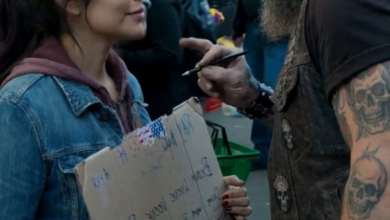
A Biker Held an Older Woman at the Supermarket Door — She Was Calling for a Child No One Could See
Part 1 — Teaser
I wrapped both arms around a screaming older woman near the supermarket entrance while she fought to get away from me, and every shopper who saw my leather vest thought I was attacking somebody who could not defend herself.
My name is Cole Dyer. I was sixty, built like the loading-dock doors I repaired for a living, with a long gray beard and a riding club vest I wore even when I was buying milk. This was a neighborhood market outside Pittsburgh, where I had stopped on the way to our club garage. The woman was Florence Hale. I did not know her name that day. I knew only that she smelled smoke where I smelled burnt toast from a demonstration oven, and that she was running straight toward the automatic doors while one glass panel had failed to slide open.
There had been a pop from the small oven near the bakery display. An employee unplugged it, and no fire spread. A faint bitter smell drifted through the front of the store. Most shoppers barely looked up. The woman did. She dropped a packet of tea bags, put a hand over her mouth, and shouted, “Get the children out.” Her eyes were fixed somewhere beyond the produce shelves. She was in the store; her voice was in another place.
I had just seen the entrance doors behave strangely. The left panel slid halfway, shuddered, then stayed where it was. The right one remained a broad sheet of clean glass that reflected the parking lot so well it looked, at a glance, like open space. A young clerk was approaching the controls from the side. Florence turned toward that reflection. She moved fast for someone her age, one hand extended as if searching through smoke. I called, “The door is closed.” She did not seem to hear me. I stepped into her path and held her around the upper arms and shoulders before she could strike the glass.
She screamed. The sound traveled across the checkout lanes. I loosened my grip immediately, but she twisted toward the narrow opening, and I held long enough for the clerk to put himself between her and the stuck panel. “Leave me alone,” she cried. “My little girl is upstairs.” I had no idea what child she meant or why an upstairs room belonged inside a one-story grocery store. I knew only that my arms were keeping her from a visible pane, and that the person inside them was terrified.
A man near the carts shoved my shoulder. “Get your hands off her.” He saw a big biker holding a woman who was calling for help. I looked at him, then at the clerk, and said, “The glass isn't moving. Please turn her this way.” The man did not let go of my vest. His wife was already calling store security. The clerk moved to Florence's side and spoke softly, telling her where the open aisle was. I eased my hands away as soon as she was no longer running at the door. She crouched beside a display of canned soup, still calling for the child upstairs.
I stayed several steps back. No one needed a stranger's arms around her twice. The clerk, whose name badge read Priya, turned off the door motor and set a bright cone across the approach. She asked the manager to clear the entrance and use the other exit. Another employee checked the demonstration oven and called for an assessment of the smoke smell. The emergency had two parts, and the person everyone filmed was only one of them.
Florence was shaking. Priya offered a chair. She refused because she needed to “find June.” I asked whether that was her daughter's name. Florence looked at me as though I had come through a wall. “How do you know her?” she asked. I told her I had heard her say it. She did not believe me. Her mouth moved as if she were counting steps on a staircase.
Security arrived, then a paramedic who had been shopping nearby introduced himself and asked if he could help. He did not try to tell Florence that there was no fire with a raised voice. He asked what she needed and whether she could feel the cool floor beneath her shoes. She looked down. Her shoes were pale blue, clean except for a scuff near one toe. She touched the tiled floor with her fingertips. For a second she was looking at this store again.
The manager wanted my name for a report. I gave it. The customer who had grabbed my vest took a photograph of me and said police should see it. I agreed that somebody should check what had happened. I had restrained a stranger and she had been frightened. I could describe the defective door, but I could not make my intentions visible in somebody else's recording. Florence straightened slowly and asked where she was. Priya said the name of the market and the day of the week. Florence's eyes filled.
“Did June get out?” she asked.
There was no child in the store who matched that name. The paramedic looked at Priya, then at me, and asked whether anybody knew someone Florence trusted. She opened the small purse still hanging from her wrist. Inside was a familiar photograph of a much younger woman standing in front of a house darkened by fire. Why had the scent of burnt bread sent her running toward a daughter who was no longer a child?
Part 2
Florence had come to the market with her neighbor, Mrs. Bennett, who was parking the car after dropping her near the entrance. They had planned to shop together for soup ingredients. Mrs. Bennett arrived to find a crowd around the front doors and her friend seated in the customer service area with Priya beside her. She recognized Florence's pale blue shoes before she saw her face. “Where's your cane?” she asked, though Florence did not use one. It was an anxious person's first question, and nobody corrected her.
Priya explained the smell, the door malfunction, and my brief hold. Florence remembered a loud noise and an urgent need to get to June, then nothing clear until the tile beneath her hand. Mrs. Bennett said Florence had memory problems and sometimes became disoriented when something reminded her of a frightening event. She did not offer a diagnosis to a crowd. She asked that people stop filming. The manager guided the shoppers farther back. A confused person deserved a smaller room, not a larger audience.
I worked on loading doors, not medical care, but I knew how an automatic entrance could look open when it wasn't. The panel had stopped with its edge aligned near the reflection of the parking lot, leaving a narrow space on one side. The clerk said maintenance had been called earlier because it had hesitated twice. A cone should have been in place before anyone tried that exit. The manager wrote that down. I had seen Florence running toward the glass; I had not caused the motor fault, and the fault did not excuse how frightening my restraint felt to her.
Mrs. Bennett phoned June, who was Florence's adult daughter. She said she would arrive in fifteen minutes. Florence heard her name and asked to speak. Priya gave her the phone. “Are you outside?” Florence asked. “Did you get out?” June spoke long enough that her mother's shoulders lowered. Florence repeated “You're grown” once, almost under her breath. I stood behind a display of apples because the sight of me made her look toward the door again. Giving space was one thing I could do without being asked.
The paramedic helped assess whether Florence had been injured in the brief struggle or needed further medical attention. Her arm was sore, but she had not fallen. She chose to sit while they waited for June. Nobody declared that a reassuring conversation had resolved her memory condition or the fear beneath it. Mrs. Bennett took her hand. Priya brought water in a paper cup and left it within reach. The ordinary items were carefully offered, one at a time.
I wanted to explain what I had done before June saw the video. Boone, my club president, called my phone about a repair job, and I almost used him as an audience for my side of the story. Instead I told him I would call later. I gave my name and number to the manager and said I would speak to June if she wanted. I had picked up a woman who was frightened and held her in front of strangers. If she never wanted to hear from me again, I would still cooperate with any report. An emergency does not erase a person's right to be angry afterward.
June arrived with rain in her hair. Florence rose so fast Priya reached for her chair, but she walked steadily to her daughter. The photograph in the purse made sense when June spoke: a kitchen fire decades earlier, a hurried escape from an upstairs bedroom, and a mother who had carried her child out through thick smoke. June explained that Florence had a dementia diagnosis and that her memories did not always stay in the same year when a smell or sound pulled at them. This time the oven and the failed door had arrived together. A store became an old house in the space of a breath.
Part 3
June did not ask for a story about a heroic biker. She asked whether her mother had hit the glass. Priya said no, and explained what I had done and why. June looked at Florence's arm, then asked her if she wanted to speak to me. Florence said she wanted to go home. That settled the question for the day. I moved aside while they left through the other exit, which staff had checked and kept clear. My relief that she had not been badly hurt did not entitle me to interrupt their leaving.
The customer who had grabbed my vest gave the manager his phone video. It began with Florence screaming in my arms and ended as I let go. From that angle the defective door was behind the camera. Security footage showed her path toward the motionless glass, but it also showed the force of my initial turn. The manager said he would keep both accounts for review. I asked whether the bakery oven had been checked. He said yes, and the door was now marked out of use pending repair. An incident has to be investigated in all the places it happened.
The next morning, Boone arrived at the garage with two coffees and found me measuring a hinge that did not need measuring. I told him the story. He asked whether I had said I was sorry to Florence. I said she had left before I could. “Then don't make the apology a performance,” he said. I did not like the advice at first. I had imagined arriving at her home with flowers and an explanation, proving I was gentle under the vest. That visit would have asked Florence to manage my feelings while she was still recovering from her own fear. Good intentions can demand work from the wrong person.
June called after the manager gave her my number with my permission. Florence was resting. Her arm hurt, but a clinician had assessed her and found no serious injury. June wanted to understand where I had stood when the door failed. We met at the closed entrance with Priya and the manager. I walked June through what I saw without reproducing the grab. She pointed to the reflection in the glass and said she could understand why her mother had run at it. Then she asked why I had not simply called out. I said I had, but Florence had kept moving. It was an answer, not a defense that required her agreement.
The manager showed the maintenance record. Staff had reported hesitation in the panel before the oven popped. He apologized for failing to block it sooner. A technician replaced a damaged component and tested the door repeatedly before it reopened. The store added a rule for closing an entrance at the first repeated fault rather than waiting for service while customers continued to use it. June asked that their incident report focus on both the smell and the door, not only on her mother's memory problems. An accessible store has to account for the building it provides.
Priya asked to be included when staff reviewed the sequence. She had seen the smoke drift, heard Florence's shout, and reached the door controls only after I had stepped into Florence's path. She did not want the summary to suggest a single person had failed to make the right move at precisely the right second. She wanted a clear instruction for closing a faulty door sooner and enough staffing that one clerk did not have to handle a machine, a crowd, and a frightened customer alone. A useful report names the system around a moment.
The clip went online anyway. A caption called me a biker who attacked a grandmother. Another post, after a bystander saw the security footage, called me a savior who “held down a dementia patient.” Both flattened Florence into a role she had not chosen. June asked the person who posted the first clip to remove her mother's face. He refused at first because he said public safety mattered. She said showing the defective door without showing Florence in distress would make that point better. He eventually took it down. Copies survived, as copies do.
Florence's doctor and family worked through how best to support her when a sensory reminder brought back the old fire. June did not tell me medical details beyond what Florence wanted shared. She said her mother had been having a difficult month, but she still enjoyed choosing tea and walking to the market with Mrs. Bennett. Losing track of the year for a few minutes did not erase those preferences. When people asked me if she lived alone, I said it was her family's business. A person's capacities are larger than her worst afternoon.
At the garage, Travis asked what I would do if I saw someone running at a pane again. I told him I would first call clearly and get staff to stop the door, because a strong voice and an open route might spare anyone being touched. If there were no time and impact was imminent, I might still physically interrupt the path, then release as soon as possible, describe what I was doing, and ask responders to help. It was an uncomfortable answer. Emergency action is not a license to remain in charge afterward.
Part 4
June sent a message a week later saying Florence wanted to visit the store again, but she did not want me there on her first return. I thanked her for telling me. Mrs. Bennett went with them in midmorning when the aisles were quiet. Priya greeted Florence by name and let her choose whether to discuss the incident. Florence picked out tea bags, soup ingredients, and a small pot of basil. At the repaired entrance she stopped, watched both panels open, and walked through with her daughter. June later told me only that it had been a hard visit and that her mother chose to finish it. Finishing was Florence's decision.
The fire in the photograph had occurred when June was eight. An electrical fault in their old house had filled the upstairs hall with smoke. Florence had found her daughter beneath a blanket and led her downstairs. Nobody had died. The family moved afterward, but the smell of scorched bread or a sharp pop from an oven could still return Florence to the moment she searched for June. Years later, as her memory became less reliable, she sometimes experienced that fear without remembering the intervening decades. The story was frightening enough without inventing a tragedy to explain it.
I learned those details from June because Florence chose to tell her daughter I could hear them. She did not want strangers using the fire as a twist in a video, and I would not. She wanted the people involved to understand why she had called for a little girl in a building that had no upstairs. When I read a summary of the event, I could feel the distance between a narrative people might share and a memory she had to inhabit. Her past had no obligation to entertain us.
The first time Florence agreed to see me, we met at a park bench near her neighborhood. June sat with us for a few minutes and then moved to a nearby table, staying within sight. Florence wore her pale blue shoes and carried the same small purse. She said she remembered my vest and the feeling of being stopped, but the rest came in pieces. I told her I had seen the glass fail to open and feared she would hit it. I said I was sorry I had held her while she was frightened. She looked at my hands and asked whether they were always so large. “Since I was a boy,” I said. She smiled faintly.
She asked if I had a child. I told her about my grown son, who lived two hours away and still called me when he needed a shelf fixed. She said June called her whenever it rained hard, as if rain were an excuse to check in. We talked about basil, old houses, and how loud supermarkets had become. The conversation made room for an ordinary woman, not an endlessly replayed scream. Before leaving, she said she was glad she had not hit the glass. She did not say she was glad I had grabbed her. I did not ask.
At the next club meeting Boone used the incident to ask how we helped when someone was frightened or confused. We agreed on simple practices: call staff and emergency services when appropriate; describe the immediate hazard; avoid crowding; ask before touching if time permits; move away once trained help takes over. We were not writing a medical protocol. We were acknowledging that the people we help may experience our size as a new threat. Travis wanted to add “Don't bring twenty bikers into a supermarket.” We laughed, then wrote it down. The joke contained a useful limit.
June offered one more correction when I told her about the meeting. A person disoriented by a smell might not respond to a stranger shouting a factual correction, she said, but a familiar voice and a clear route could help. Florence sometimes benefited from a simple question about where she wanted to go, asked without a crowd closing in. June did not offer a universal formula. She knew her mother's preferences and wanted us to listen if they were available. I took the note back to Boone without turning it into a club rule for every person with memory loss.
Part 5
The store invited a local accessibility adviser to review the front entrance after June raised concerns. Staff checked lighting, reflections, and the location of their temporary barriers, along with the door maintenance procedure. The adviser did not promise a building where nobody could ever be confused. She pointed out that if a door failed, the approach should be made unmistakably closed and another clear route should be obvious. Priya helped create a plan for guiding customers without grabbing them or shouting over one another.
Mrs. Bennett continued driving Florence to the market on Thursdays. Their shopping list was written in large letters because that was how they both liked it. Some days Florence bought the same tea twice. Sometimes she remembered the bakery worker's name before Mrs. Bennett did. June arranged support according to what her mother wanted and needed, without telling the internet where she lived or reducing her life to a diagnosis. Familiar routines could still belong to her.
On the porch after one shopping trip, Florence and Mrs. Bennett made soup with the ingredients they had chosen together. June came for dinner. Florence asked twice whether there was enough bread, and June answered twice without making a face. Later she described the yellow flowers she had seen at the store in perfect detail. Her memory was uneven; her pleasure in that evening was immediate. When June told me about it, she sounded tired and happy, a daughter who had enjoyed dinner rather than managed a public lesson about her mother's condition.
One afternoon I ran into Florence near the flower buckets. I said my name before approaching so she could place the voice. She inspected a bunch of yellow mums and asked whether the stems looked healthy. I said I knew more about hinges. She said that explained my interest in doors. We both laughed. Then she asked if the front entrance had been repaired. I said it had been checked. She walked toward it, watched it open, and kept going. I did not follow closely.
A stranger recognized me from the clip and asked for a photograph with “the biker who saved the old lady.” I declined. Florence was looking at flowers a few aisles away. Her being nearby did not give me a right to point her out. The stranger said he only wanted a story with a happy ending. I told him the door was repaired and she was shopping. That was an ending full enough for the moment.
At my son's house a month later, I described the event without naming Florence. He asked if the clip bothered me. It had, mostly because my worst second and her most frightening one were being played for strangers who could not help either of us. He asked if I had learned anything from her. I told him I had learned to announce myself and wait before putting my hands on a person when there was time. He said I had always been quick to catch a falling cabinet or a door. “People aren't cabinets,” he added. I carried that sentence home.
I called him the next week while he was assembling a bookshelf and heard myself start giving instructions before he asked for them. I stopped and said, “Do you want help or company?” He chose company and spent ten minutes complaining about a missing screw. The supermarket had not turned me into a flawless listener. It had given me a small question I could practice in a room where nobody was afraid. Habits change in ordinary conversations before they are tested in emergencies.
June later invited me to help repair a sticking porch latch. Florence wanted to hold the screws in a little ceramic bowl while I worked. Her grip was steadier than mine when I bent to fit the hinge. We tested the latch from both sides. It opened when she pushed it and closed when she wanted it to. June asked whether it would last through winter; I said I would return if it didn't. Florence told me not to make a fuss over a three-dollar screw. She understood the price of a repair and the value of leaving a door under her own hand.
Part 6
In winter, Florence sometimes forgot the park bench conversation. When she saw me at the market, June or Mrs. Bennett would introduce us again if she wanted to talk. I did not insist that she remember an apology in order for it to count. Once she asked why I was looking at the automatic doors. I said I repaired doors for work and they had taught me to notice their sounds. She listened to the panels slide, then said they sounded smoother than before. Her observation mattered even when our histories did not line up.
Priya began keeping a small list of customers who preferred quieter times, with their consent. It was not a public register of diagnoses. Florence asked to know when the bakery demonstrations were planned because the loud pop had surprised her; she could choose another time or be ready for it. The store kept its equipment properly maintained and the entrance unobstructed. The changes would help anyone startled by noise or uncertain about the exit, not just one customer with a particular memory.
At the club garage, Travis built a wooden stand for the market's temporary barrier signs. He tested it with sandbags so a gust would not knock it into the walkway. The store manager paid him for the materials. It was a small, slightly dull job, which suited us. Nobody posed beside it in leather vests. When I saw it in place near the entrance during a scheduled repair, I thought of Florence's first visit back with June. A safe route ought to be visible before someone needs it.
Florence sent my son a basil cutting after I mentioned his windowsill garden. She wrote his name on a card with June's help. The cutting grew through the winter. When he called to tell me, I passed the news to June, who told Florence at breakfast. She did not remember where the cutting had gone but wanted to know if it had enough light. That was exactly the kind of question she would have asked before the supermarket incident, before I had any place in her life.
Part 7
The following spring, I was in the market again for milk. A child spilled a handful of oranges near the entrance, and several people bent to collect them. Florence stood beside the flower buckets with Mrs. Bennett. She watched the automatic panels slide apart, then picked out a single yellow stem. Nothing about the scene suggested the fear I had seen there months before. The place had returned to its ordinary scale.
She noticed me and raised the flower in greeting. I raised my hand, then let her finish choosing before I walked over. We talked about the basil cutting and whether my son had remembered to turn its pot toward the light. She asked if the doors still made the little clicking sound. I listened. They did not. Priya had been right to report the fault, and the manager had been right to change the maintenance rule. Those quiet changes carried more lasting value than the seconds when I had held Florence still.
I cannot rewrite the sound of her scream. I can say I was afraid she would hit a pane of glass and moved to stop her, then learned that preventing injury did not mean I had understood her terror. She could be grateful she was unhurt and still remember my arms as part of a bad moment. We had managed to meet afterward as people instead of characters trapped inside a clip.
Florence paid for her flowers and walked with Mrs. Bennett through the open doors. I waited until they had room, then followed with my carton of milk. Outside, the automatic panels closed behind us with a soft, ordinary sound.
Follow our page for more biker stories about listening to the person in front of us, even when a frightening moment makes everyone rush.
CAPTION 1
A huge biker held a screaming older woman near the supermarket doors while she begged him to let her go. Shoppers rushed toward them, certain they were watching an attack.
I was the biker. I had come in for milk and had seen one automatic glass panel hesitate and stop. A small oven near the bakery made a sharp pop. The woman dropped her tea bags and suddenly called for a little girl.
She ran toward the entrance. I shouted that the glass was closed, but she kept moving. I caught her by the shoulders before she reached it. She fought me, and I let go as soon as a clerk stepped into the path and guided her aside.
A customer grabbed my vest. Security was called. From the first angle recorded on a phone, all anyone could see was an imposing man restraining a frightened woman. The faulty door was behind the camera.
The clerk shut the entrance and brought her a chair. The woman refused it. “My little girl is upstairs,” she kept saying, although the store had only one floor.
She looked down at the cool tile and seemed to recognize where she stood for one second. Then she asked a question nobody there could answer.
Read what happened next in the first c0mment.
VIDEO PROMPT 1
Create exactly 10 seconds of vertical 9:16 teaser footage in real-life cinematic video style, high-quality realistic footage, natural handheld camera movement, authentic everyday-life atmosphere, emotionally believable acting. Ordinary Pittsburgh-area supermarket with glass automatic entrance and grocery carts; Cole, imposing 60-year-old white American biker with long gray beard, tattooed forearms, plain black leather vest and boots; Florence, 76-year-old white American woman with silver hair, pale-blue shoes and small purse; Priya, adult store clerk. 0–2s: begin tight on Cole holding Florence by upper arms as she screams near a glass door, a bystander grabs his vest; no establishing shot. 2–5s: Cole releases and steps back as Priya gently guides Florence aside; shoppers keep phones raised. 5–7.5s: a small demonstration oven gives a distant pop, Florence stares at the reflected parking lot while one automatic door panel shudders and stops half-open. 7.5–10s: Florence asks for a little girl, touches the tile, and looks toward Cole in fear; he sees the stopped panel and hard CUT before anyone explains. No fall, glass break or graphic distress. No text, no logo, no readable patches. No POV. No flashback, no explanatory montage, no final twist, no resolved conflict, no happy-ending payoff; cut at the peak of mystery.
CAPTION 2
The woman was calling for her daughter as she ran toward the supermarket exit. A biker grabbed her and held on while she screamed. But her daughter was not a little girl, and there was no upstairs in that store.
Cole, a gray-bearded door repairer, had noticed something wrong with the automatic entrance. He called a warning when Florence rushed at a sheet of glass reflecting the parking lot. She didn't stop. He caught her at the shoulders, then released her as a clerk closed the entrance and helped her away.
From the checkout lanes it looked brutal. One customer seized Cole's vest. Another recorded only the seconds of Florence struggling. Cole backed off, gave his name to the manager, and waited while a paramedic spoke gently to her.
She touched the tile beneath her shoes and asked where she was. The clerk answered. Florence looked at the doors again, then asked whether a girl named June had gotten out.
The manager opened Florence's purse to find someone she trusted. Inside was an old photograph from another place, another time. Cole saw the edge of it and went still.
Read what happened next in the first c0mment.
VIDEO PROMPT 2
Create exactly 10 seconds of vertical 9:16 teaser footage in real-life cinematic video style, high-quality realistic footage, natural handheld camera movement, authentic everyday-life atmosphere, emotionally believable acting. Same supermarket: Cole, broad 60-year-old white American biker with long gray beard, tattoos, plain leather vest; Florence, 76-year-old white American woman in pale blue shoes with small purse; Priya, adult clerk; one concerned male shopper. 0–2s: start on an older woman struggling in Cole's arms inches from a bright glass exit, with shoppers shouting at him and a phone rising. 2–5s: Cole lets go and holds his hands back as Priya steps between Florence and the entrance; male shopper clutches Cole's vest. 5–7.5s: tight view of a door panel failing to slide despite its reflection resembling an open exit; Florence drops tea bags and asks where a little girl has gone. 7.5–10s: Priya offers a chair, Florence touches cool tile, then looks toward her purse as if remembering something; Cole follows her gaze and hard CUT before the past is revealed. No readable text, no impact. No text, no logo, no readable patches. No POV. No flashback, no explanatory montage, no final twist, no resolved conflict, no happy-ending payoff; cut at the peak of mystery.