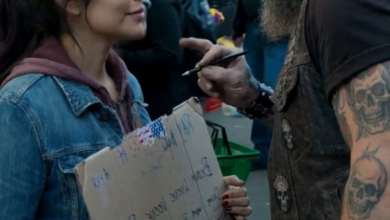
A Biker Carried a Crying Boy Out of a Laundromat — His Mother Was Still Asleep Inside
Part 1 — Teaser
I carried a crying little boy out of the laundromat against his will while his mother slept six feet away, and by the time I reached the sidewalk three strangers were shouting that I had stolen him.
My name is Ray Ellis. I was fifty-seven that October, a big man with gray in my beard, tattoos up both arms, and a motorcycle vest that made people glance twice before asking me to move aside. I was at the laundromat in Memphis because my washer had quit during a rainstorm and my work shirts were beginning to smell like the garage. The boy was named Eli. I learned that later. At the time I knew only his red sneakers, his dinosaur backpack, and the way he stood beside his mother as if standing guard were a child's job.
She sat on a plastic chair with her head bent toward a pile of folded towels. Her hand rested on the backpack strap. Eli had been trying to wake her gently, then seemed to decide she needed the sleep more than he needed an answer. I saw him take a crumpled receipt from his pocket, smooth it flat on his knee, and tuck it under her elbow so the hard edge of the chair would not press her skin. It was such a careful little movement that I looked away before he noticed me watching.
Behind him, a row of large commercial dryers turned against the back wall. One gave a high squeal at the end of each revolution. I assumed it needed a belt. Then its drum stopped, but a rough whirring continued inside the housing. I smelled heated dust and something sharper, like plastic near a soldering iron. The smell arrived before the smoke.
At first it was a thin gray thread from a seam high on the machine. The clerk was helping an older customer at the front. I called to her and pointed. She crossed the room quickly, reaching for the stop control as another puff rose behind Eli's shoulder. I told the boy to move toward the door. He shook his head and grabbed the strap of his mother's bag. “Mom,” he said. “Mom, wake up.” She did not respond at once. The clerk shouted that everyone should go outside. A woman carrying a laundry basket turned toward us, saw me step behind Eli, and shouted, “Get away from that child.”
I should have told her why. I should have used one whole sentence. What I saw instead was Eli backed against the dryer row, a small hand caught in a backpack loop and smoke thickening above him. I lifted him, strap and all, and ran the few steps to the open door. He kicked my side and cried for his mother. The woman with the basket dropped it on the floor. Outside, a man blocked the sidewalk with his phone raised. His camera caught a large biker carrying a struggling Black boy and not the machine behind us. He demanded to know whose child I had taken.
“His mom's inside,” I said, setting Eli down well away from the entrance. I stayed between him and the street without holding him. He tried to bolt past me, and I pointed through the glass. The clerk was waking the woman and guiding her toward the other door. She stumbled, caught herself on a table, and called Eli's name. He yelled back, louder than any of the adults had managed.
Another customer pushed the man with the phone aside to make a path for her. By then somebody had called 911, somebody else was saying I had grabbed a boy for no reason, and the first woman kept asking why I had not brought the mother out instead. Those were fair questions to ask from a place where the smoke could not be seen. I could hear the clerk trying to account for the people inside, and I needed to leave the doorway clear so she could get them out.
Eli's mother reached the sidewalk coughing lightly. She did not thank me. She went straight to her son, dropped to her knees, and felt his face and hands for injury. “I'm here,” she said, again and again. He kept his eyes on me. I had moved him to safety, but I had also frightened him badly. Both truths stood there in the damp Memphis air.
The clerk closed the door and called the fire department. A thin wash of gray spread behind the front window. No flames were visible. The man with the phone insisted I remain until police arrived. I agreed. I wanted them to hear from the clerk and the mother, not from the first five seconds of a video. The mother looked at the laundromat, then at me. Her eyes were red with sleep, and I could see she was trying to put the broken seconds in order.
“Why was he by that dryer?” she asked. It sounded like an accusation against herself.
Eli pulled the receipt from beneath her sleeve and held it out. His little hands were trembling. On its back were three times written in different inks, a list she had been using to get through the day. I recognized one from the morning shift at the warehouse where my club delivered food boxes. How many hours had she been awake before her body finally stopped asking permission to sleep?
Part 2
I met Tasha Walker properly at the curb while the fire crew checked the laundromat. She told Officer Ramirez that she was Eli's mother and that I had carried him outside. She also said she had not seen the dryer smoke until she came through the door. Ramirez separated what each witness knew. The clerk had watched smoke rise and seen Eli against the machine. The customer with the basket had seen me pick him up. The man with the phone had recorded only the exit. No single person had witnessed the whole minute.
Tasha did not ask to have the video deleted. She asked the man to stop filming Eli's face while he cried. Ramirez repeated the request. The man lowered his phone and said he had thought he was protecting the child. Tasha said, “Then protect him now.” It was the first time she sounded fully awake. Eli was pressed against her side, a red sneaker planted across the toe of hers. She had a bag of damp clothes and no idea whether it would be safe to collect them.
The clerk, Marisol, knew the equipment. She had shut down power to the affected bank using the controls she was trained to use and had brought everybody out. The firefighters checked the machine and the adjoining wall. Nobody went back for a missing sock or a purse. One customer wanted to know if she could take home her clothes because she had a night shift. Marisol said they would wait for clearance, and I admired how plainly she said it. She had been surrounded by conflicting demands and still kept the entrance open.
Tasha had worked one shift at a grocery distribution warehouse, another cleaning offices, and an overnight shift restocking shelves when a coworker called out. They were three back-to-back shifts across roughly a day and a half, with short bus rides and no useful sleep in between. She was not telling me this to prove she deserved sympathy. She was trying to explain to Ramirez why she had fallen asleep in a chair with her son beside her. “I sat down for one minute,” she said. One minute had become the only rest her body could claim.
Eli was seven. He knew which machines cost less after seven in the morning and which laundry bags held his school uniform. He had folded the receipt under her elbow because her arm looked sore. When she heard him explain that, she shut her eyes. “You shouldn't have to take care of me here,” she said. Eli did not seem to know what to do with the sentence. Children accept the tasks adults leave within reach. The rest of us ought to ask why those tasks were there.
My club used a garage two blocks away. I offered to call my wife, Denise, who worked with a neighborhood resource center, but I waited for Tasha to say yes. She asked whether we could first find out about the clothes and whether Eli could sit somewhere quiet. I told her the diner across the street was open, and she could decide whether she wanted us with them. She said yes to a booth but no to a procession of bikers. I texted Boone to cancel a plan he had already begun making with the club. She had not asked for an audience.
At the diner, Eli sat facing the front window. When a fire truck passed, he flinched and squeezed his mother's wrist. I brought milk; he did not drink it. Tasha asked me exactly what I had seen before I picked him up. I described the seam, the smoke, the bag strap and the distance to the door. “I should have said it out loud,” I told her. “I frightened him.” She nodded, not ready to forgive or condemn me. She was gathering facts so she could tell her son a story that did not leave a stranger as the only person who knew why he had been carried away.
Ramirez stopped by after the fire crew had made the equipment safe. The problem appeared confined to one dryer and the surrounding bank; the exact cause would be investigated. No one was hurt. Marisol would arrange for customers to retrieve belongings when cleared. That should have been the end of a narrow emergency. But Tasha watched the raw clip on somebody's phone and saw the caption already written above it: biker runs away with child as mother sleeps. Her cheeks flushed. “They're going to call me a bad mother,” she said. I had no honest promise that they would not. The next danger was a story strangers could tell about them.
Part 3
By lunch the video had crossed town. One version cut out the moment I set Eli down; another slowed his kicking as if those seconds proved a struggle. People argued about my skin, my vest, Eli's race, and Tasha's sleeping. Almost nobody asked why a child would choose to stand beside a commercial dryer rather than leave his exhausted mother unattended. I asked Boone to hold off on a club statement. We needed Tasha's permission before we turned her worst morning into our explanation.
Denise met us at the diner because Tasha asked for her. She listened without interrupting while Tasha described her schedule. Then she offered concrete choices: a list of local laundry options, a contact at the resource center who could help with the cost of missed work, and an introduction to someone who dealt with shift scheduling. She did not promise to solve three jobs by the end of the week. Tasha chose the laundromat list first. Her question was where she could clean Eli's uniform by Monday. The immediate problem fit in one small backpack.
Eli finally took a sip of milk. He wanted to know whether I had thought he was in trouble. I told him I had seen smoke and been afraid the machine behind him might hurt him. I did not ask him to say thank you. I asked if he wanted me to sit farther away. He said yes. I moved to the end of the booth. Tasha watched the exchange and said, “You can tell him about the smoke again later.” That was permission, not absolution. It let us put words around a memory his body still held as being taken from his mother.
Marisol called at three to say the fire department had cleared the front machines and a staff member could bring Tasha's bag to the door. The damaged bank remained off. I offered a ride, and Tasha said she preferred the bus because Eli knew that route and needed something familiar. I went to pick up my own laundry after checking with her. Marisol handed me the work shirts in a plastic bag. The smell of hot wiring still lingered near the closed back wall. She said maintenance had reported a strange noise in that dryer earlier in the week. An inspection would determine what had been missed. The squeal I heard was not an invention of hindsight.
A reporter called the garage. I answered and said only that a smoke incident had been handled by the clerk and fire crew, and that I would not identify a child or discuss his mother. The reporter asked if I wanted to clear my name. I told him the video was incomplete but that the family would decide whether they wanted to speak. I hung up with my chest tight. For twenty years I had worked to make the club known for quiet repair work. It would have been easy to turn Tasha's sleep into my defense. That would have been another way to use her exhaustion without helping.
On Sunday, Boone found out a club member had posted a photograph of the diner, with Eli's red sneakers visible beneath the table. He took it down immediately and apologized to Tasha when she called. I was angry enough to tell the member he might be finished with us. Denise asked me to make a better rule before I chose a punishment. We wrote one: no child's image, no account of a family's hardship, and no “rescue” post without their informed consent. The member had believed he was showing kindness. Believing that did not restore their privacy. He apologized and accepted that he would not take club photos for a while.
Tasha went back to work Monday. Denise accompanied her to a meeting she requested with a supervisor about a more predictable schedule. It did not produce a miracle. She could turn down a last-minute extra shift without losing the regular hours she needed, and the warehouse gave her a written schedule farther in advance. The resource center helped her apply for childcare support. Eli still worried whenever she closed her eyes on a bus. Tasha explained that adults sometimes sleep deeply when they are worn out and that, at the laundromat, other adults had noticed the smoke too. She was trying to give him back the right to be seven.
Part 4
The cause of the dryer smoke was eventually traced to a fault in the machine, and the owners repaired the bank after inspection. I did not know enough about the internal mechanism to tell internet strangers a dramatic story about what would have happened next. I knew what we had actually seen: smoke, a stopped drum, a child too close, people moving outside, and firefighters handling the equipment. I could say it had been right to get everybody out. I could also say my carrying Eli without an explanation had frightened him. The facts did not need a more cinematic fire.
Tasha decided to speak to one local reporter after seeing a post accuse her of abandoning her son. She did not want Eli interviewed. She met the reporter alone, with Denise beside her at her request, and described the three shifts and the moment she woke on the laundromat chair. “I went there because clean clothes matter to him,” she said. “I fell asleep because I had worked too long. Those are both true.” The reporter wrote about shift workers and the incident, but Tasha asked that Eli's school and their address stay out. The newspaper honored that request.
I was asked for a comment too. I said the clerk had acted quickly and that Tasha had come straight to Eli when she woke. I described moving him because of smoke. I did not call myself brave. Some readers wanted me to denounce the customers who thought they saw an abduction. If you see a stranger carry a crying child out of a building, asking where that child's family is can be a decent instinct. What matters is whether you keep looking when new facts arrive. The man with the phone eventually contacted Tasha through the reporter to apologize for posting without context. She chose not to meet him. An apology does not buy access to somebody else's child.
The harder conversation happened at my garage. Eli came with Tasha one afternoon because Denise had a box of winter coats for the resource center and Tasha wanted to drop one off. He stood just inside the open door and counted motorcycles. Mine was the dark green touring bike near the compressor. I expected him to avoid it. Instead he asked whether the horn was loud. I said it was louder than it needed to be and offered to honk it from far away another time. He shook his head. “I can see it,” he said, and that was enough.
I told him that when he called for his mother I had heard him and should have answered him. “I was trying to get you outside,” I said. “I am sorry you didn't know why.” He looked at Tasha, who nodded. “You can say you're mad,” she told him. He said he was mad about the backpack strap because it had scratched his hand. I offered to replace the strap. He said the backpack was fine. It carried his dinosaur drawing, and a new one would not have the same little zipper pocket. He did not owe me a neat emotional ending.
Tasha's schedule improved slowly. She reduced the least reliable shift after childcare support came through and took a regular afternoon slot at the warehouse. It still meant early mornings and crowded buses. Denise and I occasionally drove a load of laundry for the resource center, but we did not pretend that one biker's washer or one club's donation could repair the conditions that kept families so tired. Tasha chose which offers she accepted. Sometimes the most useful thing I did was bring over a replacement fan for her apartment window and leave before Eli's bedtime routine began.
We were at the reopened laundromat one month later when Marisol recognized us. Eli walked past the repaired dryer bank without reaching for Tasha's sleeve. He selected a machine near the front because he liked watching its large round window. Tasha sat beside him, awake, eating an apple. I had a bag of work shirts again, though my washer had already been fixed. I was there because the place was on my way and I wanted to see Marisol. Ordinary visits are how a frightening place becomes ordinary again.
Part 5
The reporter's piece did not end every comment, but it changed the conversation that mattered to Tasha. Her supervisor read it and asked whether the warehouse could post a list of local childcare and transport contacts where workers could find them without telling their life stories to a manager. The resource center helped compile one. It was a modest change, and Tasha reminded me that a list was only useful if the assistance was available when a worker asked. Denise said that was a fair correction. Names on a wall are not a ride home.
At the club, the video prompted a stranger to send us money for Eli. We returned it after checking with Tasha. She did not want a fundraiser attached to his face. Later she agreed that the club could contribute to the resource center's emergency laundry account, which helped many families without identifying any of them. Boone wrote a check for what members had raised at a Saturday ride. There was no photo of him handing it over. The workers at the center already knew the need; they did not need our boots lined up in their lobby to prove the money existed.
Eli started coming by the garage with Denise and Tasha when they had an errand nearby. He liked the cabinet of magnetic parts trays and once rearranged a dozen washers into neat rows without asking. I told him that was useful work but not a job he had to do to stay welcome. He asked if I was paying him. “Not for visiting,” I said. He grinned and put the washers back in their tray. Children who have had to mind the adults around them sometimes mistake an invitation for a task. I wanted him to be allowed to waste an afternoon.
One day I asked Tasha whether it bothered her that I still thought of the moment I carried him. “It bothers me that he remembers being scared,” she said. “It doesn't bother me that you remember.” She had stopped treating the incident as a debt between us. She wanted us to take seriously both the danger behind him and the fear in his face. I realized I had been searching for a sentence that would declare my decision flawless. She would not give me one because it was not hers to supply.
Marisol invited the neighborhood to a safety day with the fire department. Families could ask how the building's exit routes worked and watch staff show how they would guide customers outside if another machine smoked. We attended, not as featured guests, but because Eli wanted to see the large red fire truck from a calm distance. A firefighter asked him what he should do if he noticed smoke inside. Eli answered that he should tell a grown-up and go outside. He then asked whether his mother could come with him. “Yes,” Tasha said. They practiced leaving together.
The original clip remained somewhere online. Nobody could retrieve every copy. But Eli's own memory acquired more than those first five seconds. He remembered Marisol handing him a paper cup of water, Denise drawing dinosaurs on a napkin, and Tasha sitting beside him at the repaired front machine. He also remembered a large biker who had frightened him and later listened while he said so. That was not as neat as a viral ending. It was closer to the truth a family could live with.
At the resource center, Tasha met another parent who worked overlapping shifts and had been afraid to ask anyone for help with laundry because it sounded like such a small problem. Tasha did not repeat Eli's story to make a point. She described the emergency account and which evenings the center had an open machine. They traded bus times and childcare suggestions, and then they went home. I learned about the meeting only because Denise said the new laundry schedule had been filled by people who knew it existed. A service becomes real when someone can use it without performing gratitude.
Marisol also changed how her staff reported unusual sounds from a dryer. She kept a maintenance log by the counter and marked a machine out of service when a concern remained unresolved. The owners paid for the repairs, not our club. Eli noticed a bright tag on a machine one day and asked if it was sick. Tasha said it was being checked before anyone used it. He nodded as if the explanation were ordinary, which was exactly what the staff hoped it would become.
Part 6
Winter brought another problem at the warehouse, a schedule change that made Tasha miss Eli's school concert. She told him she was sorry without turning the apology into a history of every shift she had ever worked. Denise recorded only his song from the back row, with Tasha's permission and no other children in the frame. We watched it at the kitchen table later, Eli singing the wrong line loudly and laughing at himself. Tasha asked him to play it twice. Their evening belonged to the missed song and the replay, not to my laundromat story.
My washer broke again in February. Boone suggested I replace it; I replaced the inexpensive pump and kept it running. On a Saturday I took blankets to Marisol's laundromat anyway because the larger machines dried them better. She told me the repaired dryer had passed repeated inspections, then asked about Tasha's new shift. The people in the neighborhood had started knowing one another through normal questions. No one pointed a phone at us.
Tasha told me she had kept the receipt with the shift times until Eli began using it as scrap paper for drawings. One afternoon she found a lopsided dinosaur drawn over the last number. She could have treated it like a symbol of recovery and framed it. Instead she used the back for a grocery list. I liked that better. The paper no longer had to hold the whole family in place.
Eli was at a table folding two pillowcases into shapes that looked like boats. He showed me one, then asked whether I still had the dark green motorcycle. I did. He said its horn was probably annoying. I agreed. He offered to show me a better route to his school that avoided the noisy intersection, using the back of a receipt as a map. His lines took us through three impossible yards and across a river that did not exist. He was imagining a neighborhood, not managing an emergency.
Tasha watched him draw. She no longer apologized each time she yawned. She still worked hard, but she had stopped pretending that needing rest was a moral defect. Denise and I could help when asked; we could not give her the hours back that had led to that chair. What we could do was listen when she described what help actually fit her life. Once, that meant watching Eli for an hour while she went to an appointment. Another time it meant leaving them alone to nap.
Part 7
Nearly a year after the smoke, I found the crumpled receipt tucked inside an old jacket pocket. Three shift times were written on its back in different pens. I did not know whether Tasha had meant me to keep it or whether I had picked it up with my laundry on the sidewalk. I called and asked. She said I could throw it away. I looked at the numbers once more before I did. No child should have to memorize a parent's exhaustion, even when he loves her enough to smooth a piece of paper beneath her elbow.
At the next neighborhood fair, Eli ran past me toward a booth where children could paint small wooden airplanes. He waved but did not stop. Tasha followed at an easy pace with coffee in one hand and a folded sweater in the other. She had slept the night before. That fact would never make a gripping video, and it mattered more to her than anything I had said into a microphone.
I still hear people call me the biker who saved a boy from a dryer. I tell them Marisol cleared the room and the firefighters handled the machine, while a mother found her child outside and stayed with him. If they ask why he was crying, I say I carried him away from the only person he wanted. The smoke made me move fast. The rest took time to understand.
Eli brought his painted airplane to show me on the way home. Its wings were green like my motorcycle. He set it on the palm of my hand and took it back when his mother called. He knew exactly where he was going.
Follow our page for more biker stories about imperfect help, second chances, and the people whose ordinary lives deserve more than a viral clip.
CAPTION 1
A huge biker ran out of a Memphis laundromat carrying a Black boy who was crying and kicking. The boy's mother was still asleep inside.
I was the biker. I'd only come in to wash work shirts, and I didn't know the child's name. I had noticed his red sneakers, a dinosaur backpack, and the way he guarded his mother while she slept upright beside a pile of towels. Then I heard a strange squeal from the dryers behind him.
I called to the clerk. She hurried toward the back wall. I told the boy to move toward the door, but he grabbed his mother's bag and tried to wake her instead. Someone shouted for everyone to go outside. I lifted him and ran the few steps to the sidewalk.
A woman dropped her laundry basket. Another customer raised his phone and yelled that I had taken a child. The video he caught began with the boy struggling in my arms; it showed nothing of what I had seen behind him.
I set him down and looked back through the glass. The clerk was trying to wake his mother. The boy shouted for her, but she didn't answer at first.
Read what happened next in the first c0mment.
VIDEO PROMPT 1
Create exactly 10 seconds of vertical 9:16 teaser footage in real-life cinematic video style, high-quality realistic footage, natural handheld camera movement, authentic everyday-life atmosphere, emotionally believable acting. Memphis laundromat on a rainy afternoon. Ray, large 57-year-old white American biker with gray beard, tattooed forearms, plain leather vest, dark work shirt and boots; Eli, 7-year-old Black American boy with red sneakers and a dinosaur backpack; his mother Tasha, 32-year-old Black American woman in a faded warehouse jacket, asleep on a chair; Marisol, adult clerk. 0–2s: begin immediately with Ray carrying crying Eli through the open laundromat door while a bystander drops a laundry basket and shouts; no establishment. 2–5s: Ray sets Eli down at a safe distance, opens his hands, and points inside; Eli calls for his mother while another customer films. 5–7.5s: through the glass, Marisol bends to wake Tasha; a commercial dryer near the back gives a thin non-graphic wisp and a high squeal, barely noticed by bystanders. 7.5–10s: Tasha begins to stir, Eli reaches toward her, Ray looks from the child to the machine and hard CUT before the explanation. No visible flame or injury. No text, no logo, no readable patches. No POV. No flashback, no explanatory montage, no final twist, no resolved conflict, no happy-ending payoff; cut at the peak of mystery.
CAPTION 2
The boy had tucked a folded receipt beneath his sleeping mother's arm so the laundromat chair wouldn't hurt her. Minutes later, a stranger in a biker vest carried him outside while he screamed for her.
His name was Eli, though the stranger didn't know it yet. Ray, a gray-bearded mechanic, had been waiting for his laundry when a machine near the boy began making a sound it hadn't made before. He called to the clerk and asked Eli to step toward the front door. Eli refused to leave his mother, whose hand still rested on his backpack strap.
Ray picked him up. From the sidewalk, a customer saw a large man carrying a frightened Black child away from a woman who seemed unable to wake. A phone went up. “Whose boy is that?” somebody shouted.
Ray put Eli down away from the doorway and raised both empty hands. He pointed back inside, where the clerk was bending over the child's mother. Eli tried to run past him.
Then a thin gray shape appeared behind the glass. The woman outside stopped recording for one second and looked at the machine Ray had been watching.
Read what happened next in the first c0mment.
VIDEO PROMPT 2
Create exactly 10 seconds of vertical 9:16 teaser footage in real-life cinematic video style, high-quality realistic footage, natural handheld camera movement, authentic everyday-life atmosphere, emotionally believable acting. Same Memphis laundromat: Ray, broad 57-year-old white American biker with gray beard, tattoos and plain leather vest; Eli, small 7-year-old Black American boy in red sneakers with dinosaur backpack; Tasha, Black American mother in faded warehouse jacket asleep by folded towels; Marisol, clerk. 0–2s: start close on Eli kicking in Ray's arms as Ray rushes through the doorway; outside strangers recoil and one raises a phone. 2–5s: Ray releases Eli safely, kneels with hands visible, and points back toward Tasha without approaching the boy again. 5–7.5s: brief close view through the front glass of a folded receipt beneath Tasha's elbow, then Marisol calls to her; a faint gray wisp passes behind the dryer row. 7.5–10s: Eli cries “Mom,” Tasha's fingers move, the filming customer turns toward the dryer and hard CUT before reunion or explanation. Restrained, no injury and no readable receipts. No text, no logo, no readable patches. No POV. No flashback, no explanatory montage, no final twist, no resolved conflict, no happy-ending payoff; cut at the peak of mystery.