The Woman at the Market Held Up a Sign Asking for Work. A Biker Answered With His Hands—and Learned What Every Shop Had Missed
I had stopped at the Saturday market for a bag of peaches when I saw a young woman standing perfectly still in the loudest part of the street, holding a job sign nobody seemed willing to read. Then she noticed my hands move, and her own began to shake.
The sign was made from the back of a shipping box. Its letters were dark and careful:
I CAN’T HEAR, BUT I CAN WORK. PLEASE GIVE ME A CHANCE.
People had to walk around her to reach the produce stalls. Some glanced at the cardboard, then at the crowd behind them, and kept moving. One man raised his voice as he passed, as if volume could solve what he hadn’t stopped to ask. A woman dropped a few dollars into the young woman’s empty coffee cup. She took them out and hurried after the woman, but the woman had already turned the corner.
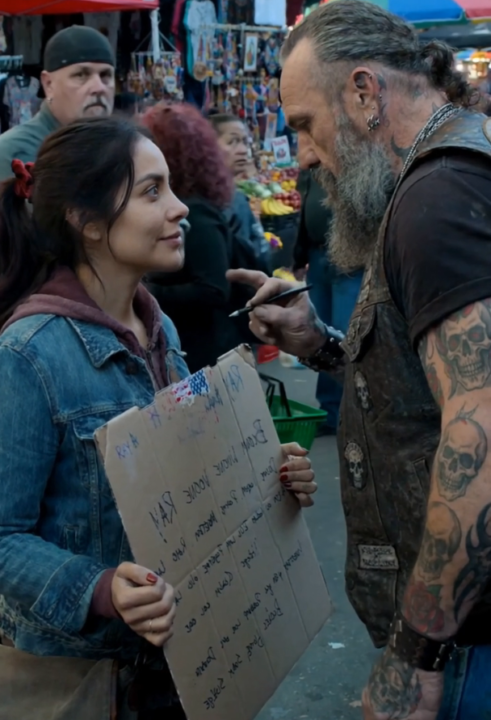
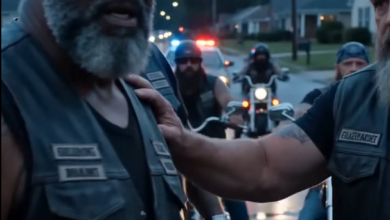
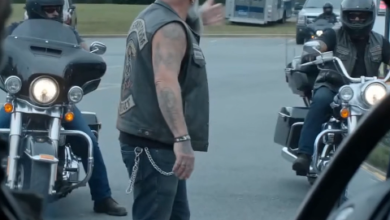
There were five of us from the Iron Lanterns that morning. We had parked our Harleys beyond the market because the street was closed to traffic. In our leather vests and heavy boots, we drew the usual second looks, although Boone was carrying flowers for his wife and Travis had powdered sugar on his beard.
I was fifty-three, broad across the shoulders, gray in the beard, and used to people deciding what I meant before I spoke. For a moment, I did the same thing to the woman with the sign. I assumed she needed a ride to an employment office or help filling out a form. I had not yet considered that she might be looking for the work we did every day.
Her name, I learned later, was Maya Alvarez. She was twenty-six. At that moment, all I knew was that she kept her chin level while strangers looked past her, and that her fingers tightened against the wet cardboard each time somebody slowed down without stopping.
I walked over and signed, Good morning. My name is Ray. May I talk with you?
She stared at my hands.
I had signed that sentence thousands of times with my daughter. I had never seen anyone react to it as though a door had opened in the middle of a street.
Maya lowered the sign. Her eyes filled before she answered. You sign?
My daughter is Deaf, I told her. She taught me. She still corrects me.
That got the smallest smile from her. Then she looked down and wiped her cheek with the heel of her hand. I waited while a delivery cart rattled past us, its driver calling for room neither of us needed to hear to understand.
I’m sorry, she signed. It’s been four months since anyone here spoke with me like this.
She meant in sign. She had exchanged written notes with people. She had answered questions on her phone. She had watched employers address whoever stood beside her instead of looking at her face. But for four months, in this town, nobody had begun an ordinary conversation in a language she could answer without a screen between them.
Behind me, Travis shifted his weight. “What’s she saying?”
I turned enough to include him, then asked Maya if I could interpret. She nodded. I told him, and his expression changed. He was twenty-eight and capable of taking apart an engine before breakfast, but he had no idea what to do with his hands now. He gave her a small wave. Maya waved back.
I asked what kind of work she wanted. Her eyes moved to our vests, then to the work boots under my jeans. She studied me for a long second, deciding whether I had asked a real question.
Metalwork, she signed.
I thought I had misunderstood. You’ve worked in a fabrication shop?
With my father since I was fourteen. I’m a welder.
Boone stepped closer when I interpreted that. He ran our garage and trusted his own welds less than anyone else’s, which was why I trusted him to inspect them. He looked at Maya’s sign, then at me.
“We do need somebody,” he said. “But Ray—”
“I know.”
We could not judge a person’s skill from a conversation in a market, and we would not put anyone near shop equipment without a safe assessment. Maya seemed to read the hesitation on both our faces. She reached into her jacket and showed me photographs of finished gates, repaired frames, and a neat row of test pieces. Photographs weren’t proof of who had made them. She knew that, too.
Let me show you, she signed.
I told her where the garage was and offered to arrange a proper skills trial during working hours. She asked if she could come that afternoon. Boone had the key, a prepared practice piece, and enough time to watch. I said yes, provided she was comfortable with the setup after seeing it.
Maya looked back at the market. For the first time since I had noticed her, her shoulders dropped.
As we walked toward the motorcycles, she tucked the cardboard sign beneath her arm. Travis offered to carry it; she shook her head. I thought she was afraid he would lose it.
At the garage, I would understand why she wanted to keep it close. I would also understand why her photographs had not been enough for the shops that turned her away.
When Boone set the practice piece on the welding table, Maya looked at the joint he had chosen and signed a question that made him stop smiling.
Is this the hard one?
Part 2
Our garage stood outside Knoxville, behind a service road lined with tire shops and small warehouses. The Iron Lanterns used the front bays for motorcycle repairs and fabrication jobs that helped pay the rent; we met in a room above the parts counter, where every chair squeaked and nobody agreed on the coffee. I had asked Maya to come through the office entrance because that was where any applicant started, and because I wanted her to see the place before anyone asked her to work in it.
She walked the floor slowly, looking at exits, cords, welding screens, and the people moving between bays. She was assessing us, too. I introduced Boone as the garage manager and asked whether she wanted me to interpret. She did for the initial conversation. After that, she preferred to write some technical answers and sign the rest. We followed her lead.
Boone showed her the trial piece: two sections of steel prepared for a difficult joint. He explained how he would assess the weld and pointed out the equipment available. Maya checked the machine settings, examined the metal, and asked for a different clamp position. Boone gave it to her. She asked where people would be walking during the trial, and he closed the bay to foot traffic.
It was not a stunt for the club. There were no phones held up to record her. Travis wanted to watch, but Boone made him stand outside the welding screen with me.
Maya put on protective equipment and began. When the arc started, I found myself staring at her left hand. It rested where she could sense what the tool and material were doing, away from the hot work. Later she explained that her father had taught her to attend to pressure, sight, and vibration, among other things. She could tell when something changed. That was a skill she had practiced for years, not a mysterious ability she had gained by being Deaf.
The pass took roughly six minutes. She stopped, set the equipment down, and waited while the metal cooled enough to inspect safely. Boone checked the result. Then he checked it again.
“What do you think?” I asked.
“I think we need to run the rest of the assessment,” he said.
Coming from Boone, that was close to an ovation.
He examined her fit-up and consistency, asked her to describe how she would approach several other jobs, and reviewed the safety procedures of the shop. We did not hire her because one weld looked good. We spent the rest of the afternoon finding out what work she knew, what training she had, and what our garage would need to change for her to work there. Maya’s answers were precise. So were her questions.
When the bay was quiet, she showed me an old photograph of a man standing beside a steel garden gate. My dad, she signed. He taught me on scrap pieces before he let me touch a customer’s job.
He had died two years earlier. Until then, she had worked alongside him. She had references from customers and a portfolio, but the small shop where they worked had closed after his death. Since moving near Knoxville to live with an aunt, Maya had applied to fabrication shops, repair garages, and factories. Some managers had refused to interview her. Others had looked at her work and then pointed toward an audible warning device.
They said I couldn’t hear the safety horn, she told me. I asked about a light. They said everyone else could hear it.
She did not claim every rejection was the same. One shop had no opening. Another needed a qualification she had not yet completed. But again and again, the conversation ended at the horn, as though the only person responsible for noticing danger was the person applying for work.
I asked whether she had discussed a visual alert with any of them. She had. One manager told her it would cost too much to change a workplace for one employee. He never asked her for an estimate.
At home that night, I told my daughter Leah about Maya. Leah was twenty-two, Deaf, and studying to be an industrial designer. She let me finish, then signed, Did you ask Maya what she needs?
“Yes.”
Did you ask the other workers whether the horn reaches every bay?
I had not.
Leah raised an eyebrow that looked exactly like her mother’s. Then you have two questions left.
The next morning, Boone and I walked the garage. From the compressor room, the warning horn sounded thin. Outside by the loading door, passing trucks could cover it. We had followed our existing procedures for years without testing the same alert from every position where people worked. Maya’s interview had made us do it.
At our club meeting, Boone put her weld photographs on the table. Travis leaned in and said, “That’s cleaner than mine.”
“Most things are,” Boone replied.
We agreed to offer Maya paid trial shifts once we had a plan for clear visual warnings and had checked the whole setup. We would ask her to review it with us, not expect her to accept something because we had installed it. It was a practical decision, but the room took longer to reach it than I wanted. Some members worried about cost. Others worried they would make a mistake communicating with her.
Leah came by after the meeting. She watched us stumbling through those concerns and signed, with me interpreting, You’re allowed to learn. Just don’t make her wait for you to become perfect before she can earn a paycheck.
Boone wrote PAID TRIAL on the calendar for Monday.
Part 3
Maya arrived for her first shift fifteen minutes early with her own notebook and a pencil tucked behind one ear. We walked her through the work planned for the day and agreed on how we would get her attention when she was concentrating: a wave within her field of view or a light tap on a nearby surface, never a hand suddenly grabbing her shoulder. Everyone in the bay learned the same signals, including me.
For the first week, communication took more time. Boone wrote down instructions he usually called across the room. Travis learned enough signs to ask whether she needed a clamp or wanted him to move. People who had always relied on shouting from behind a welding screen discovered how often they had to repeat themselves even to hearing coworkers. The garage had been noisy for years; Maya was the first person who made us look closely at how we communicated in it.
She made mistakes, like everyone learning a new shop. Once she reached for material Boone had reserved for another job. Once Travis moved a cart into the route she had just cleared. They sorted both problems out. By the end of the week, Boone had given her a customer repair with a clear inspection plan, and the customer accepted the finished work without knowing there had been an argument over whether Maya should enter the building.
That did not settle the warning system. Our landlord controlled the building’s main fire equipment, and Boone arranged for the appropriate service people to inspect it. For the shop’s additional work alerts, we added bright visual signals in the bays, positioned so that someone facing a bench or working behind a screen could notice them. The parts for those supplemental lights cost three hundred dollars. Installation and checking took more work, and we kept the existing required alarms and procedures in place.
Maya helped choose where the lights went. She stood at each work position while we tested them. At one bench, a stack of steel partly blocked her view; Boone moved the light. At another, sunlight through the loading door made a small signal hard to distinguish; we changed its position. Travis wanted to declare the job done after the first test. Maya handed him her notebook and pointed to the blank space under CHECK FROM EVERY BAY.
I liked her more for that than for the first weld.
The club had been planning an open house for local apprentices, and word about our new welder traveled before we meant it to. A supplier asked Boone if we had hired “the Deaf girl from the market.” A man who had turned Maya down came by to look at a finished gate and spent more time looking at her than at the work. I asked Maya how much of her story she wanted us to tell.
My name is Maya, she signed. You can use it.
She wanted people to know she was a welder. She did not want footage of herself crying at the market passed around as advertising for the garage. We respected that. Travis, who had been preparing a photo for our club page, put his phone away when I told him.
One afternoon, a customer asked whether she was safe working near the cutting equipment. Maya turned to face him before I could answer. She showed him the marked walkways, the visible alerts, and the sign she and Boone used when a job needed another person’s attention. Then she returned to the gate in front of her. She did not need me to make a speech over her shoulder.
Outside, the V-twin of a member’s Harley coughed twice before starting. I could feel it through the concrete near the doorway. I thought of my daughter teaching me to sign in our kitchen years earlier. I had learned because I wanted Leah to be able to tell me about her day. I had not expected that language to bring a skilled worker through our garage door.
Three months after Maya’s first paid shift, Boone asked her to review the finish on a repaired motorcycle frame. The job was on a separate bench, and two other workers were in the rear fabrication bay. I was at the parts counter. It was late afternoon, when trucks along the service road threw long shadows through the loading doors.
I saw a bright flash at the edge of my vision.
At first I thought Travis was testing the new work signal again. Then I saw Boone look up from the frame. Across the shop, every added warning light was flashing.
Maya was already moving toward the rear bay. The warning was for all of us. None of us knew yet why it had come on.
Part 4
The two workers in the rear bay were Luis and Travis. Luis had been cutting brackets; Travis was sorting stock beside a shelf. Neither had noticed that smoke was building in a service area beyond their work position. The building’s fire system had activated, but the audible unit serving that part of the garage had failed. The visual signals we had added were operating, and the main system’s other indicators gave Boone the information he needed to start our evacuation procedure.
Maya waved sharply from the marked walkway. Luis looked up at the light, then at her. Travis followed his gaze. Both set down what they were doing and headed for the exit. Boone called emergency services while I checked the front rooms and counted people outside. Nobody went back in for tools. The responding crew handled the cause and checked the building before anyone returned.
By the time I reached the parking area, Travis was bent over with his hands on his knees. He was breathing hard, though he had not been hurt. Luis stood beside him, looking at the open garage door. The firefighters were inside. Behind us, a row of motorcycles ticked as their engines cooled.
Travis finally straightened. “I didn’t hear anything.”
“Neither did I,” Luis said. “I saw the light.”
They were hearing men. Both had worked in that bay for years. The signal we had installed after listening to Maya had reached them when the horn had not. That was the fact we kept coming back to, even after everybody was safely accounted for.
The failure was investigated and repaired before we resumed work. We also went over the rest of the system, our tests, and the way we documented them. Boone was angry that the audible unit had failed. He did not soften that anger by treating the additional lights as a happy accident. They had given us another clear way to notice a warning, and we had been fortunate to have them.
Maya stood a little apart while Travis explained what he had seen. When he finished, she signed to me, Are they all right?
“They’re all right.”
Good. We should check every light again before we reopen.
Boone heard my interpretation and let out a breath that might have been a laugh. “That was my next sentence.”
Two days later, after the building had been cleared and the repairs completed, we held a meeting in the upstairs room. Travis brought a box of pastries nobody had asked for. Luis brought the notebook from our first visual alert tests. On its final page, under the positions Maya had made us check, Boone had written the date of the incident.
A member suggested we tell the story online. I looked at Maya before answering.
She considered it, then signed, You can say what happened. Tell people to look at their own shops. Leave the market photo out.
We wrote a short account together. Boone described the equipment failure and the review that followed. Maya explained why visual alerts mattered to her and why the entire team had tested them. We kept names and details she wanted private out of the post. The point was clear enough without showing the moment she had cried in public.
Calls came in anyway. Other garage owners wanted to know what we had fitted, what it cost, and who checked the layout. Some asked better questions after Maya explained that a light hidden behind a rack was of little use, whoever needed to see it. She did not offer a universal kit or pretend our setup would fit another building. She told them to assess their own workplaces with qualified people and with the workers who used them.
One man came by from a shop that had rejected her application. He waited until she finished a job, then apologized. Maya listened, hands at her sides. She thanked him for saying it. When he asked whether she might speak to his staff about visual alerts, she named her consulting rate.
I nearly smiled. He had once decided her time was worth nothing. She was under no obligation to give him more of it.
That night, Leah stopped at the garage on her way home. I told her about the calls. She asked how Maya felt, and I realized I had been too busy describing everybody else’s reaction to ask.
I found Maya cleaning her bench.
People keep saying the lights saved Luis and Travis because of me, she signed. I’m glad they went up. But Boone agreed to put them in. We all tested them.
“You’re right.”
Don’t tell the story like I arrived and rescued the garage by standing here.
I promised I would not. She nodded toward the notebook in my hand.
Show them the work.
Part 5
Within the next few months, fourteen workshops in the region told us they had added or improved visual warnings after reviewing their own setups. Some called Maya for a paid walkthrough of work positions and sight lines; others worked with their existing safety contractors. Their buildings and equipment differed. What they shared was a willingness to ask employees what might be missed during a busy shift.
At our garage, the changes went beyond the lights. Boone began writing job instructions where people could consult them instead of trying to remember a sentence shouted over machinery. We marked the routes that had to stay clear. At the start of a complicated repair, the workers involved stood together long enough to confirm who was doing what. None of those practices depended on being Deaf, and everybody’s work became easier to follow.
Maya noticed problems we had grown used to. She noticed good things, too. She told Boone when a fixture made a repair more consistent, and she praised Travis’s patient fit-up on a gate even though the final weld needed another pass. When a customer wanted an elaborate railing at a price that would barely cover materials, she calculated the hours and told us to give an honest quote. She had spent too long asking for a chance to work to pretend the work should be cheap.
Not every week was easy. A supplier once talked to me through an entire meeting while Maya sat beside the plans he wanted her to assess. I stopped him and said, “She’s leading this job.” He looked embarrassed and turned to her, but I had to remind myself of Leah’s question from the beginning. I asked Maya afterward whether she had wanted me to interrupt.
Yes, she signed. Next time, do it sooner.
That was how we learned. She could correct us and keep her job. It should not have been an unusual thing to offer someone.
Her old cardboard sign lived in a drawer under the parts counter for a while. She had brought it to the garage on the day of her assessment, folded once down the middle. One rainy morning, I found her smoothing it flat on an empty table. The ink had run at the edges, but the words were still clear.
I asked why she had kept it.
My aunt helped me make it, she said. She told me somebody would read it.
“She was right.”
Maya glanced at me. Eventually.
Her aunt had driven her to interviews after work whenever she could. When she could not, Maya took the bus with her portfolio in a waterproof folder. The market had been a last try before she moved again, farther from the people she knew. She had not gone there because she thought standing with a sign was the best way to find welding work. She had gone because applications and interviews had left her with fewer options each month.
I asked whether she wanted the sign back in the drawer.
For now, she said.
By winter, Boone was putting her in charge of more complex fabrication jobs. The title came later, after she had already become the person other workers consulted when a joint was awkward or a project needed planning. Boone offered her the position of lead welder with the pay and authority that went with it. They went through the responsibilities together, line by line, and she accepted.
The first time I called her our lead welder in front of a customer, she did not look surprised. She had read and signed the agreement the week before. I was the one still catching up to the new way the garage worked.
That evening I found Travis practicing signs beside a workbench. He was getting MEASURE and FINISHED mixed up. Maya corrected him, laughing, then handed him a tape measure so he would remember the difference. Luis had begun learning, too. Nobody was fluent except Leah and me, and I made plenty of mistakes. The effort mattered because it let a conversation start without Maya always having to provide the entire bridge.
Boone saw us and held up the schedule for the next day. Three jobs had Maya’s name beside them, along with the names of the people working with her.
“We need apprentices,” he said. “People are already asking if she’ll teach.”
I looked toward Maya. She had caught enough of that exchange to understand. She studied the schedule, then signed, If you ask them to learn, pay them while they do.
Boone picked up a pen. “That,” he said, “I can arrange.”
Part 6
We began with two apprentices because that was what the garage could train well while keeping its regular work moving. Maya laid out the skills they needed to build, the practice pieces they would complete, and the checks that would determine when they were ready for customer jobs. She refused to use finished work as a shortcut for teaching: if somebody could make one beautiful weld without understanding the preparation or the inspection, they had more to learn.
The first two apprentices were hearing. A year later, when the training schedule and supervision could support more people, two Deaf applicants joined. By the time Maya had six apprentices working through the program at different stages, two of the six were Deaf. They had different experience and asked different questions. Maya did not expect them to weld alike merely because they shared a language.
She also insisted that every apprentice learn how warnings and instructions worked across the garage. On their first day, she took them to each bay and asked them to locate the exits, the signals, and the people they should check with if a job changed. Hearing apprentices sometimes answered before looking carefully. She made them look again.
Leah visited often and became friends with Maya on terms that had little to do with me. Sometimes they went out for coffee after a shift. Sometimes I saw them across the garage signing fast enough that I caught only every third thought. I liked that there were conversations in my workplace I did not own or interpret.
The market stayed in our lives in small ways. Boone bought peaches there whenever they were in season. Travis had repaired the wheel on a produce seller’s cart. Maya went with her aunt one Saturday and came back with a photograph of the stall where she had stood with the sign. She showed it to me without saying much.
Months later, she asked if we could hang the sign in the garage. We found a place on an interior wall where people could read it without blocking a work area. She chose the spot herself. I offered to straighten the bent corner; she said to leave it.
Under the original words, someone had written a smaller line in dark marker:
WE READ IT.
I asked whether she had added it.
She smiled. No. Boone asked first.
The sign did not mean that one conversation had made everything easy. There were still deadlines, repairs that had to be redone, and weeks when Maya went home tired of explaining something a hearing coworker could have said once. There were also ordinary mornings when she unlocked her toolbox, checked the work ahead, and forgot about the sign entirely until a visitor stopped to read it.
That was the part I hoped she would have more of: ordinary work, honestly valued.
Part 7
A little more than two years after we met, Maya stood at the long fabrication table with six apprentices around her. She had set out their practice pieces in a row. Travis was there as a coworker, still capable of forgetting a tool he had just put down; Boone watched from the doorway with his coffee.
Maya pointed to a joint on the first piece. The apprentice who made it began explaining what had gone wrong. She let him finish, then showed him where to look. At the next piece, she asked a Deaf apprentice for her assessment in sign and waited while the others followed the exchange. Nobody needed me in the middle.
I was carrying a box of parts toward the counter when I saw the old market sign on the wall. Its crease still ran through PLEASE GIVE ME A CHANCE. Below it, WE READ IT had faded a little where afternoon sun reached the marker.
I remembered the woman at the market trying to return money she had never asked for. I remembered signing Good morning and watching her hands tremble. I also remembered Boone asking for the rest of a skills assessment when her first weld came out clean, Maya making us move a warning light we thought was finished, and two workers walking safely out of the rear bay months later.
There was no single moment when our garage became the place she deserved. People made choices, checked them, and made better ones. Maya did the work that earned her place at the table. The rest of us had to make sure the table had room and that she could do her job there.
One of the apprentices waved for her attention. Maya turned back to the steel. Outside, a motorcycle started and settled into its familiar low rumble. She picked up the next practice piece, looked it over, and handed it back with a question only its maker could answer.
The sign stayed on the wall. Maya kept working.
Follow our page for more biker stories about the people a crowd overlooks—and what can happen when someone finally stops long enough to listen.