An 85-Year-Old Biker Walked Into a Stranger’s Wedding and Pulled the Bride’s Hand Off Her Grandfather’s Arm Halfway Down the Aisle—Guests Called the Police, Until She Saw the Ring on His Finger
Part 2 — The Gate
They didn’t let her finish the sentence.
Harold Ashford took the envelope right out of her hand, folded it once, and slipped it into his tuxedo jacket. He moved smoothly, like a man who’d been handling paperwork his whole life.
“Katie, sweetheart,” he said, loud enough for the whole church. “This poor man is confused. He’s been following our family for years. Let the police handle it.”
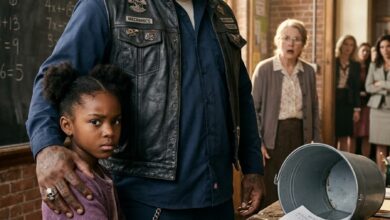
Two Annapolis police officers walked me out the front doors of St. Anne’s and down the steps into the June sunshine. The guests watched through the open doors with their phones held up.
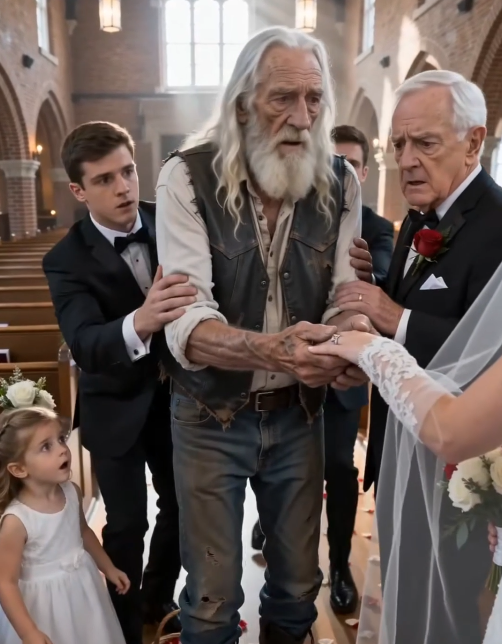
“Sir, how old are you?” one officer asked me gently on the sidewalk.
“Eighty-five.”
“Do you have family we can call?”
I didn’t answer that.
They didn’t arrest me. They wrote me a citation for disorderly conduct and told me not to come within five hundred feet of the church. Then they pointed me toward my motorcycle.
By that evening, the video had a million views. Elderly Biker Crashes Annapolis Wedding, Grabs Bride Mid-Aisle. It was the first eight seconds, with an old man in a leather vest pulling a bride’s hand away from her grandfather while the guests shrieked.
The comments were kind, in the cruelest way.
Poor guy probably has dementia.
Somebody should take his keys.
I sat on the edge of a bed at the Best Western on West Street with my helmet in my lap, and I made myself think honestly.
I am eighty-five. I forget where I put my glasses. Last month I drove to the VA clinic in Asheville on the wrong day.
For sixty years I believed Nell married Harold Ashford because I wrote her the wrong things from Vietnam. Or because she stopped loving me. Or because the baby wasn’t mine, like that letter said.
What if the letter was true? What if the ring was just a ring? Every jeweler on Main Street must have sold a hundred little sailboat rings in 1965.
What if I’d ridden five hundred miles to ruin a young woman’s wedding because I’m a lonely old man who couldn’t let go?
Then there was a knock on the motel door.
When I opened it, the bride was standing there, still in her wedding dress, with the long train gathered up in her arms. Her mascara was running.
She held up her right hand.
Then she pulled off the silver ring and held it out to me, turning it so the inside of the band caught the parking-lot light.
Engraved in tiny, worn letters:
A + N · Ride Home
“My grandma left me this,” Katie said, her voice shaking. “She made me promise to wear it on my wedding day.” She looked at my hand. “What does yours say?”
Part 3 — Ride Home
In the summer of 1965, the Chesapeake Bay smelled like salt and sun-hot docks and the crab steamers on Ego Alley.
I was twenty-four, a mechanic at a gas station on West Street, with a draft notice in my pocket and a 1966 Harley Panhead I’d bought used with every dime I had.
Eleanor “Nell” Whitaker was twenty. She was the daughter of the president of Farmers National Bank of Annapolis, and she was supposed to marry somebody important. She rode on the back of my Panhead every Sunday along Bay Ridge Road with her arms around my waist and her hair flying, laughing at everything.
She drew little sailboats on everything. In the margins of her letters. On napkins. On the back of my hand in ink.
“Because a sailboat always comes home,” she said. “Even when the wind takes it out.”
The night before I shipped out to Fort Benning, then Vietnam, I took her to Kirk’s Jewelers on Main Street. I bought two silver bands with a little sailboat carved on the outside. Inside each one, the old jeweler engraved four words.
A + N · Ride Home
“You come home to me, Abel Henning,” Nell said. “And we’ll ride.”
She signed every letter she sent me in Vietnam the same way. All my love, Nell, and a tiny sailboat drawn underneath.
Every single letter.
There was one other person in our lives that summer. Harold Ashford was twenty-seven, her father’s bright young assistant at the bank. He was always polite and always watching. That summer, he took a second job sorting mail at the Annapolis Post Office on Church Circle “to save up for a house.”
He always smiled at me.
I never thought about why.
Part 4 — The Telegram
Harold Ashford came to see me at the Best Western the next morning. He came alone, at eighty-eight, with a cane and a leather portfolio.
“I believe we have some things to discuss,” he said, sitting in the motel’s one chair. “Man to man. For Katie’s sake.”
He opened the portfolio.
The first thing was a yellowed Western Union telegram, dated March 1966.
NELL. MET SOMEONE IN SAIGON. MARRIED. NOT COMING HOME. FORGIVE ME. ABEL.
“Nell received this in March of 1966,” Harold said quietly. “She was four months pregnant. She was devastated. I was her friend. I married her two months later so that child would have a name.” He looked at me with sad, rheumy eyes. “I raised your daughter, Abel. Susan. For sixty years. I paid for her college. I walked her down the aisle. I’ve loved her granddaughter since the day she was born.”
“I never sent that telegram.”
“Then who did?”
He slid out a second page. It was a military record, my own, from the National Personnel Records Center.
Henning, Abel J. PFC. Disciplinary: Article 15, Long Binh, June 1966. Drunk and disorderly.
“You did come home,” Harold said gently. “In 1967. You came to Annapolis once. You saw Nell with the baby and you rode away. You never came back.” He leaned forward. “Abel, I’m not your enemy. I didn’t break your heart. Nell made her choice. The letter you received was in her handwriting. She chose a life. She chose me.”
He closed the portfolio.
“I won’t press charges,” he said. “But please, for Katie, don’t come near her again. Let her have her wedding. We’ve rescheduled it for two weeks from Saturday.”
He left.
I sat on the edge of the motel bed with my hands shaking.
He was right about one thing. In 1967 I came home from Vietnam with shrapnel in my leg and no idea what I was. I rode to Annapolis. I saw Nell through the window of a little house on Prince George Street, holding a baby girl. Harold Ashford was standing behind her with his hand on her shoulder.
And I left.
Maybe Nell did write that letter. Maybe she chose a banker with a house over a broken mechanic with a motorcycle.
I took the yellowed letter out again. Harold had handed it back to me that morning, “as a kindness.”
I’ve married Harold. The baby isn’t yours. Don’t come back. — Nell.
I’d read it ten thousand times.
And for the first time in sixty years, I noticed what wasn’t there.
There was no sailboat.
Part 5 — The Lockbox
Katie came to the Best Western that afternoon with her mother.
Susan Ashford was fifty-nine, a high school principal, with Nell’s dark eyes and my stubborn jaw. She stood in the motel doorway with her arms crossed and wouldn’t sit down.
“My father raised me,” she said flatly. “I don’t know who you are. And I don’t appreciate you ruining my daughter’s wedding.”
“Mom,” Katie said quietly. “Just look.”
She opened a shoebox on the motel bed.
It was the box from Nell’s cedar chest, left to Katie in the will with the ring. Inside were Nell’s letters to me, the ones I received in Vietnam, which I’d mailed back to her in a bundle in 1967 because I couldn’t stand to keep them. Every single one was signed All my love, Nell, with a tiny drawn sailboat.
Katie laid the “Dear John” letter beside them.
The loops on the letters were different. The slant was different. And there was no sailboat.
Then Katie pulled out something else she’d found in the bottom of the cedar chest, under the lining. It was a small envelope addressed to her in Nell’s shaky handwriting from her last year.
Katie — Open on your wedding day. Not before. — Grandma
“I forgot it,” Katie whispered. “I was so busy with everything. I found it this morning.”
Inside was a single key with a tag. Farmers National Bank. Safe deposit box 114.
My lawyer was a young woman from Baltimore named Danielle Okoro, who’d seen the wedding video and called me herself. She drove Katie and Susan to the bank that afternoon.
Box 114 held forty-one letters.
They were all from Vietnam, all addressed to Miss Eleanor Whitaker, Prince George Street, Annapolis. All of them were in my handwriting.
None of them had ever been opened by her. They’d been opened by someone else and resealed with tape.
On the bottom of the box was a single note on Farmers National Bank stationery, in Nell’s handwriting, dated 1998.
Found these in Harold’s office safe today. 41 letters. Abel wrote every week. The telegram was a lie. God forgive me, I am 53 years old and I don’t know what to do.
Susan sat down on the motel bed very slowly.
Danielle had one more thing. A handwriting examiner in Baltimore had compared the “Dear John” letter with Harold Ashford’s signatures on 1966 Farmers National Bank loan documents, which are public records at the Maryland State Archives.
“Same hand,” Danielle said. “The loops on the H. The crossbar on the t. Harold wrote that letter.”
There was money, too. Of course there was.
Nell died last spring. Her will left the Whitaker waterfront house on Spa Creek to Katie. It left half of the Whitaker family trust, $1.4 million, “to Abel J. Henning of North Carolina, the father of my daughter, should he be found.”
Harold Ashford was executor.
In the Anne Arundel County Orphans’ Court filing, he’d sworn under oath that Abel J. Henning was “believed deceased, no known address, diligent search conducted.”
I’ve lived at the same address in Asheville since 1978. I’m in the phone book. I’m in the VA system.
Susan stared at the will for a long time.
Then she stood up and walked out of the motel room without a word.
My phone rang an hour later. It was the Annapolis Police Department.
“Mr. Henning? Mr. Ashford has filed for a protective order. He’s alleging you threatened him at your motel this morning.”
Part 6 — The Order
I hadn’t threatened anyone. I’d sat on a motel bed and listened.
It didn’t matter. A judge in Annapolis signed a temporary protective order on Monday. I couldn’t come within a thousand feet of Harold Ashford, his home, or “any family event,” including the rescheduled wedding.
Harold’s lawyer went on WBAL-TV in Baltimore.
“Mr. Ashford is eighty-eight years old and is being stalked by a confused elderly man with a documented disciplinary history,” he said. “This man disrupted his granddaughter’s wedding and is now attempting to claim a deceased woman’s estate.”
The station ran the wedding video beside my Army photo from 1966.
The motel asked me to leave. The manager said other guests were “uncomfortable.” My Panhead was towed from the lot that night. Someone had reported it “abandoned.”
I sat on a bench at City Dock with my helmet in my lap. I didn’t have a bike or a room, and I was five hundred miles from home.
Then my chest tightened.
It wasn’t sudden. It was slow, like a fist closing.
The last thing I remember is a young woman from a crab shack kneeling beside me on the dock, calling 911.
I woke up in the cardiac unit at Anne Arundel Medical Center with wires on my chest. The doctor said it was a minor heart attack at my age, from stress and exhaustion. I’d need to stay three days.
Nobody visited the first day.
On the second day, a man in a leather vest walked into my room with a bouquet of grocery-store carnations. Then another came, and another.
Seventeen bikers from the Vietnam Veterans of America chapter in Annapolis had seen the video. One of them had served at Long Binh in ’66.
“We know about Article 15s, brother,” he said. “Half of us got one.”
On the third day, the door opened, and Susan Ashford walked in.
She stood at the foot of my hospital bed for a long time without speaking.
“I went home and asked my father about box 114,” she finally said. “He told me Mom was senile when she wrote that note. He said she made it up.”
“Do you believe him?”
Susan didn’t answer.
Instead, she pulled a chair to my bedside and sat down.
“There’s something about my mother you need to know,” she said quietly. “Something she never told anyone but me. And I’m the one who kept it from you.”
Part 7 — 1998
“Mom found those letters in 1998,” Susan said. “Just like her note says.”
She stared at her hands.
“I was thirty-two. She came to my house that night with the shoebox and told me everything. The telegram. The forty-one letters. The man in Vietnam who wrote her every single week.” Her voice cracked. “She told me Harold wasn’t my father.”
The machines beeped softly.
“She wanted to leave him. She wanted to find you. And I talked her out of it.”
I looked at her.
“I was the principal of Annapolis High School by then,” Susan said. “My father was on the school board. He was the most respected man in this town. I had a husband, a baby, and a reputation. If Mom left him and told the truth, everyone would know I was the daughter of some biker she’d never married.” She pressed her hand over her mouth. “I told her, ‘Mom, he’s been a good father to me. Let it go. Please. For me.'”
“And she did,” I said.
“She did. For twenty-six more years. She stayed in that house with the man who stole her life, because her daughter asked her to.” Susan’s tears fell freely now. “Then, at the very end, she put your name in her will and gave Katie the ring and the key. She couldn’t fix it for herself. She was trying to fix it for her granddaughter.”
I didn’t say anything for a long time.
For sixty years, I’d believed Nell stopped loving me. She hadn’t. She was lied to. She found out. And her own daughter, my daughter, asked her to stay quiet for a reputation.
I’d ridden away from a window on Prince George Street in 1967 without knocking. I’d been too proud and too broken to ask her one question.
None of us were clean.
“I rode away once,” I told Susan. “I saw her through the window, holding you. I didn’t knock. If I’d knocked, she’d have known I was alive.” I shook my head. “Harold built the wall. But I’m the one who walked away from it.”
Susan wiped her face.
“The wedding is Saturday,” she said. “Dad’s walking Katie down the aisle. He insists. He says it’s what Mom would want.” She looked at me. “They’re livestreaming it for the family in California.”
“I can’t go,” I said. “Thousand feet.”
“I know.” Susan stood up. “But Katie asked me to give you this.”
She set something on my hospital tray. It was a small folded card in Katie’s handwriting.
Grandpa Abel — Be outside the gate at 3:00. Don’t come in. Just be there. Trust me. — K
Could an eighty-five-year-old man with a bad heart and no motorcycle get back to that church gate in time?
Part 8 — The Sailboat
I made it.
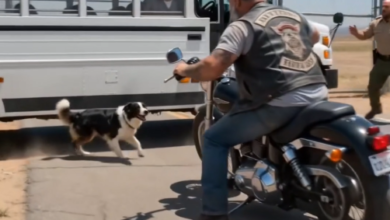
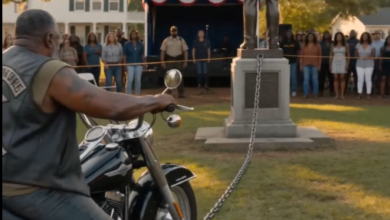
The Vietnam Veterans chapter got my Panhead out of impound on Friday. On Saturday afternoon, seventeen bikers rode me to Church Circle, slow and careful, with me on my own bike in the middle like an old man being walked to church.
At 2:55 p.m., I stood outside the iron gate of St. Anne’s. Danielle Okoro had measured the distance from the church doors at one thousand and forty feet, across Church Circle and Main Street. Seventeen silent motorcycles were lined up behind me.
The church doors were open. The livestream was on Danielle’s phone in my hand.
Inside, two hundred guests sat in the pews. The organ played. Harold Ashford stood at the back of the aisle in a gray morning suit with a cane, waiting for the bride.
Katie came out of the bridal room in her white dress.
She stopped in front of Harold. She didn’t take his arm.
“Grandpa Harold,” she said, clearly enough for the microphones to pick it up. “Before I walk, I want to ask you one question in front of everybody. About Grandma’s letters.”
Harold smiled patiently, warmly, the smile he’d worn at bank board meetings for sixty years.
“Katie, sweetheart, this isn’t the time.”
“It’s the only time,” Katie said. “The letter Abel Henning received in Vietnam in 1966. Grandma’s letter, telling him she’d married you. Did she write it?”
“Of course she wrote it,” Harold said. “I watched her write it at her mother’s kitchen table. In her own hand, right down to that silly little sailboat she drew under every letter she ever—”
He stopped.
The church went completely silent.
Katie reached into the bodice of her dress and pulled out a yellowed envelope. It was the “Dear John” letter. Harold had given it back to me “as a kindness.” I’d given it to Danielle, and Danielle had given it to Katie.
She unfolded it and held it up to the livestream camera.
“There’s no sailboat,” she said. “There isn’t one on this letter. There’s a sailboat on every single letter Grandma ever wrote in her life. Except the one you say you watched her write.”
She pulled out a second thing. It was a photocopy of the note from safe-deposit box 114.
Found these in Harold’s office safe today. 41 letters. Abel wrote every week. The telegram was a lie.
“And she drew a sailboat on this one,” Katie said, her voice breaking.
Two hundred people turned to look at the old man in the gray morning suit.
Then Susan stood up in the front row.
“He’s not my father,” she said, loud enough for the back of the church. “My mother told me in 1998. And I begged her to stay quiet.” She turned to the crowd. “My father is outside that gate. Where Harold made sure he’d always be.”
Harold Ashford’s cane slipped out of his hand and clattered on the marble floor.
Katie looked down the aisle, through the open doors, across Church Circle, at the old man standing by the iron gate with seventeen motorcycles behind him.
Then she picked up the train of her dress in both hands.
Was she going to walk down that aisle alone?
Part 9 — Ride Home
She ran.
She ran right out the front doors of St. Anne’s in her wedding dress. Two hundred guests turned in their pews. She ran down the church steps, across Church Circle and across Main Street, past every one of those thousand and forty feet.
She stopped in front of me at the iron gate, out of breath.
“Grandpa,” she said. “Will you walk me down the aisle?”
I’m eighty-five years old. I hadn’t cried since 1967.
Harold Ashford never walked down that aisle. The Anne Arundel County State’s Attorney opened an investigation the following Monday. Too much time had passed for the forged letters and the telegram. But the false sworn statement to the Orphans’ Court in 2025 was another matter. So were the forty-one letters stolen from federal mail. The State’s Attorney charged Harold with perjury, fraud against an estate, and obstruction.
At eighty-eight, he pleaded guilty. He was sentenced to home detention. The court removed him as executor of Nell’s estate. Susan asked the judge herself.
The Whitaker trust was divided exactly as Nell wrote it. I gave my half to a scholarship at Anne Arundel Community College for the children of veterans. Katie named it the Nell & Abel Ride Home Fund.
The protective order was vacated. The Annapolis police chief sent me a letter. I’m sorry, sir.
Susan and I have lunch every Thursday now. She drives to Asheville once a month. She asks me questions about her mother that nobody’s ever been able to answer: what Nell laughed at, what she sang on the back of the bike, what she smelled like in the summer of 1965.
I tell her everything I remember. Some of it, I’m surprised I remember at all.
The rescheduled wedding happened two weeks after that, at the same church, on a clear Saturday in July. Two hundred guests came, along with seventeen Vietnam veterans in the back pews.
When the organ started, I stood at the back of the aisle in a borrowed suit, with my leather vest under the jacket because Katie insisted.
Katie came out of the bridal room in her white dress and stood beside me.
The last time I stood in that aisle, I’d lifted her hand off another man’s arm while two hundred people screamed.
This time, she held her hand out to me.
I took it, very gently, like it was made of glass. Then I tucked it into the crook of my arm, the way I’d have done for her grandmother, if anybody had let me.
On her right hand was the silver ring with the tiny sailboat, and on my left hand was its match.
Halfway down the aisle, my bad leg started to shake. Katie felt it. She squeezed my arm and slowed down without a word, so I could keep up.
At the altar, before I gave her away, she leaned close to my ear.
“Grandma always said sailboats come home,” she whispered.
I looked at her, at my granddaughter in her white dress, with Nell’s dark eyes and my stubborn jaw.
“Took me sixty years,” I said. “Wind was against me.”
Katie smiled, kissed my cheek, and turned the silver ring on her finger so I could see the inside of the band.
A + N · Ride Home.
“You did, Grandpa,” she said. “You rode home.”
If Abel and Katie’s story stayed with you, follow our page. We’ve got a lot more biker stories coming, and some of them hit even harder than this one.