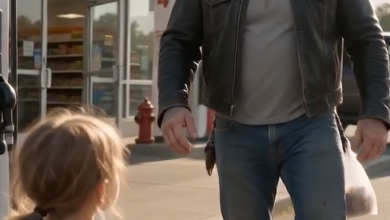
A 10-Year-Old Girl Poured A Bucket Of Water Over Her Whole Class’s Test Papers — She Refused To Explain Until Her Biker Dad Showed Up At The Principal’s Office
Part 2
I followed him to Room 21.
The students had been sent to the library. Mrs. Doyle was alone in the classroom, standing over her desk, trying to separate the wet test papers with a ruler. Laying them out on the radiator to dry. Most of them were ruined.
She looked up when Marcus came in.
She took a step back. I saw it.
He stopped in the doorway. He didn’t come any closer.
“Mrs. Doyle,” he said. “My daughter says she told you something. During the test. Before she did this.”
Mrs. Doyle’s face went still.
“She says she raised her hand,” Marcus said. “She came up to your desk. She told you three kids had the answers. Written on the inside of their water bottle labels. She says she told you she could see them copying.”

Mrs. Doyle didn’t answer right away.
“And she says you told her to focus on her own test.”
I looked at Mrs. Doyle.
Thirty years at Harmon. Never a complaint. Never a write-up. The most precise, rule-following teacher in my building.
She put down the ruler.
“She came up to my desk,” Mrs. Doyle said slowly. “About halfway through. She whispered something. I didn’t hear all of it. Something about water bottles.”
She swallowed.
“I thought she was trying to get out of the test. Kids do that. I told her to sit down and focus on her own work.”
“Did you look?” Marcus asked. “At the water bottles?”
Mrs. Doyle was quiet for a long time.
“No.”
Here’s what Nia told her father in my office. I didn’t hear it myself until later, when Marcus asked her to tell it to me again.
She’d noticed it on the Unit Four test, back in November.
Three kids in her class. Kids who usually got Cs. Suddenly got perfect scores. Then on Unit Five. Then on Unit Six.
She thought maybe they’d just gotten better.
Then, two days before Unit Seven, she was in the girls’ bathroom and heard two of the girls talking at the sinks.
My mom bought it again. Same lady. Fifty dollars.
Did you get the answers or just the test?
Both. I’m putting them on my water bottle.
Nia didn’t know what to do. She was ten. She went home and didn’t tell anybody. She lay awake.
On Thursday morning, during the test, she looked across the aisle.
Three water bottles on three desks. Labels peeled back. Tiny pencil writing on the inside of the label.
Three kids glancing down at them between every question.
She raised her hand. Mrs. Doyle didn’t see. She raised it higher. Mrs. Doyle was grading something.
So she got up and walked to the front and whispered.
Mrs. Doyle, Kayden and Brooklyn and Mason have the answers on their water bottles. I can see them.
Nia. Sit down. Focus on your own test.
She sat down.
She watched them copy for twenty more minutes.
“Why didn’t you tell me?” I asked her, later, in my office. “Why didn’t you tell me any of that when I brought you down here?”
She looked at me with those big serious eyes.
“Because you’d do what Mrs. Doyle did,” she said.
I didn’t have an answer for that.
“And because if I said their names,” she said, “their moms would get mad. Kayden’s mom is the PTA president. Everybody would say I was lying. And then the test would still count.”
She looked down at her wet shoes.
“So I made it not count.”
Part 3
By noon, it was a mess.
I’m going to tell you exactly how it went. I’m not proud of all of it.
Mrs. Doyle checked the water bottles. The three students were at lunch. Their bottles were in their cubbies.
Two of them had pencil writing on the inside of the labels. Numbers. A list of letters. A, C, C, B, D. Twenty-five of them.
The third bottle had been thrown away.
I called the three families.
Kayden Whitcomb’s mother was the PTA president. Lauren Whitcomb. She arrived at my office at 12:45 in a camel coat with her phone already in her hand.
She did not ask what her son had done. She asked what I was going to do about the child who’d destroyed his test.
“My son studied for that test,” she said. “He got a perfect score. I saw his practice sheets. And now some girl decides to throw a tantrum and he has to take it again? While she gets what, a time-out?”
I showed her the water bottle.
She looked at it for about two seconds.
“Kids write on things,” she said. “That proves nothing. Did anyone see him use it?”
“Nia did.”
“Nia Ellison,” she said. She said the last name like it tasted bad. “The girl who just poured a bucket of water on twenty-six tests. That’s your witness.”
The other two families followed her lead. By 1:30, all three mothers were in my outer office. By 2:00, one of them had called the district superintendent.
At 2:15, the superintendent called me.
He’d heard from Mrs. Whitcomb. He wanted to know why a student who’d committed what he called “deliberate destruction of assessment materials” was still in the building.
I told him what Nia had said. About the answers. About the bathroom.
He said, “Gloria. You have a ten-year-old’s word against three families who’ve been in this district for twenty years. You have a water bottle. You have a teacher who didn’t see anything.”
He paused.
“And you have a kid who poured water on twenty-six tests in front of witnesses. That one’s not in dispute.”
He told me to suspend her.
Three days. A formal written reprimand in her file.
Marcus Ellison was sitting in the hallway outside my office when I hung up. He’d been there for four hours. He’d called his shop and told them he wasn’t coming back that day.
He hadn’t said a word to the three mothers. Not one. He just sat in a plastic chair against the wall with his arms crossed and his vest on, while they talked about him in voices they thought he couldn’t hear.
Look at him.
Of course.
Gang thing, probably.
He didn’t react to any of it.
Nia was sitting next to him. Leaning against his arm.
I called them both into my office.
I told them what the superintendent said.
I’ll never forget Marcus’s face. He didn’t argue. He didn’t get angry. He just nodded slowly, like a man who’d heard this exact thing before.
“Okay,” he said.
Nia looked up at him.
“Is that okay, Daddy?”
He looked down at her.
“Did you do it?”
“Yes.”
“Did you know you’d get in trouble?”
“Yes.”
“Did you do it anyway?”
“Yes.”
“Why?”
She thought about it.
“Because it wasn’t fair,” she said. “And because of Gabe.”
Marcus nodded again.
“Then it’s okay,” he said.
He turned to me.
“Write her up,” he said. “She’ll take it. She already knew she would.”
Then he stood up.
“But you’re gonna look at the other three tests,” he said. “Units Four, Five, and Six. Because if she’s right about this one, she’s right about those.”
He looked at me for a long moment.
“And somebody’s been selling them.”
I signed the suspension form at 3:10.
Nia’s name. The date. Deliberate destruction of assessment materials. Three-day suspension. Formal reprimand placed in student file.
I thought that was the end of it.
A girl who did something wrong for a reason that might have been right. Three angry mothers. A teacher who missed it. A father who took it on the chin.
I went home that night and couldn’t sleep.
At two in the morning, I got out of bed and drove back to Harmon Elementary.
Part 4
I sat in my office with every grade report from Mrs. Doyle’s class for the entire year.
Units One through Six. Math and science.
I laid them out on my desk side by side.
It took me about ten minutes.
On Units One, Two, and Three, the three students Nia named had scored seventy-one, sixty-eight, and seventy-four. Seventy-two, sixty-five, seventy. Sixty-nine, seventy-three, seventy-one.
Average. Consistent. Normal.
On Unit Four, all three scored a hundred.
On Unit Five, all three scored a hundred.
On Unit Six, a hundred, a hundred, ninety-six.
Nobody improves like that. Not in one month. Not three kids at once.
Then I pulled the reports for the other two fifth-grade classes. Mr. Hollins’s and Ms. Archuleta’s.
There were more.
Six more students. Same pattern. Average scores through November. Then near-perfect scores on Units Four, Five, and Six.
Nine students. Three classes.
All of them, it turned out when I checked, from families active in the PTA.
At seven in the morning, I called the district’s IT office. I asked who had access to the electronic files for the fifth-grade unit tests.
Teachers, they said. The principal. The assistant principal.
And one person in the front office who handles printing and copying for the whole building.
Sharon Pettibone. Front office clerk. Fourteen years at Harmon.
I asked IT to pull the access logs.
They called back at ten.
Sharon had opened and printed every fifth-grade unit test, in both math and science, between two and five days before each one was given.
Four times that school year.
Units Four, Five, Six. And Seven.
Unit Seven had been printed three days before Nia Ellison picked up that bucket.
That’s when I found out about the group chat.
I didn’t go looking for it. It came to me.
At lunch that day, a mother I’d never met walked into my front office and asked to speak with me privately. Her name was Denise. Her son was in Mr. Hollins’s class. One of the nine.
She sat in the chair across from my desk where Nia had sat the day before. She put her phone on my desk.
She was crying.
“I heard what happened with the little girl,” she said. “With the bucket.”
She turned her phone around.
A group text. Eleven parents. Screenshots going back to November. Somebody named Sharon P offering practice materials for fifty dollars a test. Venmo usernames. Photos of answer keys.
“I bought one,” Denise said. “In January. I told myself everybody was doing it. I told myself it was just practice.”
She wiped her eyes.
“Then I heard a ten-year-old poured water on it because it wasn’t fair.”
She looked at me.
“I couldn’t sleep last night either.”
The fourth leaked exam that year.
Four.
And we’d only caught it because a ten-year-old girl decided she’d rather be punished than let it count.
Then I did the math I should have done first.
The Harrington Scholarship. Ten awards. Based on the combined scores of all unit tests that year.
I ran the rankings again. Twice. Once with the scores the way they stood. Once with the nine students’ leaked tests removed and replaced with their average from Units One through Three.
The difference was fourteen students.
Fourteen children who’d been pushed down the rankings by kids whose parents had paid for the answers. Fourteen children who, on the real scores, were in contention for those ten scholarships.
And who, on the stolen scores, weren’t even close.
I looked at the list.
The third name on it was Gabriel Sato.
Mrs. Doyle’s class. Seat 14. Directly across the aisle from Nia Ellison.
Part 5
I asked Nia about Gabe. In my office, the next day. With her father there.
She told me Gabe was her best friend since kindergarten.
His mom cleans office buildings downtown at night. His dad’s not around. They live in an apartment on Front Street with his grandmother.
Gabe wants to be an engineer. He builds bridges out of popsicle sticks. In fourth grade, he built one that held a gallon of milk. He’s been talking about the Harrington Scholarship since second grade. It’s the only way he can go to that school.
All year, he studied every night. He got Bs and B-pluses. He was proud.
Then in December, the rankings were posted on the bulletin board outside the library. Top thirty. Gabe was number twenty-eight.
He’d been number eleven in October.
“He cried in the bathroom,” Nia said. “He thought he was getting dumber. He said maybe he wasn’t smart enough for the STEM school after all.”
She looked at her hands.
“He wasn’t getting dumber. They were cheating.”
“Why didn’t you just say their names?” I asked her. “To me. To anybody.”
She shook her head.
“Nobody would believe me. Kayden’s mom is in charge of everything. They’d say I was jealous. And the test would still count. And Gabe would still lose.”
She looked up at me.
“If the test was gone, they’d have to do it again. Fair. Without the water bottles.”
“You knew you’d be suspended.”
“Yes, ma’am.”
“You knew it’d go in your file.”
“Yes.”
“You might lose your own chance at the scholarship.”
She nodded.
“I know,” she said. “But Gabe needs it more than I need a clean file.”
I looked at Marcus.
He was sitting next to her with his arms crossed. Staring at the floor.
“Mr. Ellison,” I said. “Yesterday. When I told you about the suspension. You said you’d heard it before.”
He didn’t answer right away.
Then he uncrossed his arms. Looked at his hands. STAY. TRUE.
“Seventh grade,” he said. “Scott Middle School. Nineteen ninety-four.”
He told me.
He was twelve. A skinny kid from the east side. He scored a ninety-eight on the qualifying exam for the honors math track. Highest score in the building.
His teacher didn’t believe it.
She said a kid like him couldn’t have scored that high without cheating. She said it in front of the whole class. She made him retake it alone in the principal’s office with the principal watching.
He scored a ninety-six.
They still didn’t put him in honors.
“Said the second score proved I’d seen the first one,” Marcus said. “Didn’t matter what I did. They’d already decided.”
He was quiet for a while.
“I stopped trying after that. Dropped out junior year. Did some stupid stuff. Did three years at Toledo Correctional for it.”
He looked at his daughter.
“Got out. Learned diesel. Joined the club. Met her mama. Got my GED at thirty.”
He put his big hand on top of Nia’s head.
“When she told me in your office what she did, and why,” he said, “I wasn’t mad at her. I was mad I didn’t see it coming. She’s been watching me fight unfair my whole life. Course she was gonna do it too.”
Part 6
Sharon Pettibone was placed on leave that afternoon. She was terminated a week later.
The Lucas County prosecutor charged her in May. Tampering with records. Theft in office. She’d made a little over four thousand dollars selling copies of the tests to eleven families.
The nine students who’d used the leaked answers were given failing grades on Units Four through Seven and allowed to retake them under supervision. Their parents were barred from PTA leadership. Lauren Whitcomb resigned as president before the board could remove her.
The entire fifth grade retook Unit Seven on a Monday in April. All three classes. In the cafeteria. Every water bottle collected at the door.
Mrs. Doyle proctored. Mr. Hollins proctored. Ms. Archuleta proctored. I stood in the back.
Nia Ellison came back from her suspension that morning and took it too.
She scored a ninety-four.
Gabe Sato scored a ninety-seven.
I called the Harrington Foundation and told them everything. All of it.
They reopened the scholarship review. They recalculated every ranking with the leaked scores removed.
All fourteen students were reconsidered.
Eleven of them received the Harrington Scholarship. The foundation found the money for one extra award that year. Then another. Then they called a donor.
Eleven.
Gabe Sato was one of them.
He found out in my office, with his mother in her work uniform, straight off a night shift. When I told him, he didn’t say anything. He just turned around and hugged his mom, and then he went out into the hallway and hugged Nia so hard they both fell over.
The other three of the fourteen didn’t get the Harrington.
The Glass City Riders found out.
The club has about forty members. Mechanics, welders, a couple of retired auto workers from the Jeep plant. They meet in a garage off Woodville Road. They do a toy run every December and a back-to-school drive every August.
Marcus told them at their Tuesday meeting.
By the end of the meeting, they’d passed a hat.
By the end of the month, they’d held a bike wash in the parking lot of a Kroger on Navarre Avenue and a chili cookoff at the union hall.
They raised enough to cover two years of tuition, split three ways, for the three students who’d been cheated out of the Harrington and didn’t get it back.
They didn’t want their names on it. The checks just said GLASS CITY RIDERS.
Mrs. Doyle came to see me in May.
She sat in my office and told me she’d been teaching for thirty years and had told children to focus on their own test probably ten thousand times.
“I never once thought about what I was telling them not to see,” she said.
She signed up for the district’s training on academic integrity reporting that summer. Then she asked to help write the new procedure.
It’s one line, now, printed on a laminated card taped to every teacher’s desk in Harmon Elementary during testing:
If a student reports cheating during an exam, stop and look. Every time.
Part 7
On the last day of school, I pulled Nia Ellison’s student file.
I took out the formal reprimand. The one I’d signed at 3:10 on a Thursday afternoon in March.
Deliberate destruction of assessment materials. Three-day suspension.
I’d been a principal for eighteen years. I’d never once removed a disciplinary record. I believed in rules. Clear rules. Fairly applied.
I took a red pen out of my drawer.
I drew a line through every word.
Then, underneath it, in my own handwriting, I wrote one sentence.
Student acted in the interest of fairness. — G. Benton, Principal.
I signed it. I dated it.
I put it back in her file.
Then I made a copy.
I walked it out to the front of the school at 3:15, where the parent pickup line was.
The Street Glide was already there. Parked in the visitors’ lot again. Marcus Ellison was leaning against it in his vest, waiting.
Nia came out the front doors with her backpack. Gabe was with her. They were arguing about whether a suspension bridge or a truss bridge could hold more weight.
I called her name.
She stopped. Looked a little worried. Kids always do when the principal calls their name.
I handed her the copy.
She read it. Slowly. Her lips moving on the long words.
Then she looked up at me.
“Does this mean it’s not in my file anymore?”
“The suspension’s still there,” I said. “I can’t make that disappear. But that sentence is the last thing anybody will read about it.”
She looked at it again.
Then she turned around and ran to her father and held it up to him.
Marcus took it. He read it.
He didn’t say anything for a long time.
Then he folded it very carefully, and put it in the inside pocket of his leather vest, over his heart, and buttoned it closed.
He looked across the parking lot at me.
He nodded once.
Then he lifted his daughter onto the back of the Street Glide, handed her a purple helmet, climbed on in front of her, and fired it up.
That big engine rumbled across the parking lot. Kids turned to stare. A couple of them waved.
Nia waved back with both arms.
They pulled out onto Navarre Avenue and turned toward the bridge.
Fair.
Finally.
👉 If this story stayed with you, follow our page for more stories from the road — and from the kids brave enough to stop what everyone else lets slide. 🏍️