A Biker Chained His Motorcycle to the Town Hero’s Brand-New Bronze Statue and Pulled It Down During the Unveiling—The Whole Crowd Screamed, Until He Blew a Whistle Three Times
Part 2 — Destruction of Public Property
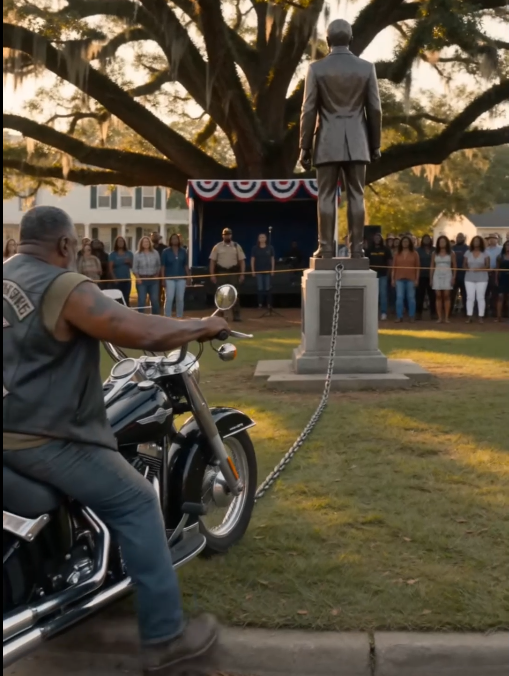
They put me in handcuffs right there on the grass, beside the fallen statue.
Deputy Travis Bunn was young and nervous. He kept glancing at the crowd. Somebody had called me a monster. Somebody else had called me worse.
“Sir, do you understand you just destroyed a three-hundred-and-eighty-thousand-dollar public monument?”
“I understand.”
Mayor Bud Larkin walked over slowly. He was seventy-one, silver-haired, with a navy suit and a small gold Medal of Valor pin on his lapel. He looked down at the bronze version of himself lying in the grass. Then he looked at me.
He didn’t look angry.
He looked sad, like a man who’d seen this coming for a long time.
“Calvin,” he said quietly. “I knew your daddy. He was a good man. I’m so sorry you’re still carrying this.”
Then he turned to the cameras.
“I won’t press charges personally,” he said. “This is a grieving son. Hurricane Floyd took a lot of people from this town. Grief makes us do things.”
The crowd softened toward him. I could feel it.
But the town council pressed charges anyway, for felony injury to public property and reckless endangerment. They booked me into the Edgecombe County Detention Center that afternoon.
By nightfall, the video had four million views. Biker Topples Hurricane Hero’s Statue During Unveiling. The first nine seconds were everywhere: a chain going tight, a motorcycle engine roaring, eight feet of bronze falling while children screamed.
Nobody shared the part with the whistle.
I sat in a cell and made myself do the hard math.
In September 1999, I was twenty-five years old and in the Marine Corps, stationed in Okinawa, Japan. I wasn’t there that night. I got the Red Cross message three days later. My father’s body was found by the National Guard two miles downstream from Highway 64, tangled in a fence line.
Everything I knew about that night came from my mother, Loretta.
And my mother has Alzheimer’s.
Some days she thinks it’s 1985 and I’m in fourth grade. Some days she calls me Ellis. Some days she tells me my father carried seven babies out of that river while Bud Larkin hid in his patrol car.
What if I’d pulled down a hero’s statue in front of four hundred people because of a story my sick mother told me? What if my father was just one of the fifty-two people who drowned in Floyd, and I needed him to be a hero so badly that I’d made one up?
At ten p.m., a guard handed me a folded note.
It was written in careful cursive on stationery from Mount Zion Baptist Church.
Mr. Ward. I was the last child out of that van. I remember three whistles. I remember an orange vest. I need to talk to you. — Tasha Mills.
The woman on the stage. The one Bud had introduced all day as his miracle.
Part 3 — Three Short
In the summer of 1998, the riverbank behind Mount Zion Baptist Church in Princeville smelled like fish fry and muddy water and Off! bug spray.
My father, Ellis Ward, was forty. He drove a log truck for a living and spent every Saturday teaching the church kids to swim in the slow brown water of the Tar River. He was a big man with forearms like fence posts and a laugh you could hear across the parking lot.
Around his neck, on a red braided cord my mother made, hung a brass coach’s whistle.
“Three short,” he told the kids, lined up on the bank in their swim trunks. He blew it so they could hear. Tweet. Tweet. Tweet. “That means come to me. No matter where you are. No matter how scared you are. You hear three short, you swim to my voice.”
He made them practice it a hundred times.
He had one more rule.
He kept an old orange life vest in his johnboat. Whenever the river got rough, he strapped it onto the weakest swimmer first, never on himself.
“Big men float,” he’d say, and wink.
Inside the vest, on the white tag, he’d written his initials in black marker. E.W. That way it always came back to him.
A young deputy named Bud Larkin used to come down to those Saturday picnics for the free fish. He’d lean against his patrol car and laugh at my father blowing that whistle.
“Ellis, you look like a gym teacher.”
“Gym teachers save lives, Bud,” my father said.
I was twenty-four that summer, home on leave, standing on the bank with a plate of hushpuppies.
That was the last time I saw my father alive.
Part 4 — The Medal of Valor
Mayor Bud Larkin came to see me himself at the Edgecombe County Detention Center the next morning. His lawyer came, and so did the town attorney.
“I want to clear the air,” Bud said gently. “For your mother’s sake.”
He slid a folder through the slot.
The first page was an Edgecombe County Sheriff’s Office incident report dated September 17th, 1999. It was signed by Deputy R.B. “Bud” Larkin.
At approximately 0100 hrs, this deputy responded to a disabled church van submerged on US-64 near the Tar River bridge. This deputy entered the water and retrieved seven (7) juveniles, transporting them to high ground on the Shiloh Farm Road. All juveniles survived.
The second page was a Governor’s Medal of Valor citation from 2000. It was signed by Sheriff Clarence Odom and supported by sworn statements from three deputies who said they witnessed the rescue.
The third page was a still frame from WRAL-TV news footage, taken at dawn on September 17th. It showed a soaked young deputy carrying a little girl in his arms through knee-deep water.
“That’s me,” Bud said quietly. “And that’s Tasha Mills.”
Then he slid over a fourth page.
It was the Edgecombe County medical examiner’s report on Ellis Ward, dated September 20th, 1999. Cause of death: drowning. Location of recovery: 2.1 miles downstream, near the flooded Piggly Wiggly on Main Street.
“Calvin,” Bud said, lowering his voice. “Your father’s body was found by the Piggly Wiggly. That store was flooded to the ceiling. There were reports that night of people…” He hesitated, as if it pained him. “Taking things. I never put that in any report. I never wanted to hurt your mama.”
I stared at him.
“You’re saying my father drowned looting a grocery store.”
“I’m saying I don’t know,” Bud said gently. “And neither do you. You were in Japan, son. All you have is what your mother told you.” He paused. “And you know her mind’s not what it was.”
He stood up and buttoned his jacket.
“I’ll ask the council to drop the felony,” he said. “If you’ll make a public apology. For your mother’s sake.”
I sat in that room alone after he left.
Three deputies had sworn to it. There was news footage and a medal citation. And there was a medical examiner’s report that put my father two miles from that church van, by a flooded grocery store.
Maybe my father wasn’t a hero.
Maybe I’d spent twenty-five years believing a story my grieving mother needed to tell.
But one thing in that folder didn’t fit.
The medical examiner had listed my father’s personal effects at the bottom of the report.
One brass whistle on red braided cord. One wallet. One wristwatch, stopped at 2:47.
Bud had said the van was at the bridge at one a.m.
If my father was looting a store downtown, why was he still wearing his whistle?
Part 5 — The Raw Footage
My lawyer was a public defender from Rocky Mount named Ayanna Pettiford. She’d grown up in Princeville. Her grandmother’s house had washed away in Floyd.
“First,” she said, “I want that WRAL footage. All of it. Not the clip they aired.”
WRAL in Raleigh still had the raw tapes in their archive. It took two weeks and a subpoena.
We watched it in Ayanna’s office on a borrowed laptop.
The tape started at 12:48 a.m. A news crew was stuck on high ground on Shiloh Farm Road with their headlights on, filming the floodwater rising over US-64 below them.
At 12:56, through the rain, you could see a church van tipped on its side in the current, kids’ faces in the windows.
At 1:04, a sheriff’s patrol car pulled up on the high ground. A young deputy got out, looked at the water and got back in.
At 1:09, a small aluminum johnboat came out of the dark, rowed by a big man.
Then, through the roar of the rain, faint but clear, came a whistle.
Tweet. Tweet. Tweet.
At 1:12, the patrol car’s headlights swung around and drove away up Shiloh Farm Road.
For the next ninety minutes, the camera caught the johnboat coming and going in the floodlight. It made seven trips. Each time, the big man pulled a child out of the van and rowed them to the high ground where the news crew stood. Each time, you could hear three short whistles.
On the seventh trip, he strapped something bright orange around a little girl.
On the eighth trip, he didn’t come back.
The tape’s timestamp read 2:44 a.m.
My father’s watch had stopped at 2:47.
At 6:20 a.m., the same patrol car came back. Deputy Bud Larkin got out, waded into knee-deep water at the edge of the high ground, and picked up a little girl in an orange life vest. She was sitting on the ground wrapped in a blanket. He carried her ten feet toward the camera.
That was the shot WRAL aired.
Ayanna sat back.
“The three deputies who signed his citation,” she said. “All three were in that patrol car with him. I pulled the radio logs. They were ordered to the Tar River bridge at 12:50. They reported back ‘scene clear, no persons in water’ at 1:15.”
Then she pulled the money.
The Larkin Floyd Heroes Foundation had been incorporated in 2001. It raised $1.4 million over twenty-three years for “flood survivors and first responders.” Ayanna pulled the IRS 990 forms. Bud’s wife, Sharon, was executive director at $94,000 a year. Bud’s book, The Night the River Rose, had a $250,000 advance from a publisher in Nashville and was coming out in October. The foundation had paid $380,000 for the bronze statue. The sculptor was Bud’s nephew.
The foundation had also been paying someone else $40,000 a year since 2010 as “Survivor Ambassador.”
Tasha Mills.
I stared at the line.
“He didn’t just steal your daddy’s story,” Ayanna said quietly. “He built a business on it.”
My phone buzzed.
It was my mother’s nursing home in Tarboro.
“Mr. Ward? The mayor’s office called. They’ve requested your mother be moved to a facility in Greenville. They say it’s for her protection. From you.”
Part 6 — Protection
The town council held an emergency meeting on Thursday. They voted 6–1 to file for a no-contact order against me, covering the Town Common, all town property, and every town-sponsored event.
The mayor’s office announced that the statue would be restored and reinstalled on the twenty-fifth anniversary of Hurricane Floyd, September 16th, in a “Rededication and Remembrance” ceremony.
Bud Larkin gave an interview to WITN in Greenville, standing in front of the empty pedestal.
“I’ve forgiven Calvin Ward,” he said. “But the families I saved deserve to feel safe. And frankly, so does his own mother.”
The station ran my Marine Corps booking photo from 1997. I’d gotten into a bar fight at Camp Lejeune as a nineteen-year-old. It was the only arrest of my life.
My tire shop on Western Boulevard lost half its customers in a week. Somebody spray-painted STATUE THUG across the bay door.
On Friday night, a sheriff’s deputy pulled me over on US-64 for “erratic lane changes.” It was Deputy Travis Bunn, the same kid from the Town Common. He wouldn’t look me in the eye. He impounded my bike for “suspected unpaid fines” that didn’t exist.
My club brothers came from Rocky Mount and Wilson. Twenty-two of them sat in the parking lot of the impound yard all night. WITN filmed that too. Biker Gang Gathers After Statue Vandal’s Arrest.
On Monday, my mother was moved from Tarboro to a nursing home in Greenville. That was forty minutes away, with a visitor list I wasn’t on.
“Her doctor agreed,” the administrator told me on the phone. “Mr. Ward, she gets very agitated after your visits. She keeps saying ‘the envelope, the envelope.'”
The envelope.
I sat alone in my shop that night under the spray paint, with my father’s brass whistle in my hand.
At eleven p.m., someone knocked.
It was a woman in her early thirties, in hospital scrubs, with dark braids pulled back. She was holding a large plastic bag against her chest.
Tasha Mills.
“Mr. Ward,” she said, shaking. “I’ve been lying for fifteen years. I need to tell you why before the anniversary.”
She held out the bag.
Inside was a faded orange life vest, stiff with age.
Part 7 — The Survivor Ambassador
Tasha sat on a stack of tires in my shop with the life vest in her lap.
“I was seven,” she said. “I remember the van tipping. I remember the water coming in the windows. And I remember three whistles, every time, like a song. Come to me. Come to me.”
She smoothed the vest with her hand.
“I was the last one. He couldn’t fit me in the boat with the life jacket he had, so he took this one off and buckled it on me. He said, ‘Big men float, baby girl.'” Her voice broke. “He rowed me to the hill and set me down and turned around for one more look in the van. To make sure nobody was left.”
She didn’t finish.
I turned the vest over. On the white tag inside, in faded black marker, were two letters.
E.W.
“When Deputy Larkin carried me in front of that camera at dawn,” Tasha said, “I told him, ‘You’re not the whistle man.’ He told me to hush. He told my mama the whistle man drowned and nobody needed to know he was a looter. That’s what he called him. A looter.” She wiped her face. “My mama believed him. Everybody did.”
“And the Survivor Ambassador job?”
Tasha looked down.
“When I was eighteen, Mayor Larkin came to my house. My daughter was born with a heart defect. Three surgeries at Duke. We didn’t have insurance.” She pressed her lips together. “He offered me forty thousand dollars a year to stand on stages and tell people he saved me. To say thank you, Bud in front of cameras.”
“And you took it.”
“I took it.” She looked up at me with red eyes. “For fifteen years. I stood on the same stage where his statue went up and said his name, when I knew whose vest I was wearing. I let your mama sit in that crowd every year listening to me thank the man who took her husband’s name off that night.”
I didn’t say anything for a long time.
I’d hated Bud Larkin for twenty-five years. I never once thought about the little girl in the orange vest. I never wondered what it would cost her to tell the truth.
“You were seven,” I said. “Then you were eighteen with a baby who needed surgery. I was in Okinawa. I didn’t come home for three weeks. I didn’t find out the truth either. I just got angry.” I shook my head. “We both left him in that water, Tasha.”
She started to cry.
“The rededication ceremony is September 16th,” she said. “The anniversary. Mayor Larkin’s book launches that same day. They’re livestreaming it. WRAL is covering it. He wants me on the stage, holding his hand, while they put the statue back up.”
“Are you going?”
Tasha wiped her face and stood up, holding the orange vest.
“I’m going,” she said. “But I’m not holding his hand.”
Then she looked at me.
“Mr. Ward, there were seven of us. Six of us are still alive. Do you think the others remember the whistle?”
Part 8 — The Twenty-Fifth Anniversary
The Tarboro Town Common was packed on September 16th. Six hundred people sat in folding chairs under the old oak trees, with a stage, a podium, and a crane truck waiting to lift the restored bronze statue back onto its pedestal.
A WRAL camera from Raleigh sat on a tripod beside the stage. The town was livestreaming on Facebook. A table in front was stacked high with copies of The Night the River Rose by Mayor R.B. Larkin, with Bud’s face on the cover, wading through floodwater with a child in his arms.
Bud stood at the podium in a navy suit with his Medal of Valor on his lapel. Tasha Mills stood beside him in a white dress.
She was holding a plastic bag.
I wasn’t on town property. I was across Main Street on the sidewalk, five hundred and twenty feet away, with twenty-two bikers lined up behind me on silent motorcycles. Ayanna had measured it twice.
My mother sat beside me in her wheelchair. The Greenville nursing home had let her come for the day with a nurse after Ayanna made one phone call to the state ombudsman.
Bud began his speech.
“Twenty-five years ago tonight,” he said, his voice thick with emotion, “the Tar River came up over Highway 64. And seven babies were trapped in a church van in the dark.”
The crowd went quiet.
“I went into that water alone,” Bud said. “Seven times. And every time, I blew my whistle three short times, so those children would know where to swim. Three short. Come to me.” He paused and wiped his eye. “That whistle is in my book. And it’s on that statue.”
I lifted my father’s brass whistle to my lips.
Across Main Street, through the hush of six hundred people, I blew it.
Tweet. Tweet. Tweet.
Three short.
The Town Common went dead silent.
Then, in the fourth row, a man in his thirties in a UPS uniform stood up slowly. Then a woman near the back, holding a toddler. Then a man in a Duke Health badge. Then a woman in a Pitt County Schools lanyard.
Five adults stood up across the crowd, one by one.
Tasha Mills set down her bag on the podium and stepped away from Bud.
“That’s not your whistle, Bud,” she said into the stage microphone. Her voice was shaking, but it carried all the way to the oak trees. “That’s Mr. Ellis’s whistle. He taught every one of us that call at Mount Zion. We swam to it seven times that night. You weren’t there. You drove away at 1:12 in the morning.”
Bud laughed into the microphone, a little too loud.
“Tasha, sweetheart, you were seven. You were in shock. Ellis Ward wasn’t anywhere near that van. They found him two miles away at the Piggly Wiggly with his whistle still around his neck—”
He stopped.
The Town Common went silent again, deeper this time.
Ayanna Pettiford stood up from the front row.
“Mayor Larkin,” she said clearly, “you’ve told this town for twenty-five years that you never saw Ellis Ward that night. That you didn’t know where his body was found or what he was wearing.” She held up a sheet of paper toward the WRAL camera. “The medical examiner’s personal-effects list was sealed in 1999. It’s never been made public. It lists one brass whistle on a red braided cord.”
She lowered the paper.
“The only people who’d know Ellis Ward was found with his whistle are the medical examiner, his family, and whoever read that sealed report to make sure his story wouldn’t fall apart.”
Then Tasha lifted the orange life vest out of her bag and held it up high, with the tag facing the camera.
E.W.
“Big men float,” she said through her tears. “That’s what he told me.”
On the big screen beside the stage, the volunteer running the livestream had pulled up the raw WRAL footage that Ayanna had given her that morning. Six hundred people watched a patrol car’s headlights swing away from the floodwater at 1:12 a.m. Then they watched a big man in a johnboat row into the dark, again and again, seven times.
Bud Larkin looked at the screen. At the vest. At the five adults standing silently in the crowd.
Then he looked across Main Street.
At an old woman in a wheelchair with tears running down her face.
Did he remember the envelope?
Part 9 — Three Short
He remembered.
Bud Larkin walked off that stage without his notes, without his book, and without Tasha’s hand. The Edgecombe County Sheriff, a woman named Gloria Haskins who’d been a seven-year-old in Princeville when Floyd hit, met him at the bottom of the steps.
She didn’t handcuff him. She just walked beside him to her car.
The State Bureau of Investigation audited the Larkin Floyd Heroes Foundation. It found $612,000 in “administrative expenses” paid to Bud and Sharon Larkin. Bud was charged with obtaining property by false pretenses and charity fraud. The Governor’s office revoked his Medal of Valor. His publisher canceled the book. He resigned as mayor and pleaded guilty the following spring. The three deputies who signed his citation, two of them retired, admitted they’d never seen the rescue. They were never charged. One of them came to my shop and apologized to my face.
Every felony against me was dropped. The town paid to fix my bay door.
Tasha Mills told the SBI everything, including the forty thousand dollars a year. The foundation was dissolved, and nobody charged her. She went back to school and finished her nursing degree at East Carolina. Her daughter is fourteen now and healthy, and she swims like a fish.
My mother came home to Tarboro. Some days she knows me. Some days she calls me Ellis. On those days, I let her.
The bronze statue of Bud Larkin was melted down that winter at a foundry in Wilson.
On September 16th the next year, the twenty-sixth anniversary of Hurricane Floyd, the Town Common filled up again.
A new statue stood under a white sheet on the pedestal. Six of the seven children from that church van stood in a line beside it. They were grown men and women now, with their own children holding their hands.
The town asked me to do the unveiling.
So I rode my motorcycle onto the Town Common for the first time in a year and parked it beside the pedestal. I took the same tow chain I’d used to pull Bud’s statue down, looped it gently around the white sheet, and hooked it to my bike.
The crowd held its breath.
This time, I barely touched the throttle.
The bike rolled forward a few feet. The chain went slack. The white sheet slid softly down off the statue and settled on the grass like snow.
There was a big man in bronze, standing in a johnboat with an oar in one hand and his other arm around a small child in a life vest. Around his neck hung a whistle on a braided cord.
The plaque at the base reads:
ELLIS WARD. 1958–1999. HE ROWED SEVEN TIMES. BIG MEN FLOAT.
Nobody said anything for a long time.
Then I pushed my mother’s wheelchair to the front, right up to the pedestal. She looked up at the bronze face of her husband for a long, long moment. Her hands trembled in her lap.
“Ellis,” she whispered. “There you are.”
I knelt beside her, took my father’s brass whistle out of my vest pocket, and put it in her hand. Then I closed her fingers around it.
She looked at it. She knew exactly what it was.
My mother, seventy-nine years old, who some days doesn’t know her own son, lifted that whistle to her lips and blew.
Tweet. Tweet. Tweet.
Three short.
And one by one, six grown men and women who were once seven scared children in the dark walked forward through the crowd and stood around her wheelchair, the way they’d once swum to his voice.
If Calvin and Ellis’s story stayed with you, follow our page. We’ve got a lot more biker stories coming, and some of them hit even harder than this one.