An 8-Year-Old Girl In A White Dress Punched A Biker Again And Again At Her Father’s Funeral — He Stood Still And Took Every Hit, And For 40 Days He Never Said Why
Part 2
I need to tell you about Nate. And about me. And about a brake line.
I met Nate Brennan in 2001. He brought a beat-up Sportster into my shop on Camino del Rio with a leaking front fork and a ski patrol sticker on the tank. He was twenty-seven. I was thirty-eight.
He hung around the shop for three hours while I fixed it. Talking. Asking questions. Handing me tools I didn’t ask for.
By the end of the afternoon, I’d agreed to go fishing with him on the Animas that Saturday.
By the end of the year, he’d joined the San Juan Riders.
By the end of the decade, I was eating Sunday dinner at his house every week.
I’d been married once. It didn’t take. No kids. I lived alone over my shop.
Nate and Sarah didn’t let that stand. When Ivy was born in 2004, Nate put her in my arms at Mercy Hospital and said, “Uncle Cy. Don’t drop her.”
I didn’t.
She called me Uncle Cy from the time she could talk. I taught her how to change a spark plug when she was six. She sat on my workbench every Saturday morning in her rain boots, handing me the wrong wrenches on purpose to make me laugh.
Nate used to say, “If anything ever happens to me, you’re on Ivy duty.”
He said it as a joke.
I’m the club mechanic. Everybody in the San Juan Riders brings me their bikes. Brakes. Wiring. Oil changes. I’ve kept that club on the road for twenty years.
I’m the one who worked on my own bike, too.
In July of 2012, I replaced the front brake lines on my Road Glide. Upgraded to braided steel lines. Aftermarket. Better feel. Better looking. I’d installed a hundred sets of them on other people’s bikes.
I did it right. I torqued every fitting. I bled the system. I tested it.
What I didn’t know, and couldn’t have known, was that the banjo fitting on the left caliper line had a hairline crack inside it. From the factory. Invisible.
The manufacturer issued a recall on that batch eight months later.
Eight months too late.
Labor Day. September 3rd, 2012. Bright blue sky. Aspens just starting to turn gold up on the pass.
Nate and I rode out of Durango at nine in the morning. East on 160 through Bayfield. Through Pagosa Springs. Then up.
Wolf Creek Pass. Ten thousand eight hundred and fifty-seven feet. One of the steepest highway passes in Colorado. Seven-percent grade. Hairpin turns. Sheer drops on one side. Signs every mile: TRUCKS USE LOWER GEAR.
And on the west side, coming down toward Pagosa, a runaway truck ramp. A long gravel lane that climbs uphill off the shoulder. For semis that lose their brakes.
We had lunch at the summit. Burgers out of a cooler. Nate talked about Ivy the whole time. She’d lost her first molar. She’d made him promise to teach her to fly-fish in the spring.
At one-thirty, we started down.
I was in front.
Part 3
The funeral was September 13th.
I’ve already told you about the chapel. The flag on the casket. The ski poles crossed on top. Two hundred people.
I’ve told you about Ivy.
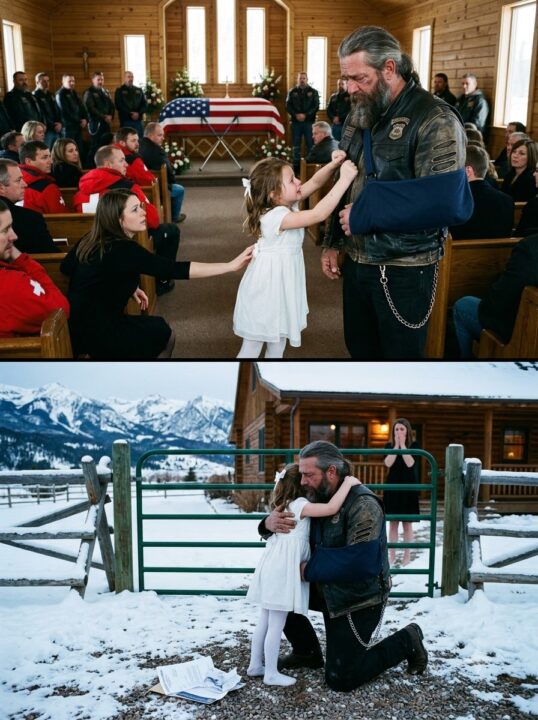
The white dress. The fists. The screaming.
You were supposed to watch him. You LEFT him.
Let me tell you about the end of it.
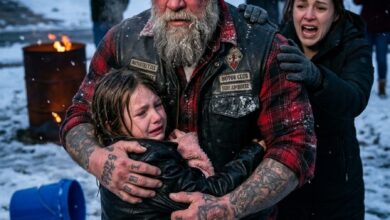
She hit me until she couldn’t anymore.
It took maybe a minute. Maybe two. It felt like a year.
Her punches got slower. Weaker. Her arms got heavy. She was sobbing so hard she couldn’t catch her breath.
Then she just stopped.
Her fists were resting against my chest. Her forehead dropped against my stomach.
And she slid down. Onto the chapel floor. In her white dress. At my feet.
She curled up and cried.
I went down on my knees.
My collarbone screamed. I didn’t care.
I put my good arm around her. Pulled her against me.
She let me.
For about five seconds, that little girl let me hold her. Her face buried in my jacket. Her small hands holding onto my shirt.
Then she remembered.
She pushed away from me. Hard.
Sarah was there. She’d gotten out of the pew. She picked Ivy up off the floor and held her.
She looked at me.
I’ll never forget that look. Not hate. Worse.
She didn’t know what to think.
She carried Ivy back to the front pew without a word.
Two hundred people stared at me.
Nobody understood.
Ski patrollers looked at each other. River guides shook their heads. Nate’s mother put her face in her hands.
My own club brothers along the back wall didn’t move. They didn’t know either.
Nobody knew what happened on that mountain except me.
Nate’s brother Chris shoved me against my truck after the service. I told you that.
His mother called me that night and asked me, crying, if Nate suffered.
I said no.
I didn’t tell her anything else.
The club president, an old Vietnam vet named Hollis Teague, came to my shop the next morning and sat on my workbench for an hour without saying anything.
Finally he said, “You want to tell me?”
“No,” I said.
He nodded. “Okay.”
He’s the only one who never asked me again.
Part 4
Ivy was eight. She didn’t know what happened either.
All she knew was what she heard the grown-ups saying.
Cy was riding in front.
Cy came home.
Nate didn’t.
To an eight-year-old, that only adds up one way.
Uncle Cy left her daddy behind.
And I never told her otherwise.
Not at the funeral. Not after.
People asked me. Over and over. Reporters from the Durango Herald. The State Patrol, during their interviews. Sarah, on the phone, two weeks after the funeral, with her voice breaking.
“Cy, please. Just tell me. Did he do something stupid? Was he going too fast? Did he—”
“No, Sarah,” I said. “He didn’t do anything wrong.”
“Then what HAPPENED?”
I couldn’t tell her.
Not yet.
Not like that.
So I went to the gate.
The day after the funeral, at six in the evening, I drove my truck out the gravel road to the log house in the Animas Valley.
I couldn’t ride. My collarbone. And my bike was gone. Impounded by the State Patrol for the investigation.
I parked on the road. I walked to the green metal gate at the end of the driveway.
I didn’t open it.
I just stood there.
I don’t know why I went. I didn’t have a plan. I just knew I couldn’t not go.
I’d promised Nate. Ivy duty.
If I couldn’t be inside that house, I’d stand outside of it.
The first evening, Sarah came out on the porch and looked at me for a long time. Then she went back inside.
The second evening, Nate’s brother Chris came out and told me to leave.
I left.
The third evening, I came back.
Every evening. Six o’clock.
Rain. Wind. The first snow on the San Juans in late September.
The pink curtain in Ivy’s second-floor window would move. She’d stand there. Watching me.
One evening, she opened the window and threw her shoe. A little purple sneaker. Missed me by ten feet.
I picked it up and set it on top of the gatepost.
The next morning, it was gone.
The next evening, there was a drawing tucked into the gate latch. Crayon. A stick figure with a beard and a big black X over him.
I folded it up and put it in my jacket pocket.
I still have it.
Day twenty, Sarah walked down the driveway. She stopped on the other side of the gate.
“Why do you keep coming?” she asked.
“Nate asked me to look after her.”
Sarah’s face crumpled.
“Then tell me,” she whispered. “Tell me what happened to him.”
I looked at her.
“The State Patrol will tell you,” I said. “Soon. I promise.”
“Why can’t YOU tell me?”
I didn’t answer.
She went back inside.
Forty days.
Part 5
On the forty-first day, October 23rd, Sarah got a manila envelope from the Colorado State Patrol.
Crash Reconstruction Unit. The final report on the fatal motorcycle collision on US Highway 160, Wolf Creek Pass, mile marker 160, September 3rd, 2012.
Forty-two pages.
She sat at her kitchen table and read every one.
She told me later she read it three times before she could understand it. And then she had to go outside and throw up.
I’ll tell you what was in it.
At 1:47 p.m., two motorcycles were descending the western grade of Wolf Creek Pass. A 2010 Harley-Davidson Road Glide, operated by Cyrus Holcomb, in front. A 2008 Harley-Davidson Street Glide, operated by Nathan Brennan, approximately two hundred feet behind.
At approximately 1:47:30, the front brake line fitting on the Holcomb motorcycle failed due to a pre-existing internal crack in the banjo fitting. Total loss of front brake hydraulic pressure.
On a seven-percent downhill grade, with only the rear brake functional, the Holcomb motorcycle began accelerating.
The rear brake, overloaded, overheated and began to fade within forty seconds.
By 1:48:15, the Holcomb motorcycle was traveling an estimated seventy-four miles per hour on a section of roadway with a posted speed of thirty-five, approaching a sharp right-hand curve with a guardrail and a three-hundred-foot drop.
Then the report described a dashcam video.
It came from a semi-truck. A driver named Raul Quintana, hauling lumber up the pass from Pagosa Springs in the uphill lane. His dashcam recorded everything.
I’ve watched it once. I’ll never watch it again.
On the video, you can see my Road Glide come around the curve above the runaway truck ramp. Too fast. Way too fast.
You can see me trying. Downshifting. Dragging my boots. Fighting the bars.
And you can see Nate.
Coming up behind me. Fast. Faster than I was.
He’d seen my brake light flickering. He’d seen me drifting wide. He’d figured it out.
He pulled out into the oncoming lane. The uphill lane. On the left side of me. To get past.
He pulled up beside me. Matched my speed. Seventy-plus.
And then he reached out across the gap between our bikes with his right hand and grabbed my left forearm.
He grabbed it and he steered me.
I remember it. I remember his glove clamping down on my sleeve. I remember him yelling something I couldn’t hear over the wind. I remember him pulling, hard, and my bike drifting right, toward the shoulder.
Toward the runaway truck ramp.
He was guiding me into it. A two-hundred-yard lane of deep loose gravel climbing uphill off the right side of the road. Built to stop eighty-thousand-pound semis.
He got me lined up with the entrance.
At the last second, he let go.
His fingers tore four long rips down my jacket sleeve as I pulled away from him.
I hit the gravel at sixty. The bike buried itself up to the axles in the ramp. I went over the bars and landed in the gravel. Collarbone. Ribs. Road rash.
Alive.
Nate was still in the uphill lane.
On the left side of the road. Going seventy.
Coming around a blind curve.
Raul Quintana’s semi came around it from the other direction.
Nate had maybe one second.
He didn’t have anywhere to go.
The report’s conclusion was one paragraph.
Mr. Brennan intentionally entered the opposing lane of travel in order to physically guide Mr. Holcomb’s disabled motorcycle to the runaway truck ramp. This action directly resulted in the survival of Mr. Holcomb. Mr. Brennan was unable to return to his lane of travel before the arrival of uphill traffic. In the professional opinion of this unit, Mr. Brennan’s actions were deliberate and lifesaving.
Sarah told me later that the last page of the report had a handwritten note paper-clipped to it.
From the trooper who’d led the investigation.
Ma’am, I have been doing this for nineteen years. I have never seen anything like what your husband did. I am so sorry for your loss. He was a hero. — Sgt. D. Ochoa
I’d known every bit of it since the moment I came to in the gravel.
I’d known why the sleeve was torn.
I’d known whose fingers did it.
And I’d chosen not to say a word.
Here’s why.
If I’d stood up at that funeral and said Nate died saving me, do you know what I’d have been saying?
I’d have been saying it was his choice.
I’d have been saying he chose me over going home to his wife and his daughter.
I’d have been telling an eight-year-old girl that her daddy picked Uncle Cy over her.
That’s not what happened. That’s not who he was. He didn’t choose me over them. He just did what he did. In one second. Without thinking. Because that’s the kind of man he was.
But I knew how it would sound coming out of my mouth. The only survivor. Explaining why the dead man’s death was the dead man’s decision.
It would sound like blame.
And he couldn’t argue back.
So I let them think it was my fault.
That, at least, was something I could carry.
Part 6
At six o’clock on the forty-first evening, I parked my truck on the gravel road and walked to the gate.
The front door of the log house burst open.
Ivy came out running.
White socks. No shoes. Across the porch. Down the steps. Across the frozen yard.
She had papers in her hand. I recognized the blue State Patrol letterhead.
Sarah was standing on the porch behind her, both hands over her mouth.
Ivy reached the gate.
She didn’t open it. She climbed it. Up the green metal bars. Swung her leg over the top. Dropped down on my side.
She stood in front of me. Out of breath. Her face red. Tears pouring down her cheeks.
She looked up at me.
Then she hit me.
One more time. One fist. Right in the middle of my chest. As hard as she could.
“Why didn’t you TELL me?” she screamed.
I didn’t answer right away.
She hit me again. Softer.
“Why didn’t you tell me Daddy saved you? Why did you let me hate you? WHY?”
I got down on my knees in the gravel. My collarbone was healing by then. It still hurt.
I looked at her.
“Because I didn’t want you to think your daddy picked me over you,” I said. “He didn’t, Ivy. He’d never. He just saw I was in trouble and he did what he always did. He didn’t stop to choose. He didn’t think about it.”
I swallowed.
“And I didn’t want to be the one who said it. Not when he’s not here to say it himself.”
She looked at me for a long time.
Then she looked down at my sleeve.
My jacket. The right sleeve. Four long parallel rips down the forearm.
She reached out with one small finger and traced them. One at a time.
“Is that where Daddy grabbed you?”
“Yeah.”
She traced them again.
Then she threw both arms around my neck and held on.
And she didn’t let go.
Sarah came down from the porch. She opened the gate.
She didn’t say anything. She just put her hand on my shoulder.
Then she said, “Come inside, Cy. Supper’s on.”
Part 7
I drove Ivy to school every day after that.
At first, because Sarah was working double shifts at the hospital and needed help. Then, because Ivy asked.
Animas Valley Elementary. Then Miller Middle School. Then Durango High.
Ten years. Every morning. Seven-fifteen. My truck at the end of the gravel road. Then, when she was fourteen and Sarah finally said yes, the back of my Road Glide.
I rebuilt it myself. With brake lines I checked every single week.
She wore Nate’s old helmet. It fit her by then.
We didn’t talk about the crash much. We didn’t need to.
But every year on Labor Day, we rode up Wolf Creek Pass together.
Slow.
At the runaway truck ramp, we’d pull over. Get off the bike. Walk out onto the gravel.
She’d stand where I landed.
I’d stand where he let go.
Then we’d ride back down.
This past May, Ivy graduated from Fort Lewis College in Durango. A degree in exercise science. She’s going to be a ski patroller at Purgatory this winter.
Like her dad.
The ceremony was outside on the lawn, with the La Plata Mountains still white behind it.
Sarah sat in the front row reserved for family. Nate’s mother beside her. Nate’s brother Chris.
And me.
Ivy put me there. She walked to the front of the family section that morning with a piece of paper and taped my name to the chair herself. In her handwriting.
UNCLE CY — FAMILY.
Chris sat down next to me. He didn’t say anything. He just put his hand on my shoulder for a second.
When they called her name, Ivy crossed the stage in her cap and gown and shook the president’s hand.
Then she turned and looked out at the crowd. Found Sarah. Waved.
Then she found me.
She held up her right fist.
I laughed so hard I had to cover my face.
After the ceremony, she came to find me on the lawn.
She had something in her hand. An old leather riding jacket. Mine. The one I hadn’t worn in years. I didn’t even know she’d taken it out of my closet.
The right sleeve. Four long rips down the forearm.
She held it up.
“I want this,” she said. “For when I start at Purgatory. For under my patrol jacket.”
I looked at it for a long time.
“It’s too big for you,” I said.
“Daddy’s helmet was too big for me once,” she said.
I handed it to her.
She put it on over her graduation gown. Right there on the lawn. The sleeves hung past her fingertips.
She ran her finger down the four rips. One at a time.
Then she looked up at me.
“He didn’t pick you over me,” she said.
“No.”
“He picked both of us.”
I couldn’t speak.
She hugged me.
And I let her.
👉 If this story stayed with you, follow our page for more stories from the road — and from the brothers who carry the truth until it’s safe to set down. 🏍️