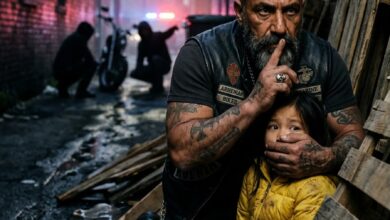
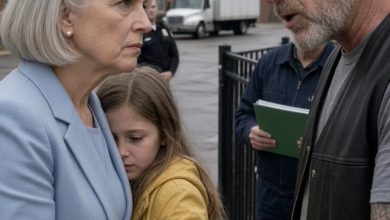
A 10-Year-Old Girl Smashed Her Own Living Room Window With A Chair At 2 A.M. — The Biker Across The Street Grabbed A Bat, Thinking It Was Burglars, Until He Heard The Coughing
Part 2
I need to tell you about the Vargas family. And about the house. And about a piece of paper I threw in the trash.
Elena Vargas moved into the bungalow across from me in the spring of 2022. Thirty-four. From Michoacán, by way of Los Angeles. Her husband had passed. Car accident on I-5. She came to Omaha because her cousin worked at the packing plant down on the river and said there was a job.
Night shift. Ten p.m. to six a.m. Cutting line.
She had two kids. Daniela, who everybody called Dani. Ten. And Leo. Six.
Elena’s cousin Marisol watched the kids at night, sleeping on the couch, until Elena got home. Then Marisol went home to her own family.
That was the routine.
The house belonged to a landlord who lived in Lincoln. Fifty miles away. He’d bought it in 2021 and done the minimum. New water heater in 2023, when the old one died. Burglar bars on every window except the big front picture window, because the bars were expensive and that window was the hardest to reach.
The front door had a double-cylinder deadbolt. The kind that needs a key on both sides. The landlord liked them. Harder to break into.
Harder to get out of, too.
Elena had a habit. Every night when she came home from the plant, she locked that deadbolt behind her with her key and put the key in her coat pocket.
There’d been three break-ins on our block that year.
She was protecting her kids.
I didn’t know any of that then.
What I knew was that their dog barked at my Harley every morning at eight. That their kids’ scooters ended up on my sidewalk. That the girl cut across my lawn every day on her way to Spring Lake Elementary.
That October, the girl knocked on my door.
I almost didn’t answer.
She was standing on my porch in her school uniform holding a stack of orange flyers.
“Hi, Mr. Gordy,” she said. “It’s Fire Prevention Week. We’re doing a project. I’m supposed to give these to my neighbors.”
She held one out.
Big black letters across the top.
GET LOW AND GO!
A cartoon of a kid crawling under a cloud of smoke. A list of rules. Smoke rises — stay low. Have two ways out. If a door is blocked, use a window. Check your smoke alarms. Check your carbon monoxide alarms.
“A firefighter came to our school,” she said. “Captain Lund. She said everybody should know this.”
I took it.
I said, “Thanks.”
I closed the door.
I threw it in the kitchen trash.
I’m telling you that so you understand.
That girl tried to teach me how to save my own life.
And I threw it in the garbage.
That night in January, Elena came home from the plant at 1:15 a.m. Marisol went home. Elena locked the deadbolt. Put the key in her coat. Hung the coat in the hall closet.
She was so tired she fell asleep on the couch in her work clothes.
Leo was in the bedroom he shared with Dani. Dani was asleep in the bottom bunk.
In the utility closet off the kitchen, the gas water heater was running.
The landlord had installed it in 2023. A Brightwell. Fifty gallons. It had a defect nobody in that house knew about.
A part inside it, the part that carries the exhaust from the gas burner up and out the vent pipe, could crack. And when it cracked, the exhaust didn’t go up the vent anymore.
It went into the house.
Carbon monoxide.
No color. No smell. No taste.
That night, it had been leaking for hours.
Part 3
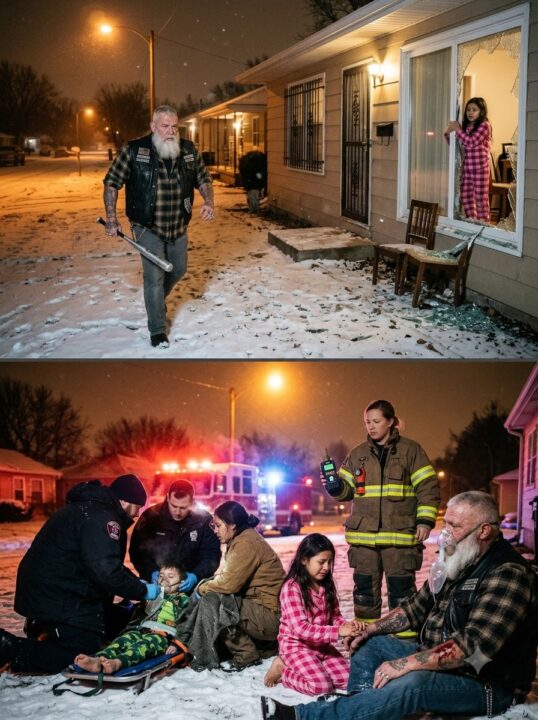
At 2:07, I ran across 21st Street with my bat.
You know that part.
The girl at the window. Running back inside. The coughing.
I dropped the bat. I kicked out the rest of the glass. I put my head through.
The headache hit me instantly.
I’d felt something like it once before. Thirty years ago in a locomotive cab with a cracked exhaust manifold, where two of us got sick before anybody figured out why. It’s a pounding behind your eyes. Like your skull’s too small.
The air in that house was wrong. Heavy. Stale. Hot.
I knew.
“CARBON MONOXIDE!” I yelled back at the street. “CALL 911! TELL ‘EM CARBON MONOXIDE!”
Mrs. Hernandez was already dialing.
I climbed through the window. Glass cut my hands. My forearm. I didn’t feel it.
The living room was dark. One lamp on in the corner.
On the carpet, right under the broken window, lying on her side, was Elena Vargas.
Still in her packing plant clothes. A hairnet still in her pocket. Unconscious. Her face pale. Her lips wrong.
She was lying with her head right at the hole in the glass. Cold air pouring in over her face.
Somebody had dragged her there.
From the hallway, I heard the dragging sound again.
I went toward it. Bent over. Dizzy. My knees didn’t want to work.
Halfway down the hall, I found them.
Dani. On her knees on the carpet. Pink pajamas. Coughing so hard she was gagging. Crying. Pulling her little brother by both wrists, walking backward on her knees, an inch at a time, dragging him across the hallway carpet toward the living room.
Leo was limp. Six years old. Dinosaur pajamas. Eyes closed. His head bumping softly along the carpet.
She looked up at me.
The mean old man from across the street.
“Help me,” she said. “Please. He won’t wake up. Mama won’t wake up.”
I picked him up.
My vision was going gray at the edges. I could feel my heart pounding wrong.
I got my other arm around Dani.
I carried them both down that hallway to the broken window. I don’t know how. I’m sixty-one. I’m not a young man.
I pushed Leo through the window to the two college kids from the duplex, who’d run across the street and were standing in the snow with their arms out.
I pushed Dani out after him.
Then I went back for Elena.
I couldn’t lift her.
I tried. I got her under the arms. My legs folded. I went down on my knees beside her.
The room was spinning.
I remember thinking: This is how it happens. This is how you go. You just get tired.
Then hands. Big ones. Grabbing me under the arms. Hauling me backward through the window frame into the cold.
Mr. Hernandez. Sixty-eight. In his undershirt and boxer shorts in seven degrees. And behind him, his son, pulling Elena out after me.
We all ended up in the snow on the front lawn.
I lay on my back in the snow, sucking in freezing air, staring up at the streetlight.
Leo wasn’t moving.
One of the college kids was kneeling over him. Doing chest compressions. Counting out loud. Crying while she did it.
Dani was on her knees beside her brother in the snow in her bare feet, holding his hand, screaming his name.
Elena was breathing. Barely. Moaning.
Leo wasn’t.
I heard sirens.
Part 4
The Omaha Fire Department got there in six minutes. An engine and two ambulances.
A paramedic pushed the college kid aside and took over Leo. Oxygen mask. Bag. The second paramedic went to Elena.
A third came to me and Dani. Put oxygen masks on both of us.
Dani pulled hers off.
“Is Leo okay? Is my brother okay?”
Nobody answered her.
Then Leo coughed.
A small, wet cough. Under the oxygen mask.
Then he cried.
Dani made a sound I’ll never forget. She fell forward in the snow and put her face against her little brother’s chest and sobbed.
A fire captain walked into that house with a gas meter. A handheld device. Beeping.
She came back out a minute later and pulled off her mask.
Captain Teresa Lund. Omaha Fire. Twenty-two years.
She looked at the meter. Then at the paramedics.
“Four hundred and sixty parts per million in the hallway,” she said quietly. “Higher in the back bedroom.”
I didn’t know what that meant.
The paramedic did. His face went still.
Captain Lund knelt down next to Dani in the snow. She looked at her for a long time.
“I know you,” she said. “Spring Lake Elementary. Fire Prevention Week. You asked me the most questions of anybody.”
Dani nodded. Shivering under a blanket.
“Tell me what happened, sweetheart.”
Dani told her.
She’d woken up at about two with the worst headache of her life. She threw up on the floor by her bunk bed. Leo was in the top bunk. She tried to wake him. He wouldn’t wake up. He just mumbled.
She went to get her mom.
Her mom was on the couch. Dani shook her. Elena opened her eyes. Couldn’t focus. Said Dani’s name like she was underwater. Then closed her eyes again.
Dani knew something was wrong. She didn’t know what.
She tried the front door. Locked. The deadbolt needed a key. She didn’t know where the key was.
She tried the back door off the kitchen. It sticks in winter. Swollen. She couldn’t budge it.
She tried the windows. Every one had iron bars.
Except one.
“How did you know to break it?” Captain Lund asked.
“You said,” Dani whispered. “At school. If the door’s blocked, use a window.”
“And why so low? Why at the bottom?”
“You said smoke goes up,” Dani said. “Get low. So the bad air is up high. So I broke the bottom. So Mama and Leo could breathe on the floor.”
Captain Lund didn’t say anything for a moment.
Then she explained something to me, later. Quietly. Away from Dani.
“What I taught them is for smoke,” she said. “Smoke is hot. It rises. You crawl under it. Carbon monoxide doesn’t work like that. It mixes into the whole room. Floor to ceiling.”
She shook her head.
“But she didn’t know that. She just did what she remembered.”
She looked over at Dani, wrapped in a blanket in the back of the ambulance, holding her brother’s hand.
“And it worked anyway. Because she broke the window right where she was going to put them. Right where their faces were. The fresh air came in at the floor, and she dragged them to it.”
She was quiet.
“Most adults would have broken the middle of the window and stood there breathing. She broke it where her family was.”
Then Captain Lund asked one more question.
“How long were you dragging them, Dani?”
Dani thought about it.
“Mama first,” she said. “She was on the couch. I rolled her off onto the floor and pulled her by her arms. It took a long time. She’s heavy.”
“Then?”
“Then I went back for Leo. He was in the top bunk. I had to pull him down. He fell on me.”
She looked at her hands.
“Then I was pulling him down the hall when Mr. Gordy came.”
Part 5
They took all three of them to the Nebraska Medical Center. And me.
Elena and Leo went into the hyperbaric chamber. A big pressurized tube that forces oxygen into your blood fast, to push the carbon monoxide out. Leo first. He was the worst.
Dani and I sat in the waiting room in hospital gowns with oxygen tubes in our noses.
I had seven stitches in my forearm from the window glass.
She had little cuts all over her bare feet.
Neither one of us said anything for a long time.
At five-thirty in the morning, a doctor came out. Dr. Anjali Rao. Emergency medicine.
She sat down across from us.
“They’re going to be okay,” she said. “Both of them. Elena’s awake. Leo’s awake. He asked for pancakes.”
Dani started crying.
Dr. Rao waited. Then she looked at me.
“Their carbon monoxide levels were very high,” she said. “Leo’s especially. Children breathe faster. They absorb it faster.”
She paused.
“If he’d been in that house another fifteen minutes, I don’t think we’d be having this conversation.”
She looked at Dani.
“Fifteen minutes. Your sister bought him that.”
I asked Dani later, in that waiting room, why she didn’t just run out the window herself after she broke it. She could have. She was at the window. She was breathing. She could’ve climbed out into the snow and been safe.
She looked at me like I’d asked the dumbest question in the world.
“Because Mama and Leo were still inside,” she said.
The fire department pulled the water heater out of that house that week.
The crack was right where Captain Lund said it would be. In the part that carries the exhaust. Hairline. Inside the unit. You’d never see it.
She looked up the model number.
There was a recall.
Brightwell had issued it eight months earlier. That May. Draft hood assembly may crack, allowing combustion gases including carbon monoxide to enter the living space.
Eight months.
Elena had never heard of it.
The recall notice went out by email. Only by email. To whoever had registered the heater’s warranty when it was installed.
In this case, the installer had registered it with an email address for the landlord. An old address he hadn’t checked in years.
Elena didn’t even have an email account. She had a prepaid flip phone. She used it to call her cousin and her kids’ school.
Nobody had ever sent a letter. Nobody had ever called.
Captain Lund kept digging.
She requested records from Brightwell. They dragged their feet. She went through the Omaha permit office instead. Every gas water heater installed in the city for the past three years has a permit with a model number.
It took her two weeks.
Three hundred and forty homes in Omaha had a recalled Brightwell water heater.
Three hundred and forty.
Most of them rentals. Most of them on the south side and the north side. Families with landlords who lived somewhere else. Families who’d never gotten an email because the email didn’t go to them.
Three hundred and forty families sleeping next to a part that might crack any night.
Part 6
I told the club.
The Missouri River Riders meet every Tuesday at a VFW hall on L Street. Thirty-some members. Mostly retired. Railroad men, packing plant men, a couple of Air Force guys from Offutt.
I stood up at the meeting and told them everything. The window. The chair. The dragging.
Then I took a crumpled orange piece of paper out of my jacket pocket.
I’d gone home from the hospital, dug through my kitchen trash, and found it. Coffee-stained. Folded. Still there.
GET LOW AND GO!
I held it up.
“That little girl gave me this in October,” I said. “I threw it away.”
Nobody said anything.
“She kept her family alive with what’s on this piece of paper,” I said. “Three hundred and forty families out there don’t even know they need it.”
Captain Lund had a list. Three hundred and forty addresses.
The fire department had eleven firefighters who could volunteer on their days off.
That’s not enough to knock on three hundred and forty doors.
The Missouri River Riders had thirty-four.
We did it in February. In the snow. Three weeks.
Two-person teams. One firefighter, one biker. Every address on the list.
We knocked. We explained. In English. In Spanish, because half our club is Mexican-American and the other half learned enough. In Vietnamese, because Captain Lund found a firefighter who spoke it. In Somali and Karen and Nepali with phone translation apps, because Omaha’s south side is full of families from everywhere.
We checked every water heater.
We handed out free carbon monoxide alarms. The club bought them. Four hundred of them. Ninety-two dollars a box of four at the Menards on 72nd Street. We cleaned them out.
Three hundred and forty homes.
Three weeks.
Eleven heaters were already leaking.
Eleven.
In one of them, on Q Street, a grandmother had been having headaches for a month. She thought it was her blood pressure. Her CO alarm went off the second we plugged it in.
In another, on North 30th, a family with a newborn baby. Twins. Three weeks old.
Eleven families who’d have gone to sleep one night and maybe not woken up.
The Nebraska Attorney General got involved after that. Then the Consumer Product Safety Commission. Captain Lund testified in Lincoln.
Brightwell changed its recall process. Now, by law, every safety recall on a gas appliance sold in Nebraska has to go out by mail. Paper. To the address where the appliance is installed. Not just the registered owner. And they have to make a phone call.
Every heater on that list was replaced. Free.
In March, the mayor of Omaha gave Dani Vargas a Certificate of Commendation for Heroism. At City Hall. In front of television cameras.
She wore a dress Elena bought her at Target. She brought Leo. Leo brought a dinosaur.
When they called her name, she walked up to the podium. She was so small she couldn’t see over it.
She stood on her tiptoes.
“I just did what Captain Lund said,” she said into the microphone.
Then she sat down.
Captain Lund cried. I saw her.
Part 7
That was a year and a half ago.
I’m not the same neighbor anymore.
The Vargas family moved out of that rented bungalow a month after the fire. The landlord didn’t fight it. They found a little house on South 22nd Street.
One block over.
Dani still cuts across my lawn every day on her way to school.
I’ve told her I’ll yell at her if she ever stops.
Leo’s seven now. He comes over on Saturday mornings and sits on the seat of my Sport Glide in the garage and makes engine noises. The dog still barks at my bike. I bought it a chew toy shaped like a motorcycle. It ignores it and keeps barking.
Elena brings me tamales at Christmas. I bring her a new carbon monoxide alarm battery every January.
Every October, during Fire Prevention Week, Dani goes door to door on our block handing out orange flyers.
She knocks on my door first.
Every year.
She holds one out.
GET LOW AND GO!
And every year, I take it from her, and read every word, out loud, right there on my porch, while she stands and watches to make sure I do.
Then I tape it to my refrigerator.
Next to the first one. The coffee-stained one. The one I dug out of the trash.
There are two up there now.
Last week, at two in the morning, I was on my porch with my coffee.
I heard a chirp.
A high, single beep. From my own kitchen.
My carbon monoxide alarm. Low battery.
I got up. I went inside. I changed the battery.
Then I stood in my kitchen, under the light, looking at those two orange flyers on my refrigerator for a long time.
Then I went back out to the porch, sat down, and watched the street.
The Vargas house, one block over, dark and quiet.
Everyone inside it breathing.
👉 If this story stayed with you, follow our page for more stories from the road — and go check your carbon monoxide alarm tonight. It takes thirty seconds. 🏍️