Part 2: A Tattooed Biker Sat Through a Three-Hour Spa Day Run by His Five-Year-Old — Then His Brothers Learned Why He Refused to Remove the Cucumber Slices
Part 2 — The Sign on My Garage Door
Caroline used to say I could rebuild anything except a quiet afternoon.
A stripped bolt did not scare me. Neither did a damaged transmission, a warped frame, or an electrical fault buried behind three layers of another mechanic’s bad decisions. Give me a problem made of metal and I could normally find where it had failed.
Grief had no failed bearing.
It had no wiring diagram.
Eight months after Caroline died, I still woke at 4:40 each morning and reached toward her side of the bed before memory caught up. Then I made coffee strong enough to taste through regret, packed Ellie’s lunch, fought with her hair, and opened Kane Custom Motorworks by seven.
From outside, it probably looked as if I had handled the transition well.
The child arrived at kindergarten on time. The bills were paid. The house remained standing. I learned which detergent did not make Ellie’s skin itch and which grocery store placed dinosaur-shaped chicken nuggets on sale every third Thursday.
Inside our home, everything waited for Caroline.
Her yellow raincoat remained near the back door. Her chipped blue mug sat above the coffee maker. A half-finished grocery list stayed beneath a magnet shaped like Memphis. I could remove an engine from a touring bike in two hours, but I could not move that piece of paper.
Ellie noticed.
Children always notice the things adults believe they have hidden.
She began asking permission for ordinary sounds. Could she turn on a cartoon? Could she drop wooden blocks onto the floor? Could she laugh at the dog next door chasing a sprinkler?
The first time she asked that last question, something inside me shifted.
“You don’t need permission to laugh,” I said.
She nodded.
But she did not laugh.
Caroline had been the noise in our family. She sang while loading the dishwasher, invented songs about missing shoes, and narrated grocery trips as if we were crossing hostile territory. I loved her because she was unafraid of silliness, and she loved me because I had spent most of my life terrified of it.
Before Caroline, I had been good at two things: motorcycles and anger.
At twenty-four, I broke a man’s jaw with a wheel wrench after he shoved my younger brother outside a roadside bar. The man survived. My excuses did not. I served six years in prison for aggravated assault and came home to find that my brother had joined the Army, my mother had sold our house, and most of my old riding friends had discovered that loyalty becomes flexible when visiting hours start.
Rook was the exception.
He rode 170 miles every second Sunday to sit across from me beneath fluorescent lights. Sometimes we talked. Sometimes we watched guards move along the wall.
When I got out, Rook helped me find work at a repair shop. We later opened Kane Custom Motorworks together, although he refused to put his name on the building.
“You do the talking,” he said.
“I don’t talk.”
“Exactly. Customers like mystery.”
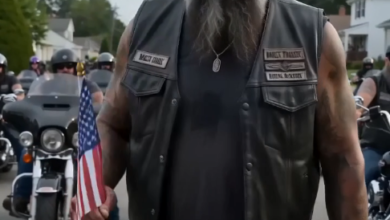
The Iron Harbor Riders grew around that shop. We were not saints, and I never pretended otherwise. Some members were veterans. Some were welders, nurses, mechanics, truck drivers, and men carrying histories that made respectable people nervous.
We also delivered groceries during floods, paid motel bills for displaced families, and sat outside hospitals when somebody had no one else.
Caroline met me at one of those hospitals.
She taught second grade at Cumberland Ridge Elementary. A student’s father had been injured in a warehouse collapse, and eight Iron Harbor riders spent the night repairing his family’s leaking roof before the next storm arrived.
Caroline showed up with sandwiches.
She looked at my tattoos and asked whether the cracked compass on my forearm was supposed to point somewhere.
“It used to,” I said.
“That is the saddest answer I’ve ever heard from a man holding a turkey sandwich.”
She laughed.
I married her eighteen months later.
When Ellie was born, Caroline caught me standing beside the hospital bassinet afraid to touch our daughter. My hands looked too large. My knuckles carried the words I had tattooed after prison—STAY HOME—as a reminder, not an instruction.
Caroline placed Ellie against my chest.
“She isn’t made of glass,” she said.
“I know.”
“No, you don’t.”
She was right.
For five years, Ellie kept teaching me the same lesson. She painted my nails before club runs. She placed stickers on my helmet. Once, she clipped twelve plastic butterflies into my beard while I slept and then cried when I tried to remove them.
So I rode to the shop wearing butterflies.
Nobody laughed twice.
Still, after Caroline died, I became harder without intending to. I mistook routine for protection. I answered pain with schedules, lunches, clean clothes, and closed garage doors.
Then came the spa.
That Saturday, Ellie carried Caroline’s old tablet into the kitchen and watched a woman in a white robe mix a simple facial mask from oats, cocoa, yogurt, and honey. The woman placed cucumber slices over her eyes while her daughter painted her fingernails.
Ellie replayed the video four times.
“Daddy, I’m opening a business.”
I was adjusting the chain on Caroline’s old bicycle. “What kind?”
“A spa.”
“We don’t have a spa.”
“We have a garage.”
I looked at her. “Garages are for motorcycles.”
“And spas.”
She said it with the confidence of somebody who had never signed a commercial lease.
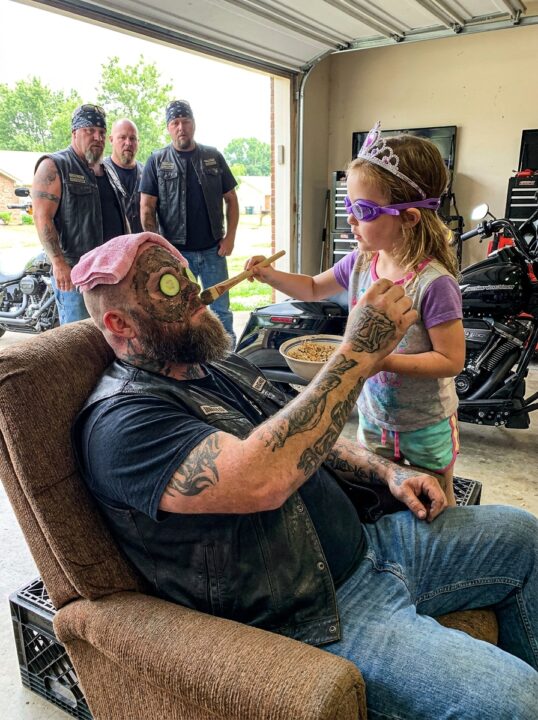
By ten, she had transformed the back half of my garage. A beach towel covered my old recliner. Caroline’s portable speaker played whale sounds interrupted every few minutes by an advertisement for discount car insurance. A cereal bowl held her mud mask. Two cucumber slices floated in a plastic cup of water.
The sign taped outside read:
ELLY ROYAL ROD SPA
Beneath that, in smaller letters:
ONE CUSTMER. VERRY IMPORTANT.
“You spelled Ellie wrong,” I said.
“It’s the business spelling.”
“Understood.”
She pointed at the chair. “Sit.”
My phone vibrated.
Rook’s name appeared above a message about City Hall. I knew the permit meeting had been moved. I also knew how difficult it had been to get the mayor, police chief, and three council members into one room.
I placed the phone facedown.
Then I sat.
Part 3 — The Most Expensive Appointment I Never Paid For
At first, I thought the spa would last fifteen minutes.
Children have short plans. They announce a restaurant, serve you one plastic egg, charge seventeen invisible dollars, and close for the day because the owner has found a cardboard box.
Ellie had prepared a schedule.
She unfolded three sheets of printer paper taped together and showed me a series of drawings. The first depicted my face beneath cucumber slices. The second showed my beard filled with purple lines. The third showed us drinking something beside a crooked clock.
“What are the purple lines?”
“Beard conditioner.”
“We don’t own beard conditioner.”
She held up a bottle of Caroline’s detangling spray.
“No.”
“It smells like apples.”
“Still no.”
She narrowed her eyes. “Do you want the regular package or VIP?”
“What’s the difference?”
“VIP doesn’t complain.”
I chose VIP.
At 11:03, she wrapped a pink towel around my shoulders. At 11:07, she applied the first mud mask. At 11:12, the cucumber slices went over my eyes.
Then she began asking questions.
“Do motorcycles get tired?”
“Yes.”
“Where do they sleep?”
“In garages.”
“Does your motorcycle miss Mommy’s motorcycle?”
Caroline had ridden a red Softail before Ellie was born. After becoming pregnant, she stopped riding but refused to sell it. The motorcycle remained beneath a canvas cover at the rear of my shop.
“I think it does,” I said.
“Do you?”
The garage became quiet except for artificial whale sounds and the distant tick of an impact wrench cooling on my workbench.
“Yes.”
Ellie dabbed more mud onto my chin.
“Me too.”
That was the first time she had said those words without immediately changing the subject.
At 11:26, someone knocked on the side door. Ellie ignored it. At 11:31, my phone vibrated on the workbench. At 11:39, a motorcycle entered the driveway.
I recognized Rook’s Road King by the slight unevenness in its idle. He had refused to let me correct it because the sound reminded him of his father’s old shovelhead.
The engine stopped.
Boots crossed the driveway.
Rook opened the garage door without knocking. Behind him stood Mateo “Saint” Alvarez, our road captain, and Jo Kessler, an emergency-room nurse who rode a dark green Street Glide and had more authority in our club than most men admitted.
They said nothing at first.
I couldn’t see them, but silence has weight. This one weighed at least 800 pounds.
“Grinder,” Rook finally said.
“Rook.”
“What happened to your face?”
“Premium treatment.”
Ellie tapped my shoulder. “VIP.”
“VIP treatment,” I corrected.
Saint made a choking sound that might have been a laugh. Jo told him to grow up, although I could hear amusement in her voice.
Rook did not laugh.
“The mayor moved the permit meeting to twelve-thirty.”
“I got the message.”
“We need to leave now.”
“Can’t.”
The word landed badly.
For seven years, the Caroline Kane Memorial Ride had raised money for local families facing sudden medical emergencies. Caroline started it after one of her students’ parents lost both legs in a factory accident. She spent months negotiating with businesses, churches, and riders who did not normally share parking lots.
After she died, the club put her name on the ride.
I had opposed it.
They outvoted me.
That year’s route was supposed to bring 600 motorcycles through Clarksville and end at the fairgrounds. Two neighborhoods had complained about noise. A council member called the event “an intimidating occupation of public roads,” and the city considered denying our permit.
My presence mattered because I knew every part of the safety plan.
It also mattered because Caroline’s name was on it.
Rook stepped closer. Leather creaked.
“Get up.”
Ellie’s hand stopped on my forehead.
I lifted one cucumber slice. Rook stood six feet away, arms folded over his cut, gray ponytail wet from mist. His face held the expression he used before telling a prospect to pack his belongings.
Behind him, Jo watched Ellie.
“I’m in the middle of something,” I said.
“This ride pays rent. It covers prescriptions. People are counting on it.”
“I know.”
“Then get up.”
Ellie climbed down from the milk crate.
The wooden brush trembled in her fingers. A drop of brown mask landed on the concrete.
“I can close,” she whispered.
That broke something open in me.
Not because she sounded disappointed. Because she sounded prepared.
At five years old, Ellie had already learned that her plans were the plans adults abandoned first. My calls came first. Broken motorcycles came first. Riders came first. Caroline’s medical appointments had once come first for good reason, and after Caroline died, almost every interruption felt important enough to become an excuse.
Ellie began folding the towel.
I covered my eye again with the cucumber slice.
“No,” I said. “The spa stays open.”
Rook’s voice lowered. “You’re choosing this?”
I understood the question beneath his question.
After prison, Rook had chosen me. When the bank rejected our first shop loan, he mortgaged his house without telling his wife until the papers required her signature. When Caroline collapsed, he reached our kitchen before the ambulance and carried Ellie outside so she would not see the paramedics stop working.
He had never asked me to repay those things.
Now he asked me to stand beside him.
“Yes,” I said. “I’m choosing this.”
Rook walked out.
Saint hesitated, then followed. Jo remained.
She knelt beside Ellie and examined the mixture.
“Oats, yogurt, cocoa, honey?”
“And water.”
“Any soap?”
“No.”
“Anything from the garage?”
Ellie looked offended. “Garage stuff is dirty.”
Jo nodded. “Approved.”
She rose and lowered her voice near my chair.
“Rook thinks you’ve stopped caring.”
“He’s wrong.”
“Then why not explain?”
“Because if I explain in front of her, she’ll think she needs a tragic reason for me to stay.”
Jo considered that.
“Who has your presentation?”
“Blue folder in the right saddlebag.”
“You planned for this?”
“I planned for Rook to lead the meeting.”
“Did you tell Rook?”
“I told him Thursday.”
“He thought you were testing him.”
“I was trusting him.”
“With you two, those look similar.”
She took the folder and left.
At 12:41, more motorcycles arrived.
The riders had heard that Rook and I had fought. Rumors improve with distance. By the time twelve Iron Harbor members stood in my driveway, the story claimed Rook had demanded my resignation while Ellie held me captive with facial products.
One prospect raised his phone.
I removed a cucumber slice.
“If that camera comes up, you’ll clean every oil pan in the shop with a toothbrush.”
The phone disappeared.
Unfortunately, a neighbor across the street had already taken a picture.
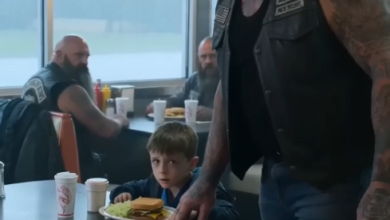
In the image, I sat motionless beneath the pink towel, face covered in mud, cucumber slices over my eyes. Ellie stood beside me holding the brush while a line of tattooed bikers watched from the driveway.
The neighbor posted it with an innocent caption:
I don’t know what’s happening at the biker house, but the tiny lady appears to be in charge.
Within an hour, the photograph had been shared across Clarksville.
Some people laughed. Some thought the club was hazing me. One man wrote that I had surrendered my dignity. Another claimed the scene had been staged for attention.
I did not see any of it.
At 1:04, Ellie began “beard relaxation.” She used a wide-toothed comb and apple detangler despite our earlier agreement. At 1:22, she served lukewarm water in Caroline’s blue mug with one cucumber floating inside.
At 1:37, the bicycle bell rang.
I started to stand.
“Not finished,” she said.
“You rang the bell.”
“That was the halfway bell.”
I checked the clock.
We had been there two and a half hours.
My lower back ached. The mud had dried tight around my mouth. The cucumber slices were warm. I had to use the bathroom, City Hall had not called, and twenty riders were now gathered outside pretending not to watch.
“Thirty more minutes,” Ellie said.
“Why three hours?”
She looked toward Caroline’s tablet.
“Because that’s how long the lady stayed.”
I assumed she meant the woman in the video.
I was wrong.
Part 4 — The Eleven Seconds Caroline Left Behind
At 1:49, Rook returned from City Hall.
I heard his Road King enter the driveway alone. The other riders moved aside, and the garage became quiet again.
His boots stopped beside my chair.
“Well?” I asked.
“The permit passed.”
I lifted both cucumber slices.
Rook looked furious.
Not relieved. Not proud. Furious.
“You knew it would.”
“I knew you could handle it.”
“The council changed the questions.”
“You had Jo.”
“The police chief challenged our emergency plan.”
“You wrote the emergency plan.”
“The mayor wanted the club president.”
“The club vice president was there.”
Rook’s jaw tightened.
He had worn the same black cut for twenty-two years. The leather around his shoulders had softened with rain and use, but that afternoon it looked rigid enough to hold him upright.
“This wasn’t trust,” he said. “You just didn’t want to go.”
“That too.”
His eyes moved toward Ellie. She was stirring the last of the mask and pretending not to listen.
Rook lowered his voice. “Caroline built that ride.”
“I remember.”
“Then act like it matters.”
The words hit harder than he intended.
Or perhaps exactly as hard.
I stood too quickly. The pink towel fell from my shoulders. Dried mud cracked along my cheeks and dropped onto my shirt. Twenty riders shifted in the driveway.
Ellie backed away.
That stopped me.
Rook saw it too. His anger left first, followed by mine.
We had both reverted to older versions of ourselves—two men who believed the person raising his voice last had won.
I sat again.
“The appointment isn’t over,” I said.
Rook looked toward Ellie.
“How long?”
“Eleven minutes,” she answered.
He dragged a mechanic’s stool across the concrete and sat opposite me.
No apology. No speech.
That was how men like us repaired the first inch.
At 2:00, Ellie rang the bell three times.
“Spa closed!”
The riders outside applauded. Saint revved one motorcycle until Jo smacked the back of his helmet. Ellie’s laugh escaped before she could stop it.
One sharp burst.
Then another.
Her shoulders rose. She covered her mouth with both hands, but the sound had already filled the garage.
I had not heard it since Caroline’s funeral.
Everything inside me went still.
Ellie laughed at the mud cracking from my beard. She laughed at the cucumber slice stuck to my neck. She laughed because Rook had placed the pink towel over his head and announced that he wanted the “angry old man discount.”
I lowered my face.
Not because I was ashamed.
Because fifty-four-year-old men with STAY HOME tattooed across their knuckles are allowed to need a moment, and sometimes the safest place to take one is behind a child-sized towel.
Rook noticed. He looked away.
Ellie brought me a damp washcloth, but before I could clean my face, she took Caroline’s tablet from the workbench.
“The lady says customers have to watch the ending.”
She opened the spa video.
It began as I remembered: a woman in a white robe showing viewers how to mix an inexpensive mask. Her little girl painted her nails. Soft music played beneath the instructions.
At the 14-minute mark, the tutorial ended. A list of suggested videos appeared.
Ellie tapped the screen twice.
The image changed.
Caroline appeared.
She sat on the old red Softail inside our garage, thinner than I remembered but smiling directly into the camera. A blue scarf covered her hair.
My body forgot how to breathe.
The recording had been made during her treatment for breast cancer three years earlier. Caroline had beaten that cancer. Her later aneurysm had been sudden and unrelated, which felt like the kind of joke the universe should not be allowed to tell.
During chemotherapy, Caroline sometimes recorded short messages for Ellie. We had watched them together after her death. I thought I had found every one.
This clip was only eleven seconds long.
Caroline lifted two cucumber slices to her eyes.
“If Daddy gets his storm face,” she said, “open the silly spa. He’ll say no. Charge him extra.”
Then the clip ended.
Nobody in the garage spoke.
Ellie replayed it.
“If Daddy gets his storm face, open the silly spa. He’ll say no. Charge him extra.”
She looked at me.
“You didn’t say no.”
“No.”
“So you don’t have to pay extra.”
“Good business.”
She smiled, but her eyes remained serious.
“Did it fix your storm face?”
That was the question Caroline had left behind.
I could have told Ellie that faces are easier to fix than the weather behind them. I could have said a mud mask could not bring her mother into that garage or return eight months of swallowed laughter.
Instead, I reached for her.
She climbed onto my lap without caring that wet mud covered my shirt. Her arms locked around my neck, small and determined.
“It helped,” I said.
Her cheek rested against the tattooed chain around my throat.
“I made the spa for you,” she whispered.
There it was.
I had assumed she wanted to copy a video. I believed she needed a distraction and I was playing along because fathers are supposed to make time for childish things.
Ellie had seen Caroline’s hidden clip weeks earlier.
She had watched me sit alone in the garage after putting her to bed. She had noticed the meals I forgot to eat, the light burning beneath the door at midnight, and the way I touched the patch inside my vest before each ride.
She had waited until she found the right tutorial.
Then she built the whole thing for me.
The backward sign. The washers. The brown mask. The three-hour schedule.
Especially the three hours.
During Caroline’s cancer treatment, each infusion had lasted close to three hours. Ellie had been two, too young to visit the treatment room, but she remembered Caroline describing it as “Mommy’s long spa where medicine teaches my body to fight.”
Caroline came home after those appointments exhausted. I would sit beside her, hold a cold cloth across her eyes, and remain until she fell asleep.
Ellie had rebuilt that memory from fragments.
Now she was asking me to let somebody stay beside me.
Rook stood and walked toward the garage door.
“Where are you going?” I asked.
“To get in line.”
He removed his cut, folded it over a toolbox, and sat in the chair I had vacated.
Ellie looked at him.
“Are you VIP?”
“No.”
“Why?”
“I complained.”
“That costs two dollars.”
Rook emptied his pockets onto the coffee-can register: six quarters, three bolts, a pocketknife, and the key to his Road King.
Ellie selected two quarters.
“Sit still.”
Within twenty minutes, the vice president of the Iron Harbor Riders had yogurt and oatmeal drying across his forehead.
Then Saint wanted a turn.
Then Jo.
By 3:30, fourteen motorcycles lined the street while their riders waited outside a garage spa run by a five-year-old. Some were there to support Ellie. Some wanted to repair the fracture between Rook and me. Most would have denied enjoying themselves.
The photograph that spread through Clarksville changed.
Now it showed Rook in the pink towel while I stood behind Ellie holding the cereal bowl. A dozen tattooed bikers waited along the wall, pretending to inspect tools.
The caption beneath the new image read:
Apparently the tiny lady has expanded.
That one traveled farther.
But the photograph did not show the tablet resting on my workbench.
It did not show Caroline’s eleven-second message.
And it could not show what three hours had returned to our garage.
Sound.
Part 5 — What the Club Thought I Had Chosen
The permit meeting should have ended the conflict between Rook and me.
It did not.
Two days later, he placed the City Hall folder on my desk and closed the shop door.
“You should have told me,” he said.
“I did tell you.”
“You said, ‘You lead Saturday.’ I thought you meant the presentation.”
“I did.”
“You didn’t say you wouldn’t be there.”
“I didn’t know about the spa.”
“That isn’t the point.”
He was right, which made the conversation more difficult.
Rook had spent years believing that being second meant being available whenever I chose to disappear. I had trusted his ability but ignored the burden of making him prove it without warning.
Caroline used to call that one of my hidden forms of control.
“You don’t ask people to lead,” she once told me. “You drop the weight and see who catches it.”
I told Rook this.
He leaned against the office wall and considered it.
“She said that?”
“Many times.”
“Smart woman.”
“She married me.”
“Everybody makes one bad decision.”
I almost smiled.
Then he asked the question he had carried since Saturday.
“If the permit had been denied, would you still think staying in that chair was worth it?”
“Yes.”
His face hardened again.
I did not soften the answer.
“The ride matters,” I said. “Those families matter. You matter. But Ellie watched her mother disappear in one morning. Since then, every time my phone rings, she watches to see if I disappear too.”
Rook looked through the office window toward the garage. Ellie’s cardboard spa sign still hung crookedly on the wall.
“I didn’t see that,” he said.
“Neither did I.”
For years, the Iron Harbor Riders had used the phrase brotherhood first as if it answered every conflict. It meant showing up to funerals, breakdowns, hospital rooms, and 2:00 a.m. calls from riders standing beside bad decisions.
But sometimes brotherhood first became an excuse for making families accept whatever time remained.
Caroline had challenged us about it after Ellie’s second birthday. Twelve riders left the party because a prospect’s bike had stalled forty miles away. The prospect was safe inside a diner. A tow truck was coming.
Still, we went.
When we returned, the cake had dried along the edges. Ellie was asleep. Caroline sat alone beneath paper decorations.
“You men love rescuing each other from inconvenience,” she said. “It lets you feel noble while somebody else cleans up the empty chairs.”
No one answered.
We never forgot it either.
After the spa day, Rook called an emergency club meeting. I assumed he planned to discuss my leadership. Instead, he placed Caroline’s old statement on the table in his own blunt words.
“We have become experts at showing up for strangers and amateurs at staying home.”
Nobody liked hearing it.
Saint argued that families understood the life. Jo asked why understanding always seemed to travel in one direction. A rider named Buck said his teenage son had stopped inviting him to school events because club emergencies always came first.
The discussion grew ugly.
Good discussions sometimes do.
We changed three rules that night. Safe breakdowns no longer required half the club to respond. Family commitments could not be challenged unless someone faced immediate danger. Every major event needed two trained leaders so the organization did not depend on one man abandoning everything else.
Rook called it the Ellie Rule.
Ellie rejected the name.
“It’s the Spa Rule,” she said. “And everybody pays.”
The city permit passed with stronger safety conditions, and the Caroline Kane Memorial Ride happened six weeks later. Seven hundred and twelve motorcycles crossed Clarksville at controlled speed, engines rolling like distant thunder.
We raised enough money to assist nine families.
Before the ride started, the mayor approached me near the fairgrounds. He was a careful man in a clean windbreaker who had once described our club as visually disruptive.
“I saw the photograph,” he said.
“Most people did.”
“My granddaughter wants to know whether the spa accepts children.”
“Owner makes those decisions.”
He handed Ellie a small envelope containing five one-dollar bills.
She returned four.
“First visit is one dollar.”
That afternoon, the mayor’s seven-year-old granddaughter sat beside Rook beneath a plastic canopy while Ellie applied harmless oatmeal masks to both of them. Reporters photographed the scene. I refused every interview.
One reporter asked why a man with my reputation had stayed beneath cucumber slices for three hours.
I gave him the only answer that mattered.
“My daughter opened a spa. I was the VIP customer. I lay still for three hours with cucumbers over my eyes. Worth every minute to hear her laugh.”
The sentence appeared beneath the photograph.
People shared it with stories about their own fathers, daughters, missed afternoons, and ridiculous games that had mattered more than anyone understood at the time.
Some comments still mocked me.
I had been mocked by better men.
What bothered me was the way strangers tried to turn the day into proof that I was secretly gentle, as if kindness could only exist in someone like me by canceling everything complicated that came before it.
The spa did not erase prison.
It did not erase the man whose jaw I broke, the birthdays I missed, or every moment Caroline asked me to come home and I answered, “After one more ride.”
Sitting still was not redemption.
It was one kept appointment.
Sometimes that is where repair begins.
Three months after the memorial ride, we received a letter from a father in Kentucky. His wife had died after a long illness. His six-year-old son had watched the spa photograph online and asked to open a barbershop in their laundry room.
The father sat for two hours while the boy combed his hair, sprayed water onto his shirt, and charged him bottle caps.
The letter ended with one sentence:
He talked about his mother the whole time.
I taped the letter inside the garage cabinet where Caroline kept spare gloves.
More letters came.
A truck driver allowed his daughter to decorate his beard before leaving for a weeklong route. A firefighter spent an afternoon inside a blanket fort because his son had stopped asking him to play. A grandfather let three grandchildren paint every fingernail a different color before his hospital surgery.
None of those men needed cucumber slices.
They needed permission to stop treating presence as time left over after important things.
Ellie’s spa did not stay a game for long.
It became a monthly booth at our clubhouse fundraisers. We used sealed, skin-safe products inspected by Jo. No child handled tools, shop chemicals, or anything from the service bays. Riders paid five dollars for hand massages, beard combing, temporary star stickers, or cucumber water served in paper cups.
Every dollar went to families facing medical emergencies.
The booth raised more than the custom motorcycle raffle during its first month.
Rook hated that fact.
“Healing costs more than chrome,” Jo told him.
“Chrome doesn’t put yogurt in my eyebrows.”
“You complained. That’s two dollars.”
He paid.
Part 6 — The Sunday Ritual
The first Sunday of every month became spa day.
Ellie opened at noon.
She had upgraded from the backward cardboard sign to a wooden board built by Rook, although she painted the words herself and still spelled “appointment” three different ways.
The rituals remained exact. She placed Caroline’s blue mug beside the chair, counted the washers in her coffee-can register, and played the same whale recording through the old speaker. The car-insurance advertisement continued interrupting the ocean every seven minutes because none of us knew how to block it.
I remained her first customer.
Sometimes the treatment lasted twenty minutes. Sometimes it lasted an hour. She brushed my beard, placed cucumber slices over my eyes, and told me about kindergarten matters too serious to discuss anywhere else.
A boy named Caleb was stealing purple crayons.
The class hamster was probably a girl despite the teacher’s opinion.
Clouds might be dead dinosaurs.
I treated each claim with the attention it deserved.
The club learned to wait.
That change was small enough for outsiders to miss. Engines still filled our driveway. Boots still crossed the shop floor. Riders still argued about routes, repairs, and whether Saint’s chili legally qualified as food.
But when the spa sign faced the street, nobody interrupted.
If a motorcycle broke down, another leader responded. If City Hall called, Rook answered. If a customer arrived early, he waited beside the service entrance until Ellie rang her bell.
The most feared men in Clarksville learned to recognize a five-year-old’s business hours.
Caroline’s tablet stayed on a shelf above the spa chair. We copied every recording to three secure drives, but Ellie wanted the original nearby.
She rarely played the eleven-second clip.
She did not need to.
One rainy Sunday, she asked why Caroline had called my expression a storm face.
“Because I looked angry when I was hurting.”
“Why?”
“Angry felt safer.”
“Is it?”
“No.”
She considered that while arranging cucumber slices on a plate.
“Your face still does it sometimes.”
“I know.”
“I charge extra.”
“I know that too.”
She placed the slices over my eyes.
Outside, twenty-three motorcycles started almost at once. The V-twin rumble traveled through the concrete floor, up the chair legs, and into my back.
Once, that sound would have pulled me upright.
That Sunday, I stayed.
When Ellie turned six, she changed the business name to Ellie and Mommy’s Royal Road Spa. She drew Caroline beside the words wearing the blue scarf from the video.
I asked whether she wanted my name included.
“No.”
“Why?”
“You’re the customer.”
Fair enough.
Rook built a second chair. Saint installed shelves. Jo added disposable brushes and child-safe supplies. The mayor’s granddaughter became assistant manager, although Ellie fired her twice for eating the cucumber inventory.
Caroline’s red Softail remained beneath its cover in the rear of the shop until the first anniversary of her death.
That morning, I rolled it into the light.
Ellie wiped dust from the fuel tank. Rook checked the tires. I drained the old fuel and began the slow work of bringing the motorcycle back without pretending its rider would return.
We did not sell it.
We mounted it behind the spa booth at the clubhouse, along with Caroline’s blue scarf and a small plaque carrying only her name and the dates she rode with us.
No speeches.
No grand dedication.
At every spa day, children placed one cucumber slice on the Softail seat before opening.
By closing time, it was always gone.
Rook blamed Saint.
Saint denied everything.
Part 7 — The Last Customer
Two years after the first spa day, I came home from a three-day ride and found the garage door open.
Ellie was seven then, taller, louder, and deeply suspicious of all vegetables except cucumber slices used for commercial purposes.
The pink towel lay across the recliner. The coffee can sat beside it. Caroline’s tablet played whale sounds from the shelf.
But Ellie was not standing behind the chair.
Rook was.
He wore purple swimming goggles over his forehead and held the wooden brush like a man preparing to rebuild a carburetor.
“What is this?” I asked.
“Appointment.”
“With whom?”
He pointed toward Ellie.
She sat in the recliner beneath a child-sized blanket, cucumber slices covering her eyes. A pale oatmeal mask crossed her cheeks.
“The owner had a difficult week,” Rook said.
Ellie lifted one slice.
“Caleb says spas are dumb.”
“Caleb still steals crayons?”
“Only blue now.”
I removed my cut and hung it beside the garage door.
“Move over, Rook.”
“There’s one brush.”
“I’ll manage.”
I sat on the concrete beside Ellie’s chair while Rook carefully applied another line of mask across her forehead. Outside, evening traffic moved along Route 41A. Somewhere beyond the houses, a Harley changed gears and continued north.
Ellie found my hand without looking.
Her fingers wrapped around my scarred knuckles, covering parts of STAY and HOME.
“Daddy?”
“Yeah?”
“Do spas fix everything?”
“No.”
“What do they fix?”
I thought about Caroline’s blue scarf, the eleven-second recording, Rook waiting through prison visiting hours, and a garage filled with men who had finally learned that staying could be an action.
“Nothing by themselves,” I said. “They give people time.”
“For what?”
“To sit beside each other.”
Ellie accepted that answer.
Rook placed cucumber slices over my eyes even though I was sitting on the floor. The concrete pressed against my knees. My back still hurt from the ride, and I could smell road dust, oatmeal, apples, and the faint gasoline scent trapped inside Caroline’s old gloves.
Nobody asked me to leave.
Nobody needed rescuing.
For the next three hours, we stayed exactly where we were.
Follow our page for more biker stories about intimidating riders, quiet fathers, and the small promises that become the most important rides home.