A WAITRESS SECRETLY PAID FOR A BROKE TEENAGE BIKER’S BREAKFAST FOR THREE WEEKS—TWELVE YEARS LATER, HE WALKED IN ON THE DAY HER DINER WAS CLOSING FOREVER.
On the last day of Bonnie’s Kitchen, Bonnie Albright had wiped the same spot on the counter eleven times.
It was 3:00 on a gray Friday afternoon in late October. The diner sat alone on Highway 9 outside Millers Gap, Tennessee, where it had stood for forty years. It had red vinyl booths, a long Formica counter, chrome stools, pies under glass domes, and an old neon OPEN sign in the front window that buzzed when it rained.
A hand-lettered piece of poster board was taped to the inside of the glass door. CLOSED FOR GOOD. THANK YOU FOR EVERYTHING.
Bonnie had written it at two in the morning and cried the whole time.
Her landlord, Vernon Stiles, stood by the register in a golf shirt and khakis, jingling his keys.
“Five o’clock, Bonnie,” he said for the third time. “I want those keys on the counter.”
Then the windows started to rattle.
A low rumble rolled in from the highway and grew until the coffee cups shook on their saucers. Bonnie looked out the front window. Motorcycles were pouring into her gravel lot. There were dozens of them, lining up in long, neat rows, and their engines cut off one by one.
Vernon reached over and yanked the plug of the old neon sign. It flickered and died.
“Wonderful,” he said loudly. “A biker gang showed up for the funeral.” He sneered toward the window. “Go find a bar, boys.”
The front door opened with a jingle.
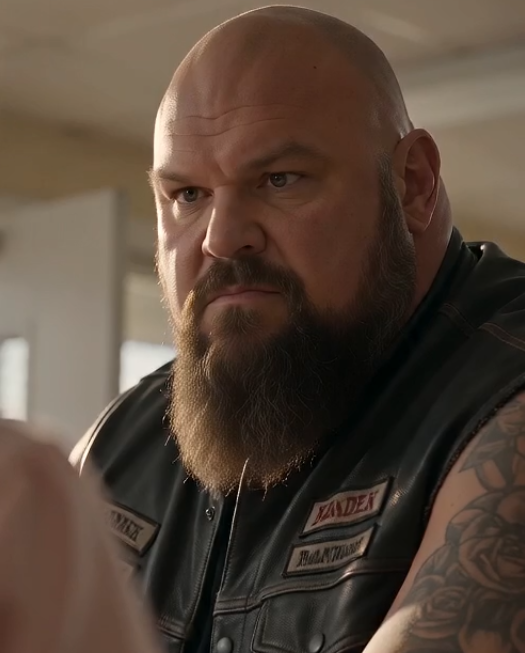
A huge man walked in. He was about thirty, six-four, with a shaved head, a thick dark beard, and tattoos down both arms. He wore a black short-sleeved leather jacket. Road dust clung to his boots.
Vernon stepped into his path.
“You deaf, pal? Kitchen’s closed.”
The man didn’t answer. He didn’t look at him. He stepped around Vernon as if he were a coat rack and walked to the counter.
He set a thick manila folder down in front of Bonnie.
Then he sat on the third stool from the end.
“Eggs, bacon, and pancakes, please, ma’am,” he said quietly.
Bonnie’s rag stopped moving.
She looked at his face for a long time, at the eyes under all that beard and ink.
Then she knew.
“Jesse?” she whispered.
Part 2
Twelve years earlier, on a cold March morning, a skinny teenage boy rode into Bonnie’s gravel lot on a rusted-out 1980s motorcycle that sounded like it was dying.
He was seventeen. He had a torn jean jacket, a backpack, and the eyes of a kid who hadn’t slept in days. He sat in the corner booth by the window and ordered a glass of tap water.
Then he stared at the menu for an hour.
Bonnie was fifty then, just a waitress, working the breakfast shift for the old owner, Earl Mabry. She’d raised two boys of her own. She knew what a kid looked like when he was trying very hard not to look hungry.
At 8:15, she walked to his booth with a plate of eggs, bacon, and three pancakes, and set it down.
“I didn’t order that,” the boy said.
“Kitchen made extra,” Bonnie said. “Shame to throw it out.”
He looked at her for a long time. Then he ate it in about four minutes.
She paid for it out of her tip jar before Earl saw the ticket.
He came back the next morning. He ordered water. She brought him eggs, bacon, and pancakes.
“Kitchen made extra again?”
“Funny how that keeps happening,” Bonnie said.
He came every morning for three weeks. She learned his name was Jesse. She learned he was from Kentucky. She learned he was sleeping in a dugout at the Little League field behind the Baptist church. He’d had a fight with his mother after his father died, said things he couldn’t take back, and ridden south until his money ran out.
He never told her more than that. She never pushed.
Then one morning, he didn’t come.
She never saw him again.
Now he was sitting at her counter, thirty years old and the size of a refrigerator, with forty motorcycles in her parking lot.
“Bonnie,” he said, smiling for the first time. “You look the same.”
“I look sixty-two and worn out,” Bonnie said. Her voice was shaking. “What are you doing here, honey?”
Before Jesse could answer, Vernon reached past him and snatched the manila folder off the counter.
“What is this?” he said. “If this is some kind of shakedown—”
He opened it.
He read the first page.
All the color drained out of his face.
Part 3
“This is a deed,” Vernon said slowly. “To my property.”
“It’s not your property anymore, Vernon,” Jesse said quietly.
“The hell it isn’t. I never sold anything.” Vernon flipped through the pages. His hands were trembling. “This is a forgery. This is fraud.”
He turned to the regulars in the booths. There were six of them, old farmers and widows who’d been coming to Bonnie’s every day for decades and had come to say goodbye.
“You see this?” Vernon said loudly. “Forty bikers roll in here on the last day, and their leader slaps down fake papers. It’s a scam, folks. They’re going to take Bonnie for whatever she’s got left.”
The old men in the booth by the window looked at each other uneasily.
Vernon pulled out his phone. “I’m calling the sheriff.”
“Go ahead,” Jesse said.
Vernon dialed.
Bonnie stared at the papers on the counter. Her name was there. Bonnie Ruth Albright. Grantee.
Her head was spinning. It was too much. It was too good. She’d been around long enough to know that when something seemed too good, somebody usually got hurt.
She’d emptied her savings to pay Vernon’s new rent. She’d sold her car and borrowed against her house. She was sixty-two years old and nearly broke. What if this was a scam? What if she signed something and lost the only thing she had left?
“Jesse,” she whispered. “I don’t understand. How could you buy it? He says he never sold it.”
The front door jingled again.
A woman in her forties in a gray pantsuit hurried in, holding a leather portfolio. She looked at the bikes in the parking lot, then at Vernon.
“Vernon, I got your text. What’s going on?”
“Kara. Tell them. Tell them we have a signed contract.”
The woman opened her portfolio. “I’m Kara Lindell, Mr. Stiles’s real estate agent,” she said to the room. “This property is under contract for sale to a national truck stop chain. Closing is in two weeks.”
She looked at Bonnie apologetically.
Jesse finally turned on his stool to face Vernon directly.
“You didn’t sell it, Vernon,” he said. “The bank did.”
The diner went silent.
“Yesterday morning, at ten o’clock,” Jesse said. “On the steps of the Coffee County Courthouse.”
Part 4
Kara Lindell’s face went blank.
“What bank?” she asked.
“First Farmers Bank of Tullahoma,” Jesse said. “Mr. Stiles took out a loan against this land four years ago. Stopped paying it last winter. The bank started foreclosure in April.”
Every head in the diner turned toward Vernon.
“That’s private,” Vernon said. “That’s none of your business.”
“It was a public auction,” Jesse said. “It was in the paper for three weeks.” He nodded at the folder. “I bought it. Then I deeded it straight to Bonnie. It was recorded at the courthouse at two o’clock yesterday.”
Kara slowly turned to Vernon.
“You told me the title was clean,” she said. “You signed a disclosure saying there were no liens and no pending foreclosure.”
“It was being handled,” Vernon said tightly.
Kara looked down at her portfolio. Then she looked at Bonnie, and something changed in her face.
“The buyer’s contract required vacant possession,” she said quietly. “No tenants. The building had to be empty before closing.” She swallowed. “Vernon, is that why you tripled her rent? Because you had to get her out before the buyer found out the bank was about to take it?”
Vernon didn’t answer.
He didn’t have to.
Bonnie felt sick. Two months of panic, two months of selling everything she owned, two months of lying awake doing math. It had never been about rent. Vernon had been racing to sell the land out from under the bank. He had to push her out first so the buyer wouldn’t ask questions.
“How much did the truck stop chain put down?” Jesse asked Kara.
“Fifty thousand,” Kara said slowly. “Earnest money. It went to Mr. Stiles in August.”
“For land he knew he was about to lose,” Jesse said.
The bell over the door jingled one more time.
A sheriff’s deputy walked in, a big man in a tan uniform with a gray mustache. He looked around at the bikers in the lot, the regulars in the booths, Vernon with his phone, and the folder on the counter.
“Somebody called about a forgery?”
Part 5
The deputy’s name was Sergeant Hollis Grady. He had been eating breakfast at Bonnie’s Kitchen every Tuesday for twenty-two years.
He picked up the deed from the folder and read it carefully. Then he pulled out his phone and made a call. He talked quietly for about three minutes.
Then he hung up and looked at Vernon.
“That was the register of deeds,” he said. “This was recorded yesterday at 2:04 p.m. It’s legitimate. The property belongs to Bonnie Albright.” He set the deed back on the counter gently. “Free and clear.”
Bonnie grabbed the edge of the counter. Her knees had gone weak.
“That’s not possible,” Vernon said. “I never got any notice.”
“County records show you got three, Vernon,” Hollis said. “Certified mail. You signed for every one of them.”
Vernon’s mouth opened and closed.
“And Kara here tells me you took fifty thousand dollars from a buyer for land you knew the bank was taking,” Hollis said. “That’s not a forgery. That’s fraud.” He nodded toward the door. “I’m going to ask you to leave Ms. Albright’s property now. I’ll be in touch about the rest.”
Vernon looked around the diner for an ally.
The old farmers in the booths stared back at him.
He threw his keys on the counter, the keys he’d been jingling all afternoon, and walked out. The door banged behind him. Forty bikers in the parking lot watched him walk to his car. Not one of them said a word.
Bonnie was crying now. She couldn’t stop.
Jesse got up, walked around the end of the counter, and put his big tattooed arms around her. She barely came up to his chest.
“Why?” she said into his leather jacket. “Why would you do this? You were a boy. I gave you a few breakfasts.”
“Twenty-one breakfasts,” Jesse said. “I counted.”
Bonnie pulled back and looked up at him.
“Why did you leave?” she asked. “That last morning. You just disappeared. I worried about you for years. I thought something terrible had happened.”
Jesse was quiet for a long time.
“Because of something you said,” he said. “The night before.”
Part 6
Bonnie didn’t remember.
“I don’t know what I said, honey.”
Jesse smiled.
“It was a Thursday night,” he said. “Raining. I came in late for once, right before you closed. You brought me a plate. And when you set it down, you put your hand on my shoulder for just a second.”
Bonnie’s eyes filled.
“You said, ‘Somebody’s worried about you, sweetheart.'”
The diner was silent. Even the old farmers had set down their forks.
“That’s all,” Jesse said. “Six words. You didn’t make a speech. You didn’t tell me to call home. You just said it, and you went back to the kitchen.”
He looked at his hands on the counter.
“I’d been gone three weeks. I’d convinced myself nobody cared. After my dad died, my mom and I said terrible things to each other. I told her I hated her. I told her it should’ve been her instead.” He swallowed hard. “I figured she was glad I was gone.”
“Oh, honey.”
“I went back to that dugout that night and lay there in the rain,” Jesse said. “And all I could hear was you. ‘Somebody’s worried about you.’ Over and over.” He shook his head. “At three in the morning, I got on that rusted-out bike and rode north. Two hundred and fifty miles in the rain. The bike died twice. I pushed it the last four miles.”
“And your mother?”
Jesse looked toward the glass front door.
“She’d been looking for me the whole time,” he said. “I knocked on the door at nine in the morning, soaking wet. She opened it and fell down on the porch.”
Bonnie had both hands over her mouth.
“I never forgot you, Bonnie,” Jesse said. “Learned to fix motorcycles that summer. Opened my own shop at twenty-two. Got three of them now in Kentucky. Joined a club.” He nodded at the forty bikes outside. “Became road captain. And three weeks ago, one of my guys rode through Millers Gap and saw the sign on your door.”
He stood up from the stool.
“I didn’t come alone, Bonnie,” he said quietly. “Somebody else wanted to say thank you herself.”
He turned toward the glass front door.
Part 7
A white-haired woman in a navy church coat stood outside the glass door, holding something folded in her hands.
Jesse opened the door for her. The little bell jingled.
She stepped inside slowly. Her hair was wild from four hours on the back of a motorcycle, and her cheeks were pink from the wind. She looked at Bonnie behind the counter.
Then she unfolded the paper in her hands.
It was a missing-person poster, yellowed and soft and creased in a dozen places. A black-and-white school photo showed a skinny boy with a crooked smile.
MISSING. JESSE CALDER, AGE 17. LAST SEEN LEXINGTON, KY. PLEASE CALL.
The plate Bonnie had just picked up, eggs, bacon, and pancakes for Jesse, slipped out of her hands and shattered on the floor.
“You’re Bonnie,” the woman said. Her voice cracked. “I’m Gail. Gail Calder. I’m his mother.”
Bonnie couldn’t speak.
“I printed five hundred of these,” Gail said, holding up the poster. “I stood at every truck stop on I-75 for three weeks, handing them out to truckers. I called every hospital and every morgue between Lexington and Atlanta. I thought he was dead.”
She walked across the black-and-white tile, stepping carefully around the broken plate, until she stood in front of the counter.
“Then one morning he was standing on my porch,” Gail said. “Soaking wet. And the first thing he said to me was, ‘A waitress in Tennessee told me somebody was worried about me.'” She pressed the poster to her chest. “And somebody was.”
Bonnie came around the counter. The two women grabbed each other and held on, in the middle of the diner, while Jesse stood behind them with his hand over his face.
The old farmers in the booths were crying. Sergeant Hollis Grady had taken off his hat.
When they finally let go, Bonnie wiped her eyes on her apron and laughed shakily.
“I’d better make you another plate, Jesse. I just broke yours.”
Then she saw the girl in booth four.
She’d almost forgotten about her.
The girl was maybe fifteen, with stringy blonde hair, a dirty pink hoodie, and a backpack on the seat beside her. She’d come in four mornings in a row this week and ordered a glass of water.
Bonnie had brought her pancakes every time.
The girl was staring at Jesse and his mother with her hands wrapped tight around her water glass. Her lip was trembling.
Jesse turned and saw her too.
He looked at the glass of water. He looked at the backpack.
Then he looked at Bonnie.
Part 8
Bonnie gave the smallest nod.
Jesse walked slowly over to booth four. He didn’t sit down right away.
“Mind if I sit, kiddo?”
The girl shrank back against the vinyl. A huge, bearded, tattooed stranger in a leather jacket was standing over her table.
“I’m not gonna hurt you,” Jesse said gently. He sat down across from her, slowly, his big hands flat on the table. “My name’s Jesse.”
The girl didn’t answer.
“I used to sit right there,” he said, nodding at the corner booth by the window. “Twelve years ago. Glass of water. Stared at the menu for an hour.”
The girl’s eyes flicked to Bonnie behind the counter. Then back to Jesse.
“How long you been gone from home?” Jesse asked.
The girl’s chin wobbled. “Nine days,” she whispered.
“Where’s home?”
“Chattanooga.”
“Got a mom?”
The girl nodded. Her eyes filled up. “We had a fight. I said really bad stuff.”
“Yeah,” Jesse said quietly. “Me too.”
He reached into the inside pocket of his leather jacket and set his phone on the table between them.
“I’m not gonna make you do anything,” he said. “But I’m gonna tell you the same thing Bonnie told me in this diner twelve years ago.” He paused. “Somebody’s worried about you, sweetheart.”
The girl broke.
She put her head down on the table and sobbed. Gail Calder walked over, slid into the booth beside her, and put an arm around her shoulders without a word.
After five minutes, the girl picked up Jesse’s phone with shaking hands and dialed a number.
It rang once.
A woman answered, screaming a name so loud that everyone in the diner heard it.
“PAIGE? PAIGE, BABY, IS THAT YOU?”
The girl, Paige, just kept crying into the phone. “Mama. Mama, I’m sorry. I’m sorry.”
Sergeant Hollis Grady quietly stepped outside to call the Chattanooga police and let them know a missing girl had been found safe.
Bonnie stood behind the counter with her hands pressed over her mouth, watching. Paige was in booth four. Jesse and Gail were beside her. Forty bikers stood in the parking lot, and the sun was setting over Highway 9.
At 5:00, the time Vernon Stiles had demanded his keys, Jesse walked back out to his motorcycle.
He came back in carrying something flat and rectangular, wrapped in a moving blanket.
Part 9
It was a new menu board, hand-painted on reclaimed barn wood, the same size and style as the one Vernon had thrown in the dumpster that afternoon. Jesse had commissioned it from a sign painter in Kentucky three weeks earlier, before he’d even known what the old one looked like.
At the bottom, under the list of eggs and pancakes and pie, there was a new section painted in bright blue letters.
SUSPENDED MEALS.
FOR ANY KID WHO NEEDS ONE. NO QUESTIONS ASKED.
Next to it was a little chalkboard with tally marks.
“Customers can pay for a meal ahead of time,” Jesse explained. “Any kid who walks in hungry gets fed, and nobody has to say kitchen made extra.”
Bonnie hung it on the wall that night, in the exact spot where the old one had been.
Here’s how the rest of it went.
Bonnie’s Kitchen did not close.
The Lonesome Pines MC made it their official stop on every ride through Tennessee. Every year on the last Friday in October, forty or fifty bikes pull into that gravel lot for eggs, bacon, and pancakes.
Vernon Stiles was charged with fraud for taking fifty thousand dollars from the truck stop chain for land he knew he was losing. He pleaded guilty, repaid every dollar, and was sentenced to three years of probation. Kara Lindell testified against him. She also became one of the first customers to pay for a suspended meal.
Paige went home to Chattanooga that night with her mother. Every few months, a card arrives at the diner, addressed to Bonnie and Jesse. Paige is a senior in high school now. She wants to be a social worker.
In the first year, the customers of Bonnie’s Kitchen paid for 912 suspended meals. Truckers did, and farmers, church groups, bikers, and strangers passing through on Highway 9. Every one of them went to a kid who walked in hungry.
The very first suspended meal was paid for the night the diner was saved.
Before she left with Jesse that night, Gail Calder walked up to the register. She opened her purse and took out a check she had written at home in Kentucky, three weeks earlier, the night Jesse told her where they were going.
She’d made it out for exactly twenty-one breakfasts.
“For the next kid,” she told Bonnie. “The way you did it for mine.”
Bonnie taped Jesse’s old missing-person poster next to the register, right under the suspended meals board. It’s still there. Kids sometimes ask about it.
She tells them the same thing every time.
“Somebody’s worried about you, sweetheart.”
People see forty bikers roll into a gravel lot, and a huge, tattooed man in a leather jacket walk through the door, and they decide who he is before he orders. A landlord in a golf shirt called them a gang and told them to find a bar. Vernon Stiles was the one who had been trying to steal that land out from under a sixty-two-year-old woman. The big biker at the counter was a boy who once couldn’t afford breakfast, and he never forgot the woman who fed him. Sometimes six small words are enough to bring somebody home.
If this story stayed with you, follow our page. We share stories like this one every week, about the kindness that finds its way back.