THIRTY PEOPLE SCREAMED AT THE BIKER BLOCKING THE DINER DOOR, AND MY DAUGHTER STARTED COUGHING—THEN I LOOKED OUT THE WINDOW AND SAW THE GREEN CLOUD.
A BIKER LOCKED THE DOOR OF A PACKED DINER AND SHOVED A TABLE AGAINST IT—30 CUSTOMERS CALLED 911, THEN THEY SAW WHAT WAS DRIFTING TOWARD THE WINDOWS.
Amber Parker was cutting a slice of cherry pie in half when the deadbolt slammed.
It was 12:07 on a sunny Saturday in May at the Crossroads Diner on Highway 62, just outside Pine Hollow, Arkansas. It was a two-story white clapboard building with a gravel lot, red vinyl booths, and the best chicken-fried steak in Benton County. Every booth was full. Truckers sat at the counter. A Little League team in red uniforms was celebrating a win. The front windows were propped open, and a warm spring breeze moved the ceiling fans.
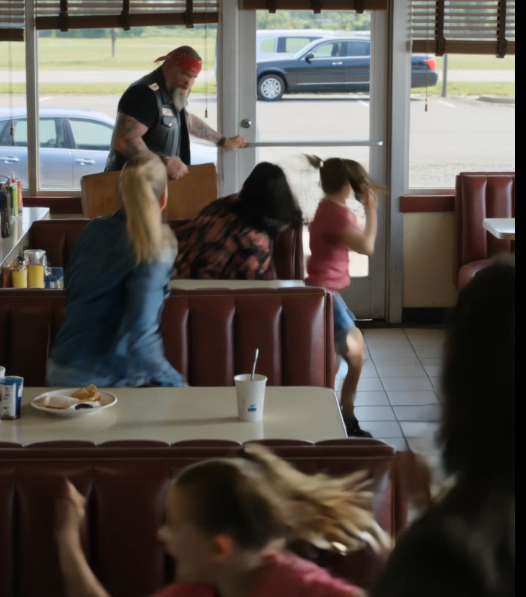
Amber’s seven-year-old daughter, Sadie, was swinging her legs under the table, waiting for her half of the pie.
Then the front door banged open.
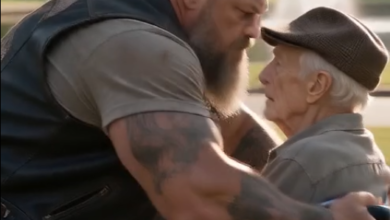
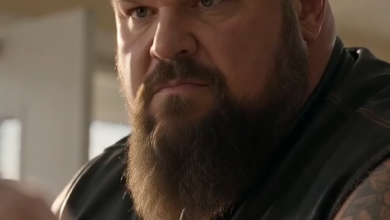
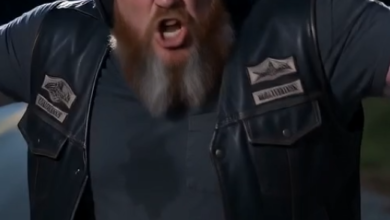
A huge man came through it fast. He was maybe sixty and six-four, with a long gray beard, a red bandana tied on his head, and forearms covered in faded tattoos. He wore a black short-sleeved leather biker jacket and mud-caked boots.
He slammed the door behind him and threw the deadbolt.
Then he grabbed the heavy wooden table by the entrance and dragged it screeching across the tile until it was jammed against the door.
The whole diner went silent.
“Close the windows!” he shouted. “Shut off the fans! Now!”
Nobody moved.
A big man at the counter stood up. He was heavyset, with a buzz cut and a contractor’s polo. Amber recognized him from church. His name was Wade Ransom.
“What the hell is this, man? You can’t lock us in here.”
“Close the windows,” the biker said again.
“Somebody call the cops,” a woman whispered. “He’s crazy.”
Phones came out. Amber heard three different people talking at once.
“911? A biker just locked us inside the Crossroads Diner on 62…”
The biker didn’t argue with any of them. He turned and ran to the front windows and slammed them shut, one, two, three. He twisted every latch. Then he reached up and yanked the chain on the ceiling fan until it stopped.
Wade and a trucker grabbed the barricade table and started hauling it away from the door.
The biker was back in two strides. He planted his boots and spread his arms wide across the doorway.
“You open that door,” he said, low and hard, “and you die.”
People screamed. Kids dove under tables.
Amber yanked Sadie into the corner of the booth and wrapped herself around her.
“Don’t look at him, baby. Don’t look.”
Wade lunged at the table again. “You think you’re gonna hold thirty people hostage?”
That’s when a teenage girl by the front window stopped screaming.
“Oh my God,” she said. “Look.”
Everyone turned.
Outside, a low, thick, yellow-green cloud was rolling across the gravel parking lot. It was waist-high, creeping along the ground like fog on a swamp. It swallowed the biker’s black motorcycle at the edge of the lot. Then the first row of cars.
It was drifting straight toward the windows he’d just shut.
Wade let go of the table.
“Chlorine,” the biker said quietly.
Part 2
Nobody spoke for three full seconds.
Then everyone spoke at once.
“What do you mean, chlorine?”
“Like pool chlorine?”
“Is that poison?”
The biker held up one big hand. The diner went quiet again.
“Tanker truck rolled over on 62 at the County Road 40 junction,” he said. “Quarter mile west. I rode right past it three minutes ago. Tank’s split open. Gas is pouring out.” He pointed at the window. “Wind’s blowing east. Right at us.”
“Then we need to get out of here!” a woman cried.
“No, ma’am,” the biker said. “That’s exactly what you don’t do. You walk out that door, you walk right into it. You can’t outrun it in a parking lot. Chlorine burns your lungs from the inside. You stay inside, you seal it up, you wait for the hazmat guys with masks.”
The owner, Rita Ochoa, a fifty-eight-year-old woman with gray-streaked black hair in a bun, came out of the kitchen wiping her hands on her apron. She took one look at the cloud outside.
“The air conditioner,” she said. “It pulls air from outside.”
“Shut it off,” the biker said. “Now.”
Rita ran to the thermostat on the wall and slapped it off. The vents went silent.
Wade Ransom stood by the barricade, his face red. “How do we know he’s not making this up? How do we know that’s not just fog?”
“Fog’s not green,” Rita said sharply.
Wade didn’t answer.
In the corner booth, Sadie coughed.
It was a small cough, dry and scratchy. Amber looked down at her.
Then Sadie coughed again, harder. Then a third time. Then she made a sound that turned Amber’s blood to ice. It was a thin, high whistle at the end of a breath.
Sadie had asthma. She’d had it since she was two. Amber knew every sound it made.
“Baby, are you okay?”
Sadie shook her head. Her eyes were wide. She pressed her small hand against her chest.
Amber grabbed her purse and dug through it frantically. Wallet, keys, gum, crayons.
No inhaler.
It was in the glove box. In the car. Forty feet away in the parking lot.
The green cloud was rolling over it right now.
Amber didn’t think. She scooped Sadie up in her arms and ran for the front door.
“Move! She needs her inhaler! It’s in the car!”
Part 3
The biker stepped in front of her.
“Not outside, ma’am.”
“Get out of my way!” Amber screamed. “She can’t breathe! Her medicine is in the car!”
“If you go out there with her, neither one of you will be able to breathe.”
Amber hit him. She shifted Sadie to one hip and pounded on his chest with her free fist, sobbing.
He didn’t move. He didn’t grab her or push her back. He just stood there and took it.
“Let her out, you psycho!” someone shouted from a booth.
“She’s got a sick kid!”
The biker looked down at the floor at his feet.
Amber looked too.
Thin, pale, yellow-green wisps were curling in under the gap beneath the front door. They spread across the tile like smoke from dry ice. A sharp, burning smell, like a swimming pool times a hundred, stung Amber’s nose and made her eyes water.
Sadie coughed harder.
The biker moved fast. He vaulted the counter, grabbed a stack of dish towels from a shelf, and soaked them under the kitchen faucet. He ran back and dropped to his knees and jammed them into the gap under the door, packing them tight with his big fists. Then he stuffed more around the edges of the door frame.
“Rita, you got an upstairs?”
“My apartment,” Rita said.
“Everybody up there. Now.” He stood up and raised his voice so the whole diner could hear. “This gas is heavier than air. It sits low, on floors, on the ground. Higher up is safer. Go. Kids first.”
For a second, nobody moved.
Then Rita grabbed the Little League coach by the arm. “You heard him. Upstairs. Go.”
They went. Thirty people climbed the narrow back staircase in a single file, the kids first, then the elderly couple, then the truckers.
Rita’s apartment was small and hot. They crowded onto the couch, the recliner, and the kitchen floor. Rita jammed wet towels under the apartment door and the bathroom door. Through the big living room window, they could see the green cloud spreading over the parking lot below and onto the highway beyond.
Amber sat on the carpet with Sadie in her lap. Sadie’s lips were pale. Every breath whistled.
The biker knelt down in front of them.
He reached into the inside pocket of his leather jacket and pulled out a battered rescue inhaler.
“Here, sweetheart,” he said softly. “Two puffs. Slow. Just like your mama taught you.”
Amber stared at him.
Sadie took it with shaking hands and breathed in. Then again.
Within a minute, the terrible high whistle began to fade.
Amber burst into tears.
That’s when she saw the tattoo on his left wrist. It was a small yellow canary on a branch, with two names underneath.
REMY. T-BOB.
“You carry an inhaler,” she whispered. “Why?”
Part 4
The biker sat back on his heels. He watched Sadie breathing easier in her mother’s lap for a long moment before he answered.
“Clyde Boudreaux,” he said. “Folks call me Canary.”
His accent was thick Louisiana, soft and slow.
“I worked at a paper mill outside Bogalusa for twenty-two years,” he said. “Paper mills use chlorine to bleach the pulp. Big tanks of it. One morning in September 2006, a valve blew on one of the tanks. Whole bleach plant filled up with that same green gas.”
The apartment had gone quiet. Even the Little League kids were listening.
“The alarm went off,” Clyde said. “Everybody panicked. Ran outside. That’s what you do, right? Something bad inside, you run outside.”
He shook his head slowly.
“Except the wind was blowing the cloud right across the yard. Right where we all ran.” He looked down at his wrist. “Remy Thibodeaux and T-Bob Landry. Best friends I ever had. We’d worked the same shift fifteen years. They ran for the parking lot. Made it about a hundred feet.”
Amber put her hand over her mouth.
“I was slower. Older knees. Got caught in a doorway when the cloud came,” Clyde said. “Somebody pulled me back inside a control room and shut the door. I breathed enough to wreck my lungs for life.” He held up the inhaler. “Been carrying one of these every day for eighteen years.”
He looked at the canary on his wrist.
“Coal miners used to take canaries down into the mines,” he said. “When the bird stopped singing, they knew the air had gone bad and they had to get out. I got that tattoo after the funeral. To remind me to watch the air.” He paused. “My buddies started calling me Canary after that. Guess it stuck.”
Wade Ransom was sitting on the kitchen floor with his back against the refrigerator. He hadn’t said a word since the stairs.
“And today you rode past that tanker,” Wade said slowly.
“Saw the cloud coming off it,” Clyde said. “Saw which way the wind was blowing. Saw this diner full of people with the windows open.” He shrugged his huge shoulders. “Didn’t have time to explain.”
At 12:39, sirens finally wailed in the distance.
At 12:52, figures in full yellow hazmat suits and air masks walked out of the green fog into the parking lot below. Two big county buses rolled up behind them.
The hazmat team came up the stairs with spare masks. They led all thirty people down and out through the cloud, one by one, onto the buses. They drove them two miles east to a church parking lot where decontamination tents had been set up.
When Amber stepped off the bus with Sadie in her arms, two sheriff’s deputies were waiting.
“Which one of you,” one of them asked, “is the biker?”
Part 5
The deputies had received three 911 calls from inside the Crossroads Diner that afternoon. All three reported a hostage situation. All three described a large, bearded biker who had barricaded the door and threatened customers.
“Sir, turn around, please,” the younger deputy said to Clyde.
Clyde turned around without a word. The cuffs clicked.
“Wait,” Amber said. “Wait, you don’t understand—”
“Ma’am, we’ve got three separate reports of a man holding people against their will and threatening to kill them,” the deputy said. “We’ll sort it out. But right now, he’s being detained.”
Across the church parking lot, a white pickup truck with a company logo on the door pulled up beside the command post. A man in his fifties climbed out in a pressed company polo and khakis, carrying a tablet. He walked straight to the sheriff.
“Kirk Vandiver,” he said loudly. “Regional safety director, Southline Chemical Carriers. That’s our tanker.” He gestured back toward the highway. “First of all, I want to stress that this was a minor release. Contained quickly. Low concentration. No evacuation was ever required.”
Amber turned and stared at him.
“Second,” Vandiver went on, glancing at Clyde in handcuffs, “I’m told some individual created a panic situation at a restaurant. He locked people in, threatened them, and forced them up a staircase. One elderly woman twisted her ankle.” He shook his head. “That kind of reckless behavior creates liability for everyone. Frankly, it’s unlawful restraint. I’d strongly encourage you to press charges.”
Wade Ransom was standing nearby with his arms crossed. He nodded slowly.
“He did threaten us,” Wade said. “Said we’d die if we opened the door.”
Amber turned on him. “Because we would have!”
“We don’t know that,” Wade said. “You heard the man. Minor release. Low concentration. Maybe we could’ve just driven away.”
A few others from the diner murmured. A trucker. The elderly man whose wife had twisted her ankle.
Amber looked down at Sadie in her arms. Her daughter was breathing normally now, holding the battered inhaler.
What if Vandiver was right? What if Clyde had overreacted? What if they’d all been terrified for nothing?
Clyde stood in handcuffs between the two deputies. He didn’t argue. He didn’t raise his voice.
He just looked at Kirk Vandiver.
“Sheriff,” he said quietly. “Ask him what time his driver called it in.”
Part 6
Vandiver’s jaw tightened. “I don’t see how that’s relevant.”
The sheriff was a tall, weathered man named Sheriff Dale Hutchins. He looked at Clyde for a long moment. Then he looked at Vandiver.
“Humor me.”
Vandiver checked his tablet. “Our driver notified dispatch promptly after the incident.”
“Notified who?” Clyde asked.
“Our company dispatch.”
“Not 911?”
Vandiver didn’t answer.
A woman in a navy windbreaker stepped forward from the command tent. She was in her forties, with reading glasses on a cord. Her name was Carol Wynn, and she was the Benton County emergency management director.
“I can answer that,” she said. “The first 911 call about the tanker came in at 12:31.” She looked at her clipboard. “From a passing motorist. Not from the driver. Not from Southline.”
“Twelve thirty-one,” Clyde said. “Sheriff, my motorcycle has a camera on the handlebars. Records every ride. It’s sitting in that parking lot under the gas right now, but the footage uploads to my phone.” He nodded toward his jacket. “Inside pocket.”
The sheriff reached into Clyde’s jacket and pulled out his phone. Clyde told him the passcode. Hutchins found the video and held it up so Carol Wynn and Vandiver could see.
The footage showed Highway 62 on a bright afternoon from handlebar height. At the County Road 40 junction, a white tanker truck lay on its side in the ditch. A thick yellow-green plume was pouring out of a split in the tank. It hung low and spread across the road.
There were no police cars and no fire trucks. Nobody was there.
The timestamp in the corner read 12:04 p.m.
“Twelve oh four,” Carol Wynn said slowly. “The tanker was already venting at twelve oh four. And we didn’t get a single call until twelve thirty-one?”
“Twenty-seven minutes,” Clyde said quietly. “That’s twenty-seven minutes of that gas drifting toward town with no warning. No sirens. No emergency alert on anybody’s phone.”
Every head turned toward Kirk Vandiver.
Vandiver’s face was very pale.
“Our driver was injured,” he said. “He was disoriented. There may have been a delay in communication—”
A paramedic leaned out of an ambulance parked at the edge of the lot.
“Sheriff? The tanker driver’s asking for you. He says it’s important.” She hesitated. “He says he needs to tell you about the phone call.”
Part 7
The tanker driver’s name was Lonnie Peete. He was fifty-eight, with a gray mustache and a bandage taped across his forehead. He was lying on a stretcher in the back of the ambulance with an oxygen mask pushed down around his chin.
His eyes were red.
When Sheriff Hutchins climbed into the ambulance, Lonnie grabbed his sleeve.
“I called them,” he said hoarsely. “Soon as I crawled out of the cab. Twelve oh three. I called dispatch.”
“Southline dispatch?”
Lonnie nodded. “Company rule. You call company dispatch first. Always. You never call 911 until Safety clears it.” His voice cracked. “Mr. Vandiver’s rule. He says calling 911 brings the news trucks and the state inspectors. Says let us handle it first.”
Clyde stood outside the ambulance doors in handcuffs with Amber beside him. They could hear every word.
“What did dispatch tell you?” the sheriff asked.
“Told me to sit tight. Said Mr. Vandiver would call me back.” Lonnie closed his eyes. “I sat there by the road for twenty-five minutes watching that gas come out. Waiting for my boss to call me back. Finally a guy in a pickup stopped and called 911 himself.”
Sheriff Hutchins was quiet.
“There’s more,” Lonnie whispered. “That tank had a bad valve. Had a slow leak for two months. I wrote it up three times. They said the repair was scheduled.” He shook his head. “And I wasn’t even supposed to be on 62. Route’s supposed to go around on the bypass. Hazmat’s not allowed through town. Mr. Vandiver changed the route last month. Said the bypass added nineteen miles and cost too much fuel.”
The sheriff stepped out of the ambulance and looked across the church parking lot at Kirk Vandiver. Vandiver was on his phone, talking fast, with his back turned.
Then Carol Wynn came hurrying over from the command tent with her phone pressed to her ear.
“Sheriff,” she said. “That was Benton County Hospital. Two people were just admitted with chlorine inhalation injuries. A married couple.” She swallowed. “They were walking along Highway 62 when the cloud came through. A quarter mile from the diner.”
Amber felt her knees go weak.
The two figures she’d seen through Rita’s upstairs window, stumbling out of the fog, bent double.
“How bad?” Clyde asked quietly.
“Both on oxygen. The husband’s in the ICU. They expect him to survive, but his lungs…” Carol shook her head.
The sheriff turned to the thirty people from the diner standing around the decontamination tents.
“How many of you are having trouble breathing right now?”
Nobody raised a hand.
Not one.
Part 8
Sheriff Hutchins walked back across the church parking lot to the two deputies holding Clyde Boudreaux.
“Take those cuffs off,” he said.
The younger deputy hesitated. “Sheriff, we’ve got three 911 reports—”
“I know what we’ve got,” Hutchins said. “We’ve got thirty people standing here breathing normally, and two people in the hospital who were outside. Take them off.”
The cuffs came off.
Then the sheriff turned to the crowd.
“I want everybody to hear this,” he said. “There will be no charges against Mr. Boudreaux. Those 911 reports are void. This man didn’t take thirty people hostage. He saved thirty lives.”
Rita Ochoa started crying. So did the grandmother with the twisted ankle. The Little League coach began clapping, and then all the kids, and then everyone.
Wade Ransom walked over slowly. He stopped in front of Clyde with his hands in his pockets.
“I tried to break the door down,” Wade said. “I called you a psycho.” He swallowed hard. “My two boys were sitting in that diner. If I’d gotten that door open…”
He couldn’t finish.
Clyde held out one huge, tattooed hand. Wade shook it. Then he pulled Clyde into a hug, awkward and fierce.
Across the lot, two Arkansas State Police officers in hazmat investigation jackets had walked up to Kirk Vandiver. They asked for his phone, his tablet, and his company’s dispatch records from 12:00 to 12:31 that afternoon.
“I’ll need to speak to our legal department,” Vandiver said.
“You can call them from the station,” one of the troopers said.
Vandiver looked across the parking lot at Clyde for a long moment. Then he got into the back of a state police SUV.
Sadie wriggled out of her mother’s arms. She ran across the parking lot in her pink T-shirt and threw both arms around Clyde’s leg.
He bent down and picked her up. She was tiny against his leather jacket.
“You gave me your medicine,” Sadie said seriously.
“I sure did.”
“What are you going to use?”
Clyde laughed, a rough, wet laugh. “I got another one in my saddlebag, darlin’. Soon as the hazmat boys say my bike’s clean.”
Sadie touched the little yellow canary tattoo on his wrist with one finger.
“It’s pretty,” she said.
Rita Ochoa walked up beside them with her arms folded and her eyes still wet.
“Mr. Boudreaux,” she said. “When I reopen my diner, I’m going to put something on that front door.”
Part 9
Here’s how the rest of it went.
The state police investigation took four months. Southline Chemical Carriers had illegally routed hazardous materials through Pine Hollow to save fuel. It had ignored three written reports of a leaking valve. It had a written company policy forbidding drivers from calling 911 during a hazmat release until a safety manager approved it.
Federal hazardous materials regulators fined Southline more than two million dollars. The company was barred from transporting chlorine for three years. Kirk Vandiver was fired. He was charged with failing to report a hazardous materials release and with reckless endangerment. He pleaded guilty and served eight months in county jail. The married couple who’d been walking on Highway 62 both survived. Southline paid for every day of their care.
Lonnie Peete testified against his former employer. He drives a school bus now.
Benton County put the Crossroads Diner story into its emergency training program. Carol Wynn’s office now holds free “Shelter in Place” classes at schools, churches, and community centers all over the county. They teach what to do if there’s ever a chemical release. Close the windows. Turn off the fans and air conditioning. Seal the gaps with wet towels. Go upstairs, because some gases sink. Don’t run outside.
The first slide in every class is a photo of a heavy wooden table jammed against the front door of a diner.
Clyde Boudreaux teaches some of those classes himself. He stands at the front of a church fellowship hall in his leather jacket and red bandana and tells people about Remy and T-Bob. He tells them about the canary.
Rita reopened the Crossroads Diner three weeks after the spill. The very first thing she did was hang a hand-painted wooden sign on the inside of the front door, at eye level, where every customer would see it on the way out.
CLOSE THE WINDOWS. GO UPSTAIRS. WET TOWELS UNDER THE DOOR.
THANK YOU TO THE MAN WHO TAUGHT US.
The heavy wooden table that had barricaded the door is still in the diner, in the same spot by the entrance. Rita won’t let anyone move it. There’s a small brass plaque screwed into the top now.
CLYDE’S TABLE. RESERVED.
He eats there every Saturday.
Amber and Sadie come in sometimes and sit with him. The first time, Sadie brought him a present wrapped in pink tissue paper.
Inside was a small hand-carved wooden canary, painted bright yellow. Sadie had made it in her second-grade art class.
“So you have another canary,” Sadie said. “To watch the air.”
Clyde turned it over in his big scarred hands for a long time without saying anything.
That summer, he went back to the tattoo shop in Fayetteville. Under the canary on his left wrist, below the names of his two friends, he had one more thing added in small, plain numbers.
30.
People see a huge, tattooed biker lock the door of a packed diner and stand in front of it with his arms spread, and they decide what kind of man he is before he can explain. Thirty people called him a psycho. A mother beat on his chest. A company man in a pressed polo told the sheriff to lock him up. Kirk Vandiver was the one who had let that gas drift toward town for twenty-seven minutes without a single warning. Sometimes the man blocking your way out is the only one who knows what’s waiting outside.
If this story stayed with you, follow our page. We share stories like this one every week, about the people who stand between us and the danger we can’t see yet.