Part 2: A Tattooed Biker Dragged a Woman Away From an ATM and Looked Like He Was Robbing Her — Then Police Found the Device That Would Have Emptied Her Account
PART 2
Sarah’s first feeling was not gratitude.
It was humiliation.
That mattered.
A stranger had grabbed her in public. A huge man in a leather vest had pulled her away from a bank machine while people watched, recorded, shouted, and decided what was happening before anyone had enough facts to understand it.
Sarah had spent her whole life being careful around men who thought their size gave them permission. She had learned to keep her keys ready in parking lots, to stand far enough from strangers in lines, to glance at reflections in store windows when someone followed too closely.
So when Diesel grabbed her arm, her body did not think rescue.
It thought threat.
Even after he showed the badge, her heart stayed fast.
Even after the plainclothes officers moved in, her hands kept shaking.
Diesel understood enough not to ask for thanks.
He stepped back immediately once uniformed officers arrived and kept both hands visible, because he knew how the scene looked. A biker yanking a woman from an ATM was exactly the kind of image the internet would punish before the truth caught up.
Officer Maya Grant, a forty-year-old Black American patrol officer with deep brown skin, short natural hair, and a calm voice, approached Sarah first.
“Ma’am, are you hurt?”
Sarah shook her head.
“Did he actually pull me away from something?”
Maya glanced at the ATM.
“Yes.”
The answer was simple, but the situation was not.
The device on the machine had been designed to look like part of the ATM. A second hidden piece had been placed nearby to capture card information as customers entered it. To ordinary people rushing after work, nothing looked wrong. To someone trained to look for small details, everything did.
Diesel had been watching that ATM for two days.
The bank had reported suspicious activity after several customers noticed strange charges. Detectives from the financial crimes unit had worked with the bank and patrol officers to monitor the location without alerting the suspects.
Diesel was there because he did not look like a detective.
That was the point.
A biker leaning against a lamppost, sipping gas-station coffee, looked like part of the street.
Nobody expected him to be watching the card slot.
Nobody except the men who installed the trap, and by the time they noticed Diesel moving, Sarah was already behind him.
PART 3
The second suspect was harder to understand at first.
He was not standing at the ATM. He was across the street near a bus stop, wearing a gray hoodie and pretending to scroll through his phone. Witnesses barely noticed him until one of the plainclothes officers crossed behind him and gently took the phone from his hand.
Later, Sarah would learn that scams like this often worked in pairs.
One person stayed near the machine.
The other watched from a distance.
Not because they were brave.
Because theft is easier when the victim does all the work.
Sarah thought of the rent money she had planned to withdraw. She thought of the school lunch fees she had paid that afternoon, the utility bill in her tote bag, the grocery list written on the back of an old cafeteria schedule. She had less than forty dollars of breathing room that month.
If Diesel had waited another ten seconds, she might have lost more than money.
She might have lost the fragile sense that one more careful week would keep her family steady.
Her fourteen-year-old son, Isaiah, had basketball tryouts on Monday. He needed new shoes, though he had pretended the old ones were fine. Her mother’s medication copay was due Wednesday. Her car made a clicking sound every morning that she ignored because mechanics did not accept hope as payment.
Sarah looked at Diesel again.
He was not smiling.
He was not acting like a hero.
He stood near the curb while other officers took statements, his leather vest slightly dusty where she had shoved against him. There was a red mark on his forearm from where her nails had caught his skin when she fought to get away.
She walked over, still angry, still shaken, but beginning to understand.
“I scratched you.”
Diesel looked down as if noticing it for the first time.
“You had reason.”
“You scared me.”
“I know.”
“You could have said police first.”
His eyes moved toward the detained suspect.
“I had about one second.”
Sarah looked back at the ATM.
One second.
That was the distance between being embarrassed in public and having her account drained in private.
PART 4
The viral video started badly.
A teenage boy standing near the bank had recorded the moment from behind Sarah. In the clip, Diesel crossed the sidewalk, grabbed her, and pulled her away from the machine while she shouted. The angle did not show the suspect’s hand moving toward the ATM. It did not show Diesel’s badge. It did not show the plainclothes officers closing in seconds later.
It showed a biker and a frightened woman.
That was enough.
By midnight, the caption had become a story of its own.
Biker attacks woman at ATM.
People shared it because outrage moves faster than correction.
Sarah saw the video before she saw the official statement.
Her cousin sent it with fifteen question marks.
She watched herself scream. She watched Diesel pull her back. She watched strangers decide he was the villain. The strange part was that some piece of her still understood why they thought that, because she had thought it too.
But the clip ended before the truth arrived.
So Sarah recorded her own video the next morning from her kitchen table. She wore a plain gray sweatshirt, no makeup, her hair wrapped in a scarf, and her voice still sounded tired.
“That man did not rob me,” she said. “He scared me, yes. I’m not going to pretend he didn’t. But he pulled me away because my card was about to go into a skimming device. Police arrested two suspects. I still have my money because he moved before I understood why.”
She paused, looking down at her hands.
“Don’t make me into someone he hurt when what actually happened is complicated. I was afraid of him. He saved me anyway. Both things are true.”
The video spread slower than the first one.
Truth usually does.
Diesel did not contact her.
He did not ask her to defend him.
That impressed Sarah more than an apology would have.
A week later, she found a sealed envelope at the bank branch with her name on it. Inside was a printed copy of the police report, a bank fraud prevention pamphlet, and a handwritten note from Diesel.
You owed me no public defense. Thank you for telling the whole story anyway.
Sarah read the line twice.
Then she folded the note and put it in her wallet.
Right behind the card he had stopped her from using.
PART 5
Diesel had not always been a detective.
Before financial crimes, he worked patrol. Before patrol, he was a mechanic. Before the badge, the vest, and the reputation that made people either step aside or ask for help, he was a kid whose mother lost an entire paycheck to a scam that came through a machine outside a grocery store.
He was sixteen then.
His mother was a home health aide who carried cash in envelopes labeled rent, power, medicine, food. She did not trust banks much, but she used an ATM once because the branch was closed and a bill was due.
Two days later, the money was gone.
Nobody grabbed her arm in time.
Nobody saw the fake piece on the machine.
Nobody stood between her and the kind of theft that does not point a weapon at you, does not break a window, does not leave a bruise, but still empties your life while smiling through a receipt slot.
That week, Diesel watched his mother cry over a kitchen table covered in late notices.
He remembered the helplessness.
He remembered the rage.
He remembered deciding that if theft could hide in plain sight, then someone needed to learn how to see it.
Years later, when he became Detective Daniel Mercer, he asked for financial crimes after a case involving elderly victims lost their savings to a series of scams. Other officers teased him at first because financial crimes sounded less dramatic than drugs, robberies, or violent calls.
Diesel did not care.
He knew quiet theft ruined people just as surely.
It made them miss rent.
It made them choose between medicine and groceries.
It made them blame themselves for trusting something designed to deceive them.
That was why Sarah’s case bothered him.
He saw his mother in the angle of Sarah’s shoulders as she approached the machine after a long workday. He saw exhaustion. Responsibility. Someone trying to handle one more errand before going home to everyone who needed her.
He could not explain all that in one second.
So he moved.
And accepted being hated for it.
PART 6
The two suspects pleaded guilty months later after investigators connected them to several similar incidents across the city.
Sarah attended one hearing.
She did not have to, but she wanted to see them as real men instead of shadows behind a machine. One was twenty-nine, thin, restless, with pale skin and a nervous jaw. The other was thirty-six, heavier, calmer, and somehow more frightening because he looked bored by the damage.
The prosecutor described the victims.
A retired grandmother.
A single father.
A college student.
Sarah.
Numbers became names.
That changed the room.
When Sarah spoke in her victim impact statement, she did not cry. She stood straight in a navy blouse and black slacks, her cafeteria ID still in her purse because she had come from work.
“You did not just try to take money,” she said. “You tried to take the little bit of safety people feel when they believe they can still manage their lives.”
Diesel stood in the back of the courtroom, arms folded, leather vest absent for once, dark blazer making him look almost uncomfortable.
Sarah saw him after court.
“You clean up strangely,” she said.
He looked down at the blazer.
“I hate this thing.”
“It hates you too.”
For the first time, he laughed.
Their friendship did not become dramatic. It became practical. Diesel spoke at Sarah’s school about fraud awareness for parents and staff, using safe, general advice without giving criminals anything useful. Sarah invited Officer Maya Grant too, because she wanted the message to come from people the community could trust.
Isaiah attended the presentation and stared at Diesel with suspicion only a teenage boy can perfect.
“You’re the guy who grabbed my mom?”
Diesel nodded.
“Yes.”
Isaiah crossed his arms.
“I didn’t like that.”
“Neither did she.”
“But you saved her money?”
“Yes.”
Isaiah looked at his mother, then back at Diesel.
“Don’t grab her again.”
Diesel nodded seriously.
“I’ll do my best to warn faster next time.”
Sarah rolled her eyes.
“There better not be a next time.”
But when she smiled, something in the room softened.
The misunderstanding had not disappeared.
It had matured into truth.
PART 7
A year later, the bank replaced the old ATM with a new machine inside a protected lobby.
The branch manager invited Sarah, Diesel, Officer Maya Grant, and several community members to a small safety event. There were no balloons, no dramatic plaque, no speech about heroes. Sarah had requested that specifically.
“I don’t want a hero ceremony,” she told the manager. “I want people to know what happened so it doesn’t happen to them.”
Diesel approved.
Hero ceremonies made him uncomfortable anyway.
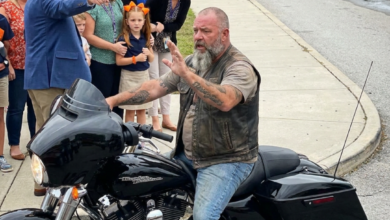
He arrived on his Harley wearing the same black leather vest people had judged in the first video. The difference was that now several people in the neighborhood waved when they saw him. Some still looked cautious. Diesel did not mind. Caution was not disrespect. Sometimes caution kept people alive.
Sarah stood beside the lobby door with Isaiah, who had finally gotten his basketball shoes and now stood several inches taller, pretending he was not impressed by the motorcycles parked outside.
The first viral video still lived online.
So did Sarah’s correction.
Occasionally, someone recognized Diesel and asked whether he was the biker who “saved that woman at the ATM.” He always answered the same way.
“She saved me from being only the worst ten seconds of a video.”
Sarah hated when he said that because it made her emotional.
At the event, Officer Grant explained how customers could protect themselves without turning fear into paranoia. The bank manager talked about reporting suspicious machines. Diesel kept his remarks short.
“Look twice,” he said. “Trust your discomfort. And if somebody pulls you away from something dangerous, you are still allowed to be scared before you are grateful.”
Sarah looked at him then.
That line was for her.
Afterward, she walked to the old sidewalk where the first incident had happened. The pickup truck was gone. The ATM was gone. The anger had faded, but the memory remained sharp enough to respect.
Diesel stood a few feet away.
“Still mad at me?” he asked.
Sarah considered it.
“A little.”
“Fair.”
“Still grateful.”
“Also fair.”
She held up her bank card.
“I check everything now.”
“Good.”
“And I keep your note behind this card.”
Diesel blinked.
Sarah smiled.
“Don’t get sentimental. It’s just a reminder that sometimes the person who scares you in the first ten seconds is the one who saw the danger before you did.”
Diesel looked toward the lobby, where Isaiah was pretending not to listen.
“My mother would’ve liked you,” he said.
Sarah did not know what to do with the softness in his voice.
So she answered practically.
“She would’ve told you to stop yanking women around sidewalks.”
“She absolutely would have.”
They both laughed.
The story never became simple, and that was why it mattered.
A woman was frightened in public.
A biker was accused in public.
Two criminals were arrested because someone noticed what everyone else missed.
And somewhere between fear, embarrassment, anger, and truth, Sarah learned that being rescued does not always feel like rescue at first.
Sometimes it feels like being pulled away from what you think you need.
Sometimes it looks ugly from the wrong angle.
Sometimes the hand that scares you is the one keeping your whole life from being emptied while you stand in line, tired, trusting, and unaware.
Follow this page for more unforgettable biker stories about misunderstood heroes, everyday danger, and the tough-looking people who notice what everyone else walks past.