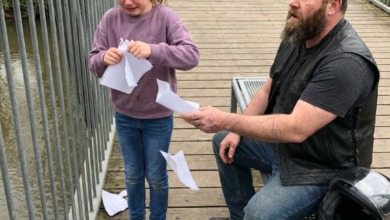
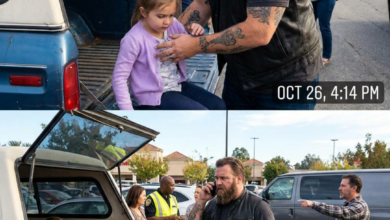
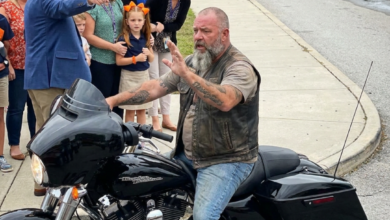
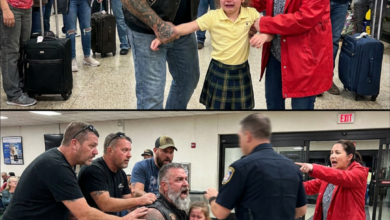
Part 2: A Massive Tattooed Biker Wrapped His Arms Around a Stranger and Forced Her Down in the Middle of the Street — Then Everyone Heard the Gunfire He Was Shielding Her From
PART 2
Claire Bennett did not like being touched by strangers.
That detail mattered more than people understood afterward.
She had worked in emergency nursing for nine years, and she knew how quickly a normal day could become chaos. She also knew the quiet fear women carry in public places when a man they do not know suddenly steps too close.
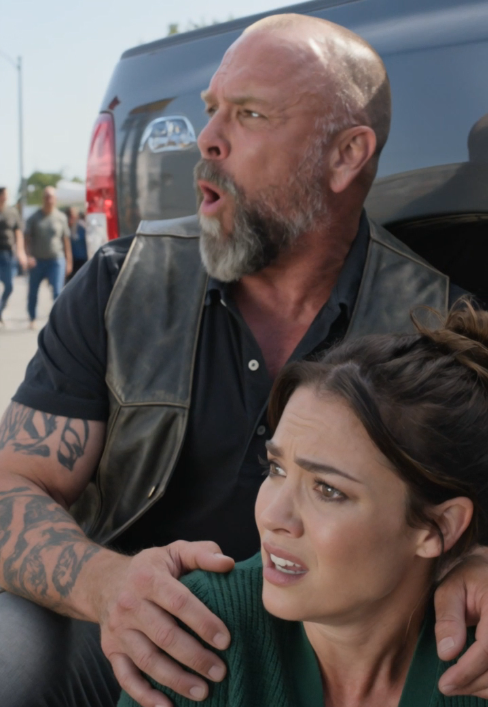
So when Caleb Donovan’s arms closed around her, Claire did not think rescue.
She thought danger.
His leather vest hit her shoulder first. His forearm locked across her chest to pull her backward, not cruelly but with a force that left no room for argument. Her grocery bag dropped. Apples rolled into the street. The world tilted, and suddenly she was on the pavement with a man twice her size pressing her down behind a pickup truck.
Her first instinct was to fight.
She elbowed him hard enough to make him grunt.
Caleb accepted it.
He did not curse. He did not tighten his grip around her throat or wrists. He only shifted his weight to cover more of her body and kept repeating the same sentence.
“Stay down. Stay down. Stay down.”
To witnesses arriving in the middle of that moment, the scene was unforgivable.
A biker had tackled a woman.
A woman was screaming.
A massive man was holding her down.
That was all they saw because fear edits reality into the simplest version it can survive.
The gunman was half a block away near the parking entrance, partly hidden by a line of vendor tents. Later, investigators would say the man appeared disoriented and angry, firing erratically toward no one in particular before officers contained the area. But in those first seconds, no one had enough information to understand his motive.
Caleb did not understand it either.
He only understood direction.
He had spent years as a construction foreman after leaving a rough childhood behind, and one thing job sites had taught him was that danger often makes a sound before the crowd understands the shape of it. A snapping cable. A falling beam. A misfired nail gun. A shouted warning swallowed by machinery.
The first shot cut through the fair like metal splitting.
People froze because the mind sometimes refuses to name what the ears have already heard.
Caleb moved because his body had learned something harsher.
When danger chooses a direction, someone has to choose a shield.
That Saturday, he chose himself.
PART 3
Officer Lena Ortiz arrived from the east end of Market Street with two patrol units.
She was a forty-one-year-old Latina American police officer with tan skin, dark hair pulled into a tight bun, and the calm, direct voice of someone trained to keep panic from multiplying.
The first emergency calls described a shooting.
The second wave described a biker attacking a woman near a pickup truck.
Both reports sounded urgent.
Both might have been true.
Lena approached carefully and saw Caleb still covering Claire. His hands were visible. His body was low. He was not striking her. He was not trying to drag her away. He was looking toward the sound of gunfire, not toward the woman beneath him.
That detail saved precious seconds.
“Sir, identify yourself!” Lena called.
Caleb did not move quickly.
“Caleb Donovan,” he answered. “She’s not hurt. Shooter west lot. I saw him before she did.”
Claire was crying now, partly from fear, partly from the humiliation of having fought the man who might have just saved her life.
Lena ordered Caleb to roll away slowly when it was safe.
He did.
Immediately.
Claire crawled backward and pressed herself against the pickup tire, trembling so hard she could barely breathe.
Another officer guided her behind a storefront wall while Lena and the others focused on the parking area.
Caleb stayed seated on the pavement with his hands raised.
He knew how he looked.
A biker that size, in a torn vest, sitting beside a terrified woman after witnesses claimed he attacked her, had no right to sudden movements.
Police contained the gunman after a brief standoff near the parked cars. The man dropped the weapon when officers surrounded him and was taken into custody without further injury to bystanders.
Only after that did people begin assembling the timeline.
Claire had been standing directly in the open when the first shot sounded.
The second shot struck the street sign behind where her head would have been if Caleb had not pulled her down.
A vendor’s security camera showed it clearly.
Caleb saw the gunman.
Caleb moved.
Caleb put his own back toward the street.
The father who had accused him of attacking Claire lowered his phone and whispered, “Oh my God.”
Caleb heard him.
He did not look angry.
He looked tired.
“I would’ve thought the same thing,” he said.
PART 4
Claire asked for Caleb before the paramedics finished checking her.
She had no visible injury except a scraped elbow and bruised knees from hitting the pavement. Caleb had a torn vest, a darkening bruise along his ribs where he had struck the curb, and one scraped forearm. He refused treatment twice until Claire glared at him with the authority of a nurse who had no patience for stubborn men.
“Sit down before I make the paramedic sit on you.”
Caleb almost smiled.
“Yes, ma’am.”
The humor broke something open.
Claire began shaking again, not from fear this time but from the delayed understanding of how close the danger had been.
“I thought you were attacking me.”
“I know.”
“I hit you.”
“You had every reason.”
“You didn’t let go.”
“No.”
“Why?”
Caleb looked at the street sign being photographed by police.
“Because if I let go when you were fighting, you would have stood up.”
She knew he was right.
That made it harder.
People like simple gratitude. They want rescue to feel clean. They want the saved person to immediately understand, embrace the hero, and cry in the correct direction.
But Claire had been terrified of Caleb before she was terrified of the bullets.
Both feelings were real.
He did not ask her to erase the first one because the second became clearer.
A woman from one of the craft booths brought Claire’s grocery bag. Most of the apples were bruised. A jar of honey had cracked open and soaked the receipt inside. The woman apologized for filming.
“I thought he was hurting you.”
Claire wiped her eyes.
“So did I.”
Caleb looked away, giving her room to say it without guilt.
That was when Claire noticed his leather vest.
One side had scraped open along the seam, and a small laminated photograph had slipped halfway from an inner pocket. It showed Caleb years younger, standing beside a little girl in a hospital bed, her hand tucked inside his huge palm.
Claire did not touch it.
She only asked, “Who is she?”
Caleb’s face changed so completely that Lena, standing nearby, noticed.
“My daughter,” he said.
Claire waited.
Caleb swallowed.
“She was eleven when I learned I couldn’t be a big enough wall for everything.”
The sentence sat between them heavier than the sirens.
Claire understood then that Caleb had not moved only because he was brave.
He had moved because somewhere inside him, one old failure was still running toward the sound of danger.
PART 5
His daughter’s name was Molly.
Caleb did not tell the story dramatically. He told it in pieces over coffee three weeks later, after Claire asked whether she could thank him somewhere quieter than a police report and a crowded street.
Molly had died eight years earlier from a sudden medical complication no one could have predicted and no amount of strength could have stopped. Caleb had been in the hospital room, holding her hand, listening to machines and doctors and the terrible language of powerlessness.
He was a large man.
People had called him Brick since high school.
Strong as a wall. Wide as a door. Hard to move.
Then his child died in a bed while he sat beside her, and all that size became useless.
After Molly, Caleb began volunteering wherever protection had a practical shape. Toy drives. Escorting elderly neighbors across icy lots. Repairing ramps. Standing beside families at court when invited by victim advocates. He never claimed heroism. He liked tasks with screws, weight, weather, logistics, and clear usefulness.
A body could not stop grief.
But maybe it could block a doorway.
Maybe it could carry sandbags.
Maybe it could step between a woman and a street before she knew why.
Claire listened without interrupting.
She told him about emergency nursing, about the way strangers often touched her without permission in crisis because they wanted help, comfort, answers, miracles. She told him that when he grabbed her, every alarm in her body screamed before her mind understood the situation.
Caleb nodded.
“I’m sorry for that part.”
“You saved my life.”
“I still scared you.”
“Yes.”
Both truths remained.
That became the foundation of their strange friendship.
Not romance, despite what online commenters invented after the video spread. Claire had no interest in turning trauma into a love story for strangers. Caleb had no interest in being rewarded with someone’s affection because he happened to be useful during ten terrible seconds.
Instead, they built something quieter.
A nurse and a biker who both understood that bodies remember fear.
A woman who knew what it meant to be grabbed without warning and still chose to thank the man who had done it for the right reason.
A man who knew saving someone did not give him ownership over their gratitude.
PART 6
The video went viral twice.
The first version showed Caleb grabbing Claire and forcing her down. It ended before the second shot hit the street sign. Commenters called him violent, dangerous, unstable, and exactly the sort of man who should not be allowed near public events.
The second version came from the vendor’s security camera and showed the entire scene.
The gunman raising the weapon.
Caleb turning before anyone else moved.
Claire standing in the open.
Caleb pulling her behind the pickup as the street sign behind her jolted from impact.
Public opinion reversed almost overnight.
People who had called him a monster began calling him a hero. Some demanded apologies from Claire, as if being saved required her to be grateful faster than fear allowed. Caleb hated that most.
He posted one statement through the Iron Saints Motorcycle Club page.
Do not shame the woman I pulled down. She did not know what I knew. She had every right to be terrified. I would rather be misunderstood for grabbing her than watch her stand in the open because I wanted to explain politely.
Claire saved the post.
She did not show him.
The court case moved forward. The gunman faced charges related to the public shooting, reckless endangerment, and weapons violations. Claire testified only to what she experienced. Caleb testified only to what he saw. Neither of them speculated about motive or tried to turn the courtroom into theater.
Afterward, Officer Lena Ortiz invited both of them to a community safety panel.
Caleb refused at first.
He did not want to become the biker people applauded for being large enough to take a bullet.
Lena corrected him.
“That isn’t the lesson.”
“What is?”
“That bystanders can misunderstand everything in the first ten seconds, and still do the right thing by calling for help.”
Claire attended with him.
She spoke about the importance of letting survivors feel complicated feelings.
“Yes, he saved me,” she told the room. “Yes, I was afraid of him. Those truths do not cancel each other. They explain how fast everything happened.”
Caleb spoke last.
“I’m big,” he said. “That helped. But size is not courage by itself. Courage was every person who called 911, every officer who ran toward the sound, every stranger who moved children behind tables, and every person willing to learn the whole story before making the first video the only truth.”
People stood.
Caleb looked uncomfortable.
Claire laughed softly.
“Take it,” she whispered.
He looked at her.
“Take what?”
“The fact that this time, being a wall worked.”
He looked down.
For once, he did not argue.
PART 7
One year later, Market Street reopened its art fair with heavier safety planning, better emergency access, and quiet memorials for the fear that had settled over the previous year’s event.
No one had died that day, but people had still been changed by it.
Claire returned because avoidance had begun shrinking her life, and she refused to give one terrible afternoon ownership of every street with music and food trucks.
Caleb returned because the organizers asked him to help set up vendor tents before dawn.
He was very good at carrying heavy things without accepting praise.
Claire found him near the same pickup spot, though the vehicle was gone and the street sign had been replaced. She carried a paper bag of apples.
“Brave choice,” Caleb said.
“They’re not for throwing.”
“I didn’t throw them.”
“You crushed two with your elbow.”
“Combat apples.”
She rolled her eyes and handed him one.
Their friendship had grown into something steady. Caleb fixed Claire’s porch railing. Claire bullied him into attending physical therapy for his old shoulder injury. Caroline, his late daughter’s mother, sent Claire a Christmas card thanking her for letting Caleb talk about Molly again. Grief, once spoken, had become less sharp at the edges.
At the fair, a young mother approached with her teenage daughter.
“You’re the biker from the video,” the mother said.
Caleb looked briefly trapped.
Claire answered for him.
“He is also the man currently stealing my apples.”
The teenager smiled.
“My dad showed me the video. He said you were a shield.”
Caleb’s jaw tightened.
Claire watched him decide whether to dodge the compliment.
He did not.
“Sometimes,” he said, “you just happen to be standing where the shield is needed.”
The girl nodded as if that made sense.
Later, Claire and Caleb walked past the new street sign. Its metal post was clean and unmarked. No one else paused there.
Claire did.
Caleb noticed.
“You okay?”
She looked at the spot where she had been standing before he pulled her down.
“I keep thinking about the version where you waited one more second.”
He did not answer immediately.
Then he said, “I keep thinking about the version where I got there too late.”
They stood with the same fear from opposite sides of the moment.
Claire reached out slowly, making sure he saw her hand.
Caleb nodded once.
She touched his forearm.
Not gratitude forced into performance.
Not romance.
Not an ending tied with a bow.
Just two people acknowledging that survival often leaves fingerprints.
Caleb did not flinch.
Claire smiled.
“You’re getting better at that.”
“At being touched?”
“At letting people know you’re not only a wall.”
He looked toward the fair, where families moved between tents under soft afternoon light.
“I don’t know what else I am.”
Claire handed him another apple.
“Start with alive.”
Caleb laughed quietly.
For a man nicknamed Brick, the sound was unexpectedly gentle.
The viral clip would always begin with fear. A biker grabbing a woman. A crowd screaming. A terrible misunderstanding in the middle of a street.
But the fuller story held more than the first image.
It held a woman allowed to be frightened before she was grateful.
A man allowed to be brave without being perfect.
A crowd allowed to be wrong and still call for help.
And one enormous biker who had once believed his body failed the person he loved most, discovering that on one Saturday afternoon, being big enough to make a wall had been exactly enough.
Follow this page for more unforgettable biker stories about misunderstood courage, human fear, and the people willing to stand between danger and a stranger even when the whole world misreads the first second.