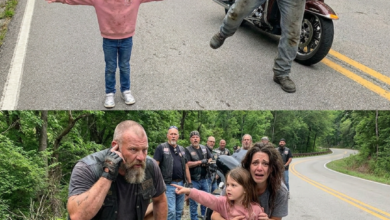
A Six-Year-Old Girl Stood in the Middle of a Kentucky Highway and Stopped Forty Harleys—Three Drivers Had Cursed and Passed Her, but What Waited Beyond the Blind Curve Explained Why Her Mother Feared Her Courage
Part 2
I had been the Iron Lanterns’ road captain for eleven years, which meant my job was not to ride fastest or look toughest. My job was to assume that every hill concealed a stopped car, every gravel patch wanted a front wheel, and every rider behind me would have less time to react than I did.
That habit saved us.
So did distance.
We had left a church parking lot less than six miles earlier. Several riders were still settling into formation, and I had kept our speed near forty instead of letting the group stretch out. When June appeared, I had enough pavement to stop progressively and enough room behind me for the signal to travel backward.
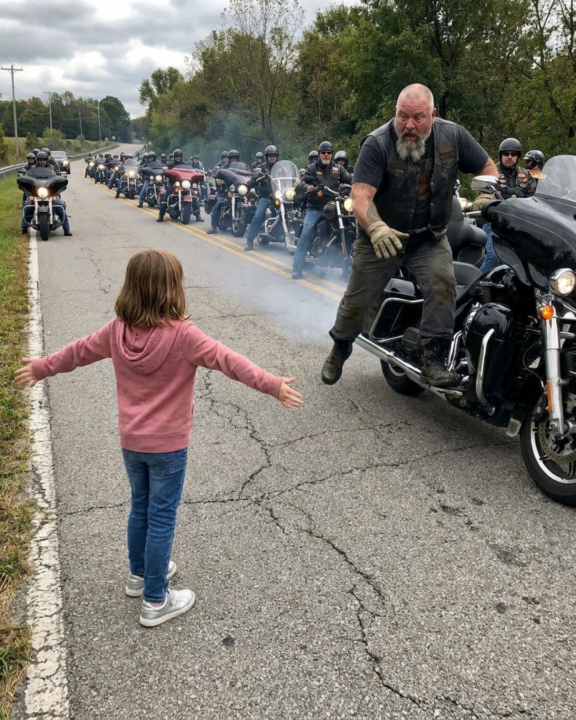
Still, it came close.
Ruth reviewed helmet-camera footage that evening. The eighth rider stopped with fewer than twelve feet remaining. Number seventeen had to move toward the shoulder. One older Road King locked its rear wheel long enough to produce the streak and smoke June later remembered.
Good planning had given us seconds.
A six-year-old had given us the warning.
Those were not the same thing.
I had learned the distinction the expensive way.
At twenty-four, I spent eleven months in county jail after a bar fight left another man with a broken jaw. I had been drinking, angry, and convinced that violence proved I could control a room.
It proved the opposite.
After release, I worked on diesel equipment, stopped drinking, and eventually joined a riding club that cared more about getting everyone home than impressing anyone at a stoplight. Ruth made me road captain because, as she put it, “You distrust your first impulse.”
She meant it as a compliment.
Most days, it was.
When I saw Mara slap June, my first impulse was to step between them. I did, but Ruth caught my vest and kept me from turning a terrified mother into another threat.
Mara’s hand was shaking harder than June’s.
That mattered.
Deputy Aaron Pike arrived first, followed by an ambulance and a volunteer fire unit. He parked upstream with emergency lights visible from the rise, moved every civilian behind the guardrail, and told us not to improvise traffic control in an active roadway.
We listened.
Several riders wanted to turn their motorcycles sideways across the lanes. Pike refused because another truck coming over the rise could have pushed the bikes into us.
Instead, we moved machines onto the gravel pull-off, put on reflective rain shells, and waited where he directed. Firefighters handled the leaking tractor-trailer. State police closed the highway at both ends.
The truck driver was conscious but trapped by the cab door. The rescue crew freed him in nineteen minutes.
The occupants of the three cars were fortunate.
The pickup driver had bruised ribs. The SUV passenger’s wrist was fractured. The sedan driver needed seven stitches and later admitted he believed June was playing a prank.
His dashboard camera showed her standing in the lane.
It also recorded his voice.
“Get out of the road, kid.”
He accelerated around her.
Seconds later, the camera spun toward the guardrail.
When the footage was reviewed, June asked why he had not believed her.
Nobody had a good answer.
Mara sat on the ground beside the ambulance with one arm around her daughter. Her bare feet were gray from the shoulder. There was a rip across one knee where she had fallen while running downhill.
She kept apologizing.
Not to us.
To June.
“I should not have hit you.”
“You were scared.”
“That doesn’t make it right.”
June considered that with the severe expression children use when adults finally speak plainly.
Then she touched her mother’s torn knee.
“You got hurt too.”
Mara began crying without making a sound.
Ruth moved the riders farther away to give them privacy. I remained because Deputy Pike had asked me to provide a statement and because June still had two fingers hooked into the edge of my glove.
The paramedic cleaned her palm. Beneath the dirt were three shallow cuts made when she climbed the back fence.
“Fourth time?” I asked Mara quietly.
She nodded.
Then she told me about Caleb.
He had been thirty-four when he died. He installed heating systems, coached Little League when work allowed, and carried peppermint candies in the truck because June became carsick on winding roads.
The morning of his crash, a gravel hauler had rolled beyond the same blind bend. One driver stopped before entering it, but he had no safe way to warn traffic approaching from the opposite side.
Caleb rounded the curve seventeen seconds later.
The coroner said death was immediate.
June remembered only sounds.
Metal sliding.
A trapped horn.
Her mother screaming his name into a phone.
A trauma counselor had worked with June for several months, but the family lost coverage when Mara changed jobs. Afterward, Mara tried to manage the episodes alone.
She added locks.
She watched the gate.
She avoided saying Caleb’s name near the road.
But fear does not disappear because a family cannot afford another appointment.
Sometimes it learns the floor plan.
Deputy Pike made a referral for family support services, partly because June had reached the highway and partly because Mara had struck her. Mara did not argue. She signed the paperwork with a hand that kept slipping on the pen.
“I need help,” she said.
That sentence changed the room around her more than any excuse could have.
Before we left, I asked June what she had done after hearing the tractor-trailer overturn.
“I ran.”
“What did you see?”
“Smoke.”
“Did you call 911?”
She shook her head.
There was no phone in the yard. She knew her mother’s number but had never been taught how to describe their location to emergency dispatchers.
“What will you do next time?” I asked.
June pointed toward the highway.
It was the only plan she trusted.
That night, forty riders continued to the fundraiser in small groups after the road reopened. We arrived almost three hours late.
At the entrance, people applauded.
I hated it.
They thought the story was about bikers surviving a close call.
It was about a child who believed the safest adult on that highway was herself.
Part 3
The following Monday, Ruth and I returned to the Holloway house.
We did not arrive with forty motorcycles.
We drove Ruth’s pickup, brought groceries because the road closure had kept Mara from reaching work, and carried a basic emergency kit assembled by one of our members who worked as an EMT.
Mara nearly refused everything.
“I don’t want her rewarded for running into traffic.”
“You’re right,” Ruth said.
That answer surprised her.
People had already begun sharing a short phone video of June stopping our formation. The person filming had added dramatic music and called her “Kentucky’s Tiny Highway Angel.”
Ruth asked the page to remove the clip.
The owner refused.
By Tuesday, the video had more than two hundred thousand views. Strangers praised June’s courage, criticized Mara, accused our riders of speeding, and invented details that had never happened.
One post claimed June had pulled an unconscious truck driver from the cab.
Another said Mara deliberately sent her daughter into the highway.
Neither was true.
Virality had taken forty seconds and removed every adult responsibility surrounding it.
June saw none of those posts. Mara kept her offline.
But people began slowing near the house to take pictures. One family left a stuffed bear at the gate. A man from two counties away arrived with a camera and asked June to recreate the moment.
Mara told him to leave.
When he stepped toward the gate, Ruth moved between them.
She did not threaten him. She photographed his license plate and called Deputy Pike.
He left before the cruiser arrived.
That afternoon, we met with June’s new counselor through a county family-resource program. The counselor’s name was Nina Patel, and she explained something we should have understood already.
June’s behavior could not be treated as simple disobedience.
The crash sound triggered a memory she could not organize. Running toward the highway gave her a sense of control. Each time nothing terrible happened, the action became more convincing to her.
And this time, it had worked.
That was the dangerous part.
Forty adults were alive and uninjured partly because June stood in the road. No lecture could make her forget the evidence of her own success.
“We cannot tell her she did nothing good,” Nina said. “She did warn people. We have to teach her a safe way to give that warning.”
The plan began with a phone mounted low inside the kitchen. June learned to dial 911, state her full name, describe the highway, and give the number printed on the utility pole opposite their driveway.
A bright orange card beside the phone carried the words Mara would read aloud until June memorized them:
There has been a crash near the blind curve.
Send police and an ambulance.
I am staying inside the fence.
No child should need a script like that.
But June did.
Mara installed a gate alarm and moved the bucket June had climbed. A neighbor agreed to respond when Mara was showering or working outside. Deputy Pike arranged for dispatch to flag the address so operators would understand the location quickly.
Those steps reduced risk at the house.
They did nothing about the curve.
Three days after the wreck, I drove the route with Pike. The tractor-trailer had been removed, absorbent material covered the stained pavement, and new gouges marked the guardrail.
From the approach, we could not see any of it until we entered the turn.
There was a yellow curve sign.
There were advisory-speed plaques.
Both were legal.
Both were easy to pass without thinking.
Pike showed me eight years of reports he could access: thirteen documented crashes within a half-mile section. Five involved loss of control near the bend. Two included overturned trucks. Caleb Holloway’s death was the only fatality.
“That enough for improvements?” I asked.
“I don’t decide.”
“Who does?”
He gave me the regional transportation office number.
I called from the shoulder.
The first person transferred me.
The second gave me an email address.
The third explained that the curve had already been reviewed after Caleb’s crash and met the minimum standards applicable to that class of roadway.
Minimum.
I wrote the word on the back of a fuel receipt.
The Iron Lanterns held a meeting that night. Some members wanted to buy warning signs and install them ourselves.
Ruth stopped that idea.
“You put unauthorized signs in a highway right-of-way, the state removes them. If a driver reacts to one and crashes, we own part of that.”
A rider named Luis suggested a convex mirror like those used near mountain driveways. Another proposed flashing lights. Someone else wanted a permanent volunteer stationed at the curve on weekends.
None of us were traffic engineers.
So we found one.
Howard Bell was a retired highway-safety consultant and the uncle of one of our younger riders. He visited the site, measured sight distance from public areas, reviewed the crash pattern available to us, and then disappointed everybody.
“A mirror alone may create distortion,” he said. “At night, glare can make it worse. Flashers that operate constantly become background noise. You need a study.”
“How long?”
“Months.”
June was sitting on the porch steps within sight of us.
“Something could happen tomorrow,” I said.
Howard nodded.
“That doesn’t make a bad fix good.”
It was the first major test of the club.
We knew how to ride somewhere, raise money, repair a porch, or fill a hospital parking lot. We were built for visible action.
This required forms.
Data.
Meetings.
Restraint.
Six riders left the project before the second week. One said we were wasting time asking permission from people who had ignored the road for years.
He was not entirely wrong.
He was still leaving.
The rest of us began gathering evidence legally. We requested public crash summaries. Residents submitted written accounts. Businesses supplied delivery-driver reports. Mara collected photographs Caleb had taken before his death showing trucks crossing the center line to clear the rock face.
Then Deputy Pike found something unexpected.
The three vehicles that crashed after passing June had initially been coded as separate loss-of-control incidents caused by the spill.
Technically, that was accurate.
But it hid the more important sequence.
Three drivers received a human warning and still entered the bend because nothing official confirmed it.
When Howard presented that pattern to the transportation district, the room finally changed.
Not enough.
But a little.
The state agreed to conduct a new site review.
Eight days later, an engineer placed temporary cameras near the curve.
On the third night, the footage captured a loaded truck crossing six inches over the center line while another vehicle entered from the opposite direction.
No collision occurred.
It did not need to.
The danger had finally introduced itself on paper.
Part 4
The site review produced recommendations.
It did not produce money.
The first proposal included new chevron boards, trimmed vegetation, refreshed pavement markings, and a radar-activated warning assembly that could detect unusually slow or stopped traffic beyond the blind curve.
The estimated cost was far beyond anything our club could responsibly install or maintain.
The convex mirror was rejected for the highway approach because of distortion concerns. However, engineers agreed a shatter-resistant mirror could improve visibility from the quarry access lane where trucks sometimes entered near the bend.
That distinction frustrated people.
They heard “mirror approved” or “mirror rejected,” depending on what they wanted to believe.
The actual answer was narrower.
One tool. One location. One part of the problem.
The automatic system was more promising. A radar sensor positioned beyond the curve could identify stopped traffic or a blocked lane. Upstream beacons would then flash beneath a clear warning sign before drivers reached the blind approach.
It would not prevent a truck from overturning.
It would create the warning Caleb never received.
The project ranked below several bridges and drainage repairs competing for the same regional funds.
That was when the eight-month fight truly began.
We attended the county meeting first. Forty riders arrived, but only six entered the chamber because Ruth did not want officials to feel surrounded.
The others waited across the street, engines off.
Mara spoke for four minutes.
She did not show June’s viral video.
She brought Caleb’s final work invoice, recovered from his truck, and placed it beside the crash map.
“He was supposed to replace a furnace motor that afternoon,” she said. “This paper stayed in his cab because he never reached the house.”
Then she described June.
Not as an angel.
Not as a hero.
As a traumatized child who had entered a live highway four times because the adults responsible for that road had provided no warning method she could see.
“If you praise her for saving those riders,” Mara said, “you also have to explain why she believed standing there was necessary.”
Nobody spoke for several seconds.
A magistrate asked whether the family intended to sue.
Mara’s shoulders stiffened.
“We came for lights.”
That became the sentence reporters used.
Some treated it as a slogan. For Mara, it was a boundary.
The county could not approve work on the state-maintained section, but it could support the grant request, provide access for electrical service, and authorize the mirror near the quarry lane.
The vote passed.
Then funding stalled again.
A regional review noted that the documented crash rate, while serious, did not automatically meet the highest intervention threshold. The state requested more traffic-volume data and a maintenance agreement for the warning equipment.
Luis slammed his helmet onto a table when he heard.
“So somebody else has to die?”
Howard looked at him.
“No. It means we answer the question they asked.”
Luis walked out.
The next morning, he returned carrying coffee and a printed spreadsheet.
That was brotherhood in the Iron Lanterns.
Not matching patches.
Coming back after anger had nowhere useful to go.
For six weeks, members volunteered in rotating pairs to count heavy vehicles from a safe private turnout with the owner’s permission. We did not stop traffic or stand in the highway. Howard checked the methodology so the numbers could support—not replace—the official study.
Local residents documented near misses through a reporting form. Pike verified what could be supported by calls or video. We discarded stories that had no date, location, or corroboration.
Accuracy cost us dramatic claims.
It gave us credibility.
During the fifth month, an approaching storm knocked a dead limb into the highway near the curve. June heard the impact from her bedroom.
Mara was cooking.
The gate alarm remained silent.
June went to the kitchen phone, dialed 911, read the orange card, and waited inside the fence.
Deputy Pike arrived before a vehicle struck the limb.
When I visited later, June asked whether that counted as saving someone.
“Yes,” I said.
“But I didn’t go outside.”
“That’s why it counts twice.”
She smiled, then looked guilty for smiling.
Trauma can make relief feel disloyal to the person who died.
Nina helped her name that too.
The funding breakthrough came from an unremarkable source: a resurfacing project already scheduled for the following construction season. By combining contracts, the district could add pavement markings, high-friction surface treatment, upgraded chevrons, and conduit for the warning equipment at a lower cost.
The county covered electrical access.
A regional road-safety grant paid most of the detection system.
Our club raised funds for the portion legally accepted through the county improvement partnership, but we did not own the equipment or control its installation.
Engineers did.
Electricians did.
The transportation authority did.
It was slower than a convoy and less photogenic than a fundraiser.
It was also the only version likely to remain after we were gone.
A naming request caused the final dispute.
The state would not rename the highway. Mara did not want that anyway. Every time she heard people say “Caleb’s curve,” she imagined his death owning the entire place.
Instead, the county approved a small memorial designation beside the completed safety installation:
The Caleb Holloway Curve Safety Project.
Not because Caleb was famous.
Because the warning he never received would now be given to others.
Installation began eight months after June stood before us.
On the first morning, she watched from behind the fence with protective earmuffs over her ears. Trucks carried poles and cabinets. Workers cut pavement for sensor loops and mounted radar equipment beyond the bend.
One worker dropped a steel plate.
The bang echoed across the hollow.
June flinched.
Her hands lifted halfway.
Then she looked at her mother, walked inside, and touched the orange card beside the phone.
She did not run.
That was the part no camera captured.
It was also the hardest victory of the day.
Part 5
The system was tested on a Thursday.
Howard arranged for an authorized maintenance truck to stop beyond the curve while transportation employees monitored the equipment. Radar detected the obstruction. Upstream, amber beacons began flashing above a warning that drivers could see before reaching the blind approach.
The first car slowed.
Then the next.
June stood with Mara in the yard, separated from the highway by the locked fence. I watched her eyes follow each vehicle as it reduced speed.
“Are the lights telling them?” she asked.
“Yes.”
“Do they believe lights?”
“More than children.”
I regretted the answer immediately.
June looked down.
I crouched so we were closer to the same height.
“They should have believed you.”
She nodded once.
“But you don’t have to make them anymore.”
That distinction mattered to her.
For two years, adults had told June not to run toward the road. She heard only that stopping danger was wrong.
Now the adults had finally separated the two truths.
Her warning had been right.
Her method could have killed her.
Both belonged in the story.
The official opening was small. Transportation staff checked the cabinet, the county representative thanked several departments, and a local reporter asked to photograph June beneath the memorial marker.
Mara declined.
“Take the equipment,” she said. “Leave her face out.”
The reporter agreed.
Our club parked in a private field and walked to the designated viewing area. No motorcycles lined the shoulder. No one blocked traffic for a photograph.
Luis brought June a child-sized reflective vest. Nina asked whether the gift might reinforce the highway behavior.
Luis immediately put it back in his truck.
He returned with a box of colored pencils.
That was growth.
Not perfect instincts.
Corrected ones.
The convex mirror was installed at the quarry access lane rather than facing the main highway. Drivers entering from that side could see approaching vehicles earlier. Vegetation was cut back. Center and edge lines were refreshed with higher-visibility material. The curve received high-friction pavement treatment, larger chevrons, and the stopped-traffic detection system.
No single change was magical.
Together, they added seconds.
On a road, seconds are infrastructure.
The online story faded, as online stories do. Another child, another rescue, another dramatic clip replaced June on strangers’ screens.
The stuffed bear at the gate became rain-soaked. Mara threw it away.
What remained was less exciting.
Counseling appointments.
A phone script.
A gate alarm.
Maintenance inspections.
Electrical bills.
Annual sensor testing.
Road safety is full of things nobody shares.
Six months after installation, a box truck lost a tire near the far end of the curve. It stopped partly in the travel lane.
The detector activated.
Upstream beacons flashed.
A school bus slowed before the bend. Two cars stopped behind it. Deputy Pike arrived and managed the scene until the truck moved.
June heard no collision.
She saw the lights flashing through her bedroom window.
For the first time, the warning reached the road before she did.
Mara called me.
“She’s sitting on the floor.”
“Is she okay?”
“She says her legs feel like running, but she’s not moving.”
I drove over.
June was still beside the kitchen phone when I arrived. Nina had taught her to press both feet against the floor, identify five things she could see, and wait for the panic to pass.
I sat near the doorway.
We did not talk about bravery.
After several minutes, June said, “The lights did it.”
“Yes.”
“They stood there.”
I looked through the window at the amber flashes reflecting faintly off the trees.
“Yes.”
She drew a picture afterward.
The road curved across the page. A truck waited beyond it. Two yellow circles shone above the lane.
At the bottom, she drew a little girl inside a square house.
Not in the highway.
Inside.
Mara taped the picture above the orange emergency card.
The following spring, official reports showed no crashes in the treated section since installation. Howard warned us not to make grand conclusions from a short period.
“Six months is not proof,” he said.
At one year, there were still no reported crashes.
At two years, none.
At three years, none.
There were mechanical breakdowns, wildlife crossings, storms, and one vehicle that ignored the flashing warning before correcting at the last second.
No system removed human foolishness.
It gave foolishness more room to recover.
The three drivers who passed June responded differently afterward.
The pickup driver sent an apology through Deputy Pike but never met the family.
The SUV passenger wrote June a letter thanking her, which Mara saved until June was old enough to decide whether to read it.
The sedan driver resisted speaking publicly. His dash-camera voice had spread online, and strangers had threatened him.
Mara asked people to stop.
“He made a terrible decision,” she said. “I will not teach my daughter that public cruelty repairs it.”
A year later, the man attended a safety meeting quietly. He sat in the back and left before anyone could photograph him.
He had paid for a new emergency-call box near a rural trailhead through an anonymous donation.
I learned that from Pike.
June never did.
Some repairs do not require the injured person to witness them.
Part 6
Every autumn, the Iron Lanterns rode through Cedar Hollow on the way to the same hospice fundraiser.
We no longer traveled forty abreast through the area. We divided into groups of eight, left larger gaps, and reduced speed well before the warning zone.
The first year, June watched from the porch behind the locked gate.
When my group approached, the radar sign remained dark because the lane beyond the curve was clear. The new chevrons caught our headlights. The high-friction surface made a different hum beneath the tires.
June raised one hand.
Not both.
I raised mine back.
Mara stood behind her.
The ritual continued.
By the third year, June was nine and tall enough to rest her chin on the top rail of the fence. She no longer wore red rain boots. She had glasses with purple frames and carried a library book under one arm.
We stopped in the private field, then walked to the memorial marker.
Mara brought peppermint candies.
Caleb had kept them in his work truck for June’s motion sickness, and she still associated the smell with him. For a long time, she could not eat one without becoming nauseated.
Now she opened the bag herself.
She gave one to Ruth.
One to Luis.
One to me.
Then she placed one beneath the marker—not as an offering the road could take, but as something her father would have recognized.
A transportation maintenance truck arrived during our visit. The technician opened the control cabinet to run an inspection.
June watched from the authorized area.
“What happens if the lights break?” she asked.
“They test them,” I said.
“And if they still break?”
“Someone reports it. Then adults fix it.”
She considered that.
“Which adults?”
“Whichever ones are responsible that day.”
She looked at our club.
“All of you?”
“Sometimes us. Sometimes them. Never only you.”
That answer seemed to satisfy her.
At the next fundraiser, we found a folded drawing beneath the windshield wiper of Ruth’s pickup.
Forty motorcycles filled the bottom of the page. A small house sat on a hill. Between them stood the warning beacon with two enormous yellow lights.
There was no child in the lane.
On the back, June had written one sentence in careful block letters:
THE ROAD KNOWS NOW.
Ruth framed it in the clubhouse.
We did not place it among the club photographs.
It went beside the first-aid cabinet and the ride-safety rules—where every new member would eventually see it.
Part 7
Three years after the tractor-trailer overturned, another crash-like sound rolled across Cedar Hollow.
A dump truck had dropped an empty steel toolbox near the quarry entrance. It struck the pavement, spun twice, and landed against the shoulder.
June was doing homework at the kitchen table.
Mara was outside hanging towels.
Both heard it.
June stood so quickly that her chair fell backward.
Her body remembered before her thoughts did.
She reached the back door.
Then she stopped.
Through the window, she could see the fence, the highway, and the warning assembly beyond the trees. The beacons were dark because traffic was moving normally.
June picked up the kitchen phone.
She told the dispatcher what she had heard and where she was. She remained inside while Mara checked the yard from behind the fence.
Deputy Pike found the toolbox and cleared it.
Nobody was injured.
That evening, Mara called me.
“She stopped at the door,” she said.
Her voice broke on the final word.
I rode to the house alone.
June sat on the porch steps with the gate locked below her. I parked in the gravel drive, removed my helmet, and sat two steps away.
“You were scared?” I asked.
“Yes.”
“You wanted to run?”
“Yes.”
“What did you do?”
“I made the call.”
We listened to traffic pass beyond the trees.
A truck entered the curve. Its engine note changed as the driver slowed near the warning sign.
June watched the roof appear, disappear, and return beyond the bend.
“Bear?”
“Yeah?”
“If Daddy had those lights, would he be alive?”
There are questions adults should never answer with certainty merely because certainty feels kinder.
“I don’t know,” I said. “I wish he’d had them.”
She leaned against her mother when Mara sat beside her.
Later, we walked to the authorized memorial area with Pike present. The small plaque carrying Caleb’s name had weathered around the edges. Mara wiped it with her sleeve.
June did not touch the roadway.
She stayed behind the barrier.
A maintenance truck briefly stopped beyond the blind curve while inspecting a damaged reflector. The detector recognized it.
Amber lights awakened above us.
One flash.
Then another.
Approaching vehicles slowed.
June slipped her hand into mine. My fingers were scarred, hers still small enough to close around only two of them—the same way she had held my glove on the day we met.
But this time, she was not pulling me toward danger.
She was watching the warning stand there for her.
The road had finally raised its own hands.
Follow the page for more biker stories about quiet courage, imperfect families, and ordinary people who stay long enough to turn one rescue into lasting change.