A Biker Kicked Open a Famous Pastor’s Charity Livestream—Then Pointed at the “Orphan” Used to Raise Millions and Told Thousands of Viewers, “That Girl Is My Daughter”
Part 2
I first saw Sophie’s fundraising photograph on a cracked phone screen at the Black River clubhouse.
A prospect named Eli found the advertisement while watching a football clip online. The campaign began automatically after the video.
He called me across the room.
“Rook, isn’t that your kid?”
I looked.
For several seconds, I saw only Sophie’s necklace.
Elena had bought it at a street fair when Sophie turned ten. The chain was inexpensive, and the moon had a small blue-glass star set into one edge.
After Elena’s funeral, Sophie wore it beneath every shirt.
The photograph showed the necklace outside her sweater.
That meant it had been taken during the seventeen days she stayed at the crisis residence.
I listened to Pastor Ward’s appeal twice.
He described children abandoned by death, addiction, and incarceration. Those were three different realities, but he folded them into one word.
Orphans.
Then the screen displayed an illustration of six small cottage homes surrounding a playground.
Ward said each donation would help create “a permanent village for children who have no family remaining.”
Sophie had family.
She had me.
That truth was not as clean as I wanted it to be.
After Elena died from a ruptured cerebral aneurysm, I relapsed. I had spent eight years away from pills, but grief made old lies sound practical.
Just sleep tonight.
Just get through the funeral.
Just stop your hands from shaking.
Within two weeks, I was hiding bottles in the garage.
Sophie found one.
She did not cry. She placed it on the kitchen table and asked whether she would lose another parent.
The next morning, I called my sponsor and entered treatment.
I signed a voluntary temporary-care agreement so Aunt Rachel could make school and medical decisions. Because Rachel lived in another county and needed time to arrange transportation, Sophie spent seventeen days in Hope Harbor House, a licensed short-term residence operated by an organization affiliated with Ward’s ministry.
I hated myself for those seventeen days.
That made the advertisement effective against me.
It took my guilt and gave it a caption.
The club wanted to ride directly to the ministry.
I refused.
Breaking a door came later. It was not our first step.
Our treasurer, Denise Park, had worked in commercial banking before joining the Black River Riders. She searched nonprofit filings, state charity registrations, deeds, and planning records.
Harbor Hearts reported substantial fundraising revenue.
Its public materials promised a children’s village.
Yet none of the parcels associated with the organization were zoned or permitted for residential cottages.
One mailing address belonged to a rented office.
Another led to an empty lot owned by somebody unrelated to the ministry.
A third belonged to Pastor Ward’s media company.
We still did not have proof of fraud.
A charity can raise money before purchasing land. Projects fail. Plans change. Public filings can lag. Denise repeated those points whenever anger tried to become evidence.
We requested information as potential donors.
The ministry sent glossy renderings, testimony videos, and a spending chart with broad categories.
It did not provide a construction address.
We asked again.
No address.
I contacted the crisis residence. Its director admitted Sophie’s photograph had been taken there but said the ministry’s media department controlled the campaign.
The release Aunt Rachel signed permitted limited program communications. It did not clearly authorize depicting Sophie as permanently parentless in national fundraising.
An attorney from a legal-aid referral service sent a cease-and-desist request demanding removal of the image.
The ministry signed for it.
Nine days later, Sophie’s face appeared in the livestream promotion again.
That was the day restraint began losing.
A local investigative reporter, Paige Holloway, agreed to meet us near the studio. She had independently examined the construction claims but needed stronger documentation.
Our plan was simple.
Ask Ward questions on camera in a public lobby.
Show the property records.
Leave if instructed.
I promised Sophie’s aunt I would not force my way anywhere.
Then I reached the ministry building and heard Ward’s amplified voice through the locked studio door.
He was telling thousands of viewers that Sophie had nobody.
I saw the old glass window in the door.
Behind it stood my daughter’s face, enlarged twelve feet high.
Security told me to leave.
I should have.
Instead, I stepped back.
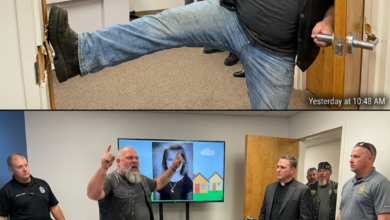
And I chose the door.
Part 3
The lock broke on the second kick.
I wish I could say anger erased my understanding of the law.
It did not.
I knew the door belonged to somebody else. I knew security had denied entry. I knew every camera inside would capture what I did.
I kicked anyway.
That decision gave Ward exactly the picture he needed: a huge tattooed biker invading a charity broadcast run by a beloved pastor.
For the first ten seconds, I became his best fundraising material.
Ward stood behind a white desk with a Bible open beside a tablet. Soft studio lights warmed the set. A telephone bank of volunteers occupied one side of the room.
Behind him, Sophie’s image filled the screen.
I walked three steps inside and stopped.
Two security volunteers approached. I raised my hands.
“No weapon.”
“Get on the floor.”
“I called the police before I came in.”
That confused them.
I had told dispatch there might be a confrontation at the ministry building and that I was requesting an officer. I had not told them I planned to break a door because, until the second before doing it, I did not.
The club members in the hallway stayed back. Denise shouted that our documents were with the reporter.
Ward addressed the camera.
“Friends, remain calm.”
I pointed at Sophie.
“That girl has a father.”
The donation counter continued moving.
Ward said the images represented children served through affiliated programs and that details were sometimes altered for privacy.
“You didn’t protect her privacy,” I said. “You changed her family.”
Security gripped my right arm.
I did not resist.
Ward could have ordered the broadcast cut immediately. He did not. I believe he thought the confrontation made him look persecuted.
That choice preserved his answers.
I asked for the address of the first cottage.
He spoke about vision.
I asked for the building permit.
He spoke about delays.
I asked why promotional footage presented rented retreat cabins as completed homes.
He called that accusation defamatory.
Then he said, “We never claimed every featured child had no living parent.”
I turned toward the camera.
“You called mine an orphan.”
The producer cut the feed.
Police arrived less than two minutes later. I followed every command, knelt, and allowed them to handcuff me.
Paige recorded from the hallway. Denise gave officers the folder. No one tried to prevent my arrest.
At the station, I was booked for criminal trespass and property damage. Ward’s security volunteer declined to accuse me of assault because I had not struck or threatened him.
My hands still shook.
Not from fear of jail.
From knowing Sophie would see the clip.
A club member posted bond that evening. Outside, a dozen cameras waited.
I said only three things.
The girl in the photograph was my daughter.
The charity had ignored a removal demand.
People should review documents, not my behavior.
The last sentence disappeared from most headlines.
“BIKER DAD STORMS FAKE ORPHAN FUNDRAISER” spread faster.
Supporters offered to pay my legal fees. Strangers praised me for doing what “real men” do. Somebody sold shirts with a picture of a boot breaking a door.
I asked them to stop.
I had not exposed the financial fraud yet.
I had damaged property on a suspicion supported by inconsistencies.
Those distinctions mattered.
When I reached Rachel’s house, Sophie waited at the kitchen table. My broken-door video played silently on a tablet.
She looked like Elena when she was disappointed—still, direct, unwilling to help me lie to myself.
“You kicked a door.”
“Yes.”
“You promised Aunt Rachel.”
“Yes.”
“Because he called me an orphan?”
“That was part of it.”
Sophie touched the crescent necklace.
“You were gone too.”
“I was in treatment.”
“I know where you were.”
Her voice rose.
“That doesn’t mean you were here.”
I tried to explain that treatment was how I came back.
She shook her head.
“You kicked down his door because you couldn’t stand him saying I had no dad. But when Mom died, I had to sleep in a strange room while you disappeared.”
Every defense I had prepared became useless.
She was not saying treatment was wrong.
She was telling me the cost had landed on her body too.
“I thought exposing him would fix it,” I said.
“Fix what?”
I had no answer.
My daughter went upstairs.
Rachel remained at the sink, drying the same plate for nearly a minute.
“You want advice?” she asked.
“No.”
“You’re getting it. Stop trying to make this the moment you rescued her.”
My phone rang before I could respond.
The caller was Paige.
A woman named Naomi Velez had contacted the state attorney general and the reporter’s newsroom. Naomi had worked as Harbor Hearts’ senior bookkeeper for four years.
She had bank statements.
Internal budgets.
Invoices.
And a spreadsheet labeled with the names of thirty-seven children used in fundraising campaigns.
Sophie was number fourteen.
Beside her name was a category code.
HIGH-RESPONSE FEMALE / BEREAVEMENT.
The photograph was not chosen accidentally.
My daughter’s grief had been tested for profitability.
Part 4
Naomi did not meet us at the clubhouse.
She chose a conference room inside her attorney’s office, where documents could be transferred properly and her identity protected until investigators determined what could be disclosed.
That was the first sign she understood the stakes better than we did.
She had resigned from Harbor Hearts four months earlier. Before leaving, she preserved records she was legally entitled or required to retain and reported suspected misconduct through internal channels.
The board chair forwarded her complaint to Pastor Ward.
Nothing changed.
Naomi then consulted counsel and submitted information to state regulators. My livestream confrontation did not create her evidence.
It convinced her the ministry was still using children after receiving direct objections.
The ledgers showed millions collected through restricted appeals for cottage construction.
Very little reached anything resembling construction.
Some funds paid for legitimate crisis-residence services, meals, temporary transportation, and staff. That fact complicated the story.
Harbor Hearts had helped families.
It had also used that work to support promises it was not fulfilling.
Large transfers went to a media-production company owned by Ward’s brother-in-law. Another affiliated company charged consulting fees for site development on property the charity never purchased.
Donations designated for cottages funded television sets, travel, donor dinners, audience acquisition, and executive compensation.
Fundraising has costs.
Those costs were presented to donors as walls, beds, and playgrounds.
Internal emails revealed staff repeatedly asking for a construction timeline. Ward’s executive team answered with staged rendering updates.
The houses existed only as images.
The “groundbreaking” footage shown in one campaign came from an unrelated housing development. Staff cropped signs and filmed volunteers moving empty wheelbarrows on a section loaned for two hours.
The retreat cabins displayed as completed children’s homes had been rented for one weekend.
No children lived there.
No permanent caregivers had been hired.
The village was a set.
The spreadsheet involving Sophie was worse in a different way.
Marketing staff classified children by story elements believed to increase donations: bereavement, visible disability, sibling separation, disaster loss, or parental addiction.
Names were not always used publicly, but faces often were.
Consent documentation varied. Some forms permitted internal newsletters. Others authorized specific program materials. Several releases had expired.
The marketing database stripped those differences away.
Sophie’s mother was dead.
Her father had entered addiction treatment.
That combination produced a strong response during small test campaigns, so her photograph moved into national appeals.
One internal note said:
“Remove father context; weakens orphan narrative.”
I read that sentence three times.
Naomi watched my hands tighten around the paper.
“Do not take that original,” she said.
I let go.
Regulators obtained records through proper legal process. Our copies remained with attorneys and reporters who could authenticate them.
The next public twist came from the crisis-residence director.
At first, she defended the ministry. Then investigators showed her how Sophie’s image had been presented.
She began crying.
She had been told the fundraising supported expansion of temporary family care. She believed cottage donations would create respite units where children could stay briefly while parents received medical or addiction treatment.
She had never been told the children were marketed as having no living family.
Her staff had not received the millions viewers assumed were funding their work.
The crisis home survived on local grants, food donations, and delayed payroll.
Ward had used a struggling real program to give his imaginary village credibility.
The ministry board suspended him after sponsors began withdrawing. Ward denied personal wrongdoing and blamed financial managers.
Naomi produced emails showing he approved the language and vendor payments.
Still, investigations take time.
There was no dramatic courtroom the next morning.
Accounts had to be traced. Donor restrictions had to be compared with actual spending. Children’s identities required protection. Social-service agencies reviewed placements so no resident lost safe care merely because a parent organization was under investigation.
My criminal case moved faster.
I pleaded guilty to a misdemeanor property offense under an agreement requiring restitution for the door, community service, and an anger-management course.
Some supporters called that unfair.
I did not.
The ministry’s fraud did not make my kick legal.
Sophie attended my plea hearing.
Afterward, I asked whether she thought I had embarrassed her.
“Yes.”
Then she added, “But the pastor did worse.”
I waited.
“That doesn’t make what you did okay.”
“No.”
It was the first conversation in which neither of us tried to force one truth to erase another.
Weeks later, Sophie asked to read the internal note about removing her father.
I wanted to protect her.
Her therapist and aunt helped decide what could be shared safely. Sophie read a redacted version with an adult beside her.
She did not cry.
She looked at me and said:
“They didn’t just call me an orphan.”
“No.”
“They decided you were bad for the story.”
That sentence revealed the deeper theft.
The campaign had not only used Sophie’s mother’s death.
It had erased a living father because reconciliation raised less money than abandonment.
Part 5
Pastor Ward’s defenders remained loud.
They said administrative errors did not erase years of ministry. They pointed to meals served, temporary beds funded, and families who had received help.
They were correct about those services.
They were wrong about what those services excused.
Good work cannot be used as camouflage for restricted donations spent elsewhere.
The state sought an injunction. A court appointed an independent receiver to preserve records, protect remaining assets, and coordinate with licensed programs serving children.
Harbor Hearts’ direct fundraising stopped.
The crisis residence remained open under temporary independent management because closing it immediately would have harmed families who had done nothing wrong.
That decision angered people demanding the entire organization disappear overnight.
Naomi supported it.
“Burning down the real bed does not punish the imaginary house,” she said.
The sentence stayed with me.
Nearly eighteen months passed before criminal charges were resolved. Ward ultimately pleaded guilty to federal wire-fraud and tax-related counts connected to affiliated-company payments. Other executives entered separate agreements based on their conduct.
The court ordered restitution, though nobody pretended every dollar would return.
The remaining charitable assets were redirected under supervision toward verified child and family services consistent with donor restrictions where legally possible.
Two planned respite units were eventually completed by an independent nonprofit with published permits, audited accounts, and no connection to Ward.
They were not orphanages.
They were temporary family-stabilization homes designed to keep children safe while parents received treatment, medical care, or emergency housing.
That distinction mattered to Sophie.
She helped name the program.
Not after herself.
Not after Elena.
She called it The Still Here Project.
When a reporter asked why, Sophie said, “Because losing one parent doesn’t make the other one disappear.”
By then, she was fifteen.
My relationship with her improved slowly.
No viral reconciliation occurred. She did not run into my arms after the investigation proved the ministry had lied.
We attended family counseling.
I answered questions about my relapse without making Elena’s death an excuse. Sophie described the crisis residence—the humming hallway light, the borrowed pajamas, and the way staff checked rooms at night.
I had imagined those seventeen days mainly through my guilt.
She made me hear them through her fear.
At home, we created one small ritual.
Every Sunday evening, we sat at the kitchen table and reviewed the coming week. School schedules. My recovery meeting. Work shifts. Therapy appointments. Club events.
If I expected to be late, I wrote it down.
If plans changed, I called.
The system looked childish for a fifty-six-year-old man.
Sophie needed predictability more than I needed pride.
The Black River Riders also changed how we handled charity work. Denise established a separate nonprofit with independent board members, annual public reports, conflict-of-interest rules, and external financial review.
Some riders complained that paperwork killed generosity.
Sophie attended one meeting and placed the Harbor Hearts promotional booklet beside the new policy binder.
“Paperwork didn’t kill those houses,” she said. “There never were houses.”
The rules passed unanimously.
The club raised money for the Still Here Project, but we did not use children’s faces. Families could share stories only through informed, specific consent, and refusing publicity never affected assistance.
No staged porch photographs.
No grief categories.
No enlarging a child’s face behind a donation counter.
The first respite unit opened almost three years after I broke Ward’s door. Sophie and I visited privately before families moved in.
The building was plain.
Two bedrooms.
A small kitchen.
A scratched secondhand dining table donated by a church that had no television studio.
Sophie stood in the doorway of the smaller bedroom.
“This is real?”
I knocked my knuckles against the wall.
“Real drywall.”
She smiled briefly.
Then she became serious.
“Don’t put my picture here.”
“We won’t.”
“Not even the good story.”
“Especially not the good story.”
She touched the crescent-moon necklace.
For the first time, I understood that protecting her did not mean telling the world what had happened.
Sometimes protection meant allowing her to remain unseen.
Part 6
The broken studio door was kept as evidence for a while, then repaired.
I paid $1,842 in restitution for the frame, lock, labor, and damaged acoustic panel. The receipt remained folded inside my vest for years.
Not as a trophy.
As a reminder that anger sends invoices even when it points toward something true.
Every anniversary of Elena’s death, Sophie and I visited the small park where she used to take us for cheap summer concerts. We carried coffee for me, hot chocolate for Sophie, and no camera.
The first year, conversation failed.
The second year, Sophie told a story about Elena burning grilled cheese and blaming the pan.
The third year, we laughed before either of us apologized.
Recovery became ordinary too.
Meetings.
Drug screenings required by my treatment plan.
Phone calls when cravings returned.
Bad nights that ended without bottles hidden in the garage.
The club stopped praising me for “saving” Sophie from the fundraiser. Boone, our road captain, corrected anyone who used that word.
“Rook exposed a lie,” he would say. “Then his kid made him face his own.”
He was right.
At seventeen, Sophie began volunteering with a youth advisory group that reviewed how nonprofits represented children in media. She did not tell strangers which campaign had used her face.
She did not need to turn her wound into identification.
One afternoon, she brought home a draft consent form and asked me to read it.
The first page explained where an image would appear.
The second stated how long permission lasted.
A child old enough to understand could say no even when an adult guardian said yes.
At the bottom was a sentence Sophie had requested:
Help will never depend on publicity.
I read it twice.
“Good?”
“Yeah.”
She nodded and returned it to her bag.
The crescent necklace caught against the zipper. Sophie freed it gently.
Years earlier, that necklace had allowed me to recognize my child inside a lie.
Now it rested against the person she had chosen to become.
Part 7
Five years after the livestream, Sophie and I attended the opening of the second Still Here respite home.
She was eighteen.
I was still large, gray-bearded, tattooed, and easier to recognize than I wanted. The viral clip of me breaking the door still resurfaced whenever Ward’s name appeared in the news.
I no longer watched it.
The new house stood on property owned by the independent nonprofit. Its permit history was public. Construction invoices had been reviewed. The kitchen cabinets closed unevenly, and one bedroom window stuck halfway up.
Real buildings have flaws.
That was how I trusted it.
A reporter approached Sophie and asked whether she would pose beside the front door.
“No.”
The reporter looked surprised.
Sophie continued.
“You can photograph the house. You can interview the director. The families using it can choose for themselves later. My face has already raised enough money without my permission.”
The reporter lowered the camera.
“Understood.”
Inside, Sophie opened a kitchen drawer and found a packet containing emergency contacts, transportation schedules, counseling resources, and a plain notebook for families to record questions.
No donation brochure.
No camera release.
No manufactured label.
She wrote something on the notebook’s first page, then closed it before I could read.
Later, after everyone left, she allowed me to look.
You are not abandoned just because your family needs help.
We stood in the quiet kitchen.
Five years earlier, I had tried to fight erasure with a boot and a broken door. I thought fatherhood meant arriving loudly enough that nobody could deny I existed.
Sophie had taught me something harder.
A father is not proven by the noise he makes when somebody calls his child an orphan.
He is proven by the mornings he returns.
The schedules he keeps.
The truths he does not dodge.
The doors he learns to knock on.
Outside, club motorcycles started one by one. Their V-twins shook the loose windowpane above the sink.
Sophie slipped the crescent moon beneath her collar and turned off the kitchen light.
I held the front door open.
She walked through first.
This time, I followed her home.
Follow the page for more biker stories about hidden corruption, complicated redemption, and the people who rebuild trust after the loudest moment is over.