A Seven-Year-Old Girl Tore Up Her Schoolbooks and Threw Them Into the River—The Biker Who Sat Beside Her Discovered She Was Trying to Save Her Mother From a Bill They Never Owed
Part 2
I had taken the river road because I was avoiding the highway.
There was construction near the interchange, and an afternoon ride through town seemed easier than sitting between two gravel trucks with the Harley heating my knees.
That decision put me beside the park footbridge at the exact moment a spelling test caught against the railing.
I saw the page first.
Then the backpack.
Then the little girl pulling at the spine of a notebook with both hands.
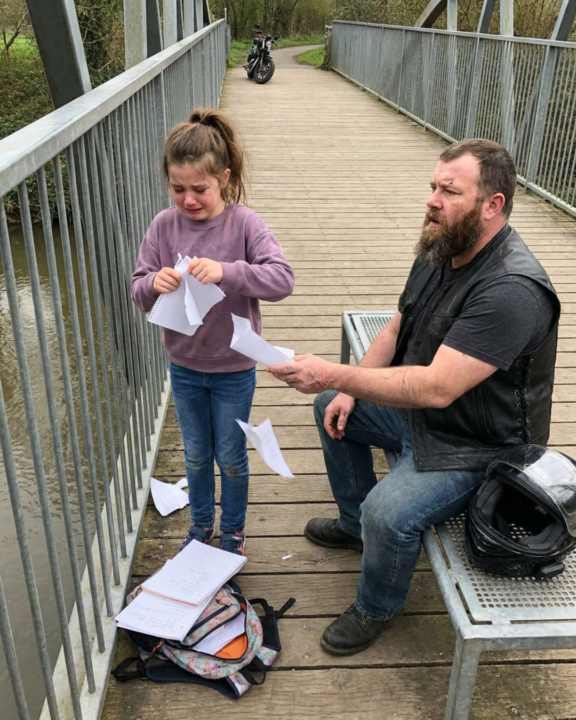
My first reaction was irritation.
I’m not proud of that, but it is true.
I saw a child destroying something an adult had probably struggled to buy, and an old sentence rose in me before I knew anything about her.
You know what those cost?
I had heard that sentence throughout my childhood.
A broken glass.
A coat left at school.
A lost pencil.
Every mistake carried a price, and every price arrived attached to an adult’s tired face.
I came from a house where money was discussed only when it had run out. By twelve, I could identify overdue notices through an envelope window. By fourteen, I had learned to ask for nothing in the week before payday.
That did not make me mature.
It made me quiet.
I stopped asking for help with schoolwork because I thought needing help was another kind of expense. Later, I left school before graduating and spent years pretending I preferred work to classrooms.
At thirty-eight, I earned my equivalency diploma at a community learning center.
The instructor who helped me used to say, “You weren’t born disliking school, Hank. Something taught you to leave before you could be left behind.”
I disliked her for saying it.
Then I kept attending.
That was why I swallowed the lecture on the bridge.
I parked near the entrance, switched off the engine, and carried my helmet onto the pedestrian walkway. The Harley’s ticking exhaust faded behind me.
Maisie heard my boots.
She looked up once and lowered her eyes.
I stopped far enough away not to crowd her.
The railing was high and closely spaced. She was standing on the walkway, not climbing or leaning over it. The immediate concern was a young child alone, not a child trying to go into the river.
I asked whether I could sit.
She shrugged.
I sat on the bench built into the wider part of the bridge, leaving space between us and keeping the route to the park open.
She resumed tearing.
A page floated toward the railing.
I caught it against my knee.
“Let’s keep these here.”
I placed my helmet between us.
She looked inside it as if I had offered an unusual trash can.
Then she dropped a handful of paper into it.
That was our first agreement.
I did not let her finish because I thought destroying books was healthy. I waited because taking hold of her possessions before understanding her distress seemed likely to make her more frightened.
I could replace paper.
I could not replace the chance to hear what she was trying to say.
The last notebook had a green cover. She pulled until the binding gave way, then sat beside it breathing hard.
“I’m not going back.”
I asked where.
“School.”
I asked whether someone had hurt her or made her afraid there.
She shook her head.
Her teacher was nice.
She liked reading.
Math was easy unless the question included a clock.
Nothing about her answers sounded like a child relieved to escape a place she hated.
Then she said her mother could not afford her going.
A cyclist passed behind us.
The river moved beneath the bridge.
Somewhere on the far bank, a mower started.
The ordinary sounds continued while a seven-year-old told me she had found a way to reduce her mother’s bills.
I asked what she thought would happen the next morning.
“I’ll stay home.”
“And your teacher?”
“Mom can say I don’t have my stuff.”
I looked at the handwriting scattered inside my helmet.
Every answer on the spelling test was correct.
The child was not running from failure.
She was trying to become cheaper.
Part 3
Finding her grandmother was the first useful thing I did.
Maisie knew the house, the street, and the telephone number because her grandmother had made her practice it. She recited the digits twice while I entered them.
A woman answered before the second ring finished.
I gave my name, explained that I was with Maisie at the park bridge, and told her the child appeared physically unhurt.
Her voice changed immediately.
She thought Maisie was still visiting the neighbor three doors away.
I asked her to remain on the phone long enough for Maisie to speak.
The girl took my phone with both hands.
“Grandma, I’m okay.”
Then her chin began shaking.
I turned slightly away to give her the little privacy available on a public bridge.
Her grandmother told her to stay where she was and said her mother was nearby.
I remained seated until Erin arrived.
I did not suggest leaving on the motorcycle.
I did not take Maisie anywhere.
We gathered the loose paper still on the walkway and placed it in the helmet. A park employee noticed what we were doing and brought a bag. I told him several pages had reached the water.
He said the maintenance crew could collect what became safely accessible along the bank.
Nobody was going into the river after a workbook.
That mattered to Maisie. She kept watching the water as though the pages might return if she stared long enough.
A torn corner had lodged in the railing.
She pulled it loose.
It carried the bottom half of a gold star.
“Can I keep this?”
“Of course.”
She placed it in her sweatshirt pocket.
When Erin reached us, she was still wearing a black diner apron. Flour marked one hip, and her keys were hooked through a belt loop.
She looked first at her daughter.
Then at me.
Then at the bag.
“Oh, Maisie.”
The girl stepped back.
I expected an explanation about being angry, not wanting homework, or getting into trouble.
Instead, she said, “I fixed it.”
Erin stopped.
“You don’t have to buy more,” Maisie continued. “I can stay with Grandma. Then you won’t need all the jobs.”
Her mother made a sound I had no name for.
Not a sob.
Not a gasp.
The sound of somebody discovering the weight she had hidden had been carried by smaller hands.
She knelt.
“Honey, no.”
Maisie began explaining faster.
She could help fold laundry.
She could clean.
She did not need new shoes.
She would stop asking whether they could get a cat.
Each promise arrived like another item she could remove from a bill.
Erin reached for her, but Maisie kept talking.
“I know the books cost money. You said you didn’t have enough.”
“I was talking about the bills.”
“I know.”
“No, sweetheart. Not about whether I want you to learn.”
Maisie’s face crumpled.
“If I don’t go, you can sleep.”
Erin held her then.
I looked toward the river because some moments do not improve with an audience.
A few minutes later, Maisie sat between her mother and grandmother, who had reached the bridge carrying a cardigan nobody needed.
Erin explained the fee notice.
She was not saying the school charged tuition. She knew public instruction was free. But the bill combined current material charges with older balances, and the notices used language she found difficult to distinguish from essential school costs.
She had never been told Maisie would be excluded from lessons.
She had simply reached the end of a week in which every envelope demanded more than she had.
“I said something stupid,” she told me.
“You said something tired.”
“That doesn’t mean she didn’t hear it.”
“No.”
I did not offer the kind of comfort that requires pretending a thing did not happen.
I asked whether she wanted company when she spoke to the school.
Her shoulders tightened.
“I can handle my daughter’s school.”
“I believe you.”
“Then why come?”
“Because two people can hear an explanation better than one person who’s afraid of it.”
She looked down at the ruined notebook.
After a while, she nodded.
That evening, I called Ruth, the president of our riding club.
I asked whether we could replace a child’s school supplies quietly.
Ruth said yes before I finished.
Then she asked what else had happened.
I told her only what Erin had permitted me to share.
Ruth had spent twenty years handling payroll at a manufacturing plant.
“Does the district have a fee-waiver policy?”
“I don’t know.”
“Ask before anybody pays.”
I looked at the invoice Erin had photographed for me.
My first plan had been simple: give her the money, buy the books, and feel useful.
Ruth stopped that plan with one question.
What if the amount was never hers to pay?
The next morning, Erin met me outside the school office with a folder pressed beneath one arm.
Maisie carried the empty green notebook.
She wanted to apologize for it.
We thought the difficult conversation would begin when the principal arrived.
Instead, it began when the secretary found an approval form Erin had nearly forgotten submitting.
Part 4
The accounts secretary’s name was Paula Reed.
She wore reading glasses on a blue cord and kept a small ceramic dish of paper clips beside her keyboard. A mug near the printer had gone cold.
I remember those things because, for the first few minutes, nothing looked like the beginning of an investigation.
It looked like a school office.
A parent arrived needing help.
A child waited with damaged supplies.
A large man sat in a chair built for somebody with narrower shoulders.
Erin explained the bill.
Paula asked whether she had applied for a waiver.
“Yes. Both years.”
“Do you have copies?”
Erin opened the folder.
There were pay stubs, utility notices, school letters, and two application receipts clipped together. She had kept them because she kept everything she was afraid she might need.
Paula entered Maisie’s student number.
Then she opened the paper file.
She stopped.
“Just a moment.”
She read the screen again.
Then the approval.
Then the screen.
The silence changed the room.
Erin leaned forward.
“What?”
Paula did not answer quickly enough to make it sound smaller.
“Your application was approved.”
“For this year?”
“For both years shown here.”
Erin looked at the bill in her hands.
“Then why did I get this?”
Paula asked the principal to join us.
Principal Denise Hart came from a classroom with a radio clipped to her waistband. She listened, reviewed the documents, and asked Paula to contact the district business office.
Nobody accused Erin of misunderstanding her income.
Nobody told her to return another day without an explanation.
That was the first thing the school did right after two years of getting it wrong.
The district’s local policy waived specified instructional-material charges for eligible households. Erin’s submitted information met the requirements.
Her paper applications had been approved.
But the billing database contained the wrong status code.
The person entering the first approval had selected a similar-looking option that did not activate the waiver. The error carried into the next year’s account setup.
The second application was filed as approved paperwork.
Nobody reconciled it with the electronic billing setting.
The paper said yes. The invoices kept saying pay.
At first, Erin did not react.
She counted something on the edge of the desk.
Then she asked how much she had already paid.
Paula could account for the school’s transactions, but she would not guess. She said the business office would verify every charge and payment before giving Erin a total.
Erin nodded.
Then she nodded again.
The movements looked automatic.
Maisie had been listening.
“If it was wrong,” she asked, “why did Mom pay it?”
Principal Hart moved her chair closer, without crowding her.
“Because adults here made a mistake, and we didn’t catch it.”
“Did Mom do the paper wrong?”
“No.”
“Did I?”
“No.”
Maisie looked at the torn notebook in her lap.
Paula took off her glasses.
Erin asked whether the school could simply remove the current balance.
“Yes,” the principal said. “We’ll place the disputed charges on hold today while the district verifies the correction.”
“And the old payments?”
“We’re asking for a complete review.”
That distinction mattered. Principal Hart could not reach into a drawer and refund two years of transactions.
There were records to verify, accounts to reconcile, and formal authorization required.
But she could stop pretending the invoice deserved trust merely because it had been printed.
With Erin’s permission, the business office examined her account in detail. The review identified a pattern worth checking elsewhere.
I was not permitted to view other families’ records.
I did not ask.
District staff compared approved applications against active billing statuses through their own controlled process. The first mismatch was not the only one.
There were thirty-four more.
Over two billing years, thirty-five households had been charged for items covered by their approved waivers.
Some had paid immediately.
Some paid in installments.
Some carried balances that grew simply because the original charge had never been corrected.
The district later released an aggregate total.
Eight thousand four hundred sixty dollars had been collected in error.
I pictured that number as wages.
Not a headline.
Not an accounting adjustment.
Hours cleaning floors after office workers went home.
Hours standing beside hot griddles.
Hours taking a second bus because a car repair had to wait.
Erin received her verified individual total a week later.
Three hundred twelve dollars.
She stared at the figure, then laughed once without humor.
“That was the tire money.”
The tires on her car had failed inspection the previous winter. She had borrowed from her sister to replace them.
A school bill had not single-handedly created her hardship.
Life was not that tidy.
But it had taken money she was already using to hold everything else together.
And her daughter had heard the strain without understanding its source.
That evening, Maisie asked whether the school computer was a person.
“No,” Erin told her.
“Then who makes it say things?”
The district would spend the next several weeks answering a more complicated version of the same question.
Part 5
Nobody had stolen the money.
That was the first assumption people made when the review became public.
A crooked employee.
A hidden account.
Someone taking cash from families who could not afford lawyers.
The findings did not support that story.
The money entered ordinary district accounts.
The problem was an entry error, repeated billing, an inadequate check between systems, and a process that treated paperwork as complete once it had been filed.
That did not make the damage harmless.
It made responsibility harder to point at.
The employee who entered the first incorrect statuses had worked across several offices during a staffing shortage. The review found no evidence of deliberate misconduct or personal benefit.
But it did find a set of approval codes that were poorly labeled, a training guide that did not match the updated system, and no required confirmation showing a parent that a waiver had actually activated.
A human mistake entered a process designed to keep believing it.
The following year, renewal approvals went into folders.
The electronic status carried forward.
Invoices generated automatically.
Parents paid because bills arrive wearing authority.
At the school-board meeting where the aggregate findings were presented, some people wanted the responsible clerk fired immediately.
A man stood and said someone needed to be made an example.
Erin stood afterward.
She had never liked speaking in public. At the diner, she could carry four plates and handle a room full of impatient customers.
At the microphone, both hands shook.
“I want somebody to answer for this,” she said. “But I don’t want the next person sitting at the same desk with the same broken instructions.”
The room quieted.
She asked for refunds.
Clear notices.
A second check.
A telephone number answered by someone who could explain the difference between a fee, a voluntary contribution, and something a child actually needed to bring.
She also asked the district to state plainly that unpaid eligible fees did not mean a child should stop attending class.
Maisie had not been barred from school.
But she had believed that leaving was the reasonable response to a bill.
That misunderstanding deserved attention too.
The district approved refunds for every verified mistaken payment. Existing affected balances were corrected. Families received individual statements explaining the original charge, the waiver approval, the amount paid, and the amount being returned.
Some refunds went electronically.
Others required checks because families had paid through different methods or no longer used the original account.
Returned mail created delays.
So did changed addresses.
A parent liaison helped locate families without publishing their names or financial circumstances.
It took weeks.
Not a single triumphant afternoon.
One mother had moved to another county. A father had paid in cash through installments and needed receipts matched against the ledger. A grandmother believed the refund notice was a scam and called the school twice before depositing the check.
Making people whole required more work than admitting the mistake.
The district revised its reconciliation process. Approved waivers had to match the active billing status, and renewal imports received a separate review.
Families received confirmation when relief was applied.
Local administrators shared the findings with regional education offices, prompting other districts to check similar processes. There was no instant statewide miracle, but there were reviews, questions, and additional safeguards.
Ruth told our club not to confuse that with the end.
“The kids still need things,” she said.
We had already offered Maisie replacement workbooks and supplies, with the school coordinating any school-owned materials.
Then the club proposed two hundred additional kits.
Not mystery bags chosen by men who thought every pencil was the same.
Teachers supplied practical lists.
Families could request age-appropriate materials.
Backpacks, notebooks, pencils, folders, crayons, glue, and replacement consumables were bought in bulk.
We partnered with the district family-resource office and a community charity rather than creating our own list of “poor children.”
No income details came to our clubhouse.
No child had to stand beside a motorcycle holding a bag for a photograph.
A member suggested putting club patches on every backpack.
Ruth shook her head.
“They need school supplies. They don’t need to advertise us.”
We left the bags plain.
Erin volunteered to help pack them.
I told her she did not owe us labor.
She looked at me.
“I know. I’m offering.”
That was a lesson I needed.
Help does not mean taking away someone’s ability to give.
Maisie joined us at a folding table, matching colored folders into sets. She checked each pack of pencils before placing it inside a bag.
Near the end, she found a notebook with a bent corner.
“Is this one still good?”
“Yes.”
She smoothed it carefully.
A month earlier, she had torn her own work apart.
Now she was making sure another child received something whole.
Part 6
Replacing the supplies was easy.
Returning Maisie to school without the belief that her education hurt her mother took longer.
On the first morning back, she carried an old backpack with a repaired zipper. Inside were new notebooks, replacement workbooks arranged through her teacher, and a small folder containing the scraps she had chosen to keep.
She refused the new backpack we offered.
“This one still works.”
That sentence worried Erin.
Was it preference?
Or another attempt to need less?
A school counselor helped them make room for both possibilities without turning every choice into a test.
Maisie was allowed to keep the bag because she liked it.
She was also told, repeatedly, that she did not have to prove she was inexpensive to deserve new things.
Erin changed how she spoke about money around her.
She did not pretend the family had become wealthy because a refund arrived.
They still counted fuel costs.
They still chose which repairs could wait.
Three jobs did not become one overnight.
But when bills came, Erin stopped saying she could not afford “school” or “everything” without explaining what she meant.
She told Maisie that money problems belonged to adults to solve with other adults.
Children could ask questions.
They did not have to become the solution.
The first replacement notebook was blue.
Maisie’s teacher, Olivia Lane, asked whether she wanted help writing her name.
Maisie shook her head.
She wrote it herself.
Then she added a sentence beneath it.
I am still coming.
Mrs. Lane photographed the page only after asking Erin’s permission. She sent the picture privately.
I printed it and put it above my garage desk.
Customers sometimes asked whether it came from my granddaughter.
“No,” I said. “A friend.”
The refund reached Erin’s account six weeks after the bridge.
She used part for a utility balance, part to repay her sister, and part for groceries she did not have to calculate twice.
There was no dramatic shopping trip.
She bought oranges.
A bag of decent coffee.
The cereal Maisie usually touched and then returned to the shelf.
Later, she told me she stood in the aisle longer than necessary because she did not have to put anything back.
That was what three hundred twelve dollars looked like.
Not an end to poverty.
A little less subtraction.
The two hundred supply kits were distributed before the next term. The remaining stock stayed at the family-resource office so children transferring midyear could receive the same help without waiting for an annual event.
I began volunteering at the community learning center where I had earned my diploma.
At first, I fixed chairs and shelves.
Then an instructor asked whether I could sit beside adults working through basic reading assignments.
I nearly refused.
Helping a child was one thing.
Sitting beside another grown man who felt stupid in a classroom brought me too close to my own history.
Ruth heard the excuse and raised an eyebrow.
“You sat beside Maisie.”
“She was seven.”
“And shame gets easier at forty?”
So I went.
One evening, a man tore a worksheet in half after making the same mistake three times.
I looked at the pieces.
Then I moved my chair closer.
I did not tell him what the paper cost.
That was when I understood the bridge had not only changed Maisie’s direction.
It had reopened a door I thought I had already walked through.
Part 7
Eight years later, Maisie came to the garage carrying a thick envelope.
She was fifteen.
Her sweatshirt sleeves fit now. Her hair was tied back, and the backpack she dropped beside my desk looked capable of surviving a minor weather event.
Erin followed her inside with coffee.
She worked two jobs by then, not three. One had steadier hours and benefits. Life remained complicated, but it no longer felt as though every week required an emergency plan.
Maisie had stayed among the strongest students in her year.
Her teachers described her as precise, persistent, and occasionally too willing to argue about an answer she believed was poorly explained.
I considered that an excellent quality.
The envelope contained an invitation to the school’s academic awards evening.
At the bottom, she had written:
You have to sign in like everybody else.
I put it beside the blue-notebook photograph.
“You expecting me to come by motorcycle?”
“I’m expecting you to come on time.”
“Demanding kid.”
“Consistent kid.”
She sat on the stool beside the workbench, the same one she had used while helping us sort supply kits.
For a while, we talked about exams and a science project.
Then she asked whether I still remembered the bridge.
“Yes.”
“All of it?”
“Most.”
“I don’t.”
I waited.
“I remember the papers. I remember Mom crying. I remember your helmet.”
“What about it?”
“You let me put the pieces somewhere.”
I had thought she remembered the questions.
Or the bills.
Or the day the school admitted the error.
What remained clearest was an empty space somebody offered without grabbing her hands.
She opened the envelope again and removed a small card.
Inside lay the corner of an old spelling test.
Half a gold star remained attached.
I recognized it immediately.
She had kept it for eight years.
“Mom wanted to throw it away,” she said. “Not in a mean way. She thought it would make me sad.”
“Does it?”
“Sometimes.”
“Then why keep it?”
She looked at the writing visible above the torn edge.
“Because I did the work before I got scared.”
I had no answer ready.
Maisie placed the scrap beside the photograph of her blue notebook.
One page said she had thought well.
The other said she was still coming.
Between them sat eight years no billing code had managed to take away.
The awards ceremony happened the following Thursday.
I wore a clean shirt beneath my leather vest and sat with Erin and her mother. Ruth and two other club members took seats behind us.
When Maisie’s name was called, she crossed the stage without looking at the floor.
Her teachers clapped.
Her mother stood.
I stayed seated for a second because the sight of her walking forward had caught me somewhere I did not expect.
Then I stood too.
Afterward, Maisie posed for a photograph because she wanted one.
No charity backdrop.
No donation bag.
No headline about a little girl who once cried on a bridge.
Just her family, a few bikers, and an award she had earned.
On the ride home, I crossed the river road slowly.
The footbridge stood beside the park, empty beneath the lamps.
For years, I had imagined that afternoon as a scene of falling pages.
Now I pictured something else.
A fifteen-year-old walking across a stage.
An old scrap kept because the work still mattered.
A blue notebook waiting for another lesson.
This time, she turned the page.
Follow the page for more biker stories about quiet kindness, second chances, and the people who sit beside someone before deciding what their struggle means.