Part 2: A Mother Threw a Biker’s Harley Keys Into a Flooding River as His Club Closed Around Her — At Sunrise She Gave Him a New Key and Asked to Ride Behind Him
Part 2 — The Boy Who Rode Between Them
Cole “Hawk” Maddox met Marlene Pierce at a truck stop outside Camp Verde in 1985.
He was eighteen, loud, broke, and driving a pickup that burned more oil than gasoline. Marlene was sixteen and working the late counter beside her mother.
Hawk ordered coffee.
Marlene served water.
“You can pay for water,” she told him.
He returned the next night with seventy-three cents.
They married four years later.
Caleb arrived during a July thunderstorm in 1991. Hospital power flickered twice before he cried. Hawk later claimed that explained why the boy never feared lightning.
Caleb was built like his mother—lean, quick, and unwilling to accept an instruction without asking why. He inherited Hawk’s dark eyes and habit of tightening his jaw when angry.
Father and son loved each other badly.
They could rebuild a carburetor together in near silence, then argue for three days over where a wrench belonged. Hawk believed protection meant making rules. Caleb believed growing up meant breaking them where his father could see.
Marlene stood between them.
For years, it worked.
Hawk’s past made home difficult. He drank heavily through his twenties, fought in bars, and spent five months in county jail after striking a man who insulted Marlene.
She did not visit.
When Hawk came home, he found his clothes in black garbage bags beside the garage.
“You defended my honor,” she said, “by leaving me alone with a four-year-old.”
That sentence reached him.
He stopped drinking. He joined the Cinder Ridge Riders after Preacher demanded a full year of sobriety. He opened a motorcycle repair shop and became the man other riders called when a frame cracked, an engine failed, or a younger brother needed a place to sleep without questions.
At home, he remained harder.
Caleb wanted to join the Coast Guard after high school. Hawk called it running away. Caleb wanted a used motorcycle. Hawk refused, then secretly rebuilt one for his eighteenth birthday.
The bike was a blue Harley-Davidson Sportster assembled from three donor machines.
Caleb called it Flood.
The name was a joke about his birth-night storm.
Marlene hated it.
She had worked for twelve years in the county clerk’s office and read too many reports involving young riders, wet roads, and parents receiving phone calls after midnight.
Hawk promised to teach him properly.
He did.
Caleb completed a safety course, wore protective gear, and rode within his limits. The boy was cautious when alone.
Around his father, he performed.
Hawk corrected him publicly. Caleb challenged him publicly. Their club brothers learned to leave the garage whenever both voices became too calm.
The final argument began over a Coast Guard acceptance letter.
Caleb had applied without telling Hawk.
He was scheduled to leave for basic training in six weeks.
Hawk found the letter beneath a motorcycle magazine and accused him of planning to disappear. Caleb accused his father of confusing control with love.
Marlene tried to stop them.
Neither listened.
Outside, monsoon rain struck the roof.
Caleb grabbed his jacket.
Hawk blocked the door.
“Not in this weather.”
“Move.”
“Road’s flooding.”
“I know the road.”
“You don’t know anything yet.”
Caleb looked at the man he had spent his life trying to impress.
“Then I should leave before I become you.”
Hawk moved.
The sentence did what Caleb intended.
He rode into the storm.
Marlene expected Hawk to follow. Instead, he stood in the garage with both fists closed, waiting for Caleb to return and apologize.
Ten minutes passed.
Then twenty.
Marlene drove after him.
Hawk remained home.
At 10:18 p.m., Caleb called.
Hawk watched the phone vibrate across his workbench.
He did not answer.
Pride needed three rings to become regret.
By the time Hawk called back, Caleb’s phone was unreachable.
A wall of water crossed Highway 89A near mile marker 384. Caleb stopped before the deepest section, according to another driver, but the shoulder collapsed beneath his motorcycle.
The flood carried both over the guardrail.
Search teams found Caleb the next morning.
The Sportster surfaced four days later.
Hawk never deleted the missed call.
He kept the phone charged for thirteen years even after service ended. Once each anniversary, he played the voicemail Caleb left after the call failed to connect.
It contained wind, rain, and seven words.
“Dad, I was wrong. Come get me.”
Hawk had ridden the memorial route every August 17 since.
Marlene had never gone with him.
She believed the ride belonged to guilt, not Caleb.
On the thirteenth year, she realized Hawk no longer intended it to end at the guardrail.
Part 3 — The Storm Gathering at the Clubhouse
The anniversary began before sunrise.
Hawk opened his shop at 4:30 a.m., although no customers were scheduled. He sharpened three drill bits, swept the floor twice, and organized a drawer that had remained disorganized since 2008.
Crow arrived at six.
Hawk gave him the title to an old welding trailer.
“You use it more.”
Crow thought nothing of it.
At seven, Hawk mailed prepaid envelopes containing spare shop keys, account information, and written instructions for unfinished repairs. At eight, he paid his electricity bill six months ahead.
At nine, he called Marlene.
She did not answer.
Hawk left no message.
Then he visited Caleb’s grave.
The grave held no ashes. Marlene had buried an empty urn because search crews initially recovered too little to cremate. When additional remains were identified months later, she divided the ashes.
Most went beneath a cottonwood tree Caleb loved.
A smaller portion went to Hawk.
He kept them inside the Harley’s right saddlebag.
Marlene did not know.
Hawk believed Caleb should complete the ride the flood interrupted. Each anniversary, he considered scattering the ashes beyond the guardrail.
Each year, he brought them home.
On the thirteenth anniversary, he placed the container in a waterproof case and removed the return strap that normally secured it. He packed no change of clothes. No food. No medication for his blood pressure.
Only ashes.
A title.
A letter.
At noon, the National Weather Service increased the flash-flood warning. Radar showed a violent storm moving toward the burn scar above Oak Creek.
I called Hawk.
“Ride’s canceled.”
“No.”
“Not asking.”
“Not your ride.”
“You wear my club patch.”
Hawk’s answer came quietly.
“Not after tonight.”
The line disconnected.
I called the brothers.
We gathered not because we supported the ride, but because we feared what Hawk would do alone. Our plan was to box him in, follow at reduced speed, and stop at the first official closure.
It was a poor plan.
Brotherhood often fails when loyalty becomes obedience.
Marlene understood that before we did.
She had spent the morning cleaning her garage. While moving an old toolbox, she found a locksmith receipt beneath Hawk’s missed-call phone. He had visited her house two days earlier to repair a leaking outdoor faucet.
He left the receipt deliberately.
It listed two keys cut from the motorcycle’s ignition code.
One had been collected.
The other was scheduled for pickup the following morning by Marlene Dawson.
She drove to Hawk’s shop.
The door stood open. His tools were labeled. Customer files lay in neat stacks. The coffee pot was unplugged.
Hawk never unplugged it.
She found a copy of his will beneath Caleb’s photograph. The date had been updated that week.
Then she understood.
Marlene did not call us.
She knew the club would argue, delay, and treat Hawk’s plan as grief that could be managed through company. She had lived with his silences longer than any brother.
She drove to the bridge.
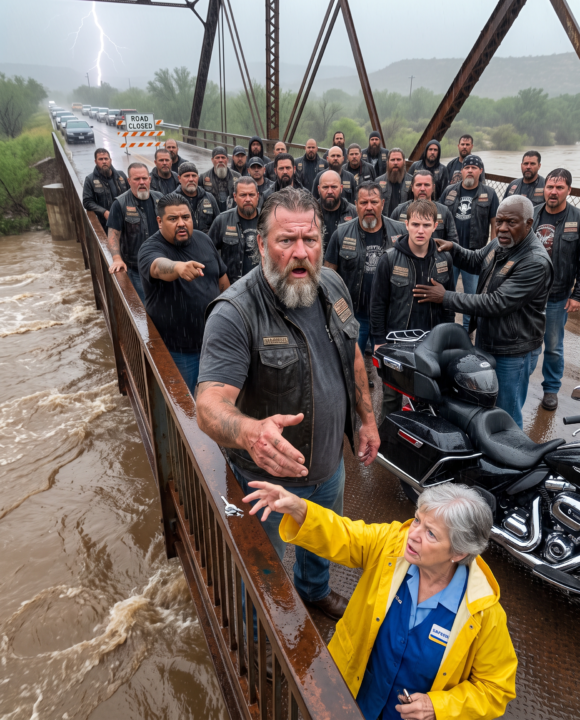
By the time she arrived, rain hammered the gravel and twenty-seven Harley engines idled in uneven rows.
Hawk sat at the front.
Marlene stepped between him and the road.
Their argument lasted less than three minutes.
The key entered the river.
After she left, anger filled the space fear should have occupied.
Crow accused her of humiliating Hawk on the worst day of his life. A prospect called the act theft. Another man suggested retrieving the spare ignition cylinder from Hawk’s shop.
I almost allowed it.
Then Hawk said, “Enough.”
We opened the saddlebag.
The signed title was on top.
Below it lay the ashes.
My letter sat underneath.
I read it beneath the clubhouse awning while rain struck the metal roof hard enough to erase every softer sound.
Preacher,
The bike belongs to the club. Crow gets first choice. Shop records are current. Don’t follow me past the gate. Somebody should come back.
No farewell.
No explanation.
Hawk wrote like a man leaving instructions after an ordinary repair.
Crow sat down on the wet concrete.
The prospect who wanted to confront Marlene removed his club cap and stared at the floor.
Hawk stood beside the silent motorcycle.
His scarred hands shook.
“You were going over that road alone,” I said.
“Was going to the marker.”
“With no return gear.”
“Didn’t need it.”
“With your title signed.”
He looked toward the river.
“You know what the voicemail says?”
“Yeah.”
“He asked me to come get him.”
“You couldn’t.”
“I didn’t answer.”
“That was thirteen years ago.”
“For him, it was the last minute.”
Lightning opened the sky.
A highway-patrol cruiser arrived fifteen minutes later. The officer announced that a section of 89A had washed out near mile marker 383.8.
Twenty yards from Caleb’s memorial.
Had Hawk left ten minutes earlier, he might have reached the collapse before the closure.
The officer called Marlene’s action luck.
It was not.
She had known exactly which man she was stopping.
Part 4 — The Second Key
Hawk slept in the clubhouse that night.
We did not leave him alone.
The brothers parked their motorcycles across the garage doors, though no one admitted we were preventing him from borrowing another bike. Crow kept the keys in his pocket. I sat beside Hawk near the cold fireplace.
He did not speak for three hours.
At midnight, the river rose another four feet.
Floodwater carried branches, tires, fence posts, and pieces of a shed beneath the bridge. Somewhere in that dark water was Hawk’s key, along with the brass tag Caleb had stamped in high-school shop class.
The tag read HOME.
Hawk watched the river through a window.
“Only thing he made me,” he said.
I knew he was not talking about the key.
“You still have the voicemail.”
“Should delete it.”
“You won’t.”
“No.”
At 2:10 a.m., Hawk asked for the ashes.
I brought the sealed container from the saddlebag.
He held it against his chest until sunrise.
Marlene returned at 5:47.
The rain had stopped. Clouds remained low over the red cliffs, and muddy water still moved fast beneath the bridge.
She wore jeans, Caleb’s old Coast Guard sweatshirt, and motorcycle boots that had not left her closet in thirteen years.
A black helmet hung from one hand.
In the other was a new key.
Caleb’s dog tag circled the ring.
The club watched her cross the yard.
No one closed around her this time.
Crow opened the door.
Marlene stopped in front of Hawk.
His eyes moved to the key, then to the helmet.
“You threw mine away.”
“Yes.”
“That tag’s gone.”
“I know.”
“It was his.”
“So is this.”
She held up the dog tag.
Caleb had received it during his pre-enlistment medical processing. He never reached basic training, but the recruiter had mailed the identification pieces to Marlene after his death.
She kept them hidden.
Hawk had never seen them.
“Why did you have a key made?” he asked.
“Because I knew you’d need one if I succeeded.”
“You knew before you came?”
“I hoped I was wrong.”
Marlene placed the new key in his palm.
“You don’t get it back for the same ride.”
Hawk closed his fingers.
“What ride, then?”
“Ours.”
She pointed toward the passenger seat.
Hawk looked at the helmet again.
“You haven’t ridden since Caleb.”
“I haven’t ridden since you let him leave.”
That sentence landed harder than blame.
Marlene’s voice broke, but she continued.
“I spent thirteen years saying you killed him by not following. You spent thirteen years agreeing with me. Neither of us ever blamed the storm because the storm couldn’t apologize.”
Hawk lowered his head.
Marlene stepped closer.
“I know what he said on the voicemail.”
Hawk looked up sharply.
“You heard it?”
“The detective played it for me.”
“You never told me.”
“You never asked what I heard.”
For thirteen years, Hawk believed Caleb’s final message ended after seven words.
Dad, I was wrong. Come get me.
It did not.
The original voicemail continued beneath wind and broken reception. Hawk’s damaged old phone cut off the last portion during playback. Investigators preserved a clearer copy.
Marlene had listened once.
She now recited the rest.
“Road’s gone. I’m staying uphill. Don’t ride into this.”
Caleb had called for help.
He had also warned his father not to follow.
The boy was not asking Hawk to risk the flood. He expected him to call rescuers and wait.
Hawk’s missed call remained a wound.
But the ride into the storm would not have saved Caleb.
It might have taken his father too.
Marlene handed me a digital copy of the complete recording. A county technician had recovered it from archived evidence after she requested the file that week.
Hawk listened.
Wind filled the clubhouse.
Caleb’s frightened voice followed.
Then the missing words arrived.
Road’s gone. I’m staying uphill. Don’t ride into this.
A pause.
Tell Mom I’m coming home.
The voicemail ended.
Hawk pressed the phone against his forehead.
No tears came.
His body folded anyway.
Marlene sat beside him on the floor. For several minutes, they held opposite sides of the ashes while the club turned away and gave them what privacy a room full of brothers could provide.
The new key lay between them.
It did not replace the one in the river.
It opened a different ride.
Part 5 — The Passenger Seat
Highway patrol kept Oak Creek Canyon closed through the morning.
Hawk did not argue.
That was the first change.
The memorial ride took a safer route south along Highway 260, then east toward an overlook above the Verde Valley where Caleb used to camp with his parents. State officers confirmed the roads were open. The club sent two scouts ahead.
Hawk restored the passenger pegs.
He had removed them because he planned to carry only ashes. Reattaching them required twelve minutes and a wrench Crow handed him without comment.
Marlene stood nearby wearing Caleb’s sweatshirt.
When the pegs were secure, Hawk tested each one twice.
“Still want to go?” he asked.
“No.”
He waited.
Marlene fastened her helmet.
“I need to.”
That answer he understood.
The twenty-seven bikes formed two staggered lines. Normally Hawk rode at the front beside me. That morning, he remained in the center where brothers could surround him without making the act obvious.
Marlene climbed onto the Harley.
Her hands hovered near his sides.
Thirteen years earlier, she would have wrapped her arms around his waist without thought. Now there was weather between them.
Hawk looked over one shoulder.
“Hold the cut.”
She gripped the leather near his ribs.
The V-twin started.
Marlene flinched at the first heavy beat. Then the engine settled into the rhythm she remembered from their marriage—the same low pulse that once announced Hawk was home before Caleb ran to the window.
We rode.
The roads remained wet, but the storm had scrubbed dust from the desert. Water ran through roadside ditches. Clouds broke over the mountains, leaving pale light across the valley.
No one hurried.
At the overlook, Hawk shut down first.
Twenty-seven engines stopped behind him.
Marlene stayed on the passenger seat until silence arrived.
Then she climbed down and removed her helmet.
Hawk opened the saddlebag.
The ashes remained sealed.
Marlene looked at him. “You were going to leave all of him?”
“Thought so.”
“And then?”
Hawk did not answer.
She knew.
He had planned to scatter Caleb at the guardrail, continue into the storm, and let chance make the final decision he could not state aloud.
Marlene took the container.
“We’re not leaving him where he died.”
Hawk stared at her.
“Where, then?”
“Where he wanted to go.”
Caleb’s Coast Guard acceptance letter listed Astoria, Oregon, as his preferred first assignment after training. He wanted to see the Columbia River meet the Pacific.
He had never made it there.
Marlene proposed something different from a dangerous anniversary ride. They would carry Caleb to Oregon the following spring, after planning the route, checking weather, arranging hotels, and inviting the club.
Not a punishment.
A trip.
Hawk touched the dog tag attached to his new key.
“That’s a long ride.”
Marlene looked toward the passenger seat.
“I know.”
The ashes returned to the saddlebag.
Nothing was scattered that morning.
Instead, Marlene removed one black zip tie from her pocket. Hawk produced another.
They fastened the two together around a small branch overlooking the valley.
Caleb had always used one zip tie.
His parents used two.
On the ride home, Marlene’s hands no longer held the edges of Hawk’s cut. They rested around his waist.
The club saw.
Nobody mentioned it.
At the bridge, Hawk slowed.
The river had begun to fall. Mud covered the lower bank. The old key was gone.
Hawk did not stop.
The new one remained in the ignition, Caleb’s dog tag tapping softly against the metal with every vibration.
For thirteen years, the memorial had ended at the place their son left the road.
That morning, it ended at home.
Part 6 — The Road to Astoria
The Oregon ride began eight months later.
Hawk prepared differently.
He packed blood-pressure medication, rain gear, emergency food, paper maps, and two spare keys. One stayed with Marlene. The other remained with me.
She inspected both before departure.
The Cinder Ridge Riders followed them through Nevada, Idaho, and eastern Oregon. We stopped before dark. We waited out bad weather. No one mocked the caution.
Caleb’s ashes rode in a padded box inside Hawk’s saddlebag.
At fuel stops, Marlene checked the straps.
At night, Hawk listened to the complete voicemail once. After the third evening, he stopped before the final sentence and handed the phone to Marlene.
“You keep it.”
She did.
They reached Astoria under gray skies and light rain.
The Columbia moved wide and cold toward the Pacific. Cargo ships waited near the horizon. Gulls argued over the docks.
Hawk carried the ashes to the shoreline.
Marlene carried Caleb’s Coast Guard letter.
They did not scatter everything. Marlene kept a small portion for the cottonwood tree in Arizona. Hawk kept enough to sew into a narrow sealed pocket behind his son’s name inside his leather cut.
The rest entered the water together.
No speech.
No apology.
Only two parents holding the same container.
When it was empty, Hawk rinsed it and returned it to the saddlebag. Marlene tied two black zip ties around the handle.
On the way back, she remained behind him.
Some evenings they spoke.
Some they did not.
Grief had spent thirteen years demanding an answer from each of them. The road offered no answer.
It gave them time beside the same silence.
That was enough.
Part 7 — Two Keys Every August
Hawk still rides on August 17.
He no longer rides into storms.
If the canyon closes, the memorial waits. If rain becomes dangerous, the club turns around. Caleb’s name does not require another family to receive a midnight call.
Marlene rides behind Hawk most years.
They never remarried.
They did not pretend thirteen years of blame disappeared because of one sunrise. She kept her house. He kept the apartment above his shop.
But on Thursday evenings, Hawk eats dinner at her kitchen table.
The complete voicemail remains in Marlene’s phone. Hawk’s old damaged phone sits inside a drawer, no longer charged.
The new Harley key has worn smooth around its edges. Caleb’s dog tag bears scratches from years of tapping the ignition.
Hawk carries two spares.
One belongs to Marlene.
He says this is practical.
Nobody believes him.
The club changed too. Before every memorial ride, we check weather, fuel, medication, routes, and the state of the rider—not only the motorcycle.
A brother can pass every mechanical inspection and still be unsafe to leave alone.
We learned that beside a river.
The prospect who once moved toward Marlene now stands nearest the bridge during each anniversary gathering. He hands her a black zip tie and never speaks about the night he nearly defended a motorcycle key from the woman protecting its owner.
Crow still searches the riverbank after major floods.
He claims he is looking for lost tools.
Hawk knows better.
The original brass tag marked HOME has never returned.
Maybe it lies beneath silt.
Maybe it reached another bridge.
Hawk no longer needs it.
One August morning, the club gathered under clear skies. Marlene climbed onto the passenger seat and tapped Hawk’s shoulder.
“Ready?”
He looked toward the canyon, then at the new key in the ignition.
“No.”
Marlene waited.
Hawk started the Harley.
“Let’s go anyway.”
The V-twin rolled across the bridge. Twenty-seven engines followed, and the river carried only rainwater beneath them.
This time, both parents came home.
Follow our page for more biker stories about misunderstood riders, tested brotherhood, and the people brave enough to stop a final ride.