A 52-Year-Old Biker Braids His Daughter’s Hair At The School Gate Every Morning — Nobody Knew Whose Voice Was Coming From The Phone On His Gas Tank
Part 2
To understand those braids, you have to understand who Grady Holt was before Kate.
I learned this in pieces. From Grady, in a few words at a time. From his club brother Kip, who talks more. And from Hazel’s second-grade teacher, Ms. Albers, who sat with me in the teachers’ lounge one afternoon with the door shut and told me things she said she’d never told anyone.
Grady grew up in a trailer outside Spearfish. His father worked the Homestake gold mine in Lead until it closed, and then he just drank. Grady joined the Army at eighteen to get out. 82nd Airborne. Panama in 1989. The Gulf in 1991.
When he came home, he didn’t know what to do with himself. So he did what his father did.
Kip says the nineties were bad. Bar fights at the Knuckle Saloon in Sturgis. A divorce at twenty-nine. A DUI at thirty-three. Two nights in the Pennington County jail after a man said something about his mother.
“He was a hard man,” Kip told me. “Not cruel. Just hard. Like he’d decided a long time ago nothing was ever gonna get inside.”
He drove a gravel truck. He rode with the Rimrock Riders on weekends. He lived alone in a cinder-block house off Highway 44 with a dog named Diesel and nothing on the walls.
That was Grady Holt at forty-one.
Then, in August of 2014, at the Sturgis Rally, he met Kate.
She wasn’t a biker. She was a school crossing guard from Rapid City, there with her sister, wearing a sundress and cowboy boots and eating a corn dog. She was thirty. She laughed at something he said, and he couldn’t remember what it was, because he wasn’t used to making anybody laugh.
Kate Shaffer. Five-foot-two. Freckles. Long, wavy, dark-blond hair she always wore in a braid down her back.
They were married eight months later.
Kip says the change was like somebody had turned the lights on in a house that had been dark for twenty years. Grady quit drinking. Painted the cinder-block house yellow because Kate wanted yellow. Put up curtains. Pictures on the walls.
In 2018, Hazel was born.
Grady was forty-five years old. Kip was in the waiting room. He says Grady came out holding her and didn’t say a word for ten minutes. Just stood there in the hallway rocking back and forth on his boots.
Kate was the crossing guard at Wildwood Elementary for six years.
Ms. Albers told me about her. Every teacher on staff knew her.
She had a vest with a deep front pocket, and she kept it stuffed with hair ties. Purple ones, mostly, because they were the cheapest at the Dollar General on Omaha Street.
Any kid who came to school with messy hair, any kid whose parents worked early shifts, any kid who’d gotten dressed by themselves in the dark, Kate would sit them down on the wooden bench by the front gate and braid their hair before the bell.
Sometimes eight or nine kids a morning. Boys too, if they had long hair. She did a little boy named Elijah’s cornrows every Monday for two years because his grandmother’s hands had gotten too bad with arthritis.
“She knew every kid’s name,” Ms. Albers said. “Every one. And every kid’s hair.”
Hazel started kindergarten at Wildwood in 2023. Kate braided her hair on that bench every single morning, while she held up her stop sign between braids.
Grady would drop them both off on the Harley.
He never learned how to braid. Never needed to. Kate did it.
In the fall of 2024, Kate got tired.
Then she got bloated. Then the pain in her side wouldn’t go away.
Ovarian cancer. Stage four by the time they found it.
She worked the crosswalk until Thanksgiving. Then she couldn’t stand that long anymore. Then she couldn’t stand at all.
She went into hospice at home in May of 2025.
She was thirty-nine years old.
And this is the part nobody at Wildwood knew. Not Ms. Albers. Not the principal. Not the moms in the drop-off line who laughed.
In those last months, in the hospital bed in the living room of the yellow cinder-block house, Kate made Grady bring her Hazel’s doll.
A big, soft doll with long yarn hair. Hazel called her Penny.
And Kate made him bring her his phone.
Part 3
The wind came down off the Black Hills hard that morning. November 13th. Gusts to forty. My stop sign kept trying to turn into a sail.
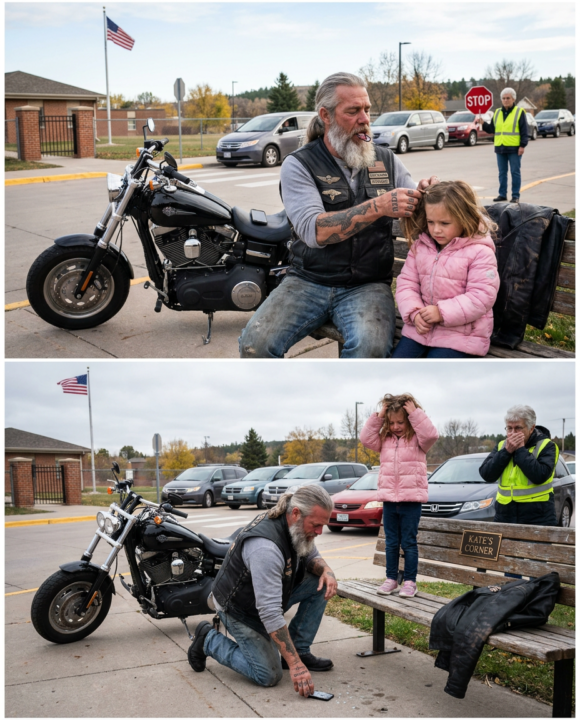
At 7:42, the Harley pulled up. Same as always.
Grady lifted Hazel off. Took off her helmet. Her hair was worse than usual, the wind already pulling it in every direction.
He took off his jacket. Laid it over the back of the bench. Smoothed it flat.
He propped the phone against the gas tank. Put three purple hair ties in his teeth. Pressed play.
Okay, babe. Today’s a French braid. You remember the French braid—
A gust hit.
The phone slid off the tank.
It hit the pavement face-down with a sound like a dropped plate.
Grady froze.
The voice cut out. Mid-sentence.
He bent down and picked it up. The screen was shattered. Spiderwebbed from corner to corner. Black.
He pressed the button. Nothing.
He pressed it again. Held it. Nothing.
Hazel was standing on the bench, staring at the phone in his hand.
“Daddy?”
He pressed the button again. His big thumb was shaking.
“Daddy, where’s Mommy?”
And then Hazel screamed.
“MOMMY! MOMMY’S IN THERE! DADDY, MOMMY’S IN THE PHONE!”
The whole drop-off line stopped.
I mean stopped. Kids getting out of minivans froze with their backpacks half on. A mom in a Subaru with her window down put her hand over her mouth. The dad in the Tahoe who used to laugh just sat there with his hands on the wheel.
Grady went down on his knees on the pavement.
He was picking up little pieces of glass with his fingers. As if he could put it back together. As if he could fit the pieces back in.
“I’ll fix it,” he said. Not to her. To himself. “I’ll fix it, I’ll fix it.”
Hazel was sobbing. Both hands in her tangled hair.
“She didn’t say good job! She didn’t say good job!”
He stood up. He picked up the comb. He tried.
No video. No voice. Just his big shaking hands and three strands of wind-whipped hair.
He got two crosses in, and it fell apart.
He started again. It fell apart again.
The bell rang.
I walked over. I didn’t decide to. My feet just went.
“Mr. Holt,” I said. “I raised three daughters. Let me—”
Hazel screamed at me. Not mean. Just desperate.
“NO! Only Daddy! Mommy said only Daddy!”
I stepped back.
Grady looked at me. His eyes were red and wet. His jaw was locked under that beard so tight I could see a muscle jumping in his cheek. Nothing fell. He wouldn’t let it.
He sat down hard on the bench.
His elbow hit the leather jacket. It slid off the back.
And for the first time, I saw the brass plaque.
I read it.
Then I had to hold onto my stop sign to stay standing.
KATE’S CORNER
Kathryn “Kate” Holt — 1986–2025
She kept them safe. She kept them pretty.
Wildwood Elementary Crossing Guard, 2019–2024
I was standing exactly where she used to stand.
I was holding her stop sign.
Part 4
Grady didn’t say anything for a long time.
The drop-off line had cleared out. The other parents had gone. It was just the three of us on that bench by the gate, the wind blowing, the flag on the pole snapping like a gunshot.
Hazel had crawled into his lap. Her face was buried in his vest. Her hair was a disaster.
He held the dead phone in one hand. With the other, he stroked her hair. Over and over. Not braiding. Just touching it.
“She made forty-seven videos,” he said finally.
His voice was low and rough. Like it hurt to use.
“In hospice. On the doll. Every style she ever did on Hazel. French braid. Dutch braid. Fishtail. Pigtails. The crown one for her birthday. Picture day.”
He swallowed.
“Took her three months. Some days she could only do five minutes before she had to stop. Some days she had to do it lying down. She’d say, ‘Again, Grady.’ Again. Again. Till I could do it on Penny without looking.”
I sat down next to him.
“I couldn’t,” he said. “Not on Hazel. Penny don’t move. Hazel’s head moves. Her hair’s different. It slips.”
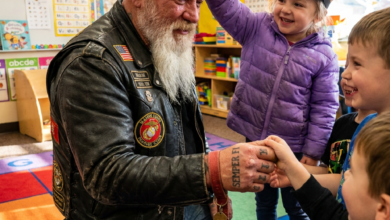
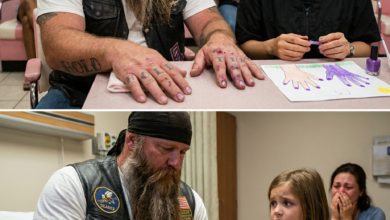
He looked down at his own hands. RIDE. SLOW.
“So every morning, I play Kate.”
I didn’t know what to say. So I didn’t say anything.
“Kate said do it here,” he said. “At the corner. Every morning. Before the bell. Like she did.”
He nodded at the plaque.
“She said if Hazel had to lose her mama, she shouldn’t have to lose her mornings too.”
The purple hair tie on his right wrist.
I asked him about it. Quietly.
He turned his wrist over and looked at it.
“Last one she had,” he said. “Took it out of her own hair the night before she went.”
The braid tattoo on the left wrist. He’d gotten it the week after the funeral. He hadn’t been in a tattoo shop in eleven years.
“So I’d remember the pattern,” he said. “Over. Under. Over. Even without the phone.”
He looked at the shattered screen.
“Didn’t work,” he said.
Here’s what Grady didn’t tell me, and Kip did later.
He’d never backed up the phone.
Not once. Not to a computer. Not to the cloud. He didn’t know how. Kate was the one who did all that. He’d been terrified to touch anything in the settings, in case he deleted something by accident.
Every one of those forty-seven videos existed on that one phone.
And that phone was lying in his hand in pieces.
He took Hazel inside. Late. Hair in the worst braid I’ve ever seen. Ms. Albers met them at the door. She took one look at Grady’s face and took Hazel’s hand without saying a word.
Grady walked back out to the Harley.
He stood beside it with that dead phone in his hand. Then he took his own phone — his old flip phone, the one he used for work — out of his vest and made one call.
“Kip,” he said. “I need you.”
That was the whole call.
Kip Dalgaard is sixty. Rimrock Riders’ treasurer. Retired from thirty years running the electronics counter at the Rushmore Mall Radio Shack, back when there was a Radio Shack. He fixes everything for everybody in the club. Phones. TVs. Garage-door openers.
He was in his garage in Box Elder when Grady called.
Grady rode there. Ten miles on I-90 in forty-mile gusts.
Kip told me he opened the garage door and Grady was just standing there in his leather jacket, holding the phone out in both hands, like you’d hold a hurt bird.
“He didn’t say anything,” Kip said. “He didn’t have to. I knew what was on it. Everybody in the club knew.”
Kip took the phone apart on his workbench. The screen was gone. The frame was bent. But the board, he said, might be okay.
Might.
He worked all day.
Grady sat on an overturned bucket in the corner of that garage and didn’t move.
At three o’clock, he rode to Wildwood and picked up Hazel. He brought her back to Kip’s garage. She fell asleep on the old couch in the corner under a Rimrock Riders blanket.
At eleven that night, three more club brothers showed up. Big men. Tattoos. They didn’t come to help with the phone. They didn’t know anything about phones. They just sat with Grady. One of them brought a pot of chili. Another brought a box of hair ties he’d bought at the Walmart on Elk Vale Road, because he didn’t know what else to bring.
At 2:47 in the morning, Kip said, “Grady.”
And turned his laptop around.
Part 5
Forty-seven video files. All there.
Every one.
Kip said Grady didn’t move for a long time. Then he reached out and touched the laptop screen with one finger, very carefully, the way you’d touch a baby’s cheek.
Then Kip said something else.
“There’s a forty-eighth.”
It was in a separate folder. Kate had made it. Grady had never seen it, because he’d never known how to look for it.
The folder was named:
GRADY — NOT YET
Kip didn’t open it. He said it wasn’t his to open.
He copied every file onto three USB drives, a laptop, two cloud accounts, and an old iPod he found in a drawer, just to be safe. Then he handed Grady a brand-new phone with everything on it. He’d driven to the Verizon store at nine that morning while Grady was at the school. He never told Grady what it cost. Grady never asked.
The next morning, at 7:42, the Harley came up Mountain View Road.
Grady got off. Lifted Hazel down. Took off his jacket.
He didn’t lay it over the plaque this time.
He laid it on the seat of the bike.
He propped the new phone against the gas tank.
Then he looked at me, standing there with Kate’s stop sign, and he did something I didn’t expect. He waved me over.
“Sit,” he said.
I sat on the bench next to Hazel.
He put three hair ties in his teeth. Then he took them out again.
He opened the folder named GRADY — NOT YET.
He pressed play.
I won’t tell you everything Kate said. It’s Grady’s. It’s Hazel’s.
But I’ll tell you some of it, because he said I could.
She was lying in the hospital bed in the living room. You could see the yellow wall behind her. She had a scarf over her head. Her face was thin, but her eyes were bright.
Hi, babe.
If you’re watching this, either you lost the phone, or you finally figured out how to open folders, or…
She smiled.
…or you don’t need my voice anymore.
I’m betting on the phone. You were always gonna lose the phone.
Grady laughed. One rough sound. He put his hand over his mouth.
Grady. Listen to me. You don’t need these videos. You never did. You’ve got the best hands I know. You built our whole house with them. You held her the day she was born and you didn’t drop her once, even though you were shaking so bad the nurse thought you were having a seizure.
You can do this without me.
Over. Under. Over. That’s all it is. That’s all anything is.
She stopped. Coughed. Took a breath.
And one more thing.
When she’s big enough, let her do yours.
Your beard. It’s been driving me crazy for eleven years.
Let her braid it.
I love you. Both of you.
Good job, babe. You did good.
The video ended.
The school parking lot was full by then. Minivans. SUVs. Parents getting kids out. Nobody honked. Nobody hurried.
The mom in the Subaru was crying. The dad in the Tahoe was standing beside his truck with his ball cap in his hand.
Grady sat there on the bench for a long time.
Then he put the phone in his vest pocket. Facedown. Didn’t touch it.
He picked up the comb.
He put three purple hair ties in his teeth.
And with no video, no voice, nothing but his own big scarred hands, he braided his daughter’s hair.
Over. Under. Over.
His lips were moving. No sound. Just the words.
It was crooked. A little loose on the left side. He’d tucked a piece in wrong near the bottom.
He tied it off with the last purple hair tie. Kate’s. The one from his wrist.
Hazel reached back and felt it with both hands.
Then she looked up at him.
“Did she say good job, Daddy?”
Grady looked at her for a long, long time.
“Yeah, baby,” he said. His voice cracked right down the middle. “She said good job.”
Part 6
He never played the videos at the gate again.
Not one morning. He kept them. All forty-eight. He watches them sometimes at night, Kip says, after Hazel’s asleep. Sitting at the kitchen table in the yellow house with the sound turned way down.
But at the corner, it’s just his hands.
By Christmas, he could do a French braid in under four minutes. By Valentine’s Day, he did a Dutch braid crown for Hazel’s class party with little red ribbons woven through it, and three moms asked him where he’d gotten it done.
“Did it myself,” he said. And walked away.
And then it started happening.
In January, a little girl named Aubrey came up to the bench while Grady was finishing Hazel’s pigtails. Her mom worked early shifts at Monument Health. Her hair was in her face.
She just stood there. Looking at him.
Grady looked at her mom, who’d stopped her car at the curb.
Her mom nodded.
He sat Aubrey down next to Hazel. He took a purple hair tie from his vest pocket. He’d started keeping a pocketful. Kate’s way.
He braided Aubrey’s hair.
The next week, Elijah came back. The boy whose cornrows Kate used to do. Nine years old now. His grandmother walked him up to the bench herself, holding onto his shoulder with her swollen hands.
“Kate used to,” she said.
Grady didn’t know how to do cornrows.
He went home that night and found a woman on YouTube in Atlanta who taught it. He practiced on a mannequin head he bought at Sally Beauty Supply on Haines Avenue.
The next Monday, Elijah got cornrows. A little crooked. His grandmother cried right there on the sidewalk.
By spring, there were mornings with six or seven kids lined up at that bench. Moms and dads standing nearby, coffee in hand, watching a gray-bearded biker with RIDE and SLOW on his knuckles do braids with three hair ties in his teeth.
The Rimrock Riders started a box in the clubhouse. Every member drops in a pack of hair ties when they come in. Purple, mostly. Somebody wrote KATE’S CORNER on the box in Sharpie.
Kip says there are four hundred hair ties in there right now.
Nobody calls him Braid Dad anymore. Not the mean way.
The kids call him Mr. Grady.
I stand at the crosswalk with Kate’s stop sign, and every morning, between cars, I look over at that bench.
The jacket doesn’t cover the plaque anymore. It lies on the seat of the Harley.
Everybody can read it now.
Part 7
This past September, Hazel started third grade.
She’s eight now. Tall for her age. Her hair is longer than ever, almost down to her waist, the same dark-blond as the woman on the plaque.
The first morning of school, the Harley came up Mountain View Road at 7:41.
At 7:42, the engine cut off.
Grady lifted her down. Took off her helmet. Her hair came out in a wild, wind-tangled mess, same as always.
He sat down on the bench.
But this time, Hazel didn’t sit down next to him.
She climbed up and stood on the bench behind him.
She took the three purple hair ties out of his vest pocket. She put them between her teeth.
Then she reached around and took hold of his beard. That long, thick, gray beard down to the middle of his chest. The one he’d worn for twenty years.
She separated it into three sections with her small fingers.
The whole drop-off line stopped.
The mom in the Subaru. The dad in the Tahoe. Ms. Albers at the front door with her coffee. Me, at the crosswalk, with my stop sign lowered.
Hazel started to braid.
“Over,” she whispered. “Under. Over.”
Grady sat perfectly still with his eyes closed and his big tattooed hands resting on his knees.
She was slow. Careful. She lost a strand once and started over. Nobody laughed.
When she got to the bottom, she tied it off with a purple hair tie.
Then she climbed down and walked around the bench and looked at him. A gray-bearded, six-foot-three, Airborne biker with a crooked little braid hanging off his chin.
She studied it for a long time with her head tilted. The same way her mother used to tilt her head.
Then she reached out and patted his cheek.
“Good job, Daddy,” she said.
Grady didn’t open his eyes right away.
When he did, they were wet.
For the first time since I’d known him, one fell.
It ran down his face, into his beard, and caught on the purple hair tie at the bottom of the braid his daughter made.
He didn’t wipe it.
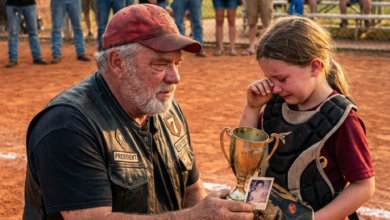
He just picked her up and held her, there on Kate’s bench, at Kate’s corner, until the bell rang.
She said good job.
👉 If this story stayed with you, follow our page for more stories from the road — and from the fathers who learn to do the things nobody ever taught them. 🏍️💜