A 60-Year-Old Biker Blocked A Bus Station Ticket Counter When An Immigrant Mom Couldn’t Afford Tickets For Her Two Kids — Then A Cop Grabbed His Arm And Everything Changed
Part 2
Let me tell you exactly what happened in the hour before he stood up. I’ve gone over it a thousand times.
The woman’s name was Lucía Morales. I didn’t know it then. I didn’t ask.
She came through the station doors at 10:47. I saw her on the camera monitor by my window. She was walking fast, almost running, pulling the boy by the hand, the little girl bouncing on her hip. She kept looking back over her shoulder at the doors.
I remember thinking she looked like somebody who’d forgotten something.
She hadn’t forgotten anything. She was checking to see if she’d been followed.
At the window, she put down her money and said, “Denver. Three. Tonight.”
I told her a hundred and forty-seven.
She looked at the money. She looked at me. She dug in her pocket and found one more quarter and pushed it under the glass, like that would make the difference.
Sixty-one twenty-five.
I told her it wasn’t enough. I told her there was a cheaper bus to Santa Fe in the morning, if that helped.
She shook her head hard. “No. No mañana. Tonight. He out. Today he out. He come.”
She pulled out her phone and held the screen up to the glass. A text message. In English. I saw the words offender and released and a time, 6:12 PM, and I thought — I swear to you, this is what I thought — that she was showing me her husband had gotten out of jail and she was going to meet him.
I thought she was trying to get to him. Not away from him.
I told her to step aside.
She pulled the folded paper from her purse. Slid it toward me. A legal document in a clear plastic sleeve. The kind people carry when it matters. I saw the seal of the State of New Mexico on the corner.
I pushed it back.
“Ma’am, I can’t help you. Step aside, please. Next.”
That’s when she broke. Her voice went high and fast. Spanish. I caught por favor and mis hijos and nothing else. She slammed her hand flat on the counter. Her boy started crying.
The man behind her in line said, “Lady, come on.”
Somebody else further back said something worse. Something about going back where she came from. I won’t repeat it all.
I picked up the phone.
Here’s who was watching.
Over by the vending machines, on a hard plastic bench, sat two bikers.
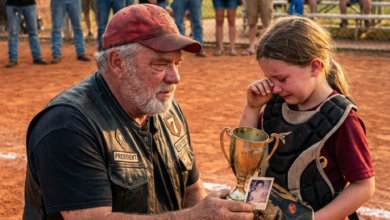
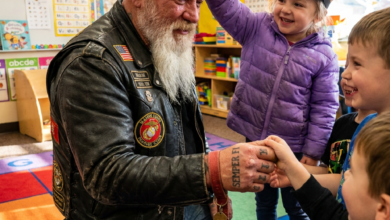
The big one, I learned later, was Wes Garrity. Sixty. A retired cement-truck driver from Moriarty, forty miles east on I-40. He’s ridden with the Sandia Riders for thirty-one years. His bike, an old black Road King with saddlebags held on with bungee cords, was parked on the curb out on First Street.
The younger one was Ramón Chávez. Forty-seven. A union electrician from the South Valley. Born in Juárez. Came to Albuquerque at nine. Wes’s club brother for twelve years.
They were waiting on the 10:30 from Phoenix. It was late. Snow on I-40 near Flagstaff.
On that bus was Wes’s younger sister, Carol. She was coming in for his birthday. She was fifty-one.
That detail matters. Hold onto it.
Ramón told me later what Wes had said to him at 10:55, when the woman first came to my window.
Wes hadn’t been looking at the woman.
“Look at the little one,” Wes said.
Ramón looked. A small girl on her mother’s hip. Red face. Eyes half closed. Pink blanket.
“She’s sick,” Ramón said.
“She’s burning up,” Wes said. “And she ain’t crying.”
Ramón shrugged. Some kids don’t cry.
Wes kept watching.
“Some kids don’t,” he said. “Some kids learn not to.”
Ramón told me Wes’s jaw went tight then. His hands on his knees closed into fists. Not angry fists. Like a man holding onto something.
When the woman’s voice went up, Ramón heard her clearly from across the room. Every word. In Spanish.
Please. Tonight. He got out today. He’s coming. I have a paper. Please look at my paper.
Ramón turned to Wes.
“She said he got out today,” Ramón said. “She’s running, Wes.”
Wes was already standing up.
Part 3
He didn’t push anyone. I want to be clear about that.
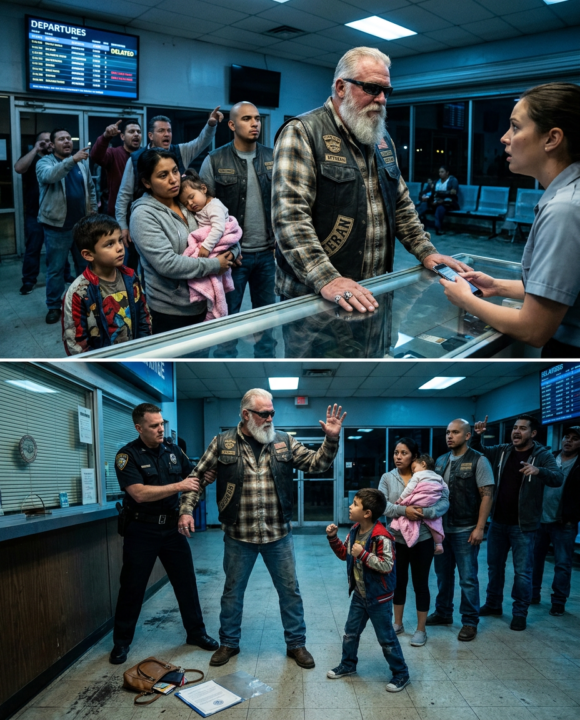
He walked to my window. He stepped in beside the woman, between her and the line. He put both hands flat on my counter.
Old hands. Big. Knuckles scarred white. Black grease worked permanently into the creases.
He looked at me through the glass.
“Nobody else buys a ticket,” he said, “until somebody listens to her.”
His voice wasn’t loud. It didn’t need to be.
I said, “Sir, I’ve called the police.”
“Good,” he said. “Then they can listen too.”
He didn’t move.
The line behind them blew up.
“Are you kidding me?”
“I’ve got a bus to catch, man!”
The man who’d said the ugly thing earlier got right up behind Wes. “Move, old man. She can’t pay, she can’t ride. That’s how it works.”
Wes didn’t turn around. Didn’t even look at him.
“That’s how it works,” Wes said quietly, “when nobody’s watching.”
The man shoved Wes’s shoulder.
Wes didn’t move. Not an inch. It was like shoving a fence post.
Ramón came up on Wes’s other side and stood there. Didn’t say anything. Just stood.
The woman had pulled both her kids in against her legs. Her boy had stopped crying and was staring up at the two bikers with his mouth open. The little girl hadn’t moved at all.
At 11:16, the doors opened and a young police officer came in.
Albuquerque PD. Twenty-eight, twenty-nine. Clean-shaven. Tall. I’d seen him a few times at the station. Officer Kyle Brandt.
He came in fast. He saw a crowd shouting. He saw an angry line. He saw a sixty-year-old biker the size of a refrigerator planted in front of my window, refusing to move.
He did what he’d been trained to do.
He went straight for the biggest threat in the room.
“Sir! Step away from the counter!”
Wes didn’t step away. He turned his head slowly and looked at the officer.
“Officer,” he said. “Read her paper.”
Brandt grabbed his arm. Hard. Pulled.
Wes went. He didn’t resist. He put his other hand up, palm open, and let himself be pulled two steps back from the window. Calm. Like a man who’d been pulled around before and knew how to do it without getting hurt.
“Read her paper,” Wes said again.
In the scuffle, the woman’s purse got knocked off the counter. It hit the floor. Everything spilled. A wallet. A bottle of children’s Tylenol, empty. A pacifier. A phone.
And the folded paper in the plastic sleeve.
It slid across the tile and stopped against Officer Brandt’s boot.
Brandt didn’t look down. He was focused on Wes.
“Sir, I’m going to need you to step outside.”
“I’ll step outside,” Wes said. “After you read her paper.”
The woman was on her knees, scrambling for her things. Her hands were shaking so badly she kept dropping them.
Brandt turned to her.
“Ma’am, the agent says you’re causing a disturbance. I’m going to have to ask you to leave the station.”
She didn’t understand. She looked up at him from the floor.
He pointed at the door. “Outside, ma’am.”
She understood that.
She went white.
Not the doors, she said, in Spanish. Not the doors. Not outside. Please.
Brandt didn’t understand her. He reached for her elbow.
And her seven-year-old son stepped in front of her.
Spider-Man jacket. Broken zipper. Seven years old. Fists clenched at his sides.
He looked up at the officer, and he said in perfect, clear, schoolroom English:
“My papá is coming. He got out of jail today. He said he’s going to kill my mom.”
The whole station went silent.
The man who’d shoved Wes stepped back.
The line went quiet.
I put down the phone in my hand.
Officer Brandt stood there, frozen, with his hand still out toward the woman’s elbow.
Then, very slowly, he looked down at his boot.
At the paper in the plastic sleeve.
Part 4
He picked it up.
He unfolded it. He read it.
I watched his face change. I watched it go from irritated, to confused, to pale.
ORDER OF PROTECTION. State of New Mexico. Second Judicial District Court. Bernalillo County.
Petitioner: Lucía Morales. Respondent: Rubén Morales.
Respondent shall not come within 100 yards of Petitioner or the minor children.
There was a case number. A judge’s signature. A date in November.
Brandt looked up at the woman. Then down at the paper. Then at her phone, still lying face-up on the floor where it had fallen.
He picked that up too.
The text message on the screen was from the New Mexico victim notification system. The automated service that tells you when someone is released from custody.
Offender RUBÉN MORALES has been RELEASED from Metropolitan Detention Center at 6:12 PM.
Five hours ago.
Brandt keyed his radio. He asked dispatch to run the name. He gave the case number from the protective order. He stood there with his radio to his mouth, waiting, staring at the woman on the floor and her two children.
Dispatch came back thirty seconds later. I heard it from my window.
Released on bond at 18:12. Original charge, aggravated battery on a household member. Active order of protection on file. Petitioner’s address listed in the South Valley.
Then one more thing.
A neighbor had called 911 an hour ago. A man was banging on the door of the petitioner’s address, shouting. He’d left before officers arrived.
Brandt lowered the radio.
He looked at the woman.
He looked at me.
And I understood, all at once, what I’d heard.
He out. He come.
She hadn’t been trying to get to him.
She’d been trying to tell me he was coming for her.
I sat down in my chair behind the glass. My legs just went.
Fourteen years. And I’d taken a woman running for her life, and her two babies, and called the police on her for being loud.
Because I didn’t understand her English.
Because I didn’t look at her paper.
Because I had a line.
Ramón knelt down on the floor beside her. He spoke to her in Spanish. Gentle. Low.
My name is Ramón. I’m with him. Nobody’s going to hurt you. Tell me what you need.
She broke.
Everything came out of her in a flood. Ramón translated it for Brandt, sentence by sentence, while she held onto the boy and sobbed.
Her name was Lucía. Thirty-one. From Chihuahua. Married eleven years. Rubén had been arrested in November after he put her in the hospital. She’d gotten the protective order. She’d been working two jobs, cleaning offices at night and a laundromat in the day.
She’d been saving. For a way out. For when he got out.
She’d thought she had more time. His hearing wasn’t until February.
But someone posted his bond today.
When the text came at 6:12, she had sixty-one dollars in a coffee can. She grabbed the kids, the paper, and the coffee can. She left everything else.
Her sister lived in Denver. There was a shelter there. She’d called them from a pay phone at the Circle K.
They said if she could get to Denver tonight, they’d meet the bus.
Wes had walked over to the little girl.
She was sitting on the floor now, propped against her mother’s leg, wrapped in the pink blanket. Silent. Eyes half open.
He crouched down. Slowly. All that size, folding down small.
He held out the back of his hand and laid it very gently against her forehead.
Then he pulled it away and looked at Ramón.
“She’s on fire,” he said.
Ramón asked Lucía. Lucía said yes. Since yesterday. The Tylenol ran out this afternoon.
“Why isn’t she crying?” Brandt asked.
Ramón asked her.
Lucía looked at her daughter for a long time.
Then she said six words in Spanish, so quietly I almost didn’t hear them.
Si llora, él se enoja.
Ramón didn’t translate it right away. He closed his eyes first.
“She says,” Ramón said. “If she cries, he gets angry.”
Three years old.
She’d already learned.
Wes stood up.
He stood there in the middle of my bus station with his fists at his sides and his jaw locked under that white beard, and I watched something go across his face that I’d never seen on a man before.
Not rage.
Recognition.
And then Officer Kyle Brandt did something I’ll never forget.
He took his own phone out of his uniform pocket.
He asked Lucía for the name of the shelter in Denver. She gave it to him. He looked it up. He called it. Right there, standing in the middle of the station.
He identified himself. Badge number. Department. He gave them the case number from the protective order. He told them the respondent had been released at 6:12, had shown up at her home, and that she and two children, one with a high fever, would be on the 11:55 to Denver. Arriving 7:40 a.m.
He asked them to have someone at the Denver bus station when it pulled in.
He asked them to call Denver PD and have an officer meet it too.
Then he asked them to stay on the line while he talked to the bus driver.
Then he turned around and looked at the man who’d shoved Wes.
He didn’t say anything.
He didn’t have to.
The man walked out of the station.
Part 5
There was still the money.
Sixty-one dollars and twenty-five cents. A hundred and forty-seven for the tickets.
I started to say I’d cover it. I did. I opened my mouth.
But Wes was already taking off his bandana.
He pulled the black bandana off his head, turned it upside down like a bowl, and dropped a fifty and a twenty into it.
Ramón dropped in two twenties.
Then Wes turned around to face the line.
The same nine people who’d been shouting at that woman twenty minutes ago. Who’d been shouting at him.
He didn’t say anything. He just held out the bandana.
A college kid in a UNM sweatshirt put in a ten.
A grandmother on her way to Pueblo put in a twenty and squeezed Lucía’s hand.
A trucker in a Peterbilt cap put in everything in his wallet. Sixty-three dollars. He didn’t count it.
A woman in scrubs, an ER nurse heading home to Colorado Springs after a double shift at UNM Hospital, put in a twenty. Then she knelt down in front of the little girl and felt her forehead and said, “I’ve got children’s ibuprofen in my bag.”
She gave her a dose right there on the floor of the bus station. She stayed with her until the bus came.
By 11:40, there was four hundred and twelve dollars in that bandana.
I printed three tickets to Denver. I didn’t charge them.
I put the rest in an envelope and wrote For Lucía on it and gave it to her through the window, and I told her I was sorry. In English. And then in the only Spanish I knew.
Lo siento.
She looked at me through the glass for a long time.
Then she nodded.
While the passengers were boarding, I asked Wes the question that had been burning in me.
Why.
Why he’d stood up. Why he’d seen what none of us saw.
He looked at the little girl, asleep now in the nurse’s arms, her cheeks a little less red.
He pulled up his right sleeve. The old tattoo. The motorcycle with the round headlight. MAMA — 1980.
“Gallup,” he said. “Nineteen eighty. I was fifteen. My sister was six.”
He didn’t say much about his father. He didn’t need to.
“One night, my mama packed a grocery sack and took us to the Greyhound depot on 66. Middle of the night. Old man was passed out. We had nineteen dollars.”
He looked over at my window.
“Ticket lady said it wasn’t enough. Said step aside. Said she’d call the police if Mama didn’t quit crying.”
I put my hand over my mouth.
“So we walked home,” Wes said. “Past the house. To my granddad’s shed. He had an old ’61 Panhead in there. Didn’t run half the time.”
“That night it ran.”
He’d put his mother on the back. His six-year-old sister in between them. Fifteen years old, no license, no helmet. A hundred and forty miles east on I-40 in the dark. To Albuquerque. To his aunt’s house.
“Mama held on so tight I had bruises for a week.”
He pulled his sleeve back down.
“Nobody stood at that counter for her,” Wes said. “Not one person.”
He looked at me.
“I been standing at it ever since.”
His sister Carol was the six-year-old on that Panhead.
She was on the bus from Phoenix. Two hours late. It came in at 12:20 a.m., twenty-five minutes after the 11:55 to Denver pulled out.
She never saw Lucía.
But when Wes told her, standing on the curb on First Street in the cold, she put both arms around her big brother’s neck and held on, just like she did when she was six.
At 11:52, Lucía walked out to the bus with her son holding one hand and the nurse carrying her daughter.
Officer Brandt walked beside her. He’d talked to the driver himself. He told him who she was and what she was carrying and who would be waiting in Denver.
Wes and Ramón walked her to the door of the bus.
At the bottom of the steps, she turned around.
She looked up at Wes. This tiny, exhausted woman in her thin gray hoodie. She put her hand flat on his chest, right over the SANDIA RIDERS patch.
She said something in Spanish.
Ramón translated it. His voice cracked halfway through.
“She says, ‘I thought nobody was standing watch on this road.'”
Wes looked down at her for a long moment.
Then he said, “Tell her somebody always is.”
Ramón told her.
She climbed the steps. The doors hissed shut.
The little girl, in the nurse’s arms, pressed her hand against the bus window.
And for the first time all night, she cried.
Loud. Long. Furious. The way a three-year-old with a fever is supposed to cry.
Lucía didn’t hush her.
She just held her and let her.
The bus pulled out onto First Street, turned north toward I-25, and was gone.
Part 6
Rubén Morales was arrested at 3:40 that morning, outside his wife’s empty house in the South Valley. Violation of an order of protection. He was held without bond this time.
Officer Kyle Brandt was the one who wrote it up. He requested the case.
Here’s what changed at the Alvarado Transportation Center.
Taped to the inside of my ticket window, at eye level, facing out, there’s a laminated card now. I made it myself. It’s in English on one side and Spanish on the other.
If you are in danger, tell me. I will listen. I will call for help.
Si está en peligro, dígame. La voy a escuchar. Voy a pedir ayuda.
Under it, the number for the statewide domestic violence hotline.
I’ve taken two Spanish classes at CNM since January. I’m terrible at it. I keep going.
I look at every paper people push under my glass now.
Every single one.
Officer Brandt asked his department for language training. He’s in his second course. Last month, he came by the station on his overnight patrol and said, in careful, badly accented Spanish, Buenas noches, señora, and I almost cried into my coffee.
And the Sandia Riders.
Once a month, Ramón drops an envelope off at my window. Cash. Never the same amount. The club passes the hat at their meetings at a bar in Tijeras.
On the envelope, Ramón writes two words.
LA GUARDIA.
The Watch.
I keep it in a locked drawer under my counter. When someone comes to my window who needs to get out of this city tonight, and they’re short, and they’ve got a paper or a bruise or a child who doesn’t cry, I open the drawer.
So far, I’ve opened it nine times.
And every Tuesday night at 11:14, the old black Road King with the bungee-corded saddlebags pulls up on the curb on First Street.
Wes Garrity walks in. He gets a coffee from the machine. He sits on the hard plastic bench by the vending machines with his back to the wall and his eyes on the doors.
He doesn’t talk to anybody. He doesn’t do anything.
He just sits there until the 11:55 leaves.
I asked him once why Tuesday.
“That’s the night I found out I was late,” he said.
Then he drank his coffee and kept watching the door.
Part 7
In April, an envelope came to the bus station. Addressed to me, by name. Tammy, Ticket Window, Alvarado Station, Albuquerque. A Denver postmark.
Inside was a photograph and a letter.
The letter was in Spanish. I read it with my CNM dictionary and a lot of help from Ramón.
Lucía and her children were safe. They’d stayed at the shelter for six weeks. Now they had a small apartment near her sister in Aurora. She was working in a hotel laundry. Mateo was in second grade. He wanted to be a police officer.
Sofía, the little one, had gotten well. The fever was an ear infection. A doctor at the shelter treated it the first morning.
She cries all the time now, Lucía wrote.
She’s three.
That’s what three-year-olds do.
The photograph was of the three of them standing on a sidewalk in front of a small brick apartment building. Spring sun. Mateo in a new jacket with a zipper that worked. Sofía on her mother’s hip, mouth wide open, mid-yell, laughing.
Lucía was smiling.
On the back of the photograph, she’d written one line. In English. In careful block letters.
FOR THE MAN WHO STAND WATCH.
I gave it to Wes the next Tuesday night.
He sat on his bench by the vending machines and held it in both of those big scarred hands for a long time.
Then he took out his wallet. An old leather one, chained to his belt. Inside, behind his driver’s license, there was another photograph. Faded. Square. Seventies colors.
A woman on the back of an old motorcycle with a round headlight. A small girl wedged in front of her. A skinny teenage boy at the handlebars, squinting into the sun.
Gallup. 1980. The morning after.
He slid Lucía’s photo in beside it.
He closed the wallet. Put it back in his pocket. Pressed his hand flat against it once.
Then he picked up his coffee and turned back toward the doors.
It was 11:14.
The 11:55 was boarding.
Somebody always is.
👉 If this story stayed with you, follow our page for more stories from the road — and from the ones who stand watch when nobody else will. 🏍️