A Biker Who’d Never Held A Baby In His Life Was Asked To Be A NICU “Cuddler” — Then Became The Only Person Who Could Calm The Sickest Infant On The Floor
Part 2
Let me tell you how Boone Callahan ended up in rocking chair number seven.
He filled out the volunteer application in October. Peg still has it. She showed it to me later, in her office, with the door shut.
Name. Address. Occupation: welder. References: three men from his motorcycle club and one Baptist preacher.
Background check: one DUI, 2002. Thirty days in Potter County. Nothing after.
And then, near the bottom, a box. Why do you want to volunteer with infants?
Most people write a paragraph. I love babies. I have grandchildren. I’m retired and want to give back.
Boone wrote one line, in pencil, in block capitals.
GOT SOME LOVE LEFT OVER.
Peg read that line and approved him over the objection of exactly one nurse.
Me.
Training was two evenings. Hand hygiene. How to support a preemie’s head and neck. How to read the monitors. How to not panic when the alarms go, because they always go.
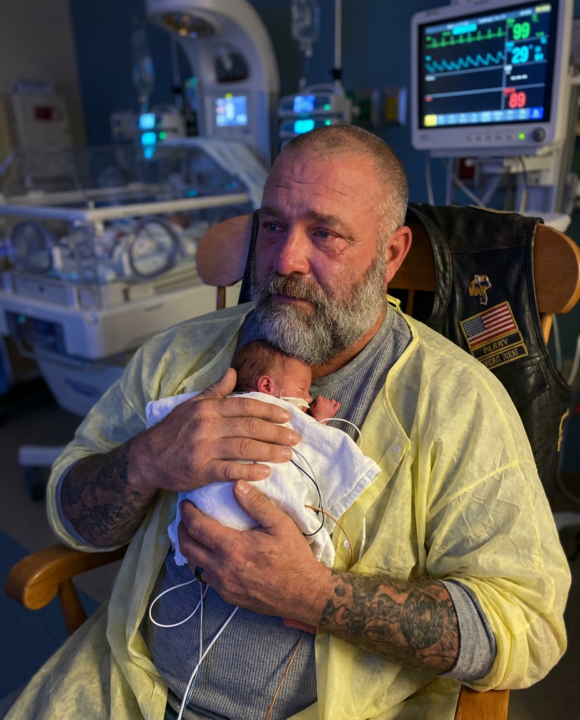
Boone took notes in a little notebook with a pencil he sharpened with a pocketknife. He asked the kind of questions nobody asks.
“How hard can I hold her before it’s too hard?”
“If she grabs my finger, do I let her keep it?”
“What if I’m doing it wrong and she can’t tell me?”
The NICU educator answered every one. He wrote every answer down.
The first night, after he hummed and the number dropped, he stayed in that rocker for three hours and twenty minutes. Volunteers usually do an hour. He didn’t move. He didn’t check his phone. His left arm went numb around hour two and he still didn’t move it.
When Peg finally took Wren back to her isolette, he stood up and his knees popped like gunshots. He looked at that tiny baby behind the plastic for a long time.
Then he went back to the locker, put the little yellow thing back in his vest pocket, and rode home.
It kept happening.
Tuesday. Thursday. 6:55, the rumble. 7:02, the boots. Wren’s numbers coming down before he even reached the sink.
I started that notebook in his second week. I’m not proud of why. I was trying to prove it was nothing.
By December, I’d stopped trying.
Our neonatologist, Dr. Patel, came in one Thursday night to watch it happen. Afterward he stood at the station with his arms crossed and said, “Deep voices travel through the chest wall. Low frequency. It could be vibration.” Then he was quiet for a while.
“Could be,” he said again. He didn’t sound convinced either.
The other volunteers liked Boone. The parents warmed up too, slowly. A young dad from Dumas whose twins were in Room 6 saw him in the hallway one night and stepped in front of his wife. Two weeks later, that same dad was sitting next to Boone in the family lounge, asking him about carburetors.
His club showed up too.
The week before Christmas, eleven motorcycles rolled into the hospital garage in the sleet. Eleven men in leather carried in boxes and set them at the nurses’ station without saying much. Diapers in micro-preemie size. Hand-knit hats. Forty pounds of tamales from somebody’s grandmother in Hereford.
A big man named Hector, with a scar through his eyebrow, stayed behind for a minute.
“He been all right?” Hector asked me. Quietly.
“He’s wonderful with her,” I said.
Hector nodded. He looked down the hall toward Room 4.
“That’s what we’re scared of,” he said.
I didn’t understand what he meant. Not yet.
Boone never said a word about home. Not one. We knew he was married. He wore a plain gold band. When we asked about kids, he said, “No, ma’am,” and changed the subject.
But every single night, before he went into Room 4, he took that pale yellow thing out of his vest. Every single night, he folded it into the pocket of his gown.
And every single night, when he left, he put it back.
Part 3
The ice storm came in on January 22nd.
I-40 closed from Amarillo to the New Mexico line. Trucks jackknifed at Bushland. The power went out across half the city. The hospital ran on generators all night.
And Wren got sick.
It started at shift change. Her belly looked swollen. Her color went gray. Then mottled. Then her heart rate went up past 200 and wouldn’t come down.
Dr. Patel ordered labs. X-rays. Antibiotics. A nurse from day shift stayed late. We worked on her for four hours.
She screamed through all of it.
That cry. That thin, desperate cry.
Then she stopped screaming. That was worse.
Her breathing got shallow. The alarms kept going. Her numbers kept climbing. 204. 209.
At 2:30 in the morning, I was standing at the foot of her isolette, and I watched Peg Holloway — thirty-one years, the steadiest woman I have ever known — put a hand on the wall to hold herself up.
At 2:47, she went to the station and picked up the phone.
“Peg,” I said. “We can’t call a volunteer. Not at three in the morning. Not in this.”
She dialed anyway.
He picked up on the first ring.
She said four words. “It’s Wren. She’s bad.”
I heard him through the receiver.
“I’m coming.”
“Boone, the roads—”
The line was already dead.
He didn’t come on the Harley. Nobody could have.
At 3:41, a pickup truck with chains on all four tires came crawling into the ambulance bay through the sleet. Hector was driving. He’d picked Boone up at his house in Bushland and driven eleven miles of black ice at fifteen miles an hour without saying a word.
Boone came off that elevator still pulling his vest off.
Snow in his beard. Ice in his eyebrows. Hands red from the cold.
He scrubbed. Three minutes. Every finger. I watched his hands shake under the water.
Then the yellow thing. Out of the vest. Into the gown pocket.
Dr. Patel looked at Peg. Peg looked at Dr. Patel. Nobody said it was against policy. Nobody said anything.
They got Wren out of the isolette with every wire and line still attached. Carefully. Like carrying a house of cards across a room.
They laid her on his chest.
He put his chin down over her head.
He hummed.
Nobody in that room moved. Not the doctor. Not me. Not the respiratory therapist with her hand still on the oxygen dial.
His eyes were closed. His beard was dripping melted ice onto the blanket. His chest went in and out, slow, slow, slow, and that hum came up from under it, low as a diesel at idle.
By 5 a.m., she was at 158. Her breathing had evened out. Her color was coming back.
By 7, the antibiotics were working.
I stood in that doorway and cried and didn’t care who saw.
I thought that was the story. The night the biker saved the baby.
It wasn’t.
Because at 7:15 that morning, Boone handed her back to Peg, stood up, walked to the window, and stood there with his back to us for a very long time.
And then he reached into his gown pocket and took out the little yellow thing, and finally, for the first time, I saw what it was.
Part 4
It was a hat.
A knit hat. Pale yellow. Newborn size. Smaller than newborn. Small enough to fit on a peach.
Somebody had made it by hand. You could see where the stitches weren’t quite even.
He turned it over in his huge, scarred fingers.
Peg walked over and stood beside him at the window. She didn’t say anything. She just waited, the way she waits for babies.
“My wife made it,” he said finally.
His voice was rough. Like he’d been yelling, except he hadn’t said a word all night.
“June. She knits.”
He was quiet for a while.
“We lost three,” he said.
Peg didn’t move.
“First one at nine weeks. Second one at eleven. Third one, we got to nineteen.” He swallowed. “Nineteen weeks. We’d painted the room. She’d knit that.”
He looked down at the hat.
“Girl,” he said. “We’d named her Lark.”
I put my hand over my mouth.
“Doctors said it’s done,” Boone said. “June’s forty-four. Her body can’t do it again. Said it’d kill her to try.”
He folded the hat back in half, very carefully.
“I used to hum to June’s belly every night,” he said. “Every night for nineteen weeks. Same tune. Didn’t even have words. Just something my granddad hummed.”
He looked back at Room 4.
“After Lark, June sat in that room for a month. I didn’t know what to do with any of it. All that love. It’s just sitting there. Nowhere for it to go.”
He shook his head.
“So I figured I’d bring it somewhere it could get used.”
Got some love left over.
I thought about that line on his application. I thought about the hat in his pocket every single night. I thought about the tune that brought a dying baby’s heart rate down in the middle of an ice storm.
He’d been humming his daughter’s lullaby.
To someone else’s daughter.
For three months.
But that’s not the twist.
The twist came six weeks later, at the end of February, when Wren was finally off oxygen, finally gaining weight, finally strong enough to go home.
And there was no home to go to.
Child Protective Services had her. The mother had never come back. No relatives had been found. The plan was a foster placement through an agency in Lubbock. A family she’d never met.
Peg called a meeting about the discharge. The social worker came. Dr. Patel came. I came.
Boone came too.
He walked in wearing a button-down shirt and his leather vest. His beard was trimmed. June was beside him. Small woman. Gray-blond hair in a braid. Holding his hand.
He set a manila folder on the table.
Inside it were papers I’d never seen before. A Texas foster home license. Approved February 19th. Home study. Background checks. CPR certifications. Thirty hours of foster parent training at the Region 1 office.
Starting date: December 2nd.
Two days after the first time Wren’s heart rate dropped at the sound of his boots.
“We’d like to apply,” Boone said. “To adopt her.”
Part 5
He’d been doing it for three months. Night classes on Mondays and Wednesdays, the two nights he didn’t come to the NICU. Paperwork at his kitchen table after twelve-hour shifts at the pipe yard.
He never told us. Not one word.
“Didn’t want to jinx it,” June told me later. “He’d lost three. He couldn’t stand to lose four.”
Hector had known. The whole club had known. That’s what he meant in December, in the hallway, when he said that’s what they were scared of.
They’d written his reference letters. All eleven of them. Hector had driven to Lubbock twice to deliver paperwork when the fax at the Region 1 office went down.
“We told him he was gonna get his heart broke,” Hector told me. “He said it was already broke. Might as well use it for something.”
The hat.
June told me she’d found Boone sitting in Lark’s empty room one night in October, holding it. The next morning he went to the hospital and filled out the volunteer form.
“He took it so she’d be there too,” June said. “Every time he held a baby. That’s what he told me.”
The hum.
Dr. Patel’s theory about vibration was probably right. Deep voices carry through the chest. A baby pressed against a big man’s sternum feels the hum in her whole body. Low, steady, rhythmic.
Like a heartbeat. Like an engine at idle.
But that doesn’t explain the monitor dropping before he reached the sink.
I asked Peg about that once. She’s thirty-one years in. She’s seen everything.
She thought about it a long time.
“Babies learn sounds,” she said. “Mama’s voice. Daddy’s voice. She learned his boots. His bike, maybe. The elevator. The way he breathes.”
She shrugged.
“Two times a week, for weeks, that sound meant somebody was coming who wouldn’t leave,” she said. “You’d learn it too.”
And Boone.
I sat down with him in the family lounge the week before discharge and asked him the question I’d wanted to ask since November. Why her. Out of twenty-two babies on the floor.
He didn’t answer for a long time.
“Nobody came,” he said.
That was it. That was the whole answer.
Then he looked at me.
“I came.”
Part 6
They took her home on March 6th, 2026.
I’ll get to that.
First I want to tell you what happened to rocking chair number seven.
The hospital foundation put a little brass plate on it in April. Peg wrote the words herself. It says: FOR WHOEVER COMES.
Boone still sits in it.
Every Thursday night, 6:55 p.m., the Road King rumbles up out of the garage. 7:02, boots in the hallway. He scrubs for three minutes. Every finger.
Wren’s at home with June on Thursdays now. He comes anyway. For the ones nobody comes for.
There’s always one.
And every Thursday, before he goes into whatever room Peg points him toward, he takes a pale yellow knit hat out of the inside pocket of his vest and folds it into the pocket of his gown.
It’s not Lark’s hat anymore. Not exactly.
Wren wore it home.
It was too small for her by then. June pulled it down over the top of her head anyway, so it sat there like a little crown. Then she took it off, kissed it, and gave it back to him.
“You keep it,” she said. “For whoever’s next.”
Wren’s adoption was finalized in September.
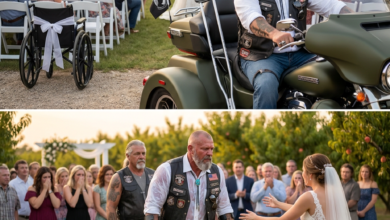
The club rode to the courthouse. Twenty-two bikes this time. They filled every parking space on Taylor Street and idled so low and slow you’d have thought it was a funeral, until Hector saw Wren in her car seat and gunned his throttle twice, and the whole street went up in a roar.
Wren didn’t cry.
She’s never once cried at the sound of a Harley.
Part 7
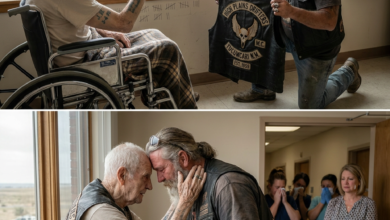
On March 6th, discharge day, half the unit lined the hallway.
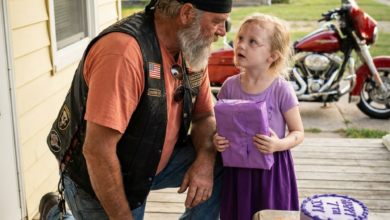
Wren was four months old. Five pounds, nine ounces. Off oxygen. Off everything. Wearing a purple onesie the night shift had bought her, with a little motorcycle on the front.
Boone carried the car seat. June walked beside him with her hand on his back.
They stopped at the nurses’ station. Boone set the car seat down very gently on the counter and turned to Peg.
He tried to say something. It didn’t come out.
He tried again.
“Thank you for calling me,” he said. “That night.”
Peg Holloway has run that unit for thirty-one years. She’s sent a few thousand babies home. I have never seen her cry at a discharge.
She reached over and touched the top of Wren’s head.
“Boone,” she said. “That baby chose her daddy the first week.”
She looked up at him.
“We were just waiting for you two to figure it out.”
He didn’t say anything.
He just nodded, once, and picked up the car seat, and walked his daughter out of the NICU.
I followed them down to the garage. I don’t know why. I think I needed to see it.
Eleven motorcycles were parked along the curb by the exit. Eleven men in leather standing beside them, helmets off.
Nobody said a word when Boone came out. They just stood there.
He buckled the car seat into June’s Silverado. Kissed his wife. Walked back to the Road King and swung his leg over.
The engine caught. That deep, slow rumble rolled through the concrete.
In the back seat of the truck, I saw Wren’s eyes open.
She turned her head toward the sound.
And she smiled.
👉 If this story stayed with you, follow our page for more stories from the road — and from the ones who show up when nobody else does. 🏍️