A Four-Year-Old Girl Was Taken in a Grocery Store — A Biker Blocked the Exit with His Harley Without Saying a Word
PART 2
The first thing people misunderstood was that Caleb did not chase.
That detail turned ugly fast.
In the first fifteen seconds, several customers thought the biker had frozen. One man near the automatic doors shouted, “Do something!” A woman holding a bag of oranges yelled, “Why is he just standing there?” Even Emily, half mad with fear, could not understand why the huge man in leather had run outside but not run toward her child.
Fear makes every second feel like betrayal.
Caleb heard none of it clearly.
Or maybe he heard all of it and sorted it behind the one thing that mattered.
He had seen the parking lot layout before he moved. Miller’s Market sat at the corner of a narrow two-lane road and a side alley with a delivery gate. The front parking lot had two exits, but one was blocked by a produce truck unloading near the curb. The other opened directly onto West Henderson Road, where Saturday traffic moved too fast for any mistake involving a child.
The man carrying Sophie was headed there.
If Caleb chased on foot, the man might run into traffic, drag the child with him, or panic into something worse. Caleb saw the distance, the angle, the bike, the exit, and the seconds bleeding away.
So he chose the wall.
That was the first small reveal.
He was not slow.
He was calculating.
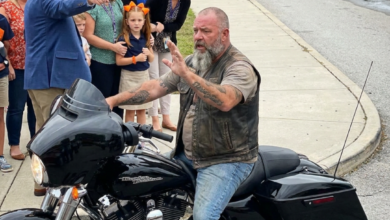
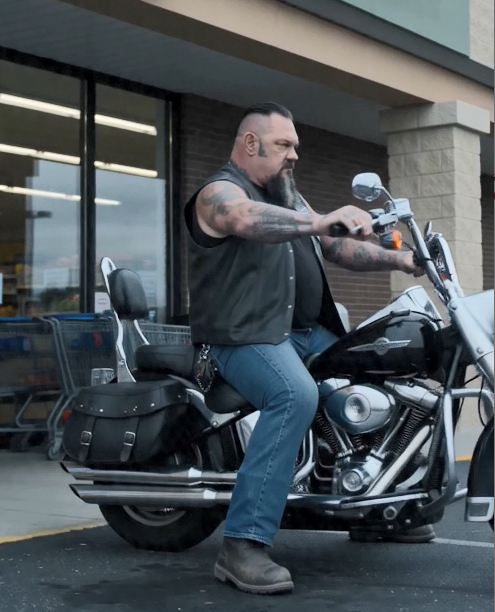
The Harley roared once as he rolled it sideways across the opening, then he killed the engine. The sudden silence after that made the parking lot feel unreal. Caleb stood upright on the foot pegs, both boots planted, one hand resting on the handlebar, the other folded across his chest.
He did not shout.
He did not threaten.
He did not move toward the man.
That was the second thing people misunderstood.
A violent man often needs noise. Caleb made none. He made himself large, still, and unavoidable. The dark-hooded man slowed because he had expected panic behind him, not a motionless biker ahead of him blocking the only road.
Sophie was crying hard now, twisting in his arms.
The man looked left.
The produce truck blocked the side lane.
He looked right.
Parents and customers were spilling out of the store.
Then he looked at Caleb.
Caleb’s face stayed still.
Not calm.
Still.
There is a difference.
Behind him, Emily screamed Sophie’s name until her voice cracked. A Black American cashier in her sixties named Mrs. DeLuca was trying to hold Emily back from running into the open lot. A Latino American stock clerk, maybe twenty, had already called 911 and was shouting directions into the phone. An older white man pointed toward the alley, thinking he was helping, while another customer filmed with both hands trembling.
Sophie’s little pink shoe came loose and dropped onto the asphalt.
That shoe changed something in Caleb’s eyes.
The man holding Sophie saw it.
For the first time, his confidence faltered.
He set her down.
Not gently. Not brutally. Fast, like something too hot to keep holding. Sophie stumbled, fell to her knees, then scrambled toward the sound of her mother’s voice. The man bolted between two parked cars, jumping a curb near the pharmacy side of the building.
Caleb did not chase him either.
People would judge that later too.
But at that exact moment, Sophie was on the asphalt between moving adults, a fallen shoe, and a mother collapsing toward her. Caleb stepped off the Harley and moved sideways, placing the bike and his body between the child and the street until Emily reached her.
That was Reveal Three.
He chose the child again.
Not the capture.
Police arrived within minutes. The first cruiser swung into the lot hard enough that a loose shopping cart rolled against a curb. Officer Dana Whitaker, a white American woman in her early forties, stepped out with a hand near her radio and eyes moving everywhere at once. A second officer, Marcus Reed, a Black American man in his thirties, ran toward the side alley where the man had fled.
Customers shouted over each other.
“He went that way!”
“The biker stopped him!”
“He didn’t even chase!”
“He blocked the exit!”
“The girl’s safe!”
Emily was on the ground, holding Sophie so tightly the child’s face disappeared into her sweater. Sophie sobbed into her mother’s neck, clutching one rabbit ear in her fist. Her other hand reached blindly for the shoe she had lost, because children do that after terror. They look for the small normal thing.
Caleb picked up the pink shoe.
He did not approach immediately.
He stood five feet away, holding it by the heel, as if even kindness needed permission after something that close to fear. Emily looked up at him through tears, saw the size of him, the tattoos, the leather, the unreadable face, and for half a second her body tightened.
She was not wrong to be frightened.
The whole morning had taught her fright.
Caleb saw it and lowered the shoe to the ground instead of handing it to her.
That was Reveal Four.
A man who needed gratitude would have stepped closer.
Caleb stepped back.
“Ma’am,” Officer Whitaker said, kneeling near Emily, “is this your child?”
Emily nodded so hard she could barely speak.
Caleb looked toward the alley where Officer Reed had disappeared.
Then toward Sophie.
Then down at his own hands.
They were shaking.
But nobody noticed.
Not yet.
PART 3
The man was caught two blocks away behind a closed laundromat, out of breath and trying to climb a chain-link fence that was taller than he had guessed. Officer Reed and a responding unit brought him down without drama worthy of the terror he had caused. That detail frustrated people later. Evil, or whatever ordinary broken thing drives a man to grab a child, often looks disappointingly small once it stops moving.
Back at Miller’s Market, the parking lot had become a circle of witnesses.
Police tape went up near the side exit. Employees stood by the automatic doors, pale and whispering. Customers who had abandoned carts now stood beside them with melting frozen food and faces full of delayed understanding. Emily sat on the curb with Sophie wrapped inside her coat, rocking even though Sophie had stopped crying.
Caleb remained by the Harley.
That became the next misunderstanding.
Several people wanted to praise him. Some wanted to question him. One man clapped him on the shoulder and said, “Man, you weren’t scared at all.” Caleb flinched so sharply the man took his hand away.
“Sorry,” the man said.
Caleb nodded once.
No smile.
Officer Whitaker approached him with her notebook.
“Sir, can I get your name?”
“Caleb Rourke.”
“You were at the coffee counter?”
“Yes, ma’am.”
“You saw the suspect carry the child?”
“Yes.”
“You chose to block the exit instead of pursue?”
Caleb looked toward Sophie.
“Yes.”
“Why?”
His answer was plain.
“Because he needed somewhere to stop.”
That was the first full turn.
Not a heroic line. Not a speech. A mechanic’s answer, almost. A man describing space, movement, pressure, escape. The suspect had been running toward open road. Caleb had removed the road.
Officer Whitaker wrote that down.
“Any law enforcement or military background?”
“No.”
“Security?”
“No.”
“Then how did you know to do that?”
Caleb hesitated.
His fingers flexed once near his thigh.
“I ride,” he said.
That sounded too simple. It wasn’t.
He explained only after Officer Whitaker waited.
He had ridden motorcycles since nineteen. He had worked as a tow operator for twelve years before opening a small repair bay outside Grove City. He had seen panicked drivers do impossible things when their path narrowed. He had seen people run into traffic because they were being chased. He had pulled cars from ditches and bikes from guardrails and once stood beside a minivan after a child survived because one stranger blocked a lane with a pickup before a second collision could happen.
“You don’t always chase,” Caleb said. “Sometimes you close the door.”
That was Redemption One.
The thing that looked like hesitation had been judgment.
Emily heard part of that from the curb.
She looked at him differently then, though tears and shock made everything slow. Sophie was calmer now, thumb in her mouth, rabbit under her chin. The little girl stared at Caleb with the solemn attention children give to people they do not fully understand but have already placed somewhere important.
“Mommy,” Sophie whispered.
Emily bent down. “What, baby?”
Sophie pointed at Caleb.
“That man didn’t run.”
Emily swallowed.
“No, sweetheart.”
“He just stood there.”
“Yes.”
Sophie’s voice was small but clear enough that Officer Whitaker heard it too.
“He was like a wall.”
Caleb looked away.
That was Redemption Two, though no one understood why his face tightened like pain.
A wall sounds fearless from the safe side.
Nobody thinks about what it feels like to be the wall.
The store manager, Tom Alvarez, a Latino American man in his fifties, came outside with security footage loaded on a tablet. He showed the officers the interior view first. Emily at the register. Sophie by the cart. The man approaching. The lift. The speed. The moment the store became aware too late.
Then he showed the exterior camera.
There was Caleb bursting out the side door, moving faster than a man his size should move. There was the Harley. The turn. The block. The stillness.
Customers leaned in.
Someone whispered, “Look at him.”
At first, they meant his stance.
Then Tom zoomed in.
Caleb stood on the foot pegs, arms folded, shoulders squared, face locked on the suspect. From a distance, he looked carved from iron. But the camera above the parking lot saw what human panic missed.
His hands were shaking.
Not a little.
Hard.
For the full two minutes between blocking the exit and police arrival, Caleb’s fingers trembled against his own forearms. His jaw moved like he was holding his teeth together. His left boot shifted once, then planted again. His face did not change, but his body knew exactly how afraid he was.
The circle went quiet.
Emily covered her mouth.
Officer Whitaker looked at Caleb, and her voice softened.
“You were scared.”
Caleb gave a short laugh without humor.
“Lady, I was terrified.”
That was Redemption Three.
The fearless biker was not fearless at all.
He had simply decided the child needed his fear to stay quieter than his body.
Emily stood slowly with Sophie in her arms. She walked toward him, stopping at the distance he had chosen earlier, the respectful distance between gratitude and overwhelm.
“Thank you,” she said.
Caleb nodded, uncomfortable.
Sophie lifted one hand from her mother’s shoulder.
“You shaked,” she said.
Adults might have hidden that.
Children do not.
Caleb looked at his hands, then at Sophie.
“Yeah,” he said. “I did.”
“But you stayed.”
That broke him more than the thank-you had.
His eyes shone, just for a second, before he looked toward the Harley.
“Had to.”
No one clapped.
That was good.
Some moments should not be turned into applause.
They should be allowed to breathe.
PART 4
The story made the local news by evening, though the news version was thinner than the real one.
Biker Helps Stop Attempted Abduction at Neighborhood Grocery Store.
That was the headline.
It was accurate.
It was also not enough.
Headlines like clean lines. Real life comes frayed. The article did not include Emily’s hands shaking so badly she could not buckle Sophie’s car seat for ten minutes. It did not include Mrs. DeLuca sitting in the employee break room afterward with her apron twisted in both fists. It did not include Caleb standing behind his repair shop that night, unable to drink the coffee he had bought because his stomach still remembered the little pink shoe on the asphalt.
People called him brave.
He hated that.
Not because he was humble in a polished way. Because the word felt too clean for what had happened inside him. Brave made it sound like he had not imagined every terrible outcome in the seconds before Sophie was set down. Brave made it sound like he had known the man would stop. He hadn’t. He had guessed. He had placed his motorcycle and his body across the exit and hoped the sight of something unmovable would be enough.
Sometimes hope has a black leather vest and shaking hands.
Emily came to the repair shop three weeks later.
She brought Sophie, who wore both pink sneakers and carried the stuffed rabbit. Caleb was under the hood of an old Chevy when they arrived. His coworker pointed them toward bay two, then wisely disappeared.
Sophie ran ahead before Emily could stop her.
Caleb froze.
Children can do that to men who have trained themselves not to expect gentleness.
Sophie stopped two feet away, tilted her head, and said, “Are you still scared?”
Emily closed her eyes, mortified.
“Sophie.”
Caleb wiped his hands on a rag and crouched slowly so he was not towering over her.
“Sometimes.”
“Of bad guys?”
“Sometimes.”
“Of loud motorcycles?”
He almost smiled. “Not usually.”
She considered this with great seriousness, then held out a folded piece of paper.
It was a drawing.
A stick figure on a motorcycle. A tiny girl beside a rabbit. A big square shape between them and a scribbled black car. Above the square, Sophie had drawn a face with a beard.
Emily said softly, “She calls it the wall man.”
Caleb looked at the drawing for a long time.
Then he said, “That’s a good wall.”
Sophie nodded. “It shakes.”
Emily started crying.
Caleb did not know what to do with that, so he did what practical men do when emotion arrives too large. He offered them folding chairs. He gave Sophie a juice box from the office refrigerator. He showed her how a motorcycle horn worked only after Emily gave permission. Sophie laughed at the sound and covered the rabbit’s ears.
The shop changed after that drawing.
Caleb taped it inside his office, not near the front where customers would see, but beside the time clock where the mechanics hung keys. For weeks, the men in the shop pretended not to notice it. Then one of them added a magnet so the corner would stop curling. Another replaced the tape when summer heat loosened it. Nobody mentioned it.
That was their way of respecting it.
The court case came and went in pieces Emily did not share publicly. The suspect faced charges. Sophie saw a counselor. Emily stopped shopping at Miller’s Market for a while, then returned one Tuesday morning because fear cannot be allowed to choose every grocery store forever. Mrs. DeLuca hugged her in the cereal aisle. Tom Alvarez walked her to the car without making it obvious.
Caleb still bought coffee there.
Not every day.
Enough.
The first time he saw Emily and Sophie there again, he did not approach. He lifted two fingers from near the coffee counter, a small acknowledgment with no demand attached. Sophie waved the rabbit’s paw at him from the cart.
That was enough too.
Months later, the city gave Caleb a certificate at a small community safety event. He stood under fluorescent lights in a button-down shirt that looked wrong on him, beard trimmed, tattoos still visible at his wrists. Emily sat in the second row with Sophie on her lap.
The mayor called him courageous.
Caleb stared at the floor.
When they handed him the certificate, his hands shook again.
This time, everyone saw.
Nobody looked away.
Afterward, Sophie tugged Emily’s sleeve and asked to say something. Emily hesitated, then let her walk to Caleb. The room softened as the little girl stood before the huge biker and handed him a small plastic toy brick from her pocket.
“It’s for your wall,” she said.
Caleb took it like it weighed more than steel.
“Thank you, ma’am.”
Sophie nodded, satisfied with his manners.
That plastic brick ended up on his desk below the drawing. Years later, when customers came in for brake work or oil changes, they sometimes noticed the odd little shrine: a child’s drawing of a shaking wall, a toy brick, and a coffee cup from Miller’s Market that Caleb never used.
If they asked, he gave the shortest version.
“Kid gave it to me.”
If they asked more, he usually changed the subject.
But sometimes, when the shop was quiet and the evening light came through the open bay doors, he would look at that drawing and remember the moment the man set Sophie down. He would remember the terrible relief, the noise returning, Emily’s scream becoming sobs, police tires against pavement, his own hands betraying the fear his face had hidden.
He never corrected people when they said he was brave.
He just knew the smaller, truer version.
He had been afraid.
He stayed anyway.
And in the memory of one little girl with pink sneakers and a stuffed rabbit, that was enough to make him a wall.
Follow the page for more emotional, cinematic stories about misjudged people, quiet courage, and the hidden kindness we almost miss when we judge too fast.