Part 2: A Foster Child Refused to Look at a Skull-Tattooed Biker — Two Years Later, He Called Him Dad
PART 2
The first three meetings were almost nothing.
At least, that was how the adults described them.
On the first Tuesday, Hank sat in the visitation room for forty minutes while Eli faced the wall and picked at the seam of his hoodie sleeve. Marsha brought in a box of board games, a juice pouch, and a small plastic container of pretzels. Eli touched none of it. Hank did not suggest a game. He did not ask about school. He did not say, “You can trust me,” which was good, because Eli hated that sentence more than almost any other.
Adults said it right before leaving.
That was the first small reveal.
Hank knew better than to ask for trust like it was a cup of sugar.
He sat quietly, drinking bad agency coffee, letting the wall have both of them.
On the second meeting, a foster mother named Karen Bell, a white American woman in her forties with tight lips and a flowered blouse, stayed in the hallway longer than she needed to. She had taken Eli in four months earlier and was already using phrases like “not a good fit” with the caseworker when she thought Eli could not hear.
He could always hear.
Children who are moved often become experts at doors.
Hank arrived in the same black vest, same worn boots, same steady pace. Karen looked him up and down like the agency had made a dangerous mistake.
“He doesn’t respond well to men,” she said.
Hank nodded.
“Most kids don’t respond well to strangers.”
Karen blinked, unsure whether that was agreement or criticism.
Eli heard it from inside the room.
He still did not turn around.
That was the second small reveal.
Hank did not defend himself.
He defended the boy’s right not to perform comfort.
On the third meeting, Eli pushed the pretzels off the table. The container hit the floor and scattered small salted pieces under the chairs. A young intern flinched. Karen sighed loudly from the doorway.
“See?” she said. “This is what I mean.”
Hank leaned forward.
Everyone expected him to correct Eli.
He did not.
He picked up the pretzels slowly, one by one, without asking Eli to help, without saying it was okay, without pretending the room did not ache. When he finished, he placed the empty container on the table and sat back down.
Eli’s eyes moved once.
Not to Hank’s face.
To his hands.
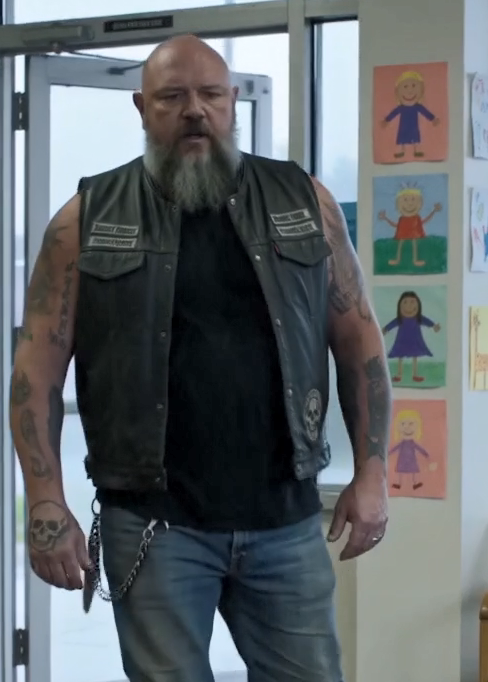
The skull tattoo covered the back of Hank’s right hand, dark ink fading around scarred knuckles. Eli stared at it for less than a second, then turned back to the wall.
Hank noticed.
He said nothing.
That was the third small reveal.
He understood that curiosity, for a child like Eli, had to stay hidden until it felt safe enough to breathe.
The fourth meeting did not happen in the visitation room.
It happened in the agency courtyard behind the building, where the grass grew unevenly and a cracked basketball hoop leaned over a patch of sunburned pavement. Hank arrived early with an old motorcycle in the back of a pickup trailer. It was not shiny. It was not loud. It looked forgotten, with dull chrome, a torn seat, and one mirror hanging at a sad angle.
Marsha came outside holding a clipboard.
“Hank,” she said carefully, “what are we doing?”
“Meeting,” he said.
“With a motorcycle?”
“With something broken.”
Marsha studied him for a moment. Then she looked at the building where Eli was watching through the blinds.
She lowered the clipboard.
“All right.”
Karen did not like it. The intern looked nervous. Two staff members lingered near the back door, ready to intervene if the biker somehow proved every fear they had about him.
Hank unfolded a canvas tool roll on the pavement. Wrenches, sockets, pliers, rags, and one old screwdriver lined up in the sun. He sat on a low stool beside the bike and began loosening a bolt near the foot peg.
He did not call Eli over.
He did not say, “Want to help?”
He simply worked.
That was the fourth small reveal.
Hank was not trying to make Eli talk.
He was building a place where silence could stand beside him without being punished.
For seventeen minutes, Eli watched from the door.
Then he stepped outside.
Nobody moved.
Hank kept his eyes on the bolt.
Eli came closer, one step at a time, hoodie still high, backpack still on his shoulders even though they were inside a fenced courtyard. He stopped near the tool roll and looked at a wrench with a red handle.
His hand hovered.
Hank loosened the bolt, then held out his left palm without looking directly at the boy.
“Hold this for me.”
Eli froze.
It was the first sentence that had asked nothing of his heart.
Only his hand.
Slowly, Eli picked up the wrench.
Hank nodded once.
“Good.”
The word was small.
Eli did not smile.
But he did not drop the wrench either.
PART 3
After that, Eli still did not become easy.
That mattered.
Stories often rush the hard part because people like healing better than patience. Eli did not hug Hank the next week. He did not tell him secrets. He did not suddenly decide that the world had apologized enough. Some meetings, he held tools. Some meetings, he sat three feet away and said nothing. Once, he threw a socket into the grass when Hank arrived late because a highway accident had blocked traffic.
Hank found the socket, wiped it clean, and placed it back in the roll.
“You were late,” Eli said.
It was one of his first full sentences.
Hank looked at him.
“I was.”
“You said two o’clock.”
“I did.”
Eli’s jaw tightened. “People say things.”
Hank absorbed that like a man taking a punch he had earned without throwing one back.
“Yes,” he said. “They do.”
That was Redemption One.
He did not explain lateness as if the child owed him understanding.
He showed up the next week twenty minutes early.
Then the week after.
Then the week after that.
The old motorcycle became their shared language. Hank taught Eli how to sort sockets by size, how to smell old gas before opening a tank, how to check a chain without putting fingers where fingers did not belong. Eli learned fast, partly because he was smart, partly because machines were fairer than people. A bolt did not promise forever. A wrench did not say “family” and pack your backpack three months later.
The agency staff began watching differently.
Marsha saw Eli stand closer to Hank each week. Karen saw it too, though by then she had told the agency she could no longer keep him. The move happened in October. Eli knew before anyone told him because the laundry stopped being folded into drawers and started being folded into stacks.
Hank arrived that Thursday and found Eli sitting on the courtyard steps with his backpack between his knees.
“Where to?” Hank asked.
Eli did not look up. “New house.”
“When?”
“Tomorrow.”
Hank sat beside him on the step. Not too close.
Eli’s voice came out flat.
“Don’t come anymore.”
Hank looked at the old motorcycle under its tarp.
“You telling me or asking me?”
Eli’s fingers tightened around the backpack zipper.
“Telling.”
Hank nodded slowly.
“Okay.”
That answer hurt Eli because it sounded like every other leaving.
Then Hank added, “I’ll need the address.”
Eli looked at him then.
It was not a hopeful look.
It was suspicion fighting for breath.
“Why?”
“Because the bike still needs work.”
That was Redemption Two.
Hank did not say, “I’ll never leave you,” because Eli would not have believed it.
He said the work was not finished.
The new foster home was across town with Denise and Robert Langley, a Black American couple in their late fifties who had raised three children and fostered more than they counted aloud. Their home smelled like lemon cleaner, fried onions, and old wood. Robert had a garage with pegboards, coffee cans full of screws, and enough space for the motorcycle if Hank came on Saturdays.
Denise watched Eli watch Hank unload the tool roll.
“You two fix bikes?” she asked.
Eli answered before Hank could.
“We’re rebuilding the carburetor.”
Denise glanced at Hank.
Hank kept his face still, but the corner of his mouth moved.
That was Redemption Three.
Eli had said we.
The next two years were built from things too small for a movie but large enough for a life.
Hank attended Eli’s school meeting when Eli broke another boy’s pencil after being called “trash bag kid.” He stood in the hallway outside the office, skull tattoo visible, while a teacher looked uncomfortable until Hank said, “The pencil was wrong. The words were worse.” He did not excuse what Eli did. He made sure the wound was named.
He taught Eli to change oil, then a tire, then a spark plug.
He taught him that anger can be used like a tool or swung like a hammer, and only one of those leaves something better afterward. He never said it like a lesson. He said it while handing Eli a rag and pointing at a stripped screw.
At eleven, Eli began leaving his backpack in the Langley hallway instead of sleeping with it beside the bed.
At eleven and a half, he let Denise buy him a winter coat without asking whether she kept the receipt.
At twelve, he started smiling in photographs, though only if Hank was not making a big deal about it.
Then came the school father-child breakfast.
Eli brought the flyer home folded into eight squares and stuffed inside his math book. Denise found it while checking homework and placed it on the kitchen table.
“You want Robert to go?” she asked gently.
Eli shrugged too quickly.
Robert, sitting in his recliner, lowered his newspaper.
“I’ll go if you want me.”
Eli stared at the flyer.
Then he said, “Can Hank come?”
The kitchen went quiet.
Not hurt quiet.
Tender quiet.
Robert nodded.
“Course he can.”
Hank arrived that morning wearing his cleanest jeans and a black button-down shirt under the vest. He had trimmed his silver beard and looked uncomfortable without grease on his hands. Eli stood by the school entrance wearing a blue polo and sneakers he had actually tied.
A white father in the parking lot looked at Hank’s tattoos and pulled his daughter slightly closer.
Eli saw it.
For the first time, he stepped toward Hank instead of away from judgment.
Inside the cafeteria, the tables were covered with paper placemats that said My Favorite Thing About My Dad. Eli stared at his placemat for a long time. Hank saw the word and reached for his coffee, pretending not to see what the paper asked.
Eli picked up a pencil.
He wrote slowly.
Hank did not look.
Not until Eli pushed the placemat toward him.
Under the printed question, Eli had written:
He stayed when I was hard to stay with.
Hank’s hand froze.
The skull tattoo on it looked suddenly less frightening than fragile.
That was when Marsha, who had come as a program guest, finally told Denise what Hank had never volunteered. Hank Mercer had grown up in foster care too. Eleven placements. No adoption. No permanent holiday table. No one to teach him how to shave without nicking his chin before school. At eighteen, he aged out with two trash bags and a temper big enough to keep people from seeing the terror underneath.
The biker club found him years later, sleeping in the back of a garage where he had been hired to sweep floors.
“They were the first family that didn’t kick me out,” Hank had once told Marsha.
He had said it like a joke.
Marsha had not laughed.
When Eli heard it later, he did not speak for almost an hour. Then he walked into the garage where Hank was rebuilding the motorcycle’s old headlight and stood beside him.
“You got moved eleven times?”
Hank set down the screwdriver.
“Yeah.”
“Nobody kept you?”
“No.”
Eli looked at the bike, at the tools, at the man with the skull tattoo and silver beard.
“Then why do you keep coming back?”
Hank’s eyes stayed on the headlight.
“Because I know what it does to a kid when nobody does.”
That was Redemption Four.
The biker had not come to rescue a child from a system he merely pitied.
He had come back to the room where part of him had never been rescued.
Eli stood there a long time.
Then he picked up the wrench with the red handle, the first tool Hank had ever asked him to hold.
“You need this?”
Hank looked at it.
Then at Eli.
“Yeah,” he said. “Hold that for me.”
PART 4
The word Dad did not arrive dramatically.
It came on a Tuesday afternoon in the Langley garage while rain tapped against the roof and the old motorcycle finally started for the first time in two years. The engine coughed, sputtered, then caught with a rough little growl that made Robert cheer from the doorway and Denise cover her ears while smiling.
Eli, now twelve, jumped back laughing.
Hank shut the engine off before the neighbors complained, though everyone knew the neighbors had heard worse from lawn mowers, leaf blowers, and family arguments through open windows.
“You did it,” Hank said.
Eli shook his head.
“We did.”
Hank nodded. “We did.”
Then Eli noticed the loose rag near the exhaust and grabbed it before it could smoke.
“Dad, watch it.”
The garage became still.
Rain kept falling.
Robert stopped smiling in the doorway. Denise put one hand over her mouth. Hank stood with his hand on the motorcycle seat, eyes fixed on the rag in Eli’s fist as if the word might disappear if he looked directly at the boy.
Eli realized what he had said.
His face changed.
Fear came back fast, old and trained.
He looked ready to apologize for wanting too much.
Hank moved carefully, the way he had the first day with the wrench. No sudden step. No big speech. No claim placed on the child like a flag. He only reached into the open tool roll, took out the red-handled wrench, and handed it to Eli.
“Hold this for me,” he said.
Eli stared at him.
Then he took it.
The word stayed.
After that, nobody forced definitions. The Langleys remained Eli’s foster parents, then his permanent guardians after months of paperwork, visits, signatures, and court dates that felt too slow for something everyone in the house already knew. Hank stayed Hank in legal documents, mentor in agency records, emergency contact on school forms, and Dad in the garage when Eli forgot to protect himself from needing the word.
Sometimes he called Robert Dad too.
Nobody made that a competition.
Love, in the Langley house, had finally learned to make room.
The old motorcycle was never meant to be sold. Hank had known that before Eli did. When it was finished, they rolled it into the driveway on a bright June afternoon. The paint was still imperfect. The seat was patched. The chrome held small scars from years of weather. But it ran clean, and Eli had touched nearly every part of it.
Hank placed one gloved hand on the handlebar.
“She’s yours when you’re old enough.”
Eli looked startled.
“I don’t have a license.”
“You also don’t have a beard. We got time.”
Eli laughed.
That laugh became one of Denise’s favorite sounds in the house.
At thirteen, Eli joined a school robotics club because machines still felt honest. Hank showed up to competitions wearing his black vest and looking wildly out of place between suburban dads in polo shirts. The first time another parent stared too long at the skull tattoo on Hank’s hand, Eli leaned over and said, “He builds better than he looks.”
Hank whispered, “That better be a compliment.”
“It is.”
“Needs work.”
At fourteen, Eli gave a presentation about designing a community workshop for foster youth, a place where kids could learn tools, cooking, art, bike repair, and small skills that made the world less mysterious. His first slide showed a simple drawing of a garage with wide doors.
He did not mention foster care eleven times.
He did not mention seven moves.
He did not mention the first sentence.
But Hank knew.
Marsha knew too. She sat in the back row, older now, hands folded over her purse, watching the boy who once faced walls speak clearly to a room full of adults. When Eli finished, Hank stood first. He clapped once too loud, then seemed embarrassed by his own hands. The room followed.
Years later, the red-handled wrench hung on the wall of that community workshop.
It was mounted in a small wooden frame Hank built badly and Robert rebuilt properly when Hank was not looking. Beneath it, Eli placed a handwritten card. Not fancy. Not dramatic.
Hold this for me. The first thing someone trusted me with.
Kids asked about it all the time.
Some were in foster care. Some had parents who loved them but worked two jobs. Some came because they liked motorcycles. Some came because the building felt like a place where nobody demanded a smile at the door.
Eli, older then, would point to the wrench and say, “That was the beginning.”
He did not always tell them the whole story.
Sometimes a kid only needs the first safe sentence.
Hank grew older in the way bikers do, denying it with louder complaints than necessary. His beard went fully white. His knees cracked when he crouched beside a bike. He still wore the vest. The skull tattoo faded at the edges, though children in the workshop continued to think it was the coolest and scariest thing in the world.
One evening, after a long class on basic engine repair, Eli found Hank sitting alone by the open garage door. The sun was low. The street outside glowed gold. A group of kids rode bicycles past, shouting at one another with the loose joy of children who expected to return somewhere safe.
Hank watched them.
“You ever think about those eleven houses?” Eli asked.
Hank rubbed his thumb over the skull tattoo.
“Less now.”
“Why?”
Hank looked toward the wall where the red-handled wrench hung.
“Because one of them finally led somewhere.”
Eli sat beside him.
For a while, neither spoke.
They did not need to fill the silence anymore. It had changed over the years. Silence had once been Eli’s wall, then Hank’s patience, then their workshop, then the space between two people who no longer feared being left just because nobody was talking.
A small boy from the evening class came back through the door, holding a loose bicycle chain in both hands.
“Mr. Eli?” he asked. “Can you fix this?”
Eli looked at Hank.
Hank smiled under his white beard.
Eli took the chain, reached for a tool, then paused and held out the red-handled wrench to the boy.
“Hold this for me,” he said.
Hank looked away fast, pretending to check the sunset.
The boy took the wrench with both hands like it mattered.
And maybe it did.
Follow the page for more emotional, cinematic stories about misjudged people, quiet courage, and the hidden kindness we almost miss when we judge too fast.