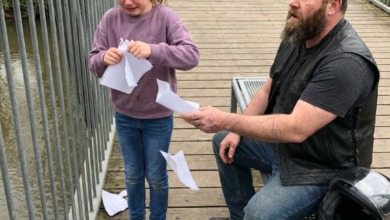
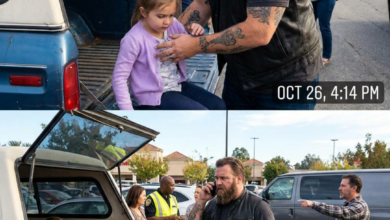
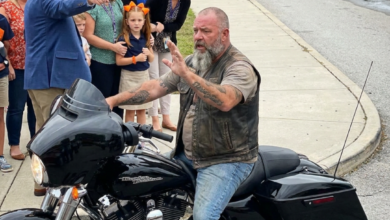
A Boy Was Mocked Because His Father Was in Prison — Then a Tattooed Biker Told a Different Story
PART 2 – REVEAL
The biker’s name was Raymond “Grizzly” Cole, though the office visitor sticker on his vest only said Ray C. in blue marker. The sticker looked absurd against the leather, like someone had tried to label a thunderstorm with a paper tag. He had signed in properly. He had passed the front desk. He had even shown his driver’s license to the secretary, who kept glancing at his tattooed hands while pretending not to.
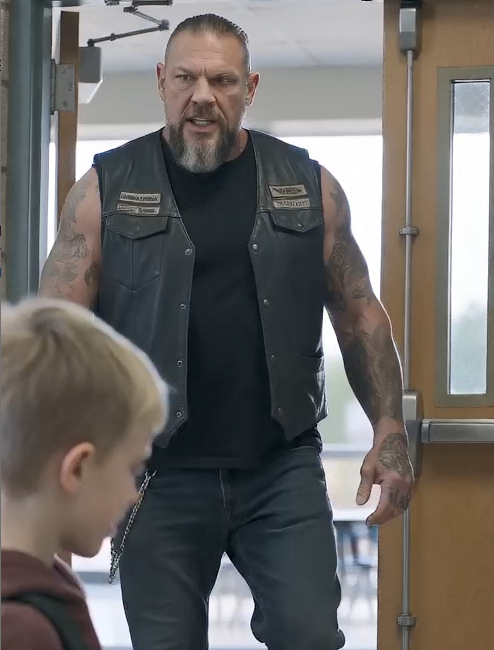
He was not there to cause trouble.
That was the first thing people should have noticed.
But people rarely notice paperwork when fear has already chosen a story.
Ray had come for Career and Community Day, a small school event where local adults talked about jobs, choices, and life after mistakes. Ridgeview usually invited firefighters, nurses, mechanics, store managers, veterans, and once a meteorologist who brought a green-screen weather map. Ray was listed as a motorcycle mechanic and veterans’ volunteer, which sounded normal enough on paper.
In person, he looked like the last man a principal would place in front of fourth graders.
He was fifty-eight, thick through the chest, with a gray beard, tired blue eyes, and hands scarred from tools, wrecks, and old anger. His leather vest had no readable club patches because the school had asked him to remove anything that might distract the children. He had agreed without complaint. That detail mattered later.
The spill had happened before his classroom visit began.
Noah’s tray lay upside down on the tile. Chocolate milk spread under a cafeteria table. The boy who made the prison joke was already backing away, face pale now that an adult shaped like trouble had entered the scene.
Ray crouched.
Slowly.
Not near the bully.
Near Noah.
He picked up the tray first, then the apple, then the unopened pack of crackers. He set each item on the table with quiet precision, as if restoring order to a moment everyone else wanted to punish.
Noah kept shaking.
The teacher holding his arm said, “Mr. Bennett, you need to calm down.”
Ray looked at her hand.
He did not raise his voice. He did not insult her. But something in his face changed just enough that she let go.
That was Reveal One.
The frightening man was careful with power.
“Did he hit anybody?” Ray asked.
The teacher blinked. “No, but he threw—”
“Did he hit anybody?”
“No.”
Ray nodded. “Then give him his arm back before this gets bigger than it is.”
The principal, Mrs. Angela Porter, arrived from the main hallway. She was a Black woman in her early fifties, composed and sharp-eyed, wearing a navy blazer and the expression of someone trying to keep a school from turning into a rumor before lunch ended.
“Mr. Cole,” she said carefully, “we can handle this.”
“I know,” Ray said. “I’m just picking up milk.”
That answer did not fit his appearance.
It made the adults pause.
Noah looked at him then, really looked, and something passed across his face. Not trust. Not yet. Recognition, maybe. The kind children show when they have been judged by strangers and suddenly see another person who knows the weather of that.
Ray turned to the boy who had made the joke.
“What’s your name?”
The boy stared at his shoes.
“Evan,” the teacher said.
Ray nodded once. “Evan, you know what a prison sentence means?”
The principal stiffened. “Mr. Cole.”
Ray lifted one hand slightly, palm open.
No threat.
Just wait.
Evan shrugged. “It means somebody did something bad.”
“That can be true,” Ray said.
The cafeteria grew quieter.
“But it does not tell you everything they ever did before that day, or everything they are still trying to do after it.”
That was Reveal Two.
He did not deny prison.
He complicated it.
A cafeteria full of children can feel confusion like weather. They had expected shouting, punishment, maybe the strange thrill of a scary man saying something scary. Instead, Ray spoke so quietly that half the room had to lean in.
Noah looked down at the floor.
Ray noticed the boy’s backpack then. On the front pocket was a small patch hand-sewn with crooked stitches. Not a brand patch. A homemade one. A little motorcycle stitched in blue thread, uneven and tender.
Ray pointed to it.
“Who made that?”
Noah’s jaw tightened.
“My dad.”
The room heard him because the room was still listening.
Evan whispered, “From jail?”
Ray turned toward him, not fast, not angry, but with enough weight that Evan’s mouth shut.
Noah’s eyes filled again. “He sends patches. Grandma sews them on.”
That was the third reveal.
Noah’s father was not just an absence. He was still reaching, piece by piece, through envelopes, fabric scraps, and whatever dignity was allowed past a prison mailroom.
Mrs. Porter looked at the patch. Her face softened by half an inch.
Ray did not explain yet.
He asked Noah, “You want me to tell them a story?”
Noah gave a tiny shake of his head.
Then, after a second, he nodded.
The principal glanced around the cafeteria, then at the watching children, the spilled milk, the teacher with her arms folded too tightly. She made a decision good principals make when rules are less important than the room’s pulse.
“Everyone,” she said, “remain seated.”
Ray stood slowly. His knees cracked. A few children stared at his tattooed fingers. A few looked afraid. One cafeteria worker crossed herself under her breath, then seemed embarrassed that she had.
Ray rested one hand on the back of a chair.
“I’m not here to tell you prison is good,” he said. “It’s not. I’m not here to tell you mistakes don’t matter. They do.”
Noah stared at the floor.
Ray looked at him only once, then looked at the whole room.
“But I once knew a man who got locked up and still taught his son how to tell the truth.”
Nobody moved.
Not even Evan.
The story had begun.
PART 3 – REDEMPTION
Ray did not say Noah’s father’s name at first.
That was the kindness of it.
He told the children about a man who worked nights at a tire plant and came home smelling like rubber and coffee. A man who packed lunches with too many napkins because he worried about spills. A man who knew how to fix a bicycle chain with a spoon handle, how to whistle through two fingers, and how to make a scared little boy laugh during thunderstorms by pretending the sky was bowling badly.
Noah’s face changed before anyone else’s did.
He knew.
Of course he knew.
Ray told them the man had made one terrible choice after many smaller desperate ones. After a layoff. After bills. After pride. After borrowing from the wrong person and trying to pay back fear with more fear. He did not name the crime in detail. He did not decorate it. He only said the man hurt the law, hurt his family, and went away because consequences are real.
The children listened harder than adults often do.
Then Ray looked at Evan.
“But when a person goes to prison,” he said, “their child does not go with them.”
That sentence landed softly, but it landed.
Noah’s shoulders moved once.
Ray kept going.
He spoke of letters written in pencil because pens were not always allowed. Of drawings folded into envelopes. Of fathers learning to say “I’m sorry” in handwriting because they could not say it at a breakfast table. Of birthday cards arriving late and still being slept beside. Of children who knew the empty chair at school events had a story nobody asked gently enough to hear.
That was Redemption One.
Noah had not been abandoned by a father who forgot him.
He was loved by a man paying for what he had done while still trying to send fatherhood through paper.
The room stayed quiet.
Not perfectly. Children shifted. A tray clinked. Someone sniffed. But nobody laughed now.
Ray reached into the inside pocket of his vest and pulled out an envelope. It was worn at the corners, folded many times. He held it up but did not open it.
“This is from a man I visit twice a month,” he said. “He asked me to bring something today if Ridgeview let me speak.”
Noah’s head snapped up.
Mrs. Porter took a step forward. “Mr. Cole—”
“I cleared it with his grandmother,” Ray said.
That was Reveal Four.
He had not wandered into Noah’s pain by chance.
He had been carrying a piece of it.
From the back of the cafeteria, an elderly white woman in a green cardigan appeared in the doorway, breathing hard from hurrying. Mrs. Ruth Bennett, Noah’s grandmother. She had been called after the cafeteria incident, but she had arrived just in time to hear what Ray said. Her hand pressed to her chest.
Noah saw her and whispered, “Grandma?”
She nodded through tears.
Ray still did not hand him the envelope.
Not yet.
He looked at Evan and the boys around him.
“I’m going to tell you something most adults forget to say plain,” he said. “A child can feel shame for something he never did. And if you hand him more of it, that says more about you than it says about his father.”
The teacher looked down.
The father waiting by the office looked away.
Even Mrs. Porter’s eyes shone, though her face stayed steady.
That was Redemption Two.
The guilt had been placed on the wrong person.
Ray finally walked to Noah, crouched in front of him, and held out the envelope. His huge tattooed hand looked startling next to the boy’s small fingers. Noah took it like it might vanish.
On the front, in careful pencil, was written:
For my brave boy, Noah. Read when the world gets loud.
Noah did not open it in front of everyone.
That told Ray he had been raised right.
The boy held it against his chest.
Evan whispered something. Nobody heard it except the girl beside him, who elbowed him hard enough to make him stop.
Ray stood again.
He could have ended there. He could have let the room feel ashamed and call that teaching. But redemption, the real kind, rarely stops at guilt. It tries to build a door.
So he told the other half of the story.
Years ago, Ray said, he had been in a veterans’ reentry program that paired volunteers with incarcerated fathers trying to stay connected to their children. He had joined because his own brother died in prison after nobody in the family answered his letters for three years. Ray had been angry at him. Justified, maybe. But after the funeral, he found a box of unsent birthday cards under his brother’s bunk.
That was why Ray visited now.
Not because prison erased harm.
Because silence multiplies it.
Noah’s father, Daniel Bennett, had been in that program for two years. He had completed welding classes, parenting courses, anger management, and a restorative justice group where men wrote letters they were not allowed to send until a counselor said the letter was for the child, not for the man’s guilt. Daniel had written Noah every week.
Every week.
Some letters were held back by the system. Some arrived late. Some arrived with black marker over lines that should never have needed censoring. But they came.
Ruth Bennett stepped into the cafeteria then, unable to stay quiet.
“He calls every Sunday,” she said, voice trembling. “Noah reads him spelling words.”
Children turned toward her.
Noah’s face crumpled.
Not in shame this time.
In the terrible relief of being defended by more than one person.
Evan looked smaller than he had ten minutes earlier. He was not evil. That matters. He was a child repeating the sharpest version of what he had heard adults say somewhere, maybe at home, maybe online, maybe at a dinner table where nobody thought a child was collecting weapons.
Mrs. Porter understood that too.
“Evan,” she said gently but firmly, “come here.”
He came.
His cheeks were red.
Ray did not make him apologize in front of the whole cafeteria. Forced public apologies often teach children only how to survive embarrassment. Instead, he stepped back and let the principal lower her voice.
Evan looked at Noah.
“I shouldn’t have said that.”
Noah stared at the envelope.
“No,” he said. “You shouldn’t have.”
That was enough.
For now.
Ray nodded once, as if he respected the boy for not making forgiveness cheap.
Then Noah opened the letter.
Not fully. Just enough to see the first line.
His lips moved as he read silently.
His father had written:
If they ever make you feel small because of where I am, remember this, my worst place is not your name.
Noah pressed the paper to his face.
Ruth Bennett covered her mouth.
Ray looked away because men like him know when a child deserves privacy, even in a crowded room.
That was Redemption Three.
The biker had not come to tell children that Noah’s father was innocent.
He had come to tell them Noah was.
PART 4 – ENDING
The cafeteria story spread through Ridgeview by dismissal, but not in the ugly way everyone expected.
Children are faster than newsletters. By three o’clock, first graders had heard that a giant biker made fourth grade stop laughing. Fifth graders heard he had once punched a bully with words, which was not accurate but somehow close. Parents heard pieces in the pickup line and began asking why there had been “a motorcycle guy” in the cafeteria.
Mrs. Porter handled it carefully.
She sent an email that evening describing a restorative conversation about family stigma, incarceration, and empathy. It was the sort of school language adults need to feel safe. It did not mention Noah by name. It did not mention the letter. It did not mention the way a child held paper against his chest like it was keeping him together.
Ray would have hated being made into a hero anyway.
He did not return the next day.
That disappointed Noah more than he admitted.
But on Friday, Ray’s motorcycle was parked outside Ridgeview again, tucked at the far end of the lot so it would not startle the buses. He arrived with Ruth Bennett this time, not as a surprise, and sat in the school office with a folder of approved visitor forms. His vest still had no readable patches. His boots were wiped clean. His beard was combed badly enough to prove he had tried.
Noah saw him through the office window and nearly ran.
He stopped himself.
Nine-year-old boys have pride.
Ray stood. “You read it?”
Noah nodded.
“All of it?”
“Twice.”
“Good.”
Then Noah asked the question that had been pressing against him since Tuesday.
“Do you think he’ll come home different?”
Ray did not answer quickly.
That was why Noah trusted him.
“I think he’s trying to,” Ray said. “And trying matters. But you get to be a kid while he does the work.”
Noah looked down.
“Kids still know.”
Ray crouched so they were almost eye level. “Then let them know this too. Your dad made mistakes. He also writes every week. Both things can be true without making you carry either one.”
Noah nodded, though he did not fully understand it yet.
Most adults do not either.
Over the next month, Ridgeview changed in small ways. Mrs. Porter invited a family counselor to speak with teachers about children with incarcerated parents. The library ordered books about complicated families that did not turn every missing parent into a villain or a tragedy. Evan and Noah were not suddenly friends, because real life is not that lazy. But Evan stopped laughing. Once, during recess, he told another boy to shut up when someone mentioned prison.
That was not redemption.
It was a beginning.
Ray started visiting Ridgeview every other Friday for the after-school repair club, which was really just eight kids learning how to fix loose chair legs, jammed zippers, bicycle chains, and eventually one donated lawn mower the principal regretted approving. Noah joined first. Evan joined third, standing awkwardly near the door until Ray handed him a screwdriver and said, “Either help or block the draft.”
That became their treaty.
One afternoon, Noah brought in a new patch from his father. This one showed a tiny wrench crossed with a pencil. Ruth had sewn it onto the inside of his backpack flap, where he could see it without everyone else touching it with questions.
Ray noticed.
He did not comment until the other children left.
“Good patch.”
Noah smiled. “Dad said tools fix outside things. Words fix inside things.”
Ray looked at the backpack for a long moment.
“Your dad say that?”
“Yeah.”
Ray swallowed. “Smart man having a hard road.”
That was as clean as mercy gets.
Months later, Daniel Bennett’s facility hosted a family day. Not release. Not freedom. Just folding chairs, vending machines, guards watching doorways, and children trying to decide whether to hug fathers who smelled like soap and institutional laundry. Ray drove Ruth and Noah there because Ruth’s car was unreliable, and because Noah asked him to.
At the entrance, Noah froze.
The building was gray. Too gray.
Ray did not touch his shoulder. He only stood beside him.
“You don’t have to be brave loud,” he said.
Noah whispered, “What if I cry?”
“Then you’ll have a wet face.”
That made Noah laugh once, and laughter broke the fear enough for his feet to move.
Daniel Bennett cried first.
He was thinner than Noah remembered, with tired eyes and hands folded carefully on the table as if he was afraid to reach too quickly. Noah stood still for one second, then walked into his father’s arms with the letter still folded in his pocket.
Ray watched from the vending machines.
He did not intrude.
That was the image Ruth remembered most: not the reunion itself, but the biker standing twenty feet away, pretending to study candy bars while making sure a boy had all the space he needed to love someone complicated.
On the drive home, Noah fell asleep with his forehead against the window.
Ruth sat in the front seat, twisting a tissue in her lap.
“You gave him something back,” she said.
Ray kept his eyes on the road.
“No,” he answered. “His dad did. I just delivered it.”
But Ruth knew better than to argue with a man who preferred his kindness unframed.
Near sunset, they passed Ridgeview Elementary. The playground was empty. The cafeteria windows reflected orange light. In one of those windows, Noah’s small sleeping face appeared for a moment beside Ray’s reflection, one boy and one biker layered together in the glass, both marked by a story other people had almost told wrong.
The next week, Noah stood in front of his class for a family-history assignment.
His paper shook.
Evan noticed but said nothing.
Noah took a breath and read five sentences about his grandmother, his dad, and the biker who taught repair club. He did not hide the prison part. He did not explain it either. He simply said, “My dad is away because he made a serious mistake, but he still writes me letters, and I am not his mistake.”
The room stayed quiet.
This time, it was the good kind.
Ray never heard that speech from Noah directly. Mrs. Porter told him later in the parking lot while he strapped a box of donated tools to his motorcycle. He pretended to adjust the bungee cord longer than necessary.
“Kid’s got steel,” he said.
“Yes,” Mrs. Porter replied. “He does.”
Ray rode away before she could say anything more tender.
That was his way.
But months later, when Noah opened his newest letter from Daniel, a small photograph fell out. It showed a prison classroom workbench, a half-built wooden toy truck, and Daniel standing beside it in a gray uniform, smiling carefully. On the back, he had written:
For Noah. Tell Mr. Ray I used the right wrench.
Noah laughed so hard Ruth came in from the kitchen.
Then he tucked the photo into his backpack, behind the patch with the wrench and pencil, and went outside to wait for Friday repair club.
Across town, Ray’s motorcycle turned onto the school road, engine low and steady, carrying a man most people still misread at first glance.
Noah did not.
He saw the story underneath.
Follow the page for more emotional, cinematic stories about misjudged people, quiet courage, and the hidden truths children carry long before adults learn to listen.