Part 2: A Biker’s Rescue Dog Jumped Into A Frozen Lake To Save A Drowning Little Girl — At The Vet Hospital, The Girl Whispered The Dog’s Real Name, One He’d Never Told Anyone
Part 2
Let me tell you about the water.
Then I’ll tell you about the name.
Scout went out onto that ice low and flat. Belly down. Spreading her weight. I don’t know how a dog knows to do that. Maybe somebody taught her once. Maybe she just knew.
Twenty feet from the hole, the ice started cracking under her. Long white lines shooting out like spiderwebs.
She didn’t stop.
The little girl was in the hole. Her head was up. She was screaming. Her mittens were scrabbling at the edge of the ice, and every time she grabbed it, it broke off in her hands. Her puffy pink snowsuit was soaking up water and dragging her down.
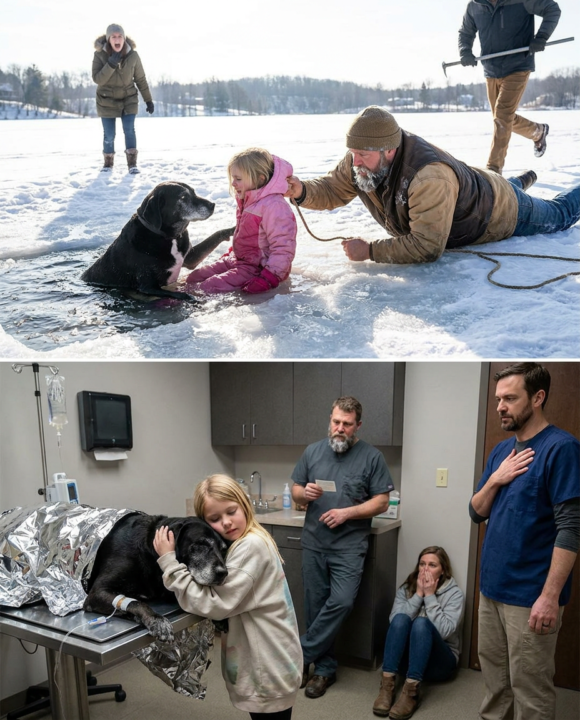
Scout went in.
She didn’t slide in. She jumped. Straight into the black water beside the girl.
For a second, they were both gone under.
Then Scout’s head came up. Then the girl’s. Scout had the hood of that pink snowsuit in her teeth.
I was on my belly on the ice by then, forty feet out, the rope uncoiled in front of me. The woman on the bank was screaming. One of the fishermen from the shacks in the middle was running toward us across the hard ice with a spud bar.
I threw the rope. Short. I pulled it back and threw it again.
The second throw landed across the hole.
The girl couldn’t grab it. Her hands were already too cold. Her fingers wouldn’t close.
Scout let go of the hood.
She swam behind the girl. Put her head under the girl’s back. And pushed.
I watched that dog shove a seven-year-old up onto the edge of the ice with her head and her shoulders. The ice broke. Scout went under. Came up. Pushed again.
The second time, it held.
The girl was half out. Chest on the ice. Legs still in the water.
I crawled the last fifteen feet. I don’t remember deciding to. I grabbed the girl by the back of the snowsuit and hauled. She slid toward me across the ice like a seal.
I got her to the fisherman. He scooped her up and ran for the bank.
Then I turned back to the hole.
Scout was still in it.
She’d pushed the girl out. She’d used everything she had.
Now she was trying to get out herself. Her front paws on the edge. Clawing. The ice breaking under her every time. Sliding back. Going under. Coming up slower.
Her eyes found mine.
I’ve seen a lot of things. I’ve never seen anything look at me like that.
I went in.
Up to my chest. The cold hit me like a car. I couldn’t breathe. My lungs locked.
I got my arms under her front legs. I pulled.
The fisherman came back with the spud bar. He lay flat on the ice and reached it out to me. I grabbed it with one hand and held onto Scout with the other.
He pulled us both out.
The girl’s name, I learned in the ambulance, was Emmy. Emmy Dahl. Seven.
She’d been in the water about three minutes. Her core temperature was dropping, but she was conscious. Crying. Shaking. Asking for “the doggy.” The paramedics wrapped her in blankets and took her to the ER at St. Joseph’s.
The woman on the bank was her aunt. Kristin Dahl. Thirty-eight. She’d raised Emmy for almost four years. She’d moved up to Brainerd from the Twin Cities the summer before and didn’t know about the creek mouth.
She kept saying she was sorry. Over and over. To me. To the paramedics. To Emmy.
Scout couldn’t stand up.
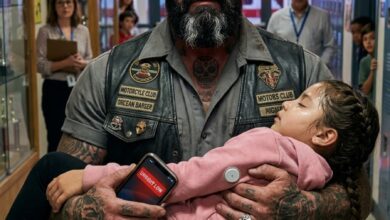
I carried her to my truck. She was shaking so hard her teeth were clattering. Her eyes kept rolling back.
I drove to the emergency vet on Washington Street with the heat on full blast and my wet jeans freezing to the seat. I don’t remember the drive.
The vet, Dr. Molly Heikkinen, met me at the door. She took one look and called for a heated table and IV fluids.
“Severe hypothermia,” she said. “And she’s exhausted. Like, completely. Her heart’s been working way too hard.”
“Is she gonna make it?”
Dr. Heikkinen didn’t answer right away.
“Next few hours,” she said.
I sat on the floor of that exam room in a pair of borrowed scrubs, because my clothes were soaked through, and I held Scout’s paw.
A vet tech brought me coffee. I didn’t drink it.
I kept thinking about the index card in my kitchen drawer.
She is good with children.
Part 3
At 4:10 that afternoon, the exam room door opened.
Kristin Dahl came in. Then the little girl, holding her hand.
The ER doctor had cleared Emmy. She’d been warmed up. She was going to be fine. They’d wanted to keep her overnight, but she wouldn’t stop asking about the dog. So the doctor said she could visit for ten minutes, then come back.
She was swimming in a gray hospital sweatshirt that came down to her knees. Her hair was still damp at the ends. Somebody at the hospital had given her a pair of fuzzy yellow socks.
She walked straight past me to the table.
Scout lay under foil blankets with an IV in her front leg. Barely moving. Eyes half closed.
Emmy stood beside the table and looked at her for a long time.
Then she pulled back the edge of the blanket.
She looked at the white patch on Scout’s chest.
The bell.
She went completely still.
I watched her face. Something happened in it. Something I couldn’t read. Like she’d seen a ghost. Like she’d seen something she’d been looking for her whole life.
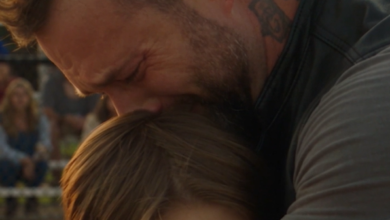
She climbed up on the rolling stool beside the table. She put her arms around Scout’s neck. She laid her cheek against Scout’s head.
And she whispered.
I heard it.
“Bluebell.”
The room tilted.
I grabbed the edge of the counter.
Four years.
I’d never said it. Not to my club. Not to Dr. Heikkinen, who’d been Scout’s vet for four years. Not to my sister, who calls every Sunday. Not to anyone.
The card was in a folder in a drawer in my kitchen in a house on the other side of town.
And a seven-year-old girl I’d never met had just whispered it into my dog’s ear.
Scout’s eyes opened.
All the way.
She lifted her head. Barely. An inch off that steel table.
She looked at the little girl.
And her tail moved under the foil blanket. Once. Then again. Then a thump against the steel.
Thump. Thump.
She hadn’t wagged her tail since we came off that ice.
She licked Emmy’s face.
Emmy started crying. Not scared crying. The other kind.
“It’s okay, Bluebell,” she whispered. “It’s okay. It’s me.”
Kristin Dahl had her back against the door. Her face had gone white. Whiter than it was on the bank.
“Emmy,” she said. Her voice was shaking. “Emmy, sweetheart. How do you know that name?”
Emmy didn’t let go of Scout. She looked up at her aunt over the dog’s head.
“That’s Mommy’s dog,” she said.
Kristin stopped breathing.
“Mommy had a dog named Bluebell,” Emmy said. “With a bell on her tummy. In my picture. You know. The one on my nightstand.”
Kristin put her hand over her mouth.
She slid down the door until she was sitting on the floor.
I didn’t understand yet.
I thought that was the end of it. A strange coincidence. A dog who’d belonged to the girl’s mother once, before she gave it up.
I thought, Well, the dog found her way home, sort of.
I thought it was a sweet story.
Then Kristin Dahl looked up at me from the floor of that exam room, and asked me a question that made my blood go cold.
“Where did you get her?”
“Rescue in Duluth,” I said. “April of 2022.”
Kristin’s face.
“My sister died in March of 2022,” she said.
Part 4
It came out in pieces. On the floor of that exam room. While Scout lay on the table with Emmy curled against her.
Kristin’s sister was named Lena. Lena Mercer. Thirty-one when it happened.
She’d had a black Lab mix before she ever got married. Rescued her as a puppy from a shelter in St. Cloud. Named her Bluebell because of the white bell on her chest. Bluebell slept beside Emmy’s crib every night of her life.
Lena married a man named Roy Mercer in 2017.
Roy was a sheriff’s deputy in Cass County. The next county over.
Kristin didn’t say much about Roy. She didn’t have to. Her hands said it. The way she held them in her lap.
“He hurt her,” she said finally. “For years. He was careful. He knew how to be careful. He was a cop.”
Lena tried to leave twice. The first time, Roy found her at a motel in Bemidji within six hours. He had a friend run her plates.
The second time, she went to a domestic violence advocate in Brainerd. She made a plan.
She told Kristin everything.
She gave Kristin a sealed envelope. Photographs. Medical records. Recordings on a flash drive. Everything Roy had done. She told her to give it to a lawyer if anything happened to her.
And she signed papers. Legal papers. Naming Kristin as Emmy’s guardian.
“She said Roy would never stop looking for her,” Kristin said. “But he’d stop looking for Emmy if Emmy was somewhere legal. Somewhere with a court order and a lawyer and a judge watching.”
On a Thursday night in March 2022, Lena brought three-year-old Emmy to Kristin’s apartment in Minneapolis. She kissed her goodbye. She said she’d be back soon.
Two days later, her car was found in the Mississippi River below the dam in Brainerd. Windows down. Doors open.
She wasn’t in it.
They searched the river for two weeks. Divers. Boats. Dogs. Nothing.
The river was high that spring. Fast. Cold.
The sheriff’s office ruled it an accident. Presumed drowning. Body never recovered.
Kristin buried an empty coffin in the cemetery in St. Cloud that June.
Then Kristin did what her sister told her to do.
She gave the envelope to a lawyer.
The lawyer gave it to the county attorney.
Roy Mercer never got custody of Emmy. A judge looked at the photographs and the recordings and gave Kristin full guardianship within a month.
Roy was put on leave. Then fired. He was investigated in his wife’s disappearance. They never found enough to charge him.
But last September, he was arrested again. He’d put a girlfriend in the hospital. And this time, prosecutors had Lena’s envelope too. A pattern. Years of it.
He was sentenced in December. Fourteen years. Stillwater.
The same prison I was in.
“What about the dog?” I asked. “What happened to Bluebell?”
Kristin shook her head.
“We never knew,” she said. “When Lena dropped Emmy off, she didn’t have Bluebell with her. I asked. She said Bluebell was safe. That’s all she’d say. She’s safe.”
Kristin looked at the dog on the table.
“I thought she meant she’d given her to a neighbor or something. After Lena died, I looked. I called people. Nobody knew anything.”
That’s when I stood up.
I asked Dr. Heikkinen if she’d watch Scout.
I drove home. Twenty minutes. I went into my kitchen and opened the drawer and took out the adoption folder.
I drove back.
I sat down on the floor next to Kristin and handed her the index card.
Her real name is Bluebell. Because of the white bell on her chest.
She is good with children. She sleeps by the bed. She is afraid of men who shout.
Please give her to someone who will keep her safe.
Please never tell anyone her name.
Kristin looked at it for a long time.
Then she started shaking.
“That’s Lena’s writing,” she whispered.
She turned the card over, as if there’d be something on the back. There wasn’t.
She looked at the date on the rescue paperwork. Surrendered: March 10, 2022.
Thursday.
The same night Lena dropped Emmy off in Minneapolis.
She’d driven to Duluth first. Two and a half hours north. Surrendered her dog at closing, paid in cash, cried the whole time.
Then driven two and a half hours south. Kissed her daughter goodbye.
And two days later, her car went into the river.
Kristin looked up at me.
“Why would she do that,” she said. “Why would she drive all the way to Duluth to give up her dog, if she was just going to—”
She stopped.
I didn’t say anything.
But I’d been to prison. I’d watched my sister hide. I know what it looks like when somebody plans to disappear.
You don’t drive five hours to protect a dog you’re planning to take with you into a river.
You do it to protect a dog you can’t take where you’re going.
Part 5
Scout lived.
By morning, she could stand. By the next afternoon, she was eating. Dr. Heikkinen said she’d never seen a dog her age come back from hypothermia that severe.
“She had a reason, I think,” the vet said, looking at Emmy, who’d come back with Kristin first thing and hadn’t left the dog’s side.
Kristin and I sat in the clinic waiting room that second afternoon and talked for three hours.
I told her about the card. About Stillwater. About my sister Ingrid and the man she married and what I did to him.
I told her I’d never said the name because the woman who wrote that card asked me not to. And I knew what it meant when a woman asked you that.
“I figured she was hiding,” I said. “I figured if anybody ever went looking for that dog by her real name, it’d be somebody she was running from.”
Kristin was quiet.
“You protected her,” she said. “For four years. Without even knowing who she was.”
“I protected the dog,” I said.
“Same thing,” Kristin said.
Then she told me something she’d never told anybody. Not the police. Not her husband.
“I never believed she drowned,” Kristin said. “Not really.”
The car windows down. The doors open. The divers who searched for two weeks.
“Lena was a state champion swimmer in high school,” Kristin said. “She swam the length of Mille Lacs once. On a dare.”
She looked at the index card in her hands.
“And now this.”
Here’s what we did.
Kristin called the domestic violence advocate in Brainerd. The one Lena had gone to in 2022. A woman named Paulette, who’d been doing that work for twenty-six years.
Kristin told her about the card.
Paulette was quiet on the phone for a long time.
Then she said, very carefully, “I can’t tell you anything about any client. Ever. You know that.”
“I know.”
“But I can tell you that a man named Roy Mercer was sentenced to fourteen years in December,” Paulette said. “And I can tell you that some women in some situations stay away a very long time. Until it’s safe. And then they don’t always know how to come home.”
Kristin couldn’t speak.
“Give me a few days,” Paulette said.
The story got out. Of course it did. One of the fishermen on Loon Lake filmed the rescue on his phone from the ice shacks. Ninety seconds. A black dog going into a hole in the ice. A little girl in a pink snowsuit being shoved up onto the edge. A big man crawling out on his belly.
The Brainerd Dispatch ran it. Then the Minneapolis TV stations. Then everybody.
Hero rescue dog saves 7-year-old from icy Minnesota lake.
They showed Scout’s face on the six o’clock news. The white bell on her chest, clear as day.
Four days later, on Wednesday morning, there was a knock at my door.
Paulette was on my porch. Sixty-something. Gray braid. Kind eyes.
Behind her, at the bottom of my steps, stood a woman I’d never seen before.
Thin. Mid-thirties. Dark hair cut short. A gray parka. Her hands shoved deep in her pockets.
She was shaking.
Not from the cold.
Scout pushed past my legs.
She’d been lying by the woodstove, still weak, still wobbly. She hadn’t run since the lake.
She ran.
Down my steps. Into the snow. She hit that woman so hard they both went down in the drift by my mailbox.
Scout was crying. Whining. That high, broken sound a dog makes when something’s been missing a very long time. Her whole body wagging. Licking the woman’s face, her hands, her hair.
The woman was on her back in the snow with seventy pounds of black Lab on top of her, and she was sobbing.
“Bluebell,” she kept saying. “Bluebell. Bluebell. I’m sorry. I’m so sorry. I’m sorry.”
Paulette stood beside me on the porch with her hand on my arm.
“Arlo,” she said quietly. “This is Lena.”
Part 6
Lena Mercer drove her car into the Mississippi River below the Brainerd dam on March 12, 2022.
She’d planned it for three months. With Paulette. With a network of advocates across four states.
She swam out of an open window in water so cold it stops your heart. She’d practiced in that river all winter. In a wetsuit, at night, below the dam.
A car was waiting a mile downstream.
By morning, she was in Montana. With a new name. A new job. A new state.
A cop’s wife, presumed drowned. A cop who would never stop looking for a living wife. But would stop looking for a dead one.
She told me all of this on my couch, with Bluebell’s head in her lap, three hours after she knocked on my door.
“He told me if I ever took Emmy, he’d find us both,” she said. “And he’d make sure I never saw her again. He was a cop. He could do it. I knew he could do it.”
She looked at her hands.
“So I gave her to Kristin. With the papers. With the envelope. I knew if Emmy was with my sister, legally, with a judge involved, he couldn’t touch her. And I knew if I was dead, he’d stop hunting.”
She swallowed.
“I didn’t know how to save us both. So I saved her.”
And Bluebell.
“I couldn’t take her,” Lena said. “A woman with a black Lab with a white bell on her chest. If Roy ever saw a picture of her, he’d know. He’d know I was alive.”
She drove her to Duluth. Two and a half hours. To the smallest rescue she could find, where nobody knew her.
She wrote the card in the parking lot.
“I asked them to change her name,” she said. “So nobody could ever find her by it. So Roy couldn’t.”
She looked at me.
“I didn’t know if anybody would ever read the card. I didn’t know if they’d care.”
“I read it,” I said.
“You never said her name.”
“You asked me not to.”
For four years, Lena lived in a small town in eastern Montana. She worked at a hardware store. She didn’t make friends. She didn’t have a phone with her real name on it.
Every month, she wrote a letter to Emmy. She gave them to Paulette, who kept them in a locked file.
Forty-six letters.
In December, when Roy was sentenced, Paulette called her.
“He’s gone,” Paulette said. “Fourteen years. You can come home.”
Lena didn’t come.
“I didn’t know how,” she told me. “What do you say to your daughter after four years? She was three. She thinks I’m dead. She has a grave. Kristin’s her mother now. Maybe she’s better off.”
Then, on a Saturday night in January, in a motel room in Montana, she turned on the TV.
And there was Bluebell.
On the news. A white bell on her chest. Lying on a vet table under foil blankets.
And beside her, a little blonde girl in a hospital sweatshirt, with her arms around her neck.
Lena told me she sat on the floor of that motel room and watched it fourteen times.
Then she called Paulette.
“Bluebell found her,” she said. “Bluebell found my baby.”
Part 7
Lena saw Emmy that Friday.
Not at my house. At Paulette’s office. With Kristin there. With a family counselor. Slowly. Carefully. The way these things have to happen.
I wasn’t there. It wasn’t my place.
But I drove Bluebell over and waited in the parking lot.
Kristin told me later that Emmy didn’t recognize her mother’s face. She’d been three.
But she recognized her voice.
Lena said, “Hi, Emmy-bug,” and Emmy stood up from her chair.
Nobody had called her Emmy-bug in four years.
It’s been nine months.
They’re figuring it out. All of them. Lena lives in Brainerd now, in an apartment three blocks from Kristin’s house. Emmy spends weekends with her mom. Weeknights with her aunt. A family therapist on Tuesdays. Some days are hard. Some days are good.
Kristin and Lena are sisters again. That took the longest.
And Bluebell?
I offered to give her back. That first week. On my couch. I said it, and it nearly killed me, but I said it.
Lena looked at me for a long time.
“I asked them to give her to someone who’d keep her safe,” she said. “She jumped into a frozen lake for my daughter while you held the rope.”
She shook her head.
“She found her someone. She’s yours.”
So she lives with me. Still.
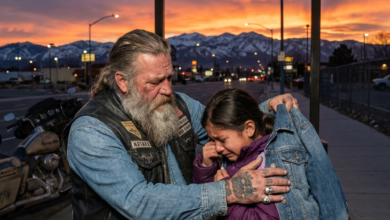
But every Sunday, rain or snow, I drive her to Loon Lake. We walk the shoreline trail. The same one.
And waiting on the bench by the creek mouth, every Sunday, are three people. A woman with short dark hair. A woman with a blonde ponytail. And a little girl in a pink snowsuit who runs down the trail the second she sees us.
There’s a sign at the creek mouth now. The county put it up. Bright orange. THIN ICE — MOVING WATER — STAY OFF.
The North Woods Riders paid for it.
Last Sunday, Emmy was walking ahead with the dog. Lena and Kristin a little behind. Me at the back, the way I like it.
Emmy stopped at the sign. Knelt down in the snow. Put her arms around the dog’s neck.
I heard her whisper.
“Good girl, Bluebell.”
Then she looked back at me over her shoulder.
“Arlo, what do you call her?”
I thought about it.
Four years of Scout. One week of Bluebell. An index card in a drawer.
“Depends who’s asking,” I said.
Emmy giggled.
The dog’s tail thumped in the snow.
She answers to both.
She always did.
👉 If this story stayed with you, follow our page for more stories from the road — and from the ones who keep a secret long enough for it to find its way home. 🏍️🐾