A Biker Grabbed a Young Woman Inside a Diner and Wouldn’t Let Her Reach the Waiting Car—Then He Recognized the Star Her Stepfather Said He Had Drawn
My mother had been dead six months.
For a moment, that was the only thing I could think of. Not the stranger beside me. Not Grant standing in the doorway. Just the ridiculous possibility that Mom had left another conversation behind for me to finish.
“What does that mean?” I asked.
Grant looked at the waitress.
“Could we have some privacy?”
“No,” she said.
Her name tag read JOAN. She kept the counter between herself and the rest of us, but she didn’t put down the telephone.
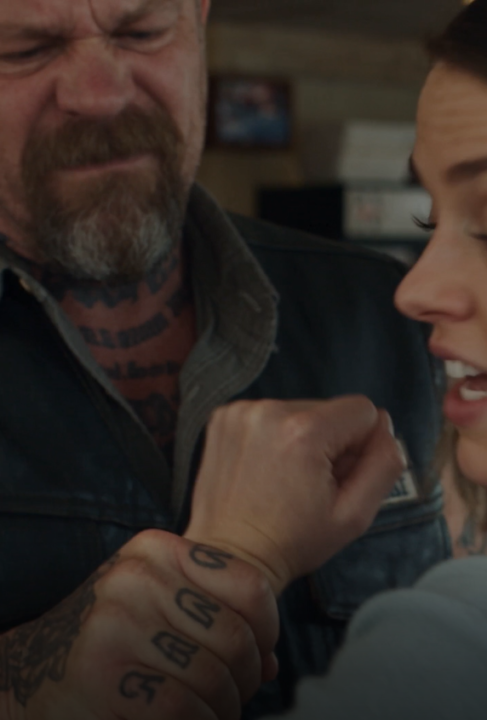
The biker had moved away from me. Both hands hung open beside his jeans.
“I’m Ray,” he said.
I knew the name.
Ray Harlan.
My mother had spoken it like a warning when I was little and like a closed subject when I got older.
“You died in a motorcycle accident.”
He swallowed.
“No.”
“Mom showed me a picture.”
“What picture?”
A newspaper clipping. A wrecked motorcycle. A black helmet beside a ditch.
I remembered the kitchen floor beneath my bare feet. Grant had bought frozen waffles afterward because nobody felt like cooking.
“I was eight,” I said.
Ray shook his head.
“I was in prison when you were eight.”
There it was.
Something solid.
Something ugly enough to make everything else look like a trick.
Grant saw my face change.
“Now you understand why your mother protected you.”
Ray didn’t argue.
That unsettled me more than a denial would have.
“What for?” I asked.
“Drunk driving. I hurt somebody.”
Joan’s coffee pot touched the counter with a small click.
I pulled my sleeve over the star.
The drawing had survived in a school notebook I kept through three moves. When I turned eighteen, I had taken it to a tattoo artist because I wanted one thing from my father that didn’t belong to the way he died.
Now I wondered whether I had built a memory around a man I shouldn’t trust.
Grant came closer.
“We can talk about this in the car.”
“What appointment?”
“The estate meeting. Ellie, we discussed this.”
We had.
My mother’s family had left money in a trust. Grant said we needed to meet an attorney in northern Kentucky to finish paperwork.
He had my folder.
He had arranged everything.
Ray looked toward the car, then back at me.
“You’re an adult,” he said. “You can go wherever you want.”
Grant made a short, satisfied sound.
“But please,” Ray continued, “make one call yourself before you sign anything.”
He reached slowly for his wallet and laid a worn photograph on an empty table.
A little girl sat on a kitchen counter with a crooked paper crown.
Me.
Beside her stood a younger version of him, holding a birthday cake with both hands.
Grant turned the photograph facedown.
“We’re not doing this here.”
I looked at his hand resting on my childhood.
Until that morning, I had trusted it with every important paper in my life.
Why was it trembling over a photograph?
The first thing I remembered was the table.
Yellow laminate, one corner lifting. Dad used to smooth it down with his thumb while he waited for the kettle.
During storms, I crawled underneath.
One night he joined me, his knees nearly touching his chin. He drew a star on the back of a grocery receipt and gave it six points because I insisted five wasn’t enough.
He left a gap at the bottom.
“A door underneath,” he said. “For anything scary that needs to leave.”
I added a dot beside the shortest point.
“That’s me.”
“That’s you.”
Later, when he worked nights, he left notes in an old square tea tin. He folded them into narrow strips and wrote the last sentence inside the envelope flap.
I always opened that part first.
He called it the back porch.
That was the good memory.
What followed came in pieces: arguments through the wall, a broken promise about a school concert, my mother crying beside a telephone.
Then Dad disappeared.
Mom married Grant when I was ten. By then we had moved twice, and I had learned that questions about Ray made the adults quiet.
Standing in the diner, I couldn’t tell which memories belonged together.
Ray waited while I studied the photograph.
He didn’t tell me what I ought to remember.
Grant did.
“Your mother was trying to keep you stable.”
I turned toward him.
“You said she expected him to die.”
“I said something badly.”
“You said she told you.”
His expression tightened.
Joan set a glass of water beside me.
“You want somebody else called?”
My aunt Rachel.
Mom’s younger sister.
She lived forty minutes away and disliked Grant so openly that we had stopped inviting them to the same holidays.
I called her.
When I said Ray’s name, she stopped breathing for long enough that I checked the screen.
“Where are you?”
I told her.
“Stay there.”
She didn’t sound surprised that he was alive.
That frightened me.
Grant heard enough to close his folder.
“Rachel has been waiting years to make your mother look bad.”
Ray picked up his photograph.
“Maybe she has something to say.”
Grant turned on him.
“You lost the right to have opinions about this family.”
“I lost my license,” Ray said. “I lost my marriage. I went to prison.”
His voice remained low.
“I didn’t die.”
The room seemed to settle around that sentence.
Joan asked Grant to move his car away from the entrance. He refused, then thought better of it when she mentioned calling the police about the disturbance.
He went outside.
I watched him through the glass.
Ray stayed several feet away.
“How long were you there?” I asked.
“Three years.”
“And after?”
“I looked.”
It was too small an answer for fifteen years.
I wanted to hate him for giving it.
Then he took a folded sheet from his wallet.
An old number. Three addresses. Dates crowded into the margins.
The last address was ours from two houses ago.
How close had he come while I was lighting birthday candles for a dead man?
Aunt Rachel arrived carrying her purse under one arm and wearing the expression she used when a restaurant tried to charge her twice.
She recognized Ray immediately.
That hurt.
Not because she smiled. She didn’t.
Because recognition meant there had been a world of living adults beyond the story I’d been given.
Grant came back inside with the folder tucked against his chest.
“Good,” he said. “Tell her about the order.”
Rachel stopped beside my table.
“What order?”
He produced a photocopy.
My mother had obtained restrictions on contact after Ray’s arrest. There were allegations about drinking, unstable behavior, frightening arguments.
Ray read the page without touching it.
“I remember.”
Grant turned to me.
“I wasn’t even in your life when that happened.”
For the first time, he looked less like the man hiding something and more like the person who had inherited somebody else’s damage.
The paper had Mom’s signature.
Her handwriting was unmistakable.
Grant produced another document: a letter she had written to my elementary school directing staff not to disclose our address.
Rachel sat down.
“She was afraid then,” she said.
“Of him?”
“Of what might happen.”
Ray rubbed the edge of his thumbnail.
“She had reasons.”
I had expected him to say she lied about everything.
His refusal made the room harder to understand.
Grant set the papers in front of me as gently as a doctor delivering results.
“Your mother made those decisions. I supported her.”
I looked at Rachel.
“Did you know he wasn’t dead?”
“Yes.”
The word came without protection.
I stood.
My chair struck the floor behind me.
Joan came around the counter, but Rachel held up a hand.
“Let her.”
“You let me believe that.”
“Your mother said you were having nightmares. She said a counselor wanted the subject left alone.”
“Did you ask the counselor?”
“No.”
Ray looked away.
Even he couldn’t make that answer easier.
Grant stepped beside me.
“We need to get going.”
For one weak second, I wanted to.
The car was familiar. His voice was familiar. I knew where he kept tissues and how he liked the radio set.
Truth had made strangers out of everybody else.
Then his folder tilted against the table.
A page slid free.
My driver’s license was copied across the top. Beneath it was a signature that looked like mine from a distance.
I picked it up.
“What’s this?”
“Just a draft.”
“I didn’t sign it.”
“It’s a sample signature. The attorney needed—”
Rachel took off her glasses.
“Which attorney?”
Grant named a firm.
She looked at the appointment letter.
“This address is a shipping center.”
“It’s temporary office space.”
Ray said nothing.
That silence gave me room to hear the words myself.
Draft.
Sample.
Temporary.
All the soft little covers people put over something sharp.
Rachel asked permission to photograph the page. I gave it.
Grant reached for the original.
I pulled it back.
If Mom had started the lie, what was Grant still trying to make me sign?
We did not get in his car.
Rachel drove me home with my permission, waited while I packed a bag, and took me to her house. Ray left separately.
Grant called seven times before we reached her driveway.
On the eighth, Rachel handed me the phone.
“You decide.”
I silenced it.
The next morning, I called the law firm whose name appeared on the appointment letter.
They had no appointment under my name.
They asked me to send a copy.
By afternoon, an attorney from their office called back and said the letter had not come from them.
I put the phone on speaker.
Rachel stopped washing a plate.
That was the first fact nobody could explain away as grief or bad memory.
We hired our own attorney, Priya Desai, using money from my savings. She asked for the trust documents, account statements, and correspondence Grant had told me I didn’t need to keep.
I had almost none of it.
My grandfather had died when I was seventeen. His trust provided for my education and specified a later distribution to me. Mom had handled the family side until her death.
Grant had continued handling everything afterward, calling it a favor.
Priya contacted the actual trustee.
There was no required trip to Kentucky.
There was no urgent deadline.
There were, however, questions about several distributions made for my benefit.
Tuition.
Housing.
A medical expense I didn’t recognize.
I had attended community college while working at a dental office. I had paid most of my own rent.
The numbers on the statements belonged to somebody with a much more expensive life.
“Don’t fill the gaps with guesses,” Priya told me.
I tried.
It got harder when we found the proposed agreement beneath my copied license.
I would have acknowledged receiving the disputed funds and authorized a large payment to Grant’s consulting business for expenses supposedly advanced on my behalf.
The forged signature sat beneath a sentence saying I had reviewed the supporting records.
I hadn’t seen any records.
Ray came to Rachel’s porch that evening.
He brought coffee for everyone and nothing for himself.
I showed him the document.
He read it twice.
“Can you prove you didn’t sign?”
“I was at work on the date.”
“Get the schedule.”
Not revenge.
Not a speech.
A thing to do.
I went inside and emailed my office manager.
Later, I learned Ray had spent years making copies of letters before he mailed them. He had returned envelopes, address searches, and invoices from a licensed investigator he could afford for only a few weeks.
Some letters had gone to the house where I lived with Grant.
The envelopes had come back marked refused.
I looked at the familiar handwriting across one of them.
Not Mom’s.
Grant’s.
Ray watched me recognize it.
“I didn’t know whether you’d written back and somebody kept it,” he said. “Or whether you wanted me gone.”
I thought of Grant waiting outside the diner with the engine running.
Was the trip supposed to finish the paperwork—or finish moving me away from anyone who could question it?
The first message arrived at my office before lunch.
A patient had forwarded a photograph from the diner.
In it, Ray’s hand was around my arm.
The caption called him a violent ex-convict harassing a young woman who had refused to leave with him.
There was no photograph of him letting go.
No mention of the papers.
My manager closed her office door before showing it to me.
“Do we need to keep somebody out of the building?”
I appreciated the question.
Then I hated that I had to answer it.
I gave her Grant’s photograph too.
By evening, relatives who hadn’t called since Mom’s funeral wanted to know why I was living with Rachel.
Grant had told them I was being manipulated.
He said Ray wanted my inheritance.
He said Rachel had always resented my mother.
Some of those things sounded close enough to old family arguments that people repeated them without checking.
Ray called once.
“If distance helps, I’ll give you distance.”
I sat on Rachel’s porch steps.
“Do you want to?”
“No.”
“Then don’t decide for me.”
He was quiet.
“Okay.”
It was the first answer from a parent that didn’t have another instruction attached.
Two days later, Grant reported that documents and money had gone missing from his home.
He named me.
He suggested Ray had encouraged me.
A detective contacted me. Priya arranged for us to respond with an inventory of what I had taken: clothes, my laptop, a school notebook, and copies of records concerning me.
We provided the bank statements I could access.
Nothing was resolved by one conversation.
I had to keep going to work while people decided whether I was a confused daughter, a thief, or a woman finally reading her own mail.
Then Grant changed the locks.
My mother’s belongings were still inside.
So was the square tea tin.
I had found it while sorting her closet after the funeral. Inside were old buttons, a spare key, and a narrow bundle of envelopes tied with elastic.
I had never opened the bundle.
Mom’s handwriting on the outer paper said RAY.
I had assumed they were letters between married adults.
Now Grant said the tin belonged to him.
Priya requested that the disputed records and personal effects be preserved. She told me not to go back alone or try the windows.
I hadn’t planned to.
But I understood why she said it.
The house held the last things I could still ask my mother.
On Friday, Grant sent me a private message.
Give back what you took, and we can stop this before anyone looks at your signature.
I stared at the screen.
Rachel asked whether it was another threat.
I told her yes.
That was true.
It wasn’t the whole truth.
Because there was one signature in those accounts that really was mine.
What would happen when Ray learned I had already helped the man who kept us apart?
I told Priya first.
Two years earlier, Mom had needed money.
That was how Grant explained it. A shortfall. A temporary problem. Something about insurance and overdue bills.
He said a distribution request had become tangled in paperwork.
Mom was in the kitchen while he spoke to me. She didn’t look up from the sink.
He placed a form in front of me and pointed to a line meant for her signature.
“She said it’s fine.”
I looked toward her.
“Mom?”
“Please, Ellie. Just help us get it done.”
So I wrote her name.
I knew I shouldn’t.
I knew it while I was doing it.
Afterward, Grant thanked me and bought dinner. Mom went to bed before the food arrived.
The money had come from an account connected to my trust.
I had believed it would pay her bills.
Priya listened without interrupting.
Then she asked exactly what I remembered, what I had been told, and whether I had copies.
She did not promise it meant nothing.
She told me she would help me address it honestly.
That was worse than reassurance.
It was also the first thing that made me feel I might survive it.
I told Ray that afternoon.
He sat across from me in Rachel’s kitchen, his hands around a mug that had gone cold.
“I helped him,” I said.
“You signed once.”
“I signed somebody else’s name.”
“Yes.”
I started crying then.
Not because he was angry.
Because he hadn’t made the truth smaller to spare me.
“Are you going to leave?”
He looked genuinely confused.
“No.”
I wiped my face with a paper towel.
“Mom knew.”
He lowered his eyes.
“I figured there was more.”
Rachel brought another piece of it the next day.
Mom had asked her to keep silent years before Grant became involved. She had admitted inventing the motorcycle death because she couldn’t manage my questions while Ray was incarcerated.
Later, the lie became harder to undo.
Then useful.
She let a new husband believe he was protecting a widow. She let me believe grief was the reason I couldn’t remember my father clearly.
But Grant had learned the truth.
The returned letters proved he had choices after that.
“Your mother was scared,” Rachel said.
“So was I.”
“I know.”
“No. I was scared of a dead man because she needed him to stay dead.”
Rachel didn’t defend her.
That silence mattered.
We disclosed the signed form through Priya instead of waiting for Grant to use it. The records that followed showed a pattern larger than my one act: altered requests, misleading descriptions, payments that did not match the claimed expenses.
The trustee sought a court accounting.
A hearing was scheduled.
Before it, Grant surrendered a box of Mom’s belongings through the attorneys.
The tea tin was inside.
Its bundle of letters had been cut open.
If he had only been protecting Mom’s privacy, why had he removed the envelope flaps?
The courtroom was smaller than I expected.
No grand staircase. No rows of spectators waiting for a revelation.
A handful of relatives came. So did the trustee’s representative, Rachel, and Ray.
Grant sat beside his attorney with a bottle of water centered neatly in front of him.
He looked like the man who had taught me how to dress for my first job interview.
I hated that I could still remember him kindly.
Priya reminded me the hearing concerned the accounting and preservation of assets. Other questions would follow their own process.
We weren’t going to settle fifteen years in one morning.
Still, the past kept appearing between the numbers.
The false appointment letter.
The proposed release.
The distributions labeled for my housing when I had been paying rent from wages.
Grant’s attorney said recordkeeping had been poor and family arrangements informal.
Then the questioning reached the letters.
Grant said my mother controlled contact with Ray.
He said he had never knowingly interfered.
The returned envelopes were shown.
He acknowledged writing refused on mail she did not want.
“Did you read the contents?”
“No.”
“Did you remove any part of the envelopes?”
“No.”
My fingers tightened around the edge of my chair.
The recovered letters had pages missing. Others stopped mid-thought.
One ended with Ray saying he had a new address and had written it where he always put the important part.
The back porch.
Inside the flap.
Mom’s bundle contained almost none of those flaps.
Ray had brought his retained copies.
For years, he had copied whole envelopes flat before sealing them because a counselor at the reentry program told him to keep records of anything important.
Priya laid one copy beside an original.
Grant leaned toward his attorney.
They whispered.
Then he shook his head.
“That address was no good anyway.”
The room became very quiet.
Priya looked up.
“Which address?”
“The one he kept sending.”
“The address where he was receiving mail?”
Grant reached for the water.
He should have stopped.
Instead, he tried to make the detail sound harmless.
“You can’t expect Lena to give a child an address hidden under a glued flap.”
Ray lifted his head.
I felt Rachel’s shoe touch mine beneath the bench.
Priya waited before speaking.
“You testified that you did not read the contents.”
Grant unscrewed the cap.
Water spilled onto the table.
“I knew how he wrote.”
“How?”
No answer.
The judge asked him to respond to the question.
Grant looked toward me, and for a moment I saw the expression from the diner: the small calculation before the reassuring smile.
This time, the smile never arrived.
The envelope copy remained on the table.
Its flap held an address where Ray had lived for four years.
An address I had never been given.
Grant had known exactly where my father was.
What else had he called protection while making sure I could never find the door?
Nothing ended when we walked out.
That was the part I hadn’t understood.
A truth could stand in a courtroom and still leave you with appointments on Tuesday.
The court required a fuller accounting and took steps to protect the remaining trust assets while the disputes were resolved. The forged documents and false representations were referred for further investigation.
Later records tied Grant to altered requests and payments to his own business.
Some money came back.
Some became a judgment.
My part in the earlier signature was disclosed and addressed with my attorney. I did not get to erase it because somebody else had done worse.
Grant did not get to turn it into permission for everything that followed.
We stopped speaking directly.
For months, I expected my phone to vibrate whenever I made a decision.
Buying a car.
Changing insurance.
Choosing whether to attend a cousin’s wedding.
I had been an adult for years. Learning to act like my choices belonged to me took longer than filling out a new form.
Ray didn’t make that easier by pretending he had always known how to be a father.
He was late once.
Ten minutes.
I stood outside the diner watching the road and felt eight years old before I realized what was happening.
When he arrived, I was furious.
He started explaining a stalled truck at the shop.
Then he saw my face.
“I should’ve called.”
“Yes.”
He took out his phone.
“Next time, I call.”
Such a small repair.
It held.
We met every other Sunday at Joan’s diner. At first we talked about work because work came with facts neither of us had to defend.
He repaired motorcycles and small engines.
I scheduled dental appointments and knew more than I wanted about insurance denials.
Later, I asked about prison.
He answered.
I asked about the person he had hurt in the crash.
He answered that too.
He didn’t use Grant’s lies to clean up his own history.
That made it possible to believe him when he told me something good.
One Sunday, he brought the original star drawing.
The receipt had yellowed almost brown.
My little dot sat beside the shortest point.
“I thought I’d lost it,” I said.
“You left it in my jacket.”
“You kept that jacket?”
“Till the zipper gave up.”
He had moved the receipt from pocket to wallet to a plastic sleeve, carrying it through years I had never known he was living.
I placed my wrist beside it.
The tattoo artist had copied one crooked line perfectly.
For a while, we sat without talking.
Outside, a motorcycle started, then faded toward the highway.
Ray touched the edge of the paper.
“I’m sorry I scared you that first day.”
“You let go.”
“I should’ve asked.”
“Yes.”
He nodded.
No excuse.
I took a pen from my purse and turned a clean napkin over.
This time, I drew the star.
Six points. A gap underneath. One tiny dot.
Then I added another.
Ray watched my hand.
“Who’s that?”
I slid the napkin toward him.
“Think there’s room for two?”
Follow this page for more biker stories about hidden family truths, imperfect parents, and the small, ordinary moments that help people find their way back to each other.