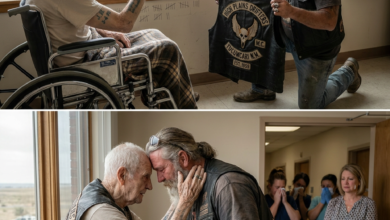
A Biker Threw a Veteran’s Prosthetic Leg Over a Mountain Cliff—Then Forty Riders Revealed What They Had Hidden on the Lower Ridge
Part 2 — The Sound Hammer Heard Beneath My Jeans
People assume veterans become skilled at accepting help because military life depends upon teams. What we actually learn is how to remain useful while surrounded by people who cannot afford weakness.
After losing my leg, I carried that lesson into civilian life.
I learned transfers, balance, socket care, adaptive driving, and how to lift my Harley after a low-speed drop without waiting for strangers. I also learned how quickly concern could become control.
Some people spoke to my prosthesis instead of my face.
Others congratulated me for buying groceries.
I hated both.
Hammer understood this better than most because he never praised me for ordinary movement. We met at a veterans’ motorcycle safety course outside Asheville four years after my discharge.
He corrected my corner entry, insulted my tire pressure, and asked whether my right-side control modification caused fatigue during long rides.
He never asked how I lost the leg.
That came later.
An improvised explosive device struck our convoy outside Kandahar. The blast killed Staff Sergeant Aaron Wells and destroyed my right leg above the knee.
Aaron was my squad leader.
He was also the man who shoved me behind the vehicle’s armored wheel before the second explosion. Medics said that movement probably saved my life.
I remembered almost none of it.
During recovery at Walter Reed, I blamed Aaron for surviving only through my body. Grief does strange arithmetic, and mine concluded that losing a leg was proof I had failed to repay a dead man.
My first prosthesis hurt constantly.
Aaron’s widow, Rachel, visited during rehabilitation and brought a small envelope containing his identification tag and a note he had written during our deployment.
The note was not a final message. Aaron had prepared it after seeing me talk a younger soldier through a panic episode.
He wrote:
“Reed thinks carrying everyone means nobody notices when he needs carrying.”
I hated the sentence.
I placed the note and tag inside a temporary training socket because I wanted Aaron present during my first steps. Later, when the hospital replaced that socket, the items disappeared during equipment transfer.
Staff searched.
Nothing surfaced.
I told Rachel it did not matter.
It did.
Years later, Hammer learned the story during a late-night repair in his garage. My adapted hand control had jammed, and we spent six hours rebuilding its linkage.
He listened while oil dripped into a pan.
Then he asked for the hospital department, approximate date, and name of my first prosthetist.
I told him to forget it.
Hammer wrote everything down.
The old prosthetic leg involved a different argument.
My current device had accumulated seven years of wear, multiple repairs, and thousands of miles beyond the period when Dr. Lena Park recommended a comprehensive replacement.
A new system would cost more than I could manage.
Insurance approved part of the everyday prosthesis but excluded several components supporting my specific work and adaptive-riding needs. The appeals moved between offices for fourteen months.
The Department of Veterans Affairs covered portions of my care, but coordination delays left a large remaining balance and disputed classifications.
I had savings.
I also had a daughter named Nia.
She was seventeen, accepted to a university engineering program, and determined to avoid student debt after watching medical bills reshape our household.
I moved money from my prosthetic fund into her tuition account.
I told nobody except Dr. Park.
She told no one until the aging socket developed recurring pressure problems. With my permission, she contacted the Iron Vow’s veteran support coordinator to discuss transportation and equipment grants.
Bear discovered the funding gap.
The club began collecting money.
They called it Project Mile.
Hammer insisted my name remain out of every fundraiser because I would recognize the story and shut it down. Members sold parts, held repair weekends, and donated overtime pay.
Luis Ortega gave the proceeds from one month of diner breakfasts. Doc Mercer sold a guitar signed by musicians nobody else believed he had met.
Bear redirected the anniversary banquet budget.
That decision caused the first fracture.
The banquet money also supported families of deceased members, emergency rent, funeral travel, and medical expenses. Several riders argued that spending so much on one veteran violated the fund’s purpose.
Hammer agreed with their concern.
Then he sold his 1978 Harley-Davidson Shovelhead.
The motorcycle had belonged to his older brother and remained the only machine Hammer swore would never leave Dawson Repair.
The sale covered most of the disputed prosthetic components without touching the family emergency reserve.
When Bear discovered it, he became furious.
“You don’t prove brotherhood by cutting pieces off yourself,” he told Hammer.
Hammer continued cleaning tools.
“Wasn’t riding it.”
“That isn’t the point.”
“Point’s got two wheels and tuition money.”
Bear understood then.
Hammer knew about Nia.
Dr. Park had mentioned only that I prioritized a family obligation. Hammer pieced together the rest after seeing Nia’s engineering acceptance letter above my workbench.
He never confronted me.
For eleven months, the club raised the funds, coordinated the fitting, and planned to reveal the prosthesis during the Fallen Brothers Ride.
I knew Dr. Park had completed measurements for a possible replacement. I believed financing had collapsed during the final authorization stage.
Instead, she finished the device.
The new leg waited at Eagle’s Shelf, where Aaron’s widow and my daughter planned to surprise me after the memorial.
Hammer was supposed to lead me there.
Then he heard the click beneath my jeans.
At the first fuel stop, he asked whether the prosthesis felt different. I lied.
At the second, he crouched beside my boot and listened while I shifted weight.
By Falcon Crest, the click had become a snap.
Hammer knew the surprise no longer mattered.
The only thing that mattered was stopping me before stubbornness turned a damaged prosthesis into a mountain accident.
Part 3 — The Crack Above Laurel Gorge
The final climb toward Falcon Crest included seven tight switchbacks. Each required me to shift my hips, stabilize the motorcycle at low speed, and trust the prosthetic side whenever traffic compressed.
The leg felt loose.
I told myself the socket was warm.
When I stopped behind Hammer near the overlook entrance, my right foot touched pavement and the knee rotated farther than expected. The motorcycle leaned.
Hammer caught the handlebar.
“What moved?”
“Gravel.”
“There ain’t gravel.”
He ordered the group into the overlook. I wanted to continue because Eagle’s Shelf remained only fourteen miles away, but Hammer parked his Road King across my path.
Forty engines shut down.
The sudden quiet exposed the clicking sound.
Dr. Park answered Hammer’s video call. He raised my pant leg and showed her the crack while I complained about being discussed like machinery.
She asked me to remove weight from the device.
I refused until she changed her wording.
“Marcus, the component may fail without warning.”
The overlook pavement sloped toward the guardrail. My motorcycle weighed more than eight hundred pounds with luggage.
A collapse during mounting could trap me beneath it.
A collapse on the next hairpin might be worse.
I knew that.
Pride remained louder.
I told Hammer I would ride slowly and keep my left foot prepared. He pointed out that mountain curves did not negotiate with plans made in parking lots.
We argued until tourists began watching.
Bear asked me to sit.
I accused him of choosing Hammer’s authority over my own body.
That accusation hurt him because Bear had spent years helping veterans reclaim decisions other people made for them. He stepped backward.
Hammer did not.
“You decide what happens to you,” he said. “You don’t decide what broken carbon does.”
I removed the prosthesis to inspect it myself. Hammer took it before I could reattach the connector.
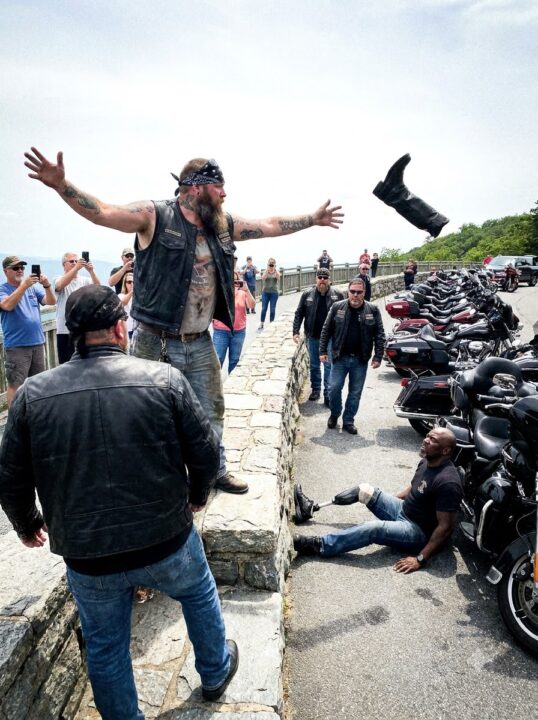
Then he walked toward the cliff.
I thought he intended to show the crack under stronger light.
He threw it over the guardrail.
Rage erased every safety argument.
That leg had carried me through my daughter’s middle-school graduation, my first post-service job, Aaron’s memorial, and the day I returned to motorcycle riding.
It had fallen with me.
It had brought me back up.
Hammer discarded it as if those years meant nothing.
I lunged from the bench and struck the pavement. Bear caught me before my residual limb hit the ground, but the crowd saw a disabled veteran thrown down after losing his prosthesis.
People shouted.
One former Marine grabbed Hammer’s vest and demanded he retrieve the leg. Hammer allowed the man to hold him against the guardrail.
“It’s in the net,” Hammer said.
Nobody heard.
The gorge returned only wind.
Then a park ranger arrived and cleared the front section of the overlook. She had approved the club’s recovery setup days earlier but did not know Hammer would use it before the scheduled ceremony.
Thirty feet below, a cargo net stretched between reinforced points above the ranger service platform. The old leg rested in its center.
It had not struck rock.
It had not entered the forest.
Hammer planned everything except my reaction.
That was his failure.
He removed danger without preserving dignity, and the difference mattered.
When the lower group’s motorcycles started, sound climbed through Laurel Gorge. A white adaptive transport van appeared on the service road beneath us.
Dr. Park stepped out.
So did Nia.
My daughter looked from me to Hammer, then toward the net holding my old leg. Her face contained anger, relief, and the dread of someone watching two stubborn men damage each other while trying to prevent physical harm.
She climbed the service stairs.
“What did you do?” she asked Hammer.
“Stopped him.”
“You threw his leg.”
“Stopped that too.”
Nia turned toward me. “You knew it was cracking?”
I said I knew it was making noise.
“That wasn’t my question.”
She inherited my interrogation voice.
I looked away.
Nia had spent months believing my replacement process was delayed by paperwork. She did not know I diverted funds toward her tuition.
When she learned, her anger shifted.
“You used your leg money for school?”
“I had another leg.”
“You had a failing leg.”
“I had time.”
Hammer pointed toward the gorge.
“No, you didn’t.”
The black case arrived from the lower platform. Dr. Park opened it, but I refused to look inside.
I told the club I would not wear equipment purchased through secret pity. I demanded my old prosthesis back, even if it could only serve as a temporary spare after repair.
Hammer retrieved it personally.
He climbed down the service stairs, crossed the platform, and lifted the damaged leg from the net. When he returned, he placed it beside me rather than handing it over.
The crack had widened during the fall into the padded net.
A thin section near the adapter separated beneath gentle pressure from Dr. Park’s inspection tool.
Had I reattached it, the next hard load might have finished the break.
The overlook fell silent.
The immediate danger was over.
I still rejected the replacement.
Hammer had saved me from the mountain, but he had also made me feel like the broken object everyone came to watch.
That should have ended Project Mile.
Instead, Nia opened the new socket and found Aaron’s military identification tag secured inside a removable memorial compartment.
Beside it lay the note we believed the hospital had lost.
Someone had written another message beneath Aaron’s original sentence.
The handwriting belonged to Hammer.
“Carrying you was never the same as owning your steps.”
I looked at him.
For the first time, Hammer appeared uncertain.
He knew stopping the ride had been necessary.
He did not know whether our brotherhood would survive the way he did it.
Part 4 — The Hospital Box Marked Training Equipment
Hammer found Aaron’s tag through persistence that bordered on harassment.
He contacted the hospital’s prosthetics department with written authorization from me, though I had signed the release years earlier without understanding how long he would keep searching.
Old temporary sockets were not retained indefinitely. Some training equipment was recycled, others transferred to research programs, and personal items were usually returned during final fitting.
Mine had been mislabeled.
A retired technician remembered placing a military tag and folded paper inside a clear property pouch. The pouch entered a storage box marked TRAINING EQUIPMENT — REED, M.
The box later moved to a rehabilitation research archive in Maryland.
Hammer called every month.
After three years, an inventory review located it.
The hospital shipped the items to Dr. Park after verifying my identity. She planned to return them privately during the Eagle’s Shelf ceremony.
Hammer asked whether they could be incorporated safely into the new prosthesis without interfering with structure or maintenance.
Dr. Park designed a removable compartment inside the cosmetic cover, separate from all load-bearing components. Aaron’s tag could travel with me, yet remain accessible whenever service required inspection.
No sentimental object compromised the device.
Hammer insisted upon that.
The new prosthesis was not simply an expensive surprise pulled from a box. I had completed measurements, alignment trials, gait assessments, and component testing during appointments presented to me as preparation for an appeal.
Dr. Park did not lie about the clinical work.
She withheld only the funding approval and final delivery date at my family’s request.
I still felt manipulated.
Nia apologized.
Bear apologized.
Dr. Park acknowledged that the reveal should never have overridden my right to decide whether, when, and where I accepted the device.
Hammer did not apologize immediately.
He sat across from me at the ranger station while tourists continued sharing footage from the overlook.
In the shortest recording, he appeared to seize a wounded veteran’s leg and throw it into a ravine. The safety crack, recovery net, new prosthesis, and eleven months of planning remained outside the frame.
The club wanted to release everything.
I refused.
I did not want my medical history, financing disputes, or daughter’s tuition discussed publicly merely to protect Hammer from criticism.
Bear supported me.
Several riders did not.
They had worked overtime, sold possessions, and endured arguments to fund the prosthesis. Watching Hammer called a traitor felt unbearable.
Brotherhood faced another test.
Would the Iron Vow protect its road captain by exposing the private veteran he had tried to protect, or accept public hatred because my story remained mine?
Hammer settled it.
“Nothing goes out without Marcus.”
The club obeyed.
By evening, the shortened video had reached hundreds of thousands of viewers. A veterans’ organization issued a statement condemning the unknown biker, while strangers identified Dawson Repair and posted threats.
Hammer unplugged the shop telephone.
Then he returned to the ranger station.
I asked whether he regretted throwing the leg.
“Yes.”
That surprised me.
“You think I should’ve ridden?”
“No.”
“Then what?”
Hammer rubbed his beard.
“Should’ve told you about the net.”
He had thrown the prosthesis because the planned retirement ceremony involved tossing the failed device into the recovery net before revealing the replacement. Bear designed the symbolism months earlier.
The riders believed I might enjoy watching the old leg take one final flight.
They were wrong.
When the crack became urgent, Hammer followed the prepared action without recognizing that a surprise could become humiliation once I lost control of the moment.
He saved my body.
He mishandled my dignity.
Both truths could stand together.
That distinction allowed me to speak honestly.
I admitted I had concealed the worsening condition, ignored Dr. Park’s advice, and prioritized tuition without discussing alternatives with Nia.
I had treated self-sacrifice as authority over everyone who would suffer if I fell.
Hammer looked at the damaged prosthesis.
“Two stubborn men on a mountain.”
“Only one threw a leg.”
“Only one brought a cracked one.”
We sat in silence.
Then Rachel Wells entered the ranger station.
Aaron’s widow had waited at Eagle’s Shelf for the planned memorial. When she heard the ride had stopped, she drove down with the letter Hammer recovered.
Rachel hugged Nia first.
She placed Aaron’s identification tag in my palm but kept the note.
“You’ve carried this sentence like an order,” she said.
Aaron’s words accused me of hiding my needs, but I had turned them into proof that he expected me to keep carrying others.
Rachel unfolded the paper.
A second sentence appeared on the reverse side, one I had never seen because the fold concealed it.
“If Reed ever lets us carry him, don’t make a ceremony out of it.”
Bear turned away.
Hammer closed his eyes.
Forty bikers had spent eleven months planning exactly the ceremony Aaron warned against.
Rachel laughed before any of us could decide whether to cry.
“My husband knew you people.”
She handed me the note.
The new prosthesis waited inside the black case. Dr. Park said I could accept it, delay fitting, request changes, or reject it entirely.
The decision returned to me.
I asked one question.
“Can I walk on it today?”
“After alignment checks.”
“Can I ride?”
“Not today.”
Hammer expected another argument.
I nodded.
The mountain would remain there.
That was the first step I took before wearing the new leg: accepting that finishing later did not mean failing now.
Part 5 — The First Step on the Lower Ridge
Dr. Park fitted the prosthesis inside the ranger station while Nia, Rachel, and one rehabilitation assistant remained with me. The Iron Vow waited outside because I requested privacy.
Hammer waited farthest from the door.
The new socket felt unfamiliar. Pressure landed in different areas, the knee response required adjustment, and the foot returned energy in a way my old device no longer could.
Nothing about it felt instantly miraculous.
A prosthesis is not a replacement limb pulled from a gift box and mastered within minutes. It is equipment requiring professional fitting, practice, maintenance, and an honest relationship with discomfort.
I took four steps between parallel rails.
Then I sat down.
Dr. Park adjusted alignment.
I tried again.
By the third attempt, I walked across the small room without rails. Nia followed closely but did not touch me.
When I opened the door, forty bikers stood in two lines leading toward the lower overlook.
No applause.
Rachel had instructed them well.
Hammer remained beside the final rail.
I walked toward him slowly. The new knee responded late once, forcing me to pause, but nobody reached out until I raised my hand.
Bear offered his forearm.
I used it for three steps.
Then I released him.
At the overlook edge, the new prosthesis supported my weight while Laurel Gorge opened beneath us. Falcon Crest stood above, its stone rail small against the trees.
My old leg rested inside the recovery net.
I asked Hammer to bring it.
He carried it carefully this time.
The cracked socket, scratched cosmetic cover, worn foot shell, and faded service labels recorded seven years of ordinary life. Throwing it away felt wrong, even though using it again would be unsafe.
We retired it instead.
Dr. Park removed reusable nonstructural parts according to proper procedure. The club later built a display case for the remaining shell, but I refused any plaque calling it a symbol of courage.
The label read:
THIS EQUIPMENT DID ITS JOB.
Nothing more.
The club’s contributions required another conversation. I asked how much each rider paid, intending to repay them gradually.
Bear refused to provide names.
I threatened to reject the leg.
Hammer handed me a ledger.
Every dollar was recorded, though individual donors were identified only by numbers. The project included no money from the family emergency fund after Hammer sold his Shovelhead.
I stared at the sale entry.
“You sold your brother’s bike?”
“Sold metal.”
“You called it family.”
“Family ain’t the thing parked under a tarp.”
I knew that answer cost him.
The buyer lived in Virginia and had promised Hammer first refusal if he ever sold the Shovelhead again. Still, there was no guarantee it would return.
I asked why Hammer contributed more than everyone else.
He pointed toward Nia.
“Engineering school.”
My daughter began crying.
Hammer became uncomfortable and inspected the guardrail bolts.
Project Mile paid only for uncovered prosthetic costs, travel, and professional fitting. Remaining donations created a transparent adaptive-equipment grant administered through an independent veterans’ nonprofit.
The Iron Vow would not decide medical priorities.
Qualified professionals and applicants would.
That structure grew from the arguments nearly dividing the club. Members who opposed spending the common emergency fund had been right to demand accountability.
Hammer’s sale prevented the immediate conflict.
It did not eliminate the need for rules.
We created them.
Applicants retained privacy and decision-making authority. Equipment would never be presented as a public surprise unless the recipient explicitly requested one.
No more cliffs.
Bear placed that sentence in the policy.
At midday, a van transported me from the ranger station to Eagle’s Shelf. The motorcycles followed at safe distance while Hammer drove my adapted Harley on a trailer.
I hated seeing it carried.
I accepted it.
At Eagle’s Shelf, a stone memorial honored Aaron and six other service members connected to our club. Rachel placed flowers near her husband’s name.
Nia stood beside me.
Hammer remained behind.
I took thirteen steps toward the memorial using the new prosthesis and a cane. The movement was slower than arriving by motorcycle would have been.
It felt more honest.
Rachel handed me Aaron’s note.
I placed a copy beneath his photograph but kept the original inside the prosthesis compartment.
Before leaving, I called Hammer forward.
Tourists recognized him from the video and began recording again. Hammer hesitated because he expected a public accusation or reconciliation.
I offered him my hand.
He looked at it.
“You were wrong,” I said.
“Yep.”
“You were also right.”
“Worse.”
I laughed.
Then I pulled him into an embrace.
The crowd applauded, but neither of us enjoyed it.
Aaron had warned against ceremonies.
We walked away before someone made a speech.
Part 6 — The Ride We Finished Without Proving Anything
I did not ride the mountain again the following week.
Dr. Park required several fitting adjustments, and my physical therapist rebuilt strength around movement patterns the worn prosthesis had allowed me to compensate for.
Hammer drove me to appointments.
He complained about hospital parking, waiting-room coffee, and every magazine older than his motorcycle. He never asked when I would be ready to ride.
That restraint repaired more than an apology.
Two months later, I completed a controlled road evaluation with an adaptive-riding instructor. We tested mounting, stops, uneven pavement, emergency braking, and the interface between my prosthesis and motorcycle controls.
Only after clearance did I return to the Blue Ridge Parkway.
The Iron Vow expected a full convoy.
I invited four people: Nia, Hammer, Bear, and Rachel.
Nia followed in a support vehicle. Rachel rode with Bear, while Hammer remained several bike lengths ahead where I could watch his lines through each switchback.
At Falcon Crest, we stopped beside the same guardrail.
No tourists recognized us.
The cargo net was gone.
I stood where Hammer had thrown my old leg and listened to wind moving through Laurel Gorge.
“Want to toss anything?” he asked.
I handed him an empty coffee cup.
He placed it in a trash container.
“Learned something,” he said.
We continued toward Eagle’s Shelf.
The new prosthesis felt stable, though stability did not eliminate attention. I monitored socket pressure, fatigue, road camber, and every stop.
At the final curve, Hammer reduced speed.
He did not wave me forward.
I passed him anyway.
The memorial appeared beyond the trees.
This time, I arrived on my own motorcycle, but nothing about the moment was solitary. Dr. Park’s work, Nia’s anger, Aaron’s note, Rachel’s permission, the club’s money, and Hammer’s impossible decision traveled within it.
I parked safely.
Then I removed the prosthesis because the socket needed adjustment.
Nobody panicked.
Equipment could come off without independence disappearing.
That understanding had taken me years.
The full story behind the overlook video eventually became public after I chose what to share. I released a written statement protecting medical details while explaining the crack, recovery net, and replacement.
I did not describe Hammer as a hero.
I described him as a brother who recognized danger, acted correctly, and handled part of that action badly.
Hammer approved.
“Sounds accurate.”
Public outrage softened. Some people apologized, while others continued insisting no explanation justified throwing the prosthesis.
I understood them.
The act was dramatic because the planning team believed I needed drama to accept help. They had mistaken my stubbornness for a language only force could answer.
Afterward, they learned another language.
Consent.
Patience.
A case opened without an audience.
The adaptive-equipment grant helped its first recipient that winter, a Navy veteran needing modifications to continue working as a mechanic.
Hammer delivered no oversized check.
The nonprofit paid the approved provider directly. The veteran received his equipment during a private appointment.
Nobody recorded it.
Project Mile worked best once nobody could turn it into content.
My old prosthesis remains inside a case at Dawson Repair. Mechanics occasionally ask why a carbon leg stands beside vintage motorcycle parts.
Hammer gives the same answer.
“Seven good years. One bad crack.”
Every anniversary, I inspect the crack with my daughter. Nia completed her engineering degree and now works in rehabilitation-device testing.
She says the failure line taught her more about material fatigue than several textbooks.
I remind her my tuition caused the problem.
She reminds me secrecy caused the problem.
We are both right.
Hammer never recovered his Shovelhead.
He stopped searching after the buyer’s family said the motorcycle had become part of their own story. Instead, I helped him rebuild another 1978 frame from mismatched parts.
It was not his brother’s motorcycle.
Hammer understood.
Some things are replacements.
Some are continuations.
The difference does not make either worthless.
Part 7 — What Hammer Threw and What He Kept
Five years after Falcon Crest, the Iron Vow returned to Eagle’s Shelf for another Fallen Brothers Ride.
My new prosthesis had become an old prosthesis by then. Its cosmetic cover carried scratches, the foot required maintenance, and the socket had been replaced after changes in my body.
We inspected everything before leaving.
Hammer checked twice.
He was sixty-one, his beard mostly gray, and the tattoos across his forearms had softened beneath weathered skin. He still rode his black Road King, though his repaired 1978 project remained at home.
The mountain weather stayed clear.
Forty riders climbed through the switchbacks without incident. At Falcon Crest, we stopped long enough to place a small metal marker beside the ranger station.
It did not commemorate the throw.
It thanked the park staff, prosthetic clinicians, adaptive instructors, and recovery crew who prevented a surprise from becoming an accident.
No heroic photograph appeared.
The cliff needed none.
A young veteran approached while Hammer and I stood near the guardrail. He had recently lost part of his left leg and was still using crutches.
He recognized me from Project Mile.
Then he recognized Hammer from the old video.
“You’re the guy who threw it.”
Hammer looked toward me.
“Allegedly.”
The young veteran asked whether accepting equipment from a charity felt humiliating.
I answered before Hammer could.
“Sometimes.”
He seemed surprised.
I explained that gratitude and discomfort can occupy the same body. Receiving help does not require pretending every method was perfect.
Hammer added, “Make them ask first.”
The veteran nodded.
He attended the next grant meeting.
At Eagle’s Shelf, Rachel placed flowers beside Aaron’s name while Nia inspected the memorial bolts because engineers apparently cannot visit anything without examining its structure.
I opened the compartment inside my prosthesis and removed Aaron’s tag.
For years, I believed carrying it meant taking Aaron everywhere. That morning, I left it with Rachel at the memorial.
She asked whether I was certain.
“I don’t need metal to know who pushed me.”
Hammer looked at the words carved into the stone.
He understood.
On the ride home, I led through the lower curves. Hammer followed close enough to help but far enough to let the road remain mine.
At Falcon Crest, sunlight struck the place where my old prosthesis disappeared beyond the guardrail. Nothing marked the exact point.
The gorge held no leg.
The club had recovered it.
It held no litter.
The park had cleared the net.
What remained was the space between one decision and the meaning people assigned before seeing what waited below.
My motorcycle settled into the next curve.
The prosthesis held.
Hammer’s headlight remained inside my mirror.
When Route 221 opened beyond the mountains, he moved alongside me for several seconds. Neither of us waved or spoke.
Then he dropped behind again.
Brothers know when to carry.
They also know when to follow.
Follow our page and leave “HAMMER” below for more unforgettable biker stories about wounded pride, tested brotherhood, and help strong enough to ask permission.