A Biker Snatched My Daughter’s Cancer Donation Box in Front of Our Entire Town—Then Asked Why Her Stepfather Wouldn’t Let Me Call the Doctor Myself
Grant reached for the letter before I did.
That was the first thing I understood afterward. In the moment, I only saw my husband trying to stop my brother from frightening our child.
“Different doctor,” Grant said. “Same last name.”
Ray kept his hands open.
“Then let Claire call.”
The fellowship hall smelled like coffee burned onto a hot plate. Behind Grant, somebody’s phone was still recording. Lily had gone perfectly still beside the table, her pink cap slipping over one eyebrow.
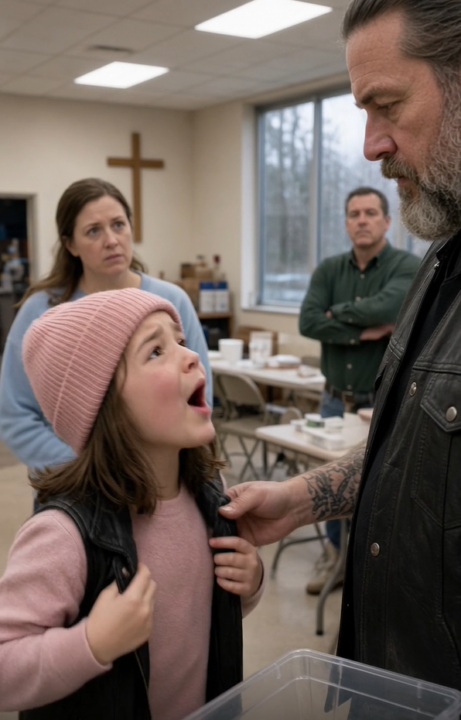
I remembered the physician’s name from Dad’s paperwork.
But remembering a name wasn’t proof.
Neither was my brother’s certainty.
I had seen blood drawn from Lily’s arm. I had held her while she cried afterward. There were appointment reminders on our refrigerator and a folder thick enough to make the kitchen drawer stick.
Grant turned toward me.
“You were there for the testing.”
I was.
For a moment, Ray looked like a man who had mistaken something ordinary for a conspiracy because he wanted his sister back.
That possibility hurt almost as much.
I asked the fundraiser coordinator, Beth, to stop accepting donations.
Grant shook his head.
“Claire, people drove an hour.”
“Then they can wait.”
Beth brought two volunteers to the table. They counted the cash without moving it out of sight, wrote down the total, and sealed the box with packing tape. Grant objected to every step.
Ray objected to nothing.
That frightened me.
I took Lily into the little kitchen beside the hall. Ray stayed by the doorway while I called the number printed on the letter.
An automated voice directed me to a billing service.
Not a clinic.
Grant followed us inside.
“They outsource,” he said.
I searched for the practice separately on my phone. The physician whose name appeared on the letter was listed as an adult internal medicine doctor.
I remembered Dad complaining about his waiting room.
Lily began pulling loose threads from her cap.
“Mommy?”
“Just a minute, honey.”
Grant put a hand on the counter beside my phone.
“You’re letting him do this again.”
Again.
There it was.
Dad’s funeral. The missing money. The brother who had stopped defending himself after I told him never to come back.
Ray looked down at his boots.
I hated him for making me choose in front of strangers.
Then Lily took off the cap.
Her hair fell to her shoulders, damp at the temples. Grant had told us treatment might make it fall out later. He had said the cap would help people understand what was coming.
“Am I in trouble?” she asked.
I crouched.
“For what?”
“For feeling okay today.”
No one answered quickly enough.
Beth appeared with a glass of water. Ray stepped aside to let her through, and Lily caught the edge of his vest.
I looked at my husband.
“Tell me the specialist’s first name.”
He gave me one.
It wasn’t the name on the letter.
And why did he look at my daughter before correcting himself?
Four months earlier, I would have called Grant the reason our family still worked.
He packed Lily’s lunches when my early shift started at the grocery store. He remembered which yogurt she liked. On Saturdays, he made pancakes shaped like badly drawn rabbits and let her criticize the ears.
One Sunday, before any of this, our kitchen printer chewed up her school calendar.
Grant pulled the paper free, leaving a black crescent along the margin.
“Pickup roller,” he said, tapping the little mark. “I’ll replace it when I get a minute.”
Then he folded the calendar into thirds, printed side out, the way he folded every piece of paper he wanted to keep.
Lily stuck it under a strawberry magnet.
I remember thinking how peaceful the house had become.
That was before the bruises on her shins, before the tired afternoons, before Grant offered to handle the appointments because his schedule was flexible.
Before I mistook being excluded for being cared for.
Back in the church kitchen, the office I had found online answered. It was a weekday fundraiser, scheduled around the church’s regular community supper, and the receptionist was still at her desk.
She would not discuss anything until she verified who I was.
Good.
For the first time that afternoon, someone followed a rule that made sense.
After checking my information, she explained that her practice did not provide pediatric cancer treatment. She couldn’t tell me where Lily had been seen.
She could tell me the letter needed to be reported.
Grant took a breath through his nose.
“Obviously somebody mixed up the attachments.”
I wanted that explanation.
I wanted it so badly I nearly handed him my phone.
Instead, I called Lily’s pediatrician.
A nurse listened while I read the letter. She asked about Lily’s current condition and whether she had received any medications or procedures I couldn’t identify.
“No chemotherapy,” I said. “Grant said we were waiting for the next stage.”
The nurse paused.
She arranged for us to come in the following morning and told me where to take Lily sooner if she became unwell.
There was no dramatic announcement.
No diagnosis over the telephone.
Just questions I should have been asking for weeks.
Grant offered to drive.
“I’m taking her,” I said.
His expression changed so quickly I almost missed it.
Not anger.
Calculation.
Outside, Ray’s old Harley ticked as its engine cooled. He offered to call a friend with a car so Lily could stay dry.
I told him we had our own.
He nodded and stepped back.
Then Grant placed his phone on the counter.
An email was open.
A request for payment.
It carried Ray’s name, his repair business, and an account number.
“You want to talk about documents?” Grant asked.
Ray leaned forward.
His face lost color.
Why was my brother’s name on an invoice for my daughter’s treatment?
For several seconds, Ray said nothing.
That silence nearly finished us.
Grant turned the phone toward me as if he were giving evidence to a jury.
“Ray offered to arrange transportation and specialist access,” he said. “Then he started demanding money. I didn’t want you dragged into another fight.”
The email had a familiar-looking signature.
Raymond Mercer.
Mercer Motorcycle Repair.
Under it was a charge for patient coordination and transportation.
I knew my brother’s shop sometimes organized charity rides. I knew he had driven people to appointments in his pickup during the winter.
It fit.
That was what made it dangerous.
Ray asked for the email to be forwarded.
Grant refused.
“Show her your bank account.”
Ray reached for his phone, then stopped.
He looked at me instead.
“Do you believe I sent this?”
I could have said no.
I could have offered him one clean thing after nineteen months.
Instead, I said, “I don’t know.”
He nodded once.
“Fair enough.”
He gave Beth his business card and asked her to preserve a photograph of the screen. Then he left before Grant could turn his departure into an escape.
That night, I took Lily to my friend Denise’s apartment.
Grant said I was humiliating him.
I packed her toothbrush anyway.
The next morning, Lily’s pediatrician reviewed the original bloodwork with me. The tests Grant had described as the beginning of a cancer diagnosis had led to a much more ordinary follow-up: iron deficiency and dietary changes.
The doctor examined Lily and arranged updated testing.
He did not promise that one examination could answer every question. He did tell me there was no documented leukemia diagnosis in the records he had, and the supposed oncology letter contained claims his office had never made.
I sat with both feet pressed flat against the floor.
Lily swung hers beneath the examination table.
“Can I go to gym?” she asked.
I cried then.
Quietly, into a tissue that disintegrated in my hand.
By the end of that week, the records we had requested and the new results supported what the pediatrician had first suspected: Lily had been made the subject of a cancer fundraiser without a cancer diagnosis.
She needed ordinary medical follow-up.
She did not need the treatment Grant had described to our town.
Meanwhile, Ray went to the police about the invoice.
He brought business records showing that the account listed on it wasn’t his. He also brought an old insurance packet from a collision Grant had helped him document two years earlier.
It contained a copy of Ray’s identification and business information.
The signature on the invoice resembled the one in that packet.
Resembled it exactly.
A detective asked me to save everything.
Emails. Screenshots. Envelopes.
Even the papers I was embarrassed to admit I had never read.
That evening, Beth called.
The fundraiser had included online payments as well as cash.
The online account was controlled by Grant.
And according to the statement he had sent the church, the medical payments had already been made.
To whom?
The statement was three pages long.
Grant had made it look reassuring.
Dates. Amounts. A running balance.
There were charges for consultations, transportation, lodging, and a procedure I couldn’t remember anyone naming aloud.
At the bottom, the available balance was almost zero.
Beth printed it for me.
A black crescent sat beside the final line.
I touched it before I understood why.
Our kitchen calendar.
The hungry printer.
Grant’s thumb rubbing black dust from the paper.
I asked Beth for an envelope.
I didn’t call Grant.
For once, I let a question remain a question until someone could help me answer it.
The detective took copies. Beth preserved the original files she had received. With her help, the church asked the payment service to review the fundraiser and prevent further withdrawals where possible.
Some money had already gone.
That was all anyone could honestly tell us.
I wanted a neat number, something I could put beside the fear and understand.
Instead, I got waiting.
While we waited, I went through the household papers I had brought from home. I had access to our shared bills and the laptop we both used. The detective told me to preserve what was already available to me and leave anything disputed alone.
In a downloads folder, I found versions of the medical letter.
One still contained a blank line where Lily’s name belonged.
Another used a different date.
I closed the laptop without changing anything and called the detective.
My hands shook so badly I dropped the phone against my knee.
Later, investigators would connect the records, the fundraiser payments, and the accounts receiving the transfers. At that point, I only had pieces.
A fake transportation invoice.
A household printer mark.
Documents saved where our grocery coupons usually lived.
And a husband who had begun sending messages that sounded less like explanations and more like instructions.
Delete the screenshots.
Stop upsetting Lily.
Tell Beth this was a misunderstanding.
Then came one message that made me sit down.
You signed the consent page.
He was right.
I remembered signing it beside the stove while Lily looked for a missing sneaker. Grant said it allowed a specialist to review her records.
The page I signed had not contained a diagnosis.
Now the copy attached to his message sat behind one.
My signature was real.
The story around it wasn’t.
Ray drove to Denise’s with a paper grocery bag and stood outside until I invited him in.
Soup. Crackers. Applesauce.
Nothing heroic.
He set the bag down and asked whether Lily wanted the applesauce cold.
I wanted to tell him everything.
Instead, I asked about Dad’s funeral money.
His face tightened.
“Grant still telling you I took it?”
“You never explained.”
“You told me not to contact you.”
He pulled a folded receipt from his wallet, softened almost white along the creases.
The funeral home had received the payment.
The amount matched the money Grant said Ray stole.
Who had benefited from making me stop answering my brother?
Ray didn’t ask me to apologize.
That made it worse.
He showed me the receipt, then put it away when Lily came into the room. She carried a school worksheet Denise had found in her kitchen drawer.
“Can you help with fractions?”
Ray took off his reading glasses, cleaned them on his shirt, and put them back on.
“Probably not.”
She laughed.
It was the first unguarded sound I had heard from her all week.
The next morning, Grant reached her school before I did.
He was listed as an authorized pickup person. I had been so busy calling doctors and preserving documents that I hadn’t changed the ordinary permissions holding our old life together.
The school called because Lily refused to leave with him.
By the time I arrived, the principal had kept her in the office while they sorted out the conflicting instructions.
Grant stood beside the reception counter.
Calm.
Clean shirt. Wedding ring. Concerned husband.
He said Ray was unstable. He said I had taken Lily out of our home under his influence. He said there was a court order.
There wasn’t.
When an officer arrived and asked to see it, Grant described something he was “in the process of getting.”
The difference mattered.
I gave the school updated instructions and the paperwork they requested. Grant was Lily’s stepfather, not her adoptive parent, but removing him from our routines still took calls, forms, and the unpleasant work of explaining private things to strangers.
Lily stayed behind the principal’s chair.
Grant crouched toward her.
“Tell them I’ve been taking care of you.”
She looked at me.
I didn’t answer for her.
Finally, she said, “You told me not to tell.”
Grant stood up.
He stopped asking her questions.
That afternoon, several donors began sharing a post about me.
Grant said I was having a breakdown. He said my brother had disrupted a legitimate medical fundraiser to get access to the money. He included a photograph from the hall.
Ray holding the box.
Lily reaching toward him.
Me looking frightened.
Without the sound, it told exactly the story Grant wanted.
One of Ray’s riding friends called and suggested he stay away from us until things settled down.
Ray listened from Denise’s back steps.
“Kid asked for me,” he said.
Then he hung up.
He didn’t bring a row of motorcycles to the school. He didn’t threaten Grant. He started keeping his phone charged and writing down the times he arrived and left.
It was a miserable kind of protection.
Receipts for being decent.
That evening, Grant sent me a photograph of a bank withdrawal slip.
My handwriting was on it.
Beneath the image, he wrote:
Tell them where the first twenty-three hundred went.
I read it three times.
Denise asked what was wrong.
I couldn’t make myself answer.
Because what would happen when everyone learned that some of the money had come to me?
I had taken twenty-three hundred dollars from the fundraiser account.
There was no cleaner way to say it.
Our rent was overdue. Grant said the account could reimburse household expenses because keeping Lily housed was part of keeping her healthy.
I asked whether the church knew.
He said he had handled it.
I wanted him to have handled it.
That was the part I could no longer excuse.
At the time, I believed my daughter had cancer. I did not know about the forged records. But I knew the money had been given for treatment, and I let relief carry me past the question I should have asked.
I took the slip to the detective myself.
Then I told Beth.
She sat across from me in the church office with her hands folded over a yellow notepad.
“Did you know she wasn’t diagnosed?” she asked.
“No.”
“Did you know the donors thought they were paying medical expenses?”
“Yes.”
She wrote that down.
I hated the sound of her pen.
She didn’t call me a monster.
She didn’t tell me it was fine.
She asked me to give her copies of the rent notice and payment receipt.
Afterward, I sat in my car without starting it.
Ray knocked lightly on the passenger window.
I unlocked the door.
He waited until I spoke.
“I used some.”
He nodded.
“Grant told you?”
“He threatened to.”
Ray looked through the windshield.
“You tell them first?”
“Yes.”
“Good.”
“I don’t feel good.”
“Wasn’t talking about feeling.”
He stayed until I could drive.
There was another confession waiting at Denise’s.
Lily had drawn a building with blue doors. She pushed it toward me after dinner, smoothing the page with both palms.
“That’s where we went.”
I recognized the outpatient laboratory.
Not an oncology center.
She explained that Grant took her there for the blood draw, then parked near another medical building on later trips. Sometimes they ate crackers in the car. Sometimes he made phone calls.
He told her I was scared.
He told her too many questions would make me lose sleep.
At the fundraiser, he said people needed to see how serious things were or we might have to move again.
She had understood just enough to be frightened.
Not enough to recognize a lie.
“Did I help him?” she asked.
I pulled my chair closer.
“You were eight.”
“I’m still eight.”
“I know.”
She watched my face until I said the rest.
“None of this was your job.”
That night, I found the first voicemail from her pediatrician—the follow-up call Grant said he would return.
I had listened to the beginning weeks earlier.
Then stopped.
I was exhausted. I was working. I thought someone else was carrying that part.
Now I listened all the way through.
There had been a door open to the truth.
I had walked past it.
When Beth proposed a meeting for donors, Grant insisted on attending to “clear his name.”
Would I still tell the whole truth when it cost me something too?
The donor meeting happened five weeks after the fundraiser.
Long enough for the pink balloons to come down.
Not long enough for people to stop recognizing us in grocery aisles.
Beth held it in the same fellowship hall. There was no livestream. Lily stayed with Denise.
I asked for that.
My daughter had already spent enough time being looked at.
Ray came in a clean shirt beneath his vest. Two friends from his riding group came with him, including the man who had asked him to stay away.
They sat near the back.
Nobody announced them.
The detective knew about the meeting. By then, investigators had obtained records I couldn’t get on my own. She told me not to turn the room into an interrogation.
“Say what you know,” she said. “Don’t guess.”
Beth began with the money.
What had been collected in cash. What had come through the online account. What was being held. What was still being traced.
She corrected herself once.
She refused to give an estimate she couldn’t support.
For the first time, uncertainty sounded trustworthy.
Then I stood.
I said Lily had not been diagnosed with leukemia.
I said her doctors had reviewed her records and her current health.
I said I had believed Grant.
A woman in the second row covered her mouth.
A man near the coffee table asked whether any part of the fundraiser had been real.
“My daughter is real,” I said.
Then I told them about the rent.
All twenty-three hundred dollars.
My voice broke on the amount.
I kept going.
I explained what I had believed and what I had chosen not to question. I described the payment plan I had offered while the larger accounting continued.
Someone walked out.
I let him.
Grant waited until I sat down.
Then he stood with a folder under one arm.
He said the records had been misunderstood. He said different providers used different billing names. He said I was confusing a preliminary diagnosis with a confirmed one.
Beth asked him to identify the treating oncologist.
He returned to the billing arrangements.
She asked again.
He opened his folder.
Out came the letter with the physician’s name.
The one Ray recognized.
Grant held it by the corners.
“Original document,” he said.
On the table beside Beth lay the family calendar I had brought from home.
The black crescents were visible on both pages.
I hadn’t brought it as a trick.
The detective already had copies. I brought it because, for weeks, that tiny ordinary mark had been the only part of our kitchen I could bear to remember.
“That came from our printer,” I said.
Grant glanced at it.
“A mark proves nothing.”
“No. It doesn’t.”
He looked almost relieved.
Then Beth asked where he had obtained the letter he was calling an original.
Grant said the clinic.
I looked at the crescent again.
“Then perhaps their printer had the same problem.”
He answered before he thought.
“Not their printer. Ours. The pickup roller was dragging before I replaced it.”
The room went quiet.
And if he knew which household printer made the letter, why had he just said the clinic gave it to him?
Grant heard himself.
I watched him hear it.
He lowered the paper a fraction and said he meant the statement, not the medical letter.
Beth didn’t argue.
She asked him to put both documents on the table.
He held them tighter.
A man who had organized the raffle leaned forward.
“Grant. Just set them down.”
That was the moment the room changed.
Not when Ray took the box.
Not when I said cancer.
When somebody who had trusted my husband stopped helping him explain.
Grant looked at me.
“You know I printed things from the portal.”
“What portal?”
“The medical portal.”
“Which practice?”
He named the adult physician’s office.
The same office that had told me it did not provide pediatric cancer treatment.
Then he changed it.
Then he said I was twisting his words.
I didn’t need him to confess in front of everyone.
By then, the evidence was larger than the room.
Investigators had records linking the fundraiser account to transfers used for his personal obligations. They had obtained the underlying transaction information behind the invoice bearing Ray’s name.
They had the files preserved from our laptop.
The forged letters were not explained by a printer mark. The mark had simply given me a reason to stop accepting the explanation.
Beth said the church would provide further updates in writing after checking them with the investigators and the payment service.
Grant tried once more.
He lifted the consent page.
My signature faced the room.
“She approved everything.”
I stood.
“I approved a records review. Show them the page I signed, without the pages you attached later.”
He looked toward the door.
Ray stayed seated.
That mattered to me more than anything he might have said.
Grant had built so much of this around my brother being the kind of man people expected to lunge.
Now Ray gave him nothing.
No threat.
No shove.
Not even a raised voice.
Grant left without taking the calendar.
The legal part moved slowly after that.
Requests. Interviews. More records.
A hearing where nobody sounded like television.
I learned that evidence could be overwhelming to a wife and still require careful work before it became a case someone could prove.
The detective called when charges were filed.
She didn’t say, “We got him.”
She told me what would happen next and whom to contact with questions.
Months later, Grant entered a guilty plea to charges arising from the fundraiser scheme and the forged documents. The exact accounting became part of the case.
Some donors recovered money through reversals and preserved funds.
Others had to wait.
Some were still waiting when I began writing this.
I returned the rent money in installments.
The church kept a separate record.
Nobody called it a donation.
Ray was cleared of the supposed transportation payment. Beth sent the correction to everyone who had received Grant’s accusation.
A few people apologized.
A few only stopped repeating it.
I finally called my brother one evening without needing anything.
He answered over the sound of a ratchet.
“Everything okay?”
I said yes.
Neither of us knew what to say after that.
When a family has spent so long speaking only during emergencies, how do you begin an ordinary conversation?
We started with groceries.
Ray called on Tuesdays when he passed our apartment after work.
Need milk?
Sometimes we did.
Sometimes I said no and asked whether he wanted coffee.
He stopped bringing the funeral receipt.
I stopped rehearsing my apology.
One afternoon, I said it while washing two chipped mugs.
“I should have let you explain.”
He dried one slowly.
“Probably.”
I nodded.
He put it in the cabinet.
“I should’ve tried again.”
Neither sentence repaired nineteen months.
But they gave us somewhere to stand.
Lily’s health improved with the care her actual doctors recommended. Her energy returned in the unremarkable ways I had once taken for granted: forgotten shoes, complaints about bedtime, a backpack dropped exactly where somebody would trip over it.
She still asked whether things were expensive.
A field trip.
New sneakers.
Apples at the store.
I answered honestly without handing her the weight.
She began seeing a counselor who helped her find words for what Grant had made her carry. Some days she used them. Some days she wanted to talk about a girl in her class who borrowed markers and never returned the caps.
I learned to welcome both conversations.
I filed for divorce.
There were forms for that too.
This time, I read them.
The public part did not end cleanly. An old fundraiser photograph resurfaced online, and somebody who hadn’t followed the case called Ray a thief.
Beth sent the correction again.
Ray asked her to stop forwarding him the replies.
He had engines to fix.
I had work.
Lily had a spelling test.
Our lives became ordinary before they became easy.
The donation box stayed at the church until the case no longer required it. When Beth asked what we wanted done with it, I said throw it away.
Lily heard me.
“Can I see it first?”
I almost said no.
Instead, I asked why.
She shrugged.
“I want it to be something else.”
We took off the medical letter together.
The tape left cloudy strips across the clear lid. A corner of paper stayed caught near the slot. I worked at it with my thumbnail while Lily sorted seed packets on the kitchen table.
Beans.
Marigolds.
A packet of sunflowers Ray said would grow taller than him.
We washed the box and let it dry beside the sink.
The following Saturday, Ray helped her punch drainage holes in the bottom. He held the plastic steady while she pressed the tool, his tattooed hands on either side of hers.
Then they filled it with soil.
For several weeks, nothing happened.
Lily checked anyway.
One morning, a small green hook pushed through the dirt.
She called us both over as if the kitchen were on fire.
Ray leaned down. His leather vest creaked.
Lily touched her thumb to her little finger.
The cricket motion.
Then she looked from the tiny stem to her uncle, studying the amount of room between them.
“Think it’ll get as big as you?”