A Biker Locked the City Council Doors to Expose Our Poisoned Wells—Then My Granddaughter Pointed at the Chairman and Asked Why Grandpa Owned the Company
Hal adjusted the microphone.
A small movement. Two fingers against the silver stem.
I had watched him do it at school dedications, retirement dinners, and the service after my first husband died. Until that night, the gesture meant he was about to make a difficult room feel manageable.
“That document is being misrepresented,” he said.
Owen lowered his phone enough to show the officer his other hand.
The officer told him to step away from the entrance. He did. She kept him beside the wall while another officer checked that people could leave.
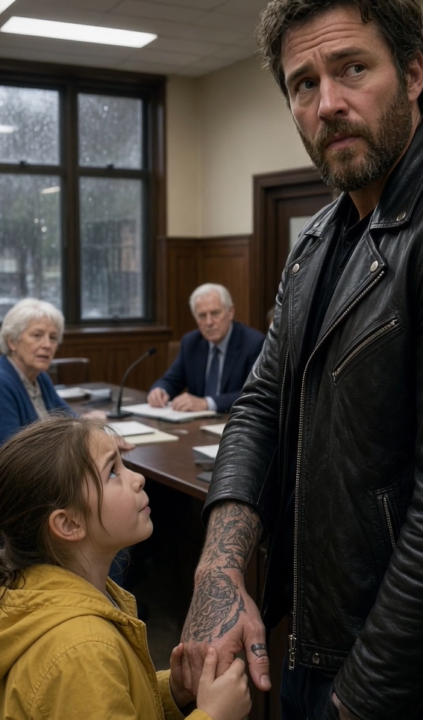
I wanted to slap my son.
Then hold him.
Then ask why he hadn’t called me before turning a council meeting into something Nina would remember forever.
A man near the back shouted that Owen should be taken out.
Owen nodded toward the open doors.
“You can go.”
“You don’t get to tell us that.”
“No,” Owen said. “I don’t.”
That admission unsettled me more than an argument would have.
Hal waited until the room quieted.
Then he explained that our family trust had once held an interest in a local industrial-services business. That interest, he said, had been sold. The payment on Owen’s screen was an accounting distribution connected to the old sale.
It sounded possible.
Hal’s explanations usually did.
I had signed documents for that trust. I remembered the attorney’s conference table, a bowl of peppermint candies, Hal telling me which pages needed initials.
I had not read every attachment.
Now my own signature seemed to rise somewhere behind my husband’s.
Owen kept the broadcast running while a woman in the second row photographed the displayed pages. He hadn’t brought a screen or arranged an audience. People were leaning over one another to see a phone.
It was awkward.
Hard to hear.
Nothing like a prepared revelation.
“Dad,” Nina whispered.
Owen looked toward her.
She pointed at the water bottle beside Hal’s nameplate.
“Is that from our house?”
“No, sweetheart.”
“Then why couldn’t I drink ours?”
I put a hand around hers.
For three weeks, Owen had insisted she use bottled water when she visited us. Hal said he was feeding her anxiety. I had quietly bought bottles so they would stop arguing.
I had treated the water as a disagreement between men.
The officer asked Owen whether he had any weapons.
“No.”
She checked him, then asked for identification. He gave it to her without looking away from Nina.
Hal leaned toward me.
“Ruth. Take her home.”
I looked at the man I had been married to for twenty-two years.
“Which home?”
His mouth tightened.
Owen’s apartment was on city water. Our kitchen tap drew from a private well.
Hal knew that.
So did I.
The city engineer, Mara Ellis, asked permission to examine the reports. Hal reminded her that the meeting had adjourned.
She stood anyway.
“I can read a document after a meeting.”
For the first time that night, my husband looked frightened.
But was he frightened of the water—or of what those pages would make us ask?
There had been a summer when all of us fit around one picnic table.
Owen was twenty-four, still trying to pretend he didn’t like Hal. My husband was helping him repair the latch on a borrowed motorcycle trailer while I cut peaches beneath the apple tree.
Hal came inside for a pencil and opened the shallow kitchen drawer.
Inside lay a brass key with a crookedly stamped seventeen.
“Plant service gate,” he said when I asked. “They’re always locking something they shouldn’t.”
Outside, Owen pointed toward a wet strip beyond the orchard.
Hal wiped his hands on a dish towel.
“Old orchard line. Runs behind the third settling tank. Nothing to do with our well.”
Owen went back to the trailer.
I went back to the peaches.
By supper, Hal had taught him how to keep the trailer latch from sticking, and the two of them were laughing at something neither would repeat.
For years, that was the afternoon I used when I needed proof we had become a family.
At the council hall, Mara spread Owen’s copies across an empty table.
She asked about sampling dates, locations, and who had collected the water.
Owen answered carefully.
An independent environmental consultant had collected the recent samples. The laboratory had received sealed containers with the collection paperwork. Several homeowners had paid together after earlier complaints went nowhere.
Mara asked for the consultant’s contact information.
Owen handed it over.
Then she found the result Hal had been quoting in the city newsletter.
“No exceedances detected,” she read.
Hal folded his arms.
“Exactly.”
Mara checked the location number.
“This sample came from the public-water standpipe at the maintenance yard.”
“That was the approved collection point.”
“For that sample,” she said. “It doesn’t tell us what’s in these private wells.”
Nobody shouted.
The distinction moved through the room more effectively than shouting could have.
Our city-water neighbors had been reassuring us with a result that hadn’t tested the water coming into our houses.
Hal said that was a technical misunderstanding.
Mara said the county health office needed the private-well results directly.
She called from the hallway.
The officer told Owen he would need to provide a statement about the locked doors. His broadcast had ended when his phone battery failed.
A woman offered him a charging cable.
He thanked her.
I watched him sit on a folding chair with a police officer beside him and a borrowed cable stretched across his knee.
My son had spent years fixing engines people thought were finished. He could hear trouble in a sound I couldn’t distinguish from ordinary machinery.
I had never asked when he began hearing it at home.
Hal touched my elbow.
“Come with me. We can sort this out privately.”
For once, I stayed where I was.
Across the table, Mara had placed the clean public-water result beside the contaminated private-well reports.
If the reassuring test had never covered our wells, what else had we accepted because it came on official paper?
By morning, Hal had an attorney.
By lunch, he had a statement.
He denied controlling the company currently operating the industrial site. He expressed concern for residents, supported further testing, and condemned the disruption of a public meeting.
I read it at our kitchen table.
His coffee cup sat across from mine.
For twenty-two years, that cup had been enough to tell me whether he was home.
Now I watched his hands instead.
He gave me a copy of a stock-sale agreement showing that he had transferred his direct holdings several years earlier.
There was a purchase price.
A date.
An attorney’s signature.
Even Owen’s dividend page, viewed beside it, became less certain. A payment could belong to an old obligation. A trust could receive money without managing the company.
I called my son.
“Did you see the sale agreement?”
A pause.
“No.”
I heard a compressor start in his shop.
“Then you need to.”
He didn’t argue.
That afternoon, the company’s operations manager gave an interview outside the plant. His name was Evan Price, and he had the uncomfortable expression of a man discovering that his job title had become a public accusation.
He said he managed schedules and maintenance.
He didn’t own the property.
Hal’s statement described him as the person responsible for daily operations.
It was a neat transfer of weight.
Evan had signed maintenance logs. Evan had supervised waste handling. Evan had been there when neighbors noticed trucks moving after dark.
For several hours, suspicion shifted toward him.
Even Owen admitted it.
“Maybe Hal’s covering old money,” he said. “Maybe Price did this.”
It would have been easier.
A bad manager.
An innocent chairman.
A family argument that had gone too far.
Then a woman named Teresa Bell came to Owen’s shop.
I was there when she arrived, carrying a plastic grocery bag with the handles knotted twice.
She had kept the company’s books until the previous winter.
She wouldn’t let Owen film her.
He put his phone in a drawer.
Teresa sat beneath a calendar three months behind the date and explained that Evan couldn’t authorize expenses over a fixed amount without approval from someone outside the plant.
“Who?” Owen asked.
She looked at me.
I understood then that people had been deciding what to say in front of me for years.
Teresa took an envelope from the bag.
Inside were copies of correspondence she had retained concerning her own employment and a disputed payment. She said she had already contacted investigators about the company records.
One email referred to the sale agreement.
Not as a clean departure.
As part of an arrangement that left voting control elsewhere.
My stomach tightened.
Teresa tapped the attached page.
“Ask about the management trust.”
I looked down.
The name wasn’t Hal’s.
It was ours.
The Whitcomb Family Management Trust.
I remembered signing the papers.
Had my husband sold the company—or only moved it somewhere I wouldn’t think to look?
I did not take the papers home.
That decision felt like betrayal until I understood how much of my marriage depended on bringing everything back to Hal.
Questions.
Bills.
Other people’s complaints.
He had become the place where difficult information went to stop moving.
I called an attorney of my own.
She asked for the documents I had and told me not to guess about the ones I didn’t. We arranged to obtain the trust records I was entitled to see.
I spent the next week learning how much ignorance could fit beneath a familiar signature.
Hal had transferred his direct shares.
That much was true.
But the documents left control and a continuing financial interest with the family management trust through a structure I had never understood.
My husband had given the public a true sentence.
He had relied on nobody asking for the next one.
The correspondence also described a proposed property transaction. Its value depended on environmental conditions and disclosures that could affect the buyer’s willingness to proceed.
An expensive cleanup would threaten the deal.
So would proof that the problem had been known and concealed.
That gave the delays a shape.
The unanswered complaints.
The narrow testing.
The repeated request to wait for “a complete picture.”
While we waited, people kept filling kettles.
The county health office received the independent results and began coordinating follow-up testing and household guidance. We followed the advice given for our well rather than trying to make the water safe ourselves.
Owen delivered sealed drinking water in his pickup.
He left Nina with her mother on delivery evenings.
No child needed to become the face of what the adults had failed to address.
At Mrs. Dobbins’s house, I carried two smaller containers because I couldn’t lift the big ones.
She apologized for her porch steps.
I apologized for nothing.
I had run out of words that weren’t about me.
Her kitchen sink had a towel wrapped around a dripping pipe. On the counter sat three unanswered letters she had sent to city hall.
One was addressed to me.
I recognized my old job title beneath my name.
Deputy records clerk.
I had retired eighteen months earlier.
Mrs. Dobbins saw me looking.
“Your husband said you were checking it.”
I set the water down too hard.
A little splashed against the lid.
That evening, investigators requested additional company records. I later learned that the financial documents were only one part of their work. Sampling, site conditions, operating records, and interviews had to establish what had actually happened.
The water results alone did not prove who ordered a discharge.
The ownership papers alone did not prove what entered the wells.
The pieces had to meet.
Hal knew that.
At home, he waited beside my suitcase.
“You’re letting them use you.”
I looked at the clothes he had folded on the bed.
My clothes.
My suitcase.
He had packed for me.
“Where am I supposed to go?”
“Somewhere you can calm down.”
Then he held up a copy of Mrs. Dobbins’s old complaint.
My initials were in the corner.
What was I going to say when Owen saw them?
Before I could tell my son, Hal told the town.
Not everything.
Only enough.
A photograph of the complaint appeared online beside a photograph of Owen holding the meeting-room doors. The post said our family had known about the allegations for years.
It asked why we were suddenly making trouble.
Hal didn’t post it himself.
He didn’t need to.
The image traveled through neighborhood groups while my phone filled with messages from people who wanted either an explanation or a person to blame.
At Owen’s shop, two customers canceled repairs.
A supplier asked whether his account would remain current.
Then the landlord called about complaints that the property was being used to organize unlawful activity.
Owen put the phone on speaker while he changed a brake pad.
“It’s a motorcycle shop,” he said.
“I understand.”
“Do you?”
The landlord asked him to keep gatherings off the premises until things settled down.
There had been no gatherings.
Just Teresa at a folding table and me with a grocery-store coffee.
That distinction did not help.
The officer handling the door incident contacted Owen again. He went to the station with his attorney and gave his account.
He did not claim the contamination justified preventing people from leaving.
He admitted turning the lock.
Hearing him say it made me flinch.
His lawyer later helped him resolve the resulting misdemeanor case. The consequence was separate from the environmental investigation, exactly as it should have been.
But Hal wanted them braided together.
The biker broke the law.
Therefore the biker’s documents were suspect.
Therefore the water could wait.
One evening, a reporter asked Owen whether he regretted the meeting.
“I regret the lock,” he said.
“Do you regret the broadcast?”
“No.”
That answer ran beneath footage of his boots.
Not his face.
Not the reports.
His boots.
I watched the segment in a motel room with a refrigerator that clicked all night. Hal had called twice. I let both calls go unanswered.
On the bed lay Mrs. Dobbins’s complaint.
I had taken it with me.
I could still remember the afternoon it arrived: the office copier jamming, my husband waiting outside with sandwiches, a voicemail from Owen about his father’s old tools.
I remembered being tired.
I remembered wanting one part of life to stay uncomplicated.
The complaint had described a chemical smell after heavy rain and changes in several private wells. It asked for the city to forward the concern to the appropriate office if it lacked authority.
I had prepared a referral.
Then Hal told me to hold it.
Just until the company completed its own review.
I had told myself that was a short delay.
I looked at the date.
Six years.
When my son knocked on the motel door, I nearly hid the page beneath the blanket.
Instead, I handed it to him.
What would be left between us after he learned I had helped the silence last?
Owen read the complaint standing up.
Then he read the routing notes attached behind it.
The motel heater rattled beneath the window.
I wanted it to stop.
I wanted some smaller sound to be the thing I could fix.
“You told me there wasn’t a complaint,” he said.
“There wasn’t a completed referral.”
He looked at me.
I heard the sentence as he heard it.
Careful.
Narrow.
Hal’s kind of sentence.
“Yes,” I said. “I told you there wasn’t one.”
Owen laid the papers on the dresser.
Six years earlier, he had asked about the water after a neighbor mentioned an unusual smell. He had wanted to know whether anyone else had reported it.
I said no.
I had not known the wells contained the contaminants later found by the laboratory. I had not seen a discharge or understood the company’s ownership.
But I had possessed a complaint that deserved an answer.
And I had let my husband make it a family problem instead of an official one.
“Why?” Owen asked.
Because Hal said the plant employed people we knew.
Because he said a premature allegation could close it.
Because my first husband had died leaving debts, and I remembered the particular terror of not knowing whether a paycheck would arrive.
Because I was relieved to be married to somebody who always sounded certain.
None of those reasons improved when spoken aloud.
I gave him all of them anyway.
Owen sat on the edge of the bed.
His hands hung between his knees.
“You let me think I was the only one asking.”
That was the sentence I couldn’t get past.
Not an accusation about water.
An accusation about loneliness.
I had watched my son become the difficult man at cookouts. The one who asked another question. The one Hal could dismiss with a joke about exhaust fumes and too much coffee.
And I had helped.
The next morning, I gave my attorney the original complaint and explained what I had done. We arranged for it to reach the investigators with my account attached.
I also told Mrs. Dobbins.
She listened on her porch without inviting me inside.
“Did you believe me?”
“I believed you noticed something.”
“That wasn’t what I asked.”
I looked at the containers Owen had left beside her door.
“No,” I said. “Not enough.”
She nodded once.
I did not ask for forgiveness.
There was another consequence. My initials made me a witness whose conduct needed examination, not simply a spouse surprised by her husband’s finances.
I answered questions.
Corrected dates.
Admitted what I couldn’t remember.
Hal’s attorney contacted mine.
There were suggestions of a private separation agreement and a joint statement describing an unfortunate misunderstanding.
I declined.
Then Mara called Owen.
Independent follow-up work had identified a drainage route absent from the simplified diagram the company had supplied to residents. Investigators were examining whether it connected to the movement of contaminated water.
The route ran behind the old orchard.
I closed my eyes.
A summer table.
Peaches.
A brass key.
What else had Hal once told us when he thought we had no reason to remember?
The public briefing took place in the high-school cafeteria.
A larger room.
More exits.
Owen noticed both.
He stood beside me beneath a basketball schedule and waited while people found seats. His riding friends helped carry water from a delivery truck outside, then came in quietly.
Nobody parked across a driveway.
Nobody stood guard.
Nina stayed with her mother.
Before she left, she made Owen bend down so she could touch the crescent scar beneath his thumb.
“Listen first,” she told him.
He smiled without showing his teeth.
“Yes, ma’am.”
The briefing was not a trial. County staff explained the testing and household guidance. Mara described the difference between public-water sampling and private wells.
A consultant showed a map.
People asked questions that had nothing to do with speeches.
Could they wash dishes?
Who would pay for more testing?
What should they tell a buyer if they had to sell?
Some answers were specific.
Others were not yet available.
I watched the officials resist the temptation to sound more certain than they were.
Then Hal stood.
He had taken leave from chairing council meetings while the investigation continued, but he still knew how to command a room.
He expressed sympathy.
He praised the testing effort.
Then he said nobody had established that the company’s current operations caused the contamination.
That point required evidence.
He was entitled to make it.
But he kept going.
He said his financial connection was historical. He said he had never directed plant maintenance or known the internal drainage arrangements.
Beside me, Owen’s jaw tightened.
I touched his wrist.
“Listen first,” I whispered.
Hal pointed toward the projected diagram.
“These people are drawing conclusions from an obsolete ditch.”
The consultant explained that the displayed route was under investigation and distinguished what had been observed from what was inferred.
Hal interrupted.
“That’s not the orchard line.”
The room shifted.
I knew the phrase before Owen did.
Hal stepped closer to the screen.
“The orchard line runs behind the third settling tank. You’re pointing to the old surface drain.”
The consultant stopped moving his pointer.
Mara turned toward him.
Owen did not raise his voice.
“How do you know?”
Hal looked at my son.
Then at me.
For one second, I saw the kitchen drawer opening between us.
The brass key.
The crooked seventeen.
The afternoon when knowing the plant had seemed like being useful.
“You just told us you didn’t know the drainage,” Owen said.
Hal gave a short laugh.
“Everyone local knows that.”
“No,” I said.
My voice sounded small through the room.
Then I stood.
“You told us in our kitchen. You had the service-gate key.”
Hal stared at me.
I described the summer afternoon.
The trailer.
The wet ground.
The exact phrase I had filed away as something ordinary.
The consultant asked Hal whether he would provide the basis for his description to investigators.
Hal said his attorney would respond.
That was the sensible answer.
It came too late to erase the first one.
Behind him, the map remained projected.
The route he had corrected had not been labeled “orchard line” on the public slide.
How long had he known enough to correct a map while telling his neighbors there was nothing to investigate?
The briefing did not end with handcuffs.
Hal left through an open door with his attorney.
I stayed behind to stack chairs.
For some reason, that is the part I remember most clearly: the rubber feet catching against one another, Owen taking the heavier stacks without asking, the consultant still answering a woman who had brought photographs of her well casing.
There was work left after the revelation.
More than before it.
Investigators later obtained company records that mattered far more than Hal’s slip in the cafeteria. Maintenance correspondence connected him to decisions about the drainage route. Financial records clarified the control he had denied.
Former employees gave accounts that could be checked against dates and documents.
The old complaint became part of the timeline.
So did my decision to hold it.
I was questioned again.
I answered again.
Nobody promised that telling the truth now would make the earlier choice disappear.
The environmental case took many months. Separate proceedings addressed the company’s conduct, Hal’s involvement, and the financial consequences.
There were negotiated resolutions, penalties, and obligations that sounded impressive in a headline but still required somebody to make sure the work happened.
Hal lost his council position.
Our marriage ended more quietly.
Two attorneys.
An inventory.
A question about which dining chairs I wanted.
I took none.
Some homes received treatment systems while the longer work continued. Some residents pursued connection to public water where it was feasible. Cleanup and monitoring outlasted the part of the story people shared online.
We followed the written guidance for each property.
We stopped treating clear water as proof.
Mrs. Dobbins eventually let me inside.
She did not announce forgiveness.
She handed me a dish towel and asked whether I could dry.
I could.
Owen and I learned a different kind of conversation.
At first, he called about documents.
Then water deliveries.
Then one evening he called because Nina had made a cake that leaned sharply to the left and wanted me to see it before they cut it.
I drove over.
No meeting.
No folder.
Just cake.
The brass key came to me among the personal items returned after investigators no longer needed them.
I kept it in an envelope until Nina found it while helping me unpack in my new apartment.
“What’s it open?”
“Something I should have asked about.”
She turned it over, studying the crooked number.
“Can we throw it away?”
I almost said yes.
Instead, I asked Owen to keep it until we knew there was no further reason to preserve it. I had spent enough years deciding that inconvenient things no longer mattered.
By spring, I volunteered at the Saturday water distribution twice a month.
Owen repaired an old folding table so it stopped pinching our fingers.
Nina helped arrange empty containers, then did homework beside us.
One morning, he set his motorcycle helmet upside down on the table while he lifted a delivery box.
She dropped the brass key inside it.
A small metallic knock.
Owen looked over.
Nina held out her hand.
He gave her the key, then rested his rough thumb against her palm so she could touch the crescent scar.
She studied his face.
Beyond them, neighbors moved through the open doorway with their containers.
“Next time, can we keep the doors open?”