A Biker Cut Open a Kennel Holding My Late Husband’s K9—Then the Trainer Showed Me a Receipt Signed by the Police Chief Who Promised to Bring Him Home
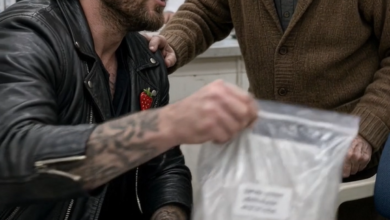
The trainer held the invoice between two fingers.
My father’s signature sat beneath the price.
Frank Bell. Chief of Police.
I knew the sharp downward stroke of the B. He had signed my report cards that way, then my first car loan, then the letter telling me how proud he was when I married Ben.
“That doesn’t mean what you think,” I said.
Cal looked at me. His brother’s dog stood inside the open kennel, one back leg held stiffly beneath him. The broken padlock lay beside Cal’s boot.
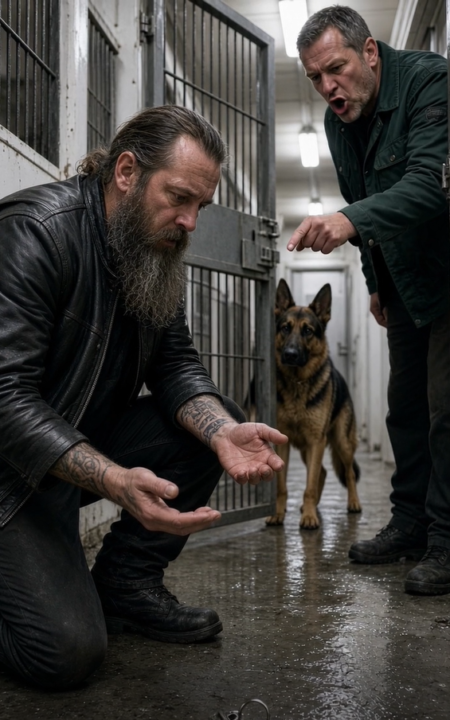
“Tell me what it means, Mara.”
I couldn’t.
The trainer, Aaron Pike, asked Cal to put down the cutters and move away from the gate. Cal set them on the concrete and stepped back. Aaron had already called the county sheriff’s office about the damage. Now he asked that somebody independent document the ownership dispute too.
He didn’t sound like a man afraid of paperwork.
That made me doubt myself.
I had pictured cruelty. A hidden dog. Men who would panic when confronted.
Instead, Aaron wore muddy sneakers and carried a folder thick with purchase documents. His kennels were clean. Atlas had water. None of that explained why my husband’s retired partner had been taken from our house, but it complicated the story I wanted to tell.
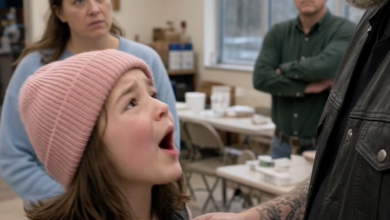
Ellie stood with me behind the visitor rail. She pressed two fingers against the hollow of her wrist, the place Ben used to check her pretend pulse when she played doctor.
“Mom?”
I put my hand around hers.
Cal had crossed the marked visitor line when Aaron refused to open the kennel. I had told him to stop. He cut the lock anyway.
Now he was breathing through his mouth as though the anger had left him short of air.
Atlas watched him.
“Off the clock,” Cal said softly.
The dog took one step forward, then stopped.
That was Ben’s kitchen phrase. Nothing to do with police work. It meant the harness was coming off and somebody might drop toast.
Ellie’s shoulders started shaking.
Aaron shut the outer passage gate before allowing us closer. He handled the leash himself, leaving space around Atlas’s stiff hind leg. The dog touched my coat, breathed against my pocket, then leaned toward Ellie’s voice.
I had forgotten the warm, dusty smell of his neck.
Aaron brought the handheld scanner from his office. The number it read matched the identification in Ben’s old records. Atlas’s response to our voices had brought me to my knees, but the number gave the deputy something he could write down without having to believe what the dog remembered. He checked the digits against both folders before closing either one.
Six weeks wasn’t long enough to forget that.
The deputy arrived and separated us for statements. Cal admitted cutting the lock. He didn’t claim the dog had been in immediate physical danger.
“I thought they were sending him away tomorrow,” he said.
Aaron confirmed a transport had been scheduled. He agreed to suspend it while the ownership documents were reviewed.
Then he showed the deputy another page.
A surrender authorization.
My name at the bottom.
My signature looked familiar because it was familiar. I had signed something at our kitchen table the week Atlas left.
But the heading above it wasn’t the heading I remembered.
If my father sold a dog I had already surrendered, what right did I have to demand him back?
Ben’s last birthday was a Sunday in September.
We ate supermarket cake in our backyard outside Ashford, Ohio, while Atlas slept beside the picnic table with his nose against Ben’s boot.
Dad was arguing cheerfully about the department’s next K9 purchase.
“Dog’s one line. Training’s another,” he said, separating two imaginary columns with his fork.
Ben grinned at me.
“Your dad could turn a birthday into a purchase order.”
Later, Ben took off his blue flannel shirt and folded it into Atlas’s bed. A crooked yellow repair ran inside one sleeve, where Ellie had insisted on helping me mend it.
She touched two fingers to her wrist.
“Check his heartbeat, Daddy.”
Ben gently rested her hand against the dog’s chest instead.
“Ask nicely. Give him room.”
Then he loosened Atlas’s harness.
“Off the clock.”
The dog thumped the grass with his tail.
At the training facility, that same tail moved once against the kennel wall. Ellie saw it and wiped her face with both sleeves.
Aaron brought a chair so she didn’t have to crouch beside the visitor rail. He asked me before bringing Atlas within reach, and I asked Ellie whether she wanted him closer.
She nodded.
Nobody hugged him around the neck. Ben had taught us that long before anyone had a reason to be careful around his sore leg.
The deputy photographed the documents and asked where my original paperwork was kept.
“At home,” I said.
“Can someone bring it?”
Cal offered to drive. The deputy told him to stay until they finished discussing the property damage.
I called my neighbor, Tessa.
She had a spare house key and knew which drawer held the folder marked BEN. She found the retirement transfer beneath his life-insurance correspondence and drove it out in a grocery bag because rain had started.
The dog had retired after Ben’s death. An earlier injury and the evaluation afterward had made a return to operational work inappropriate. A written transfer had placed him with our family.
I had the signed acceptance.
The dog’s identifying information matched.
Ben had been dead four months. During the first weeks, people brought enough food to fill two freezers. By the time Atlas left, the visits had slowed. I had thought that meant we were expected to manage. Looking at the two forms, I wondered who had decided we were ready. Beside me, Tessa quietly wrote down the deputy’s name.
That should have made me feel safe.
Instead, Aaron laid the later surrender beside it.
Both looked official.
Both carried my name somewhere they shouldn’t have needed to compete.
The deputy called a supervisor outside our city department. My father led a small municipal force. This facility stood beyond its jurisdiction, but his signature still changed the way people handled the folder.
They checked more carefully.
They also spoke more quietly.
Tessa took Ellie to the car with crackers while I called Dad.
He answered on the second ring.
“I heard about Cal.”
Not Atlas.
Cal.
I asked whether he had sold the dog.
“A retired working animal requires a responsible placement, Mara.”
“That’s not what I asked.”
He breathed out through his nose, the sound that used to stop arguments when I was sixteen.
“Come home. Bring the papers. We’ll straighten this out.”
But if this was a mistake, why did he want the papers brought to him instead of sent to the deputy?
Dad’s explanation arrived through an attorney the following afternoon.
He said he had helped arrange a professional placement after I asked for assistance. He said the retirement transfer never entitled me to disregard the dog’s needs. He said the purchase funds were paid to a working-dog support fund, not to him personally.
Aaron’s invoice matched the amount in the fund’s receipt.
Eighteen thousand dollars.
For several hours, the numbers made Dad look less guilty.
Perhaps he had made a hard decision while I was unable to make one. Perhaps the signature I distrusted belonged to the father who had once driven all night because my car broke down outside Cincinnati.
Cal read the explanation at my kitchen table.
He said nothing until I asked what he thought.
“I think you should get your own lawyer.”
I hated him for sounding as if I hadn’t thought of that.
Then I called one.
Her name was Ellen Shaw. She asked for both versions of the transfer documents and warned me that affection, ownership, and an animal’s care were related questions with different answers.
I wanted her to say Atlas was ours.
She asked whether I had kept a copy of what I signed six weeks earlier.
I searched my phone until I found the photograph. A crooked image, taken beneath a kitchen light while Ellie called for me from upstairs.
Temporary boarding and evaluation authorization.
The later surrender carried an extra page and language I had never photographed.
Ellen asked me not to confront Dad about the difference before she preserved what we had.
Meanwhile, Aaron supplied a message from the department’s administrative coordinator stating that all required approvals had been obtained.
Her name was Denise Lowe.
I knew her. She had brought a casserole after Ben’s funeral and quietly collected the pan weeks later so I wouldn’t have to wash it.
The approval packet had come from her office address.
Dad hadn’t invented every document himself.
The possibility gave me a sick little breath of relief.
Then Denise called Ellen after receiving a request to preserve records.
She had sent the packet.
At my father’s direction.
She had not prepared the surrender, witnessed my signature, or verified that I had agreed to a sale. She had forwarded what the chief supplied and assumed the underlying approvals existed.
Another familiar person had trusted him.
That did not make her careful.
It did make her account something that could be checked against the messages she retained.
Aaron also provided the original purchase correspondence. He had asked whether the family would object to Atlas leaving the area after a period of assessment.
Dad’s reply said the widow had requested complete separation.
Complete separation.
Aaron had bought Atlas for a demonstration and scent-work program, subject to assessment, on the strength of the records supplied. His plans weren’t evidence that Atlas belonged there. They did explain the money he had risked and the questions he now wanted answered. He had been promised a clear transfer. Instead, he had a child crying outside his kennel.
I read those words while Ellie’s dog bowl sat upside down beside our sink, where I had kept washing dust out of it.
My father had explained my grief to a stranger.
He had used it to make sure the stranger wouldn’t call me.
If the family supposedly wanted no contact, who had decided our silence counted as consent?
Atlas stayed at the facility for four more nights while the immediate dispute was addressed.
Aaron canceled the transport, documented his care, and gave Ellen access to the relevant purchase records. An independent veterinarian examined the hind-leg stiffness and the patch of rubbed fur beneath his collar.
The dog needed follow-up care, not a dramatic rescue from the edge of death.
That mattered.
Cal had done damage because he feared losing him, not because cutting a lock was the only way to keep him alive.
He paid for the lock before anyone demanded it.
The rest of his case would take longer.
My attorney sought an agreement that would move Atlas to neutral boarding while the ownership dispute and the disputed paperwork were investigated. Aaron agreed through his attorney.
He wanted his purchase money returned.
I wanted my dog.
For once, those wishes pointed in the same direction.
The financial records took us somewhere different.
The working-dog support fund had a name that sounded like a community charity. Its paperwork did not make the eighteen thousand dollars city revenue, and the city finance office had no record of receiving the sale proceeds.
Ellen referred what she found to investigators outside Dad’s department.
They obtained records I couldn’t demand on my own.
I learned later that money from the fund had paid personal expenses tied to Dad. Some transfers had descriptions that made them sound connected to department work.
The underlying purchases told another story.
The sale wasn’t a simple accounting error.
I kept expecting somebody to call with a different explanation. A transposed number. A missing authorization. Some ordinary mistake large enough to shelter my father. Every time the phone rang, I answered too quickly. Every time it was a reminder about Ellie’s school lunch balance or my next shift, I stood holding the phone after the caller hung up.
Nor was Atlas the only transaction investigators wanted explained.
Dad had counted on the gap between a document looking official and somebody checking where its money went.
Cal brought me that distinction in an ordinary way.
He arrived after closing his motorcycle shop with three folders and a bag of hamburgers. He laid the food beside the bills and asked which pile belonged upstairs, away from Ellie.
I realized he had started noticing what she could read over my shoulder.
She was eight.
She could read plenty.
That evening, she asked whether Grandpa had taken Atlas because Daddy wasn’t coming back.
I sat beside her bed.
“Grandpa made choices the grown-ups are checking.”
“Did he ask Daddy?”
“No.”
She rubbed the hollow of her wrist until I gently put my hand over hers.
“Did he ask you?”
I looked toward the doorway.
Cal was downstairs washing plates. I heard the faucet stop.
“Not to sell him,” I said.
That answer was true.
It wasn’t complete.
At the bottom of my kitchen drawer lay the authorization I’d photographed, the one I hadn’t shown Cal when he first promised to bring Atlas home.
My phone lit up before I could close the drawer.
A message from Dad.
Tell your brother-in-law who asked me to take the dog.
What would Cal say when he learned Atlas hadn’t left our house against every wish I’d expressed?
Dad spoke before I did.
A statement circulated describing a grieving widow who had requested removal of an animal she could no longer manage. It described Cal’s conduct at the facility as an attempt to take police property through intimidation.
The broken lock appeared in every photograph.
The completed retirement transfer appeared in none.
Cal lost two repair appointments. A customer asked whether he had threatened a trainer in front of a child.
He said he had cut a lock, that it was wrong, and that he hadn’t threatened anybody.
Some people heard only the first part.
I couldn’t blame the trainer for calling the police. Cal couldn’t either. He gave his statement with an attorney present and cooperated with the case concerning his own actions.
But Dad used that separate incident as if it answered every question about the sale.
The money.
The altered authorization.
Our ownership.
At work, my supervisor at the dental office asked whether I needed time away from the front desk. She meant it kindly. I heard that patients were talking.
I took two days, then worried about the hours I wasn’t being paid.
Ellen told me not to argue online. Preserve the messages, correct factual errors through appropriate channels, keep Ellie out of public statements.
The sensible choices felt terribly quiet.
Tessa helped with the quiet parts. She picked Ellie up from school, sat with her while I spoke to Ellen, and put a clean towel in my kitchen when she noticed there wasn’t one. I had known her six years. Until that month, I couldn’t have said whether she took sugar in her coffee. Now I remembered to ask.
Dad’s version was loud.
Then he filed a report describing Atlas as a safety concern and requested that the dog be returned to department control pending another evaluation.
He cited the very temporary authorization he had replaced with a surrender when speaking to Aaron.
Two versions of my wishes.
One for each door he needed opened.
The attorneys arranged for the existing neutral placement to continue while the relevant authorities reviewed the documents. I wasn’t allowed to settle anything by driving over with a leash.
Neither was Dad.
That evening, Cal found me sitting on the laundry-room floor with Ben’s blue flannel in my lap.
The shirt had been packed with Atlas’s things when he left. Aaron had returned the personal belongings through the boarding facility.
A yellow seam curled beneath my thumb.
Ellie’s crooked stitches.
Cal stood in the doorway.
“Did he growl at somebody?”
I looked up.
He had read the report Dad submitted. It mentioned an incident at home that I had never described to him.
“A handyman reached toward his bad leg,” I said.
“Did Atlas bite?”
“No.”
“Did you have him checked?”
“Ben’s old vet. Then a behavior consultation.”
“Why didn’t you tell me?”
I pulled the shirt tighter against my knees.
Because Cal had already lost his brother.
Because he believed bringing Atlas back would put something right.
Because I had been scared, exhausted, and ashamed that sometimes the dog’s pacing made my own chest race.
“I asked Dad to take him for two nights,” I said.
Cal sat down on the dryer without speaking.
Could I still call myself betrayed when I had hidden the first part of the story from the man helping me?
The night I called Dad, Atlas had walked between the front door and Ben’s empty chair until after midnight.
I couldn’t settle him.
I couldn’t settle myself.
Ellie was asleep upstairs. I sat on the floor near the dog without touching him and called the only parent I had left.
“Please take him,” I said.
Those were the words Dad kept.
He left out what followed.
“Just until Friday. I need to sleep.”
I told Cal the whole conversation. The missed meals. The consultation. The way I had cried when Atlas carried one of Ben’s slippers into the hall.
“You could have called me,” he said.
“You were angry every time somebody moved his things.”
Cal looked down at the floor.
He had accused me of boxing up Ben too quickly. He had apologized, but apologies don’t always erase the place a sentence lands.
“Yeah,” he said. “I was.”
We sat with that.
No one in our family had been grieving neatly enough to recognize another person’s need for rest.
Cal picked a loose thread from the edge of the flannel. He started to say something, then stopped. Finally, he told me he’d been keeping Ben’s last voicemail unheard because playing it would make it the last time he heard something new. I had done the same thing with a message about buying bread. We sat beside each other until the dryer stopped.
Then I showed him the messages arranging Friday’s return. Three questions from me. Two replies from Dad about delays. A later assurance that Atlas was receiving specialist assessment.
I hadn’t agreed to permanent surrender.
I had asked for help and mistaken my father’s confidence for an answer.
Cal read everything.
“You needing two nights doesn’t give him the dog,” he said.
My throat tightened so hard I had to look away.
That week, the independent review addressed Atlas’s care as well as his paperwork. The veterinarian confirmed chronic discomfort requiring management. A qualified behavior professional reviewed the household history and observed him with adults before recommending a structured return to family life if ownership was resolved.
Affection wasn’t a substitute for that work.
Neither was a label calling him dangerous.
I agreed to appointments, practical changes at home, and boundaries Ellie already remembered from Ben. His rest area would remain his. Nobody would reach for a sore leg or crowd him while he slept.
Ellen submitted the messages and the original photograph of my temporary authorization. Aaron supplied the full chain of correspondence behind his purchase.
Denise confirmed which documents had come from Dad.
The proposed sale had been discussed before the night I asked for two days of help.
I read the date again.
Dad hadn’t found a solution to my request.
My request had supplied cover for a plan already underway.
Aaron’s itemized invoice divided the eighteen thousand dollars into two amounts. Fourteen thousand for Atlas. Four thousand for additional assessment and training services bundled into the arrangement.
Dog’s one line. Training’s another.
I heard my father at Ben’s birthday table.
Then the city scheduled a public session concerning the disputed disposition of department property and the handling of related funds.
Dad said he would answer every allegation in person.
Would he still separate the columns when the numbers described what he had done to his own granddaughter?
We left Ellie with Tessa.
She wanted to come.
I told her the adults were going to discuss records and money, and she didn’t have to listen to people argue about whether her family had wanted its dog.
“We did,” she said.
“I know.”
Cal drove his pickup so I wouldn’t have to manage the parking garage alone. His motorcycle stayed at the shop. He wore his leather vest over a clean shirt and carried a folder with soft corners.
Nobody brought a chain of motorcycles to the building.
Two friends came as quiet company and sat behind us.
The city attorney explained that this session would establish what the city had authorized, hear the relevant accounts, and address the records before council. Criminal allegations remained with outside investigators.
She also explained that the prior retirement transfer mattered: a chief’s title did not by itself give him authority over an animal already transferred out of city ownership. The disputed surrender couldn’t simply be assumed valid because it arrived from his office. For weeks, I had been answering questions as though I needed permission to believe the first document.
I had learned to be grateful when people described the limit of their authority.
Dad sat at a separate table.
He looked like the man who had stood beside me at Ben’s funeral, steady enough that I had leaned my whole weight against him.
I remembered that weight.
Then I remembered the invoice.
The finance director confirmed that the city had not received the purchase proceeds. The written retirement transfer and my temporary boarding authorization were displayed beside the later surrender document.
My attorney explained the differences. Aaron described the representations made to him and the amount he had paid.
Dad listened with his jaw set.
When given a chance to respond, he said he had acted to protect a vulnerable family and an animal requiring specialist care.
He denied personally selling Atlas.
“I facilitated a placement,” he said.
I stood when called and described asking for two nights. I didn’t hide the growl, my exhaustion, or the arguments with Cal.
Some people looked down.
I kept talking.
Aaron’s payment was discussed again. A council member asked why eighteen thousand dollars had gone to the support fund rather than through an approved city transaction.
Dad leaned toward his microphone.
“Because eighteen thousand isn’t the price of the dog.”
The city attorney asked him to explain.
“Four thousand was the training component. I sold him for fourteen.”
The room went still.
My father stopped speaking.
He had corrected the column before protecting the sentence.
Dog’s one line.
Training’s another.
A family joke returning without anything funny left in it.
“Chief Bell,” the attorney said, “you just told us you did not sell this animal.”
Dad looked toward me.
Not the attorney.
Me.
“You asked me to take him.”
“For two nights.”
“You weren’t coping.”
My hands shook against the folder.
“That wasn’t permission.”
He opened his mouth, then closed it.
The records mattered more than the slip. They showed the prior transfer, the planned transaction, the disputed surrender, and the destination of the money.
But his own words ended the room’s willingness to let him describe the sale as something that had happened around him.
If he had merely helped arrange care, why did he know exactly how much he had sold Atlas for?
Atlas came home on a Thursday.
Not from the council room.
Not because the crowd demanded it.
The return followed written resolution of his ownership and release from the neutral placement. We collected him with the care plan, his veterinary records, and an appointment already booked.
Cal waited by the pickup while I signed.
This time, I read every page.
Aaron handed over Atlas’s lead. He had his own claim over the purchase money and his own questions about trusting paperwork that arrived beneath a police chief’s name.
He apologized for the weeks we lost.
Cal apologized for the lock.
Neither apology required the other man to pretend everything was settled.
At home, Ellie stood beside the kitchen doorway until I told her we were ready. She let Atlas approach instead of running toward him.
He smelled her shoes.
Her hands.
The pocket where she kept a biscuit she had been told to wait before offering.
Then he settled against the edge of Ben’s old chair.
Ellie sat on the floor a little distance away and began telling him about school.
He slept before she finished.
My father left office while the investigations continued. The records concerning the unauthorized sale, disputed documents, and use of the fund became part of the proceedings that followed.
He eventually entered a guilty plea to charges arising from that conduct. Repayment and other consequences were addressed through the case, not negotiated around our dinner table.
I attended one hearing.
Cal drove me home afterward and asked whether I wanted coffee.
I said yes.
That was the whole conversation for twenty minutes.
Later, he asked whether I wanted him to come inside. I said I wanted an hour alone first. He didn’t stiffen or ask whether that meant I was shutting him out. He checked that I had dinner, then said he’d call tomorrow. That small exchange felt like a new kind of promise: help could leave room for the person receiving it.
Cal’s property-damage case also ended. He paid the costs required of him and stopped describing that afternoon as the day he rescued Atlas.
“Found him,” he said when Ellie asked.
She considered the distinction, then returned to her homework.
Atlas’s stiff leg didn’t disappear because the address changed. We kept the appointments. We adjusted his activity. Some nights he paced, and I called Cal before I reached the place where I couldn’t ask anybody for help.
Sometimes Cal came over.
Sometimes he stayed on the phone while I made tea and let the dog settle in his own space.
The blue flannel became the cover on his bed again. Ellie’s yellow stitches held through repeated washing. She checked them every Sunday, serious as a mechanic inspecting a repair.
One evening, she brought me the broken padlock in a paper envelope. It had been returned among the documented items after the relevant proceedings no longer needed it.
“Do we keep this?”
I looked at Cal.
He shook his head.
We photographed it, checked that nobody needed it retained, and put it aside for disposal.
The thing worth keeping was asleep across the room.
Ellie crouched beside Atlas’s bed without touching him. When he lifted his head, she tapped two fingers against her wrist.
“Off the clock,” she whispered.
His tail moved against the flannel.
Then she looked up at me.
“Can we all be off the clock now?”