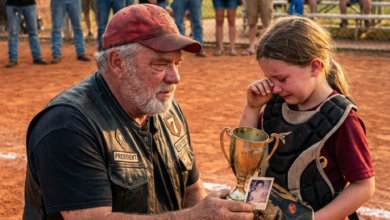
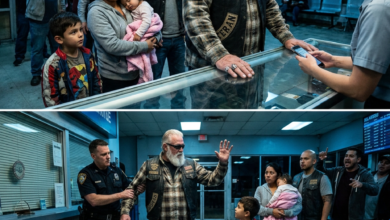
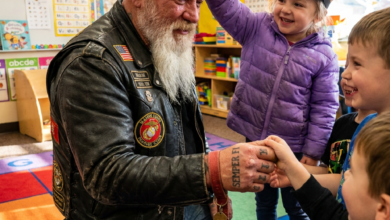
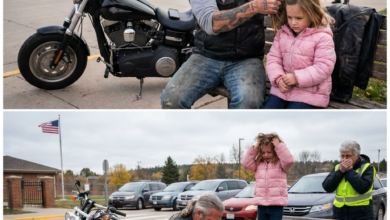
Part 2: A 285-Pound Biker Ripped the White Cane From a Blind Man and Ran Through an Albuquerque Crowd — The Next Morning, He Returned With a New Cane Cut From His Dead Brother’s Harley
Part 2 — The Blind Man Who Heard the Fall
People told the story afterward as though Hammer had saved Maya alone.
He never allowed that version to survive.
Whenever someone thanked him, he pointed at me and said, “He found her.”
That was not completely true either.
I had heard the grate move. Hammer had understood what the sound meant. Neither of us had been enough without the other, but communities prefer one hero because two people sharing a moment makes the truth harder to print on a plaque.
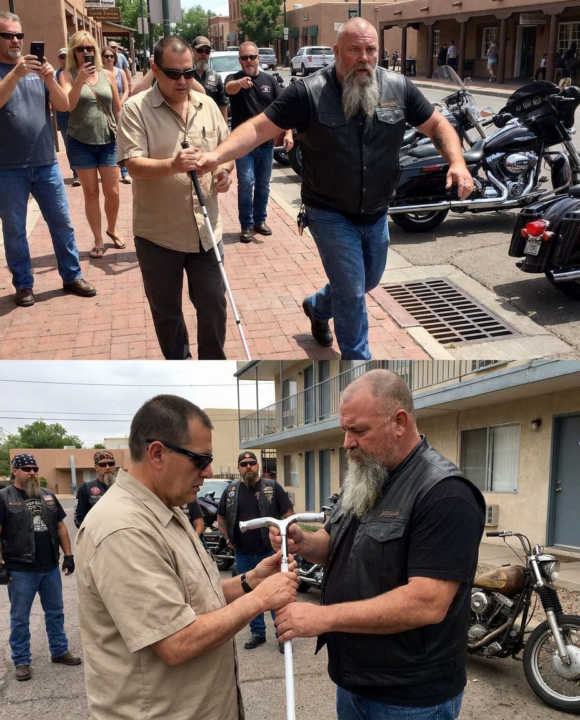
Three weeks after the rescue, the city installed a temporary metal cover over the storm drain. News crews arrived. Officials promised an inspection. Maya’s parents thanked emergency workers, shop owners, strangers, and the biker nobody had managed to interview.
Hammer avoided all of it.
I learned why when he appeared outside my apartment the following morning with the new cane.
He knocked once.
The building hallway amplified his weight, the faint chain beside his hip, and the uneven scrape of one boot. He had injured his right knee at the drain, though he had refused an ambulance.
I opened the door.
“You’re early.”
“Could leave.”
“Then I would have to locate you.”
“You did yesterday.”
He placed something upright against my palm.
At first I assumed he had bought a standard folding mobility cane. The shaft was lightweight carbon fiber with a reflective white finish, a red lower section, a fresh rolling tip, and the correct elastic tension.
The grip was different.
Cold metal curved beneath black rubber worn smooth by decades of use. A shallow crescent dent rested beneath my thumb. The end had been capped and polished, but the slight bend remained unmistakable.
It was a motorcycle handlebar.
“You built this?”
“Club helped.”
“From what?”
Hammer did not answer.
I rotated the cane and felt a small raised mark set into the metal. It was not decoration. Someone had engraved three letters by hand.
ELI.
“Who was Eli?”
“My brother.”
The hallway fell quiet.
I asked whether his brother was alive.
“No.”
I held the cane toward him.
“I can’t take this.”
“Fits your height.”
“That is not what I said.”
“Tip rolls. Shaft folds. Grip won’t slip.”
“You cut apart your dead brother’s motorcycle to replace something you damaged for six minutes.”
“Seven.”
“You counted?”
“Yep.”
I extended the cane again.
He did not accept it.
Elias Dawson had been nine years older than Hammer. Their father disappeared when Hammer was six, leaving their mother with two boys, three unpaid bills, and a refrigerator that hummed louder when it contained nothing.
Elias became brother, mechanic, and half-trained parent.
He taught Hammer to repair bicycles behind their rental house in Gallup. At sixteen, Elias bought the remains of a 1978 Harley Shovelhead from a burned storage shed. The engine arrived in one box, the transmission in another, and the frame had no paperwork anyone trusted.
They spent four years rebuilding it.
The handlebars came from a police auction. Elias heated the left side with a torch and bent it toward himself because an old shoulder injury limited his reach. That shallow curve became his signature.
By the time Hammer turned twenty, Elias could identify a failing bearing by sound. He could synchronize carburetors by placing two fingers against the intake. He could tell when his younger brother lied because Hammer stopped moving his hands.
Then Elias began losing his sight.
Retinitis pigmentosa narrowed his vision slowly. First he stopped riding at night. Then he missed road signs. Finally, a dark truck crossed in front of him on a county road, and Elias struck the rear quarter panel.
He survived.
The left handlebar did not.
The crescent dent beneath my thumb came from that collision.
Elias repaired the motorcycle but never rode it again. Instead, he taught Hammer what people rarely teach the sighted: never pull a blind person without warning, never move an object and assume they will remember the new position, and never confuse help with control.
“Ask,” Elias would say. “Then listen.”
That explained why Hammer had never touched my elbow outside Nora’s shop.
It also explained why taking my cane bothered him more than the crowd’s accusations.
“Your brother taught you to ask,” I said.
“Yep.”
“And you didn’t.”
“No time.”
“You still hate that.”
“Yep.”
His answers were never larger than necessary.
I touched the engraved letters again.
“Why keep this handlebar?”
Elias died eighteen years after the collision, not from the crash or his failing sight, but from pancreatic cancer that moved faster than the doctors expected.
During his final week, Hammer brought pieces of the Shovelhead into Elias’s bedroom so he could identify them by touch. Elias recognized the fuel cap, clutch lever, timing cover, and the left handlebar.
He kept his hand around that grip for nearly an hour.
After his death, Hammer restored the Harley with replacement bars. The original handlebar remained mounted above the workbench at Dawson Fleet and Diesel.
No one touched it.
Not even Hammer.
I understood what he had brought me now.
It was not payment for a damaged cane.
It was part of the last machine his brother could still see.
I tried returning it again.
Hammer closed my fingers around the grip.
“Eli said tools die on walls.”
Then he left.
The hallway door closed behind him. His boots crossed the courtyard. A moment later, the Harley engine started and settled into a low V-twin pulse.
I tested the cane across my apartment.
The weight was balanced. The modified grip rested naturally against my palm. The rolling tip located the sofa, coffee table, doorway, kitchen tile, and the small raised threshold leading outside.
Hammer had measured everything.
Even the angle of my wrist.
What I did not know was that cutting the handlebar had nearly split the Iron Mercy Riders apart—or that the youngest man in the club had tried to stop the blade with his bare hand.
Part 3 — Nine Feet Beneath Old Town
The rescue lasted only seven minutes.
Inside those seven minutes were enough mistakes, accidents, and choices to change every person standing near that drain.
Maya Chen had come to Old Town with her mother, Linda, to buy a birthday gift for her grandfather. Maya carried a yellow backpack containing a water bottle, two crayons, a stuffed rabbit, and a small brass bell she had purchased from a street vendor with four dollars saved from chores.
The bell mattered.
It was the first sound I heard below the crowd.
When Maya stepped onto the damaged grate, one rusted support flange snapped. The iron plate rotated downward, taking her with it, then shifted partly back into position after her backpack caught.
From across the street, the drain looked closed.
Maya hung below it.
Her backpack strap tightened across her chest. Her left sneaker found a wet pipe, but the pipe was too narrow to support her weight. Water from a storm over the Sandia foothills was moving through connecting channels toward Old Town.
The small brass bell struck concrete each time Maya tried to climb.
That was what reached me.
Hammer heard the grate.
I heard the bell.
He asked how long my cane was because the drain opening measured less than twenty inches across, while Maya hung almost five feet below the sidewalk. A broom from Nora’s shop was too thick at the handle. A metal café pole was too short. A motorcycle tie-down hook could have cut the child.
My cane was light, narrow, and fifty-eight inches long.
Perfect.
Hammer took it and ran.
Behind him, the crowd formed its own truth. A tattooed biker had ripped an assistive device from a blind man. Phones appeared. Two men pursued him. A woman called police.
One tourist tackled Cole Mercer, the youngest Iron Mercy prospect, after Cole tried to follow Hammer through the crowd.
Cole pushed him away.
Boone Collins, the club’s road captain, caught Cole before his fist moved.
“Kid first,” Boone said.
Those two words held the club together.
At the drain, Hammer dropped onto his right knee hard enough to crack the kneecap cartilage. He barely felt it. He shoved aside the broken grate, looked down, and found Maya’s face in a rectangle of weak daylight.
“Don’t move,” he said.
“I’m falling.”
“I know.”
“Get my mom.”
“She’s coming.”
That was not true yet. Linda remained across the street, unaware that the red pinwheel beside the vendor no longer belonged to anyone.
Hammer pushed the cane downward.
Maya reached with her right hand. The tip moved past her fingers.
“Missed,” Hammer said.
“I can’t see.”
“Listen to it.”
He tapped the cane against the pipe.
I reached the edge of the crowd then. A stranger had offered his forearm, and I accepted because without my cane the street was an unmapped field of bodies, curbs, chairs, and parked motorcycles.
Maya coughed below us.
The echo told me the drain widened slightly to the right.
“Move it toward her tapping hand,” I said.
Hammer shifted the cane.
Metal touched skin.
“Found her,” he answered.
Maya closed one hand around the shaft. Hammer told her to use both, but the backpack strap prevented her left shoulder from rising.
The first surge of water arrived.
It struck her calves, removed her sneaker, and pushed her foot from the pipe.
Maya fell six inches.
The crowd screamed.
Hammer did not.
He rotated the cane beneath the backpack strap and pulled. The aluminum shaft bowed against the edge of the drain.
Boone grabbed the back of Hammer’s vest. Cole wrapped both arms around his boots. Nora lay beside Hammer and reached through the gap.
The white finish cracked.
Maya rose two inches.
The backpack began tearing.
“Leave the bag,” Hammer said.
“My rabbit.”
“Leave it.”
Maya refused.
Children do not measure danger by price or practicality. That stuffed rabbit had belonged to her grandmother. Maya held the backpack strap with one hand while clinging to the cane with the other.
The water climbed to her knees.
Hammer looked at Boone.
“More.”
Boone pulled backward. Cole braced his boots against the curb. Three strangers joined them, including one of the men who had chased Hammer.
My cane bent nearly ninety degrees.
For a moment, nobody breathed.
Then the rolling tip snapped away.
The sudden release pulled Maya upward. Nora caught her wrist. Hammer forced his tattooed arm through the broken grate until the concrete removed skin from his forearm.
His hand closed around Maya.
The backpack tore.
Water took it.
Maya screamed for the rabbit as Hammer lifted her through the opening and rolled onto the sidewalk.
She landed across his chest.
The brass bell remained clenched in her left hand.
Linda reached them seconds later. She struck Hammer once because she believed he had hurt her daughter. Then she saw Maya alive against his vest and dropped beside them.
Hammer did not blame her.
He placed Maya in her mother’s arms.
“Breathing,” he said.
The crowd began cheering, but Hammer was watching the drain. He asked whether anyone else had fallen. He asked whether the culvert connected to an open channel. He ordered Cole to block the street before another child stepped near the broken iron.
Only when emergency workers arrived did he remember me.
He carried the ruined cane back.
The aluminum was warm from his hands. One section had folded inward. The rubber grip had split where Hammer’s skull ring pressed into it.
“Sorry,” he said.
I examined the cane with my fingers.
“Child alive?”
“Yep.”
“Then it worked.”
A police officer named Harris approached us. The dispatcher had reported a robbery in progress involving multiple bikers. Harris saw my damaged cane, Hammer’s blood, and the crowd still holding phones.
“Sir,” he asked me, “did this man forcibly take your cane?”
Hammer said nothing.
He had a prior conviction for assault from his twenties. He knew how the scene appeared. If I said yes without context, he might leave in handcuffs.
I turned toward the drain.
“Maya,” I called.
A weak voice answered from inside the ambulance.
“Yes?”
“Did the cane reach you?”
“Yes.”
“Then nobody took it from me. We loaned it.”
Hammer exhaled once.
That was all.
The news video later showed him starting his Harley and leaving while paramedics cleaned his arm. Viewers assumed he was avoiding attention.
The truth was harder.
Hammer rode directly to Dawson Fleet and Diesel, stood beneath the old handlebar for forty-three minutes, and tried to decide whether saving a child gave him the right to cut apart the last thing his brother had held.
Part 4 — The Handlebar Nobody Was Allowed to Touch
Dawson Fleet and Diesel sat behind a truck stop on the western edge of Albuquerque, where the air smelled of hot rubber, welding smoke, stale road coffee, and motor oil ground permanently into concrete.
Hammer opened the shop at 4:38 Sunday morning.
Boone was already waiting.
So were Deacon Price, Lobo Ramirez, Cole Mercer, and two older Iron Mercy riders who had known Elias Dawson before he lost his sight.
Nobody had slept much.
The damaged cane lay on Hammer’s workbench. Beside it sat a new carbon-fiber mobility shaft purchased from a twenty-four-hour medical supplier in Santa Fe.
Above them hung the handlebar.
Elias’s handlebar had become the closest thing Iron Mercy possessed to a sacred object. New members heard its history before earning their full patch. Nobody placed tools beneath it. Nobody wiped away the dust without Hammer’s permission.
Elias had never founded the club, but he had created the rule that shaped it.
No rider gets abandoned because he slows down.
When Elias’s vision narrowed, riders began escorting him to appointments. When he could no longer identify faces, they introduced themselves each time they entered the shop. When he stopped riding, they placed him in the recovery truck during charity convoys so he could hear the engines.
He knew every motorcycle by sound.
After Elias died, Hammer mounted the damaged handlebar above the workbench with the original grip still attached. He refused to use the metal in the restored Shovelhead.
“That bar is finished,” he told Boone.
Now Hammer lifted it from the wall.
Cole stepped forward.
“No.”
Hammer looked at him.
Cole had been ten when Elias died. His father served prison time. His mother worked nights. Elias taught him to read micrometers, count change, and cross a repair bay safely while engines were running.
To Cole, the handlebar was not scrap.
It was a grave marker.
“Buy the man a cane,” Cole said. “Buy him ten. Don’t cut Eli’s bar.”
“Already bought the shaft.”
“Then use a rubber grip.”
Hammer placed the handlebar in a padded vise.
Cole put one hand over the cutting line.
Boone grabbed his wrist before the saw started.
“Move,” Hammer said.
“You said nobody touches it.”
“I’m touching it.”
“He held that bar on his last ride.”
Hammer’s jaw tightened.
“I know.”
“You’ll destroy it.”
“No.”
“What do you call cutting it in half?”
Hammer looked at the ruined white cane.
“Putting it back on the road.”
Cole pulled against Boone’s grip. Other riders shifted closer. For one dangerous second, brotherhood became a circle of men defending different versions of the same dead person.
Then Deacon placed Elias’s old notebook on the workbench.
He had retrieved it from a locked cabinet.
The notebook contained repair measurements, medication schedules, crude jokes, and instructions Elias dictated after he could no longer write clearly. On the final page was a sentence Hammer had avoided for eighteen years.
Ray keeps too much dead metal.
Under it, Elias had added another line.
If a part can still carry somebody, it isn’t mine anymore.
Cole stopped pulling.
Boone released him.
Hammer positioned the cutting wheel.
He hesitated.
This was the man who had entered a collapsing drain without pausing. He had faced knives, prison cells, roadside fires, and a truck axle falling from a lift.
But his hands shook above that handlebar.
Boone noticed.
“Want me to do it?”
“No.”
Hammer lowered his face shield.
The saw touched chrome.
Sparks crossed the dark shop.
Nobody spoke while the blade passed through the bar. Hammer preserved the bent left section with Elias’s worn rubber grip and returned the remaining metal to the wall bracket.
He did not discard a single shaving.
Lobo machined a lightweight connector for the carbon-fiber shaft. Deacon added the reflective white coating and red lower section. Boone adjusted the wrist angle using measurements taken from my damaged cane.
Cole remained near the door.
At 5:51, he walked to the bench.
“The balance is wrong,” he said.
Hammer handed him the unfinished cane.
Cole held it horizontally across two fingers. The motorcycle grip made the upper section too heavy. A mobility cane needed feedback from the tip, not weight dragging against the wrist.
They could not simply attach a piece of Harley to a medical device and call sentiment good engineering.
So Cole hollowed the steel.
He worked slowly, removing unnecessary material from inside the handlebar without damaging Elias’s grip or the crescent dent. Lobo installed a small counterweight near the connector. Boone tested the folding mechanism.
At 6:37, the cane balanced.
Hammer tapped it across the shop floor with his eyes closed. The rolling tip located a tire, toolbox, lift post, and oil drain.
He struck a bucket.
Cole moved it.
“Don’t,” Hammer said.
“What?”
“Eli said sighted people move things and call it helping.”
Cole returned the bucket to its original place.
Hammer tested the cane again.
At 6:54, he carved ELI into the metal. Three rough letters. No dates. No speech.
At 7:03, the club rolled six Harleys outside. Hammer placed the cane across his saddlebag, then removed it.
Too risky.
He strapped it along his back instead.
Before leaving, he stood beneath the remaining half of Elias’s handlebar.
Cole joined him.
“Still mad?” Hammer asked.
“Yep.”
“Good.”
“You?”
“Yep.”
Cole touched the empty space on the wall bracket.
“Think Eli would’ve let you cut it?”
Hammer looked at the cane.
“No.”
Cole frowned.
Hammer started toward the door.
“He would’ve cut it himself.”
Seven V-twins started in the gray morning. Hammer rode to my apartment alone while the others followed at a distance.
He believed he was replacing something he had broken.
He did not yet understand that Elias’s handlebar would reveal a failure beneath Old Town that the city had ignored for eight years.
Part 5 — What the City Buried Beneath the Grate
I refused the cane twice before accepting it.
The third time, Hammer placed the tip on the courtyard pavement and pushed the grip toward me.
“Test it.”
I unfolded the sections. The elastic cord tightened them with a clean snap. I swept the cane left, then right.
The handlebar grip changed the feedback. Its curve aligned my wrist more naturally than the straight foam handle on my old cane. Each tap traveled through the carbon fiber and into the hollow steel, producing a lower tone.
Concrete sounded broad.
Brick sounded sharper.
The metal drain cover outside my building rang like a small bell.
I stopped.
“Do that again,” Hammer said.
I tapped it.
The hollow handle amplified vibration. Elias had spent years tuning machines through his hands, and now part of his motorcycle was translating the ground for me.
Hammer heard the difference too.
“That why you found Maya?” he asked.
“Not exactly. I heard her bell and the grate shifting.”
“Before she fell?”
“I heard a low rattle when I passed that corner three weeks earlier.”
Hammer became still.
I had reported the sound to Albuquerque’s municipal service line. Twice.
The first time, an operator classified it as street noise. The second time, a contractor inspected the wrong storm drain fifty yards away and closed the complaint.
I still had the confirmation numbers recorded on my phone.
Hammer asked to hear them.
He wrote both numbers on his wrist.
Two days later, he returned with Boone and a civil engineer named Priya Nair, whose wheelchair-accessible van Iron Mercy had repaired the previous winter.
Priya inspected the failed grate.
The rust was not recent. Water had entered the frame for years. Two support flanges had separated beneath the sidewalk. Worse, the replacement grate installed after Maya’s rescue rested on the same weakened concrete.
“It can fail again,” Priya said.
The city disagreed.
Officials said the temporary cover met emergency requirements. They asked Priya not to interfere with an active assessment. They told Hammer that removing barricades could lead to arrest.
Hammer crossed his arms.
“Then arrest the rust.”
The quote reached local television by evening.
Public attention forced a broader inspection. Crews tested thirty-seven storm drains around Old Town.
Eleven failed load standards.
Three stood beside school walking routes.
The city closed them immediately.
That should have ended the story.
It did not.
A records clerk found my first complaint. The audio file contained the metallic rattle I had tried to describe. In the background, a city employee could be heard telling another caller that blind residents often misidentified construction sounds.
Hammer listened once.
Then again.
He did not shout. He did not threaten anyone. He drove to the municipal building, placed Elias’s old notebook on the counter, and requested a public-comment form.
Because the form was available only in small print, he asked for an accessible version.
There wasn’t one.
Hammer stood there until somebody created it.
At the next council meeting, I spoke for three minutes. Maya’s mother spoke for five. Priya explained structural corrosion. Nora brought security footage showing the grate moving when delivery trucks passed.
Hammer sat in the rear row.
He refused the microphone.
When a council member thanked him for his bravery, Hammer shook his head and pointed toward me.
“He reported it.”
The room turned in my direction.
For eleven years, strangers had praised me for crossing streets, buying groceries, or entering buildings without assistance. Those compliments never felt like respect. They felt like surprise that blindness had not erased ordinary competence.
Hammer did something different.
He gave me evidence.
The city reopened every unresolved accessibility complaint filed during the previous ten years. It hired blind residents to participate in pedestrian-safety audits and created an audio-confirmation system for infrastructure reports.
Maya attended the final inspection with her mother.
She carried a new stuffed rabbit. The original had traveled almost a mile through the storm channel before a maintenance worker found it caught against a screen. The yellow backpack was ruined, but the rabbit survived after three washes and one replaced ear.
Maya walked toward Hammer.
He immediately stepped backward.
Children made him nervous when their parents were watching.
She held out the little brass bell.
“For your motorcycle.”
“No.”
“It helped Mr. Daniel hear me.”
“Then give it to him.”
“I bought two.”
She opened her other hand.
Hammer accepted one bell.
I accepted the other.
Maya’s mother asked Hammer why he had left the rescue scene before anyone could thank him.
“Had work.”
“What work?”
Hammer looked at my cane.
“Replacement part.”
Linda touched the curved handlebar grip.
“Was it expensive?”
Hammer answered honestly.
“Yep.”
She assumed he meant money.
I knew better.
The greatest cost had been removing dead metal from a wall and allowing it to become useful again.
That evening, I visited Dawson Fleet and Diesel for the first time. Hammer guided me through the shop without touching me. He described nothing until I asked.
I found the wall above his bench by tapping with the cane.
There was an empty bracket beside the remaining half of Elias’s handlebar.
“Does it bother you?” I asked.
“Yep.”
“Do you regret it?”
Hammer took a long time to answer.
Then he tapped the grip resting in my hand.
“No.”
Cole stood nearby. He still looked toward the empty bracket each morning. He still disliked the cut.
But when I turned to leave, he adjusted the cane’s wrist loop so it would not burn my skin if somebody ever grabbed it again.
That was his apology.
Hammer’s was the handlebar.
Elias’s was the balance.
Part 6 — The Route Elias Could No Longer See
Every second Saturday, Hammer began meeting me outside Nora’s coffee shop at 7:12 in the morning.
We walked the same route through Old Town.
I tested curb ramps, broken pavement, loose utility covers, outdoor tables, low signs, and construction barriers. Hammer recorded measurements. Boone photographed hazards. Cole carried orange chalk but learned not to mark anything until I confirmed its position.
Maya joined us with her mother when school allowed.
She wore no yellow backpack.
The first time we reached the repaired storm drain, she froze. Water moved below it, producing the same hollow rush she remembered.
Hammer stood beside her.
He did not say she was safe. He did not tell her to be brave.
He placed the small brass bell on the grate and flicked it with one finger.
The note rang through the street.
Maya placed her shoe beside it.
Then the other.
She crossed.
Hammer attached her second bell beneath the clutch lever of his Harley. It was too small to hear over the engine, but it moved whenever the motorcycle did.
My bell hung from the wrist loop of the cane.
The handlebar grip darkened beneath my palm. Elias’s worn rubber slowly adapted to the shape of another hand. The crescent dent remained beneath my thumb, always pointing forward.
People sometimes asked whether the cane belonged in a museum.
Hammer answered before I could.
“It’s working.”
The city eventually replaced all eleven failed drains and added tactile warning strips at four crossings. Priya’s inspection protocol became part of Albuquerque’s annual pedestrian-safety review.
No plaque mentioned Iron Mercy.
Hammer preferred it that way.
At the shop, the remaining section of Elias’s handlebar stayed above the workbench. Cole mounted nothing in the empty space. Dust outlined what had been removed.
Once a year, on the anniversary of Elias’s death, Hammer started the restored Shovelhead and let it idle outside.
He never rode it.
I asked why.
“Bars feel wrong.”
“Put the old one back.”
“Can’t.”
“You still have half.”
Hammer looked toward my cane.
“Other half’s busy.”
After that, the sound of Elias’s motorcycle no longer ended at the shop wall. Part of it traveled with me—across brick, concrete, steel grates, bus steps, courthouse floors, and the curb beside the place where Maya almost disappeared.
The dead machine had found another road.
Part 7 — The Day Hammer Finally Asked
Three years after the rescue, Maya turned ten.
Her parents held a small birthday gathering in Old Town near Nora’s coffee shop. City workers had inspected every drain that morning, though nobody admitted the timing was deliberate.
Maya arrived wearing a new yellow backpack.
A stuffed rabbit looked through the zipper.
Hammer parked across the street with fourteen Iron Mercy Riders. He planned to remain near the motorcycles, but Maya walked over and took his scarred hand.
“Come see.”
She led him to the repaired drain.
Children had drawn around it with washable chalk. Blue water. Red motorcycles. A white cane stretching across the entire sidewalk.
In the center, Maya had drawn two enormous hands holding the cane.
One was Hammer’s.
The other was mine.
“You made my tattoos wrong,” Hammer said.
“You have too many.”
“Fair.”
Maya’s mother brought out a narrow wooden box. Inside was a certified replacement mobility cane purchased by the neighborhood association.
My Harley cane was aging. The original rubber had begun cracking. The carbon-fiber lower section carried scratches from thousands of miles of pavement.
Everyone expected me to retire it.
I unfolded the new cane, tested its balance, and handed it back.
“Good spare.”
Hammer’s beard moved with the beginning of a smile.
We walked to Dawson Fleet and Diesel after the party. The restored 1978 Shovelhead waited outside. Its replacement handlebars gleamed in the afternoon sun I could no longer see.
Hammer started the engine.
The V-twin settled into a heavy, uneven rhythm. I placed one hand against the fuel tank and felt the machine Elias and Hammer had assembled as young men.
“Want a ride?” Hammer asked.
It was the first time he had asked.
Not assumed.
Not grabbed.
Asked.
I climbed into the sidecar Iron Mercy had installed that winter. Hammer secured my helmet, then paused before touching the strap.
“Okay?”
“Okay.”
Maya rang her brass bell. Mine answered from the cane folded across my lap. A third bell moved beneath Hammer’s clutch lever.
The riders entered Central Avenue slowly.
At the first intersection, Hammer stopped beside a storm drain. I tapped its cover with Elias’s handlebar.
Solid.
He accelerated west, and sixteen Harley engines carried the sound beyond Old Town.
The cane stayed in my hands.
Drop HANDLEBAR below and follow the page for more full stories about bikers whose roughest choices quietly carry someone home.